How to Wash a Hermès Blanket Safely: The Wool and Cashmere Throw Guide
The Safe Answer, Up Front
Do not put a Hermès wool or cashmere blanket in the washing machine. By default, a Hermès throw is not a machine-wash item, and treating it like ordinary bedding is the fastest way to shrink it, felt it, or ruin its weave.
The safe default is simple. Check the care label first. If it says dry clean only, take it to a professional cleaner and wash nothing at home. If the label allows hand washing, hand wash only, in cool water, with a wool detergent, and dry it flat.
That is the whole answer in brief. Everything that follows explains how to apply it, where rival guides disagree with it, and when to stop and hand the blanket to a professional instead of risking a home wash.
A wool or cashmere throw is a large, loosely woven, often fringed piece. It holds a great deal of water, stretches under its own wet weight, and felts when heat, agitation, and detergent change act together. Each of those risks is avoidable, but only if you wash gently or not at all.
Many guides skip this caution entirely. They describe a gentle machine cycle as if it were a safe shortcut for any wool blanket, and some even call it the easy option. This guide disagrees with that advice plainly, and the final section explains why.
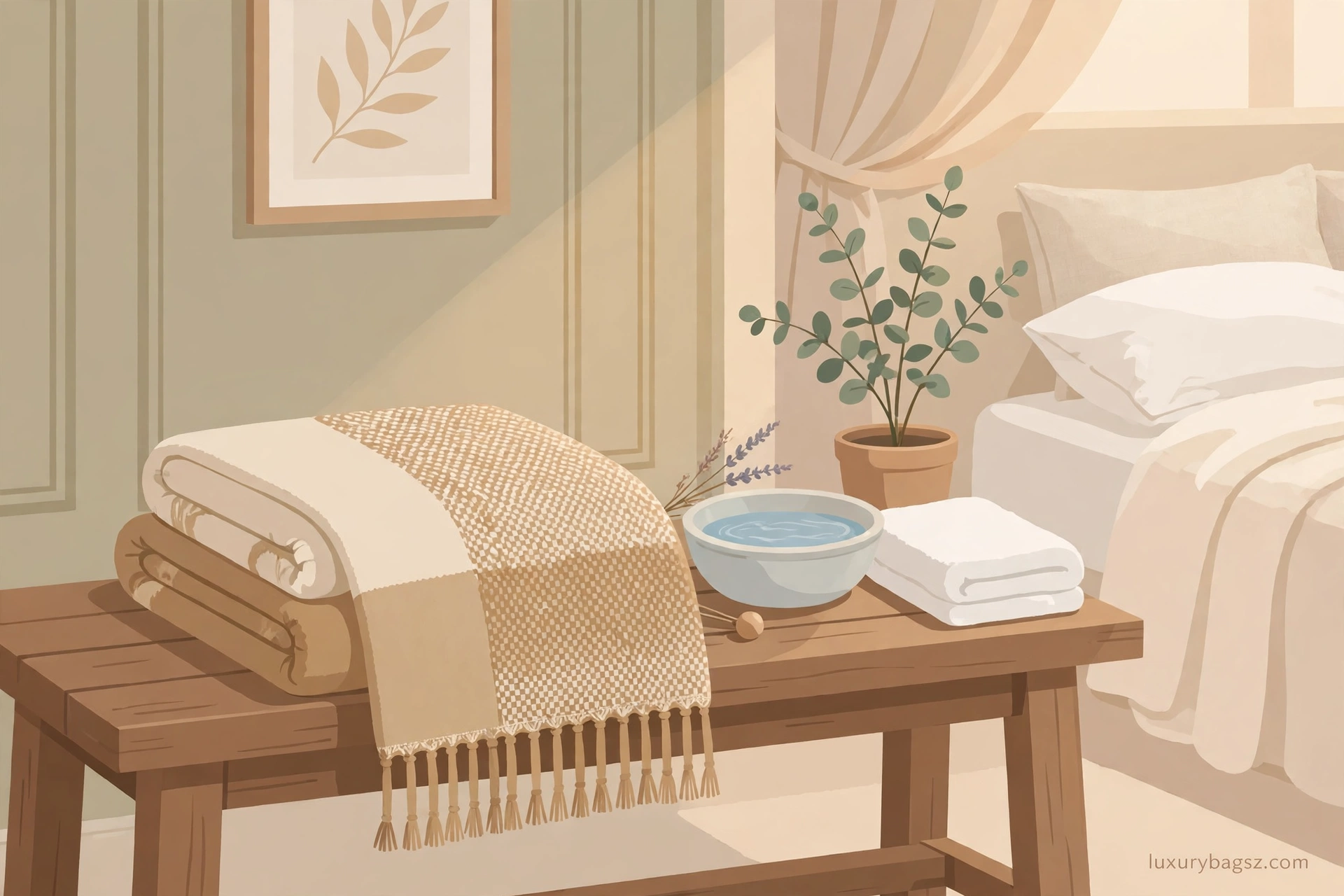
Every image in this guide is a generic illustration, not a photograph of a real Hermès product. No trademark logo has been reproduced. The illustrations show the general shape and idea of a woven throw so you can follow the care steps.
Where sources disagree on washability, water temperature, detergent, or drying, this guide says so openly instead of quietly picking one version. Draft text here prevails over any simplification in an image or infographic.
Table of Contents
Key Takeaways
- The safe default is: check the care label first, and when in doubt, choose professional dry cleaning over any home wash.
- A wool or cashmere Hermès throw is NOT a machine-wash item by default. Never machine wash it unless its own label clearly allows it.
- Hand washing, where allowed, means cool water, a small amount of wool detergent, no agitation, and no wringing at any point.
- Always dry a wool or cashmere throw flat, reshaped to its normal size, away from direct heat and direct sun. Never use a tumble dryer.
- Blot stains, never rub them. Stop at once if colour lifts, and take set, large, or valuable-piece stains to a professional cleaner.
- Never use bleach, hot water, harsh detergents, fabric softener, or a washing machine cycle as a shortcut on a fine throw.
- Cashmere is more delicate than wool, and blends follow the most delicate fibre in the mix. When you are unsure, treat the blanket as cashmere.
The Safe Default: Label First, Dry Cleaning When in Doubt
Start with one decision, made before water, detergent, or a basin enters the picture. Either your blanket’s own care label allows a home wash, or it does not. Everything else in this guide is subordinate to that label.
If the label says dry clean only, the safe move is professional dry cleaning. That is not a timid suggestion or a way to sell cleaning services. It is the maker’s own instruction for that piece, and it reflects how its fibres, dyes, and weave behave.
If the label allows hand washing, you may hand wash, following the hand-washing section exactly. Even then, hand washing is a considered choice, not a routine chore. A throw that is only dusty or lightly used usually needs airing and spot cleaning, not a full wash.
When the label is missing, faded, or unreadable, treat the blanket as dry clean only. A missing label is not permission to guess. It is a reason to be more careful, because you have lost the one instruction that was made for that exact piece.
The same rule applies when you cannot identify the fibre. Wool and cashmere behave differently, and a blend follows its most delicate fibre. If you do not know what you are washing, you do not know how it will react to water and detergent.
Professional cleaning costs money, and that is a real drawback. It is still cheaper than replacing a shrunken or felted throw, and far cheaper than repairing dye damage that a home wash caused. Cost is a reason to wash less often, not a reason to wash riskily.
Reading the Care Label, Symbol by Symbol
Care labels use symbols because they must work in every language, but the symbols only help if you can read them. The five that matter most for a throw are wash, bleach, dry, iron, and dry clean, and each one sets a hard limit.
A hand in a tub means hand wash only, usually in cool water. A tub with a number, such as 30, means a machine wash at that temperature in Celsius, but do not assume a Hermès throw carries that symbol. Most fine throws do not, and that absence is itself the message.
A circle with a letter, most often P, is a dry-cleaning symbol. A crossed-out circle means do not dry clean. A triangle means bleach is allowed, while a crossed-out triangle means no bleach of any kind, including so-called colour-safe bleach.
A square with a horizontal line inside means dry flat. That symbol matters enormously for wool, because it tells you the maker expects the piece to lose its shape if it is hung wet. A square with a circle inside refers to tumble drying, and a cross through it bans the dryer.
If any symbol is crossed out, that ban overrides every other instruction and every blog post. A crossed-out tub beats a guide that says a gentle cycle is fine. A crossed-out triangle beats a stain tip that suggests a splash of bleach.

Photograph the label before the first wash, and keep the photo with your other care notes. Labels fade, fray, and sometimes get cut out by a previous owner. A photo taken on day one is the only copy you may ever have.
One more caution about labels: a label describes the piece it is sewn into, not every throw that looks like it. Two throws in similar colours and patterns can carry different labels, because their fibre mixes differ. Always read your own blanket’s label, never a lookalike’s.
Identifying the Material: Wool, Cashmere, and Blends
Most Hermès throws are woven from wool, cashmere, or a blend of the two, sometimes with a small share of another fibre. The blend decides the care, and the most delicate fibre in the mix sets the limit for the whole blanket.
Wool fibres have tiny scales along their surface. Heat, water, and movement together make those scales lock against each other, which is felting. Felted wool shrinks, thickens, and loses its drape, and the change is permanent. That is why agitation is the enemy.
Cashmere is finer, softer, and more fragile than ordinary wool. Its fibres are shorter and lighter, which gives the famous softness, but also means it pills more easily, stretches more readily when wet, and tolerates less handling. Cashmere needs the gentlest version of every step in this guide.
Blends are common, and they are often described by their headline fibre rather than their full mix. A throw sold as a wool throw may still contain cashmere, and a cashmere-feel throw may be mostly wool. Read the full fibre percentages on the label, not just the first word.
Fibre also explains why a throw and a scarf need different care. A cashmere shawl is lighter and smaller, while a throw is heavier, holds far more water, and pulls harder on its own weave when wet. If you want the fibre comparison, read our guide to the cashmere shawl vs silk scarf for how cashmere behaves against a very different fibre.
Do the touch test before you wash. Hold the throw up to the light and look at the weave: an open, airy weave will stretch more when wet than a tight, dense one. Run your hand over the fringe and edges, which are usually the first places to fray, pill, or pull loose.
If the blanket feels very fine, very soft, and very light for its size, treat it as cashmere even if you suspect it is wool. The cautious rule costs you nothing when you are wrong, while the bold rule costs you the blanket when you are wrong.
Before Any Water Touches It: Pre-Wash Checks
A full wash should never be the first thing you try. Most throws that look dirty are only dusty, lightly marked, or in need of airing. A wash is the strongest intervention, so it should come last, after gentler options have been tried.
Start by taking the throw outside on a dry, shaded day and shaking it gently. Then lay it flat and brush it lightly with a soft clothes brush, working in one direction. This alone removes dust, lint, and surface debris that a wash would only push deeper.
Next, air the throw flat indoors, away from sun, for several hours. Wool naturally releases odours when aired, and many musty or stale smells fade without any water at all. A throw that smells of a closed cupboard often needs air, not detergent.
Inspect the whole blanket before washing, front and back. Look for loose fringe, pulled threads, thin patches, moth holes, and weak seams at the edges. Water and handling will worsen every weakness you find, so a damaged throw should go to a professional, not into a basin.
Do a colour test on a hidden corner, such as a folded-back edge. Press a white cloth barely dampened with cool water against it for a minute, then check the cloth for transferred colour. If dye lifts, stop: the blanket is not a safe home wash, whatever the label’s wash symbol may allow.
Measure the throw before washing, and write the measurements down. Length, width, and fringe length give you a target when you reshape it for drying. Without measurements, you are reshaping from memory, and memory is a poor guide to a rectangle.
Finally, clear a drying space before you start washing, not after. A wet throw cannot wait on a bathroom floor while you find a rack and towels. The drying section explains the drying layout, and it must be ready before the blanket gets wet.
Spot Cleaning: The First Line of Defence
Spot cleaning is how most marks should be handled, and it is the reason many throws never need a full wash at all. A small mark does not justify soaking a whole blanket, with all the shrinkage and stretching risk that brings.
The rule for every fresh mark is the same: blot, do not rub. Press a clean white cloth gently onto the mark to lift what you can, working from the outside edge inward so the stain does not spread. Rubbing pushes the mark deeper and disturbs the weave.
For a water-based mark, such as tea or juice, follow blotting with a second white cloth barely dampened with cool water. Dab lightly, then blot dry with a clean towel. Repeat with a fresh area of the cloth, and stop as soon as the cloth stops picking up colour.
For a dry mark, such as dust or crumbs, brush it off once dry rather than wetting it at once. Wetting a dry mark can turn a brushable speck into a set stain. Patience here saves more throws than any cleaning product does.
Never use a coloured cloth for blotting or dabbing. Dye from a coloured towel can transfer onto a damp throw, and you will then be treating two stains instead of one. White, clean, lint-free cloths are the only safe choice.
The same blot-first habit applies across delicate pieces, even when the fibres differ. We recommend the same gentle order when you wash a silk scarf, because rubbing is the common mistake that turns a small mark into a damaged patch.
If a mark does not lift with blotting and cool water dabbing, do not escalate to stronger products on your own. That is the point where a professional cleaner, who can test solvents on a hidden area, is the safer next step. The stain-by-stain section covers stain types in detail.
Hand-Washing a Washable Wool Throw, Step by Step
This part applies only to a throw whose label allows hand washing. If your label says dry clean only, skip this part entirely and book a professional cleaner. No step here overrides a dry-clean-only label.
Use a clean basin or a clean bathtub, large enough for the throw to lie loosely without being crammed. A crammed throw cannot be rinsed evenly, and folds pressed together trap detergent that later stiffens the weave.
Fill the basin with cool water first, then add a small amount of wool detergent and stir until it dissolves. The water should feel cool to your hand, not warm, and the detergent should be fully dissolved before the throw goes in. Undissolved detergent can leave marks.
Lower the throw in gently and press it down until it is submerged. Do not twist, scrunch, or plunge it. Let it soak briefly, around ten to fifteen minutes for a lightly soiled throw, while you press it softly now and then to let the water move through the weave.
Do not agitate the throw. Do not rub one part against another, do not scrub, and do not lift and drop it repeatedly. Agitation plus water is exactly the combination that felts wool, and a throw that has felted will not return to its former size or drape.
Drain the soapy water without lifting the heavy, wet throw. Then refill the basin with cool, clean water and press the throw gently to rinse. Repeat the rinse until the water runs clear and no longer feels slippery, which usually takes two or three rinses.
Lift the throw by supporting its whole weight, ideally with a helper, or by gathering it in a clean sheet like a sling. Never lift a soaking throw by one corner or edge, because wet wool stretches under its own weight and that stretch may not reverse.

Press the water out by rolling the throw in clean, dry towels and pressing along the roll. Do not wring it, twist it, or hang it dripping over a rail. Wringing is the single most damaging thing you can do to wet wool, and it takes only seconds.
If the throw still feels heavy after towel-rolling, repeat with fresh dry towels. Two towel rolls remove far more water than one, and every litre removed now is a litre that will not pull the weave out of shape while it dries.

Water Temperature, Detergent, and Soak Time: Where Advice Splits
This is the point in the wash where guides disagree most, and where honest guidance has to show its working. Three variables decide what the water does to wool and cashmere: temperature, detergent, and soak time. The rule below each heading is this guide’s position, followed by where rival advice splits.
Water temperature: cool water only, at about hand temperature or below. Cool water cleans without shocking the fibre. The split: some guides say lukewarm is fine and some say cool is mandatory. Lukewarm water is not a disaster, but it narrows the margin for error, because the warmer the water, the faster wool’s fibre scales lock together. Cool water keeps the widest safety margin.
Detergent: a small amount of a detergent made for wool, no more than the product’s minimum dose. The split: some sources suggest mild shampoo or even dish soap as substitutes. This guide does not follow them. Wool detergents are pH-balanced for protein fibres; shampoos and dish soaps are not, and some contain additives that leave residue in a dense weave. Never use a detergent with bleach, and never use fabric softener.
Soak time: brief, about ten to fifteen minutes, and never an extended soak. The split: some guides advise soaking for thirty minutes or longer, arguing that more time means more cleaning. A long soak loosens dirt, but it also swells the fibres, and swollen fibres are more vulnerable to every mistake that follows. Brief is safer.
One more split concerns rinsing. Some guides advise a splash of white vinegar in the final rinse to neutralise detergent. It is unnecessary if you rinsed properly, and it is an extra chemical a sensitive weave does not need. Skip it, and rinse until the water runs clear instead.
Agitation is the one variable where there is no honest split. Every reliable source agrees: do not agitate wool or cashmere. Do not rub, scrub, twist, or wring. The fibres felt when heat, moisture, and movement combine, and felting is irreversible. Gentle pressing and slow submersion are the only movement the throw should experience.
Where this guide and a rival disagree and both claims are defensible, choose the gentler option. The gentler option has the widest margin for error, and a wide margin is exactly what an expensive throw deserves.
Drying Flat: The Part That Decides the Shape
Drying decides the shape of the finished throw more than washing does. A perfect hand wash followed by careless drying still ends in a misshapen blanket. The rule is one line: dry flat, reshaped to the throw’s normal size, away from direct heat and direct sun.
Lay the throw flat on a clean, dry surface the moment it comes out of the towels. A spare bed covered with clean sheets, a mesh drying rack, or a clean floor with towels underneath all work. Smooth the throw into its normal rectangle, straighten the edges, and arrange the fringe neatly by hand.
Reshape before you leave it. Wool dries into whatever shape it was left in, so this is your one chance to set it. Compare against the measurements you took before washing: if an edge has drawn in, ease it gently back. Do not pull or stretch hard; coax, do not tug.
Give it air, shade, and time. A shaded, airy room dries a throw in a day or two. Direct sun fades dyes and weakens fibres, and direct heat from radiators or hair dryers can shrink wool suddenly. A fan at a distance, aimed across rather than at the throw, speeds things safely.
Turn the throw over after several hours so both sides dry evenly. Replace any damp towels underneath at the same time, because a throw sitting on a wet towel dries from the top only and can develop a musty smell.

Do not use a tumble dryer at any setting, not even a cool or air-only cycle. The tumbling action felts wool by itself, and the heat of a normal cycle makes it worse. The dry-flat symbol on the care label is an explicit instruction, not a suggestion.
Do not hang a wet throw to dry, even on a padded rail. Gravity pulls a water-heavy weave out of shape exactly as it did during lifting, and the fold over the rail can crease the weave permanently. Flat is the only safe orientation for a heavy, wet throw.
Wait until the throw is fully dry before folding or storing it. Wool can feel dry on the surface while the middle of the weave is still damp. Press your hand into the middle of the throw: if it feels cool or heavy, it is not dry yet. Give it another day of flat airing.
Stain by Stain Rescue
Stains behave differently by type, and the wrong first move often sets them. The universal rules are: act quickly, blot rather than rub, work from the outside inward, and test any product on a hidden corner. Rubbing spreads a stain and pushes it deeper into the weave.
Food and drink marks, such as coffee, tea, or soup, respond best to immediate blotting followed by cool water dabbing, as described in the spot-cleaning section. Lift as much as you can while the mark is fresh, because a dried food stain bonds with the fibre and is far harder to shift.
Red wine is the stain throw owners fear most, and the advice around it is noisy. Some guides suggest salt, white wine, or sparkling water. This guide recommends only blotting, then cool water dabbing, then a professional if the mark remains. Salt can dry into the weave, and white wine adds a second stain.
Oil and grease need blotting first, with a clean dry cloth, pressing gently without rubbing. A light dusting of plain absorbent powder, such as cornstarch, left for several hours can draw out surface oil. Brush the powder off gently and reassess before trying anything stronger.
Dark oil that has soaked in is a different problem, and home methods rarely remove it fully. If the dark patch remains after blotting and powder, take the throw to a professional rather than scrubbing harder. Scrubbing an oil stain usually spreads it and wears the weave around it.
Pet marks need prompt blotting and cool water dabbing, followed by thorough airing once dry. Do not use scented sprays, disinfectants, or enzyme cleaners unless a professional has approved them for wool and cashmere, because enzymes and perfumes can damage protein fibres and dyes.

Blood, ink, and dye transfer are the hardest home stains of all. A fresh mark may lighten slightly with gentle cool water dabbing, but most set ink or dye will not come out at home without damaging the weave around it. Do not try alcohol, acetone, or stain pens on a fine throw.
Chocolate, mud, and other solid marks should be left to dry completely, then brushed off gently before any water is used. Wetting mud turns it into a stain, while dried mud often lifts away with a soft brush. Letting a stain dry feels counterintuitive, but for solids it is the correct first move.
If any stain survives gentle treatment, or if colour starts to lift from the throw itself rather than from the stain, stop at once. That colour lift is your warning that the dye is moving, and further home treatment will likely make the damage worse, not better.
What Never to Use
Some products appear in blanket-care advice so often that they deserve a single clear list. Never machine wash a wool or cashmere throw by default, even on a wool or delicate cycle, unless its own label clearly allows machine washing. The default ban is the point.
Never use bleach, including oxygen bleach and colour-safe bleach, on a fine throw. Bleach attacks protein fibres, weakens the weave, and can shift dyes in ways that only become obvious once the blanket is dry. There is no safe bleach shortcut for wool or cashmere.
Never use hot water, boiling water, or a hot rinse at any point. Heat is a felting trigger, and a single hot wash can shrink a throw by a visible amount. If you cannot tell whether the water is cool or lukewarm, test it on the inside of your wrist and err toward cooler.
Never use harsh detergents, washing powder, dish soap, or all-purpose cleaners. Dish soap is designed to strip grease from plates, and it strips the natural oils and finish from fine wool just as effectively. A wool detergent used sparingly is the only cleaner made for the job.
Never use fabric softener, as the temperature and detergent section explains, and never use scented dryer sheets, which belong to a dryer the throw should never enter. Never use a steam cleaner, a carpet cleaner, or a pressure washer on a throw, however tempting the deep-clean promise sounds.

Never wring, twist, or hang a wet throw, and never dry it with a tumble dryer, a radiator, a hair dryer, or direct sun. Each of these seems like a time-saver, and each one trades a few hours for permanent shape, texture, or colour damage.
Never use mothballs directly against the throw, and never store it in a sealed plastic bag while damp. Mothballs leave a smell that is hard to remove and can affect dyes, while sealed damp storage invites mustiness. The storage section covers safer storage options.
If a product is not made for wool and cashmere, do not test it on your throw to find out. The colour test in the pre-wash checks section exists for products made for fine fibres. It is not a licence to try household chemicals on a hidden corner and hope for the best.
Fringe, Edges, and Woven Patterns
Fringe is usually the first part of a throw to show damage, because it is exposed, thin, and handled every time the throw is folded, moved, or draped. Most fringe is twisted or knotted yarn, and it tangles, snags, and felts more readily than the dense body of the throw. Any care routine that ignores the fringe will eventually produce a throw with a perfect body and a ruined edge.
Never pull a snagged fringe thread to straighten it. Pulling tightens the knot or weave behind it and can distort a whole row of fringe. Trim a badly snagged strand only if you are certain it is a loose end rather than a structural thread, and even then trim conservatively, because fringe cannot be regrown. If you are unsure, leave it for a professional.
During washing, keep fringe untangled and spread out rather than knotted together. A fringe that is knotted into a bunch before washing will dry into that bunch. Comb the fringe gently with your fingers after the final towel roll, while it is still damp, laying each strand flat and separate. This single habit does more for the finished look than any other finishing step.
Woven patterns need care for a different reason. A patterned throw often uses yarns of different colours and sometimes different fibre mixes in the same weave. Each yarn can react to water differently: one may shrink slightly while its neighbour does not, or one dye may be less stable than another. The colour test in the pre-wash checks section matters even more for patterned throws, and so does keeping the wash cool and brief.
Patterned throws also show uneven wear more clearly than plain ones. A felted patch, a faded area, or a stretched corner is harder to see on a solid colour and obvious on a pattern. Handle patterned throws with extra care during lifting and drying, supporting them evenly so no single area stretches, and avoid any rubbing or spot treatment that concentrates force on one part of the pattern.
Edges and hems carry the structural load of the throw. When a wet throw is lifted by its edge, the edge bears the full weight and stretches first. When a throw is hung, the fold takes the strain. Flat drying and whole-weight lifting, as Parts 6 and 8 describe, protect the edges as much as the body. Never tug a damp edge to straighten it; reshape by pressing and smoothing, never by pulling.
If the fringe or an edge is already damaged, do not wash the throw at home at all. Loose fringe, unravelling edges, and pulled pattern threads are all signs that the throw needs professional attention before any water touches it. Washing a structurally weakened throw can turn a small repair into a large one.
How Often to Wash, and When Not To
A throw does not need washing on a schedule, and washing it often is one of the most common ways to shorten its life. Every wash, however gentle, is handling, water, and drying stress on fibres that were woven to be used, not laundered weekly.
For a throw in regular use on a sofa or bed, a full wash once or twice a year is plenty, and many throws need even less. Between washes, shaking, brushing, airing, and spot cleaning handle nearly all everyday freshness. A throw that looks clean and smells fresh does not need a wash.
Wash promptly only when there is a real reason: a spill that spot cleaning could not fully lift, a persistent odour that airing did not remove, or visible soiling across a large area. A single small mark is a spot-cleaning job, not a reason to soak the whole blanket.
Do not wash a throw before storing it for the season unless it is actually dirty. A clean, dry throw stores well, but a throw that was washed and put away even slightly damp will smell musty when it comes out. Dryness matters more than freshness at storage time.
Do not wash a throw just because a guest is coming, or because a guide suggests a seasonal deep clean. Wool benefits from rest, air, and minimal handling, and an unnecessary wash adds risk without adding any benefit the throw needed.
The contrast with sturdier household textiles is worth stating. A cotton canvas item tolerates far more washing than a wool throw, which is why the routine for how to clean a canvas bag is more hands-on than anything recommended here. Fibre decides frequency, not habit.
If you are unsure whether a wash is needed, ask one question: would spot cleaning and airing solve the actual problem? If the answer is yes, do those two things and leave the basin in the cupboard. Restraint is a care method, not a gap in one.
Storage Between Washes
Good storage prevents more damage than any wash repairs. Wool and cashmere are natural fibres, and they suffer from the same four enemies in storage: moths, damp, sun, and crushing. Each enemy has a simple countermeasure.
Store the throw clean, fully dry, and loosely folded or rolled in a breathable cotton bag or a clean cotton pillowcase. Breathable storage lets air move and moisture escape, while a sealed plastic bag traps any remaining damp and invites mustiness.
Keep the storage place cool, dry, and dark, away from windows, radiators, and damp walls. Sun fades dyes through a bag over time, heat dries fibres, and damp encourages mould and a musty smell that is hard to remove from wool.
Use cedar blocks or lavender sachets for moth protection, placed near the throw rather than directly against it. Check them every few months and replace them when their scent fades. Never place mothballs directly against the throw, as the never-use section explains.
Do not stack heavy items on top of a stored throw. Weight compresses the weave and can set creases that are hard to ease out of wool. If space is tight, roll the throw instead of folding it sharply, because a roll avoids hard fold lines.
The same fold-versus-roll thinking applies elsewhere. Rolling rather than sharply folding is also why our guide to storing a silk scarf without creases recommends rolling, and why the cool, dry, dust-bag habit used when storing a Kelly works across materials.
Take the throw out every few months, shake it gently outdoors, and refold it along different lines. Refolding prevents permanent creases, and the inspection catches moth damage early, when it is a small repair rather than a spread of holes.
If you find moth holes, isolate the throw at once so moths do not spread to other wool or cashmere pieces. Put it in a sealed bag and take it to a professional cleaner, who can advise on cleaning and on whether the damage can be rewoven or invisibly repaired.
When to Stop and See a Professional Cleaner or Hermès After-Sales
Home care has a clear boundary, and knowing it saves throws. Stop and seek professional help for any of these: a dry-clean-only label, a missing or unreadable label on a valuable piece, dye that lifts in the colour test, or a throw you cannot identify by fibre.
Also stop for set or large stains, ink, blood, dye transfer, oil that has soaked in, moth damage, loose hems, unravelling edges, or a throw that smells musty after full drying. Each of these needs tools, solvents, or repair skills that home care cannot replace.
A good professional cleaner experienced in wool and cashmere can clean a whole throw evenly, test solvents on hidden areas, and advise honestly when a stain is permanent. Ask whether they have handled fine woven throws before, and say what the throw is worth to you before they begin.
Hermès after-sales can advise on care, repair scope, and cleaning for current pieces, and can tell you what is and is not possible for your specific throw. Ask about cost and turnaround before leaving a piece, and get the advice in writing for a valuable item.
For a pre-owned throw, professional cleaning before first use is often money well spent. A previous owner’s products, storage, and spills are already in the fibres, and a professional can assess what is wear, what is damage, and what is reversible. That assessment also helps you judge whether the throw was honestly described.
One caution about third-party repair: anyone who offers to re-dye a whole throw a new colour is changing the throw, not cleaning it. Full re-dyeing can look good at first and wear unevenly across a woven pattern, and it may affect resale honesty. Discuss it as a change, not a clean, and think twice before agreeing.
The Machine-Wash Shortcut, and Why the Label Decides
Most rival blanket guides fail in the same few places, and this guide was written to close those gaps. The first gap is the machine-wash shortcut. Many guides present a gentle machine cycle as safe for any wool blanket, without mentioning felting, shrinkage, or the throw’s own label.
This guide disagrees with that advice plainly. A gentle cycle still combines water, movement, and detergent change, and a large woven throw has more weave to felt and more weight to stretch than a small wool garment. The machine is the risk, not the solution.
The second gap is the label. Rival guides often give one washing method for every blanket, as if all throws carried the same instructions. They do not, and a guide that never tells you to read your own label is a guide that will damage someone’s dry-clean-only piece.
The third gap is drying. Many guides mention drying briefly, or suggest hanging the throw over a line, without explaining that wet wool stretches under its own weight. Flat drying is not a preference in this guide; it is the method that preserves the throw’s shape.
The fourth gap is disagreement itself. Rival guides often state one water temperature, one detergent, and one soak time as if they were settled facts, when published advice genuinely splits on all three. This guide states each split openly and gives the cautious rule, so readers can judge for themselves.
The fifth gap is stain honesty. Rival guides often promise that home methods remove red wine, oil, and set dye transfer. They usually do not, and scrubbing harder only spreads the stain and wears the weave. This guide says plainly where home care ends and professional help begins.
The final gap is frequency. Some guides suggest washing a throw every few weeks, as if it were bedding. A fine wool or cashmere throw is not bedding, and washing it that often shortens its life. Airing, brushing, and spot cleaning should do most of the work, with full washes rare.
Frequently Asked Questions
Can I machine wash a Hermès blanket?
No, not by default. A wool or cashmere Hermès throw is not a machine-wash item unless its own care label clearly allows machine washing. The safe default is professional dry cleaning, or hand washing in cool water where the label allows it.
What does dry clean only mean for a throw?
It means do not wash it at home, by hand or by machine. Take it to a professional cleaner experienced in wool and cashmere. Ignoring a dry-clean-only label is the most common cause of shrunken or felted throws.
Can I hand wash a cashmere throw?
Only if its label allows hand washing, and only with the gentlest method: cool water, a small amount of wool detergent, a brief soak, no agitation, no wringing, and flat drying. If the label says dry clean only, or you are unsure, choose professional cleaning.
What water temperature should I use for a wool throw?
Cool water, around 30 degrees Celsius or below. Some guides allow lukewarm water, but this guide sides with cool water because heat is a felting trigger and lukewarm water that drifts hotter is a real risk. Never use hot water.
What detergent is safe for a Hermès blanket?
A wool detergent made for hand washing, used sparingly and fully dissolved before the throw goes in. Avoid regular detergent, washing powder, dish soap, and harsh cleaners, and never use fabric softener on wool or cashmere.
How do I dry a wool blanket after washing?
Lay it flat on clean dry towels over a rack, reshaped to its measured size, in a shaded, airy room. Turn it after several hours and replace damp towels. Never hang it wet, never tumble dry it, and never use a radiator, hair dryer, or direct sun.
How do I remove a red wine stain from a wool throw?
Blot at once, do not rub, then dab lightly with cool water on a white cloth and blot dry. Do not use salt, white wine, or sparkling water tricks. If the mark remains, or colour lifts from the throw, stop and take it to a professional cleaner.
Can I use bleach on a wool or cashmere throw?
No. Bleach, including oxygen bleach and colour-safe bleach, attacks protein fibres, weakens the weave, and can shift dyes. There is no safe bleach shortcut for a fine wool or cashmere throw.
How often should I wash a Hermès blanket?
Rarely. A full wash once or twice a year is plenty for a throw in regular use, and many throws need even less. Between washes, shake, brush, air, and spot clean. Wash promptly only for a spill or soiling that spot cleaning could not lift.
When should I stop and see a professional cleaner?
Stop for a dry-clean-only label, dye that lifts in a colour test, set or large stains, ink, moth damage, loose hems, or a musty smell after full drying. A professional cleaner or Hermès after-sales has the tools and matched methods that home care cannot replace.
Summary
A safely washed Hermès blanket is not the result of one heroic soak. It is the result of a careful decision made before any water is involved, a gentle method applied exactly, and the restraint to stop when home care reaches its limit.
Check the label first, every time. When in doubt, choose professional dry cleaning. Never machine wash a wool or cashmere throw by default, never use bleach or hot water, and never wring or tumble dry a piece you care about.
Wash rarely, and only a throw whose label allows it. Use cool water, a little wool detergent, a brief soak, and no agitation. Rinse until the water runs clear, lift the throw with its whole weight supported, press the water out in towels, and dry it flat in the shade.
Blot stains, never rub them. Protect the fringe and edges, store the throw clean and fully dry in a breathable bag, and let airing and spot cleaning do most of the work between washes. When a stain, a dye, or an edge is beyond gentle methods, let a professional take over before a small problem becomes a permanent one.
A throw cared for this way does what a good throw is meant to do. It keeps its size, its drape, and its pattern, stays soft without going limp, and looks better with years of use rather than merely older. That is the whole payoff, and it starts with the simplest rule of all: when in doubt, do not wash it at home.