

What Is a Hermès Cashmere Shawl vs Silk Scarf
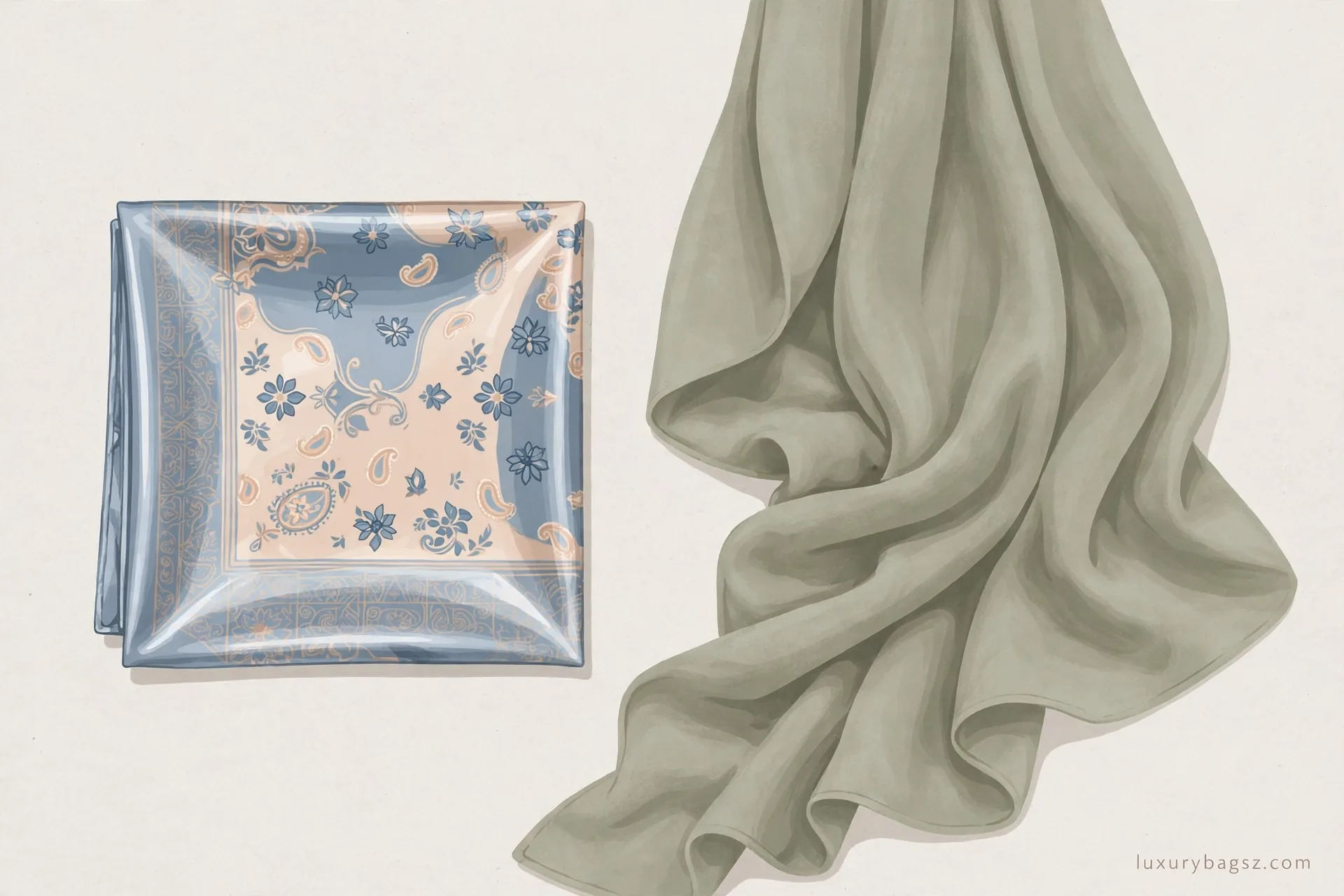
Cashmere Shawl or Silk Scarf in Brief
A Hermès silk scarf and a Hermès cashmere shawl are not two versions of the same thing in different fabrics. They are two different tools. The classic silk scarf is usually a 90 cm square of 100% silk twill: crisp, glossy, light, and made for precise knots, bright printed colour, and warm-weather or indoor wear.
The classic cashmere shawl is usually a much larger 140 cm square woven from a cashmere and silk blend: soft, matte, heavier, and made for draping over shoulders, wrapping around the neck in cold weather, and layering over a coat. Size alone does not settle the question, because Hermès also makes silk in 140 cm, so a 140 cm square can be either silk or a cashmere blend. Fibre, not size, is the real dividing line, and the care label of the piece in your hands is the only reliable proof of which one you are holding.
Choose the silk scarf first if you want crisp knots, a bright printed design that reads clearly, a light layer for spring, summer, or a warm room, and a piece that packs small. Choose the cashmere-blend shawl first if you want real warmth, a soft drape that falls without fuss, a wrap that covers shoulders and back, and a piece you will reach for all through autumn and winter.
If you can only buy one and you live somewhere with a real winter, the shawl will probably earn its place faster. If you love knotting, colour, and collecting printed designs, the silk scarf will probably give you more joy. Neither choice is wrong, and many long-term collectors end up with both, because each one does a job the other cannot do well.
Introduction: Why This Comparison Confuses Even Experienced Buyers
Ask a shop assistant, a resale listing, and a collector forum what a Hermès cashmere shawl is, and you may get three different answers. One will say it is a 140 cm square. Another will say it is 70% cashmere and 30% silk. A third will say it is pure cashmere.
All three can be describing a real Hermès piece, and none of them, on its own, is a complete definition. That confusion is not the buyer’s fault. It comes from the way Hermès itself uses overlapping names, reissues the same design in different fabrics and sizes, and changes blend details from one edition to another.
Most short comparison guides make the confusion worse. They reduce the choice to “silk is light, cashmere is warm” and stop there. They rarely explain that the famous cashmere shawl is usually a blend rather than pure cashmere, that silk also comes in the large 140 cm size, that the two fabrics need completely different care, or that a shawl and a scarf fail in completely different ways: silk snags and water-marks, cashmere pills and attracts moths.
They also rarely say what each piece is actually like to wear day after day, how much space it takes in a bag, what it costs to clean, or what to check before buying secondhand.
This guide fills those gaps. It starts with names, because the names are where most mistakes begin. It then works through fibre and weave, size and shape, look and drape, warmth and seasons, styling, colour and design choice, price, durability, care, travel, and buying, with the disagreements between sources stated plainly rather than smoothed over.
Where a fact varies by edition — above all the cashmere-to-silk ratio — this guide says so, and tells you where to check it on the piece itself. By the end, you should be able to pick up any Hermès square, read its label and feel, and know which family it belongs to, how to wear it, and how to look after it.
The Names, Untangled
Hermès does not use one tidy naming system, and secondhand sellers add their own shorthand on top. Untangling four terms clears up most of the confusion.
Carré. Carré is the French word for square, and in Hermès language it is the classic silk scarf, above all the 90 cm square in silk twill. When someone says “a carré,” they usually mean a printed silk square with hand-rolled edges.
The first Hermès silk carré appeared in 1937, and the 90 cm format has remained the flagship ever since. A detailed look at that format, its history, and its designs is covered in the guide to the 90 cm carré.
Shawl, and GM. Shawl is a size word as much as a fabric word. In collector shorthand, GM (grand modèle, or large model) means the large 140 cm square, and a GM is often called a shawl because it is big enough to cover shoulders and back like a wrap.
That is why you will see listings for a “140 silk shawl” and a “140 cashmere shawl” side by side: both are shawl-sized, but only one contains cashmere. Size tells you how much cloth you are getting. It does not tell you what the cloth is made of.
CSGM. CSGM is collector shorthand for “cashmere and silk grand modèle”: the large 140 cm square in the cashmere-silk blend. If a listing says CSGM, it means a 140 cm cashmere-blend shawl, not a silk one and not a small scarf.
The shorthand is useful once you know it, but it is also a trap for new buyers, because sellers sometimes use “cashmere shawl” loosely for any large soft square, including a large silk one.
Cashmere shawl. In everyday Hermès talk, “cashmere shawl” almost always means the CSGM: the 140 cm cashmere-silk blend square. It does not usually mean a piece made from 100% cashmere, although a small number of Hermès editions, including some long rectangular scarves and special embroidered pieces, are described as cashmere or as having a higher cashmere content.
The safe rule is simple: trust the label, not the listing title. A seller’s title is marketing. The fibre label sewn into the piece is the fact.
Two other naming traps are worth knowing. First, Hermès also makes silk in many other formats — small squares, a 70 cm square, bandanas, twillies, triangles, and losanges — so “silk scarf” covers a whole family, not just the 90 cm carré. Second, designs cross over between fabrics.
A design first issued on 90 cm silk twill may later appear as a 140 cm cashmere-blend shawl, in different colours, with the artwork redrawn or cropped for the larger square. Loving a design therefore does not tell you which fabric you are buying. Always check fibre and size together.
Fibre and Weave: What Each Cloth Actually Is
Silk twill. The classic Hermès silk scarf is woven from 100% silk in a twill weave. Twill means the threads cross in a diagonal pattern, which you can see if you look closely at the cloth: a fine, even diagonal rib. That weave is part of why a silk carré feels the way it does. It is smooth and slightly crisp rather than floppy, it holds a knot without collapsing, it has a gentle sheen that catches light, and it shows printed colour with unusual sharpness.
Silk twill is also strong for its weight, which is why a 90 cm square can be folded, knotted, and worn hard while still looking structured. Its weaknesses follow from the same qualities: the smooth surface shows water marks, it can snag on rough jewellery or a bag clasp, and it slips, so a knot that is not secured can work loose during the day.
Cashmere and silk blend. The classic Hermès cashmere shawl is woven from a blend of cashmere and silk. Cashmere is the soft undercoat fibre of cashmere goats, prized for warmth at very low weight and for a buttery, matte softness. Silk in the blend adds strength, a little sheen, and a fluid drape that pure cashmere alone can lack, and it helps the large square fall in soft folds rather than sitting stiffly.
The result feels completely different in the hand from silk twill: warm, soft, slightly fuzzy at the surface, matte rather than glossy, and heavier. It drapes rather than holds a shape, which is why it is so easy to throw over shoulders and so poor at holding a crisp, sculpted knot.
The weave matters for a second reason: print. On silk twill, screen-printed designs look sharp, with clean edges and vivid colour, because the smooth surface takes print precisely. On a cashmere blend, the same artwork looks softer. Colours are a little more muted, edges a little less crisp, and fine detail can blur slightly into the fuzzy surface.
That is not a flaw. It is the nature of the cloth, and it is one reason collectors often prefer bold, large-scale designs on a shawl and intricate, detailed designs on silk. If you fall in love with a design because of its fine detail, see it in the fabric you intend to buy, not only in a photograph of the silk version.
Other fabrics you may meet. Hermès also issues scarves in mousseline (a light silk chiffon), plissé (silk twill pleated into tiny accordion folds), washed silk, cotton, and other weaves. Those are outside this comparison, but they explain why a listing can say “Hermès silk scarf” and mean something much lighter and softer than a classic twill carré.
When comparing, always pin down the weave as well as the fibre: silk twill is not the same wearing experience as silk mousseline, just as a cashmere blend is not the same as pure cashmere.

The Blend-Ratio Disagreement, Stated Plainly
Here is a disagreement that short guides usually hide, and buyers deserve to know about it. Sources do not agree on a single cashmere-to-silk ratio for Hermès shawls, because there is not one single ratio across all editions.
An older collector guide, drawing on the Hermès leaflet “Profile of a Scarf,” describes the popular GM blend as 65% cashmere and 35% silk. Many current resale listings, by contrast, describe the same kind of 140 cm shawl as 70% cashmere and 30% silk.
Both figures appear widely, and both are attached to genuine-looking pieces. The honest reading is that the ratio has varied by edition, season, and piece, and that some listings may also be repeating a standard figure rather than reading the label of the exact piece for sale.
What should you do with that disagreement? Three things. First, never buy on a ratio quoted in a listing title alone. Ask for a photograph of the care label, and read the fibre percentages on that label for that piece.
Second, do not treat a 5% difference as a quality verdict. A 65/35 blend and a 70/30 blend will feel very similar in the hand; the weave, the finishing, and the condition of the piece matter far more than five percentage points.
Third, be extra careful with any listing that claims “100% cashmere” for a standard 140 cm square. Pure cashmere Hermès pieces exist, but they are not the standard CSGM, and a standard blend piece mislabelled as pure cashmere is either a seller error or a warning sign. When in doubt, the label wins over the listing, every time.
Size and Shape: The Full Map
The classic pairing — 90 cm silk versus 140 cm cashmere blend — is real, but it is only the centre of a larger map. Knowing the whole map stops you from overpaying for a size you did not want, or from dismissing a piece that would suit you because it does not match the classic pairing.
Silk sizes. The silk family includes very small squares (around 20 cm), pocket squares (around 40 to 45 cm), bandanas (around 55 cm), the 70 cm square, the classic 90 cm carré, and the large 140 cm silk square. There are also twillies, long narrow silk strips around 86 cm by 5 cm, worn around the neck, wrist, or bag handle, and triangle and losange shapes in various sizes. A full comparison of how those sizes wear is covered in the guide to scarf sizes.
Cashmere-blend sizes. The cashmere-blend family is centred on the 140 cm square, and that is the format most buyers mean by “cashmere shawl.” There are also smaller cashmere and cashmere-blend pieces, and long rectangular formats — for example, scarves around 30 cm by 140 cm — that wear very differently from a square: they wrap the neck repeatedly and drape down the front, but they cannot cover shoulders and back the way a 140 cm square can.
Some special editions, including embroidered shawls, are also 140 cm squares but heavier and more decorative, and those are best treated as occasion pieces rather than everyday wraps.
Why size changes everything. A 90 cm square has an area of 8,100 square centimetres. A 140 cm square has an area of 19,600 square centimetres, more than twice as much cloth.
That difference explains almost every practical contrast in this guide: the shawl is warmer because there is more of it, it is bulkier in a bag, it covers more of the body, it is harder to knot neatly, and it costs more, because it uses more fibre and more printing.
It also explains why a 140 cm silk square feels so different from a 90 cm silk square even though the fibre is the same: the same crisp cloth, at more than double the area, becomes a wrap rather than a neck scarf, with a great deal more volume to manage.
A practical size test. Before buying, fold the size in your mind against your own body. A 90 cm square, folded into a triangle, sits neatly at the neck and chest. A 140 cm square, folded the same way, reaches well past the waist on most wearers and can be worn as a cape, a wrap, a top layer over a coat, or a blanket on a plane.
If you are petite, a 140 cm square can overwhelm a small frame unless it is draped loosely rather than knotted tightly. If you are tall or broad-shouldered, a 90 cm square can look like a neat accent rather than a wrap, which is exactly right if that is what you want, and disappointing if you wanted coverage. Try both sizes on, in person, before committing to the more expensive shawl.

Look, Feel, and Drape: The Hand Test
If you close your eyes and handle the two cloths, the difference is immediate, and it is the fastest way to tell them apart in a shop or at a resale viewing.
Silk twill in the hand. Cool at first touch, smooth, with a slight crispness, like good paper that has been softened. It rustles faintly. It holds a fold when you crease it, and it springs back into shape when you shake it out.
Held up to light, it has a sheen that moves across the surface as the cloth moves. The hand-rolled edges feel plump and firm, like a tiny cord rolled inside the hem and stitched by hand. A silk carré looks “finished” even when it is simply folded into a square: the print is sharp, the colours are bright, and the cloth looks deliberate.
Cashmere blend in the hand. Warm at first touch, soft and slightly fuzzy, with no rustle and no crispness. It collapses into soft folds when you gather it, and it stays where you put it rather than springing back. Held up to light, it looks matte, absorbing light rather than reflecting it.
The edges are softer and less defined than a silk carré’s rolled hem, and the whole piece feels more like a wrap than a picture.
A cashmere shawl looks best in motion, falling over shoulders or wrapped loosely, and it can look a little shapeless when folded into a tight square in a drawer, which surprises buyers who expect it to look as graphic folded as a silk scarf does.
Drape, in plain terms. Drape is how cloth falls under its own weight. Silk twill has a structured drape: it falls in defined folds and holds a knot’s shape. Cashmere blend has a fluid drape: it falls in soft, rounded folds and settles against the body. That single difference drives styling. Structured drape suits knots, bows, and precise arrangements.
Fluid drape suits throwing, wrapping, and layering. Neither drape is better in the abstract. The question is which drape suits the way you actually dress. If your wardrobe is tailored, with blazers and neat necklines, silk’s structure will fit naturally. If your wardrobe is relaxed, with coats, knitwear, and layers, the shawl’s fluid fall will fit naturally.
The touch test for buyers. When you handle a piece secondhand, run three checks with your hands. First, feel for evenness: a genuine Hermès cloth feels consistent across the whole square, with no thin patches, stiff printed areas, or rough spots except at the hem.
Second, check the edges: silk carrés have the famous plump hand-rolled hem, while shawls have a softer finish that still feels careful and even, never machine-stiff or fraying. Third, shake the piece out and let it fall: silk should fall with a little body and sheen, cashmere blend should fall softly and heavily.
A piece that feels papery, plasticky, or unevenly stiff is worth a second look before you pay, whatever the listing says.
Warmth, Weight, and Seasons
Warmth. This is the shawl’s clearest win. Cashmere is an insulating fibre: its fine, crimped fibres trap air, and air is what keeps you warm. A 140 cm cashmere-blend shawl, wrapped twice around the neck or worn over shoulders, gives real warmth, enough to replace a light jacket indoors or to add a serious layer over a coat outdoors.
Silk, by contrast, gives light warmth at best. A silk carré at the neck takes the chill off a draughty room and adds a layer under a coat, but it will not keep you warm on a cold walk on its own. Silk does regulate temperature well: it feels cool in heat and not clammy in a warm room, which is why it works as a year-round accent. Cashmere blend, for the same reason, can feel too warm in summer, especially indoors.
Weight and bulk. A 90 cm silk carré is light and packs almost flat. It fits in a small bag, a coat pocket, or a handbag’s inner pocket without changing the bag’s shape. A 140 cm cashmere-blend shawl is heavier and far bulkier. Folded, it is a thick, soft bundle that fills a tote bag compartment or needs its own space in a suitcase.
That bulk is part of the luxury — the feeling of generous cloth — but it is also a practical cost. If you travel light, or you carry a small bag, the shawl may spend more time at home than you expect, while the silk scarf travels everywhere.
Seasons, honestly. Silk works in all four seasons as an accent: a neck knot in spring, a light layer in a summer restaurant with air conditioning, a colour accent in autumn, and an extra layer under a winter coat. Cashmere blend works best from autumn through spring, and it is at its best in cold weather, on planes, and in the evening.
In high summer it is usually too warm except in heavily air-conditioned rooms. A useful rule: if the weather makes you reach for a sweater, you will reach for the shawl. If the weather makes you reach for sunglasses, you will reach for the silk.
Layering. The shawl layers over knitwear, coats, and dresses, and it can stand in for a cardigan on a mild evening. The silk scarf layers under coats and jackets, at the neck, where it adds colour without bulk.
Worn together, they do not compete: a silk carré at the neck under a coat, with a cashmere shawl over the coat, is a classic cold-weather combination, but it is a lot of Hermès at once, and most wearers will choose one or the other on any given day.

How Each One Is Actually Worn
Silk: knots, bows, and precision. Silk twill rewards technique. Its crispness means a knot stays where you put it, a bow holds its loops, and a folded band stays neat at the neck. Classic silk styles include the simple neck knot, the ascot fold, the bias fold worn as a band, the head wrap, and the top or halter made from a 90 cm or 140 cm silk square.
Silk also works well with accessories that hold it in place, because its smooth surface slips: a scarf ring can anchor a knot that would otherwise loosen, and it adds a piece of jewellery to the arrangement at the same time.
If you enjoy learning knots and trying new arrangements, silk gives you far more to play with. A good starting point is a guide to tying a silk scarf, which covers the basic folds before the fancy knots.
Cashmere blend: draping, wrapping, and throwing on. The shawl rewards the opposite skill: not knotting, but draping. Its best styles are the simplest ones. Drape it over both shoulders like a cape, with the front open.
Wrap it once around the neck and let the ends fall down the front. Fold it into a wide triangle and wear it as a wrap over a dress. Use it as a blanket on a plane, folded double over the knees.
Try to tie it into a small, precise knot and it will fight you: the bulk makes the knot large and soft, and the cloth slips out of shape. Some wearers do knot a shawl loosely at the front, and that can look beautiful, but it is a loose, soft knot, not a crisp one, and it should be treated as a drape with a twist rather than a structured knot.
On a bag. Small silk formats are made for bags. A twilly wrapped around a bag handle is a classic Hermès look, and the guide to a twilly on a bag handle shows how to wrap one without creasing it permanently. A 90 cm silk carré can also be tied to a handle, though it adds more volume.
A 140 cm cashmere shawl, by contrast, is far too large and heavy for a bag handle, and wrapping it there would crush the cloth and invite snagging on hardware. Keep the shawl for wearing, and keep bag decoration to the small silk formats.
At work, at events, and at home. Silk suits offices, restaurants, and events where you want a neat, polished accent that does not get in the way. It sits close to the body, it does not trail, and it does not catch on chair arms.
The shawl suits travel, cold rooms, outdoor events, and evenings at home, where coverage and warmth matter more than neatness. It trails, it catches, and it needs a little management around food, drink, and bag straps, which is a fair trade for the warmth it gives.
Who wears which, in practice. Collectors often say that the 90 cm silk carré is the piece they admire and the 140 cm cashmere shawl is the piece they actually wear most in winter. Forum advice repeats the same pattern: buyers who find 90 cm silk hard to style, or a little formal, often find the 140 cm cashmere blend far easier and more forgiving, because draping needs no technique.
If you are buying your first Hermès scarf and you are unsure about knotting, the shawl is the more forgiving first buy. If you already love knots and you want a piece that rewards practice, silk is the more interesting first buy.

Colour, Design, and Choice
Design availability. Far more designs are issued on 90 cm silk twill than on 140 cm cashmere blend. Silk is the flagship format, and most new designs appear there first.
That means a silk buyer has a huge choice of artwork, colourways, and themes, from equestrian scenes to abstract patterns, and a much better chance of finding a design that matches a particular outfit or collection.
Cashmere-blend buyers have a smaller, more curated choice, and popular shawl designs can be harder to find, especially in a sought-after colourway. If a specific design matters to you more than the fabric, check which fabrics it was actually issued in before falling in love with a photograph. A design you love on silk may never have been made as a shawl, and vice versa.
How colour reads on each cloth. On silk twill, colour is vivid and precise. Bright reds, deep blues, and sharp contrasts look their best on silk, and fine colour shading in the print stays visible. On cashmere blend, colour is softer and more muted. The same red will look a little deeper and less bright, and subtle shading can merge into the fuzzy surface.
That softening suits large, bold motifs and rich autumn colours, and it can make a busy design feel calmer. It also means that a colourway that looks electric on silk may look subdued as a shawl, so judge colour on the fabric you will buy, in person if possible, rather than from a silk photograph.
Neutrals versus brights. Experienced collectors often advise buying neutrals first in the shawl format, because a large shawl in a neutral colour works with almost everything and gets worn constantly, while a large shawl in a very bright or busy print can dominate an outfit and get worn less.
For silk, the opposite advice is common: because a 90 cm carré is a smaller accent, a bright or detailed design is easier to wear and gives more pleasure. Both pieces of advice are about proportion. A large area of bright pattern is a statement. A small area of bright pattern is an accent. Buy the statement only if you want to make it often.
Collecting. Silk carrés are collected by design, by artist, by year, and by colourway, and a collection can grow large without taking much storage space. Shawls are collected more slowly, because each one costs more, takes more storage space, and is chosen for wear as much as for display.
Neither approach is better, but they lead to different buying habits. A silk collector may buy several carrés a year. A shawl buyer may buy one shawl and wear it for a whole winter. Know which kind of buyer you are before you set a budget.
Price and Value, Without False Precision
Prices for Hermès scarves change by region, by season, and by design, and resale prices change with condition, rarity, and colourway. Any guide that quotes a single price as “the price” is misleading you. What follows is a tier comparison, with one dated snapshot to show the size of the gap, not a promise of what you will pay today.
A price round-up updated in January 2026, using prices dated 6 October 2025, listed a 90 cm silk scarf at $780 in the United States, a large 140 cm silk scarf at $1,175, and a large 140 cm cashmere shawl at $1,575. An earlier table in the same round-up listed the 90 cm silk at $620 and the cashmere shawl at $1,450.
The exact numbers moved between tables, but the pattern did not: the cashmere shawl cost roughly twice the classic 90 cm silk scarf, and roughly a third more than a 140 cm silk square of the same size. That pattern is the useful fact. The shawl costs more because it uses more, and more expensive, fibre, and because it is a larger, heavier piece to weave and print.
Three price traps deserve a plain warning. First, a single resale listing is never a market average. One shawl listed at a very high price may be a rare colourway, a mint-condition piece, or simply an optimistic seller. One listed very cheaply may be damaged, misdescribed, or not genuine.
Judge value from several comparable listings in similar condition, not from one eye-catching price. Second, price does not prove fibre. A high price does not prove a piece is cashmere, and a low price does not prove it is silk. Only the label and the feel prove fibre. Third, cleaning and care costs are part of the price.
A silk carré that needs specialist dry cleaning, and a shawl that needs careful de-pilling and moth protection, both carry ongoing costs that a buyer should factor in, especially if the piece will be worn often.
Value, in wear terms. Value is not the same as price. A shawl worn three times a week all winter may cost less per wear than a silk carré worn once a month, even though the shawl cost twice as much to buy.
A silk carré that completes ten outfits and is collected for years may hold its appeal longer than a shawl in a trendy colour that dates quickly. Buy the piece you will actually wear, in a colour you will actually reach for, and the per-wear cost will take care of itself. Buy the piece you admire but never wear, and even a bargain price is wasted money.
Durability: How Each One Fails
Knowing how each cloth fails helps you prevent the damage, and helps you judge a secondhand piece honestly.
Silk twill: snags, water marks, and fading. Silk’s smooth surface snags on rough jewellery, bag hardware, zips, and Velcro. A single snag can pull a thread and leave a visible line. Silk also water-marks: a drop of rain, perfume, or a spilled drink can leave a ring that is difficult to remove, because the water moves dyes unevenly as it dries. Strong sunlight fades printed silk over time, especially reds and dark colours, so a silk carré left in a sunny window or a car will fade unevenly.
Silk does not pill in the way cashmere does, and it does not attract moths in the same way, which are two real advantages. Its hand-rolled edges, however, are vulnerable: a pulled thread at the hem, or a hem flattened by bad pressing, is hard to restore.
Cashmere blend: pilling, moths, and stretching. Cashmere pills. Every honest guide and every experienced owner says so, and any seller who says a cashmere shawl will never pill is not telling the truth. Pilling happens where cloth rubs cloth: under bag straps, at the sides where arms rub the body, and where a shawl is wrapped tightly. Pills are small balls of tangled fibre on the surface. They are normal, they are removable, and they are not, on their own, a sign of poor quality or damage.
What matters is how many pills there are, and whether they have been pulled off roughly, which can thin the cloth. Cashmere also attracts clothes moths, which eat animal fibres and leave small holes.
Moth damage is the most serious durability risk for a shawl, because a few holes can ruin a large, expensive piece. Finally, a heavy shawl stretches if it is hung for a long time, especially when damp, so hanging is a storage risk for shawls in a way it is not for a light silk carré.
Secondhand checks from durability. When you inspect a secondhand silk carré, look for snags, water marks, faded patches, and hem damage, especially near the corners where handling is heaviest. When you inspect a secondhand shawl, look for pilling density, moth holes (hold the cloth up to light and look for pinpricks), stretched areas, and thinning where pills have been pulled. Light pilling on a shawl is normal wear and can be managed.
Heavy pilling combined with thinning, or any moth holes, should reduce the price sharply, or stop the purchase altogether. For both fabrics, check the whole square, not just the centre: damage often hides in folds and at edges.
Care, Cleaning, and Storage: Where the Two Fabrics Diverge Most
Care is where treating a shawl like a silk scarf, or a silk scarf like a shawl, causes real damage. The two fabrics need different routines, and the safest rule is to follow the care label of the piece in your hands, and to use a specialist cleaner when you are unsure.
Silk care. Hermès advises against washing silk scarves at home, and recommends entrusting them to a professional cleaner with experience in printed silk and hand-rolled hems. That advice exists for good reasons. Home washing can water-mark printed silk, distort the hand-rolled edges, and fade dyes. If a silk carré gets wet in rain, blot it gently with a soft, dry towel, do not rub, and let it dry flat away from heat and sunlight.
Do not iron printed silk directly: heat can scorch silk and leave a shine, and a hot iron can flatten the hand-rolled hem. If a silk carré needs pressing, a specialist should do it, or it should be pressed at the lowest silk setting through a clean cotton cloth, with no steam directly on the print, and only if you are confident in the method.
For storage, keep silk clean, dry, and out of sunlight, folded loosely or rolled loosely with acid-free tissue, in a cool, dark, dry place. Change fold lines from time to time so no single line sets permanently. Keep silk away from perfume, hairspray, and rough jewellery, and never store a dirty or damp silk carré, because stains set and mildew can follow.
Cashmere-blend care. A cashmere-blend shawl needs gentler, more regular attention, but of a different kind. Let it rest between wears, ideally for a day, so fibres recover and moisture from wear can escape. Air it flat or draped loosely after wearing, away from sunlight and heat, before putting it away.
Remove pills gently with a cashmere comb or a fabric shaver used lightly, working in one direction and never pulling pills off by hand, which can pull fibres out and thin the cloth. Store a shawl clean, because moths are attracted to body oils and food traces as well as to the fibre itself, and use moth protection that suits your home, such as cedar or lavender, kept away from direct contact with the cloth.
Never hang a heavy shawl for months, and never store it damp. Fold it loosely or roll it loosely, with tissue between folds, in a clean, dry drawer or breathable box. For cleaning, follow the label and, for a valuable piece, use a cleaner experienced with cashmere blends.
Some owners hand-wash cashmere blends in cool water with a gentle wool and cashmere soap, reshaping the piece and drying it flat, but that method carries real risk for a printed Hermès shawl: dyes, print, and size can all be affected by water and handling. If the piece is valuable, printed, or you are unsure, specialist cleaning is the safer choice, and the cost of that cleaning is part of owning the shawl.
What never to do, for either fabric. Never machine-wash a Hermès silk carré or cashmere shawl. Never tumble-dry either one. Never hang either one wet. Never pull a snag or a pill. Never spray perfume directly onto either cloth.
Never store either one in a sealed plastic bag or a vacuum bag for months, where trapped moisture can cause mildew and where compression can set creases. Never leave either one in strong sunlight, in a hot car, or near a radiator. These rules sound strict, but they are simply the price of cloth that is meant to last decades rather than seasons.
A note on the care infographic. The care infographic that accompanies this guide simplifies both routines into do and do-not lists. It is a reminder, not a replacement for the routines above.
In particular, where the infographic says to store silk flat, the fuller advice in this part also allows loose rolling with tissue, and where it says to fold a shawl loosely, loose rolling is equally acceptable. The text of this guide prevails wherever an illustration simplifies a point.

Travel and Everyday Life
Packing. A silk carré is a traveller’s friend. It folds flat, weighs almost nothing, and can be slipped into a handbag, a coat pocket, or a suitcase corner. It also does several jobs on a trip: a neck accent, a head covering, a wrap for a cool restaurant, and a colour lift for a small travel wardrobe.
A cashmere shawl is a different kind of travel piece. It is bulky, but on a long flight or a cold-weather trip it earns its space many times over, as a wrap, a blanket, and a layer over everything else. Pack a shawl loosely rolled in its own breathable pouch or laid flat on top of soft clothes, never compressed under heavy items, and never in a vacuum bag.
Pack a silk carré folded loosely with tissue, or rolled loosely, and keep it away from zips, buckles, and rough bag linings that can snag it.
Everyday wear. For a daily commute, silk is easier. It stays neat under a coat, it does not trail, and it does not need adjusting every few minutes. For a day outdoors, a cold office, or a long day of travel, the shawl is easier, because it gives warmth without a separate jacket and it can be rearranged as a wrap, a blanket, or a scarf as the day changes.
For a bag carried on the shoulder, be careful with both: a shoulder strap rubbing the same spot on a shawl will pill that spot, and a strap clasp catching a silk carré can snag it. Wear the strap under the shawl, or move the scarf to the other side, rather than letting hardware grind against cloth all day.
Children, pets, and food. Neither fabric is made for rough daily contact, but the risks differ. Silk is vulnerable to food and drink stains and to water marks, so it needs care at meals. Cashmere blend is vulnerable to pet claws, which snag and pull fibres, and to food traces left in the cloth, which attract moths later.
If you live with pets or small children, silk may be the easier everyday piece, because a snag on silk is at least visible at once, while moth damage on a shawl can go unnoticed in storage for months. Either way, check and air both fabrics after a day of hard wear, and store them clean.
Buying Checklist: Questions to Ask Before You Pay
Use this checklist for a boutique purchase and, with extra care, for a secondhand purchase. It is designed to catch the mistakes this guide has described.
- What is the fibre, on the label? Ask to see the care label. Silk twill should read as silk. A cashmere shawl should read as a cashmere and silk blend, with percentages. If the seller cannot show the label, treat the fibre as unproven.
- What is the size, measured? Ask for the size in centimetres, measured edge to edge, not just “large” or “GM.” A 90 cm square and a 140 cm square are very different purchases.
- Is the design available in this fabric? Check whether the design was issued in the fabric and size claimed. A design that only exists on silk, sold as a cashmere shawl, is a warning sign.
- What is the condition, in full light? For silk, check snags, water marks, fading, and hem condition. For cashmere blend, check pilling, moth holes, stretching, and thinning. Inspect edges and folds, not just the centre.
- Has it been cleaned, and how? A piece cleaned by a specialist is a plus. A piece machine-washed at home, or ironed directly, may carry hidden damage to print or hem.
- What does the price compare with? Compare with several listings of the same design, fabric, size, and condition, not with a single listing. Remember that a single listing is never a market average.
- Will you wear it? Picture three outfits you already own that the piece will complete, in the season you are buying for. If you cannot picture three, wait. A beautiful piece that does not fit your wardrobe is an expensive decoration.
- Do you have the storage and care for it? A shawl needs drawer space, moth protection, and time for de-pilling. A silk carré needs a specialist cleaner and careful storage. Buy the care routine as well as the cloth.
Buying secondhand, extra care. Buy from a seller who photographs the label, the hem, the corners, and any damage, and who answers questions about cleaning and storage. Be wary of stock photographs, of titles that claim pure cashmere for a standard blend piece, and of prices far below comparable listings, which often signal damage or a copy.
When a piece arrives, inspect it at once in good light, feel the cloth, check the hem, and hold a shawl up to light for moth holes. Keep the packaging and the seller’s description until you are satisfied, in case a return is needed.
Mistakes Buyers Make Most Often
Mistake 1: Assuming 140 cm means cashmere. A 140 cm square can be silk or a cashmere blend. Size proves size. Only the label proves fibre.
Mistake 2: Assuming “cashmere shawl” means pure cashmere. The standard Hermès cashmere shawl is a cashmere-silk blend. Pure cashmere pieces exist, but they are not the standard, and a blend piece sold as pure cashmere should be questioned.
Mistake 3: Buying the design, not the fabric. Falling in love with a design on silk and buying it as a shawl, or vice versa, without checking how the artwork and colour read on the other cloth, leads to disappointment when the print looks softer, the colours look muted, or the size overwhelms.
Mistake 4: Buying for a life you do not live. A shawl bought for a warm climate, or a silk carré bought for a cold outdoor job, will sit unused. Match the fabric to your climate, your commute, and your bag size, not to an imagined wardrobe.
Mistake 5: Treating both fabrics the same in care. Machine-washing a shawl because “wool can be washed,” or soaking a silk carré because “silk is washable,” damages both. Each fabric has its own routine, and specialist cleaning is cheaper than replacing the piece.
Mistake 6: Ignoring pilling or snagging until it is severe. Light pilling on a shawl, removed gently and regularly, is easy to manage. Heavy pilling, left for a season under bag straps, thins the cloth. A small snag on silk, left to catch again, becomes a pulled thread. Deal with small damage early, gently, and do not pull.
Mistake 7: Judging value from one listing. A single high or low resale price proves nothing about the market. Compare several pieces in the same condition, and remember that condition, colourway, and rarity move price more than fibre alone.
Frequently Asked Questions
Is a Hermès cashmere shawl pure cashmere?
Usually no. The standard 140 cm cashmere shawl is a cashmere and silk blend. Pure cashmere Hermès pieces exist, but they are not the standard format, and the care label of the piece in hand is the proof.
What is the cashmere-to-silk ratio?
Sources disagree, and the ratio varies by edition. Older collector guidance gives 65% cashmere and 35% silk, while many current listings give 70% cashmere and 30% silk. Read the label of the exact piece, and do not treat a small ratio difference as a quality verdict.
Is a 140 cm silk scarf the same as a cashmere shawl?
No. Both are 140 cm squares, and both are sometimes called shawls because of their size, but one is silk and the other is a cashmere blend. They feel, drape, warm, and care for completely differently.
Which is warmer?
The cashmere-blend shawl, by a wide margin. Silk gives light warmth and temperature regulation. Cashmere blend gives real insulation, especially when wrapped or worn over shoulders.
Which is easier to wear?
The shawl, for most beginners, because draping needs no knotting technique. Silk rewards knotting skill and gives more precise styles, but it takes practice to look effortless.
Which lasts longer?
Both can last decades with correct care, and both fail in different ways. Silk is vulnerable to snags, water marks, and fading. Cashmere blend is vulnerable to pilling, moths, and stretching. The longer-lasting piece is the one whose risks you are willing to manage.
Can I wash either one at home?
For a valuable printed piece, specialist cleaning is the safer choice for both fabrics. Home washing risks water marks on silk and dye, print, and size changes on a cashmere blend. Follow the care label, and ask a specialist when unsure.
Do cashmere shawls always pill?
Yes, pilling is normal for cashmere. It is caused by friction, especially under bag straps, and it can be removed gently with a cashmere comb or a light fabric shaver. Pilling on its own is not damage. Thinning from rough pill removal is damage.
Can I wear a shawl in summer?
You can, in a cool room or a heavily air-conditioned space, but most wearers will find a cashmere-blend shawl too warm for summer outdoors. Silk is the better summer choice.
Which should I buy first?
Buy the shawl first if warmth, easy draping, and cold-weather wear matter most. Buy the silk scarf first if knots, bright printed colour, light packing, and warm-weather wear matter most. If you are still unsure, try both sizes on in person, in the fabric you intend to buy, before spending on the more expensive shawl.

Shawl or Scarf: Two Answers, Not Rivals
A Hermès cashmere shawl and a Hermès silk scarf are not rivals, and the best answer is rarely “one is better.” They are two different answers to two different needs. The silk scarf is a crisp, bright, precise piece: a 90 cm square of silk twill that knots beautifully, shows print at its sharpest, packs small, and works all year as an accent.
The cashmere shawl is a soft, warm, generous piece: a 140 cm square of cashmere and silk that drapes without effort, covers shoulders and back, warms a cold day, and asks for regular, gentle care in return.
Buy silk first if your life is warm, neat, and knot-friendly, and if you love printed design for its own sake. Buy the shawl first if your life is cold, layered, and travel-heavy, and if you want one piece that will be reached for again and again all winter. Buy both, over time, if you can, because together they cover every season and almost every outfit.
Whichever you buy first, check the label, not the listing title, for fibre and size. Try it on. Picture three outfits it will complete. And care for it the way its own cloth demands, not the way the other cloth would. A piece bought that way, in either fabric, will not sit in a drawer. It will be worn, and worn well, for years.
Silk and cashmere answer different mornings in my own wardrobe, and I store them differently for the same reason this guide gives: silk keeps its edge folded and rested, while cashmere needs air and a little forgiveness. After years of handling both, my advice matches the guide’s — buy the one your climate asks for first, and let the other follow.






