

Rolex Submariner Buyer’s Guide: History, References, Prices and Pre-Owned Checks
The Submariner in Brief
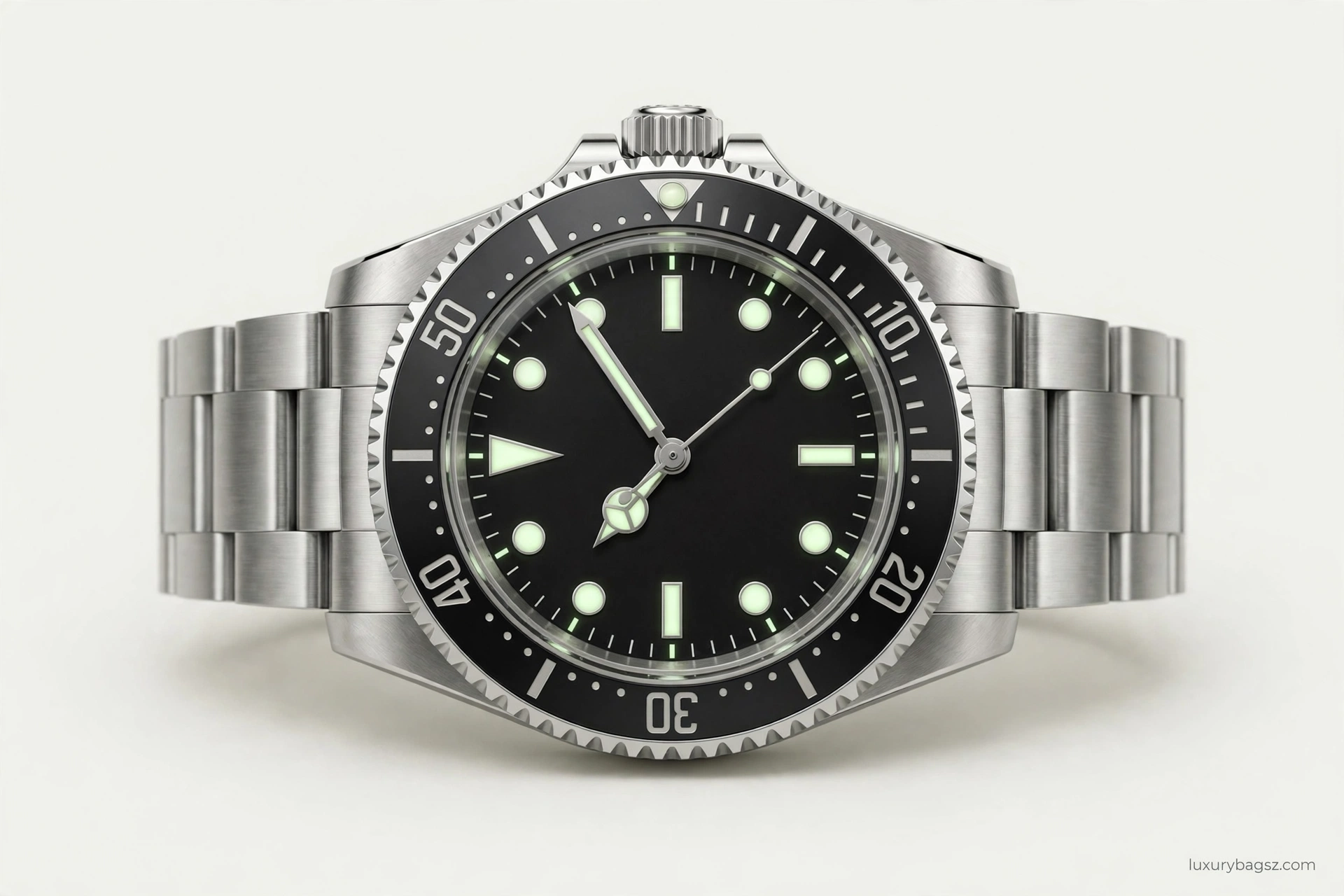
The Submariner is the dive watch against which every other dive watch is measured. It began in 1953 as a purpose-built tool for divers, rated to 100 metres, and it has been in continuous production for more than seventy years. No other sports watch has stayed in production that long without losing its shape.
The single most important choice is date versus no-date. The no-date ref. 124060 is the purist's watch, with a clean, symmetrical dial and no magnifying lens. The date ref. 126610LN adds a date window and a Cyclops lens, and the green-bezel 126610LV, nicknamed Starbucks, adds colour. All three share a 41 mm case, 300 metres of water resistance, and a 70-hour movement.
On the secondary market in 2026, expect roughly $11,500 to $13,500 for a no-date 124060 and around $15,000 to $17,500 for a date model, according to WatchGuys. Retail is $10,050 for the no-date and $10,250 for the black date, according to The Watchology's January 2026 Rolex US list, but authorised dealers run waitlists of 12 to 24 months.
Key Takeaways
- The Submariner debuted in 1953 as one of the first wristwatches purpose-built for diving, originally rated to 100 metres, with the first commercial references 6204 and 6205 launching in 1954.
- The reference chain runs 6204 to 5513 to 14060 to 114060 to 124060 for no-date, and 1680 to 16800 to 16610 to 116610 to 126610 for date models.
- Current models are 41 mm, water resistant to 300 metres, and run calibre 3230 in the no-date and calibre 3235 in the date, both with 70-hour power reserves.
- The green bezels have three generations: Kermit on the 16610LV, Hulk on the 116610LV, and Starbucks on the 126610LV, and they are not interchangeable.
- 2026 retail, per The Watchology, is $10,050 for the 124060, $10,250 for the 126610LN, and $10,950 for the 126610LV, while WatchGuys gives higher figures for the date models, so verify with a dealer.
- Pre-owned checks that matter most: bezel action, bracelet stretch, box and papers, service history, serial numbers matched to paperwork, and a pressure test before swimming.
The Dive Watch That Defined the Category
Before the Submariner, a waterproof watch was a novelty and a dive watch barely existed as a category. Divers used watches that fogged, leaked, or stopped under pressure, and no single design had solved the problem of reading elapsed time underwater. The Submariner solved it with three ideas that are now standard on every dive watch.
The first idea was the rotating timing bezel, marked in minutes, which a diver sets against the minute hand at the start of a dive. The second was a highly legible dial with luminous indices, readable in dark water. The third was a robust, waterproof Oyster case with a screw-down crown, which kept water out at depth.
Rolex executive René-Paul Jeanneret, an amateur diver himself, pushed the company to build a watch specifically for divers, according to Luxury Watches USA. The result was not a dress watch adapted for water. It was a tool designed from the case outward for underwater use, and it happened to look good enough to wear everywhere else.
That dual identity is the Submariner's whole story. It was built for divers, adopted by soldiers, actors, and collectors, and it never changed its basic shape in seventy years. Other watches chased fashion; the Submariner stayed a dive watch, and fashion came to it.
1953 and the First Submariners
The Submariner's dating carries a small disagreement worth stating plainly. WatchGuys and WatchScanning date the Submariner's introduction to 1953, while The Watchology dates its Baselworld debut to 1954 as ref. 6204, and Luxury Watches USA says the first commercial references 6204 and 6205 launched in 1954. This guide uses 1953 for the introduction and 1954 for the first commercial references, which reconciles all four sources.
The first commercial Submariners, refs. 6204 and 6205, were rated to 100 metres, a breakthrough at the time, according to Luxury Watches USA. The 6204 featured a slim pencil crown and a bidirectional rotating bezel, according to The Watchology. It was 37 mm by The Watchology's account, small by modern standards but normal for the era.
The ref. 6200 followed and is widely considered the definitive original Submariner, with a larger crown and a cleaner dial, according to Luxury Watches USA. It set the foundation on which everything since has been built, including the Mercedes hour hand shape that became a Submariner signature.
Rolex proved the concept dramatically in 1953, when oceanographer Auguste Piccard and his son Jacques strapped a Rolex prototype to the outside of their bathyscaphe and dived to a record 3,131 metres, according to Luxury Watches USA. The watch survived a depth far beyond its rating, and the story became part of the Submariner's legend.
Early Submariners are now collector artefacts, not starter watches. Survivors are rare, and the earliest references command multiples of modern prices. The modern Submariner carries the same design in a tougher, more practical form, and that is where this guide spends its time.
The Timeline: Seventy Years Without Losing Its Shape
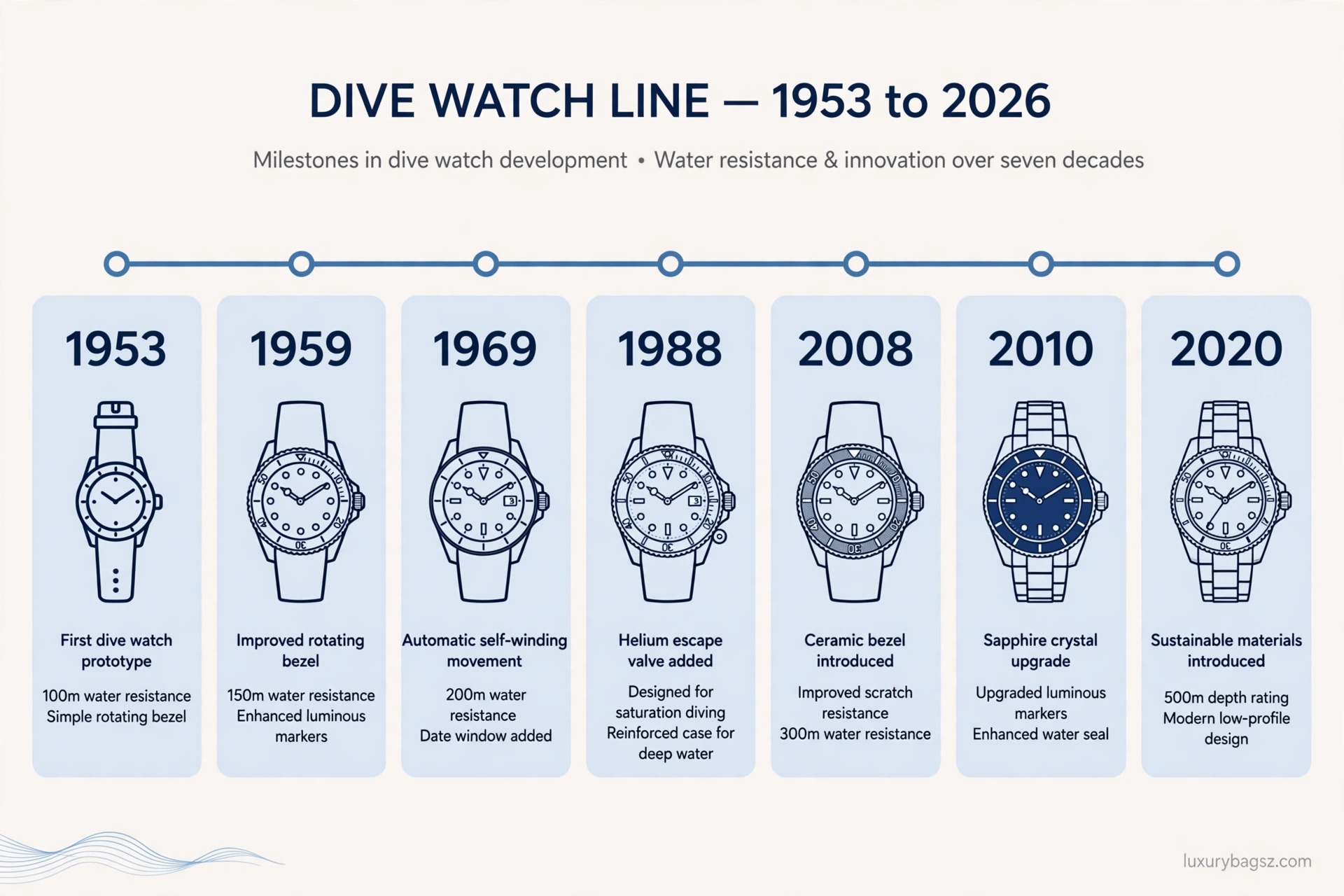
The Submariner's history is unusually continuous. Where other watch lines were discontinued, renamed, or redesigned beyond recognition, the Submariner evolved in small steps, each one keeping the previous generation's shape. The table below follows the reference chains given by WatchScanning and The Watchology.
| Year | Milestone |
|---|---|
| 1953 | Submariner introduced as a purpose-built dive watch, rated to 100 metres |
| 1954 | First commercial refs. 6204 and 6205 launch, followed by ref. 6200 |
| 1959 | Ref. 5512 introduces crown guards, the protective flanges around the crown |
| 1962 | Sean Connery wears a ref. 6538 Submariner as James Bond in Dr. No |
| 1969 | Ref. 1680 introduces the date complication to the Submariner line |
| Following decades | Refs. 5512 and 5513 become the quintessential vintage Submariners |
| Following decades | Refs. 14060, 16610, 114060, and 116610 carry both lines toward the ceramic era |
| Ceramic era | Green-bezel Hulk, ref. 116610LV, defines the ceramic era |
| 2020 | Current generation grows to 41 mm, with calibre 3230 and 3235 |
| 2026 | Three steel references anchor the line: 124060, 126610LN, 126610LV |
The 40 mm to 41 mm jump in 2020 deserves attention, because it changed how the watch wears. WatchScanning notes that the case stayed 40 mm until 2020, when the current generation grew to 41 mm. The growth came with slimmer lugs, so the watch wears closer to its predecessor than the number suggests, but it is visibly larger on the wrist.
The other constant is water resistance. The original 100-metre rating grew over the decades to the current 300 metres, or 1,000 feet, on every current reference. That growth came from better cases, better crowns, and better seals, not from a change in the watch's purpose.
Crown Guards and the 5512 and 5513 Era
The true design turning point came in 1959 with ref. 5512, the first Submariner to feature crown guards, according to The Watchology. Crown guards are the protective flanges that frame the winding crown, and they became a signature of every Rolex sports watch that followed. They also made the watch tougher, because the crown is the most vulnerable point on a dive watch.
The refs. 5512 and 5513 became the quintessential vintage Submariners, according to WatchScanning. The 5512 was the chronometer-certified version, while the 5513 was the non-certified version, and both shared the same case, dial, and bezel. Collectors treat them as a pair, with the 5512 commanding a premium for its certification.
This era also produced the Submariner's most famous screen moment. Sean Connery wore a ref. 6538 Submariner as James Bond in Dr. No in 1962, according to WatchScanning. The 6538, with its large crown and no crown guards, is now nicknamed the James Bond Submariner, and exceptional examples trade at collector-grade multiples.
Military-issued Submariners, known as MilSubs, and special-commission dials such as the Khanjar, bearing the Omani royal emblem, also come from this period, according to WatchScanning. These are the rarest vintage Submariners, and they trade in a market entirely separate from ordinary vintage pieces.
For a buyer, the 5512 and 5513 era matters because it set the template the modern watch still follows. Crown guards, Mercedes hands, a black dial, and a rotating bezel have been present ever since, and any Submariner that lacks them is either very early or not a Submariner at all.
The Date Arrives: Ref. 1680 and the Red Sub
The ref. 1680 introduced the date complication to the Submariner, and it split the line in two forever. Before the 1680, every Submariner was a no-date watch. After it, buyers had to choose between a clean dial and a practical date, and that choice still defines the line today.
Early 1680s are nicknamed Red Subs, because their Submariner text was printed in red rather than white. The red text lasted only for the earliest production, which makes Red Subs collectible, with Luxury Watches USA putting their trade prices from $80,000 upward. Later 1680s switched to white text and are far more affordable.
The date line then ran through refs. 16800, 16610, 116610, and today's 126610, according to WatchScanning. Each step added something: sapphire crystals, better movements, ceramic bezels, and finally the 41 mm case. The date window itself never moved from 3 o'clock, and the Cyclops magnifying lens above it never left.
The no-date line ran in parallel through refs. 5513, 14060, 114060, and today's 124060. It kept the symmetrical dial that purists love, and it never gained a Cyclops lens. That symmetry is the no-date's whole argument, and it is why the no-date survives alongside the more practical date model.
The Ceramic Era and the Super Case
The ceramic era changed the Submariner's bezel from a wearing part into a near-permanent one. Aluminium bezel inserts scratched, faded, and dented, and collectors loved them for exactly those flaws. Ceramic Cerachrom bezels resist scratches and fading, so a ceramic Submariner looks new far longer than an aluminium one.
The ceramic generation also brought the Super Case, with thicker lugs and a broader, more present stance on the wrist. Some collectors found the Super Case too blocky, and it is one reason the 40 mm ceramic models divide opinion. The 2020 generation slimmed the lugs again, which softened that criticism without abandoning the ceramic bezel.
The most famous ceramic Submariner is the Hulk, ref. 116610LV, with a green dial and a green ceramic bezel. It was discontinued when the 41 mm generation arrived, and its green-on-green look has never been repeated. That discontinuation is a large part of why the Hulk trades at a premium over the black ceramic models it replaced.
Ceramic bezels also changed pre-owned buying. A chipped ceramic bezel is expensive to replace, while a scratched aluminium bezel was cheap. Check the bezel edges carefully on any ceramic Submariner, because a chip at the edge is the one flaw that cannot be polished away.
The Current Lineup: Six References, One Case
Rolex sells six Submariners today, all 41 mm and water resistant to 300 metres, according to WatchScanning. Most buyers choose between the steel no-date and the steel date, while the green bezel, two-tone, and solid gold models sit above them. All six share the same 41 mm Oyster case, 300-metre rating, and Triplock crown.
The steel core is three references. The 124060 is the Submariner with no date, a black dial, and a black bezel, on calibre 3230. The 126610LN is the Submariner Date in black, on calibre 3235, with a date window and a Cyclops lens. The 126610LV is the Starbucks, with a green ceramic bezel and a black dial, also on calibre 3235.
Above steel sit the two-tone and gold models. The 126613LN pairs steel with yellow gold and a black bezel, while the 126613LB, nicknamed Bluesy, pairs steel with yellow gold and a blue bezel. Solid gold versions, refs. 126618LB in yellow gold and 126619LB in white gold, sit at the top of the range.
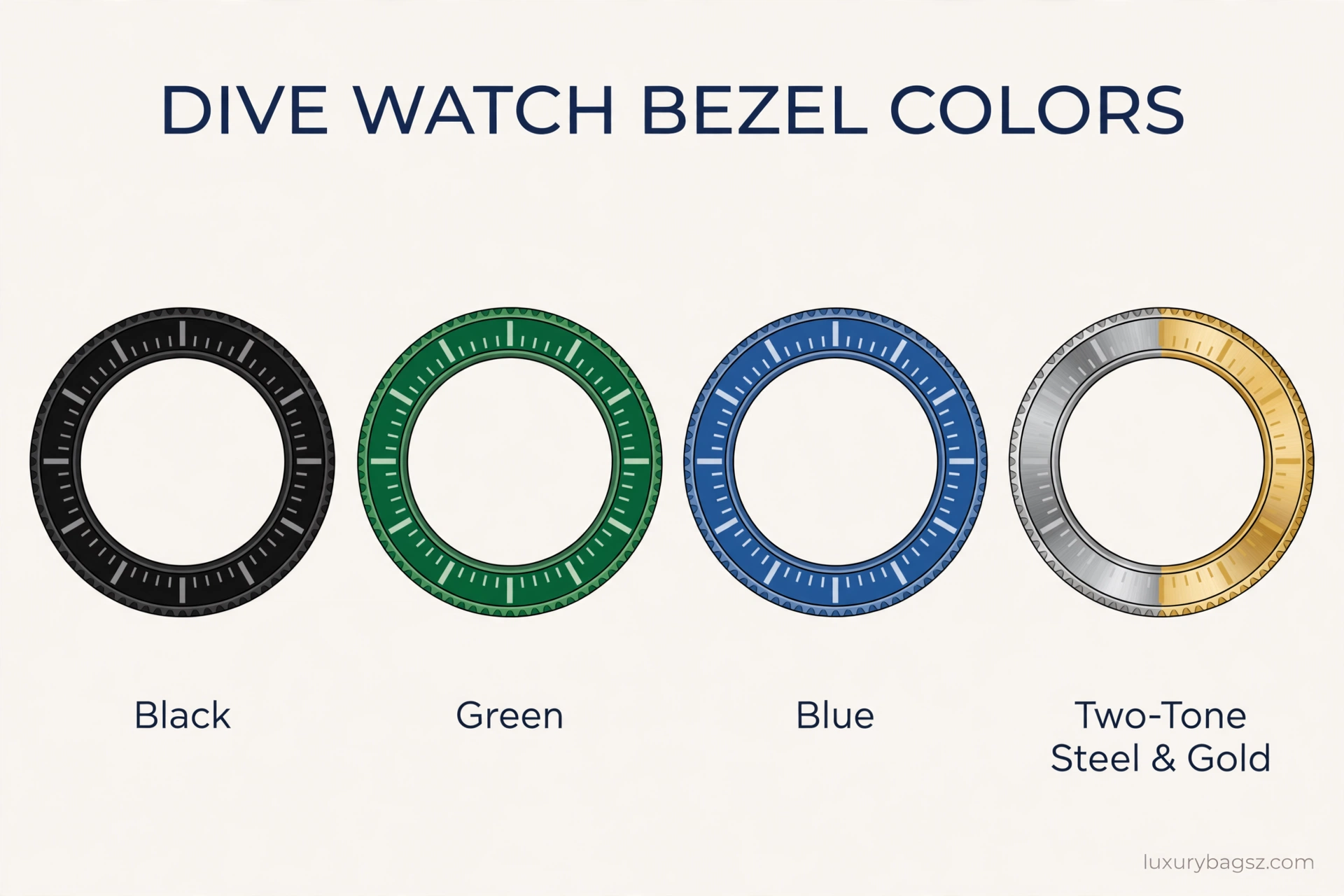
Rolex reference numbers decode by their final digits and letters, according to WatchGuys. The final digit indicates material, with 0 for steel, 3 for Rolesor steel and gold, 8 for yellow gold, and 9 for white gold. Letters after the number denote bezel colour: LN for black, LV for green, and LB for blue.
For the same reason, our guide to Rolex serial number checks stresses decoding the numbers before trusting a listing. A Submariner reference tells you the material, the bezel, and the date complication, and a seller who gets those details wrong deserves a second look.

Date Versus No-Date: Which to Choose
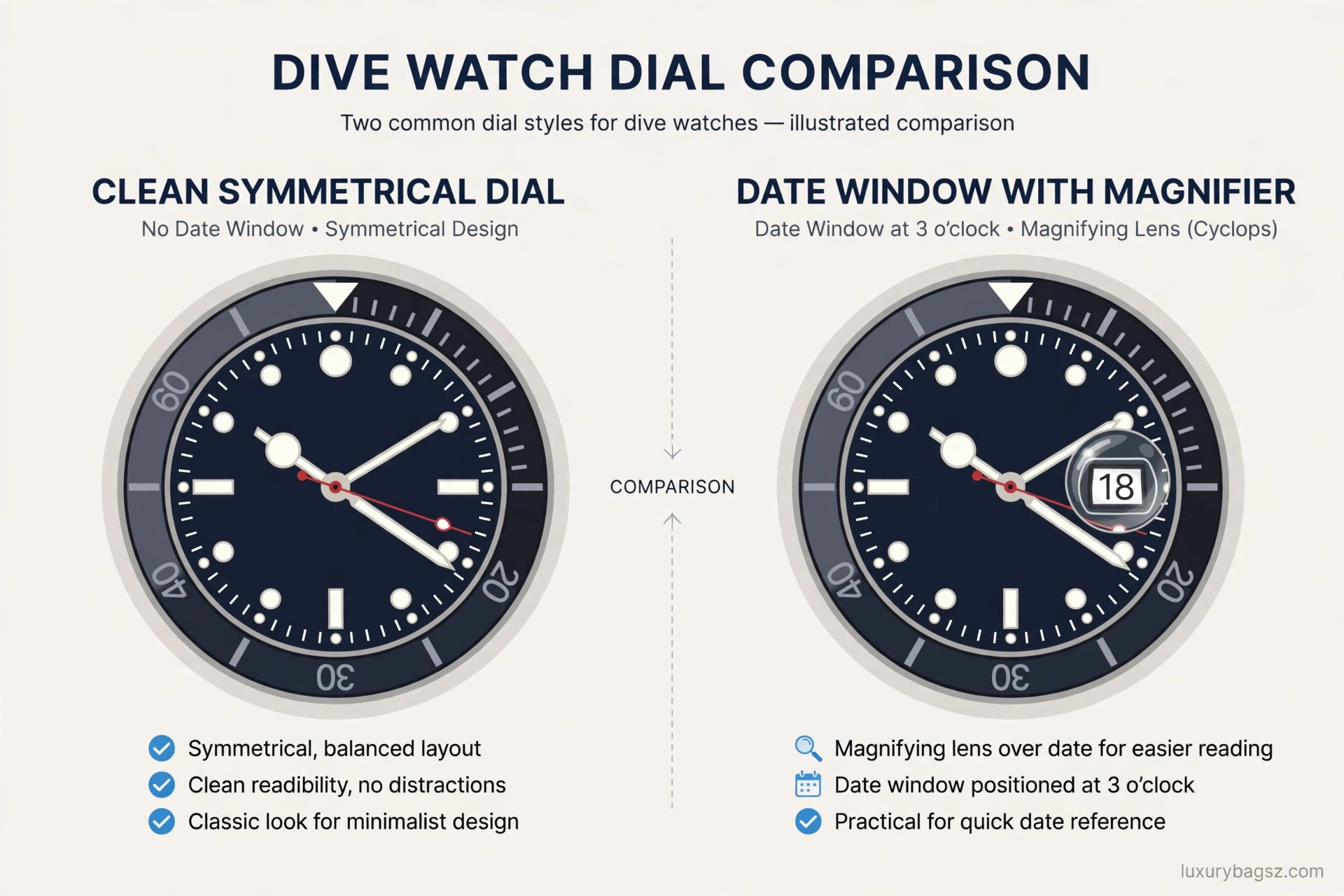
The date versus no-date choice is the Submariner's great debate, and it comes down to symmetry versus practicality. The no-date 124060 has a clean, symmetrical dial with no window and no Cyclops lens. The date 126610LN adds a date window at 3 o'clock under a Cyclops magnifier, which breaks the symmetry but adds daily usefulness.
Purists prefer the no-date, because it is closer to the original Submariner and because its dial is balanced. The no-date also has its own movement, calibre 3230, distinct from the date model's calibre 3235, according to Swiss Connection Watches. That distinction matters to collectors, because the no-date is not simply a date model with a part removed.
Practical buyers prefer the date, because a watch without a date is a watch you check your phone against once a day. The date model's Cyclops lens magnifies the date by two and a half times, making it readable at a glance, and the date changes instantly at midnight. For a daily wearer, that convenience is hard to give up.
Price also separates them. The no-date retails lower and trades lower on the secondary market, which makes it the more accessible entry into the Submariner line. The date models cost more at retail and trade higher second-hand, particularly the green-bezel Starbucks. Neither is the wrong choice, but they serve different buyers.
If you own one watch and wear it every day, buy the date. If you collect, or if you love the Submariner's original symmetry, buy the no-date. Either way, you are buying the same case, the same bracelet, and the same 70-hour movement family, so the choice is about the dial, not the watch underneath.
Green Bezels: Kermit, Hulk, and Starbucks
No Submariner topic confuses buyers more than the green bezels, because three different green watches share one nickname family. Kermit, Hulk, and Starbucks are three distinct references, and knowing which is which protects you from overpaying for the wrong one.
The Kermit is ref. 16610LV, the first green-bezel Submariner, with a green aluminium bezel and a black dial. It is the oldest of the three, and it has climbed steadily since retirement, according to Luxury Watches USA. Its aluminium bezel fades and wears in ways ceramic never will, which collectors prize.
The Hulk is ref. 116610LV, with a green ceramic bezel and a green dial. Green on green is the Hulk's signature, and it is the only Submariner that pairs a green dial with a green bezel. It was discontinued when the 41 mm generation arrived, and its green dial has never been repeated.
The Starbucks is ref. 126610LV, the current green-bezel Submariner, with a green ceramic bezel and a black dial. It returned to the Kermit's black-dial formula while keeping the ceramic bezel, and it is the green Submariner you can still buy new. Its nickname comes from the green bezel's resemblance to a coffee chain's branding.
Do not pay Hulk money for a Starbucks, and do not accept a Kermit described as ceramic. The bezel material and the dial colour together identify each watch, and a seller who confuses them is either careless or dishonest. Check the reference number, then check the dial, and the three greens sort themselves out.
The Bracelet and the Glidelock Clasp
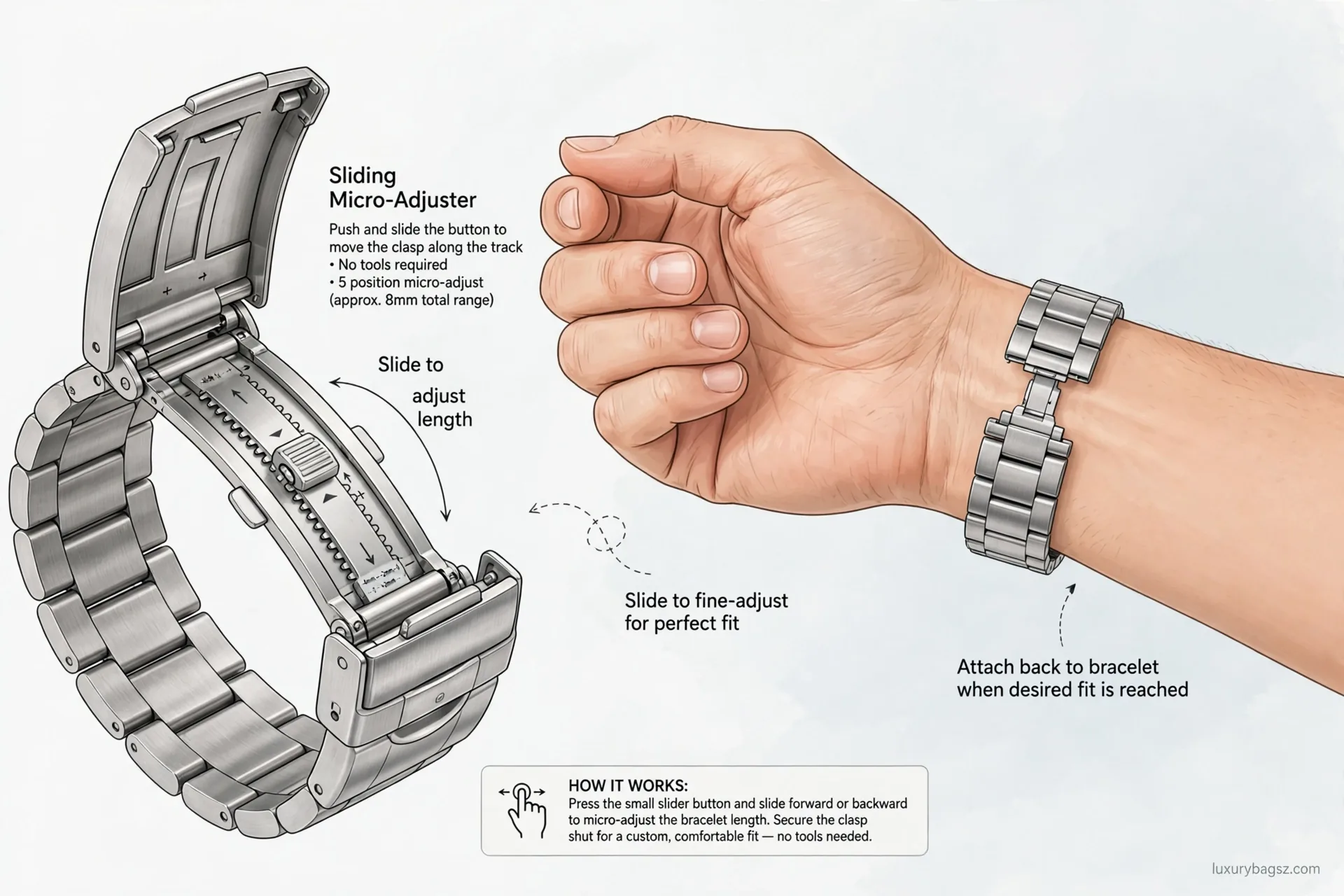
The Submariner's Oyster bracelet is as much a part of the watch as its case. Current models use a solid-link Oyster bracelet with a Glidelock extension system, according to WatchGuys. The Glidelock lets the bracelet lengthen in small steps without tools, which matters for diving, when a wetsuit changes wrist size, and for daily wear, when wrists swell in heat.
Older bracelets were lighter and less solid, with folded links that stretched over time. Modern solid links resist stretch far better, but they are not immune to it. A bracelet that sags sideways has worn links, and that wear is expensive to fix, because Rolex bracelets are priced as major components, not accessories.
The clasp deserves its own check. It should close with a firm click, stay closed under pressure, and show no play in its hinge. The Glidelock mechanism should slide smoothly through its range and lock at each step. A clasp that pops open or a Glidelock that slips is a service job, and it should change the price.
Sizing matters more on a dive watch than on a dress watch, because a loose Submariner slides and a tight one pinches. Use the Glidelock to fine-tune the fit after sizing, and keep the extra links. Full sets with extra links trade higher, according to the pre-owned guides, and a bracelet that cannot be sized to your wrist is a watch you cannot wear.
Prices in 2026: Retail, Secondary, and What Moves Them
Submariner pricing needs care, because sources disagree on the date models. The Watchology, citing the Rolex US retail list from January 2026, gives $10,050 for the no-date 124060, $10,250 for the date 126610LN, and $10,950 for the Starbucks 126610LV. WatchGuys gives higher figures for the same date references, around $11,350 for the 126610LN and $11,900 for the Starbucks.
This guide reports both, because a buyer comparing pages will meet both, and the difference likely reflects different points in Rolex's 2026 price adjustments. Rolex raised retail prices by approximately 5 to 7 percent on steel models in January 2026, according to WatchGuys, which pushed secondary floors higher in step. Verify the current retail price with an authorised dealer before you treat any figure as final.
On the secondary market, WatchGuys puts the no-date 124060 at $11,500 to $13,500, the date 126610LN at around $15,000, and the Starbucks at $15,000 to $17,500, all for watches in good to excellent condition with complete sets. WatchScanning agrees on the date model, putting an unworn 126610LN at around $15,000 to $17,000 in mid-2026.
Luxury Watches USA gives lower pre-owned floors, from $9,000 to $12,000 for the no-date and $9,500 to $16,000 for date models, which likely reflects older or less complete examples. Watches without box and papers typically sell for 10 to 20 percent less, according to WatchGuys, so completeness explains much of the spread.
What moves a Submariner's price, beyond the reference, is condition, completeness, and originality. An unpolished case, a clean ceramic bezel, a tight bracelet, and a full set all add value. A polished case, a chipped bezel, a stretched bracelet, or missing papers all subtract it. Green bezels command premiums over black, and discontinued references like the Hulk command premiums over current ones.
Buying Pre-Owned: Checks That Actually Matter
The Submariner is one of the most counterfeited watches in the world, and our guide to spotting a fake Rolex covers the full method. This part gives the Submariner-specific checks that catch most problems before money changes hands.
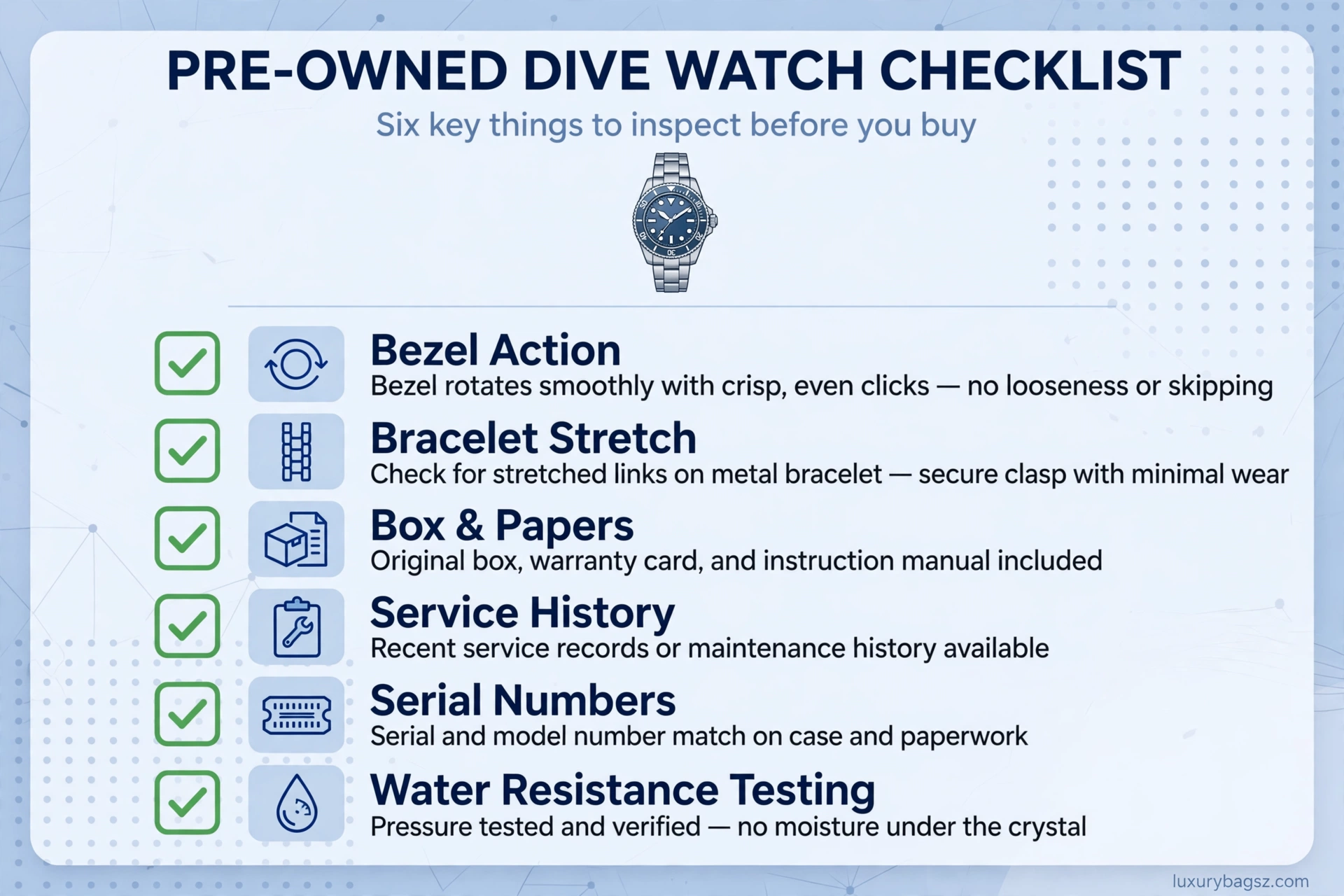
Start with the bezel. It should rotate in one direction only, with firm, even clicks and no play. Ceramic bezels should show crisp numerals with no chips at the edges, while aluminium bezels on vintage models should show honest wear. A bezel that spins both ways or feels gritty needs a service, and a chipped ceramic bezel needs a replacement.
Check the bracelet for stretch by holding it horizontally and looking for sag between the links, then test the clasp and the Glidelock mechanism. A stretched bracelet is expensive to replace, and it suggests a watch worn hard without servicing. Ask whether the extra links are included, because a bracelet that cannot be sized to your wrist is a watch you cannot wear.
Confirm the serial and reference numbers against the paperwork. The reference tells you the material, bezel, and date complication, and the serial number should match the warranty card. A mismatch anywhere deserves an explanation. For a fuller method, read our guide to spotting a fake Rolex Datejust, which shares the same Rolex checking discipline.
Ask for service history, and check when the movement was last serviced and whether the watch was pressure-tested. A Submariner that has not been serviced in a decade may run, but its seals are past their best, and a full Rolex service is a significant cost to inherit. A recently serviced watch with documentation is worth paying more for.
Retail Versus Secondary: Waitlists and Reality
Buying a Submariner at retail requires patience. WatchScanning reports that authorised dealer waitlists run 12 to 24 months, because demand for steel Submariners outstrips supply. That wait applies to all three steel references, with the Starbucks typically the hardest to get.
The retail path has real advantages. You pay the published price, you get a fresh manufacturer warranty, and you know the watch's full history from day one. If you have a dealer relationship and can wait, retail is the cheapest route to a current Submariner, and the wait is the price you pay for that discount.
The secondary market offers immediate access, including discontinued references no longer available at retail, such as the Hulk and the Kermit. Pre-owned dealers authenticate, inspect, and warranty their watches, but at a premium above retail for most steel configurations. That premium is the cost of skipping the waitlist.
One rule protects you on either path: never pay more than retail to an authorised dealer, because legitimate dealers sell at Rolex's published price, according to WatchScanning. A dealer asking above retail is not an authorised dealer in the normal sense, and a private seller asking far above the secondary range needs to justify it with condition, completeness, or rarity.
For the same reason, our guide to buying on Rolex finance is worth reading before you commit to monthly payments. A Submariner bought on finance costs more than its sticker price, and the total cost deserves the same attention as the reference choice.
Servicing and Real Water Resistance
The Submariner is rated to 300 metres, but that rating applies to a new, sealed watch, not to a ten-year-old watch that has never been pressure-tested. Seals age, crowns wear, and a watch that was waterproof when new can leak after years without service. Have any pre-owned Submariner pressure-tested before you swim with it.
Rolex recommends servicing roughly every ten years for modern movements, though heavy use, swimming, and harsh conditions shorten that interval. A full Rolex service restores the movement, replaces worn seals, and pressure-tests the case, which is what keeps the 300-metre rating honest. Budget for it as part of ownership, not as an emergency.
Daily wear is where the Submariner earns its keep. The ceramic bezel resists scratches, the Chromalight display stays legible at night, and the Glidelock clasp handles warm days. It is one of the few luxury watches that genuinely works as a single-watch collection, because it is tough, legible, and understated enough for most rooms.
Cleaning is simple, and our guide to how to clean a watch covers cases, crystals, bracelets, and straps in detail. For a Submariner, warm water, mild soap, and a soft brush on the bracelet, with the crown screwed down, is enough for routine care. Leave case opening and movement work to a professional.
Five Mistakes First-Time Submariner Buyers Make
The first mistake is buying the green nickname instead of the reference. Kermit, Hulk, and Starbucks are three different watches, and paying Hulk money for a Starbucks is an expensive confusion. Always match the reference number to the bezel material and dial colour before you pay.
The second mistake is ignoring bracelet stretch. A Submariner bracelet that sags sideways has worn links, and replacing a Rolex bracelet costs far more than most buyers expect. Hold the bracelet flat, check for sag, and test the clasp and Glidelock. A tight bracelet on a loose watch is a warning, not a bargain.
The third mistake is skipping the pressure test. A Submariner's 300-metre rating means nothing on a watch that has not been tested in years, and a leak ruins a movement faster than any other fault. Ask for a recent pressure test, or get one done before the watch goes near water.
The fourth mistake is paying for a story instead of a watch. Military provenance, celebrity ownership, and rare-dial claims all add romance, and some add value, but only with paperwork that proves them. A story without documents is just a story, and it should not change the price.
The fifth mistake is buying the wrong size by diameter alone. The Submariner is 41 mm, but its slimmed lugs make it wear closer to a 40 mm watch, while its wide bezel adds presence. Try it on, check how it sits under a cuff, and judge by wrist presence rather than the number alone.
Avoid those five mistakes and the rest of the purchase gets simpler. The Submariner is a well-documented watch with a clear reference system, and a buyer who checks the bezel, the bracelet, the papers, and the service history is hard to fool.
Which Submariner Should You Buy?
Buy the no-date 124060 if you want the purest Submariner, the cleanest dial, and the lowest entry price. It is the closest modern watch to the original 1953 tool, and its symmetry is the whole argument. It is also the easiest steel Submariner to find at or near retail.
Buy the date 126610LN if you want the classic black Submariner with daily practicality. It is the most popular Submariner by sales volume, according to WatchScanning, and its date complication is genuinely useful. It costs more than the no-date, but it is the reference most owners keep longest.
Buy the Starbucks 126610LV if you want colour without leaving the Submariner line. Its green ceramic bezel stands out without shouting, and it holds a premium over the black date models. Buy the Bluesy 126613LB if you want two-tone warmth, and buy gold only if you want the Submariner as jewellery rather than as a tool.
Whatever you choose, decode the reference, check the bezel, confirm the full set, and budget for servicing and a pressure test. A Submariner in the right configuration, unpolished, complete, and recently serviced is a watch for decades. A Submariner bought on nickname alone, without those checks, is a gamble at prices where gambles are expensive.
Wearing the Submariner Every Day
The Submariner's 41 mm case wears smaller than its number suggests, because the 2020 generation slimmed the lugs that made the ceramic 40 mm models feel blocky. On most wrists it sits flat, with the case edges inside the wrist's width, and the wide bezel adds presence without adding bulk. Try it on before judging by diameter alone.
Comfort comes from the Glidelock clasp as much as from the case. A Submariner sized correctly, then fine-tuned with the Glidelock, stays put through warm days and long wear, without sliding down the wrist or pinching. That adjustability is one reason owners wear their Submariners daily while other luxury watches stay in boxes.
For daily wear, the Submariner is unusually easy to live with. The ceramic bezel resists desk scratches, the Chromalight display stays legible at night, and the 300-metre rating means rain, swimming, and washing up are non-events, provided the seals are fresh. It is one of the few luxury watches that genuinely works as a single-watch collection.
One honest drawback: the Submariner's popularity means it is instantly recognisable, and some owners prefer a watch that draws less attention. If anonymity matters to you, the black no-date draws the least notice, while the green Starbucks draws the most. Choose the colour with that in mind, not just with resale in mind.
Frequently Asked Questions
When was the Submariner launched?
In 1953 as a purpose-built dive watch, with the first commercial references 6204 and 6205 launching in 1954. Sources differ slightly, with some dating the debut to Baselworld 1954, but all agree the watch was developed in 1953 and sold from 1954. It was originally rated to 100 metres.
What is the difference between the Submariner and the Submariner Date, and what are the Kermit, Hulk and Starbucks?
The Submariner, ref. 124060, has no date window and no Cyclops lens, with a clean, symmetrical dial on calibre 3230. The Submariner Date, ref. 126610LN or 126610LV, adds a date window at 3 o'clock under a Cyclops lens, on calibre 3235. Both share a 41 mm case, 300-metre rating, and 70-hour reserve.
The Kermit is ref. 16610LV, with a green aluminium bezel and a black dial. The Hulk is ref. 116610LV, with a green ceramic bezel and a green dial. The Starbucks is ref. 126610LV, the current model, with a green ceramic bezel and a black dial. They are three distinct references, not three names for one watch.
How big is the Submariner, and how water resistant is it?
Current models are 41 mm, water resistant to 300 metres, with a Triplock crown and a Glidelock bracelet extension. The 300-metre rating applies to a new, sealed watch, so have a pre-owned example pressure-tested before swimming with it.
How much does a Submariner cost in 2026, and how long is the waitlist?
The Watchology's January 2026 Rolex US list gives $10,050 for the 124060, $10,250 for the 126610LN, and $10,950 for the 126610LV, while WatchGuys gives higher figures for the date models. On the secondary market, WatchGuys puts the no-date at $11,500 to $13,500 and date models at around $15,000 to $17,500.
Authorised dealer waitlists run 12 to 24 months, according to WatchScanning, with the Starbucks typically the hardest to get. The secondary market offers immediate access at a premium above retail, which is the cost of skipping the waitlist.
Is the Submariner a good investment, and should you buy at retail or pre-owned?
Modern steel Submariners hold value well, with secondary prices rarely dipping far below retail, and discontinued references like the Kermit and Hulk have appreciated since retirement. That is a market observation, not a guarantee. Condition, originality, and completeness decide more than the reference name alone.
Buy at retail if you have a dealer relationship and can wait 12 to 24 months for a popular steel reference, and want a fresh manufacturer warranty. Buy pre-owned if you want immediate access, a discontinued reference, or a specific bezel colour. Either way, verify authenticity, service history, and completeness before paying.
How do you spot a fake Submariner?
Check that the bezel rotates in one direction only with firm clicks, that ceramic numerals are crisp with no chips, that the bracelet shows no heavy stretch, and that serial and reference numbers match the paperwork. For a fuller method, read our guide to spotting a fake Rolex.
How often should a Submariner be serviced?
Roughly every ten years for modern movements, according to Rolex's guidance as reported by rival guides, with heavy use and swimming shortening that interval. A full service restores the movement, replaces seals, and pressure-tests the case, which keeps the 300-metre rating honest.
Conclusion
The Submariner began as a diver's tool and became the benchmark for every sports watch since, because it never chased fashion. A rotating bezel, a legible dial, and a waterproof case solved a real problem in 1953, and the same three ideas still define the watch today. Ceramic bezels and a 70-hour movement made it tougher, but the shape never changed, because it never needed to.
Choose the no-date if you want purity, the date if you want practicality, and the Starbucks if you want colour. Whichever reference you pick, decode the numbers, check the bezel, confirm the full set, and get a pressure test before it goes near water. A Submariner bought that way is a watch for decades, and it will still be the benchmark long after the trends around it have faded.






