How to Spot a Fake Rolex Datejust
The Datejust Details That Matter Most
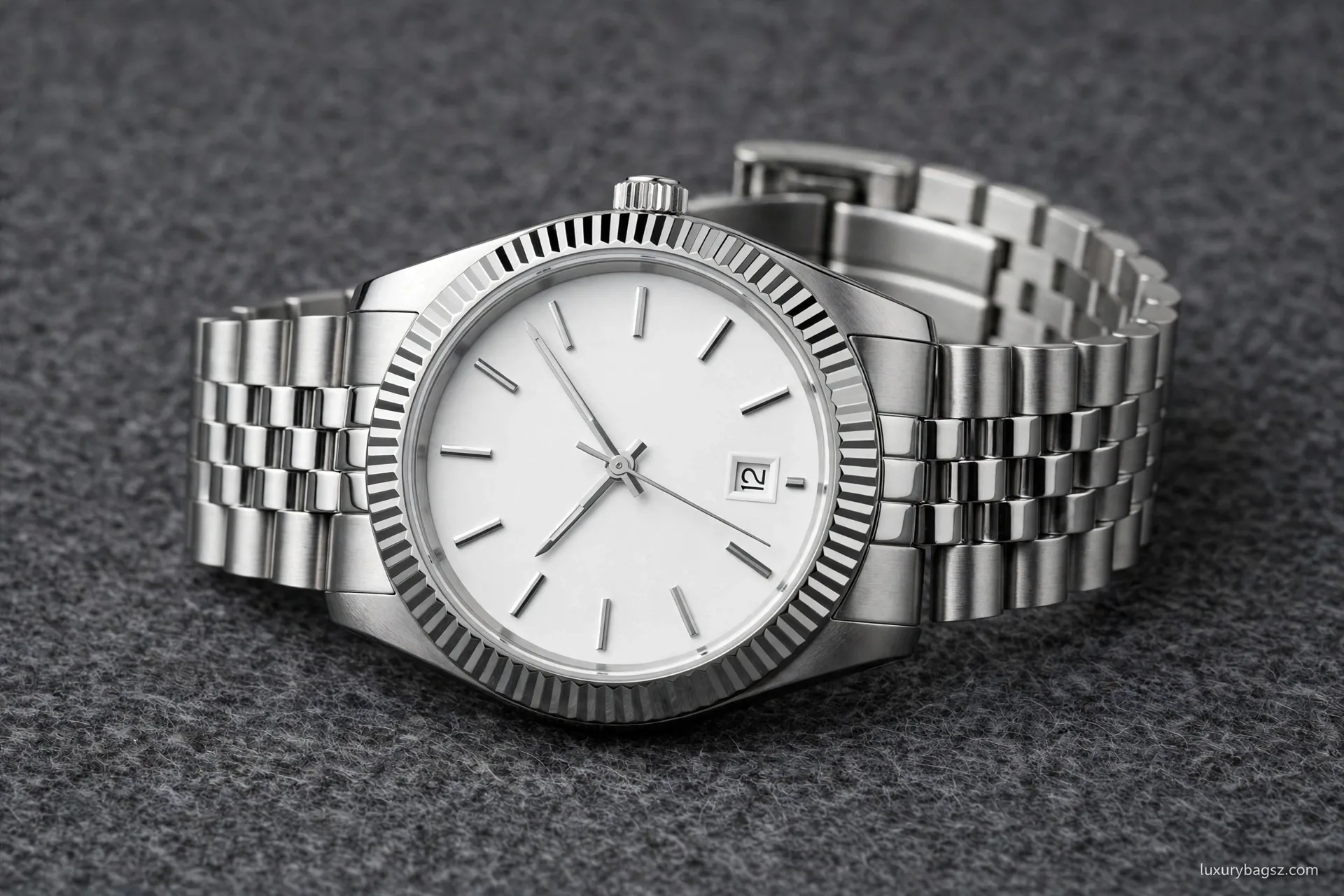
For a Datejust, concentrate on the cyclops over the date, the bezel, the bracelet, whether the dial belongs on that reference, and the movement for its era. Those are the model-specific tests, and they matter more than general impressions of the watch.
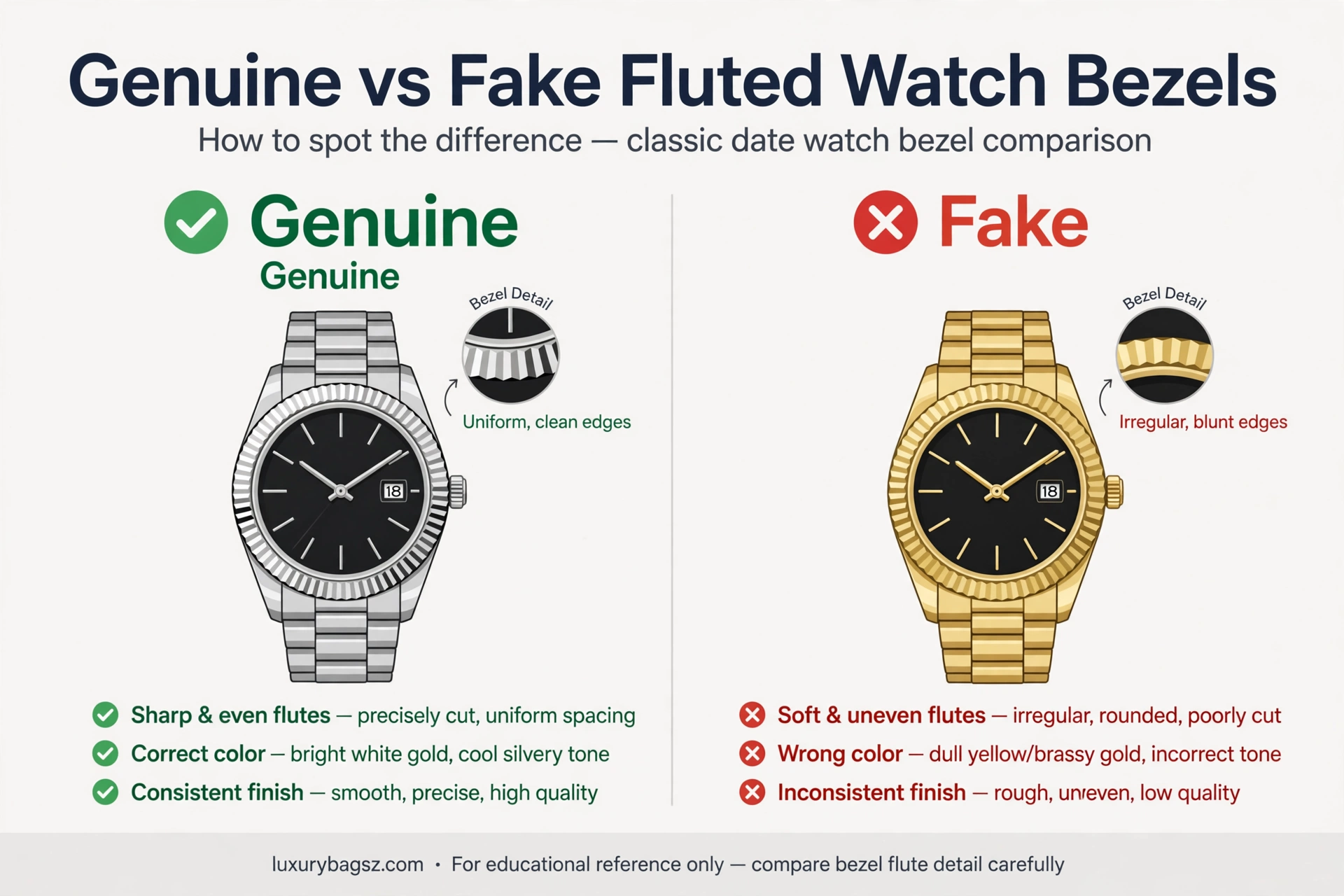
The lens should enlarge the date by roughly two and a half times, with the numeral centred and filling its window neatly. Where that reference calls for fluting in white gold, expect ridges that are sharp, deep and evenly cut, in a metal that looks softer than bright polished steel.
A Jubilee bracelet, built from five links, should drape and move smoothly without stiffness or rough edges. Dial colour, markers and hands must have been offered on that reference, and the calibre — 3035, 3135 or 3235 depending on generation — must match it.
The Datejust at a Glance
This guide covers Datejust-specific checks only. A general fake Rolex guide already exists, and repeating it wholesale would waste your time. What follows is what is distinctive about the Datejust: the fluted bezel, the Jubilee bracelet, the cyclops date, the dial variants by reference, and the calibre changes that let you date a watch and catch a fake.
For general Rolex tells that apply to every model, such as crown and caseback principles, use the general guide alongside this one, and let this guide decide the Datejust questions.
The Datejust, launched in 1945, is Rolex's classic date watch: an Oyster case, a date window at 3 o'clock magnified by a cyclops lens, and, on most variants, either a fluted white-gold bezel or a smooth steel bezel, paired with a Jubilee or Oyster bracelet. It has been made in 36 mm and 41 mm modern sizes, with earlier 34 mm and other sizes, in steel, two-tone, and gold, with a wide range of dial colours and marker styles.
That variety is the counterfeiter's opportunity and the careful buyer's tool: every Datejust variant has a correct combination of bezel, bracelet, dial, and calibre, and a watch that mixes them is wrong.
Because the Datejust is Rolex's highest-volume classic model, it is also one of the most faked, including in high-grade superclone form. External copying is now good enough that this guide puts decisive weight on the bezel and bracelet construction, the cyclops optics, the dial variant match, and the calibre and date mechanism, confirmed by an independent inspection before purchase.
Key Takeaways
- This guide is Datejust-specific: fluted bezel, Jubilee bracelet, cyclops date, dial variants, and calibre by reference. General Rolex checks live in the general guide.
- The fluted bezel on genuine Datejust models is sharply and evenly fluted in white gold where specified; soft, uneven, or steel-looking fluting on a white-gold-bezel reference is a warning.
- The Jubilee bracelet's five links should articulate smoothly with even finishing; stiff, rattly, or roughly finished Jubilee bracelets are a common fake giveaway.
- The cyclops lens should magnify the date by about 2.5 times, with the date filling the window cleanly; weak magnification or a date that sits off-centre is a Datejust-specific red flag.
- Dial, bezel, bracelet, and calibre must match the reference and era: a 36 mm dial layout on a 41 mm case, or a calibre 3235 in a reference that should carry a 3135, fails the check.
- Modern Datejust models carry a rehaut engraving and, on later examples, updated bracelet and clasp designs; those details must suit the reference and production date.
Reference First: Size, Material, and Era
Datejust references encode the watch. Modern five-digit and six-digit references distinguish size, bezel, bracelet, and material, and the production era determines the calibre: calibre 3035 on many five-digit references, calibre 3135 on later five-digit and early six-digit references, and calibre 3235 on current six-digit references, with other calibres on specific variants.
Before checking anything, obtain the full reference number, the serial number, and the production era, and learn the correct combination for that reference from Rolex materials and reputable dealer listings.
Common modern references illustrate the system. A 36 mm steel and white-gold Datejust on Jubilee with a fluted bezel is a different watch from a 41 mm steel Datejust on Oyster with a smooth bezel, even though both are Datejust models.
Dial options, marker styles, and bracelet options also vary by reference: not every dial was offered on every reference, and a dial colour or marker style that was never offered on that reference is a fake tell, however attractive it looks.
Vintage Datejust models add further variation, including pie-pan dials on early examples, different bezel profiles, and bracelets that have often been replaced or restored. Judge vintage watches against other examples from the same era, not against current production, and treat any vintage watch whose combination of features matches no known reference as suspect until a specialist proves otherwise.
The Cyclops Date: Magnification, Alignment, and Font
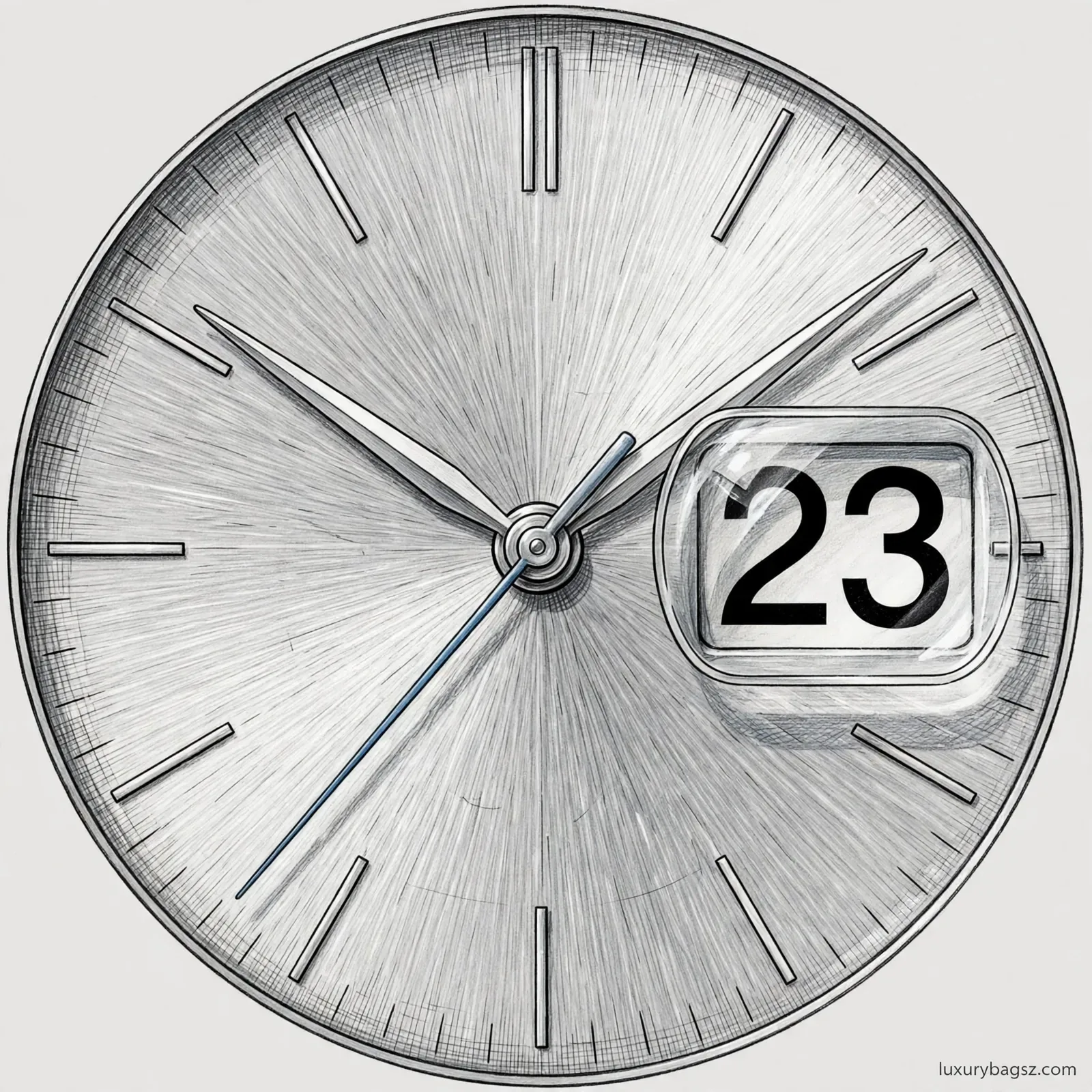
The cyclops lens is the Datejust's most testable feature. On a genuine Datejust, the cyclops magnifies the date by approximately 2.5 times, so the date numeral fills its window cleanly and is easy to read at a glance. A cyclops that magnifies weakly, leaving the date small in its window, or that magnifies unevenly, distorting one side of the numeral, is a strong warning.
Photograph the date straight on and compare the magnification against a verified genuine example of the same reference.
Alignment matters as much as magnification. The date disc should sit centrally in its window, with even margins on all sides, and the numeral should be correctly formed in the font used for that reference and era. A date that sits high, low, or off-centre, a numeral that is cropped by the window edge, or a font that differs from the reference's date font all indicate a fake crystal, a wrong date disc, or a fake watch.
Also check the date change: on a genuine Datejust, the date should change crisply at midnight, not drag gradually over hours. A slow, dragging date change suggests a wrong or poor-quality movement.
On some vintage Datejust models, the cyclops may show wear, and a replaced crystal is legitimate maintenance when disclosed. A replaced crystal should still magnify correctly and align centrally; a replacement that fails either test is a poor replacement at best, and on an unknown watch it should be treated as a fake tell until a watchmaker advises otherwise.
Dial Variants: Colour, Markers, and Hands by Reference
Datejust dials come in a wide range, and the range itself is the test. For any reference, only certain dial colours, marker styles, and hand styles were offered: champagne, silver, white, black, blue, and other colours, with baton, Roman, Arabic, diamond, or other markers depending on the reference and era.
A dial colour or marker style that was never offered on that reference, however beautiful, means the dial is fake, replaced with a wrong dial, or fitted to the wrong case. Verify the dial against dealer listings and auction records for the same reference before judging its quality.
Dial quality checks then apply within the correct variant. Genuine Datejust dials show crisp printing, correctly formed markers, and even lume where fitted. Applied markers should sit evenly with clean facets; printed markers should be sharp with no bleeding.
The Rolex coronet and signature should be correctly rendered for the era: coronet shape, signature font, and placement all varied subtly over the decades, and a coronet or signature from the wrong era on a dial is a warning.
Hands must match the dial and reference: baton hands with baton markers, for example, and the correct hand lengths for the case size. A 36 mm Datejust's hands differ in length from a 41 mm's, and hands that are too short or too long for the case are a mismatch tell. Lume consistency between hands and markers matters too; hands that glow differently from markers suggest replacement or fakery.
The Jubilee Bracelet: Five Links, Smooth Articulation
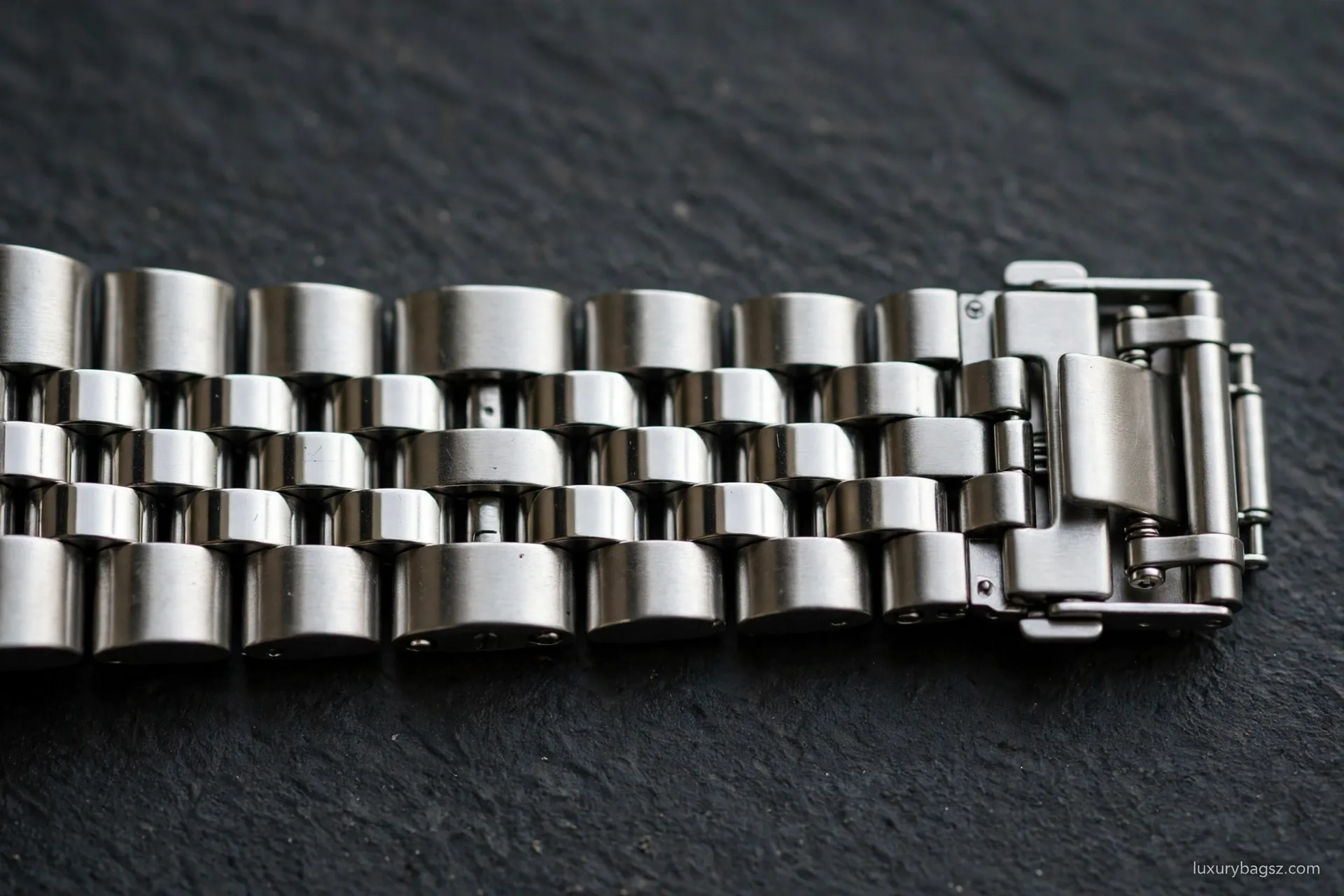
The Jubilee bracelet, with its five-link construction, is a defining Datejust feature and a demanding fake test. On a genuine Jubilee, the five links articulate smoothly and evenly, draping around the wrist with a supple feel, and each link is finished consistently, with polished centre links and brushed outer links on the classic configuration, or as otherwise specified for the reference.
Links that catch, grind, vary in size, or show rough edges are warnings.
Examine the bracelet from the side and from underneath, where counterfeiters often economise. Genuine Jubilee links are solidly constructed on modern references, with clean finishing on all surfaces, not just the visible top. Hollow, rattly, or roughly finished links, especially on the underside, indicate a fake or a poor-quality replacement bracelet.
The end links where the bracelet meets the case should fit snugly with even gaps on both sides; end links that sit proud or leave uneven gaps suggest a mismatched bracelet.
The clasp is the companion test. A genuine Jubilee clasp closes with a firm, precise snap, sits flush, and carries clean, correctly rendered markings, including the coronet where specified, with the correct clasp code for the bracelet's era. A clasp that feels flimsy, closes loosely, or shows shallow or misspelled markings is a serious warning.
Clasp codes also help date the bracelet: a clasp code from a different era than the watch's case suggests a swapped bracelet, which must be disclosed and priced accordingly.
The Fluted Bezel: Sharp, Even, White Gold
The fluted bezel is the Datejust's jewellery element, and its execution separates genuine watches from most fakes. On references specified with a white-gold fluted bezel, the fluting should be sharp, deep, and evenly spaced around the full bezel, with clean, crisp ridges that catch light uniformly.
The bezel should be white gold, with the colour and lustre of white gold, not the brighter, whiter look of polished steel or the dull look of plated base metal.
Fakes commonly fail here in three ways. First, soft fluting: ridges that are shallow, rounded, or unevenly spaced, because sharp fluting requires precise machining. Second, wrong material: a steel bezel polished to imitate white gold, which looks subtly wrong in colour and wears differently. Third, inconsistent fluting: ridges that vary in depth or spacing around the bezel, or that show tool marks or rough edges.
Run a fingertip lightly around the bezel, if the seller permits handling, and look at it under raking light: genuine fluting feels and looks uniform all the way around.
Smooth-bezel Datejust references need a different check: the smooth bezel should be flawlessly polished, with no waviness, scratches inconsistent with the watch's stated condition, or uneven reflections. A smooth bezel that looks wavy or shows polishing marks bleeding onto the case is a warning, just as soft fluting is on a fluted reference.
In both cases, judge the bezel against the reference specification, not against a general idea of what a Datejust bezel should look like.
The Oyster Case and Crown by Datejust Reference
Datejust Oyster cases vary by size and era, and their dimensions must match the reference. Modern Datejust models are 36 mm or 41 mm, with thickness and lug proportions that differ between the two sizes; earlier models include 34 mm and other sizes.
Measure the case and compare it against the reference specification: a 36 mm watch sold as a 41 mm, or a case noticeably thicker than the genuine reference, fails the check even if the dial looks right.
The Twinlock or Triplock crown, as specified for the reference, should be correctly sized, correctly marked with the coronet, and should wind and set smoothly, screwing down correctly where the design requires it. A crown that is the wrong size, that carries a poorly rendered coronet, or that feels gritty or loose is a warning. Crown guards, where fitted on certain references, should be correctly proportioned and finished.
Case finishing follows the same standard as other Rolex models: even brushing and polishing as specified, crisp transitions, and clean lug edges. Pay attention to the case sides and lug undersides, where fakes often show rough finishing. A Datejust case that is beautifully finished on the front but rough on the sides is telling you where the counterfeiter spent their effort, and where they did not.
Calibre and Date Mechanism by Era
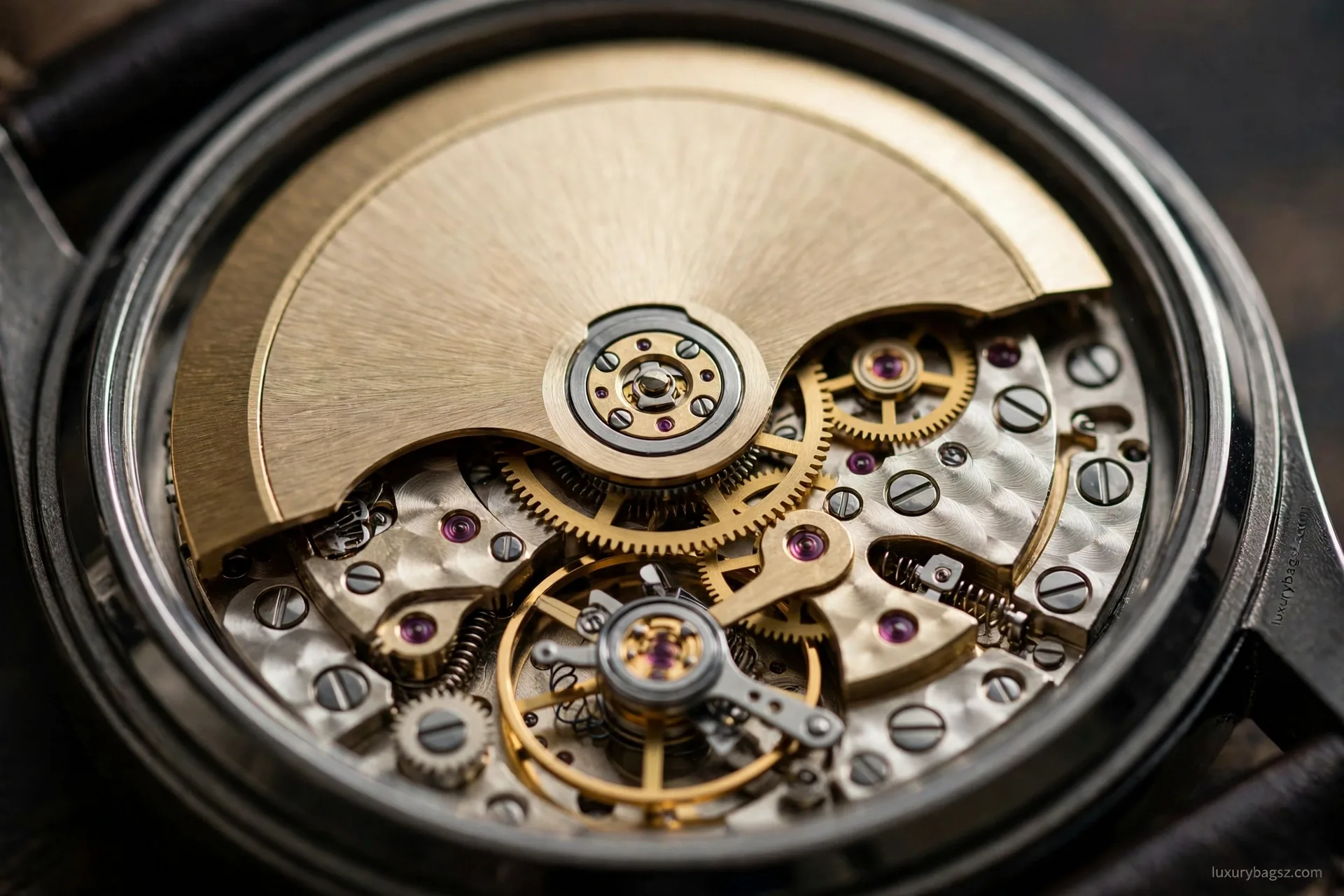
The calibre check is Datejust-specific because the calibre changed with the reference generations. Calibre 3035, with quickset date, appears on many five-digit references; calibre 3135 succeeds it on later five-digit and early six-digit references; calibre 3235, with a longer power reserve and improved efficiency, appears on current six-digit references. Other calibres appear on specific variants, such as calibre 2236 on some 31 mm models.
The movement in the watch must be the calibre specified for its reference and era, and a mismatch is a hard fail.
When the case is opened by a qualified watchmaker, a genuine Rolex calibre shows clean, precise finishing, correctly marked bridges, and the calibre designation and Rolex markings as specified. Rough finishing, generic unmarked parts, glue, or a movement that is visibly a decorated generic calibre are hard evidence of fakery.
The date mechanism deserves particular attention on a Datejust: the quickset function should operate correctly for its calibre generation, and the date should change crisply at midnight, as noted above.
Also check the movement's behaviour over a full day if you have the opportunity. A genuine Datejust runs steadily, with the date changing once per day at midnight and the timekeeping within the expected range for its calibre and service state.
A watch that gains or loses erratically, whose date changes twice or not at all, or whose quickset fails, has a movement problem that, on an unknown watch, should be treated as a fakery warning until a watchmaker proves otherwise.
Rehaut, Serial, and Case Markings on Modern Datejust Models
Modern Datejust models, from the mid-2000s onward depending on reference, carry the Rolex coronet and serial number engraved on the rehaut, the inner ring between the dial and the crystal, visible at 6 o'clock. On a genuine modern Datejust, this engraving is crisp, evenly deep, and correctly aligned, with the serial number matching the case and papers.
Fakes often show shallow, uneven, or misaligned rehaut engraving, or a serial that does not match the case markings.
The presence or absence of rehaut engraving must suit the production date. A Datejust from before the rehaut-engraving era should not carry it, and a modern Datejust that lacks it, or carries it in a crude form, is suspect. Similarly, the serial number format and its location, whether on the case between the lugs, on the rehaut, or on the papers, must suit the era.
A serial format from the wrong era is a warning that the case, or at least its markings, does not belong to the claimed watch.
Check the markings between the lugs as well, where reference and serial numbers are traditionally engraved. Genuine engraving there is sharp and correctly formatted; shallow, uneven, or oddly spaced engraving in this hidden area is a warning, because counterfeiters focus on visible surfaces. Photograph both the rehaut and the lug markings in raking light and compare them against verified examples of the same reference and era.
Crystal, Lume, and Dial Age Consistency
The Datejust crystal is sapphire on modern references, with the cyclops lens as described above. Check that the crystal is clear, hard, and correctly seated, with the cyclops aligned centrally over the date window and bonded cleanly, with no glue visible around its edge and no distortion. A cyclops that sits off-centre, shows glue, or distorts the date unevenly is a warning, even if its magnification seems approximately right.
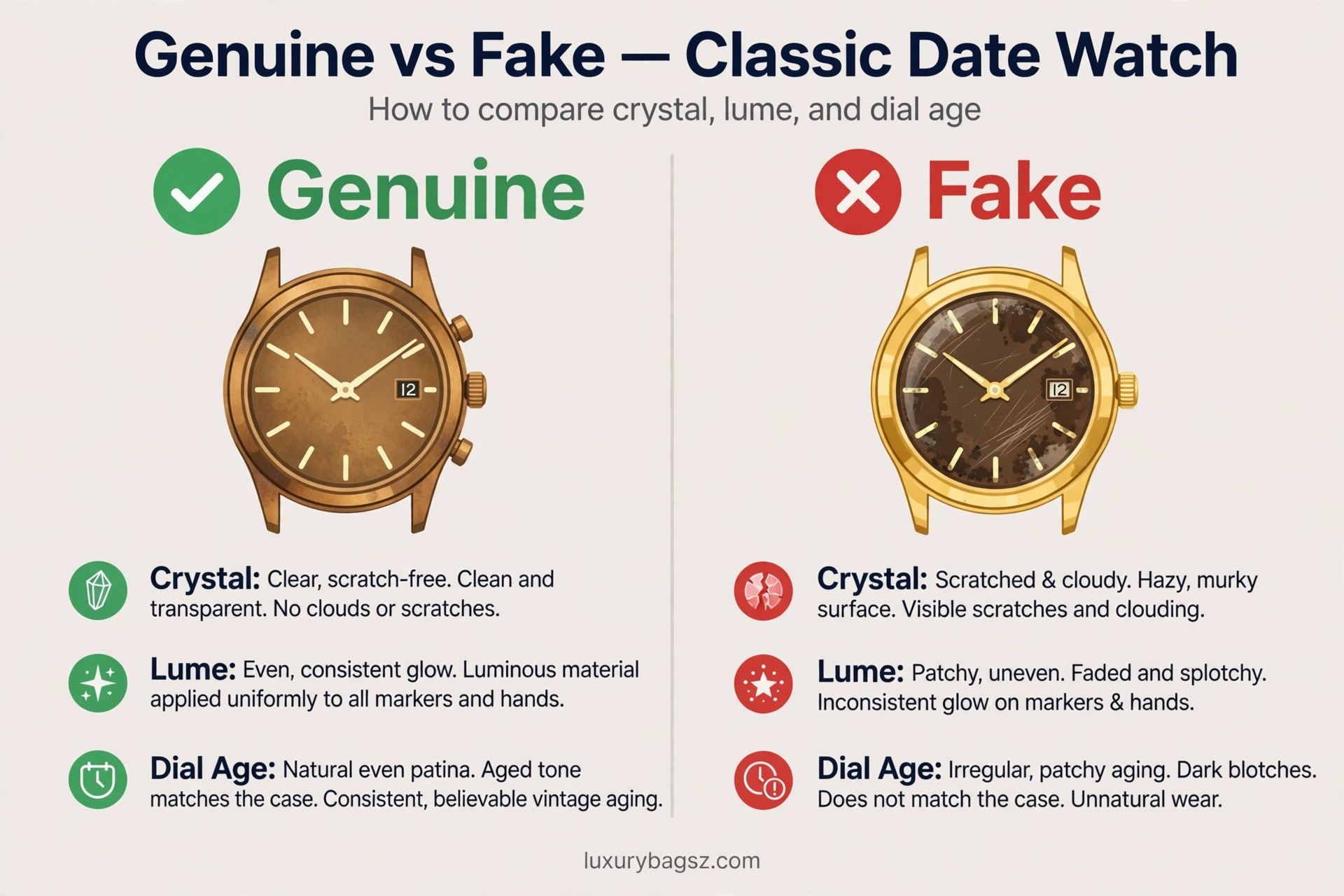
Lume and dial ageing must be consistent. On modern Datejust models with Chromalight or Super-LumiNova, the lume should be evenly applied and consistent in colour between hands and markers, glowing uniformly. On vintage models with tritium dials, patina should be consistent across hands and markers, and the dial should show era-appropriate ageing.
Hands that look freshly lumed on a patinated vintage dial, or a dial that looks freshly printed on a worn case, suggest replacement or fakery, and must be disclosed and investigated.
Also check the dial's overall condition against the watch's stated history. A watch sold as unworn should have a flawless dial, crystal, bezel, and bracelet; a watch sold as worn should show honest, even wear, not a mixture of pristine and heavily worn parts that suggests assembly from mixed sources.
Inconsistent wear across parts is a classic sign of a watch assembled from genuine and fake components, sometimes called a Frankenwatch, and it should end the deal unless a specialist verifies every part.
Box, Papers, and Provenance for a Datejust
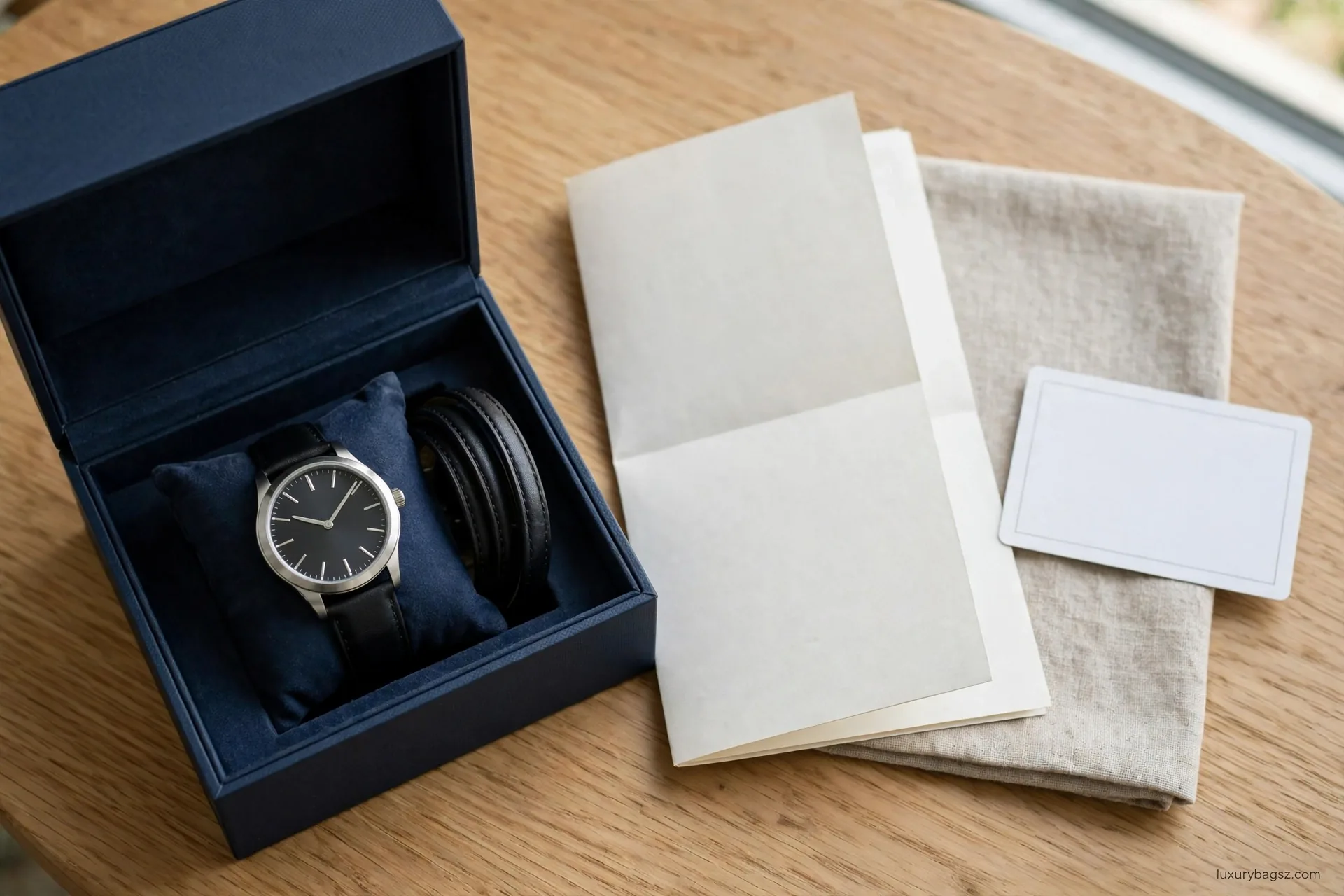
Datejust boxes and papers should suit the watch's era and reference. Modern Rolex presentation boxes are well made and correctly branded, and the guarantee card should show the reference, serial number, and purchase details matching the watch exactly. A box style from a different era, a guarantee card whose serial differs from the case, or printing that is fuzzy or inconsistent are warnings.
As with every model, box and papers support but never prove genuineness: fake boxes and papers are common, and genuine watches frequently lose theirs.
Provenance for a Datejust means a verifiable dealer history, service records, or a reputable marketplace trail. Because the Datejust is so common, a plausible story is easy to invent and hard to verify, so insist on documentation rather than narrative. Where servicing has occurred, ask for records and check that replaced parts are disclosed.
A serviced Datejust with a replaced crystal or bracelet is normal maintenance; a Datejust with an undisclosed replacement dial, bezel, or movement is a different matter.
Superclone Traps Specific to the Datejust
High-grade fake Datejust watches are among the best superclones in existence, because the model's popularity justifies the counterfeiter's investment. They copy the fluted bezel, the Jubilee bracelet, and the cyclops reasonably well, and they photograph convincingly. The traps that let them through are Datejust-specific. First, judging the watch by its fluted bezel alone, while ignoring the calibre and date mechanism.
Second, accepting a cyclops that looks approximately right without measuring its magnification and alignment. Third, accepting a dial colour or marker style that was never offered on that reference, because it looks attractive. Fourth, trusting papers without checking the serial match and era style.
The defence is the model-specific checklist in this guide, applied in order: reference, cyclops, dial variant, Jubilee or Oyster bracelet, fluted or smooth bezel, case, calibre, rehaut and serial, crystal and ageing, papers, and then an independent inspection. A seller who welcomes that procedure, provides additional photographs, and agrees to an inspection window is behaving like a seller of a genuine Datejust.
A seller who resists it is providing behavioural evidence that should weigh as heavily as any physical tell.
Buying Safely: Inspection, Escrow, and Recourse
Before paying in full for a pre-owned Datejust, secure a written return period that allows an independent inspection, including opening the case where appropriate, and agree in writing what happens if the watch is judged fake or not as described.
Take the watch to a reputable watchmaker or Rolex specialist, ask them to check the calibre, the date mechanism, the bezel and bracelet construction, and the rehaut and serial markings, and get their opinion in writing. If the seller refuses an inspection window, walk away.
Use payment methods with recourse and avoid irreversible transfers to unknown sellers. Escrow through a reputable marketplace can help, but check what it covers: some services verify only that the watch matches its listing photographs, not that it is genuine in the full sense of this guide. Keep complete records of the listing, the seller's description, correspondence, photographs of the watch and serial number, papers, and the inspection report.
A genuine Datejust is a classic for life; the days spent verifying it are a small price for decades of confidence.
The same inspection-first approach works for other luxury sports watches, and the Audemars Piguet Royal Oak history and sizes guide is a useful companion if you are comparing sports-watch purchases, just as the Cartier Love bracelet fake guide is for jewellery purchases.
Jubilee Stretch, Servicing, and Restoration Realities
Jubilee bracelet stretch is the Datejust ownership issue that buyers most often overlook, and it deserves its own discussion because it affects both value and authentication. Over years of daily wear, Jubilee bracelets develop stretch: the links wear at their pins and joints, the bracelet lengthens slightly, and it drapes more loosely than when new.
Light stretch is normal on a worn Datejust and is priced into pre-owned values; heavy stretch, where the bracelet sags, rattles excessively, or shows visible gaps between links when held horizontally, indicates advanced wear and may need bracelet rebuilding or replacement, both of which are costly.
When buying, hold the bracelet horizontally and look for sag, flex it gently to feel for looseness, and compare its drape against a newer example of the same bracelet. A bracelet with heavy stretch is not fake, but it is a value and maintenance issue that must be priced accordingly.
Servicing follows the same logic as other Rolex models, with Datejust-specific notes. Rolex recommends servicing at intervals measured in years, and a Datejust with a documented service history is easier to trust, because service involves movement inspection, gasket replacement, and water-resistance testing.
When buying pre-owned, ask for service records and check whether the bracelet, clasp, and crown were addressed, and budget for a service if the history is unknown. Water resistance, in particular, should never be assumed on a pre-owned Datejust without a recent pressure test, because gaskets age and crowns wear, and a watch that was water-resistant when new may no longer be so.
Restoration realities complete the picture. A Datejust with a refinished case, a replaced dial, or a replaced bezel or bracelet may look attractive, but collectors value originality, and undisclosed restoration reduces trust and price. Legitimate maintenance, such as replacing a worn crystal, a tired bracelet, or a damaged crown with correct parts, is normal when disclosed.
Restoration that changes appearance, such as heavy polishing that softens fluting, re-dialling, or fitting a dial variant never offered on that reference, is a different matter. Before buying a restored Datejust, or authorising restoration on one you own, ask a specialist what the work does to originality and value, not just to appearance, because a shinier Datejust is not always a more valuable one.
Dial Variations Through the Decades: Pie-Pan, Linen, and Beyond
Datejust dials tell the model's history, and learning their variations helps you spot both fakes and mismatched assemblies. Early Datejust dials include pie-pan designs, where the dial's outer edge slopes downward like a pie dish, creating depth and a distinctive play of light.
Pie-pan dials are specific to early references and eras, and a pie-pan dial on a reference that never offered one, or a pie-pan dial whose slope is uneven or whose printing does not suit its era, is a mismatch tell. Genuine pie-pan dials show crisp printing that follows the dial's contours, with markers and text correctly placed for the reference, and their ageing, including patina and luminous changes, should be consistent with their age.
Later decades brought linen dials, with a woven texture, tapestry dials, with a fine crosshatch pattern, and a wide range of coloured, lacquered, and stone dials, each specific to certain references and eras. Linen and tapestry textures should be even and fine, not coarse or irregular, and their printing should sit cleanly on the texture without smudging or gaps.
Coloured dials, from champagne and silver to blue, black, and more unusual colours, should match the reference's offered palette: a colour never offered on that reference is a fake tell, however attractive it looks, and a colour that was offered only in a later era on an earlier watch is an era mismatch.
Marker evolution matters too. Datejust markers moved through applied baton, Roman, Arabic, diamond, and other styles, with luminous material changing from radium to tritium to modern luminous compounds over the decades. A dial whose markers, luminous material, and printing belong to different eras, for example tritium-style patina on a dial whose printing suits a modern reference, is a mixed or fake dial.
When judging a vintage Datejust dial, compare it against other dials from the same reference and era, look for consistency across markers, printing, and luminous ageing, and let a specialist judge any dial whose variation you cannot verify.
Dial knowledge is slow to build, but it is one of the most reliable Datejust skills, because counterfeiters copy popular dials well and unusual dials badly, and because a dial that matches its reference and era exactly is strong evidence for the whole watch.

Frequently Asked Questions
Does this guide replace the general fake Rolex guide?
No. This guide covers Datejust-specific checks only, as stated at the start. Use it together with the general fake Rolex guide, which covers Rolex-wide principles, and let this guide decide the Datejust-specific questions.
What is the most reliable Datejust-specific tell?
The combination of cyclops magnification and alignment with the calibre and date mechanism for the reference. A fake often gets one of those right and the other wrong; a genuine Datejust gets both right together.
Should a Datejust cyclops magnify exactly 2.5 times?
Approximately 2.5 times, with the date filling its window cleanly. Small measurement variation is normal, but a date that looks small in its window, or that is distorted or off-centre, fails the test.
Are all genuine Datejust bezels fluted?
No. Many Datejust references have smooth steel bezels, and some have other bezel styles. Judge the bezel against the specific reference: fluted where fluted is specified, smooth where smooth is specified.
Is a Jubilee bracelet required on a genuine Datejust?
No. Datejust models were offered on both Jubilee and Oyster bracelets, depending on reference. Judge the bracelet against the reference, and check its construction and clasp code for its era.
Can a Datejust dial colour prove a watch is fake?
Yes, when the colour or marker style was never offered on that reference. An attractive but never-offered dial is a fake tell, however good its quality looks in isolation.
Do modern Datejust models always have rehaut engraving?
Modern Datejust models from the rehaut-engraving era onward do, and the engraving must be crisp and match the case serial. Earlier models do not, and rehaut engraving on a pre-era watch is itself a warning.
How do I know which calibre my Datejust reference should have?
From the reference and era: broadly, calibre 3035 on many five-digit references, 3135 on later five-digit and early six-digit references, and 3235 on current six-digit references, with variants by model. Confirm against reputable dealer listings for the exact reference.
Is a Datejust with a replaced crystal still worth buying?
Yes, if the replacement is correct, disclosed, and magnifies and aligns properly. A replaced crystal that fails the cyclops test is a poor replacement and should be investigated further.
Should I avoid Datejust watches without box and papers?
Not necessarily. Many genuine Datejust watches, especially vintage ones, have lost their boxes and papers. Missing papers lower the price and raise the need for inspection, but they do not prove fakery.
Summary
A genuine Rolex Datejust proves itself in its model-specific details: a fluted bezel that is sharp and evenly cut in the right metal, a Jubilee bracelet that articulates like a well-made chain, a cyclops that magnifies the date cleanly and centrally, a dial variant that was actually offered on that reference, and a calibre and date mechanism that belong to its era.
Those details, checked in order and confirmed by an independent inspection, separate the classic from the copy. Buy on that evidence, with a return window, and the Datejust you bring home will be what it has been since 1945: the definitive everyday Rolex.