

Cartier Santos Buyer’s Guide: History, Sizes, Prices and Pre-Owned Checks
The Santos in Brief
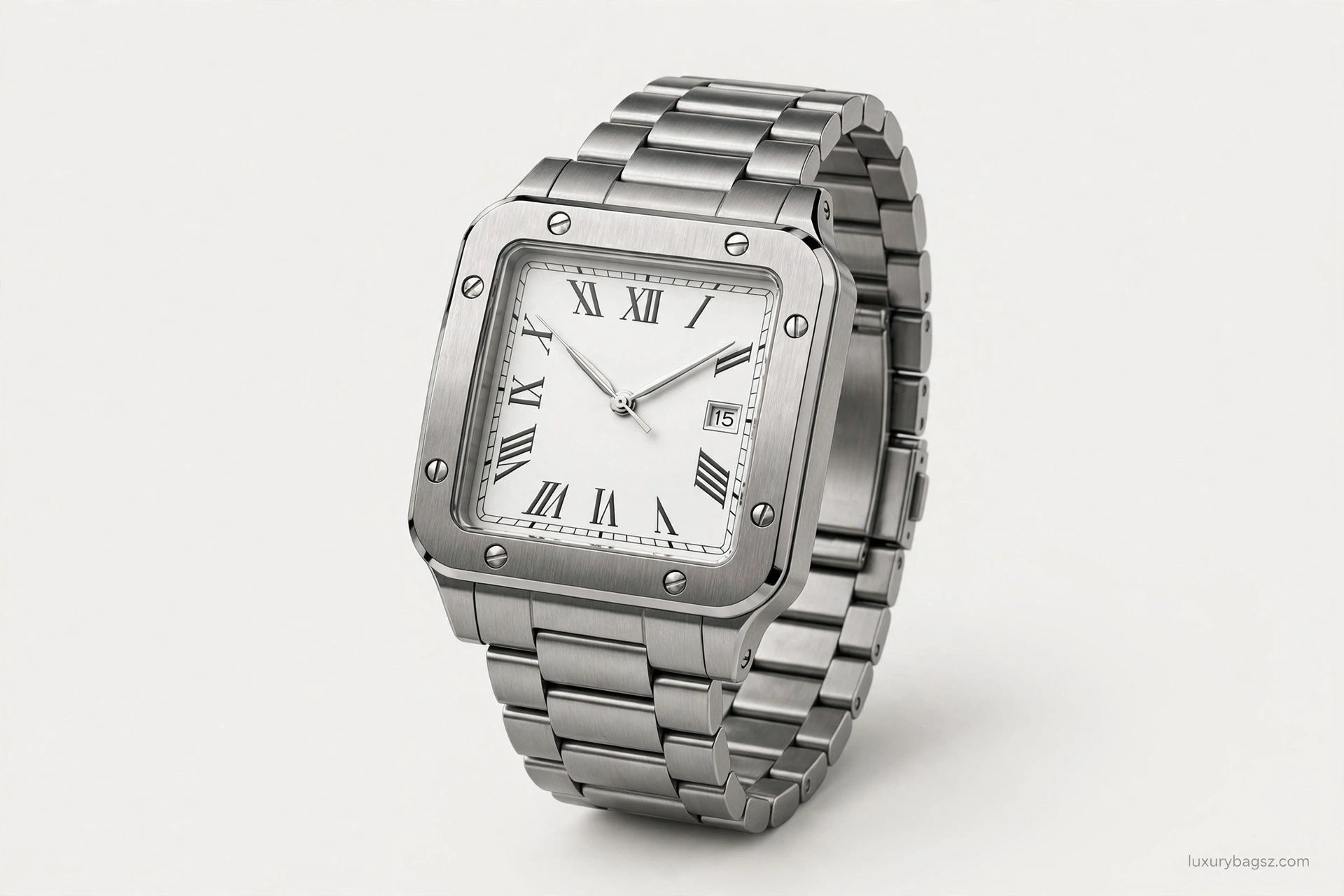
The Santos is the watch that invented the men's wristwatch. In 1904, Louis Cartier built a square wristwatch for his friend, Brazilian aviator Alberto Santos-Dumont, who could not read a pocket watch while flying. It was one of the first wristwatches made for a man, and its square case, exposed screws, and Roman numerals are still recognisable more than a century later.
The single most important choice is between the two modern families. The Santos de Cartier is the sports watch, on a steel bracelet, water resistant to 100 metres, with an automatic movement. The Santos-Dumont is the dress watch, thinner, on a leather strap, with a manual-wind movement. Same design language, very different watches.
On the secondary market, expect roughly 80 to 85 percent of retail for a modern Santos in excellent condition, according to Luxury Watches USA. New steel models start at around $4,200 to $5,800 depending on the source, while gold and skeleton models climb past $30,000 and, in rose gold skeleton form, past $60,000.
Key Takeaways
- Louis Cartier created the Santos in 1904 for aviator Alberto Santos-Dumont, and commercial production began in 1911, initially in platinum and yellow gold with leather straps.
- The modern Santos de Cartier comes in Medium at 35.1 by 41.9 mm and Large at 39.8 by 47.5 mm, both water resistant to 100 metres, with square cases that wear larger than their width suggests.
- The Santos de Cartier runs Cartier's automatic calibre 1847 MC with a 42-hour power reserve, while the Santos-Dumont runs the manual-wind calibre 430 MC.
- The 2018 relaunch added two practical systems: QuickSwitch for changing straps without tools, and SmartLink for adjusting the bracelet without tools.
- Key chapters: the late-1970s Santos de Cartier sports watch, the curved Galbée of 1987, the Santos 100 of 2004, and the 2018 relaunch with thirteen new pieces.
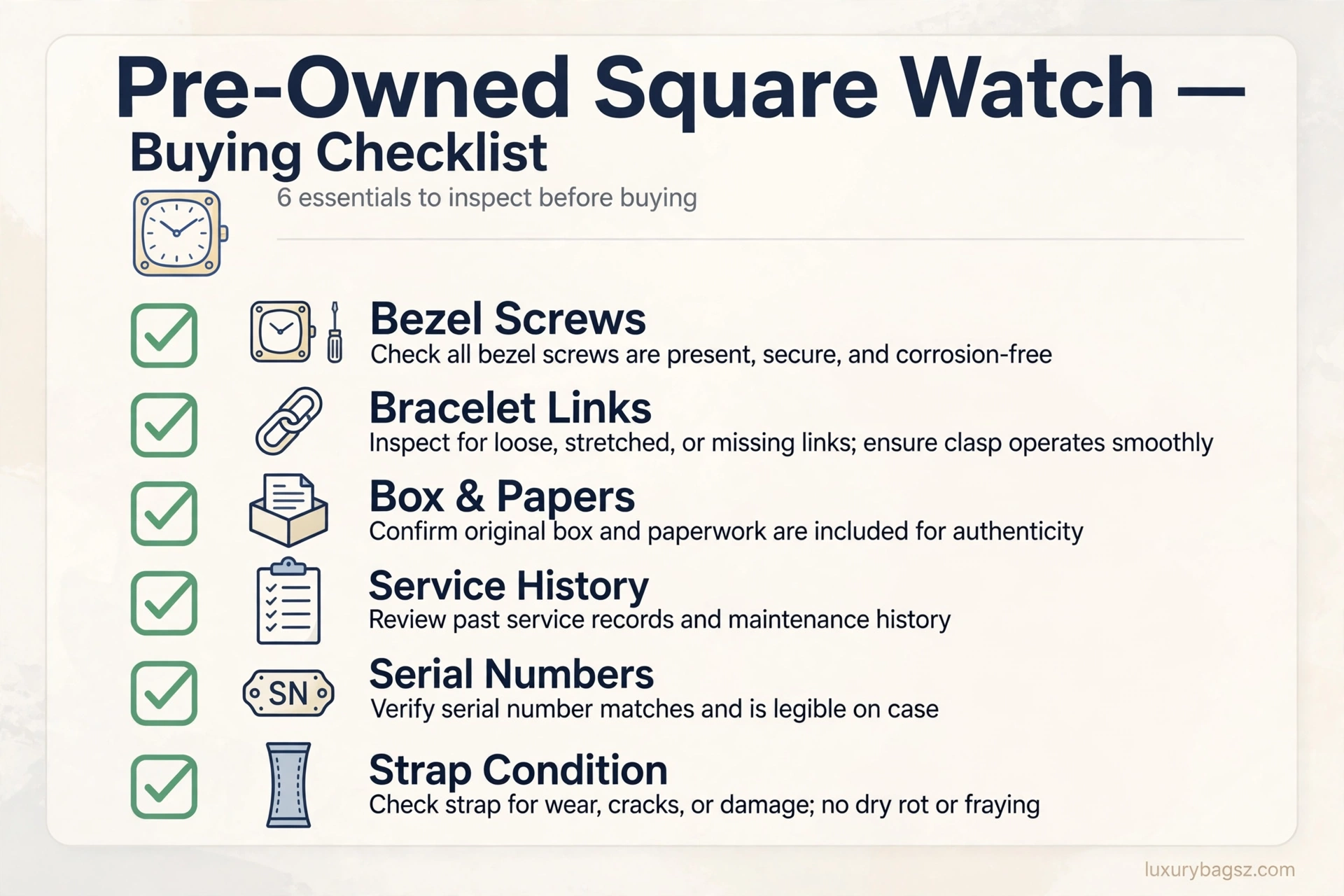
- Pre-owned checks that matter most: bezel screws, bracelet links, box and papers, service history, serial numbers, and strap condition on Santos-Dumont models.
A Pilot's Complaint That Changed Watchmaking
In 1904, wristwatches were not men's watches. Men carried pocket watches, and wristwatches were a niche, mostly worn by women. That convention broke because one man had a practical problem: Brazilian aviation pioneer Alberto Santos-Dumont could not check a pocket watch while flying without taking his hands off the controls.
Santos-Dumont voiced his dissatisfaction to his friend, jeweller Louis Cartier, according to Rebag. Cartier's answer was a wristwatch with a square bezel, built to be read at a glance while flying. It was a practical solution to a practical problem, not a fashion statement, and that is why it worked.
Santos-Dumont himself wore a Cartier timepiece during his groundbreaking airplane flight in 1906, according to Rebag. The watch's aviation origin is not marketing legend. It is documented, and it is the reason the Santos carries an aviator's name rather than a jeweller's.
The Santos matters beyond Cartier because it proved the wristwatch could be a man's tool. Within a decade, soldiers, pilots, and drivers were all wearing wristwatches, and the pocket watch's dominance was over. The Santos did not just launch a collection. It helped launch a category.
1904 to 1911: From One Watch to a Collection
The first Santos was made for one man, not for sale. Louis Cartier built it for Santos-Dumont in 1904, and it stayed a personal piece until demand turned it into a product. Commercial production began in 1911, initially in platinum and yellow gold with leather straps, according to Luxury Watches USA.
That seven-year gap matters, because it explains why the Santos feels like a design rather than a product line. It was drawn for a purpose, worn by its intended user, and only then offered to the public. The square case, the exposed screws, and the Roman numerals were all present from the start, and they have barely changed since.
The dial design embraced the Art Deco era, which reigned through the 1920s and 1930s, according to Rebag. The Santos's geometry, with its clean lines and architectural proportions, fit that era perfectly, and it is why a 1904 design still looks current. Art Deco never really left, and neither did the Santos.
Early Santos watches were dress watches, not sports watches. They were slim, on leather straps, and built for elegance rather than toughness. The sports character that defines the modern Santos de Cartier came much later, in the late 1970s, and that transformation is covered in the next parts.
The Timeline: 1904 to Today
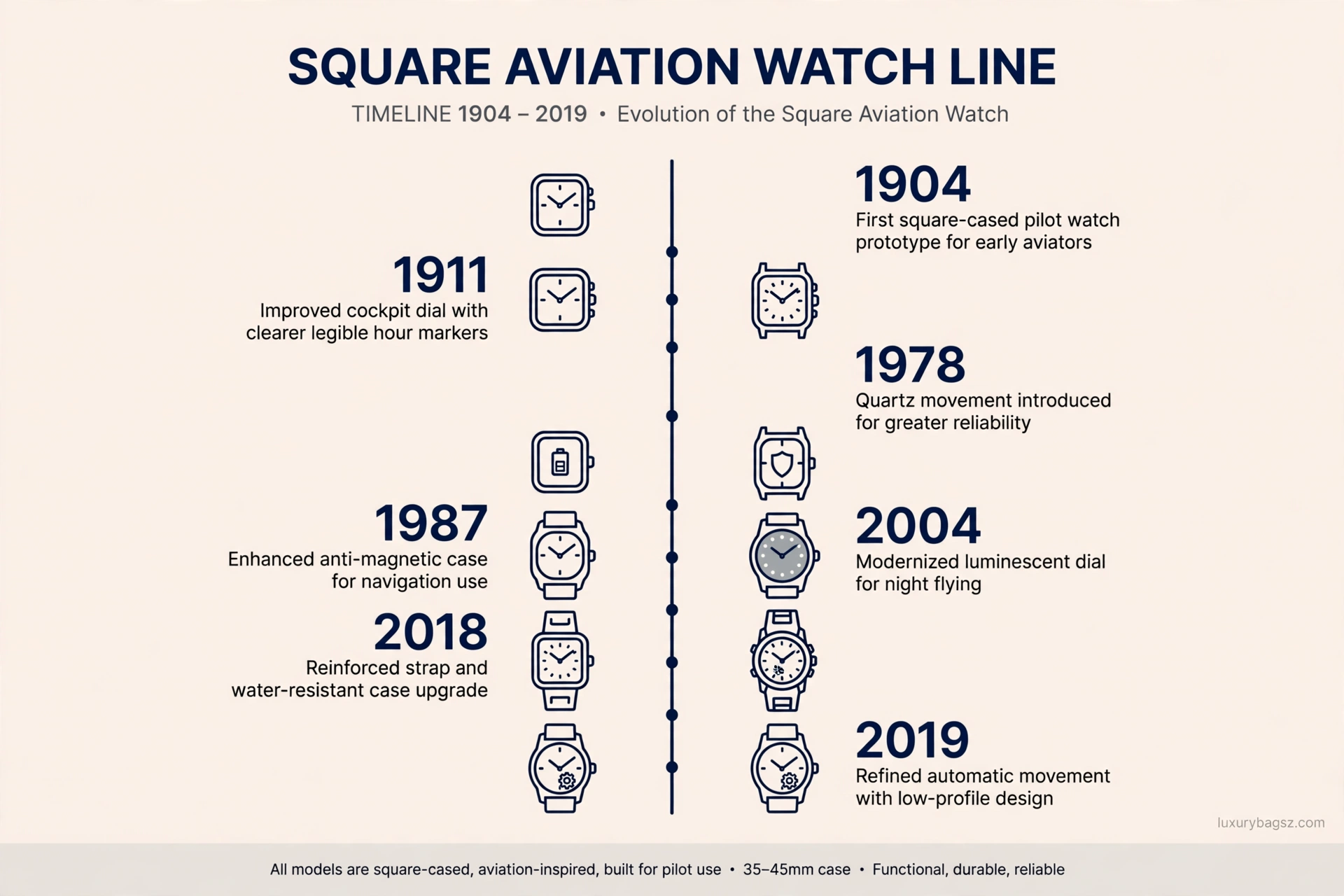
The Santos's history divides into clear chapters, and knowing them helps you date any reference you meet. The table below follows Rebag's history and the rival guides read for this article.
| Year | Milestone |
|---|---|
| 1904 | Louis Cartier creates a square wristwatch for aviator Alberto Santos-Dumont |
| 1906 | Santos-Dumont wears a Cartier timepiece during his groundbreaking flight |
| 1911 | Commercial production begins, in platinum and yellow gold, on leather straps |
| Late 1970s | Santos de Cartier launches as an accessible steel sports watch with a bracelet |
| 1980s | Bimetal gold-and-steel Santos becomes hugely popular, followed by all-steel versions |
| 1987 | Santos Galbée arrives with a curved, ergonomic case |
| 2004 | Santos 100 collection modernises the line for its centenary |
| 2018 | Santos de Cartier relaunches with thirteen pieces, two sizes, and SmartLink |
| 2019 | Santos Chronograph and a quartz Santos-Dumont join the line |
The late-1970s chapter deserves emphasis, because it reinvented the Santos. Cartier introduced the Santos de Cartier as a sports watch for a younger audience, with a stainless steel case and an integrated bracelet, according to Rebag. The bimetal version, fusing gold and steel, became hugely popular through the 1980s, and an all-steel version followed.
The 2018 relaunch is the other chapter that matters for current buyers, because it defines every modern reference. Cartier unveiled thirteen timepieces in two sizes at the Salon International de la Haute Horlogerie in Geneva, according to Rebag, including a steel-and-rose-gold skeleton version. The relaunch kept the design and added modern practicality, which is the right way to update an icon.
The Design: Square Case, Screws, and Roman Numerals
The Santos's design has four elements, and all four have survived since 1904. The square case with rounded corners gives the watch its architectural character. The exposed screws on the bezel, eight of them, give it its industrial edge. The Roman numerals give it its Cartier identity. The sword-shaped blued steel hands give it its legibility.
Louis Cartier drew the square case geometry from Parisian architectural proportions, according to Luxury Watches USA, and the octagonal profile with exposed bezel screws became one of watchmaking's most distinctive signatures. The screws are not decoration. They hold the bezel, and they are the detail fakes get wrong most often.
The Roman numerals carry a hidden detail collectors love: the Cartier signature is hidden inside the VII numeral on some models, including the Galbée, according to a long-term Galbée owner's account. It is a small, quiet signature, and it is the kind of detail that separates a Cartier from a square watch that merely resembles one.
The cabochon crown, a small polished stone set into the winding crown, completes the design. It is a jewellery detail on a sports watch, and it captures the Santos's dual nature: a tool born in aviation, finished by a jeweller. That duality is why the Santos suits both a suit and a weekend, and why it has outlasted most of its contemporaries.
Sizes: Medium, Large, and How a Square Case Wears
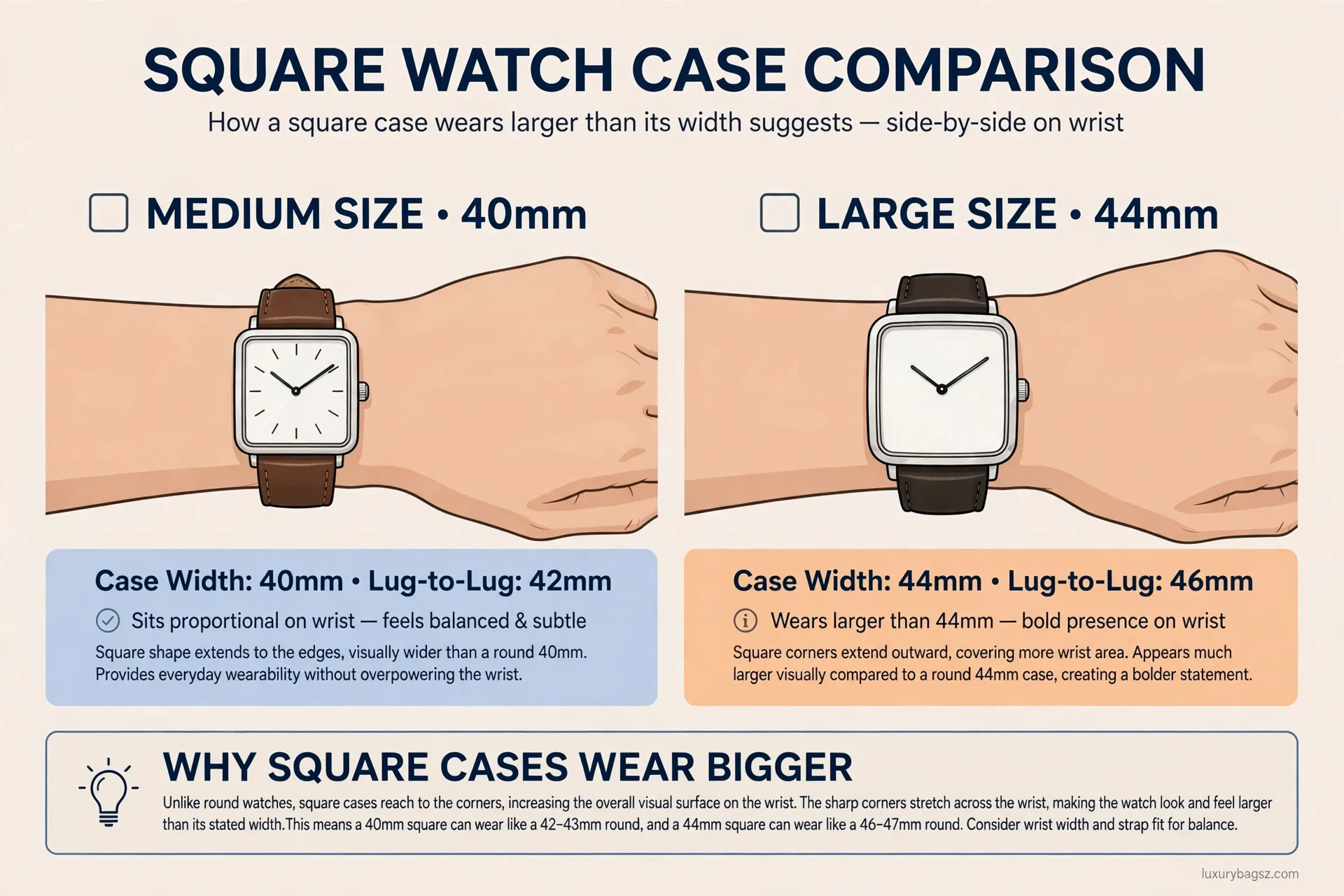
Square watches wear larger than round watches of the same width, and the Santos is the classic example. A square case fills the wrist differently, with corners that extend the visual footprint, so the Santos's millimetre numbers understate its presence. Try one on before judging by the measurements.
The modern Santos de Cartier comes in Medium at 35.1 by 41.9 mm and 8.83 mm thick, and Large at 39.8 by 47.5 mm and 9.08 mm thick, according to Luxury Watches USA. Both wear larger than the numbers suggest because of the square profile, and the Large in particular is a substantial watch.
Size naming varies by source, which is worth flagging. One rival guide lists a Small Santos at 29.9 mm, while another lists Small at 35.1 mm, and the Small is generally a quartz model while Medium and Large are automatic. Confirm the reference number before buying, because the name alone does not settle the size.
For wrist guidance, this guide gives reasoned advice, flagged as such, rather than a sourced table that does not exist. Under about 16.5 cm wrist circumference, try the Medium first. Between about 16.5 and 18.5 cm, both sizes work, with the Medium reading dressier and the Large reading sportier. Above about 18.5 cm, the Large wears most naturally.
The Santos-Dumont sizes differently, because it is a dress watch. Its Large, ref. WSSA0085, is 43.5 by 31.4 mm and only 7.3 mm thick, according to Swiss Connection Watches. It wears long and flat, which is the point: it slides under a cuff where the Santos de Cartier cannot.
The Late-1970s Santos de Cartier and the Galbée
The late 1970s transformed the Santos from a dress watch into a sports watch. Cartier introduced the Santos de Cartier as an accessible sports watch for a younger audience, with a stainless steel case and an integrated bracelet, according to Rebag. It was a deliberate break from the gold dress watches of the past.
The bimetal version, fusing gold and steel, became hugely popular through the 1980s, according to Rebag, and an all-steel version followed. That bimetal formula, gold screws and bezel details on a steel case and bracelet, became the Santos's signature look for a decade, and it is still the most recognisable vintage Santos configuration.
In 1987, the Santos emerged anew as the Santos Galbée, with a curved and ergonomic case, according to Rebag. The Galbée's curved case hugged the wrist in a way the flat Santos never had, and its integrated bracelet with a concealed butterfly clasp made it one of the most comfortable watches of its era.
A long-term Galbée owner's account gives useful specifics for the two-tone Galbée XL, ref. 2823: a 32 mm case with a 45 mm lug-to-lug, 8.8 mm thick, on a calibre 049 movement with a 42-hour reserve, and 30 metres of water resistance. The owner notes that the 32 mm case wears closer to 36 or 37 mm because of its lug-to-lug length, which confirms the square-case sizing warning in the previous part.
Vintage Galbée models are now a popular entry into Santos collecting, because they offer the classic design at lower prices than modern pieces. Check the bracelet carefully, because integrated bracelets are expensive to replace, and check the crown, which owners describe as a tricky octagonal shape that needs care.
Santos 100 and the 2004 Modernisation
The year 2004 brought the Santos 100 collection, a modernisation for the line's centenary, according to Rebag. The Santos 100 was larger, bolder, and more contemporary than the Galbée, with a bigger case and a more pronounced presence. It marked the Santos's shift from a discreet dress watch toward a modern sports watch.
The Santos 100 matters for buyers because it is the bridge between vintage and modern Santos. It introduced larger sizes and a more robust build, while keeping the square case, screws, and Roman numerals. Pre-owned Santos 100 models are now affordable, and they offer the modern Santos look at vintage prices.
Cartier continued to produce the Santos-Dumont in yellow gold through this period, catering to buyers who wanted the original dress watch, according to Rebag. The Collection Privée Cartier Paris also produced new renditions within the Santos-Dumont lineage, for collectors who wanted limited, historically minded versions.
The lesson of the Santos 100 era is that the Santos can grow without losing itself. Every Santos generation has been larger, tougher, or more practical than the last, and each one kept the square case and screws. That continuity is why a 2004 Santos 100 still reads as a Santos, not as a period piece.
Santos de Cartier Versus Santos-Dumont
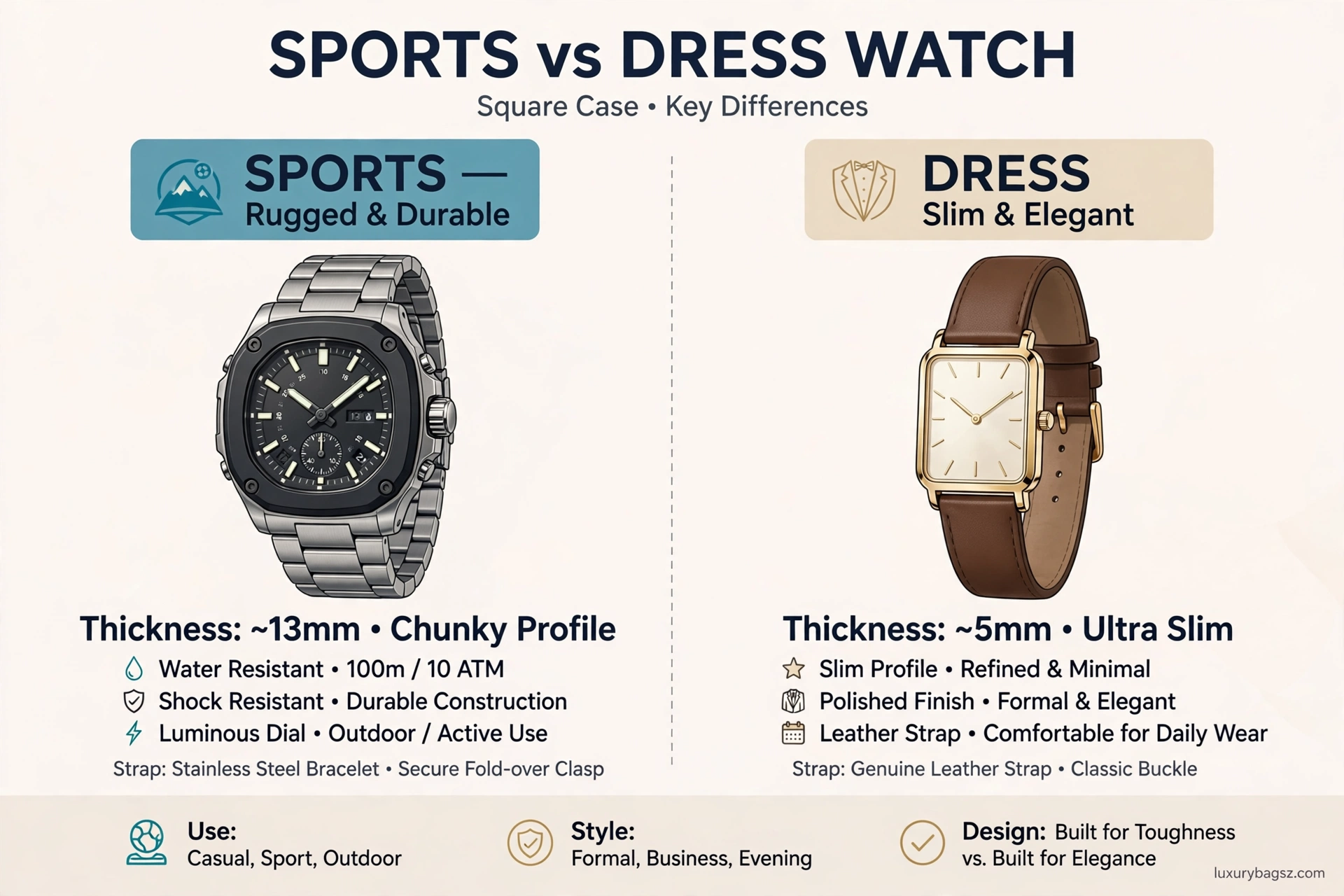
The modern Santos line has two families, and confusing them is the most common buyer mistake. The Santos de Cartier is the sports watch, on a steel bracelet, water resistant to 100 metres, with an automatic movement. The Santos-Dumont is the dress watch, thinner, on a leather strap, with a manual-wind movement.
The Santos de Cartier suits everyday wear. Its bracelet, water resistance, and automatic movement mean it needs no attention beyond wearing it, and its 100-metre rating covers swimming and daily life. It is the Santos for buyers who want one watch for everything.
The Santos-Dumont suits formal wear. Its Large model is only 7.3 mm thick, according to Swiss Connection Watches, so it slides under a cuff where the Santos de Cartier cannot. Its manual-wind movement needs daily winding, and its leather strap needs more care than a bracelet, but its thinness and elegance repay that attention.
Within the Santos family, the Santos-Dumont occupies the slimmest and most formal position, according to Swiss Connection Watches, while the Santos de Cartier runs an automatic and suits everyday sports-dress wear. That summary is the whole decision in one sentence: everyday sports-dress wear means Santos de Cartier, formal thinness means Santos-Dumont.
Movements: Calibre 1847 MC and Calibre 430 MC
Modern Santos de Cartier models run Cartier's in-house calibre 1847 MC, an automatic movement with a 42-hour power reserve, running at 28,800 vibrations per hour, with nickel phosphorus components and anti-magnetic properties, according to Luxury Watches USA. It is a reliable, modern automatic, built for daily wear rather than for display.
That last point is the movement's honest weakness. The Santos has a solid caseback, which hides the movement from view, and reviewers describe the 1847 MC as respectable on paper but underwhelming for enthusiasts who care about finishing and artistry. One full review calls the Santos almost perfect, with the movement as its one reservation.
That criticism needs context. The 1847 MC replaced the ETA calibres used in earlier Santos generations, and it is a genuine in-house Cartier movement, not a bought-in calibre. It keeps time well, resists magnetism, and needs no more attention than any modern automatic. Its shortcoming is character, not reliability.
The Santos-Dumont runs the manual-wind calibre 430 MC, and sources disagree on its power reserve, giving 38 hours in one place and 43 hours in another. This guide reports both figures, because a buyer comparing pages will meet both, and the difference likely reflects different measurement points. Either way, it needs daily winding, which is part of the dress watch ritual.
Skeleton Santos models run different movements entirely, including calibre 9611 MC and 9624 MC, according to Luxury Watches USA. Those movements are made to be seen, with openworked dials that show the mechanism, and they sit at the top of the Santos price range for exactly that reason.
For the same reason, our guide to how to clean a watch is worth reading before you handle any Santos, because its polished surfaces and exposed screws show marks more readily than a brushed sports watch. Clean it gently, and leave movement work to a professional.

Bracelet Systems: SmartLink and QuickSwitch
The 2018 relaunch added two systems that changed how the Santos is worn, and both are genuinely useful. SmartLink adjusts the bracelet length without tools, by pressing a button on the link and sliding it. QuickSwitch changes the strap without tools, by pressing a button on the strap's underside and sliding it off.
SmartLink matters because bracelet fit changes through the day. Wrists swell in heat and shrink in cold, and a bracelet that fit in the morning can pinch by afternoon. SmartLink lets the wearer adjust by a few millimetres without a tool, a dealer, or a watchmaker, which is a small luxury that owners use constantly.
QuickSwitch matters because it makes the Santos two watches in one. A steel bracelet for weekdays, a leather strap for evenings, and a rubber strap for weekends, all changed in seconds. Cartier sells additional straps for exactly this purpose, and a Santos with two straps is a more versatile purchase than a Santos with one.
Both systems are also pre-owned checks. A SmartLink button that sticks, or a QuickSwitch mechanism that does not lock firmly, is a service job, and it should change the price. Test both systems on any pre-owned Santos, and check that the extra links and straps the seller promises are actually included.
One practical note: SmartLink and QuickSwitch arrived with the 2018 relaunch, so earlier Santos models do not have them. A pre-2018 Santos needs tools for bracelet adjustment and strap changes, which is normal for its era but worth knowing before you buy. Do not expect modern convenience from a vintage reference.
Prices and Value Retention in 2026
Santos pricing varies by source, so this part reports ranges with attribution rather than a single figure. Luxury Watches USA puts the steel entry point at around $4,200, while a rival buying guide puts new Santos watches from $5,800 for a quartz Medium model to over $30,000 for limited editions, with automatic steel Large models around $7,400. Bob's Watches puts entry-level Santos-Dumont steel at around $5,000.
At the top of the range, the figures climb steeply. Bob's Watches puts elaborate models, such as the Santos de Cartier Skeleton in rose gold, above $60,000. Luxury Watches USA lists a titanium Large at $11,790, a luminescent skeleton Large at $29,500, and a yellow gold skeleton Large at $67,000. Skeleton and gold models are a different market from steel time-and-date models, and they should not be compared directly.
Value retention is the Santos's quiet strength. Luxury Watches USA reports that contemporary Santos models trade at 80 to 85 percent of retail on the secondary market in excellent condition, a modest but predictable depreciation profile. That is not speculation-grade retention, but it is stable, and it beats most luxury watches that lose a third of their value on purchase.
Vintage Santos models behave differently. Luxury Watches USA reports 8 to 15 percent annual appreciation for vintage references, driven by collector demand for pre-QuickSwitch models and early production examples. Treat that figure as a market claim from one source, not a measured fact, because vintage prices vary enormously by condition and reference.

Retail Versus Secondary: Boutiques and the Pre-Owned Market
Buying a Santos at retail is straightforward, because Cartier sells through its own boutiques and authorised dealers without the waitlists that define Rolex sports watches. You pay the published price, you get a fresh manufacturer warranty, and you know the watch's full history from day one. For most buyers, retail is the simplest route.
The secondary market offers two advantages retail cannot: discontinued references and lower prices. Vintage Galbée models, Santos 100 models, and pre-2018 references are only available pre-owned, and modern steel models trade at 80 to 85 percent of retail in excellent condition, according to Luxury Watches USA. That discount is the cost of buying a watch someone else has worn.
One rule protects you on either path: buy the seller as much as the watch. A Santos from a reputable dealer with authentication, warranty, and a return policy is a different purchase from a Santos from an unknown seller with no paperwork. For a fuller method, read our guide to spotting a fake Cartier Tank watch, which shares the Cartier checking discipline.
For the same reason, our guide to pre-owned luxury condition grades is worth reading before you judge a listing. Condition grades decide more of a Santos's price than its reference name, and a seller's idea of excellent condition may differ from yours.
Buying Pre-Owned: Checks That Actually Matter
The Santos is a popular watch, and popular watches attract fakes and rebuilt examples. These checks catch most problems before money changes hands, and they focus on the details that define a genuine Santos.
Start with the bezel screws. They should be clean, evenly finished, and correctly aligned, with no chewed slots or mismatched screws. The screws are the Santos's signature, and they are the first detail a fake gets wrong. A watch with replaced or damaged screws has either been serviced carelessly or was never genuine.
Check the bracelet links and the clasp. Integrated bracelets are expensive to replace, so look for stretch, sag, and worn link screws. Test the SmartLink adjustment on 2018 and later models, and check that the extra links are included. A bracelet that cannot be sized to your wrist is a watch you cannot wear.
Confirm the serial and reference numbers against the paperwork. The reference tells you the size, material, and movement, and the serial number should match the warranty card. A mismatch anywhere deserves an explanation. For a fuller method, read our guide to spotting a fake Cartier Panthère watch, which covers Cartier authentication in detail.
Check the strap on Santos-Dumont models, because leather straps wear faster than bracelets. A worn strap is a minor cost, but a non-Cartier strap on a watch sold as complete is a sign the seller has cut corners. Ask for service history too, because a Santos that has not been serviced in a decade may run, but its seals and lubricants are past their best.
Servicing, Care, and the Cost of Keeping a Santos
Cartier recommends servicing roughly every five to eight years for modern automatic movements, though heavy use and harsh conditions shorten that interval. A full Cartier service restores the movement, replaces worn seals, and pressure-tests the case, which matters on a watch rated to 100 metres. Budget for it as part of ownership, not as an emergency.
Water resistance deserves a plain warning. The modern Santos de Cartier is rated to 100 metres, according to Luxury Watches USA and Mint Cover, but that rating applies to a new, sealed watch. Vintage Galbée models are rated to only 30 metres, and any pre-owned Santos that has not been pressure-tested should stay away from water until it has been.
Daily care is simple, and our guide to how to clean a watch covers cases, crystals, bracelets, and straps in detail. For a Santos, warm water, mild soap, and a soft cloth on the bracelet, with the crown pushed in, is enough for routine care. Polished surfaces show scratches readily, so avoid abrasive cloths and harsh cleaners.
Leather straps need their own attention. Keep them dry, rotate them with a second strap if you wear the watch daily, and replace them when the lining cracks or the stitching loosens. A strap is a consumable, not a lifetime part, and treating it as one keeps the watch looking right for years.
Five Mistakes First-Time Santos Buyers Make
The first mistake is confusing the two families. A Santos de Cartier and a Santos-Dumont share a design language but differ in thickness, movement, water resistance, and bracelet. Buying a Santos-Dumont for daily sports wear, or a Santos de Cartier for black-tie thinness, is buying the wrong watch for the job.
The second mistake is judging size by width alone. Square cases wear larger than round cases of the same width, and the Large Santos is a substantial watch. Try both sizes on, check how the case sits on your wrist, and judge by presence rather than the millimetre number.
The third mistake is ignoring the bracelet. Integrated Santos bracelets are expensive to replace, and a stretched bracelet or a faulty SmartLink mechanism is a significant cost. Test the bracelet, test the adjustment, and confirm the extra links are included before you pay.
The fourth mistake is paying skeleton money for a time-and-date watch, or vice versa. Skeleton Santos models run different movements and sit at far higher prices than steel time-and-date models. Check the reference number, confirm the movement, and make sure the price matches the watch in front of you.
The fifth mistake is skipping the service question. A Santos that has not been serviced in a decade may run, but its seals are tired and its lubricants are dry. Ask when it was last serviced, who serviced it, and whether the work is documented. An undocumented service by an unknown watchmaker is a discount, not a feature.
Avoid those five mistakes and the rest of the purchase gets simpler. The Santos is a well-documented watch with a clear reference system, and a buyer who checks the screws, the bracelet, the papers, and the service history is hard to fool.
Which Santos Should You Buy?
Buy the Santos de Cartier Large in steel if you want the definitive modern Santos, with an automatic movement, a steel bracelet, and 100 metres of water resistance. It is the most versatile Santos, the easiest to resell, and the one whose design needs no explanation. It suits wrists from medium upward, and it works as a daily wearer.
Buy the Santos de Cartier Medium if you want the same watch in a smaller, dressier size, or if your wrist finds the Large too present. The Medium shares the Large's movement, water resistance, and bracelet systems, in a case that suits more wrists and more formal rooms. It is the quieter choice, and often the smarter one.
Buy the Santos-Dumont Large if you want thinness above all else, and you accept manual winding and a leather strap. At 7.3 mm thick, it is one of the thinnest luxury watches at its price, and it slides under a cuff where no Santos de Cartier can. Buy a vintage Galbée if you want the classic design at a lower price, and you accept an older movement and a 30-metre rating.
Whatever you choose, decode the reference, check the screws, confirm the full set, and budget for servicing. A Santos in the right size, complete, and recently serviced is a watch for decades. A Santos bought on its square case alone, without those checks, is a gamble at prices where gambles are expensive.
Frequently Asked Questions
When was the Santos created?
In 1904, when Louis Cartier built a square wristwatch for his friend, Brazilian aviator Alberto Santos-Dumont, who could not read a pocket watch while flying. Commercial production began in 1911, initially in platinum and yellow gold with leather straps.
What is the difference between the Santos de Cartier and the Santos-Dumont?
The Santos de Cartier is the sports watch, on a steel bracelet, water resistant to 100 metres, with an automatic calibre 1847 MC movement. The Santos-Dumont is the dress watch, thinner, on a leather strap, with a manual-wind calibre 430 MC movement. Same design language, very different watches.
What sizes does the Santos come in?
The modern Santos de Cartier comes in Medium at 35.1 by 41.9 mm and Large at 39.8 by 47.5 mm, both water resistant to 100 metres. A Small quartz model also exists, but sources disagree on its exact width, so confirm the reference number before buying. Square cases wear larger than their width suggests.
What movement powers the Santos?
Modern Santos de Cartier models run Cartier's automatic calibre 1847 MC, with a 42-hour power reserve and a 28,800 vibration-per-hour rate. Santos-Dumont models run the manual-wind calibre 430 MC, with sources giving 38 to 43 hours of reserve. Skeleton models run calibre 9611 MC or 9624 MC.
How much does a Santos cost in 2026?
New steel models start at around $4,200 to $5,800 depending on the source, with automatic steel Large models around $7,400. Gold and skeleton models climb past $30,000, and a rose gold skeleton can exceed $60,000. On the secondary market, modern models in excellent condition trade at roughly 80 to 85 percent of retail.
What are SmartLink and QuickSwitch?
SmartLink adjusts the bracelet length without tools, by pressing a button on the link and sliding it. QuickSwitch changes the strap without tools, by pressing a button on the strap and sliding it off. Both arrived with the 2018 relaunch, so earlier Santos models need tools for bracelet and strap changes.
Is the Santos a good investment?
Contemporary Santos models hold roughly 80 to 85 percent of retail on the secondary market in excellent condition, which is stable but not speculative. Vintage references have reportedly appreciated, but that is a market claim from one source, not a guarantee. Condition, completeness, and reference decide more than the name alone.
How do you spot a fake Santos?
Check that bezel screws are clean, evenly finished, and correctly aligned, that the bracelet shows no heavy stretch, that SmartLink and QuickSwitch work firmly, and that serial and reference numbers match the paperwork. For a fuller method, read our guide to spotting a fake Cartier Tank watch.
How water resistant is the Santos?
Modern Santos de Cartier models are water resistant to 100 metres, which covers swimming and daily life, provided the seals are fresh. Vintage Galbée models are rated to only 30 metres. Have any pre-owned Santos pressure-tested before it goes near water.
Should I buy a Santos at retail or pre-owned?
Buy at retail if you want a current reference with a fresh warranty and no waitlist, which is the simplest route for most Santos buyers. Buy pre-owned if you want a discontinued reference like the Galbée or Santos 100, or a modern steel model at roughly 80 to 85 percent of retail. Either way, verify authenticity, service history, and completeness before paying.
The Santos: Eight Screws, One Verdict
The Santos began as a pilot's complaint and became the first men's wristwatch, because its idea never needed updating. A square case, eight exposed screws, and Roman numerals solved a real problem in 1904, and the same four elements still define the watch today. Steel bracelets, automatic movements, and tool-free adjustment made it practical, but the design never changed, because it never needed to.
Choose the Santos de Cartier if you want a sports watch for every day, the Medium if you want it smaller, and the Santos-Dumont if you want thinness above all else. Whichever family you pick, decode the reference, check the screws, confirm the full set, and budget for servicing. A Santos bought that way is a watch for decades, and it will still be the square watch every other square watch is measured against.
Eight exposed screws make the Santos a gift to anyone who checks things for a living: the hardware either sits true or it does not. I start with screws, engravings and the bracelet’s adjustment on any pre-owned Santos, the same way I start with hardware on a bag. Get those right and the 1904 design does the rest.






