

Rolex GMT-Master II Buyer’s Guide: History, Nicknames, Prices and Pre-Owned Checks
The GMT-Master II in Brief
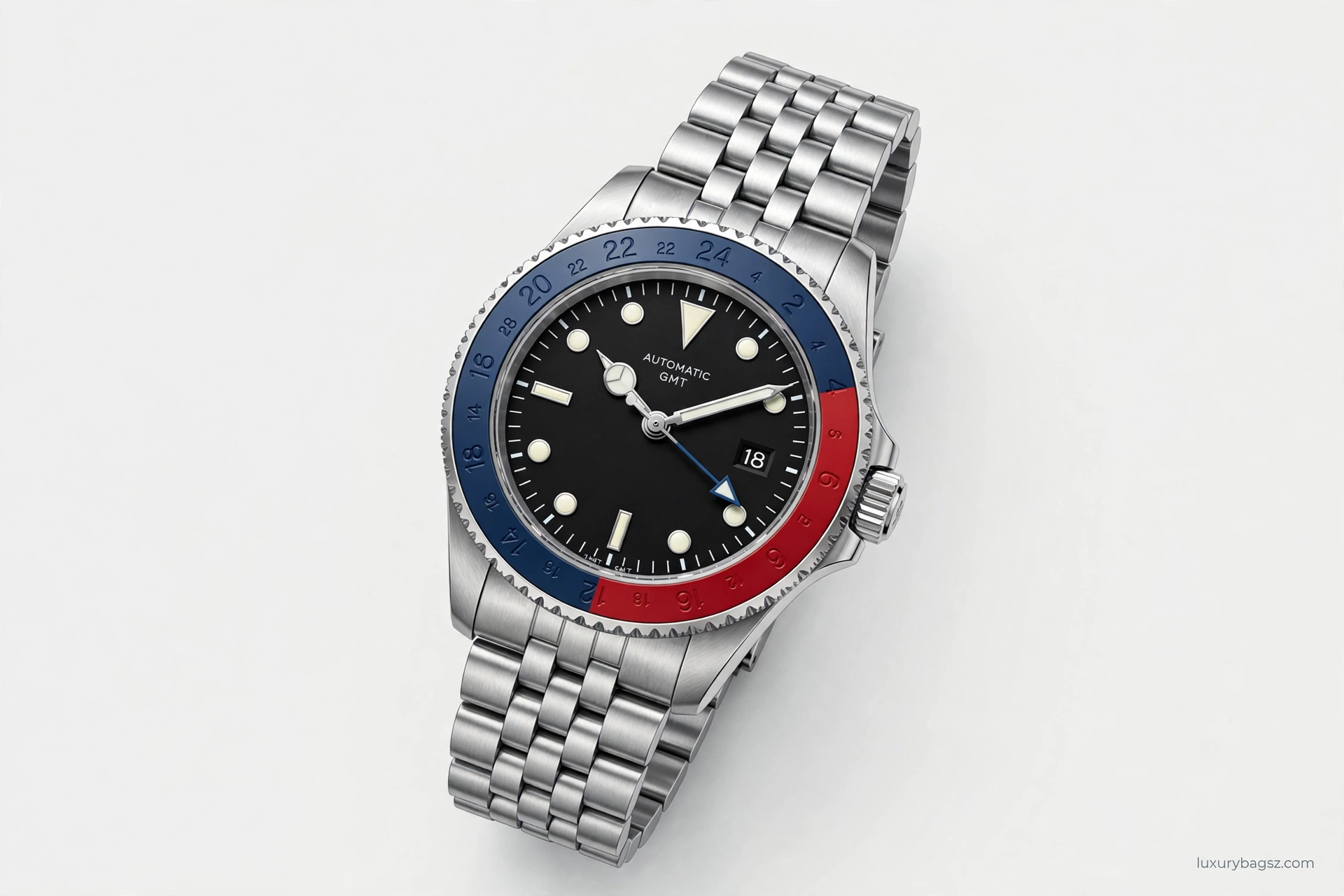
The GMT-Master II is Rolex's pilot watch, built to read two time zones at once. It began as a Pan Am commission in the 1950s, when long-haul crews needed home time and local time on one dial. A fourth hand, set to a 24-hour scale on a rotating bezel, solved that problem without a second watch.
The single most important choice is the bezel colour, because it decides both the look and the price. The red-and-blue Pepsi is the icon, the black-and-blue Batman is the modern favourite, and the brown-and-black Root Beer is the dressier two-tone option. All current models share the same 40 mm case, calibre 3285 movement, and 100 metres of water resistance.
On the secondary market in 2026, expect roughly $14,000 to $30,000 or more for modern steel models, according to ECI Jewelers, with the Pepsi at $20,000 to $30,000 or more. Steel retail sits around $11,000 to $12,300, according to Bob's Watches, but authorised dealers run long waitlists for the popular colours.
Pan Am and the Pilot's Problem
In the early 1950s, commercial aviation changed what a watch had to do. Pan Am's crews crossed oceans and time zones in a single duty, and a watch that showed only local time left them guessing about home time. Pocket watches were useless in a cockpit, and carrying two watches was a poor answer.
Pan Am approached Rolex with a clear brief: one wristwatch that could read two time zones at a glance. Rolex answered with a fourth hand, geared to circle the dial once every 24 hours, paired with a rotating bezel marked in 24 hours. Set the hand to home time, rotate the bezel, and both zones were visible without touching the crown.
The name comes from Greenwich Mean Time, the global timekeeping anchor established in 1884, according to Bagaholicboy. GMT is the standard every pilot, navigator, and airline schedule worked from, so naming the watch after it was a statement of purpose, not marketing decoration.
The watch's early fame was earned in cockpits, not boutiques. In July 1959, a GMT-Master accompanied Pan Am's first non-stop New York to Moscow flight, and its captain later remarked that the flight itself was navigated by Rolex, according to Sotheby's Realty. Test pilot William J. Knight wore one when he reached Mach 6.7 in 1967, a record that still stands.
That professional origin is why the GMT-Master II still matters. It was not designed as jewellery that happens to tell two times. It was designed as a tool for people whose work depended on knowing the time somewhere else, and every later version keeps that brief intact.
The First GMT-Master: Ref. 6542
The first GMT-Master, ref. 6542, arrived in 1954 to 1955, and sources differ slightly on the exact year. The Watchology dates it to 1954 to 1955, while Sotheby's Realty and Bagaholicboy give 1955. This guide uses 1954 to 1955, because the launch straddled the two years and the disagreement is about months, not about the watch itself.
The 6542's defining feature was its two-tone bezel insert, red for daytime hours and blue for nighttime hours. That red-and-blue pairing is the origin of the Pepsi nickname, which has stuck through every generation since. The bezel was bidirectional, and the 24-hour hand made one full rotation per day.
Early 6542 bezels were made from Bakelite, a fragile plastic that cracked in service and was usually replaced under warranty. Few original Bakelite inserts survive, which is why a confirmed early 6542 with documented Pan Am pilot provenance sold at Sotheby's in May 2023 for 177,800 CHF, according to The Watchology.
The 6542 was based loosely on the Turn-O-Graph, an earlier Rolex with a rotating bezel, according to Sotheby's Realty. Rolex took that rotating-bezel idea and gave it a purpose: instead of timing an event, the bezel now tracked a second time zone against the 24-hour hand.
Collectors treat the 6542 as the foundation of the whole line, but it is not a watch most buyers should chase first. Survivors are rare, fragile, and priced as artefacts. The modern GMT-Master II carries the same idea in a far tougher, more wearable form, and that is where this guide spends its time.
The Timeline: From Pan Am to Ceramic
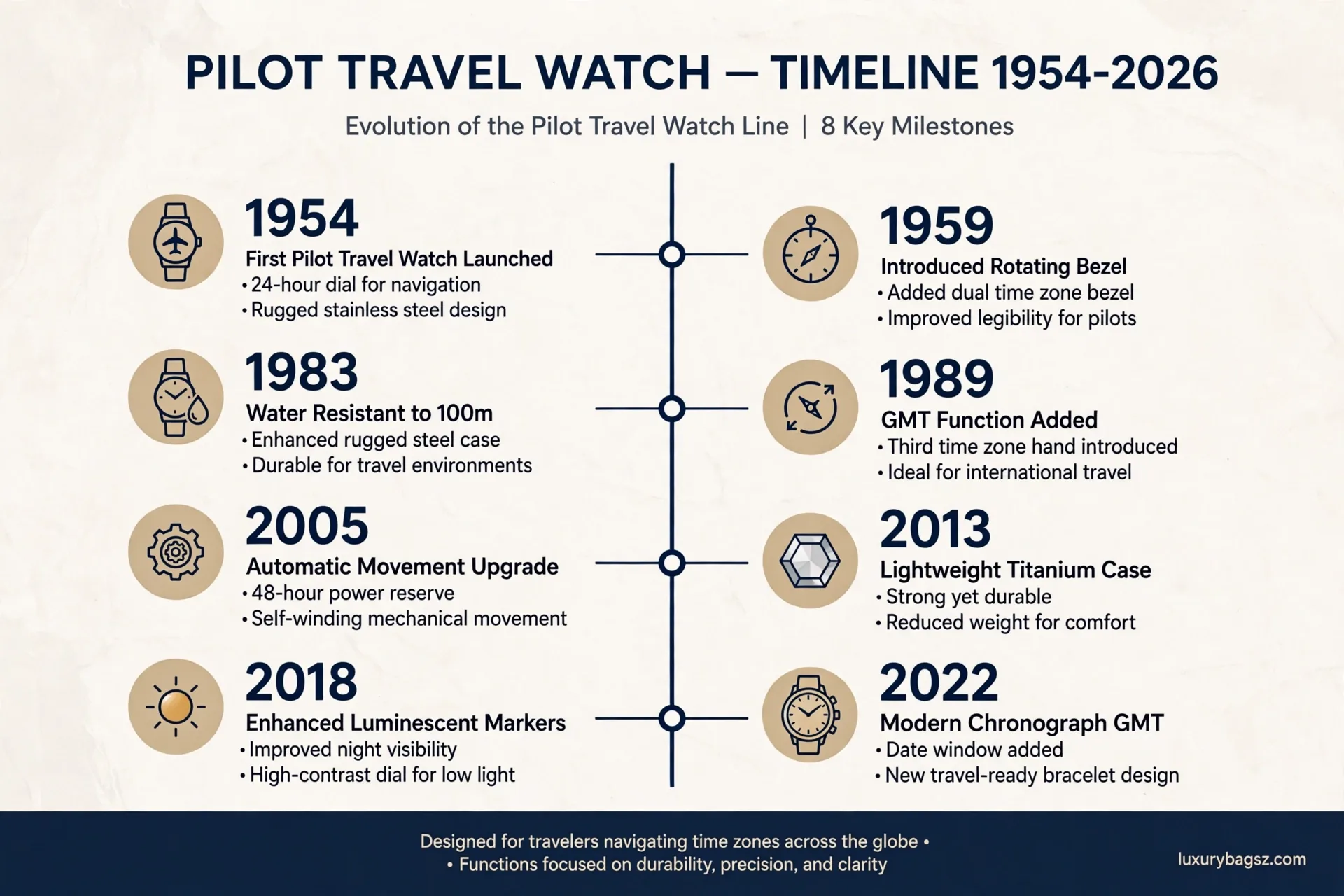
The GMT-Master's history divides into clear chapters, and knowing them helps you date any reference you meet. The table below combines the rival guides read for this article, with disagreements flagged rather than smoothed over.
| Year | Milestone |
|---|---|
| 1954 to 1955 | Ref. 6542 debuts for Pan Am crews, red-and-blue Bakelite bezel, 24-hour hand |
| Late 1950s | Ref. 1675 becomes the long-running GMT-Master, aluminium bezel inserts |
| 1982 to 1983 | GMT-Master II arrives with an independently adjustable hour hand, first as ref. 16760 |
| 1988 to 1999 | Ref. 16700, the last original GMT-Master and the only one with a sapphire crystal |
| 1989 to 2007 | Ref. 16710, the neo-vintage GMT-Master II, in Coke, Pepsi, and black |
| 2005 onward | Ceramic Cerachrom bezels arrive, starting with gold models |
| 2013 | Black-and-blue ceramic Batman bezel launches |
| 2014 | Red-and-blue ceramic Pepsi bezel returns |
| 2018 | Steel Pepsi ref. 126710BLRO launches on the Jubilee bracelet |
| 2019 | Jubilee-bracelet Batgirl and white gold meteorite-dial models arrive |
| 2022 | Left-handed Sprite ref. 126720VTNR, crown on the left, green-and-black bezel |
| 2025 | White gold Sprite ref. 126729VTNR with the first ceramic dial Rolex has made |
| 2026 | Steel Pepsi discontinued in April, secondary prices climb past $27,000 |
The 1982 to 1983 dating needs a note, because sources split. Bagaholicboy and Bob's Watches date the GMT-Master II's arrival to 1982, while The Watchology dates the first GMT-Master II reference, the 16760, to 1983. Both agree on what changed: the hour hand could finally move on its own.
The ceramic era matters most for current buyers, because it defines every modern bezel. Ceramic is scratch resistant and fade resistant in a way aluminium never was, which is why a ten-year-old ceramic Pepsi still looks new while a vintage aluminium Pepsi fades to softer tones that collectors prize for different reasons.
The 1675 Era: The Watch That Made the Legend
After the 6542, the ref. 1675 became the GMT-Master most people picture when they hear the name. It ran for roughly two decades, and it is the reference that carried the watch from a pilot's tool into popular culture. Its aluminium bezel inserts came in Pepsi, Coke, and all-black versions.
The 1675's long run is also why it is the most accessible vintage GMT-Master today. Thousands were made, and they survive in every condition from battered to pristine. That spread is useful for a buyer, because it means you can choose your budget by choosing your condition, rather than hunting a single rare variant.
Vintage GMT-Masters reward patience and punish haste. Faded bezels, replaced hands, and service dials all change value, and none of them are obvious to a first-time buyer. A faded Pepsi bezel, known as a ghost bezel in collector slang, can be original and desirable, or it can be a later replacement. Paperwork and expert eyes matter more here than anywhere else in the line.
The original GMT-Master line ended with ref. 16700, built from 1988 to 1999, according to Bob's Watches. It was the final original GMT-Master and the only one with a sapphire crystal. Clean examples usually run $10,000 to $14,000, with complete sets higher, which makes it a sensible entry into vintage GMT ownership.
If you want one watch that captures the vintage GMT story without vintage risk, the 16710 is the answer. It is covered in the next parts, and it remains the sweet spot between old character and modern reliability.
Nicknames Decoded: Pepsi, Batman, Root Beer and More
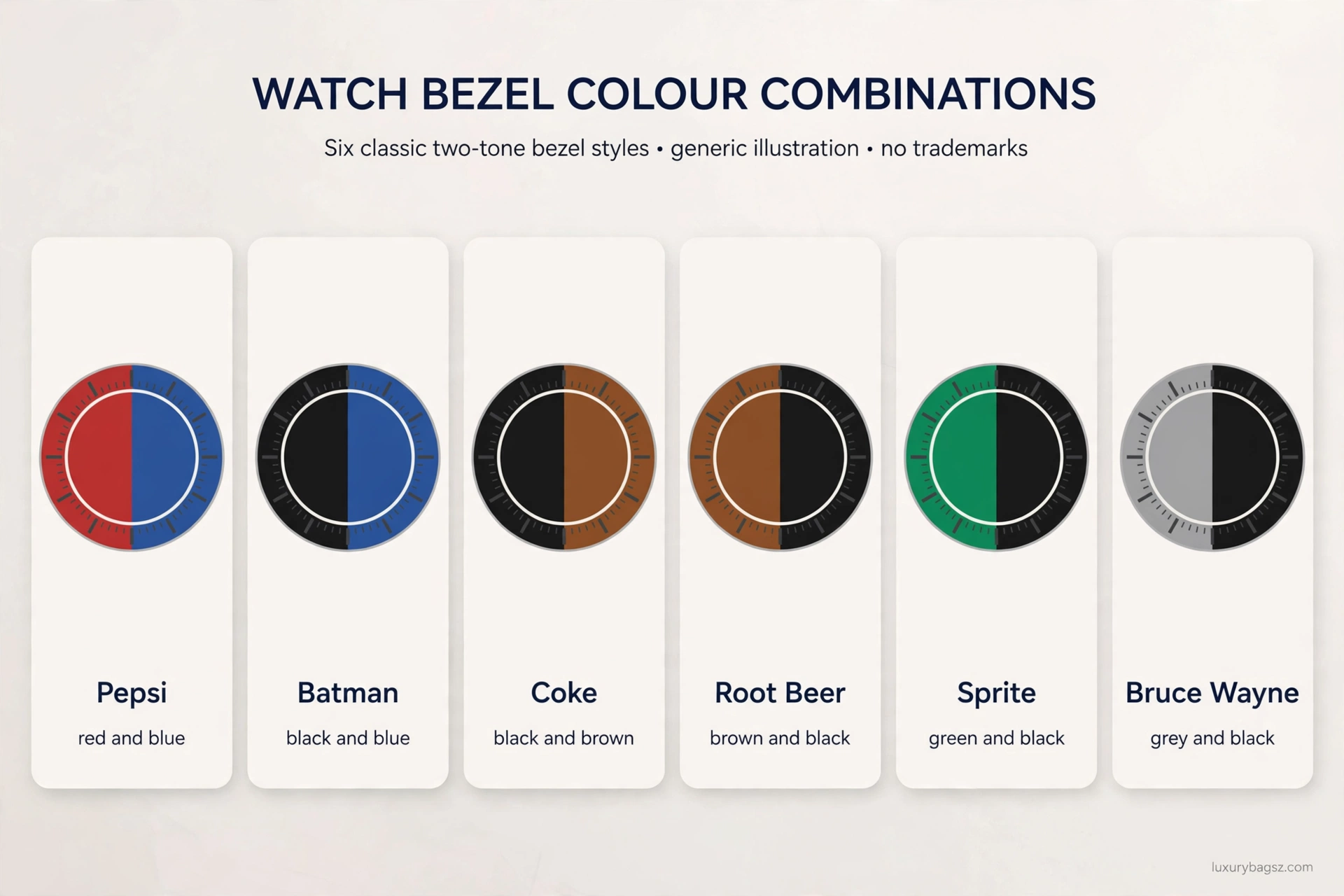
GMT-Master II nicknames are not official Rolex names. They are collector shorthand for bezel colours, and learning them is the fastest way to read any listing. Rebag's own guide lists the main nicknames, and this part follows that list while flagging one disagreement.
Pepsi is red and blue, the original pairing, and the most popular GMT-Master style, according to Rebag. It is available in stainless steel or 18-karat gold, on a Jubilee or Oyster bracelet. The modern steel Pepsi is ref. 126710BLRO, and it was discontinued in April 2026.
Batman is black and blue. Rebag dates the Batman to 2018, but Bagaholicboy dates the black-and-blue ceramic bezel to 2013. The likeliest reading is that the ceramic Batman bezel arrived in 2013 on an Oyster bracelet, and Rebag's 2018 date reflects a later configuration. This guide treats 2013 as the bezel's arrival.
Batgirl is the Jubilee-bracelet version of the black-and-blue watch, introduced in 2019, according to Rebag. Same bezel as the Batman, different bracelet, and a different nickname. The bracelet changes the whole character of the watch, which is why collectors gave it a separate name.
Root Beer is brown and black. Rebag describes a steel-and-Everose model with a brown-and-black ceramic bezel under the name Coke, but collectors generally reserve Coke for the vintage black-and-red bezel. The brown-and-black two-tone is the Root Beer, ref. 126711CHNR, and the full Everose version is ref. 126715CHNR.
Sprite is green and black, on the left-handed ref. 126720VTNR, with the crown on the left side of the case. Bruce Wayne is grey and black, ref. 126710GRNR, a quieter, more understated pairing. Meteorite is the 2019 white gold model with a meteorite dial and a red-and-blue bezel, according to Rebag.
The GMT-Master II Arrives: The Independent Hour Hand
The GMT-Master II's defining change is invisible at a glance and transformative in use. On the original GMT-Master, the hour hand and the 24-hour hand were mechanically linked, so setting local time moved both together. Reading a second zone meant rotating the bezel, not moving a hand.
The GMT-Master II broke that link. Its movement lets the hour hand jump in one-hour steps without stopping the watch and without moving the 24-hour hand. Land in a new time zone, jump the hour hand to local time, and home time stays put on the 24-hour hand. The bezel then frees up for a third zone.
The first GMT-Master II, ref. 16760, launched in 1983 with calibre 3085, according to The Watchology. Collectors call it the Fat Lady or Sophia Loren, because its case was marginally wider than its predecessor's. It wore the red-and-black Coke bezel, and clean examples are scarce, often trading from around $15,000 upward.
The neo-vintage sweet spot is ref. 16710, produced from 1989 to 2007 with Coke, Pepsi, and black inserts, according to Bob's Watches. It is the most accessible collectible GMT-Master II, with modern sapphire, a slimmer case than the Fat Lady, and bezels that can still be swapped by a watchmaker. Many collectors start here.
Current models run calibre 3285, a self-winding automatic with a 70-hour power reserve, a Chronergy escapement, and strong magnetic resistance, according to Bagaholicboy and Sotheby's Realty. That 70-hour reserve means the watch survives a long weekend off the wrist, which matters more in daily life than any single specification.
How to Read Three Time Zones at Once
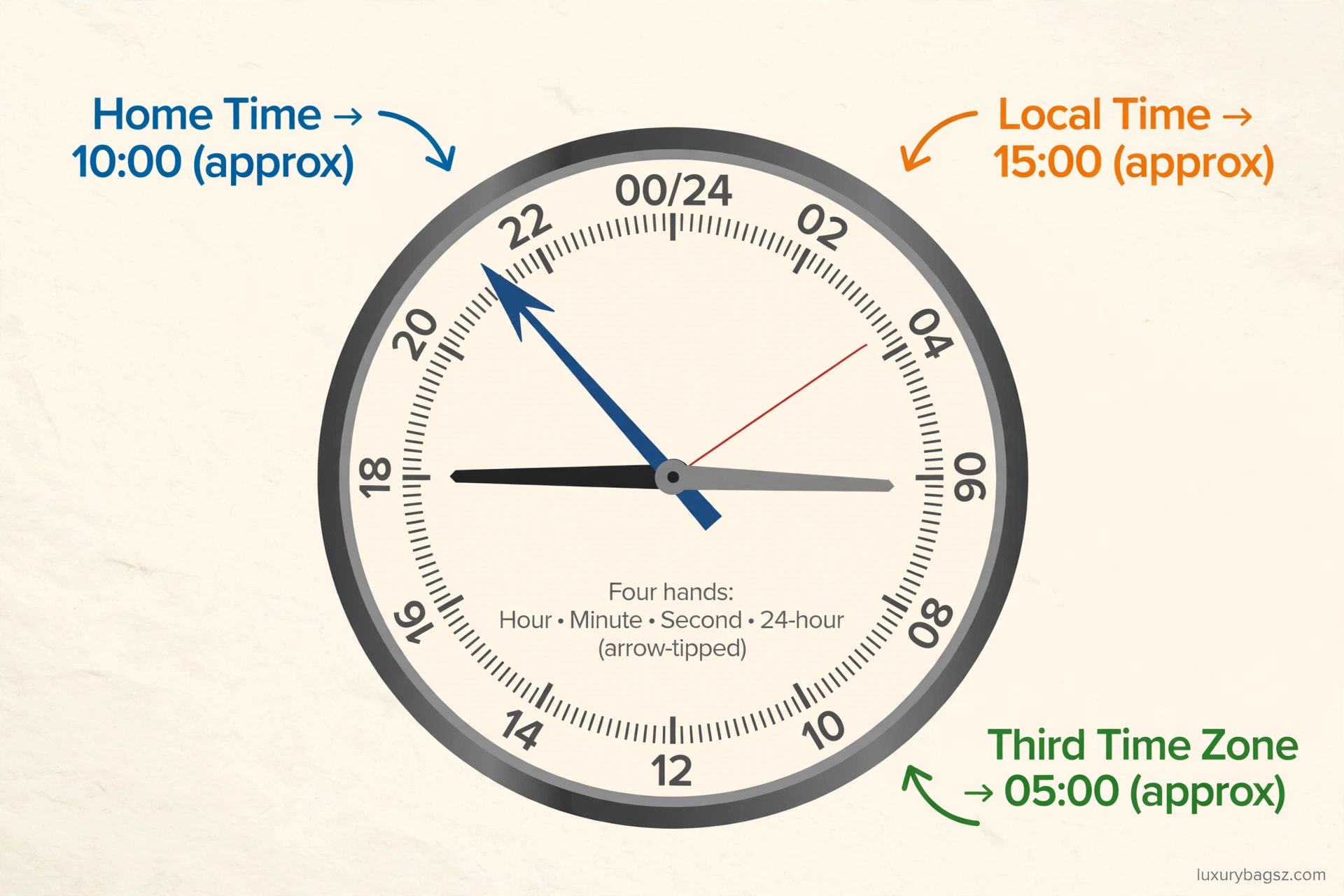
The GMT-Master II's party trick is reading three zones, and it takes about a minute to learn. The regular hour hand shows local time, set by jumping it in one-hour steps as you travel. The arrow-tipped 24-hour hand shows home time, read against the 24-hour bezel scale.
The bezel adds the third zone. Rotate it so the bezel's 24-hour scale aligns with the third zone's offset from home time, and the same 24-hour hand now reads that zone too. A traveller in London tracking New York and Tokyo, for example, sets the hour hand to London, the 24-hour hand to New York, and the bezel to Tokyo.
In practice, most owners use two zones and leave the bezel alone. That is fine. The bezel is a tool, not an obligation, and a GMT-Master II worn with the bezel at zero still tells home and local time perfectly. The third zone is there for the trips when you need it.
One practical tip: set the 24-hour hand to the zone you call most, not the zone you are in. Home time is the anchor you return to, and keeping it fixed means you never have to recalculate it mid-trip. Jump the hour hand as you move, and let the 24-hour hand sit still.
The Modern Lineup: References Worth Knowing
Every GMT-Master II in production today is a 40 mm watch on calibre 3285, according to ECI Jewelers and Sotheby's Realty. That shared foundation makes choosing simpler than the long reference list suggests. Pick the bezel colour, pick the material, pick the bracelet, and the watch underneath is the same.
The steel core is the 126710 family. The 126710BLRO is the Pepsi, the 126710BLNR is the Batman, and the 126710GRNR is the Bruce Wayne, in grey and black ceramic. All three come on Oyster or Jubilee bracelets, and the bracelet choice changes both the price and the feel, covered in the next part.
The two-tone and gold models sit above steel. The 126711CHNR pairs steel with Everose gold and a brown-and-black Root Beer bezel, while the 126715CHNR is the full Everose version. Solid gold models climb further, with white gold versions including the Pepsi and the green-dial Sprite.
The Sprite deserves its own note, because it breaks the pattern. The steel Sprite, ref. 126720VTNR, arrived in 2022 with the crown on the left side of the case, a green-and-black bezel, and a movement re-engineered for the left-handed layout, according to Swiss Connection Watches. It is the only left-handed GMT-Master II, and it wears differently from every other reference.
The 2025 white gold Sprite, ref. 126729VTNR, goes further still. It pairs a green-and-black bezel with a green ceramic dial, the first dial Rolex has made entirely from ceramic, according to Bagaholicboy. It is a collector's piece first and a daily wearer second, and its price reflects that.
For the same reason, our guide to Rolex serial number checks stresses decoding the numbers before trusting a listing. A GMT-Master II reference tells you the bezel, the material, and the bracelet, and a seller who gets those details wrong deserves a second look.

Bracelets: Oyster Versus Jubilee
The GMT-Master II comes on two bracelets, and the choice matters more than most buyers expect. The Oyster is a three-link bracelet with a sporty, robust feel, while the Jubilee is a five-link bracelet with a dressier, more fluid drape, according to Bagaholicboy. Same watch, different personality.
The Oyster suits the watch's tool origins. It is sturdier in feel, easier to clean after travel, and it matches the GMT-Master II's pilot brief. The Batman launched on the Oyster, and many collectors still prefer it there, because the watch reads as a sports watch first.
The Jubilee suits the watch's second life as an everyday luxury piece. It drapes better on a smaller wrist, catches light across its smaller links, and dresses the watch up without changing the case. The steel Pepsi's 2018 relaunch on the Jubilee is a large part of why that reference became so desirable.
Both bracelets use Rolex's Oysterlock safety clasp, and current models include the Easylink comfort extension, which lets the bracelet lengthen by a few millimetres without tools. That extension is genuinely useful on long flights, when wrists swell, and it is one of the small details that separates a modern GMT-Master II from its predecessors.
Try both before you buy, because bracelet preference is personal and hard to predict from photos. A Jubilee that looks elegant in a listing can feel busy on your wrist, and an Oyster that looks plain can feel exactly right. The bracelet is half the watch, and it is the half you touch every day.
Prices in 2026: Retail, Secondary, and What Moves Them
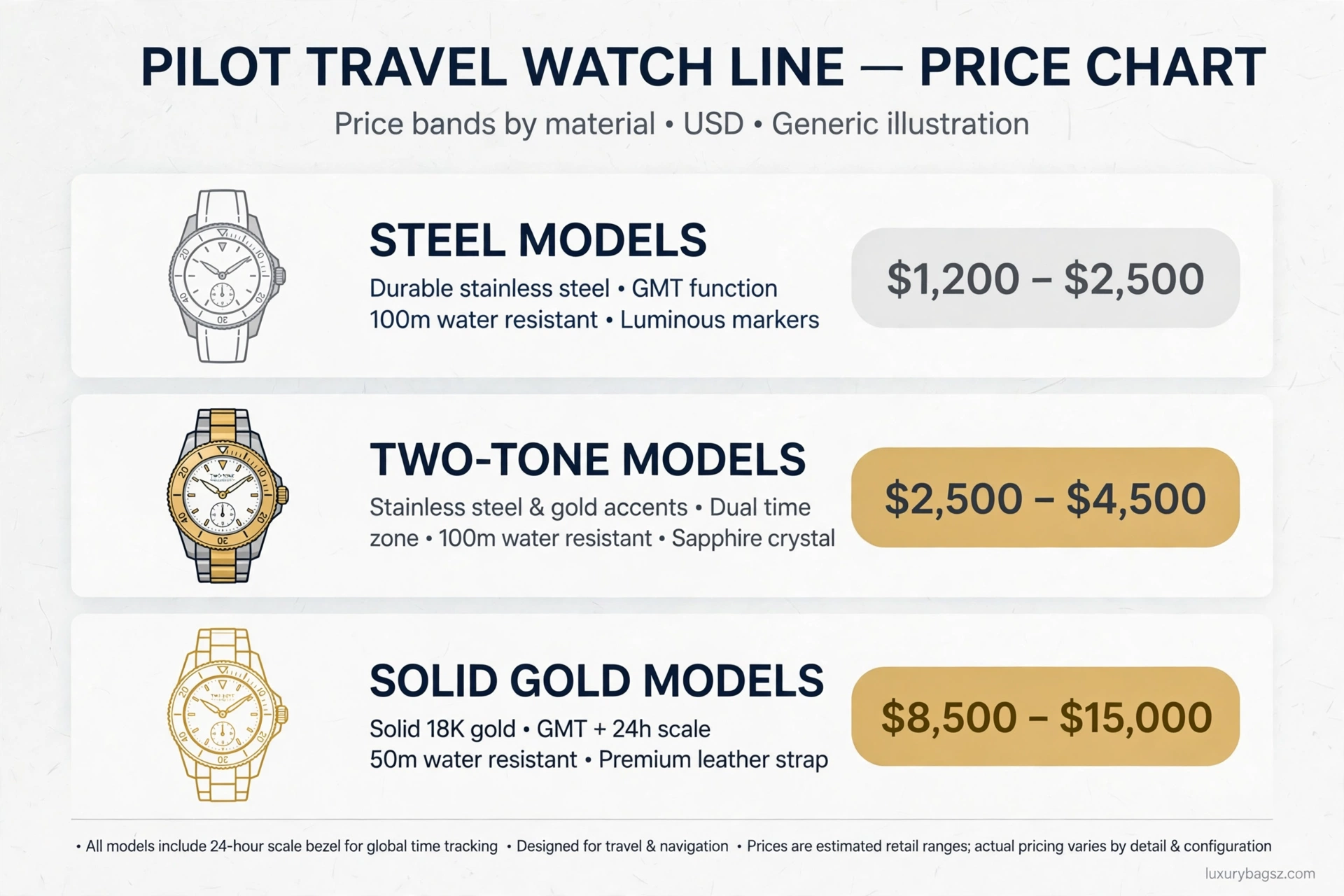
GMT-Master II pricing needs care, because retail and secondary prices live in different worlds. Bob's Watches puts current steel retail at roughly $10,700 to $12,300, depending on bracelet and configuration, while solid gold models climb between $38,000 and $57,000 at retail. Those are authorised-dealer prices, not prices you can simply walk in and pay.
The secondary market tells a different story. ECI Jewelers puts modern steel models at $14,000 to $30,000 or more, with the Pepsi at $20,000 to $30,000 or more, Batman and Batgirl at $16,000 to $25,000 or more, and the Sprite at $17,000 to $27,000 or more. Two-tone Root Beer models sit at $18,000 to $28,000 or more, and full gold models at $40,000 to $70,000 or more.
The Pepsi's April 2026 discontinuation changed its market overnight. The Watchology reports that secondary prices for the steel Pepsi had risen past $27,000 by October 2026, after Rolex retired the reference at Watches and Wonders on 1 April 2026. Discontinuation does not guarantee further gains, but it removed the cheapest route to the most famous bezel colour.
What moves a GMT-Master II's price, beyond the reference itself, is condition, completeness, and bezel colour. Box and papers, an unpolished case, and a clean bezel all add value, while a stretched bracelet or a replaced bezel insert subtracts it. Blue and red Pepsi bezels command the highest premiums, followed by Batman, with quieter colours like Bruce Wayne trading lower.
Retail Versus Secondary: Waitlists and Reality
Buying a GMT-Master II at retail requires patience. Sotheby's Realty reports that most authorised dealers operate long waitlists, particularly for the Pepsi and Batman references, and UAE retail for steel models starts at around AED 44,050, with secondary premiums of 30 to 50 percent not uncommon. The pattern is the same in other markets, with local prices varying.
The retail path has real advantages. You pay the published price, you get a fresh manufacturer warranty, and you know the watch's full history from day one. If you have a dealer relationship and can wait, retail is the cheapest route to a popular reference, and the wait is the price you pay for that discount.
The secondary market offers immediate access, including discontinued references no longer available at retail, such as the steel Pepsi after April 2026. Pre-owned dealers authenticate, inspect, and warranty their watches, but at a premium above retail for most steel configurations. That premium is the cost of skipping the waitlist.
One rule protects you on either path: never pay more than retail to an authorised dealer, because legitimate dealers sell at Rolex's published price. A dealer asking above retail is not an authorised dealer in the normal sense, and a private seller asking far above the secondary range needs to justify it with condition, completeness, or rarity.
For the same reason, our guide to buying on Rolex finance is worth reading before you commit to monthly payments. A GMT-Master II bought on finance costs more than its sticker price, and the total cost deserves the same attention as the reference choice.
Buying Pre-Owned: Checks That Actually Matter
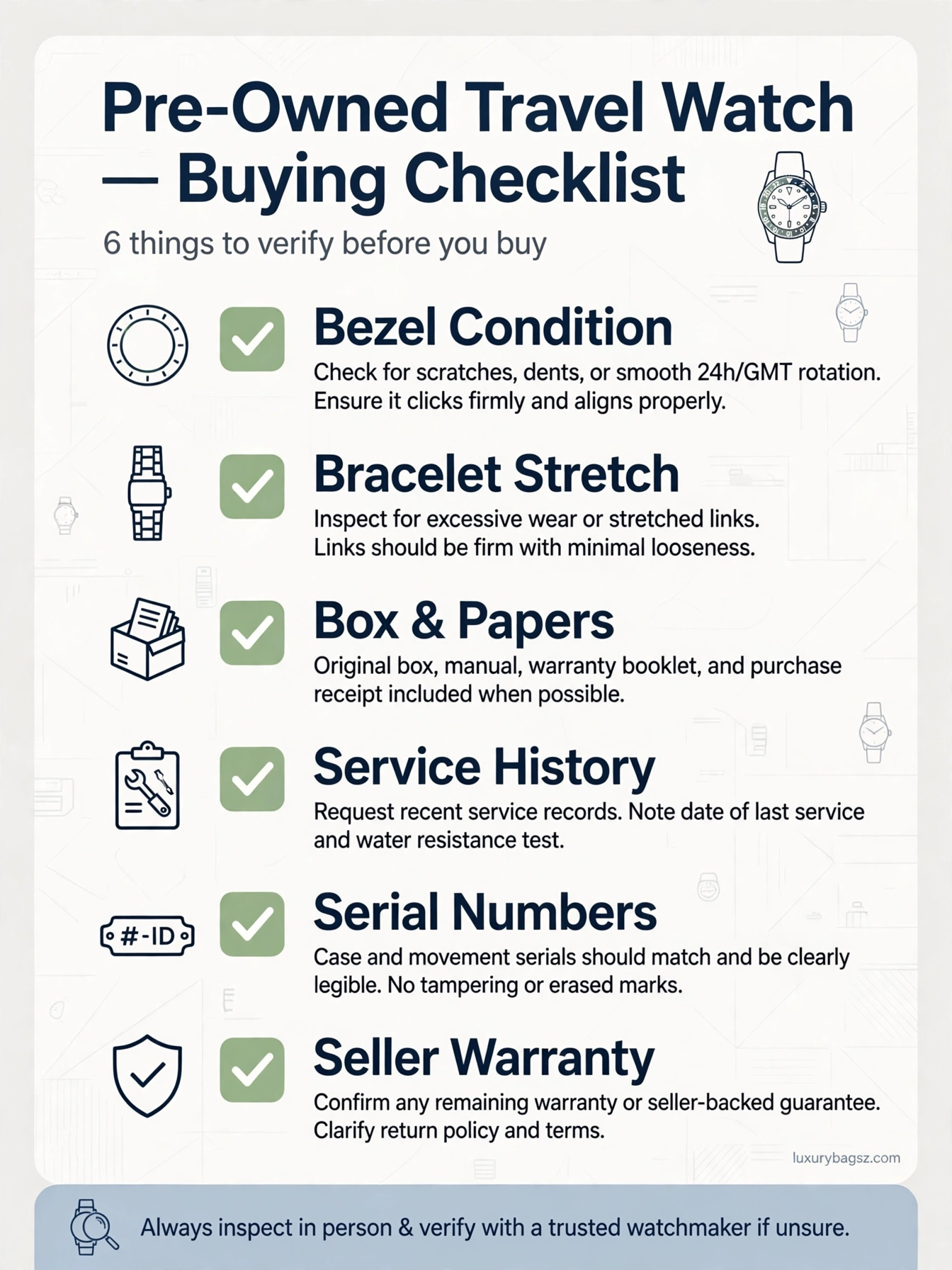
The GMT-Master II is one of the most faked and most modified Rolex models, because its bezel colours invite swapping. A black bezel can be changed, a bracelet can be swapped, and a watch can be rebuilt from parts that never left the factory together. These checks catch most of that.
Start with the bezel. Ceramic bezels should be crisp, with clean numerals and no chips at the edges. Aluminium bezels on vintage models should show honest wear, not fresh paint. A bezel colour that does not match the reference is the single biggest red flag, because it suggests the watch was assembled from parts.
Check the bracelet for stretch. Hold the bracelet horizontally and look for sag between the links, then check that the clasp closes firmly and the Easylink extension works. A stretched bracelet is expensive to replace, and it suggests a watch that was worn hard without servicing.
Confirm the full set and the serial numbers. The serial number, found between the lugs or on the rehaut on modern models, should match the warranty card and any paperwork, and the reference number should match the bezel, material, and bracelet in front of you. A mismatch anywhere deserves an explanation before money changes hands.
Ask for service history, and check when the movement was last serviced. A GMT-Master II that has not been serviced in a decade may run, but its seals and lubricants are past their best, and a full Rolex service is a significant cost to inherit. A recently serviced watch with documentation is worth paying more for.
Servicing, Wear, and the Cost of Keeping a GMT
Rolex recommends servicing roughly every ten years for modern movements, though heavy use, swimming, and harsh conditions shorten that interval. A full Rolex service restores the movement, replaces worn seals, and pressure-tests the case, which matters on a watch rated to 100 metres. Budget for it as part of ownership, not as an emergency.
Water resistance deserves a plain warning. The GMT-Master II is rated to 100 metres, and Rebag confirms that all GMT-Master II models carry that rating. That rating applies to a new, sealed watch, not to a ten-year-old watch that has never been pressure-tested. Have the seals checked before you swim with a pre-owned GMT-Master II.
Daily wear is where the GMT-Master II earns its keep. The ceramic bezel resists scratches that would scar an aluminium bezel, the Chromalight display stays legible at night, and the Cyclops lens magnifies the date for quick reading. It is a watch designed to be worn hard, and it rewards that treatment.
Cleaning is simple, and our guide to how to clean a watch covers cases, crystals, bracelets, and straps in detail. For a GMT-Master II, warm water, mild soap, and a soft brush on the bracelet, with the crown screwed down, is enough for routine care. Leave the case opening and movement work to a professional.
Which GMT-Master II Should You Buy?
Buy the steel Pepsi, ref. 126710BLRO, if you want the icon and can accept the secondary premium after its 2026 discontinuation. It is the most recognisable GMT-Master II, the easiest to resell, and the one whose story needs no explanation. Buy it on the Jubilee if you want the 2018 look, or on the Oyster if you prefer the sportier feel.
Buy the Batman, ref. 126710BLNR, if you want the modern favourite at a lower premium than the Pepsi. Its black-and-blue bezel is more understated, it pairs with more outfits, and it is the reference most collectors name as the best all-rounder in the current line. The Batgirl, on the Jubilee, is the same watch with a dressier bracelet.
Buy the Root Beer, ref. 126711CHNR, if you want two-tone warmth and a watch that dresses up more easily. It is the GMT-Master II for buyers who find steel too plain and full gold too loud. Buy the Sprite if you are left-handed or want the most distinctive modern reference, and accept that its left-handed layout narrows its resale audience.
Whatever you choose, decode the reference, check the bezel, confirm the full set, and budget for servicing. A GMT-Master II in the right colour, unpolished, complete, and recently serviced is a watch for decades of travel. A GMT-Master II bought on nickname alone, without those checks, is a gamble at prices where gambles are expensive.
Five Mistakes First-Time GMT Buyers Make
The first mistake is buying the nickname instead of the watch. A listing that shouts Pepsi but shows a bezel colour that does not match the reference is either misdescribed or rebuilt. Always match the reference number to the bezel, material, and bracelet in front of you before you fall for the name.
The second mistake is ignoring bracelet stretch. A GMT-Master II bracelet that sags sideways has worn links, and replacing a Rolex bracelet costs far more than most buyers expect. Hold the bracelet flat, check for sag, and test the clasp. A tight bracelet on a loose watch is a warning, not a bargain.
The third mistake is skipping the service question. A GMT-Master II that has not been serviced in a decade may keep time, but its seals are tired and its lubricants are dry. Ask when it was last serviced, who serviced it, and whether the work is documented. An undocumented service by an unknown watchmaker is a discount, not a feature.
The fourth mistake is paying a premium for a story instead of a watch. Pilot provenance, celebrity ownership, and limited-edition claims all add romance, and some add value, but only with paperwork that proves them. A story without documents is just a story, and it should not change the price.
The fifth mistake is buying the wrong size by diameter alone. The GMT-Master II is 40 mm, but its wide bezel and bracelet make it wear larger than a round 40 mm dress watch. Try it on, check how it sits under a cuff, and judge by wrist presence rather than the number. A watch that looks right in a photo can feel too present on a smaller wrist.
Avoid those five mistakes and the rest of the purchase gets simpler. The GMT-Master II is a well-documented watch with a clear reference system, and a buyer who checks the bezel, the bracelet, the papers, and the service history is hard to fool.
On the Wrist: Sizing, Comfort, and Daily Wear
The GMT-Master II is 40 mm across, but that number does not tell the whole sizing story. Its wide ceramic bezel, broad lugs, and metal bracelet give it more wrist presence than a round 40 mm dress watch, and buyers with wrists under about 16.5 cm should try it before committing. The watch should sit flat, with the case edges inside the wrist's width.
Comfort comes from the bracelet more than the case. The Oyster bracelet's three broad links feel solid and planted, while the Jubilee's five smaller links drape and flex more easily around a smaller wrist. If the case feels large, the Jubilee often fixes the problem without changing the watch, because it softens the watch's outline.
For daily wear, the GMT-Master II is unusually easy to live with. The ceramic bezel shrugs off desk scratches, the 70-hour reserve covers a long weekend, and the Easylink extension handles warm days. It is one of the few luxury watches that genuinely works as a single-watch collection, because it is tough, legible, and understated enough for most rooms.
One honest drawback: the Cyclops lens divides opinion, and it cannot be removed without changing the crystal. Some owners love the magnified date, others find the bump distracting. Decide before you buy, because it is part of every modern GMT-Master II, and it is not a detail you can change later without cost.
Frequently Asked Questions
When was the GMT-Master launched?
In 1954 to 1955, as ref. 6542, built for Pan Am crews who needed to read two time zones at once. Sources differ slightly on the year, with The Watchology giving 1954 to 1955 and other guides giving 1955. The watch paired a 24-hour hand with a rotating 24-hour bezel.
What is the difference between the GMT-Master and the GMT-Master II?
The original GMT-Master linked its hour hand and 24-hour hand together, so setting local time moved both. The GMT-Master II, arriving in 1982 to 1983, lets the hour hand jump independently in one-hour steps without stopping the watch or moving the 24-hour hand. Every Rolex GMT made since 1999 is a GMT-Master II.
What do the GMT-Master II nicknames mean?
Pepsi is red and blue, Batman is black and blue, Batgirl is the Jubilee-bracelet Batman, Root Beer is brown and black, Sprite is green and black, Bruce Wayne is grey and black, and Coke is the vintage black-and-red bezel. Nicknames describe bezel colours, not official Rolex names.
How big is the GMT-Master II, and how water resistant is it?
Current models are 40 mm, run calibre 3285 with a 70-hour power reserve, and are water resistant to 100 metres, according to Rebag and rival guides. The 100-metre rating applies to a new, sealed watch, so have a pre-owned example pressure-tested before swimming with it.
How much does a GMT-Master II cost in 2026?
Bob's Watches puts steel retail at roughly $10,700 to $12,300 and solid gold at $38,000 to $57,000. On the secondary market, ECI Jewelers puts modern steel at $14,000 to $30,000 or more, with the Pepsi at $20,000 to $30,000 or more. Prices move with condition, completeness, and bezel colour.
Why was the steel Pepsi discontinued?
Rolex retired the steel Pepsi, ref. 126710BLRO, at Watches and Wonders on 1 April 2026, according to The Watchology and Bob's Watches. By October 2026, secondary prices had risen past $27,000. Rolex does not publish reasons for individual discontinuations, so any explanation beyond the retirement itself is speculation.
What is the Sprite, and why is its crown on the left?
The Sprite, ref. 126720VTNR, arrived in 2022 as the first left-handed GMT-Master II, with the crown on the left side of the case and a green-and-black bezel. Moving the crown forced a re-engineering of the calibre 3285's date mechanism, according to Swiss Connection Watches. A white gold Sprite with a green ceramic dial followed in 2025.
Which bracelet should I choose, Oyster or Jubilee?
Choose the Oyster for a sportier, more robust feel that matches the watch's pilot origins. Choose the Jubilee for a dressier drape that catches light and suits smaller wrists. Both use the Oysterlock clasp with an Easylink extension. Try both before buying, because the bracelet is half the watch.
How do you spot a fake GMT-Master II?
Check that the bezel colour matches the reference, that ceramic numerals are crisp with no chips, that the bracelet shows no heavy stretch, and that serial and reference numbers match the paperwork. For a fuller method, read our guide to spotting a fake Rolex, which covers the checks that catch most fakes.
Is the GMT-Master II a good investment?
Steel Pepsi and Batman models have traded above retail for years, and the Pepsi's 2026 discontinuation pushed its secondary price higher. That is a market observation, not a guarantee. Condition, dial and bezel originality, polishing history, and completeness decide more than the reference name alone.
Final Verdict
The GMT-Master II began as a pilot's tool and became the definitive travel watch, because its idea never needed updating. A fourth hand, a rotating bezel, and an hour hand that jumps on its own still solve the traveller's problem better than anything else on the wrist. Ceramic bezels and a 70-hour movement made it tougher, but the brief Pan Am wrote in the 1950s is unchanged.
Choose the Pepsi if you want the icon, the Batman if you want the all-rounder, and the Root Beer if you want warmth that steel cannot give. Whichever colour you pick, decode the reference, check the bezel, confirm the full set, and budget for servicing. A GMT-Master II bought that way is a watch for decades of departures, and it will still be telling two times, in two places, long after the trip that justified it is over.






