

Leather Types Explained: How to Identify Each One and Care for It
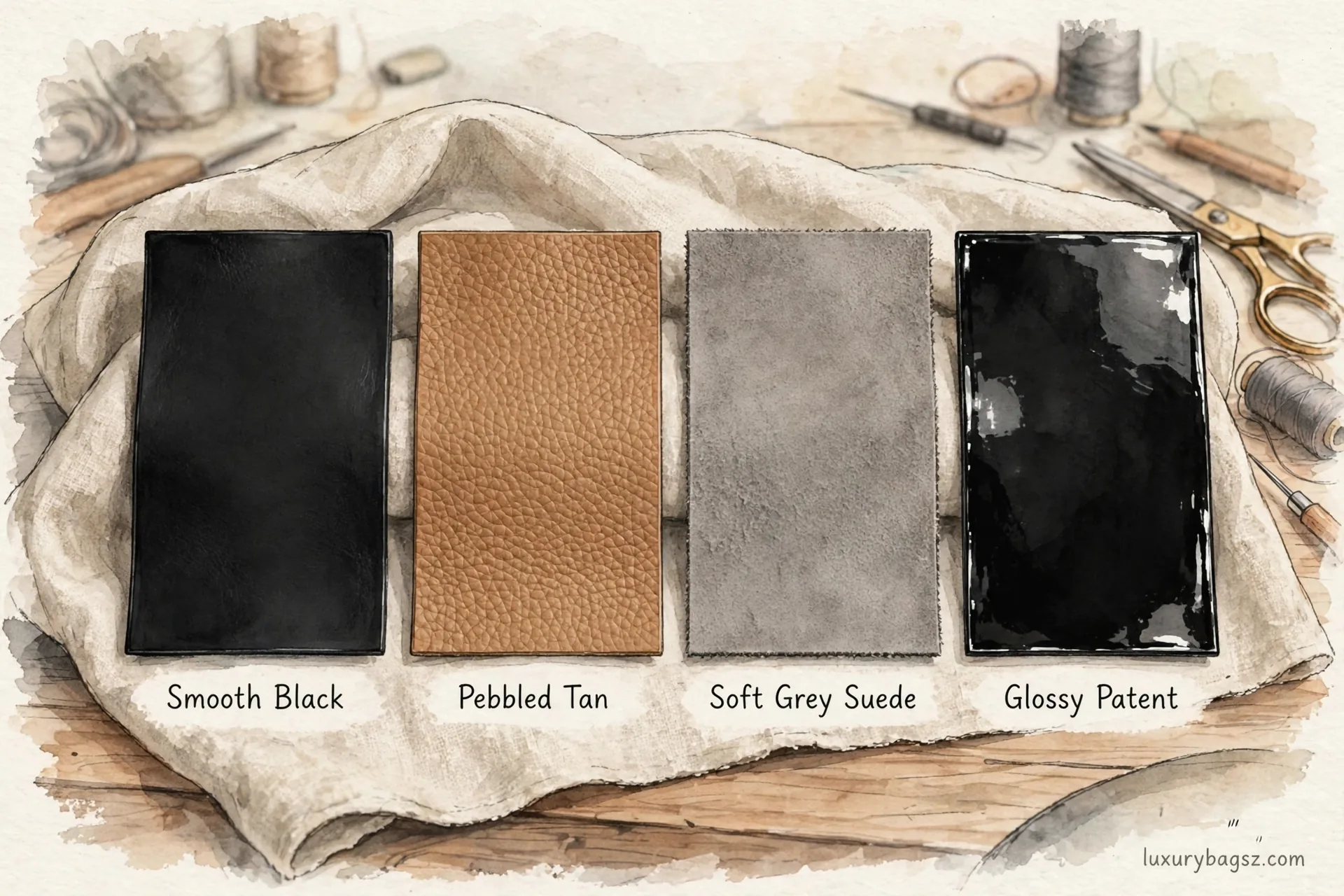
Leather Types, in Brief
Leather is not one material, and treating it as one is how good bags and shoes get ruined. Smooth leather wants conditioner and polish, suede wants a dry brush and nothing creamy, and patent wants little more than a damp cloth. Use the wrong product on the wrong leather and you can flatten a nap, cloud a shine, or stain a surface that never recovers.
The confusion usually comes from labels. A label can describe the grade (which layer of the hide), the animal (cow, calf, lamb, goat), or the finish (pebbled, patent, suede). "Full-grain pebbled cowhide" uses all three at once, and each word tells you something different about durability and care.
This guide covers the seven families you will actually meet: smooth, pebbled and grained, suede, nubuck, cordovan, exotic and reptile, and patent. For each one you get how to recognise it, what it needs, and what to avoid. Deeper dives are linked where they exist, so this overview stays readable.
Key Takeaways

- Always identify the leather before you clean or condition anything.
- Smooth and pebbled leathers take conditioner; suede and nubuck do not take creams.
- Suede comes from the flesh side of the hide; nubuck is sanded grain side, finer and more delicate.
- Cordovan is horse shell leather: glossy, hard-wearing, and slow to crease.
- Exotic leathers dry out and crack if starved of conditioner, especially crocodile.
- Patent needs only a damp cloth and a patent cleaner; wax and heavy creams cloud it.
- Pebbled grain hides scuffs far better than smooth leather, which shows every mark.
- When in doubt, test any product on a hidden spot first and wait a day.
How Leather Labels Actually Work
Grade tells you which layer of the hide was used and how much it was altered. Full-grain keeps the whole grain layer, with pores and small natural marks intact, and it develops a patina over years. Top-grain comes from the same layer but is lightly sanded and coated, so it looks more uniform and resists stains better.
"Genuine leather" sounds reassuring but usually means a lower grade. It is real leather, typically a split from below the grain layer, sanded and sprayed with pigment and an artificial grain. It is fine for linings and cheap accessories, but it wears and cracks sooner than full-grain or top-grain.
Bonded leather is the bottom rung: leather fibres ground up, glued onto a backing, and coated to look like a hide. It peels and flakes with age and cannot be conditioned back to health. If a label says bonded, expect a short life whatever the price suggests.
A note on veg-tan leather, which appears in belts and structured bags: untreated vegetable-tanned leather darkens with sun and handling, developing a honey patina. This is expected, not a defect, but it means water spots show easily early on. Condition lightly and let the patina build evenly rather than chasing every mark.
Hide tells you the animal, and finish tells you the surface treatment. Calfskin is fine-grained and refined, lambskin is buttery and delicate, and cowhide is thick and hard-wearing. Pebbled, saffiano, nappa, patent, suede and nubuck are all finishes, not animals, which is why the same cowhide can appear in several very different forms.
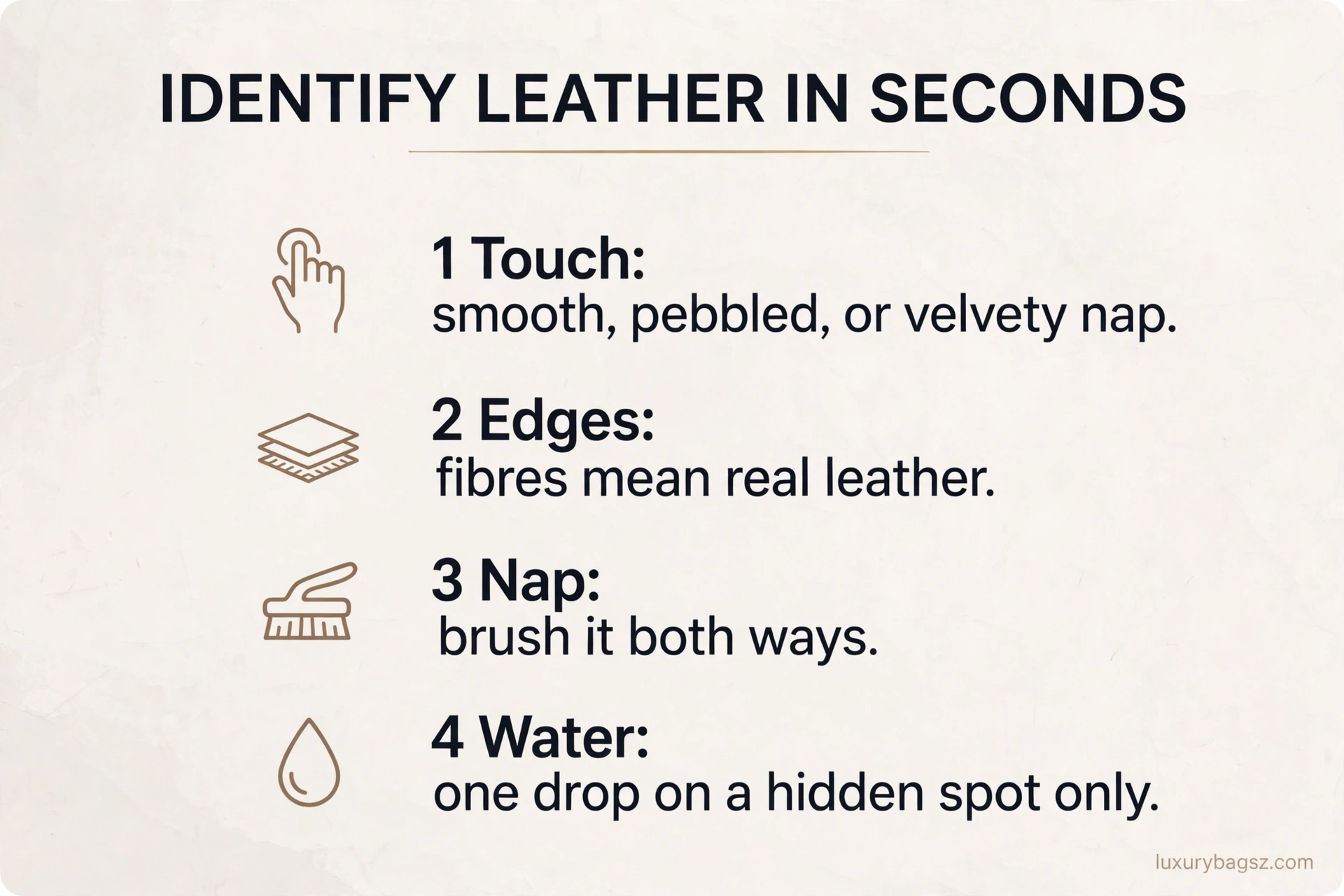
How to Identify Any Leather in Seconds
Start with touch and look. Smooth leather feels flat and even, with visible pores if it is full-grain. Pebbled leather feels bumpy and raised. Suede and nubuck feel velvety and matte, with a nap that changes shade when you brush a finger across it. Patent feels hard, glassy and almost plastic.
Check the edges next. Real leather edges show fibres, while coated or bonded materials often show a fabric backing or a clean plastic-like cut. Stitching also helps: even, tight stitching with sealed or painted edges usually signals a better-made piece, whatever the leather type.
The nap test separates suede from nubuck. Brush the surface lightly one way, then the other. Suede has a longer, looser nap that shifts obviously, while nubuck has a very short, fine nap that barely moves. If a stiff brush damages the surface, you are almost certainly dealing with nubuck, not suede.
Smell is a useful backup test, though it takes practice. Real leather smells rich and earthy, while bonded and plastic-coated materials smell chemical or faintly sweet. Do not rely on smell alone, since heavily finished leather smells faintly too, but a strong plastic smell on a piece sold as full-grain is a warning sign.
Water tells you about finish and porosity, so use it sparingly and only on a hidden spot. Untreated and nappa leathers darken fast as they absorb a drop, while coated, patent and waxed leathers bead it. Never soak a piece to test it; one small drop on an inner edge is enough.
Smooth Leather
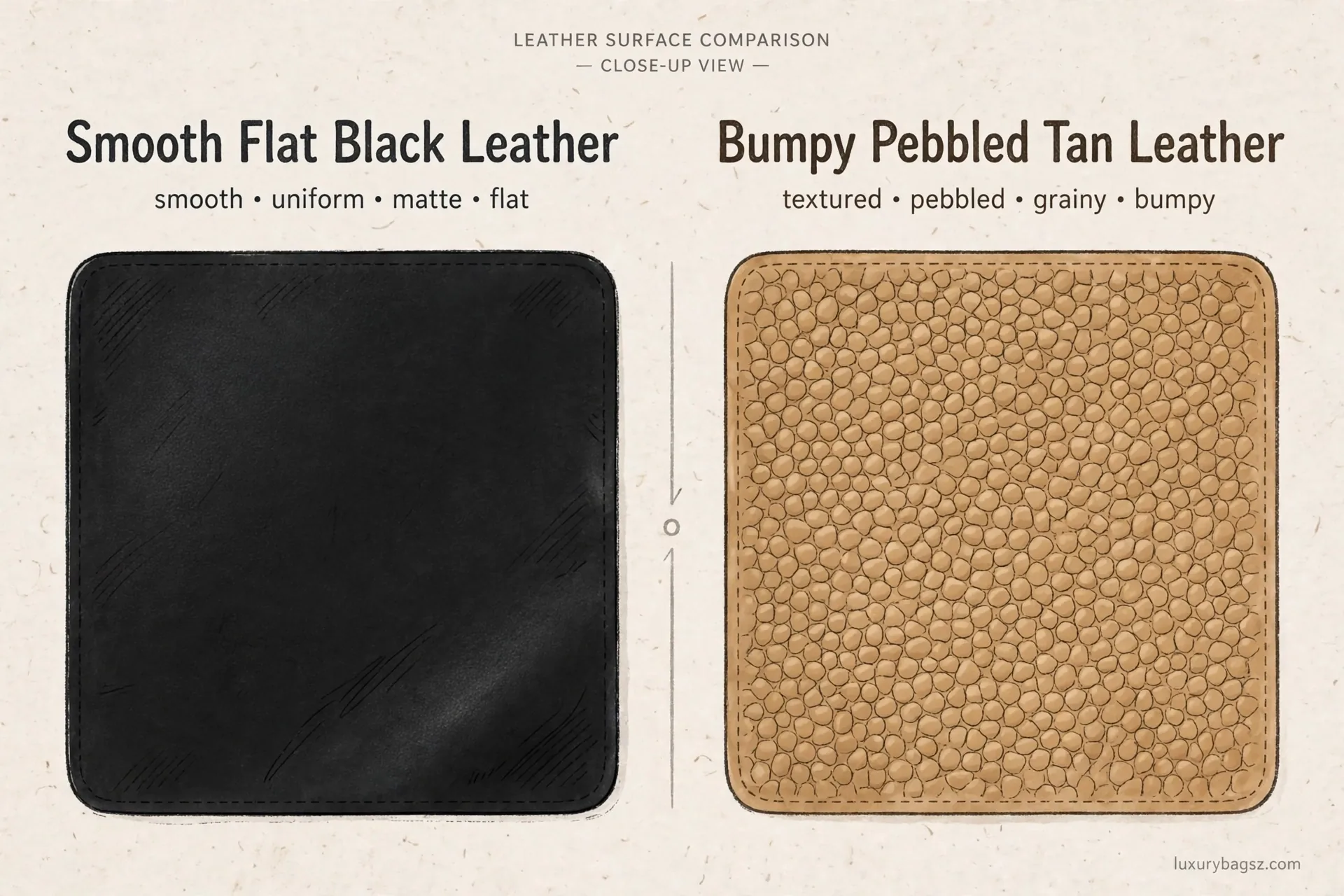
Smooth leather is the most common leather on shoes, bags and jackets. It has a flat, even surface with a fine pore structure, and it ranges from sturdy cowhide to delicate lambskin. Full-grain smooth leather shows natural pores and small marks, while corrected smooth leather looks almost perfectly uniform.
Care is straightforward: clean gently, condition now and then, and polish if you want shine. A light conditioner keeps the leather supple and stops it drying and cracking, which is the main way smooth leather ages badly. Condition every few months for everyday pieces, and more often for items worn in sun or dry air.
Very soft smooth leather needs a lighter hand. Nappa leather is famously soft and porous, and it is rarely waxed, because wax would change its natural feel. Use a light balm made for nappa rather than a heavy wax polish, and protect it from water and dye transfer.
What to avoid: soaking, harsh solvents, and silicone-heavy sprays that sit on the surface and trap dirt in the pores. Test any new product on a hidden spot first. For a full routine, the guide to Saphir Renovateur covers a conditioner that suits most smooth leathers.
Pebbled and Grained Leathers
Pebbled leather is smooth leather with a raised, bumpy grain, either natural from tumbling the hide or pressed in with a heated plate. The texture is the point: it hides scratches and scuffs that would show plainly on smooth leather, which makes it one of the most practical choices for everyday bags.
Care is nearly the same as smooth leather, with one difference: use polish lightly. Heavy wax builds up in the grooves of the grain and leaves a white residue, especially after contact with water. A soft cloth and a light cream, worked in thinly, keep the grain clean without clogging it.
A stiff bristle brush helps after polishing, since it clears cream from the grooves. This matters most on dark pebbled leather, where white residue shows up fastest. Apart from that, condition on the same schedule as smooth leather and protect from prolonged sun, which fades dyed grain unevenly.
Chanel's caviar leather is the famous example of a pebbled calfskin, prized exactly because it shrugs off daily wear. The comparison of caviar vs lambskin shows the trade-off well: pebbled grain for durability, smooth lambskin for softness and drape.
Suede
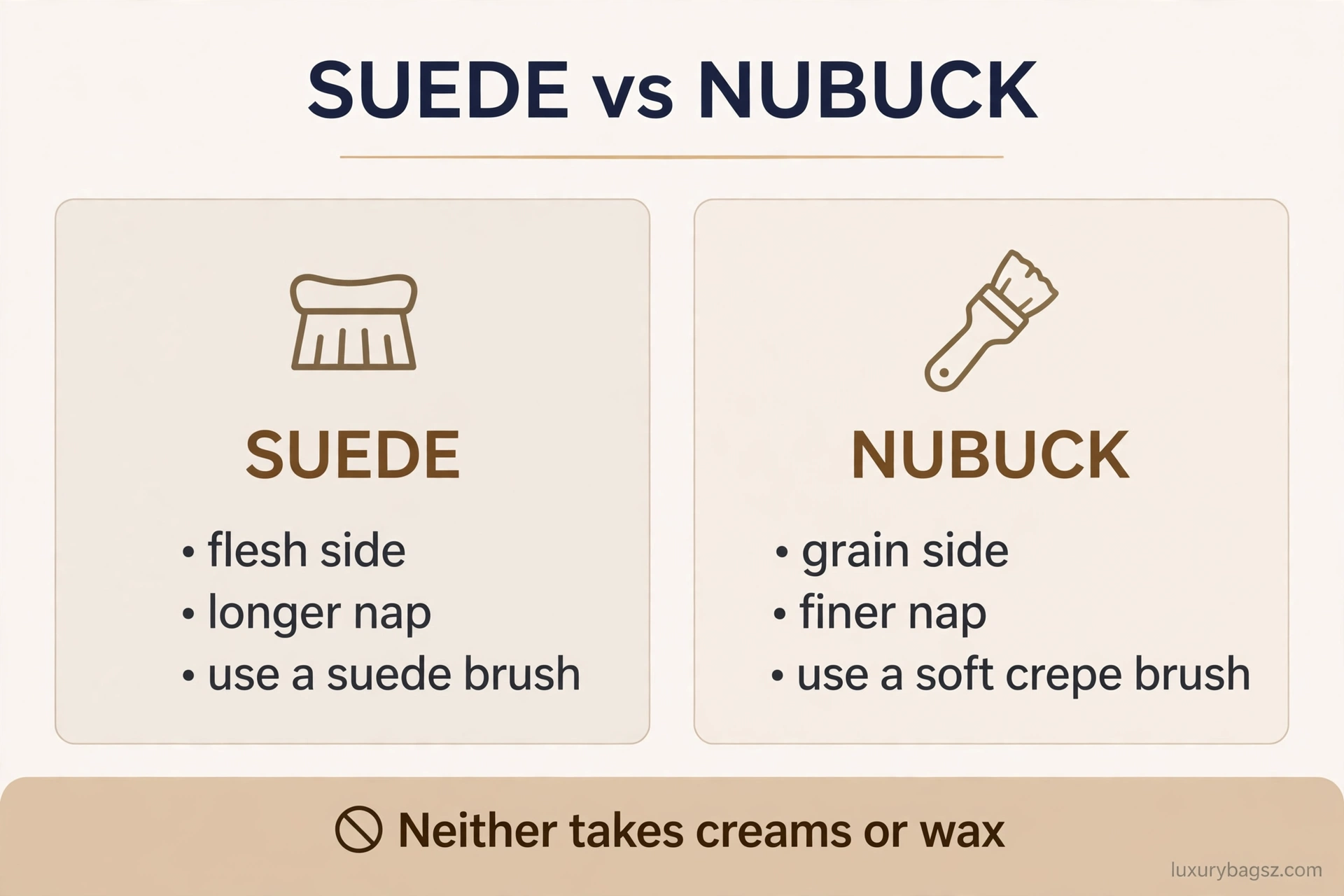
Suede comes from the flesh side of the hide, the inner layer, which is napped to raise soft fibres. It feels light and velvety, looks matte, and absorbs water and stains eagerly. That thirst is its weakness: a rain shower that smooth leather shrugs off can spot suede permanently.
Care is dry first, always. Brush regularly with a suede brush to lift dirt and keep the nap fluffy, and use a suede eraser for marks. For wet cleaning, use a shampoo made for suede, applied sparingly, and let the piece dry fully at room temperature before brushing again.
Never use creams, waxes or ordinary leather conditioner on suede. These products coat the fibres, flatten the nap, and can darken or stain the surface. Protective sprays made for suede are the exception, and they should be applied to clean, dry suede before first wear and topped up now and then.
Sources disagree on how water-resistant treated suede really is. Some makers claim good protection from sprays, while repairers warn that no spray makes suede truly rainproof. The safe reading is that spray helps with light splashes, but suede is still the wrong choice for wet weather.
Nubuck
Nubuck looks like suede but comes from the opposite side of the hide. It is the grain side, lightly sanded to a very fine, velvety nap. The result is stronger than suede, with a tighter, more refined feel, but it is just as sensitive to water and oil, and its nap is more delicate.
That delicacy changes the brush. A stiff suede brush can damage nubuck, so use a soft crepe brush instead, with a very light hand. Brush only when the piece is fully dry, and brush in one direction to keep the nap even. Heavy scrubbing flattens the nap and leaves shiny patches.
Cleaning follows the suede rules: dry methods first, suede shampoo sparingly for stains, and no creams or waxes. Nubuck also stains easily from skin oils, so handle light-coloured nubuck with clean hands and keep it away from denim dye and dark straps.
Nubuck suits shoes and bags that get careful use, not hard daily wear in bad weather. If you love the look but live in a rainy climate, treat it before first wear and accept that it will need more attention than smooth or pebbled leather. For the same reason, nubuck is a poor choice for children's shoes or work boots that face mud daily.
Cordovan
Cordovan, properly shell cordovan, comes from a small oval of horsehide on the horse's rump. It is dense, glossy and famously hard-wearing, and it creases in soft rolls rather than sharp lines. It is also rare and expensive, which is why it appears mostly on premium shoes and small leather goods.
Care is refreshingly minimal. Brush often, wipe with a slightly damp cloth, and condition only every few months, because cordovan is already rich in oils. Too much conditioner can over-soften it, so a thin coat of a cordovan cream, well buffed, beats a heavy application.
One quirk to know: cordovan can develop a whitish bloom as oils rise to the surface. This is normal, not damage, and it brushes away easily. New owners often mistake bloom for mould or dryness, and over-condition in response, which is the opposite of what the leather needs.
For the myths around this leather, including whether it creases and whether it is worth the price, the guide to shell cordovan myths covers each claim in full. This overview keeps the care summary short on purpose, so the deep dive stays the place for detail.
Exotic and Reptile Leathers
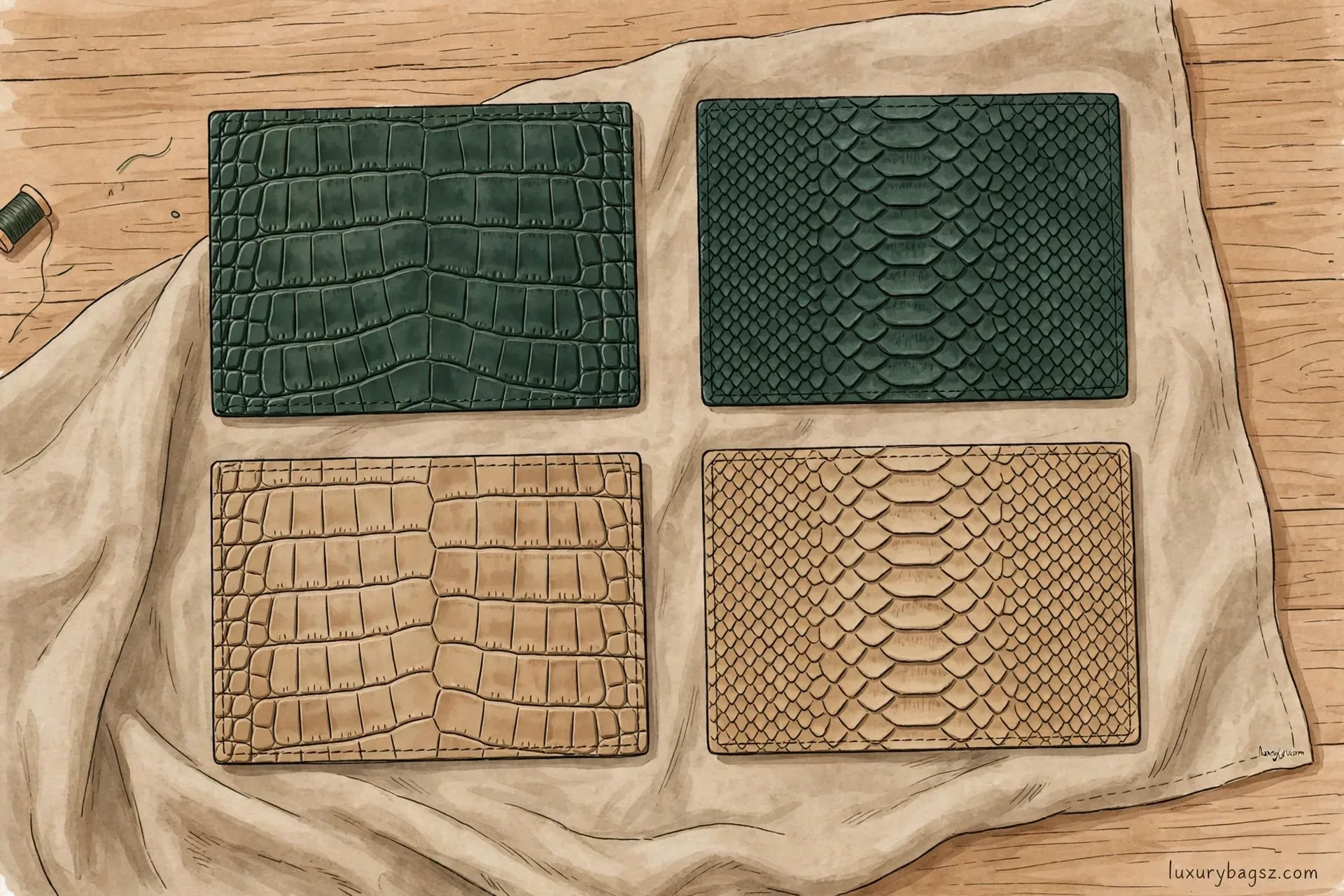
Exotic leathers include crocodile, alligator, lizard, snake and ostrich, and each behaves differently from cowhide. Crocodile and alligator have large, defined scales; smaller scales and fewer panels usually mean a more expensive piece. Lizard and snake have finer, more fragile scales.
The shared risk is drying. Reptile skins are not very porous, and they crack if starved of moisture, so regular conditioning with a reptile-specific balm matters more than with cowhide. Clean gently with a soft cloth and a mild leather soap, and never soak an exotic piece.
Ostrich is the softest exotic, with its distinctive quill pattern, and it takes a light balm well. Snake and lizard need the lightest touch of all: their scales can lift if brushed hard or bent sharply, so store exotic pieces stuffed, unbent, and away from heat.
Embossed leather is not the same as exotic leather. It is ordinary cowhide or calfskin pressed with a reptile pattern, and it cares like the cowhide underneath, not like the animal it imitates. Check the label: honest embossed leather names the real leather beneath the pattern.
Patent Leather
Patent leather is smooth leather coated with a varnish or lacquer that gives a hard, mirror-like shine. It is water-resistant, wipes clean easily, and suits evening bags and formal shoes. The coating is also its weakness: it can crack if folded sharply and can pick up dye from other materials.
Care is the simplest of any leather here. Wipe with a soft, slightly damp cloth, and use a patent-specific cleaner for scuffs and dullness. That is usually the whole routine, and it needs doing far less often than conditioning smooth leather.
What to avoid matters more than what to use. Do not apply wax polish, heavy creams or ordinary conditioner to patent, since these can cloud the coating or leave a sticky film. Do not store patent against other patent pieces or dark dyed materials, because colour can transfer and stick.
For scuffs, try a patent cleaner on a soft cloth first, working in small circles. Deep scratches that cut through the coating cannot be polished away, and touch-up products rarely match the original gloss. In that case, a professional repairer is a better bet than layering on more product at home.
Heat is the other enemy. Patent stored in a hot car or near a radiator can soften, stick to neighbouring surfaces, and peel when pulled apart. Store patent pieces separately, in cloth bags, at room temperature, and never folded.
Care at a Glance and Costly Mistakes
The universal rules work across all seven families. Clean before you condition, condition before you protect, and test every new product on a hidden spot. Store leather stuffed, in a breathable dust bag, away from sun, damp and heat, and never in sealed plastic, which traps moisture.
The single costliest mistake is using one product on everything. A cream that revives smooth leather will ruin suede, a wax that shines calfskin will cloud patent, and a stiff brush that suits suede will damage nubuck. Keep at least two routines: one for smooth and grained leathers, one for napped leathers.
Seasonal care is worth a note too. Winter salt and slush attack smooth leather and stain suede, so wipe shoes and bags down after wet days and reapply protector before the season starts. Summer sun fades dyed leather unevenly, so keep prized pieces out of direct window light during storage.
The second mistake is over-conditioning. More product does not mean more protection; it means sticky surfaces, darkened colour and, on cordovan and exotics, a dulled finish. Thin coats, fully absorbed, beat thick coats every time, and most leathers need conditioning only a few times a year.
For a fuller routine covering cleaning, conditioning, protection and storage across bags and shoes, the guide to leather bags and shoes care is the natural next read. Start with identification, match the product to the leather, and the rest of leather care becomes straightforward.
Frequently Asked Questions
How do I tell suede from nubuck?
Suede has a longer, looser nap from the flesh side of the hide, while nubuck has a very short, fine nap from the sanded grain side. Nubuck feels tighter and more refined, and a stiff suede brush can damage it, so use a soft crepe brush.
Can I use ordinary leather conditioner on suede?
No. Creams and waxes coat the fibres, flatten the nap, and can stain suede permanently. Use a dry brush, a suede eraser, and suede shampoo sparingly, plus a spray made for suede.
What is the difference between full-grain and top-grain leather?
Full-grain keeps the whole grain layer with natural pores and marks, and develops a patina. Top-grain is lightly sanded and coated, so it looks more uniform and resists stains, but ages with less patina.
Is patent leather real leather?
Usually yes: it is real leather coated with a varnish or lacquer for shine. The coating, not the hide, decides the care, which is why patent needs only a damp cloth and patent cleaner.
Why does my cordovan have white marks on it?
That is bloom, oils rising to the surface, and it is normal for cordovan. Brush it away gently. It is not mould or dryness, and over-conditioning in response will do more harm than good.
Which leather is best for an everyday bag?
Pebbled or full-grain cowhide. Pebbled grain hides scuffs, full-grain ages well, and both survive daily use far better than lambskin, suede or bonded leather.
Can exotic leather be repaired if it cracks?
Small dryness can sometimes be improved with reptile balm, but cracked scales and split skins are very hard to repair well. Prevention through regular conditioning matters far more than any fix.
Does nubuck need waterproofing spray?
A spray made for suede and nubuck helps with light splashes, but it does not make nubuck rainproof. Treat before first wear, reapply now and then, and still avoid heavy rain where possible.
What does "genuine leather" on a label really mean?
It means real leather, but usually a lower grade: a split from below the grain layer, sanded and sprayed with pigment. It is not a mark of quality, despite how it sounds.
How often should I condition smooth leather?
Every few months for everyday pieces, less for items used rarely, and more often for pieces exposed to sun or dry air. Thin coats, fully absorbed, are better than one heavy coat.
Summary
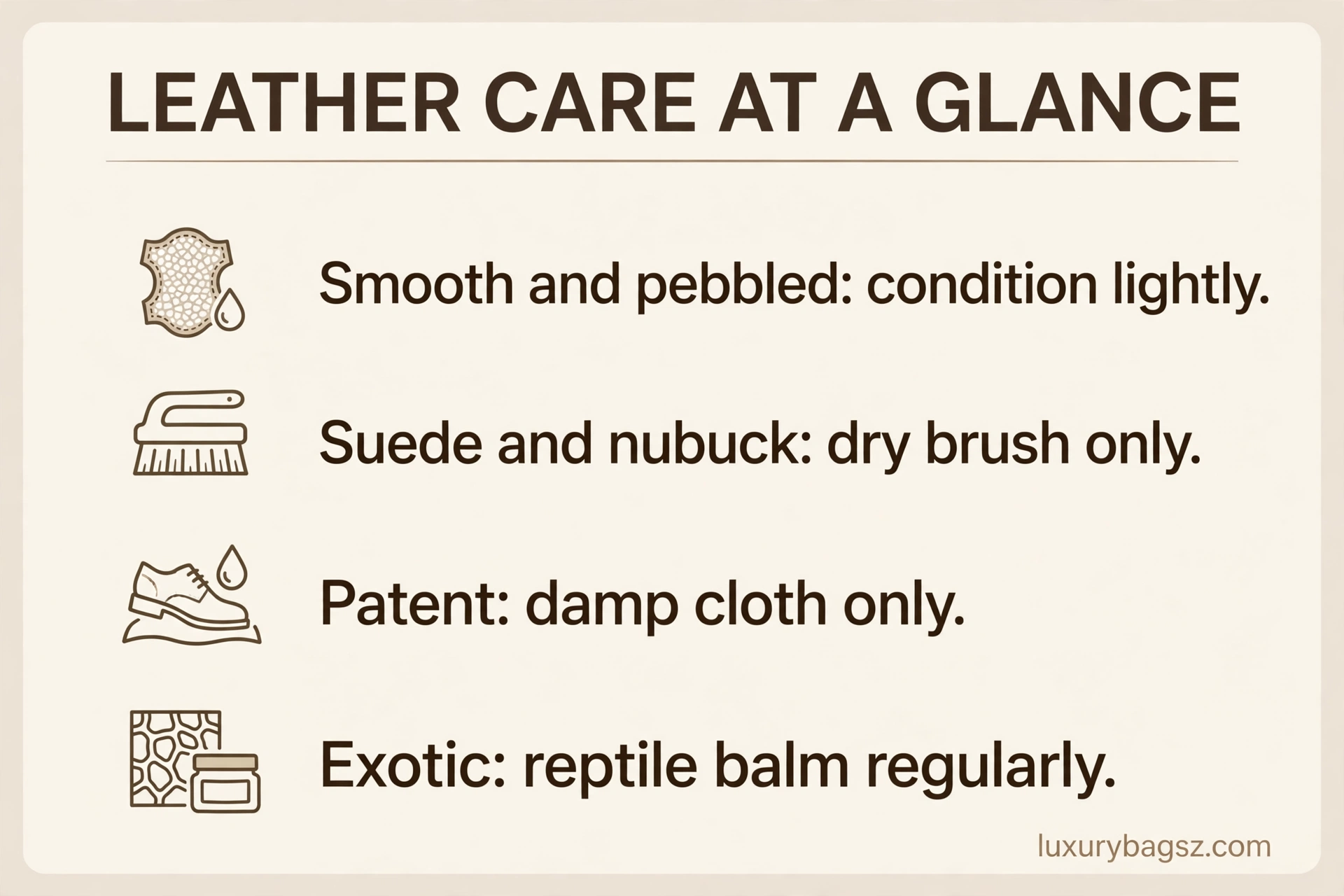
Identify first, then care. Smooth and pebbled leathers reward conditioner, suede and nubuck reward a dry brush, cordovan rewards restraint, exotics reward regular balm, and patent rewards leaving it alone. Match the product to the leather and most leather problems never start.
Keep this guide as your map and follow the linked deep dives for nappa and cordovan when those leathers matter to you. Good leather lasts decades with the right routine, and it is the wrong product, not the leather, that usually shortens its life.






