Chanel Caviar vs Lambskin: Which Leather Is Right for You?
Caviar or Lambskin in Brief
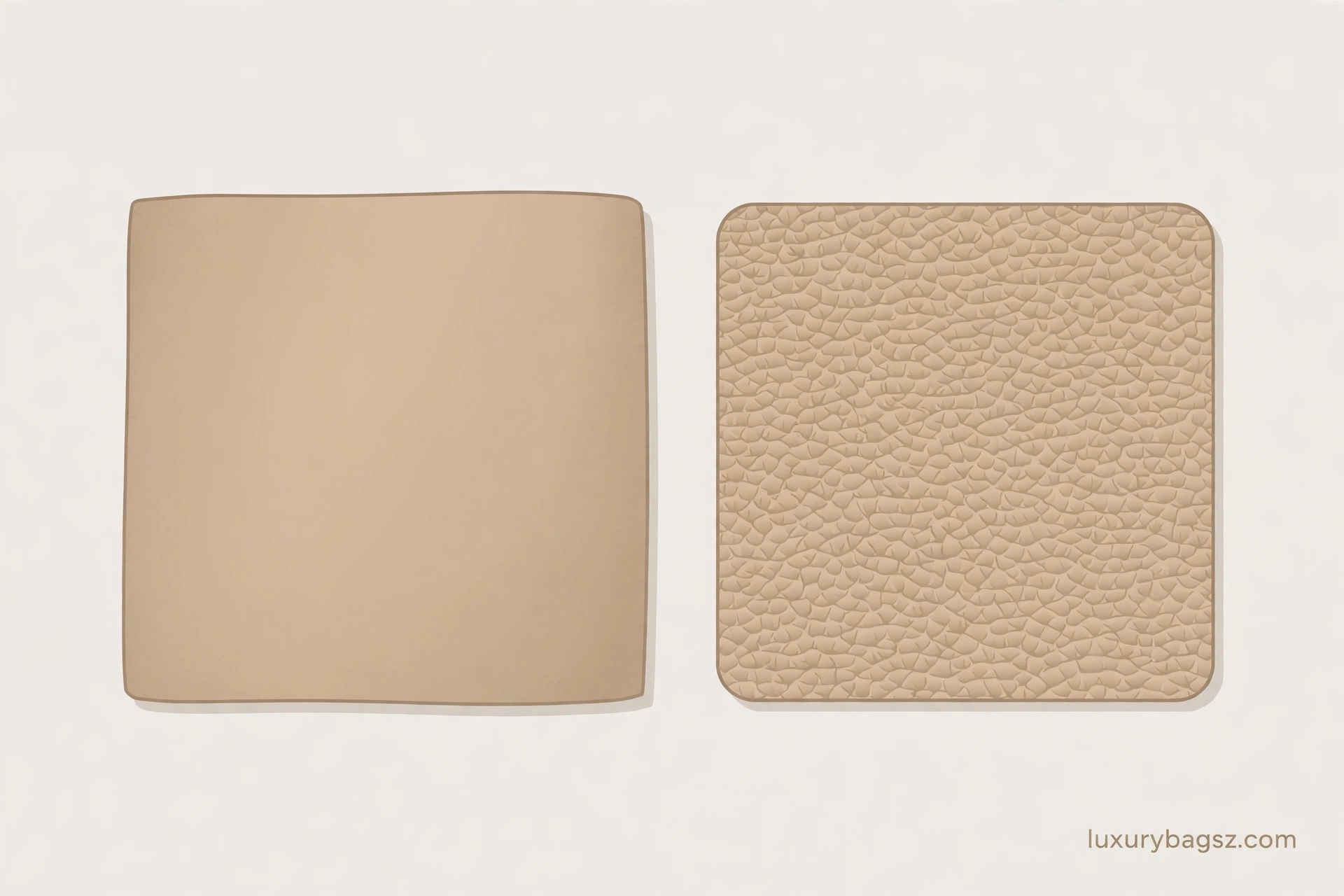
Caviar and lambskin are Chanel's two core leathers, and the choice between them matters more than the choice between most bag styles. Lambskin is smooth, buttery and delicate. Caviar is grained calfskin: pebbled, structured and far more forgiving of scratches. Everything else — durability, care, storage, resale — follows from that contrast.
The short answer: buy caviar if you will carry the bag daily, in all weathers, and want it to look good with minimal fuss. Buy lambskin if you love the softest feel and the most luxurious look, and you accept careful handling, gentler use, and more visible wear over time. Colour changes the equation: pale caviar can need more vigilance than dark lambskin, so judge colour and leather together, never leather alone.
One warning applies to the whole guide. Care-product advice conflicts directly across competitor guides, and no single product is universally safe. The care routines section states the conflict plainly and gives the rule that protects you: test any product on a hidden spot first, and ask Chanel or a specialist before applying anything you are unsure about.
Key Takeaways
- Lambskin is smooth, buttery and delicate; caviar is pebbled, structured and far more forgiving of scratches.
- Caviar suits daily, all-weather use; lambskin suits careful, occasion use and buyers who prize softness above toughness.
- Care advice conflicts: one guide allows a damp cloth with pH-neutral soap for caviar, another says do not use water at all, and a third warns products may darken or streak — test on a hidden spot first.
- Condition caviar 2–3 times a year by one guide, once a year by another; a bag spa every 1–2 years runs about $100–$300.
- Store bags upright in a dust bag, stuffed with acid-free tissue, chains wrapped in tissue, out of sun, heat and humidity, at roughly 40–50% humidity.
- Pale caviar can need more vigilance than dark lambskin — judge colour and leather together.
- On pre-owned bags, check lambskin for scuffs and refinishing, and caviar for worn grain and corners; leather condition directly affects resale value.
The Core Contrast
Every competitor guide agrees on the core contrast, and it is the foundation of this whole comparison. Lambskin is smooth, buttery and delicate: it feels soft the moment you touch it, drapes beautifully, and gives a bag its most luxurious hand-feel. Caviar is grained calfskin: its pebbled surface is firmer, more structured, and far more forgiving of scratches, scuffs and daily knocks.
That contrast decides the rest. A lambskin bag shows its life more quickly, because its smooth surface has nowhere to hide a mark. A caviar bag hides small marks in its grain, holds its shape better when carried loaded, and forgives the kind of contact — keys, doorframes, car seats — that marks lambskin on first touch. Neither leather is better in the abstract. The question is always which set of trade-offs fits your life.
What Caviar Actually Is
Caviar is not a separate animal or a coating. It is calfskin that has been treated to give it a pebbled, grained surface, and that grain is the whole point: it adds structure, hides small marks, and makes the leather more resistant to scratches than a smooth skin. A caviar bag feels firm and slightly textured, holds its quilted shape well, and looks much the same after years of use as it did when new, provided its corners and edges are looked after.
Caviar's firmness has a cost. It is heavier and stiffer than lambskin, so a large caviar bag carried loaded feels more substantial, and its structured shape shows dents more clearly than a soft bag would. Its grain can also wear smooth in high-contact areas — handles, flap edges, base corners — and once the pebbling is rubbed away, that patch looks different from the rest of the bag. Check those areas first on any pre-owned caviar bag.
What Lambskin Actually Is
Lambskin is the skin of young sheep, and its appeal is its softness. It is smooth, buttery and supple, with a fine, almost silky surface that makes a quilted bag look and feel exceptionally luxurious. It drapes rather than holding a rigid shape, which suits smaller flap bags beautifully and gives larger bags a softer, more relaxed silhouette.
That softness is also its weakness. Lambskin scratches easily, scuffs on contact with rough surfaces, and shows colour loss where it rubs repeatedly. It absorbs oils from hands and creams more readily than caviar, and it is more vulnerable to water marks, perfume and makeup. A lambskin bag rewards careful handling: carried on the shoulder rather than set on rough surfaces, kept away from rain where possible, and stored with the same care described in the storage section.
Look and Feel Side by Side
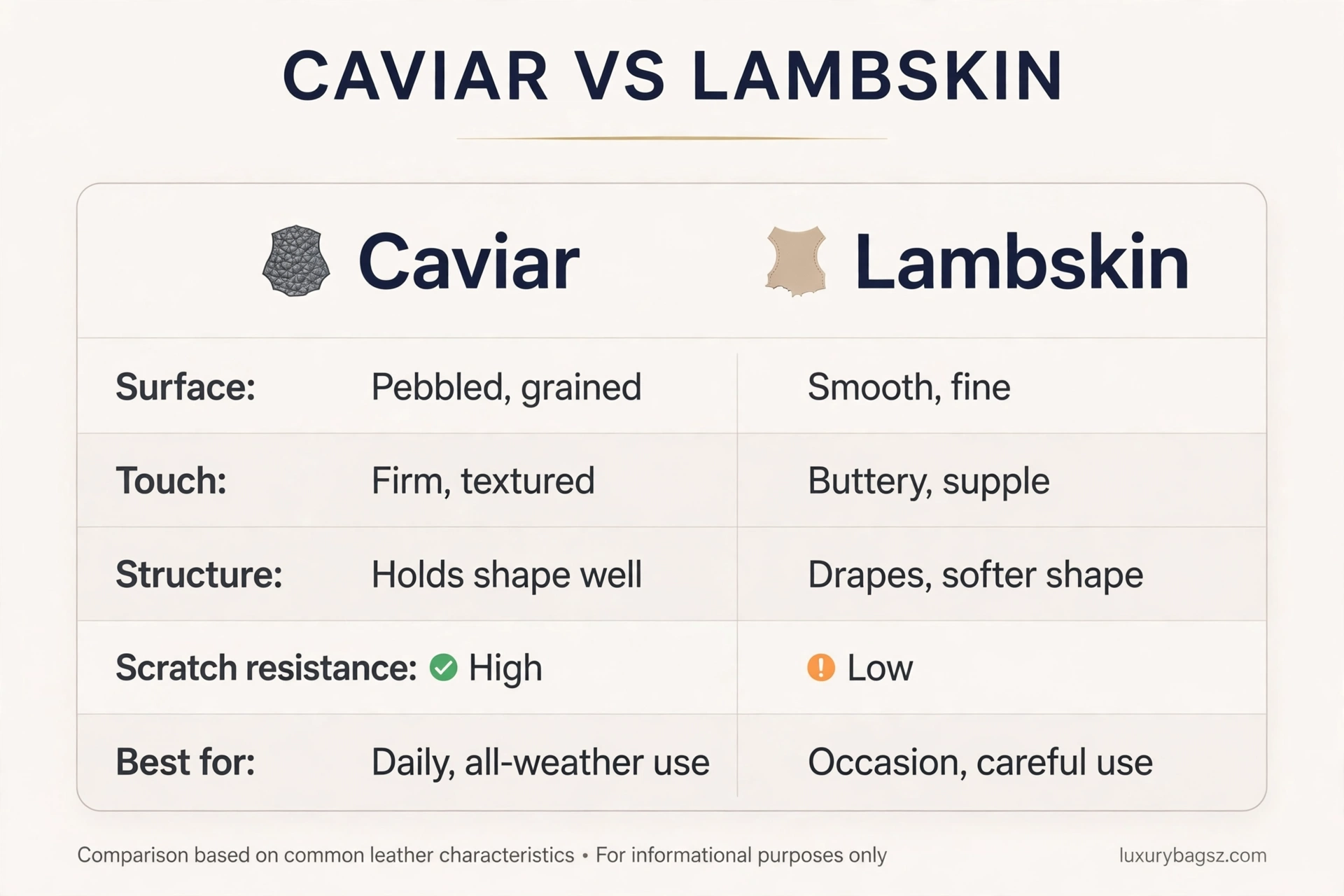
No competitor guide gives a clean side-by-side table for the two leathers, so here is one. It is the table to check before believing any listing that calls a bag "durable lambskin" or "soft caviar" — both phrases are marketing, not leather science.
| Feature | Caviar | Lambskin |
|---|---|---|
| Surface | Pebbled, grained | Smooth, fine |
| Touch | Firm, textured | Buttery, supple |
| Structure | Holds shape well | Drapes, softer shape |
| Scratch resistance | High, grain hides marks | Low, marks show quickly |
| Weight | Heavier, stiffer | Lighter, softer |
| Ageing | Grain may wear smooth at contact points | Scuffs, colour loss, softening |
| Best for | Daily, all-weather use | Occasion, careful use |
The table's message is simple: caviar forgives, lambskin flatters. A caviar bag looks good with less effort. A lambskin bag looks extraordinary with more effort, and less good without it.
Durability in Daily Use
Daily use is where the two leathers separate most clearly. Caviar survives commuting, travel and shopping with far fewer visible marks: its grain absorbs small knocks, its structure resists sagging when loaded, and its corners tolerate contact with pavements and car boots better than lambskin's. A caviar bag used daily for a year typically looks lightly worn; a lambskin bag used the same way typically looks clearly worn.
Lambskin's weak points are specific. Flap edges and front faces scratch first, because they meet the world every time the bag is carried. Base corners scuff where the bag is set down. Handles darken and soften where hands grip them, and light-coloured lambskin picks up colour transfer from dark clothing, especially denim. Caviar's weak points are different: worn-smooth grain at handles and corners, and edge wear where the structured shape meets hard surfaces. Inspect the leather's own weak points, not the other leather's, when judging condition.
Weather and Accidents: Rain, Spills and Sun
Rain is the accident most owners face, and the two leathers respond differently. Caviar tolerates a rain shower better than lambskin: its grained surface sheds light rain, and a quick blot and air-dry usually leaves no mark. Lambskin is more vulnerable: rain can leave water marks, and a soaked lambskin bag needs careful drying to avoid stiffness and staining.
If either leather gets caught in rain, follow the same protocol. Blot gently with a soft, dry cloth — never rub, since rubbing spreads water and can mark the surface. Let the bag air-dry naturally at room temperature, stuffed lightly to hold its shape, away from direct heat, radiators and hairdryers, which can stiffen leather and set marks. Do not use the bag again until it is fully dry, and check the lining too, since a wet lining can mark leather from the inside. For sun, the rule is shared: prolonged sun fades colour and dries leather on both types, so never store or display a bag in direct sunlight.
Stain by Stain: What to Blot, What Never to Rub, When to Stop
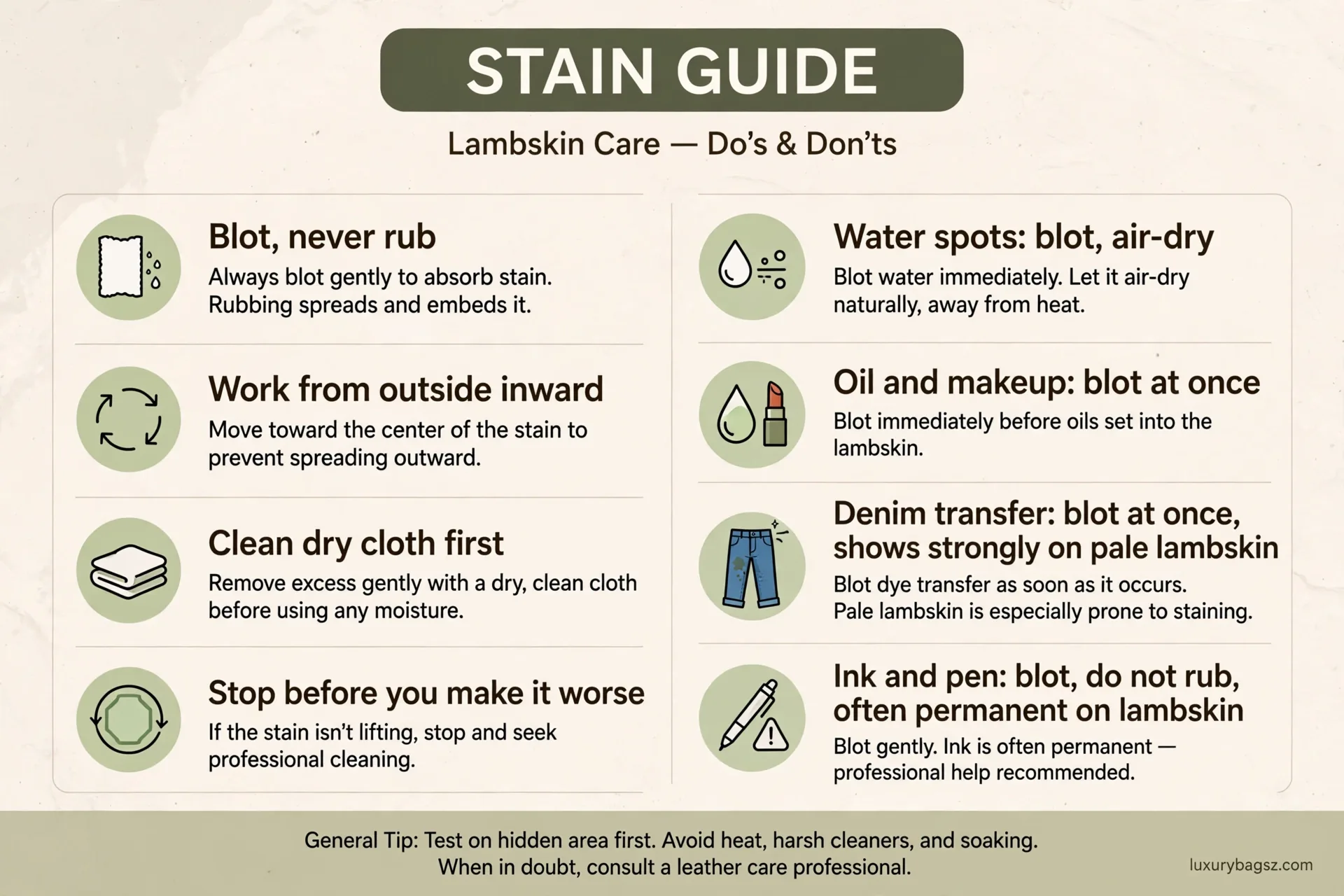
No competitor guide gives a stain-by-stain table, so here is one built from the guides' shared principles. The universal rules come first: blot, never rub; work from the outside of a mark inward; use a clean, soft, dry cloth first; and stop before you make the mark worse — a professional clean is cheaper than a home repair gone wrong.
| Stain | Caviar | Lambskin | When to stop |
|---|---|---|---|
| Water spots | Blot, air-dry; usually fades | Blot immediately, air-dry; marks linger more | If a ring remains after drying, go professional |
| Rain soaking | Blot, stuff lightly, air-dry naturally | Same, but expect longer drying and check for stiffness | If leather feels stiff or stained after drying, go professional |
| Oil and makeup | Blot at once, do not spread; light marks may lift | Blot at once; oils absorb faster and mark more | If the mark darkens or spreads, stop and go professional |
| Denim transfer | Blot, gentle wipe; grain hides light transfer | Blot at once; transfer shows strongly, especially on pale colours | If colour remains after gentle blotting, go professional |
| Ink and pen | Blot, do not rub; ink rarely lifts fully at home | Same, with lower expectations — ink on lambskin is often permanent | Stop immediately if rubbing spreads the ink; go professional |
| Perfume and hand cream | Blot, air-dry; oils can darken the spot | Blot at once; perfume and creams mark and darken more readily | If darkening appears, stop and go professional |
For sticky spills on caviar, one guide adds a specific step: after blotting, a dab with distilled water on a clean cloth can help, but only after blotting and only on caviar, never as a first resort on lambskin. Test any damp method on a hidden spot first, and never soak either leather.
Care Routines by Leather, With the Product Conflict Stated
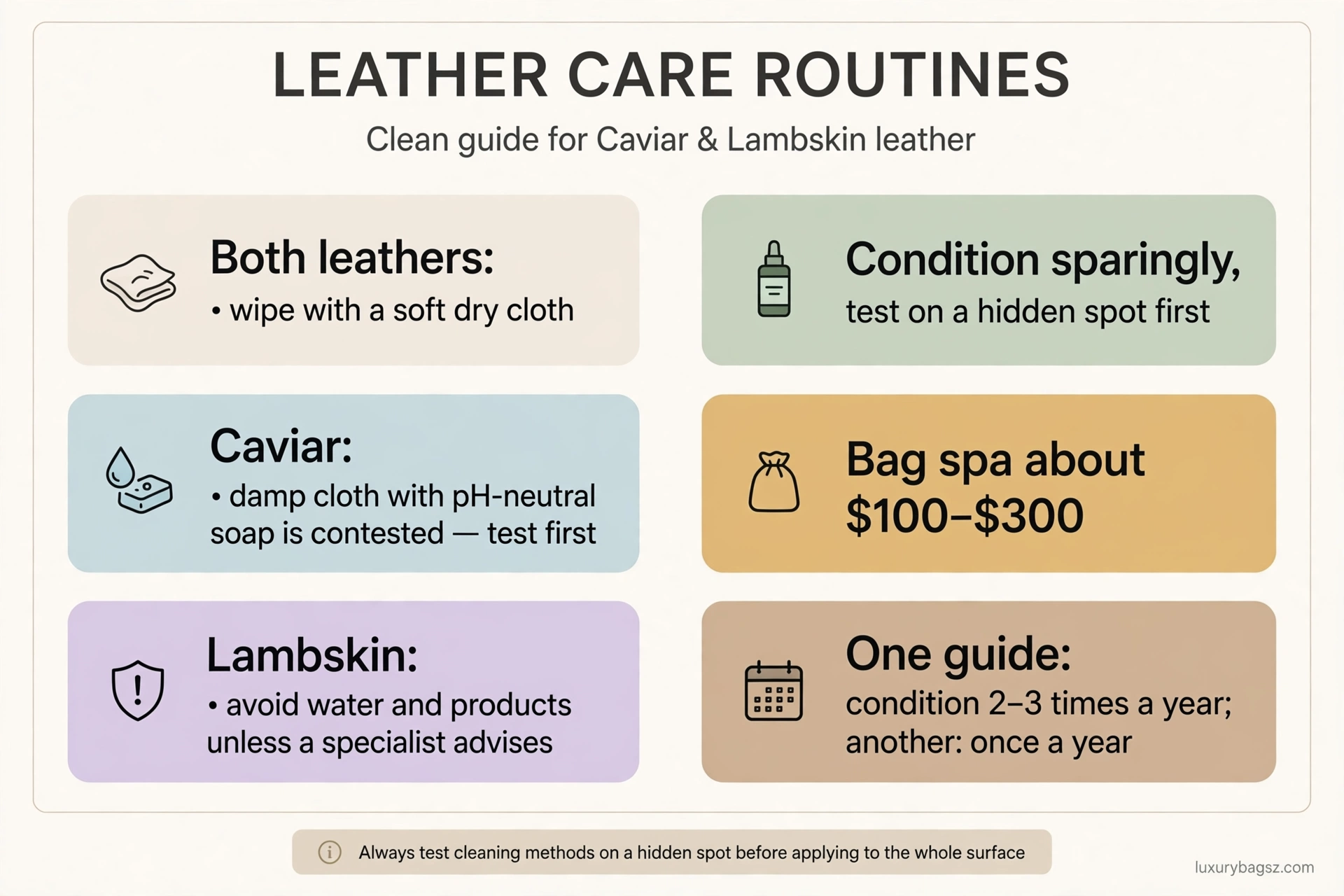
Care-product advice conflicts directly across competitor guides, so this part states the conflict rather than picking a winner. One guide names Cadillac Select and Apple Brand Leather Care, recommends conditioning 2–3 times a year (every 3–4 months with daily use), and allows a damp cloth with pH-neutral soap for caviar. Another guide says do not use water at all, warning that water lines and stains depend on local hardness, recommends Collonil 1909 Neutral Leather Cream, and says condition once a year plus a bag spa every 1–2 years. A third guide warns that conditioners and waterproofing agents may darken, streak or change sheen, and says to ask Chanel or a specialist before applying any product.
The safe routine follows from that conflict. For both leathers, wipe regularly with a soft, dry microfibre cloth, and keep bags out of sun, heat and humidity. For caviar, the damp-cloth method is the contested point: if you use it, use a barely damp cloth, test on a hidden spot first, and never soak the leather. For lambskin, avoid water and products unless a specialist advises them, since its smooth surface shows every change. For both, condition sparingly if at all, test on a hidden spot first, and prefer a professional spa — about $100–$300 per one guide — over an untested home product. Our guide on how to clean Chanel bags covers gentle cleaning routines in detail.
Storage and Climate
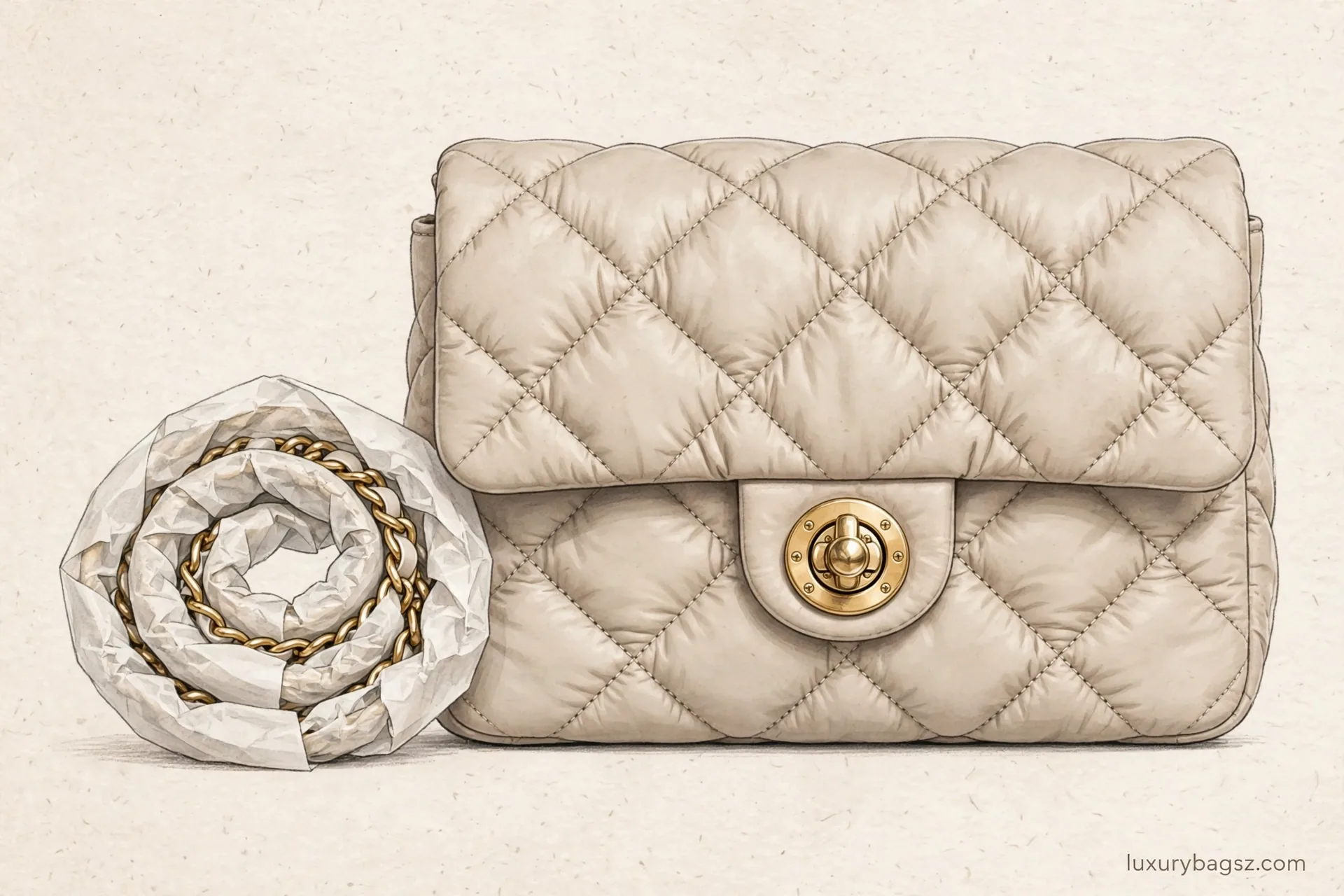
Storage is where good bags stay good, and the guides agree more here than anywhere else. Store bags upright in their dust bags, stuffed with acid-free tissue so they hold their shape without stretching. Wrap chains in tissue so they cannot scratch the leather or leave imprints on the flap. Keep bags out of direct sun, away from heat sources and radiators, and out of damp rooms.
Humidity deserves a number. One guide gives a storage humidity range of 40–50%, with silica gel packets placed near the bag but not touching it, since direct contact can mark leather. That range is the practical target: too dry and leather stiffens and cracks, too damp and mould and mustiness follow. Do not hang bags by their chains for long periods, since the weight stretches chains and pulls at attachment points. Do not stack bags, since weight flattens quilting, and do not store a bag in a sealed plastic bag, since trapped moisture damages leather far faster than dust does.
Hardware and Quilting Care
Hardware and quilting care is the area competitor guides mention only in passing, so here is the fuller version. Plating wears first on the CC lock face, the chain links and the turn-lock edges, and it wears faster on bags carried daily. Wipe hardware with a soft, dry cloth, keep it away from perfume, hand cream and water, and accept that heavy use will eventually thin plating — replating is a specialist job, and a poor replate lowers value more than honest wear does.
Chain imprints are the quiet flaw to check. A chain stored folded against the flap leaves curved imprints on the leather over time, and those imprints show more on smooth lambskin than on grained caviar. Always wrap chains in tissue before storage. Flattened quilting is the other quiet flaw: overfilling a bag stretches the diamond puffs flat, and the effect is worse on lambskin, whose soft puffs collapse more readily than caviar's firm ones. Carry what the bag was designed to hold, and no more, if you want the quilting to stay puffed.
Colour Changes Everything
Colour is the factor buyers underestimate, and one guide states it better than the rest: pale caviar can need more vigilance than dark lambskin, and colour and leather must be judged together. A pale caviar bag shows denim transfer, dirt and scuffs more readily than a dark lambskin bag does, even though caviar is the tougher leather. A dark lambskin bag hides small marks better than a pale caviar bag, even though lambskin is the more delicate leather.
The practical rule follows. If you want a light-coloured bag — white, beige, pastel — buy caviar, since its grain hides transfer better than smooth lambskin, and accept that even caviar in a pale colour needs careful handling. If you want a dark bag — black, navy, dark burgundy — lambskin becomes a realistic daily choice, since its marks show less on dark colours. And whatever the colour, inspect light bags in bright light before buying pre-owned, since transfer and dirt hide in dim photos.
Which Leather for Which Buyer and Lifestyle
This decision guide is the part competitor guides never quite write, so here it is plainly. Buy caviar if you commute, travel, or carry your bag daily in all weathers; if you have children or pets; if you set your bag down on varied surfaces; or if you want one bag to do everything with minimal fuss. Caviar is the workhorse, and it is the right default for a first Chanel bag.
Buy lambskin if you love the softest feel and the most luxurious look; if you carry your bag mainly for occasions, evenings and careful days out; if you are happy to handle it gently, store it carefully, and accept visible wear over time; or if you already own a caviar workhorse and want something softer for contrast. Our full Classic Flap vs Boy bag comparison shows how the Classic's formal shape compares with a modern one, and the same logic applies here: match the leather to the life the bag will actually live. Avoid lambskin as your only bag if you need one bag for everything, and avoid caviar if what you truly want is the softest, most luxurious feel — no amount of durability compensates for a texture you do not love.

Pre-Owned Checklist by Leather, and Resale Impact
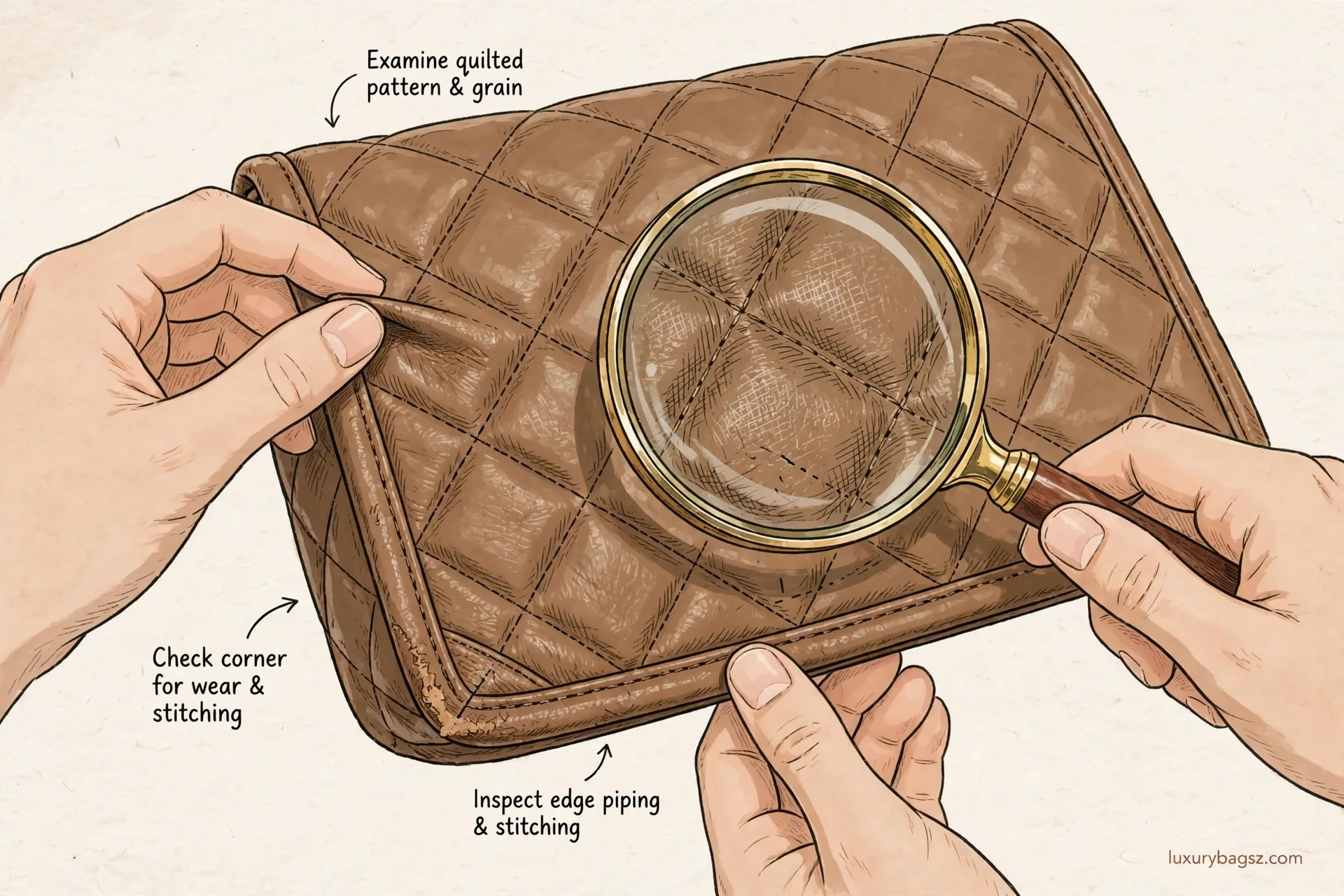
Pre-owned buying is where leather knowledge pays directly, and no competitor guide gives a material-specific checklist. For lambskin, check the flap edges and front face for scratches and scuffs, the base corners for wear, the handles for darkening and softening, and the whole bag for refinishing: a redyed lambskin bag may look clean in photos but trades lower than an honestly worn original, and redye can hide the very flaws you are checking for. Ask the seller directly whether the bag has been restored.
For caviar, check the grain: it should be even and intact, with no worn-smooth patches at handles, flap edges and corners. Check corners and edges for scuffs, and check the quilting for flattened puffs from overfilling. For both leathers, check the lining for pen marks and stains, the chain for plating wear, and the lock for smooth action. On resale, leather condition directly affects value: a well-kept caviar bag holds value better than a scuffed lambskin bag of the same style, and a bag spa at about $100–$300 can lift a tired bag's presentation, though it cannot undo deep scratches or worn grain.
How to Decide in Five Minutes
If you are still torn, decide in five minutes with three questions. First, how will you carry it? Daily and everywhere points to caviar; occasions and careful days point to lambskin. Second, what colour do you want? Pale points to caviar whatever your lifestyle; dark makes lambskin realistic even for regular use. Third, how do you feel about visible wear? If marks will bother you, buy caviar; if you accept wear as the price of softness, buy lambskin.
Then handle both leathers if you can before buying. Touch matters more than photographs: caviar's firm grain and lambskin's buttery smoothness are immediately obvious in the hand, and most buyers know their preference within seconds of touching both. Buy the leather you love touching, in the colour you will actually carry, for the life you actually live — and care for it by the rules in Parts 8 and 9, testing any product on a hidden spot first.
Frequently Asked Questions
Which is better, Chanel caviar or lambskin?
Neither is better in the abstract. Caviar is tougher, more structured and more forgiving of scratches, so it suits daily, all-weather use. Lambskin is softer, smoother and more luxurious to touch, so it suits careful, occasion use. Choose by your lifestyle, not by a ranking.
Is caviar leather more durable than lambskin?
Yes, clearly. Caviar's pebbled grain hides small marks, holds its shape better when loaded, and tolerates daily knocks far better than lambskin's smooth surface. A caviar bag used daily for a year typically looks lightly worn, while a lambskin bag used the same way typically looks clearly worn.
Does lambskin scratch easily?
Yes. Lambskin's smooth surface shows scratches, scuffs and colour loss quickly, especially on flap edges, front faces and base corners. Light marks can be honest wear, but deep scratches on a bag sold as excellent condition are a warning, and lambskin needs gentler handling than caviar.
Can caviar leather get wet?
It tolerates light rain better than lambskin, and a quick blot and air-dry usually leaves no mark. Never soak either leather, never use direct heat to dry a wet bag, and let any wet bag air-dry naturally at room temperature, stuffed lightly to hold its shape.
How do you clean caviar vs lambskin?
Wipe both regularly with a soft, dry microfibre cloth. Care products conflict across guides: one allows a damp cloth with pH-neutral soap for caviar, another says do not use water at all, and a third warns products may darken or streak. Test any product on a hidden spot first, and prefer a professional spa at about $100–$300 over an untested home product.
How often should you condition a Chanel bag?
Guides disagree: one says 2–3 times a year (every 3–4 months with daily use), another says once a year plus a bag spa every 1–2 years. Condition sparingly if at all, test on a hidden spot first, and ask Chanel or a specialist before applying any product you are unsure about.
How should you store caviar and lambskin bags?
Upright in a dust bag, stuffed with acid-free tissue, chains wrapped in tissue, out of sun, heat and humidity, at roughly 40–50% humidity with silica gel packets near but not touching the bag. Never hang bags by their chains, stack them, or store them in sealed plastic.
Does colour matter as much as leather?
Yes, sometimes more. Pale caviar can need more vigilance than dark lambskin, since pale colours show denim transfer, dirt and scuffs readily. Judge colour and leather together: pale points to caviar, dark makes lambskin realistic even for regular use.
Which leather holds its value better pre-owned?
Well-kept caviar generally holds value better than scuffed lambskin of the same style, because its condition survives daily use better. Leather condition directly affects resale: check lambskin for scuffs and refinishing, and caviar for worn grain and corners, before paying.
Should a first-time Chanel buyer choose caviar or lambskin?
Caviar, as the default. It is the workhorse: tougher, more forgiving, easier to care for, and easier to resell in good condition. Choose lambskin first only if you love its softness above all else and accept careful handling and more visible wear.
Final Verdict
Caviar and lambskin are not rivals competing for a single crown. They are two answers to two different lives. Caviar answers the life of daily carrying, all weathers, and minimal fuss: it forgives, it holds its shape, and it still looks good years later. Lambskin answers the life of softness, luxury and occasion: it flatters, it drapes, and it rewards the care you give it with a feel no other leather matches.
So choose by the life the bag will actually live, in the colour you will actually carry, and care for it by the rules that survive the guides' disagreements: dry wiping, careful storage, test-first products, and professional help before home experiments. A bag bought that way — in the right leather, for the right life — is a bag you will reach for without hesitation, and that is the only verdict that matters.