

History of Cartier: From a Paris Workshop to Jeweller of Kings
Cartier in Brief: The Paris Jeweller That Dressed Royalty
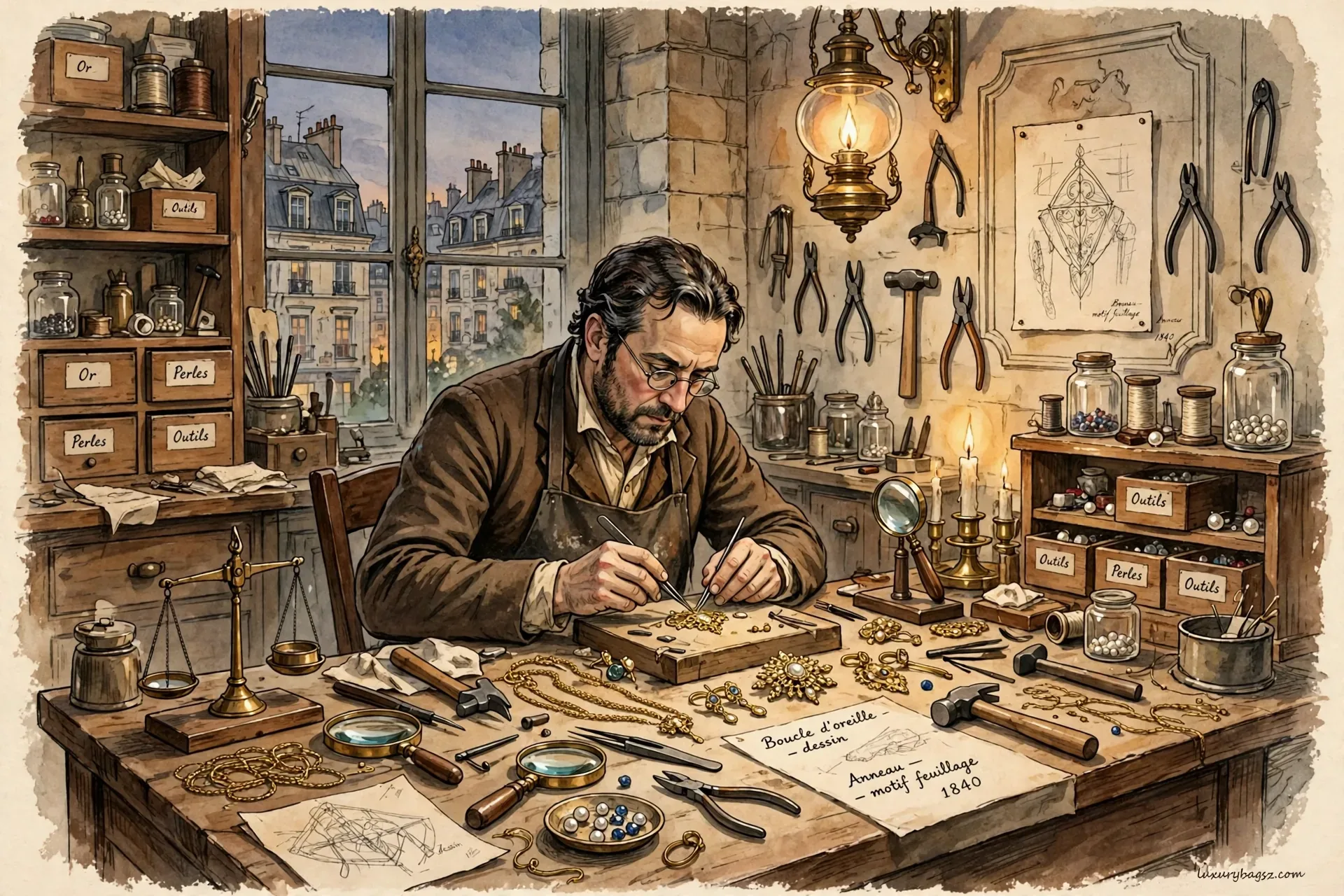
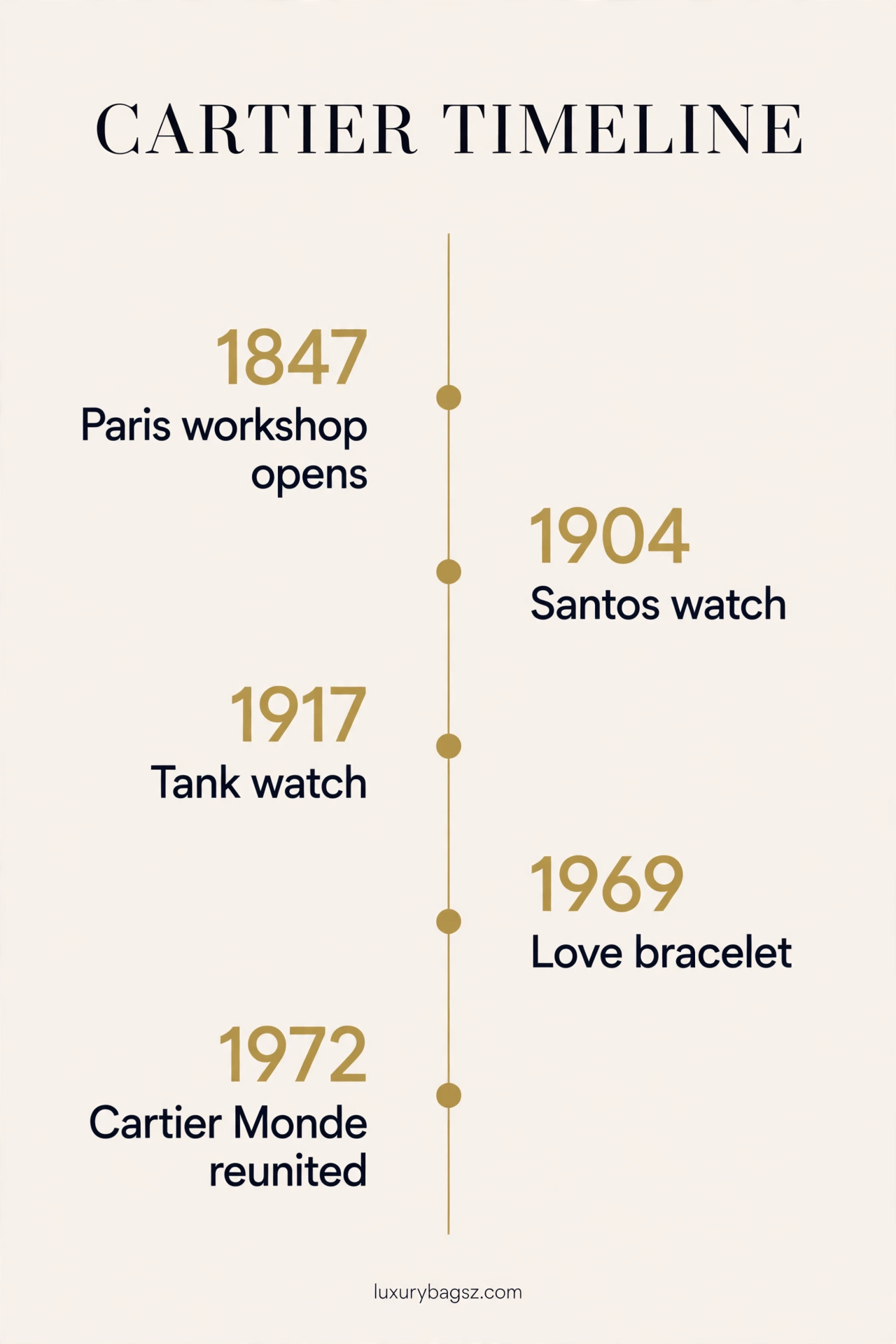
Cartier began in 1847, when Louis-François Cartier took over the Paris workshop of his master, Adolphe Picard, at 29 Rue Montorgueil. From that modest start, the house grew into one of the world's great jewellery and watch makers, earning the famous description "jeweller of kings and king of jewellers" through commissions for royalty, maharajas, and society figures across Europe and beyond.
The house's rise was a family story. Louis-François's son Alfred took over in 1874, and Alfred's three sons — Louis, Pierre, and Jacques — carried Cartier to Paris, London, and New York, turning a French workshop into a global maison. Their era produced the icons still worn today: the Santos watch of 1904, the Tank of 1917, and later the Love bracelet of 1969 and the Juste un Clou of 1971. Each of those icons has its own full guide in our complete Cartier guide collection.
Today Cartier is part of the Swiss Richemont Group, with boutiques worldwide and a thriving pre-owned market. Its history matters to buyers for a practical reason: knowing when a design was born, how it changed, and what marks to expect helps you choose well, avoid fakes, and understand why some pieces hold value while others do not.
Key Takeaways
- Cartier was founded in Paris in 1847 by Louis-François Cartier, who took over his master Adolphe Picard's workshop.
- Alfred Cartier took over in 1874; his sons Louis, Pierre, and Jacques built the Paris, London, and New York branches.
- The Santos (1904) was made for aviator Alberto Santos-Dumont, and the Tank (1917) was inspired by the military tanks of the First World War.
- The Love bracelet (1969) and Juste un Clou (1971), both designed by Aldo Cipullo in New York, brought Cartier to a younger generation.
- The family lost control in 1964; Cartier Paris was bought in 1972 and the branches reunited as Cartier Monde, now part of Richemont.
A Workshop on Rue Montorgueil
Louis-François Cartier was born in Paris in 1819 and entered the jewellery trade as an apprentice under Adolphe Picard. When Picard retired, the young Cartier took over the workshop, founding the house in 1847. Paris at the time was the centre of European taste, and a jeweller who could combine fine craftsmanship with restrained, elegant design had a ready audience among the city's wealthy residents.
Early Cartier pieces favoured simplified, refined forms over the heavily ornate styles then in fashion. That restraint became a house trait: Cartier jewellery rarely shouts, even when the stones are spectacular. The workshop's reputation grew steadily, and an early breakthrough came when Princess Mathilde, cousin of Emperor Napoleon III, bought Cartier pieces in the 1850s. Royal and aristocratic patronage followed, giving the young house both income and prestige.
In 1859 Cartier moved to the Boulevard des Italiens, a more prominent Paris address, and the business continued to grow. By the time Louis-François handed over to his son Alfred in 1874, Cartier was an established Paris jeweller. What it was not yet, however, was a global brand. That transformation would be the work of the third generation, three brothers with very different talents and a shared ambition.
Three Brothers, Three Cities
Alfred Cartier's sons divided the world between them. Louis stayed in Paris and led design, moving the boutique to 13 Rue de la Paix in 1899, in the heart of Parisian luxury retail. Pierre took New York, where his flair for spectacular deals became legend. Jacques took London, building relationships with the British aristocracy and the court. Together they made Cartier a name that royalty across continents recognised.
Pierre's most famous deal came in 1917, when he acquired the Plant mansion at 653 Fifth Avenue in New York — still Cartier's flagship today — in exchange for a pearl necklace and a sum of money. Accounts differ on the exact terms, with the famous version describing two strands of natural pearls valued at $1 million, but the outcome is not in doubt: Cartier gained one of Manhattan's grandest addresses, and the mansion remains a symbol of the house. The story shows Pierre's genius for theatre as well as commerce.
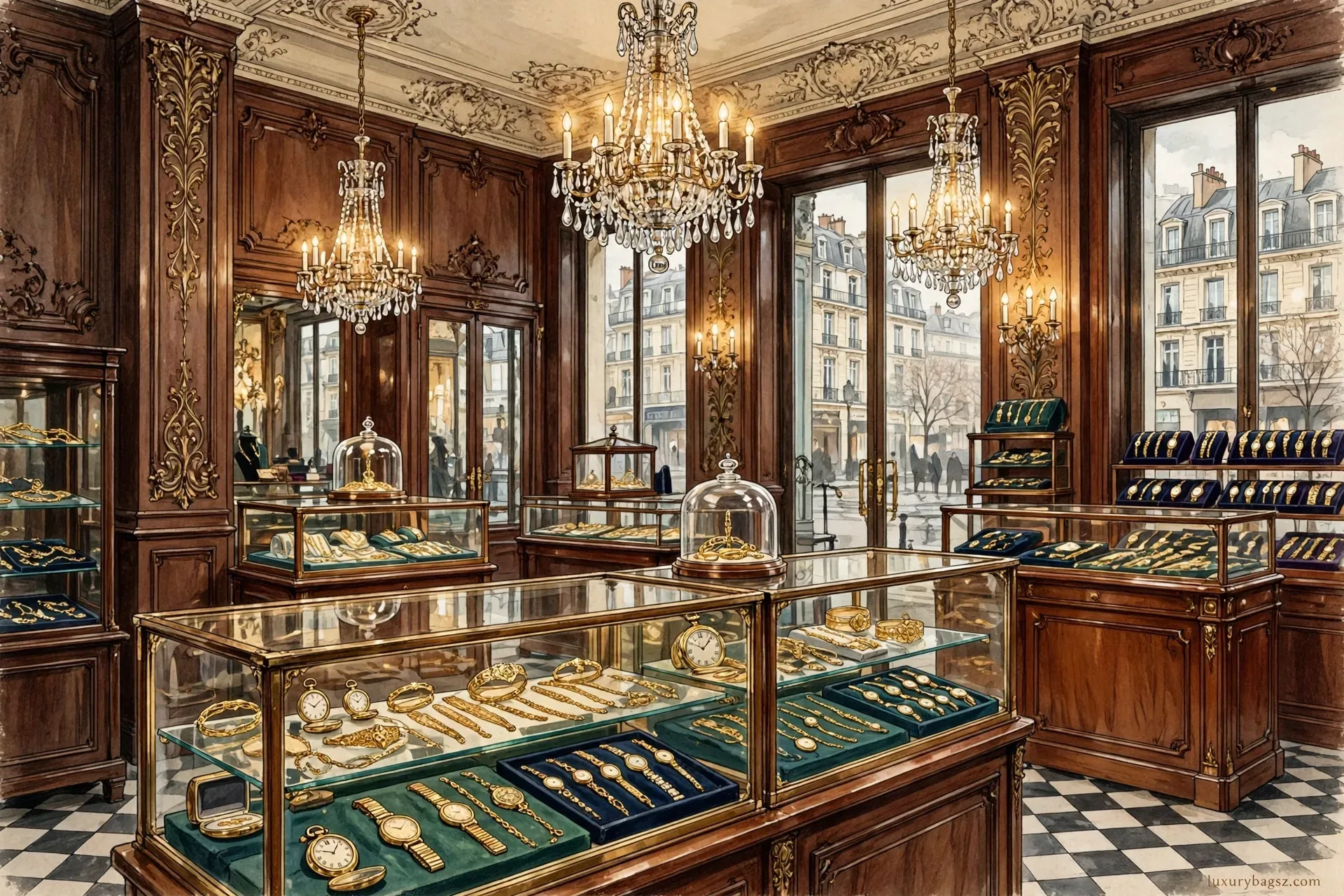
Jacques, meanwhile, travelled widely, including to India, where he built relationships with maharajas whose commissions — turban ornaments, necklaces, and ceremonial jewels — pushed Cartier's craftsmanship to new heights. The house's Indian-inspired pieces, with carved emeralds, rubies, and diamonds set in platinum, remain among its most admired historic work. Where sources disagree on details of individual commissions, the broad pattern is clear: Cartier thrived by serving the world's most demanding clients, and learning from each of them.
From Jewellery to Watches
Cartier was first a jeweller, not a watchmaker, and its move into watches came through design rather than mechanics. Early Cartier watches used Swiss movements fitted into cases designed and finished in Paris, a division of labour common at the time. What set Cartier apart was the case: clean geometry, Roman numerals, blued sword hands, and a sapphire cabochon crown became instantly recognisable house codes.
The first great Cartier watch was the Santos, created in 1904. Louis Cartier designed it for his friend Alberto Santos-Dumont, the Brazilian aviation pioneer, who needed to tell the time while flying without letting go of the controls. The square case, exposed screws, and leather strap made it one of the first wristwatches designed for men, at a time when men still mostly carried pocket watches. It is widely described as the first pilot's watch, and it remains in production today.
The Tank followed in 1917, its rectangular case said to be inspired by the Renault tanks Louis Cartier saw on the Western Front. The Tank's clean lines and Roman dial made it a design classic, worn by figures as varied as Jacqueline Kennedy Onassis and Andy Warhol. Later came the Pasha, the Panthère, and the Santos's many descendants, each reworking the same geometric language. For buyers, this continuity is useful: a Tank from any era is recognisable, but case sizes, movements, and dial details vary, so era matters when pricing.
Art Deco, the Panthère, and Mystery Clocks
The 1920s were Cartier's golden design decade. Under Louis Cartier in Paris, the house embraced Art Deco geometry, bold colour contrasts, and exotic influences, producing jewels that mixed diamonds with emeralds, sapphires, rubies, and onyx in striking combinations. The Tutti Frutti style — carved coloured stones set like fruit and flowers — became a Cartier signature, inspired partly by Indian jewellery and partly by the era's love of vivid colour.
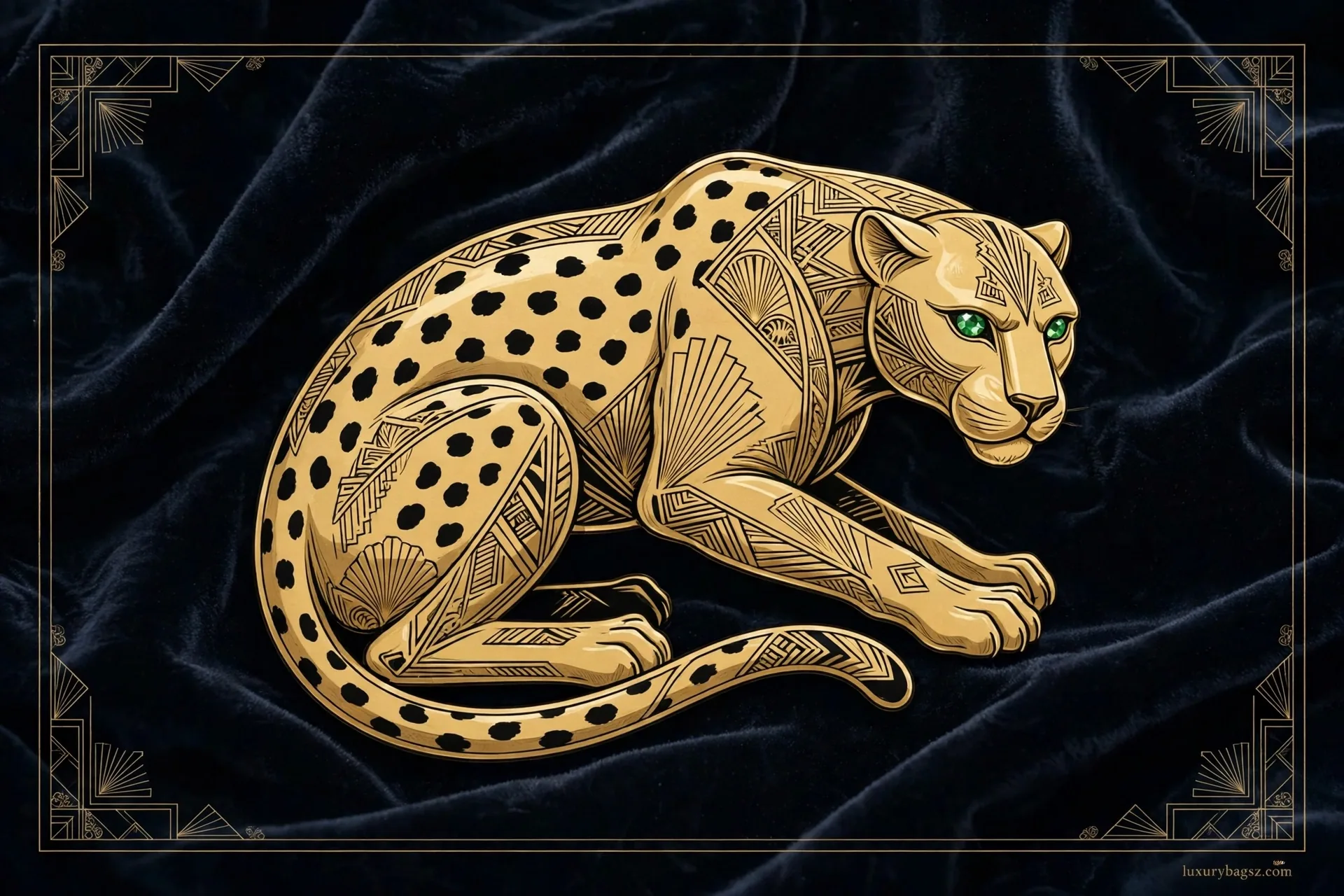
The panther became the house's animal emblem during this period, first appearing as a motif in 1914 and developing into the three-dimensional Panthère jewels of later decades. A Cartier panther, whether a brooch, bracelet, or ring, is built from pavé diamonds, onyx spots, and emerald eyes, and remains one of the maison's most copied designs. Genuine vintage panthers show extraordinary finishing; copies often fail on the setting work and the articulation of the animal's body.
Cartier also became famous for mystery clocks, in which the hands appear to float on a transparent dial with no visible mechanism. These were technical showpieces as much as timekeepers, made to impress in a drawing room. They are rarely practical purchases today, but they explain Cartier's reputation for combining artistry with engineering — a reputation the house still trades on in its high watchmaking, where in-house movements such as the calibre 1847 MC now power many models.

Love, Juste un Clou, and a New Generation
By the late 1960s, Cartier faced a problem: its image felt grand but distant to younger buyers. The answer came from New York designer Aldo Cipullo, who created the Love bracelet in 1969. The Love is a rigid gold oval, fastened with a screwdriver, designed to be worn permanently as a symbol of commitment. It was radical in its simplicity, unisex in its appeal, and perfectly timed for an era questioning old luxury rules.
Two years later, Cipullo created the Juste un Clou — literally "just a nail" — a bracelet shaped from an ordinary hardware nail, bent into a circle. Where the Love spoke of devotion, the nail spoke of everyday rebellion: luxury made from the mundane. Both designs became staples, and both remain among Cartier's best-selling jewellery today. Their success proved that Cartier could speak to a new generation without abandoning its craftsmanship.
Sizing matters enormously for both pieces, especially the Love, which is fitted rather than flexible. Our guide to Cartier Love bracelet sizes explains how the numbered sizes translate to wrist measurements and what to do if you fall between sizes. Getting the fit right matters more than chasing a particular metal: a well-fitted yellow gold Love you wear daily beats a white gold one that slides or pinches.
The Icons at a Glance
For a new buyer, Cartier's catalogue can feel overwhelming, so it helps to group the icons by type. In watches, start with the Santos, the Tank, and the Ballon Bleu: the Santos for its pilot-watch history and square case, the Tank for its rectangular purity, and the Ballon Bleu for its rounded, modern softness. Our Cartier Santos guide and Cartier Tank guide compare sizes, models, and prices in detail.
In jewellery, the Love, the Juste un Clou, and the Panthère form the core trio. The Love suits buyers who want a permanent, symbolic piece; the Juste un Clou suits those who want something bolder and more sculptural; the Panthère suits collectors who love figurative high jewellery. All three are widely faked, so buy from a source that offers returns and, ideally, a condition report.
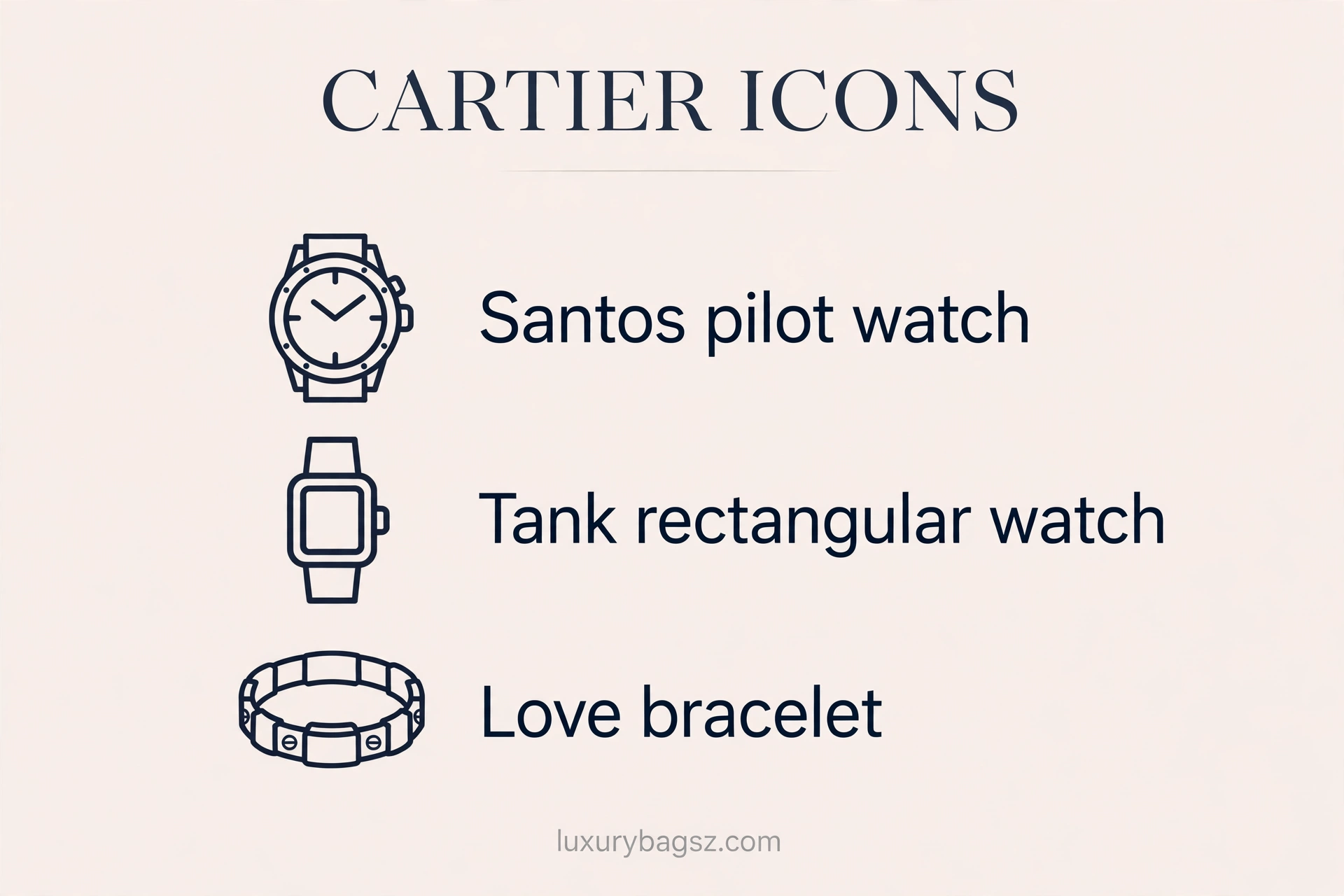
Beyond these, Cartier's heritage includes the Trinity ring of 1924 — three interlinked bands in yellow, white, and rose gold — and the Crash watch, whose distorted case allegedly recalls a watch melted in a car accident. Neither is an everyday first purchase, but both show the house's willingness to play with form. A collection built slowly, one icon at a time, usually brings more pleasure than a rushed set of trend pieces.
Buying Pre-Owned Cartier Safely
Pre-owned Cartier holds appeal because the icons change slowly: a Tank or Love from a decade ago still looks current. That stability also attracts counterfeiters, so checks matter. Start with hallmarks and engraving: genuine Cartier pieces carry crisp, evenly spaced marks, including the Cartier signature, metal hallmarks, and, on watches, a serial number. Blurred, uneven, or misspelled engraving is a serious warning sign.
For watches, check the movement, case, and dial together. A genuine Cartier dial has clean printing, correctly shaped Roman numerals, and a sapphire cabochon crown that sits flush. The movement should match the model and era; a dealer who will not open the case back or provide a movement photo deserves caution. For bracelets, check weight, screw mechanism, and clasp action — a Love bracelet should fasten firmly with its screwdriver, not loosely or with a rattling fit.
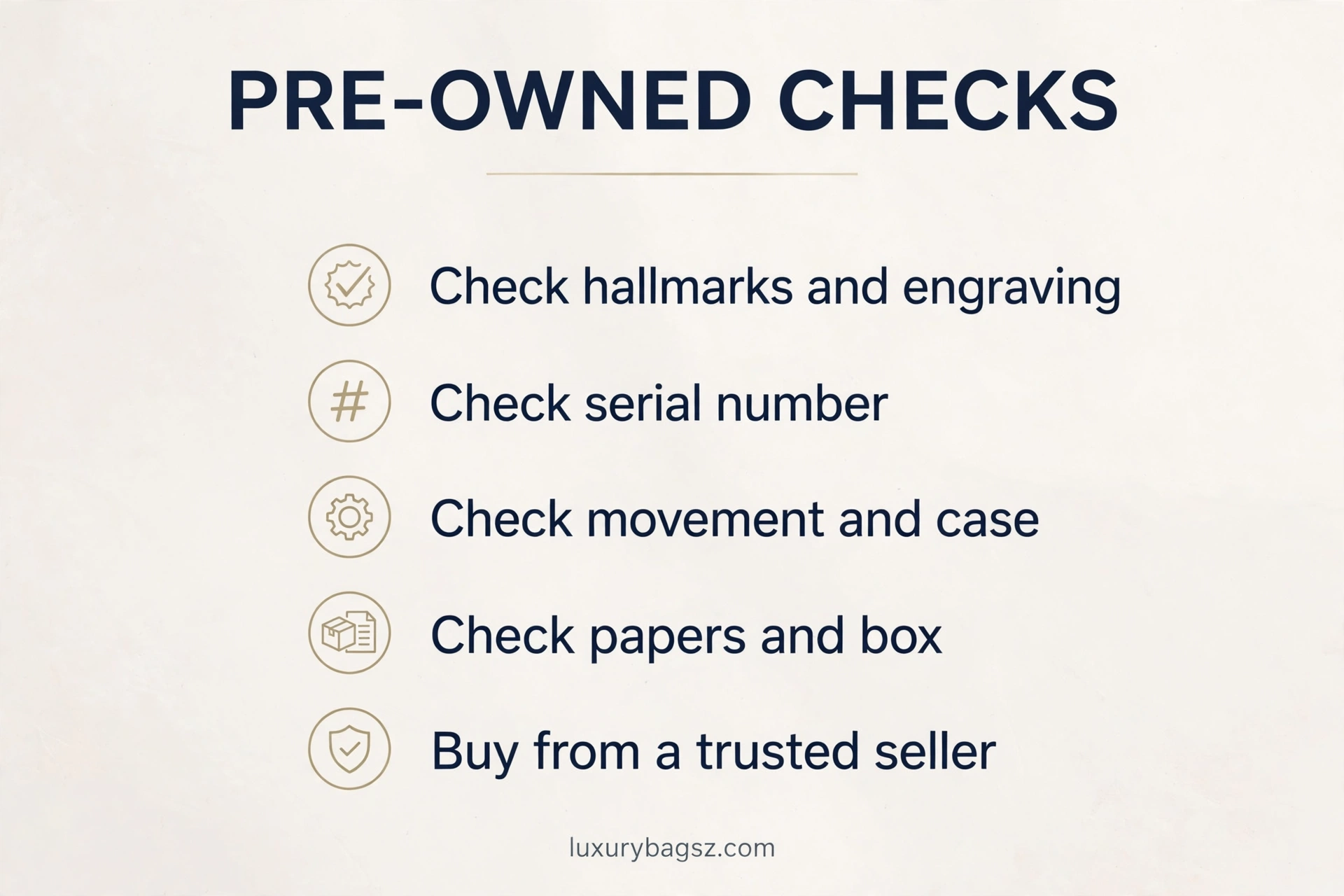
Papers and box help but do not guarantee authenticity on their own, since both can be faked or mismatched. Treat them as supporting evidence, not proof. Price is another check: if a piece is far below market, ask why, and compare with reputable dealers before committing. Our guide to whether Cartier bracelets are a good investment looks at resale patterns honestly, and our fake Cartier Love bracelet checks give ten practical tests you can apply before buying.
Cartier Today: Richemont, Boutiques, and Craft
The Cartier family sold the business in stages, losing control in 1964. In 1972, a group led by Joseph Kanoui bought Cartier Paris, and over the following years the Paris, London, and New York branches were reunited as Cartier Monde. The house later became part of the Richemont Group, the Swiss luxury group that also owns watchmakers such as Jaeger-LeCoultre and Vacheron Constantin, giving Cartier the manufacturing scale its founders could never have imagined.
Today Cartier runs boutiques in major cities worldwide, including the Fifth Avenue mansion, the Rue de la Paix boutique, and London's New Bond Street store. Its current collections balance heritage reissues with new high jewellery, and its watchmaking has grown more technically ambitious, with in-house movements, complications, and métiers d'art pieces. At the same time, the house has leaned into its archive, restaging historic pieces in exhibitions such as the Victoria and Albert Museum's Cartier show, which drew new audiences to the maison's story.
For buyers, the lesson of Cartier's history is simple: buy the design, not just the name. A Santos, Tank, or Love endures because its proportions are right, not because a logo says so. Choose the size that fits your wrist and life, check authenticity carefully, and prefer a piece you will wear for decades over a novelty that dates in a season. That approach would have made sense in Louis-François Cartier's workshop in 1847, and it still makes sense today.
Servicing deserves the same long view. A mechanical Cartier watch benefits from a service every few years, ideally through Cartier or a watchmaker experienced with the brand, and a service record supports resale value. Keep the box, papers, and any service receipts together, insure valuable pieces, and have bracelets checked for clasp wear. These small habits protect both the piece and its value, which is exactly what a 175-year-old house would expect of its owners. A well-kept Cartier, serviced on time and worn with care, is the closest thing jewellery offers to a permanent purchase.
Frequently Asked Questions
When was Cartier founded?
Cartier was founded in Paris in 1847, when Louis-François Cartier took over the workshop of his master, Adolphe Picard, at 29 Rue Montorgueil.
Who founded Cartier?
Louis-François Cartier (1819–1904) founded the house. His son Alfred took over in 1874, and Alfred's sons Louis, Pierre, and Jacques built the global brand.
What does "jeweller of kings" mean?
The phrase reflects Cartier's long history of commissions for royalty and aristocracy, including European courts and Indian maharajas, from the 19th century onward.
When was the Cartier Santos made?
The Santos was created in 1904 for aviator Alberto Santos-Dumont, making it one of the first men's wristwatches and widely regarded as the first pilot's watch.
When was the Cartier Tank made?
The Tank was introduced in 1917, with a rectangular case said to be inspired by the military tanks of the First World War.
When was the Cartier Love bracelet made?
The Love bracelet was designed by Aldo Cipullo in New York in 1969. It is a rigid oval bracelet fastened with a screwdriver.
Who owns Cartier now?
Cartier is part of the Richemont Group, the Swiss luxury group, after the family branches were reunited as Cartier Monde in the 1970s.
Is Cartier French or Swiss?
Cartier is a French maison founded in Paris, but its parent company, Richemont, is Swiss, and many Cartier watch movements are made in Switzerland.
Are pre-owned Cartier watches a good buy?
Icons such as the Santos and Tank hold appeal because their designs change slowly, but condition, service history, and authenticity matter more than age alone.
How do I spot a fake Cartier bracelet?
Check engraving sharpness, hallmarks, weight, screw and clasp action, and overall finishing against verified examples, and buy from a reputable seller with a returns policy.
Conclusion: Why Cartier Still Matters
Cartier's history runs from a single Paris workshop to a global maison, yet its core idea never changed: restrained geometry, superb finishing, and designs made to be worn for a lifetime. The Santos, the Tank, and the Love endure not because they are fashionable, but because they are right. Buy with that standard in mind, and a Cartier piece becomes not just a purchase, but a small part of a 175-year story.






