

How to Spot a Fake Cartier Love Bracelet: 10 Checks
The Verdict in Brief
A Love bracelet earns the word “authenticated” the slow way: all ten checks in this guide passed, with the original documentation beside it — the standard any specialist would accept. Anything short of that is a probability, and this guide treats it as one.
The counting rule is strict. Fail three or more of the ten checks and the piece is treated as counterfeit until proven otherwise, following Opulent's rule. Authentication here is cumulative — the verdict is the total, not any single screw, stamp or serial.
Key Takeaways
- Authentication is cumulative: fail three or more of the ten checks and treat the piece as counterfeit until proven otherwise.
- Genuine Love bracelets are solid 18k gold (750) or platinum (950), never plated, never sterling silver, and never magnetic.
- Serial numbers were added from 1974, in formats of one letter plus five digits, two letters plus four digits, or three letters plus three digits.
- The 2011 captive-screw redesign is a dating test: a post-2011 Classic whose screw comes fully out is likely fake, and a vintage Classic whose screw stays attached is likely fake.
- Classic weight in size 17 is around 30 to 32 grams, size 18 around 32 to 34 grams, size 19 around 34 to 36 grams; Small weighs roughly half.
- Cartier no longer authenticates Love bracelets, according to 1stDibs, so buy from sellers who accept returns and get an independent professional opinion on expensive pieces.
Why the Love Is the Most Faked Bracelet in the World
Price is the first filter, and it is blunt but honest. 1stDibs quotes industry consultant Anna Rasche: these bracelets are hot on the secondary market, nobody needs to sell them for a low price, so a very low price is a big red flag. A genuine Classic Love retailed for well over $7,000 in 2026, according to Jonathan's, and excellent pre-owned pieces trade at roughly 70 to 85 percent of retail.
A "genuine" Classic at half that price needs an extraordinary explanation.
Know the Variant Before You Check Anything
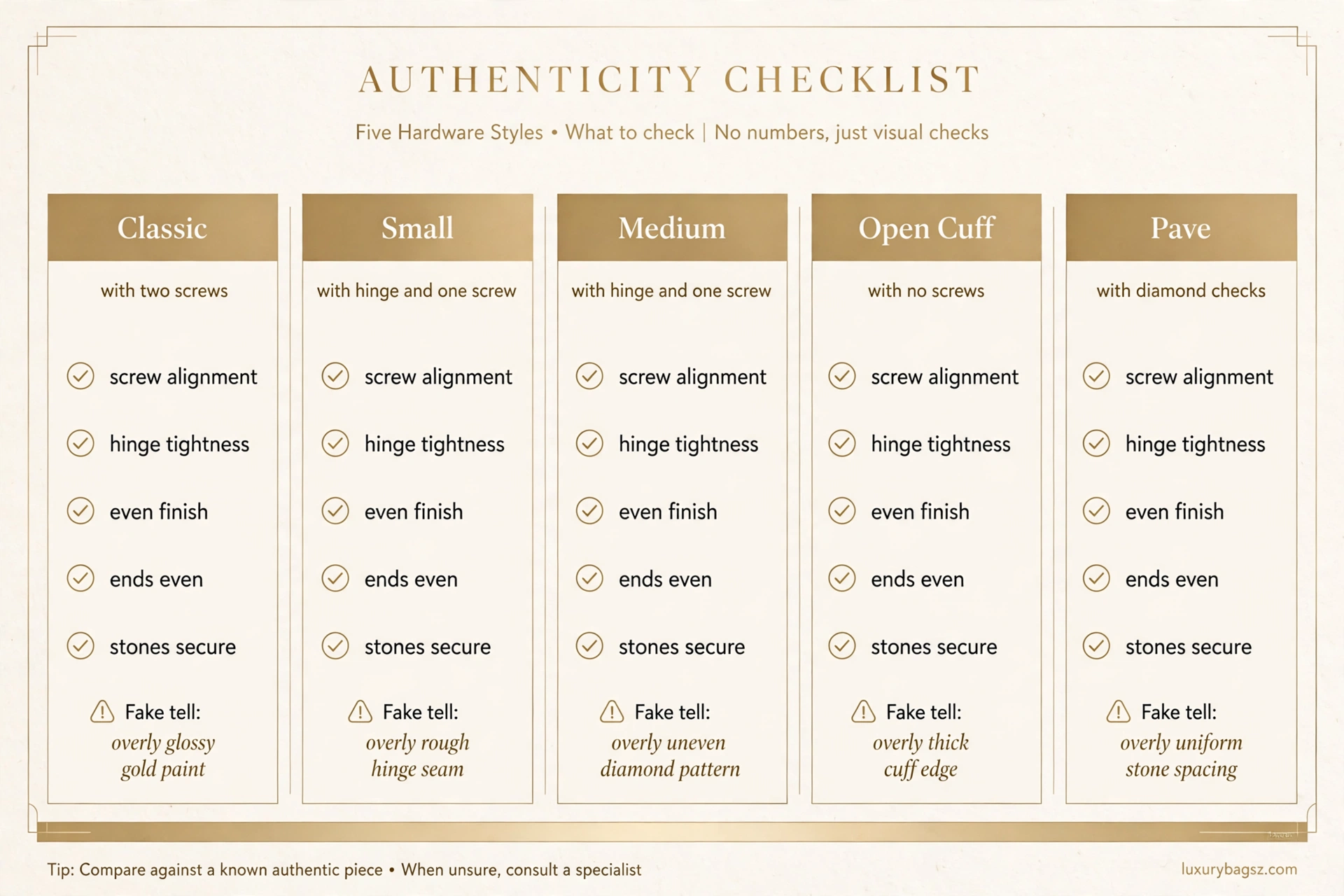
Every check in this guide depends on knowing which Love you are looking at, because the variants differ in width, closure, weight and diamonds. Checking a Small as if it were a Classic will produce false alarms, and checking a cuff as if it were a closed bracelet will produce nonsense.
The Classic is 6.1 mm wide, according to Opulent, with two working screws and no hinge. It comes in sizes 15 to 21, in yellow, rose and white gold, platinum and tri-gold, with plain, four-diamond, ten-diamond and fully paved versions. It is the most common Love pre-owned, and the most commonly faked.
The Small is 3.65 mm wide, with a single captive working screw paired with a hinge. It comes in sizes 15 to 19, in yellow, rose and white gold, with various diamond configurations, and it weighs roughly half the Classic at the same size. A Small with two working screws, or with no hinge, is wrong on sight.
The Medium is 4.8 mm wide, introduced in 2024 according to Opulent, with the same single-screw-plus-hinge closure as the Small. It comes in sizes 15 to 22 and is the only width that offers size 22. A Medium claimed in a size or configuration outside that range needs verification.
The open Love cuff slips on without a screwdriver, according to Jonathan's, and it has no screw closure to test. Ceramic versions pair a ceramic body with 18k gold screws, and pavé versions replace screw motifs with diamonds. Each variant gets its own tells in the variant tells section, after the ten general checks.
Check 1: The Metal Must Be Solid Gold or Platinum
Genuine Love bracelets are solid 18k gold or platinum. Cartier does not plate the Love, and a sterling silver Love is a fake on sight, according to 1stDibs. If a bracelet tarnishes, that is also a fake tell, because solid gold does not tarnish the way plated base metal does.
Run the magnet test first, because it is free and fast. Gold and platinum are not magnetic, so any attraction to a household magnet is an immediate red flag. Plated fakes may be slightly magnetic, according to Jonathan's, because their base metal core responds to the magnet through thin plating.
Look for visible discoloration, peeling, or unevenness of metal tone across the bracelet, especially on the inside where it rubs against the wrist. Plating wears first where skin contact is constant, so the inner face is where fakes reveal themselves. A genuine Love keeps an even tone inside and out, even when scratched.
Check 2: The Inner Engraving, Font, and Hallmark Order
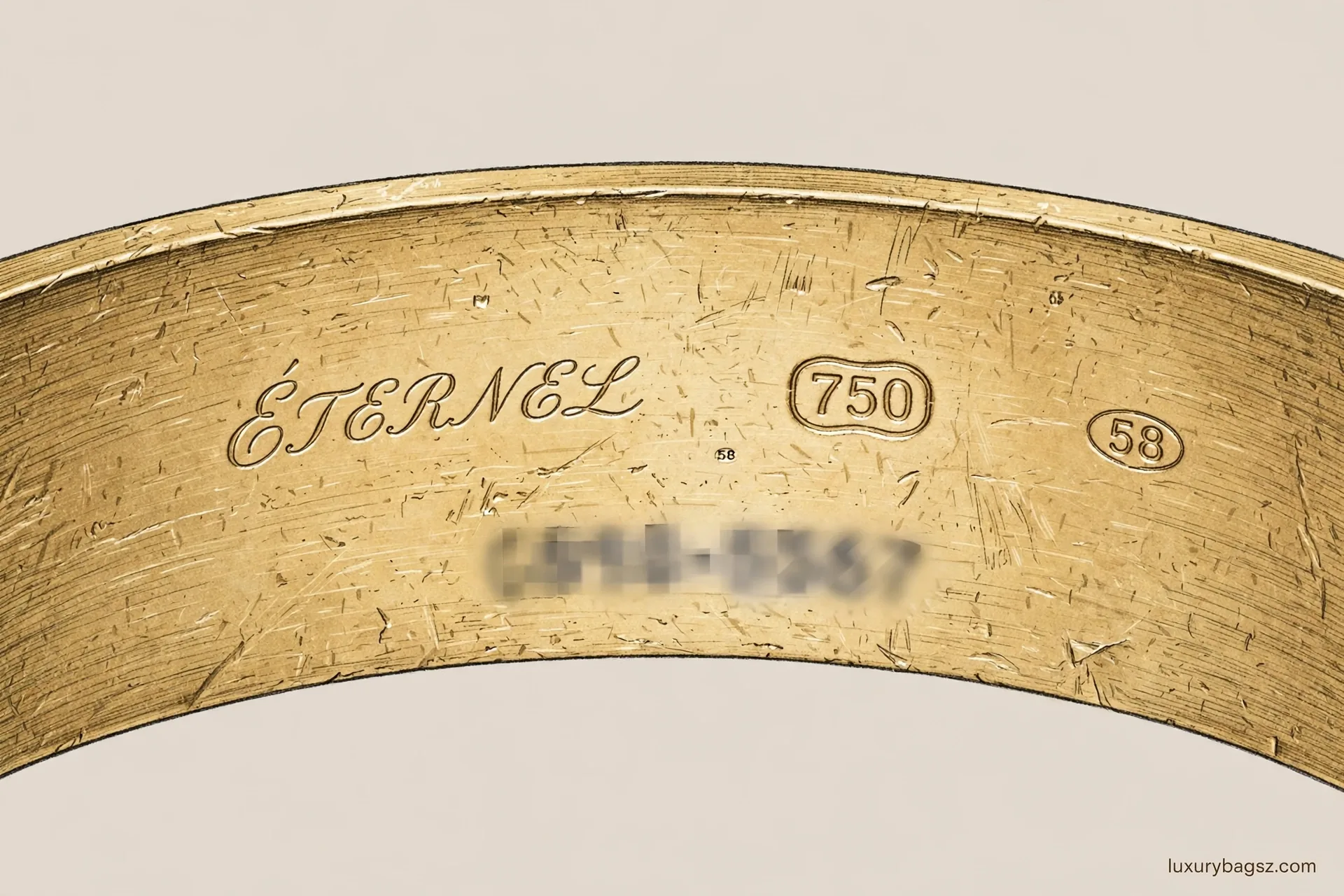
Turn the bracelet over and read the inside. A genuine Love carries the Cartier signature in its trademark cursive lettering, the metal purity mark, the size number, and a unique serial number. The engraving is laser-cut to uniform depth with even letter spacing in Cartier's proprietary font, according to Opulent.
Counterfeit engraving is typically shallower, slightly unevenly spaced, or shows faint tool chatter along letter edges under magnification. Generic fonts such as Helvetica or Times New Roman on the interior are a definitive sign of a fake, according to Opulent. Compare the script with a photograph from Cartier's own site if you are looking at a recent bracelet, as 1stDibs advises.
Check the hallmark order and the purity mark. An 18k gold bracelet is stamped 750, meaning the alloy is 75 percent gold, and a platinum bracelet is marked 950, meaning 95 percent platinum. A purity mark that is wrong, blurry, or missing is a strong warning, because Cartier's stamping is consistent.
Check 3: All Ten Screw Motifs, Front and Back
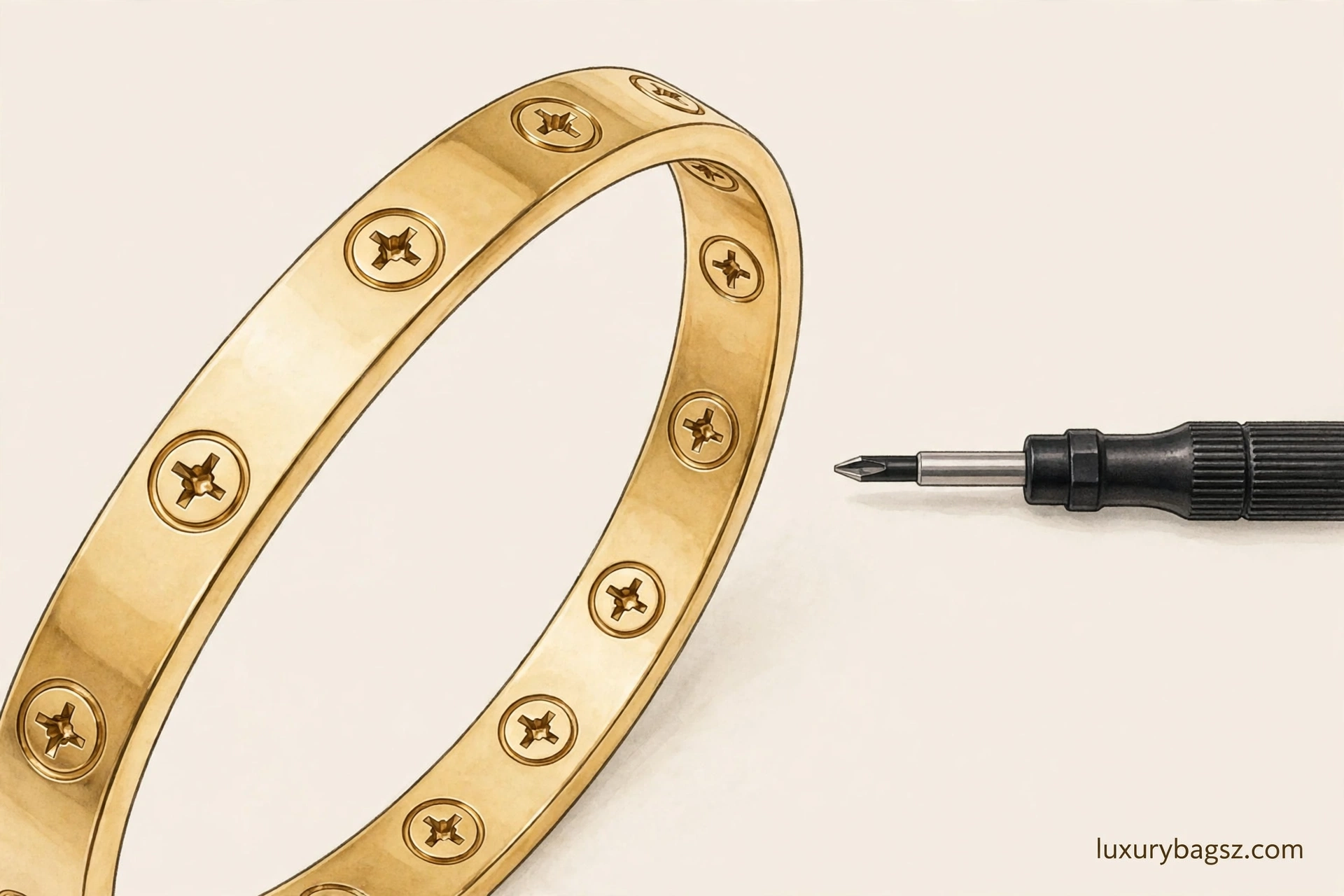
The Classic Love has ten screw-head motifs in total: five distributed across the front face of the oval and five mirrored across the back. Separate from these, two working screws secure the closure on the Classic, while the Small and Medium use a single working screw paired with a hinge. Counting to ten is the start of this check, not the end of it.
On an authentic piece, every one of the ten motif slots is milled to identical depth and width, and every motif has the same diameter. The screw design is stamped into the metal, uniform in shape, horizontally aligned and evenly spaced, according to 1stDibs. Checking all ten motifs, including the five on the inner face that counterfeiters often neglect, is one of the fastest inspections a trained eye can perform.
Counterfeits consistently fail here. Slot centring is slightly off, slot depths vary across the ten positions, and the metal polish inside each slot is inconsistent. Screws may be misaligned, uneven or poorly seated, and slots can be crooked or oversized, according to Jonathan's. A single motif that looks different from the other nine is enough to pause the purchase.
Check the working screws separately from the decorative motifs. On the Classic, only two screws are functional, one on each side, opened with the small screwdriver Cartier supplies. The rest are decorative. A closed Classic with a hinge or clasp that a real closed Love does not have, as Jonathan's notes, is wrong on sight.

Check 4: Weight Within Two Grams of the Right Range
Weigh the bracelet on a digital jewellery scale, without the screwdriver, box or papers, and compare it with the known weight for that exact model and size. Opulent gives Classic 18k gold weights for sizes 17 to 19: size 17 around 30 to 32 grams, size 18 around 32 to 34 grams, and size 19 around 34 to 36 grams. A reading more than two grams outside the expected range for the size, width and metal deserves closer inspection.
1stDibs gives a broader range of 30 to 38 grams for a genuine Love, depending on size, design and metal. That range is useful as a screen but too broad as a verdict, because it covers all sizes and metals at once. Always compare like with like: a Classic size 17 against the size 17 range, a Small against the Small range, a platinum piece against platinum, and a pavé piece against pavé.
The Small weighs roughly half the Classic at each size, according to Opulent, which puts a Small size 17 near 15 to 17 grams as an estimate from that note, not as a published table. No competitor guide found gives a full weight table by size, width and metal, and this guide does not invent one. For sizes outside 17 to 19, ask the seller for the weight and compare it with the same model and size from a reputable dealer.
Check 5: The Screw System Must Match the Era
This check separates good fakes from genuine pieces, and it only works if you know the date. On the original Classic closure, both working screws unscrew completely and separate from the bracelet, so one half of the oval comes fully away from the other. On the updated closure, the two working screws remain attached to the bracelet even when fully loosened, held in a small casing.
In 2011, according to 1stDibs, Cartier redesigned the opening mechanism so the screw remains attached. If the screw on a Love bracelet made post-2011 comes out entirely when you open it, it is probably bogus. If a vintage bracelet has a screw that stays attached, that is also wrong, because the vintage system did not work that way. The screw's behaviour must match the bracelet's era.
Working screws should turn cleanly and smoothly against the Cartier screwdriver. Any grinding, catching, or resistance, or the feeling that the screwdriver does not quite fit the slot, is a warning sign, according to Opulent. On hinged pieces, the Small and Medium widths, the hinge should close flush with no visible gap, no glue residue, and no step between the two halves.
Check 6: The Serial Number Format, and What It Cannot Prove
From 1974 on, all Love bracelets have been stamped with a Cartier serial number, according to 1stDibs. Each alphanumeric sequence is unique to a particular piece and sits inside the bracelet in one of three formats: one letter and five digits, two letters and four digits, or three letters and three digits. Before 1974, Love bracelets had no serial numbers, because serials were added in response to a surge of counterfeits in the 1970s.
Opulent describes serials differently, as typically six to eight characters combining letters and digits. Those two descriptions are consistent in length but not identical in pattern, and a buyer cross-checking pages will find no single consistent rule stated. This guide gives you both, and tells you to treat a serial that fits neither description as suspect, while treating a serial that fits one description as only a pass on this check.
A serial that is too short, too long, or uses character combinations Cartier does not use is disqualifying on its own, according to Opulent. A missing serial on a post-1974 bracelet is equally serious. But a correct-format serial proves far less than sellers claim, because serials are copied. Jonathan's notes duplicated serial numbers as a known fake tell, mentioned only in passing by most guides.
Check 7: Seams, Fit, and Construction Quality
Hold the bracelet closed and run a finger along the seam where the two halves meet. On a genuine Love, the metal is smooth and even, and the place where the two halves meet sits flush, according to 1stDibs. A visible seam at the closure, a step between the two halves, or a gap that catches a fingernail is one of the fastest counterfeit tells.
Check the fit of the oval itself. A genuine Love is a precise oval, not a bent circle, and it sits flat against the wrist rather than rolling. A bracelet that is visibly out of round, that rocks on a flat surface, or whose two halves do not align when closed has either been damaged or was never made to Cartier tolerances. Damage lowers value; bad manufacture suggests a fake.
Check 8: Diamonds Must Show Inside and Out
On a genuine diamond Love, the diamonds are visible on the inner as well as the outer surface of the bracelet, according to 1stDibs. That is because the stones are set through the band, not glued onto it. A diamond that is visible only from the outside, or that sits in a shallow cup with no inner presence, is a strong fake tell.
Count the diamonds and compare the count with the version claimed. The Classic comes in plain, four-diamond, ten-diamond and fully paved versions, according to Opulent. A bracelet claimed as ten-diamond that carries six stones, or a four-diamond piece with unevenly spaced stones, is either misdescribed or fake.
Diamond counts by version are not given in a full table by any competitor guide found, so verify the count against the listing and the certificate, not against a table invented here.
Check the setting quality under magnification. Genuine pavé stones sit evenly, match in cut and colour, and sit flush without gaps. Missing stones, mismatched replacement diamonds that do not match the original cut or colour grade, and settings that sit proud of the surface all lower value and raise suspicion.
Checks 9 and 10: Variant Tells, Box, Papers, Screwdriver
Check 9 is variant-specific, and it catches fakes that pass the general checks. For the Small and Medium, check the hinge: a single captive working screw paired with a hinge on the opposite side, opening like a clasp. A Small with two working screws, no hinge, or a hinge that gaps when closed is wrong. For the cuff, check that it slips on without a screwdriver and has no screw closure at all; a cuff with working screws is a contradiction.
For ceramic versions, check that the body is ceramic with 18k gold screws, not gold-coloured plastic with painted screws. Ceramic should feel cool, hard and consistent, and the gold screws should sit flush and turn smoothly. For diamond and pavé versions, apply Check 8 rigorously, because pavé fakes hide poor metalwork under stones.
Check 10 is the set: the box, the papers, and the screwdriver. Authentic Cartier boxes are a specific deep cardinal red with consistent padding made from batting rather than memory foam, according to Opulent. Counterfeit boxes often read slightly orange or dull, and their mechanisms do not open cleanly. Packaging alone does not authenticate a bracelet, but wrong packaging is a warning.
Check the certificate serial against the bracelet serial, character by character. Check that the screwdriver fits the working screws and matches the era. Check the pouch and any receipt for consistency with the bracelet's claimed age. No competitor guide found details box variations by era, screwdriver variations, or receipt features in full, so this guide does not claim to give them. A complete set adds value; a wrong set subtracts trust.
Seller and Listing Red Flags Beyond the Bracelet
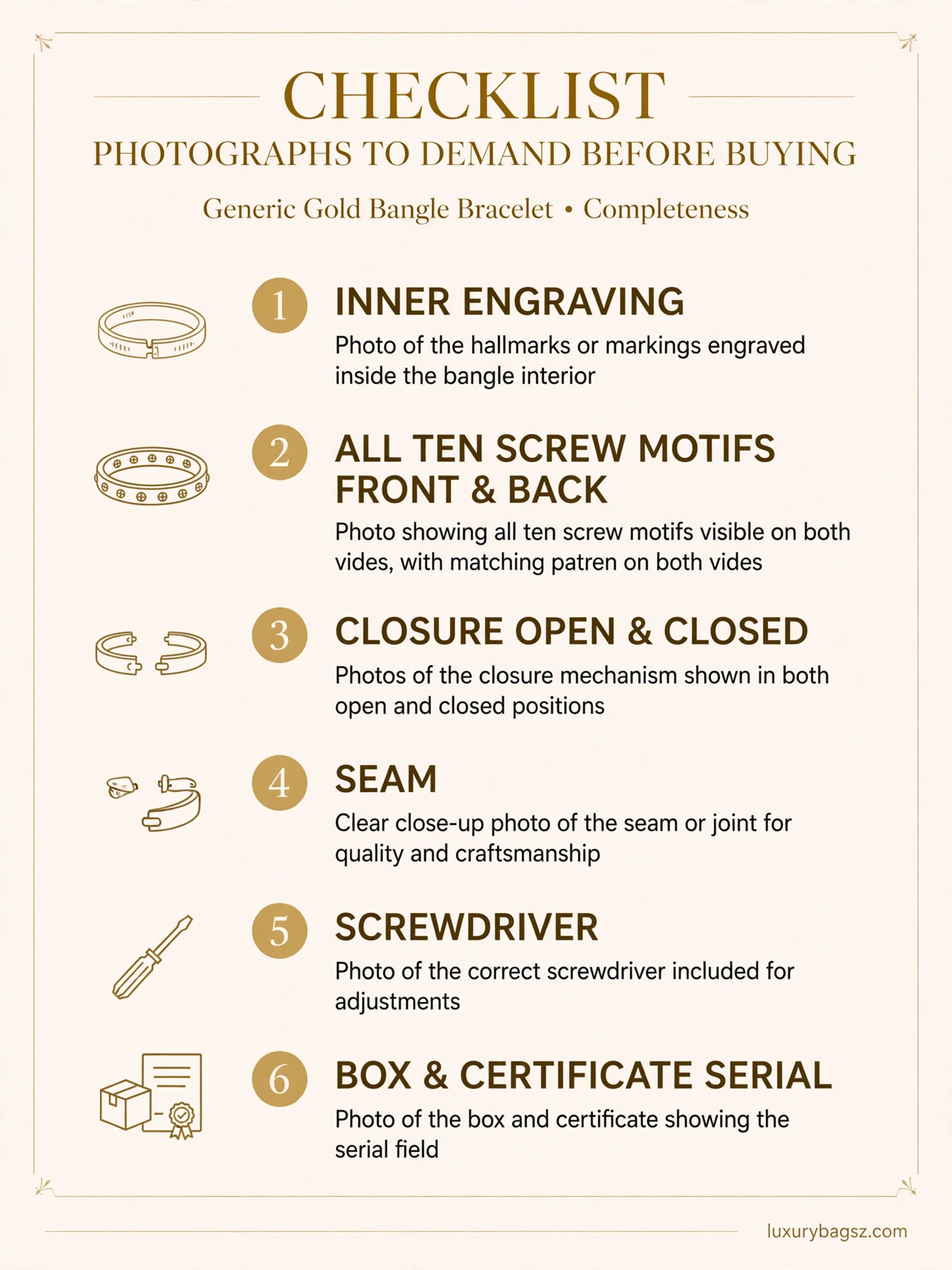
A genuine Love at a genuine price is rarely sold by a seller who hides. Demand the full photograph set before you pay: the inner engraving, all ten screw motifs front and back, the closure open and closed, the seam, the screwdriver, the box, and the certificate with its serial number. A seller who refuses any of these photographs, or who offers only stock photographs, is asking you to buy blind.
Read the listing language for tells. "Cartier style," "inspired by," and "unbranded" in a listing that also shows a Cartier logo mean the seller knows the piece is not genuine. A price far below market, a seller with no return policy, and pressure to pay by an irreversible method are all reasons to walk away, whatever the photographs show.
For the same reason, our guide to telling a fake Rolex stresses buying the seller as much as the watch, and our guide to Rolex serial number checks shows how a serial alone never proves a piece real. The Love market works the same way: the seller's reputation and return policy are part of the authentication.
What to Do If You Already Bought a Suspected Fake
Stop wearing it and keep everything: the bracelet, the box, the papers, the screwdriver, the listing screenshots, the messages with the seller, and the payment receipt. Do not attempt to polish, repair or alter the piece, because alteration destroys evidence and can void a return. Photograph the bracelet exactly as received, including any damage you noticed on arrival.
Contact the seller in writing, state which checks failed, and ask for a return and refund within the marketplace or seller's return window. Quote the specific failures, such as a magnetic response, a wrong serial format, or a weight outside the range, rather than a general claim that the piece "feels fake." Specific failures are harder to dismiss and easier for a marketplace to act on.
Do not resell a piece you believe is fake as genuine, and do not sell it as "unbranded" with Cartier photographs. Selling a known counterfeit, even with a warning note attached, can create legal trouble, and it passes the loss to another buyer. If the piece is confirmed fake and cannot be returned, dispose of it rather than putting it back into circulation.
The Professional Route, and When to Pay for It
Pay for a professional opinion on any Love bought outside a boutique above a few thousand dollars, on any piece where two or more checks are borderline, and on any piece whose serial, weight or screw behaviour does not match its claimed era. The fee is small against the price of the bracelet, and a written opinion gives you a basis for a return if the piece fails.
Note the limit that 1stDibs states: Cartier no longer authenticates Love bracelets. Do not buy a piece on a seller's promise that "Cartier will confirm it," because that confirmation is not available. Use an independent authenticator or a reputable jeweller with Cartier experience instead, and ask what their opinion covers before you pay for it.
The Ten Checks at a Glance: A Pocket Routine
Second, read the inside under magnification. Check the Cartier script, the 750 or 950 mark, the size number, and the serial format. Check that the font is Cartier's own, evenly spaced and evenly deep, and that no logo appears on the outside. A generic font, a missing serial on a post-1974 piece, or a wrong purity mark ends the inspection.
A piece that passes all six stages has passed the ten checks, and a piece that fails three or more individual checks should be treated as counterfeit until a professional proves otherwise.
Frequently Asked Questions
How can you tell if a Cartier Love bracelet is real?
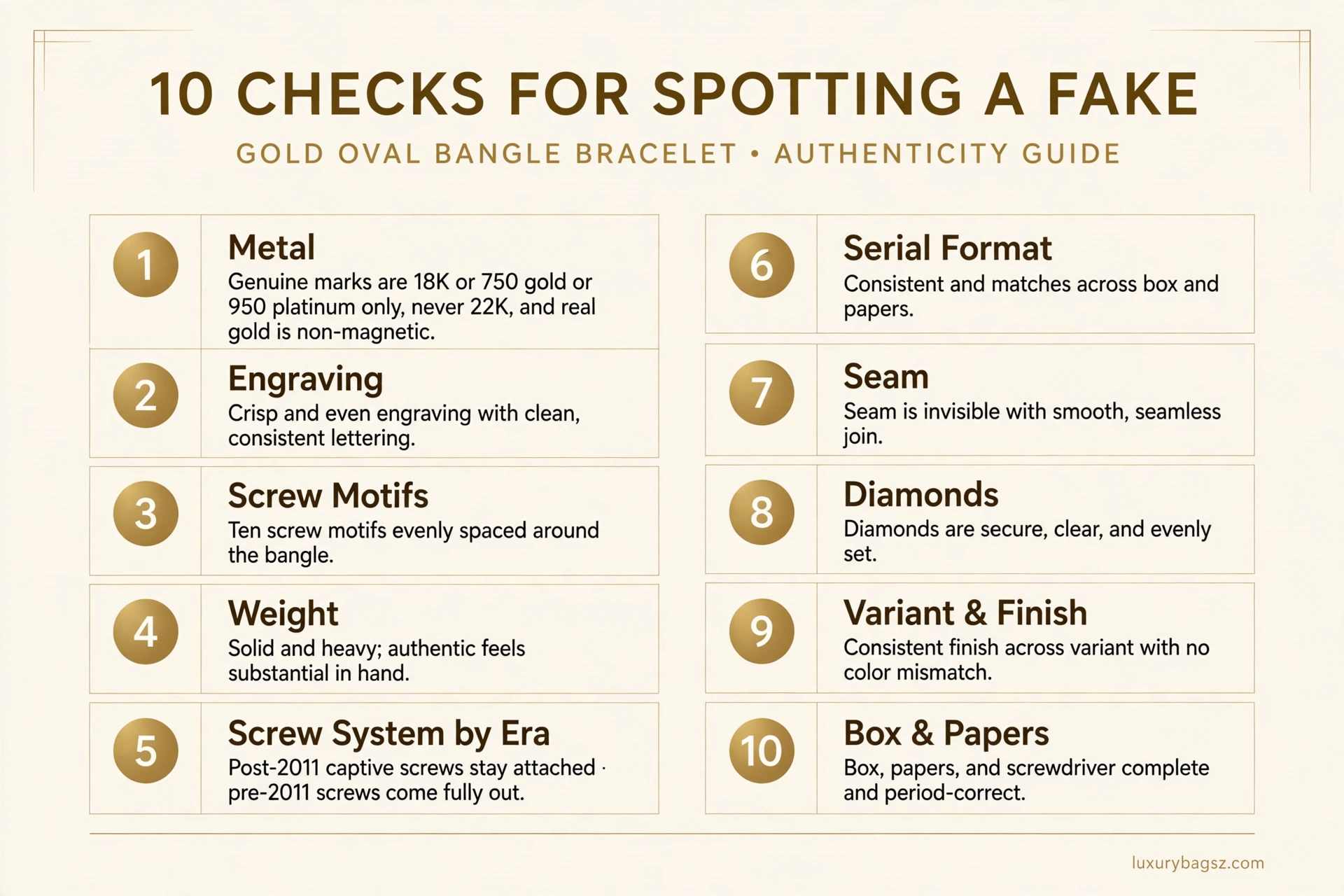
Run the ten checks in this guide in order: metal, engraving, screw motifs, weight, screw system by era, serial format, seam and construction, diamonds, variant tells, and the box, papers and screwdriver. No single check proves a piece real. A piece that fails three or more checks should be treated as counterfeit until proven otherwise.
Do real Cartier Love bracelets have serial numbers?
Yes, from 1974 onward. Formats are one letter plus five digits, two letters plus four digits, or three letters plus three digits, according to 1stDibs, or typically six to eight characters combining letters and digits, according to Opulent. Bracelets from before 1974 had no serial numbers.
How much should a real Cartier Love bracelet weigh?
A Classic 18k gold Love weighs around 30 to 32 grams in size 17, 32 to 34 grams in size 18, and 34 to 36 grams in size 19, according to Opulent. 1stDibs gives a broader 30 to 38 gram range across sizes and metals. The Small weighs roughly half the Classic at the same size.
What is the difference between the old and new Cartier Love screw systems?
On the original Classic closure, both working screws unscrew completely and separate from the bracelet. In 2011, Cartier redesigned the closure so the screws stay attached when fully loosened, held in a small casing. A post-2011 Classic whose screw comes fully out is likely fake, and a vintage Classic whose screw stays attached is likely fake.
Are fake Cartier Love bracelets magnetic?
Many are, because they are plated base metal rather than solid gold. Genuine gold and platinum are not magnetic, so any attraction to a household magnet is an immediate red flag. A non-magnetic result does not prove a piece real, because some fakes use non-magnetic base metals.
How do you check a Small or Medium Love bracelet differently?
The Small and Medium use a single captive working screw paired with a hinge, not the Classic's two working screws. Check that the hinge closes flush with no gap, that the single screw turns smoothly, and that the weight is roughly half the Classic at the same size for the Small. A Small with two working screws is wrong on sight.
Does a Cartier box and certificate prove a Love bracelet is real?
No. Boxes, certificates and screwdrivers are faked too. Check that the box is deep cardinal red with batting padding, not orange or dull with memory foam, and that the certificate serial matches the bracelet serial character by character. Packaging alone never authenticates a bracelet.
Can Cartier authenticate my Love bracelet?
No, according to 1stDibs, Cartier no longer authenticates Love bracelets. Use an independent authenticator or a reputable jeweller with Cartier experience, including an XRF metal test, and get the opinion in writing before the return window closes.
What should I do if I bought a fake Love bracelet?
Stop wearing it, keep everything including listing screenshots and payment records, and contact the seller in writing with the specific checks that failed. Escalate through marketplace protection or your card issuer if the seller refuses, get a written professional opinion, and never resell a known fake as genuine.
Is a very cheap Cartier Love bracelet always fake?
Almost always, and the burden of proof sits with the seller. Genuine Classic Love bracelets retailed for well over $7,000 in 2026, and excellent pre-owned pieces trade at roughly 70 to 85 percent of retail. A price far below market, with no credible explanation, is the oldest red flag in this market.
Summary
Check the metal, the engraving, the ten screw motifs, the weight, the screw system for its era, the serial format, the seam, the diamonds, the variant tells, and the set. Ten checks, in that order, catch the great majority of fake Love bracelets before money changes hands. Fail three or more, and walk away.
Know your variant before you start, because a Small, a Medium, a cuff, a ceramic piece and a pavé piece each fail differently. Demand the full photograph set, the exact weight, and a matching certificate serial, and buy from a seller who accepts returns. On an expensive piece, pay for a professional opinion with an XRF test.
A genuine Love bracelet is worth the care it takes to verify. It is solid gold, precisely made, and built to last generations. A fake is worth nothing but the lesson it teaches. Run the ten checks, trust the failures over the seller's story, and keep your money for a piece that passes them all.






