Cartier Love Bracelet Size Guide: How to Find Your Fit
The Fit in Brief
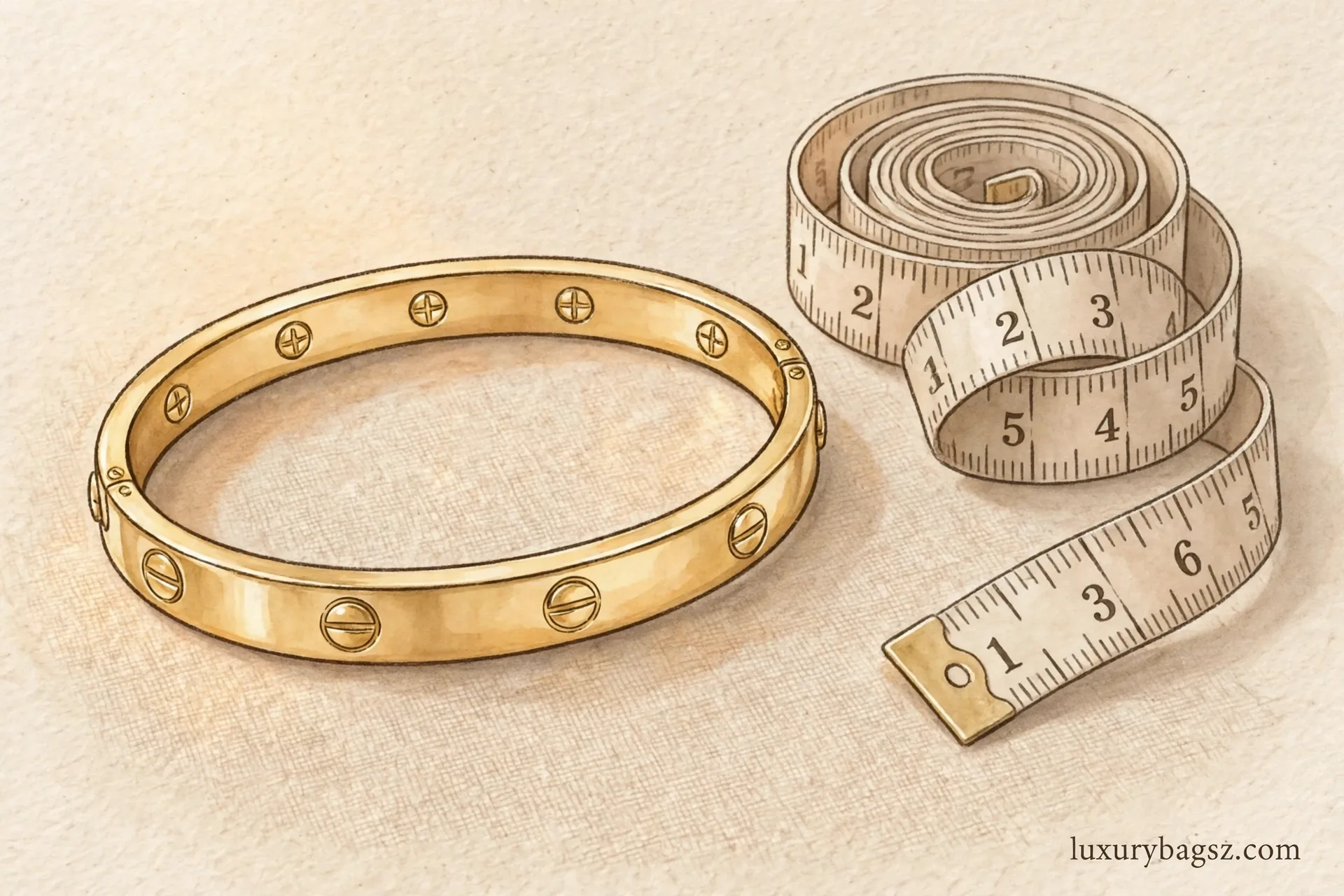
Measure your wrist just below the wrist bone, add comfort room, and round to a whole-centimetre size. That single sentence is the whole method, and it is also where the arguments start, because the best guides disagree on how much room to add.
Opulent Jewelers, updated April 2026, says add 1.5 to 2 cm and size down when you fall between sizes. Hardly Ever Worn It, published May 2026, says add 1 to 1.5 cm, or 2 cm for a looser fit, and size up when between sizes. Libas Collective says add 1 cm. Jonathan's Fine Jewelers says add 0.5 cm for a tight fit and 1 cm for comfort.
The most common sizes are 17, 18 and 19. Size 17 suits a wrist of roughly 15 to 15.5 cm under the stricter rule, size 18 suits roughly 16 to 16.5 cm, and size 19 suits roughly 17 to 17.5 cm. If your wrist measures above 19.5 cm, check the Medium width, because it is the only width offered in size 22.
Key Takeaways
- Love sizes are inner circumference in centimetres, running from size 15 upward, and the bracelet cannot be resized.
- Measure below the wrist bone with a soft tape, then add room: 1.5 to 2 cm (Opulent), 1 to 1.5 cm (HEWI), or 1 cm (Libas) — the disagreement is real and explained in the fit rules section.
- Three rigid widths exist: Small 3.65 mm, Medium 4.8 mm, Classic 6.1 mm, with the same size numbering across widths.
- Size 22 exists only in Medium; Small tops out at size 19 and Classic at size 21, according to Opulent's April 2026 table.
- Between sizes, Opulent says size down and HEWI says size up: this guide tells you which way to lean for daily wear, stacking, and larger wrists.
- Pre-owned prices in Dubai run roughly 22 to 38 percent below UAE boutique prices, and a full set with screwdriver, box and papers sells for more.
Why Sizing Matters More Here Than on Any Other Bracelet
The Love bracelet was designed in 1969 by Aldo Cipullo for Cartier in New York. It is a fixed oval made of two rigid arcs that screw together, and it was designed to stay on once fastened. That permanence is the romance of the piece, and it is also the risk.
Most bracelets can be adjusted, shortened, or let out. The Love cannot. Cartier does not resize it, because cutting and rejoining the oval would change its inner measurement and break the clean construction the design depends on. A wrong size is an exchange, not an alteration, and pre-owned exchanges are rarely simple.
Buy too small and the oval presses on the wrist bone, which hurts within hours and can leave a mark. Buy too large and the bracelet slides toward the hand, twists on the arm, and knocks against watches, desks and door frames. A loose Love also scratches faster, because it moves more.
How Cartier Sizes Actually Work
Cartier Love sizes are whole centimetres of inner circumference. A size 17 bracelet has an inner circumference of 17 cm, or about 6.7 inches. A size 18 measures 18 cm, or about 7.1 inches, and a size 19 measures 19 cm, or about 7.5 inches.
The number is not your wrist measurement. It is the measurement of the inside of the oval, and it must be larger than your wrist, or the bracelet cannot close around it. Every fit rule in this guide is really a rule about how much larger it should be.
The oval shape matters as much as the number. A Love bracelet is not round, so it sits flatter against the wrist than a round bangle of the same circumference. It rests against the wrist bone rather than rolling over it, and it slides about an inch toward the elbow when you raise your arm.
The Size Chart, Width by Width
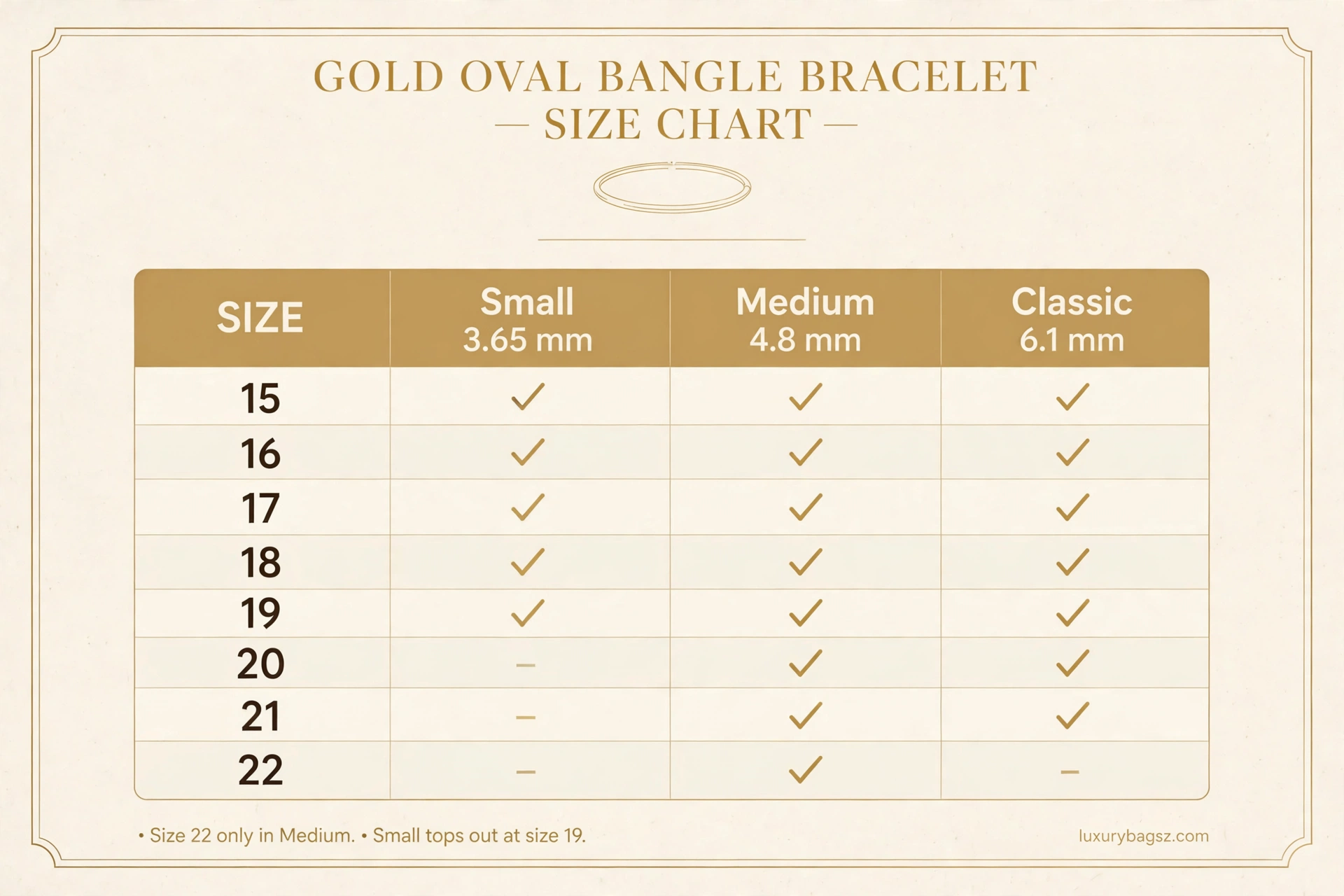
Opulent's April 2026 table is the fullest size chart found in this research, and it is reproduced here with its availability notes intact. A tick means Cartier currently offers that size in that width. A dash means it does not.
| Size | Inner circumference | Small 3.65 mm | Medium 4.8 mm | Classic 6.1 mm |
|---|---|---|---|---|
| 15 | 15 cm / 5.9 in | Yes | Yes | Yes |
| 16 | 16 cm / 6.3 in | Yes | Yes | Yes |
| 17 | 17 cm / 6.7 in | Yes | Yes | Yes |
| 18 | 18 cm / 7.1 in | Yes | Yes | Yes |
| 19 | 19 cm / 7.5 in | Yes | Yes | Yes |
| 20 | 20 cm / 7.9 in | No | Yes | Yes |
| 21 | 21 cm / 8.3 in | No | Yes | Yes |
| 22 | 22 cm / 8.7 in | No | Yes | No |
Two disagreements must be stated plainly. First, HEWI's May 2026 guide gives the range as 15 to 21 and discusses only Classic and Small, while Libas gives 14 to 22 cm. Second, HEWI gives the Classic width as 6.2 mm, while Opulent gives 6.1 mm. This guide follows Opulent's 6.1 mm and its 15 to 22 table, because it is the only one that breaks availability down by width.
The Fit Rules Disagree: Here Is Why, and What to Do
Four reputable guides give four different answers, and none of them is lying. They are answering different questions. Opulent's add 1.5 to 2 cm rule assumes daily wear, all day, with natural movement. HEWI's add 1 to 1.5 cm rule assumes a snug, classic fit, with 2 cm only for a looser, lower-arm fit.
Libas's add 1 cm rule assumes the oval sits close to the wrist bone. Jonathan's adds 0.5 cm for tight and 1 cm for comfort, measured in a warm climate where wrists swell.
Wrist shape explains part of the gap. A prominent wrist bone needs more room than a flat wrist of the same circumference, because the oval must clear the bone. An oval wrist, wider than it is deep, wears a Love differently from a round wrist, because the bracelet's own oval either matches the wrist or fights it.
Between sizes, Opulent says size down, because a loose Love shifts, scratches and reads as ill-fitting. HEWI says size up, because a tight Love cannot be stretched. This guide leans Opulent for daily wear and HEWI for occasional wear: if the bracelet will live on your wrist, a slightly snug fit settles better than a loose one, but never choose a size that presses the wrist bone when you first try it.
Measure Your Wrist Properly, Step by Step
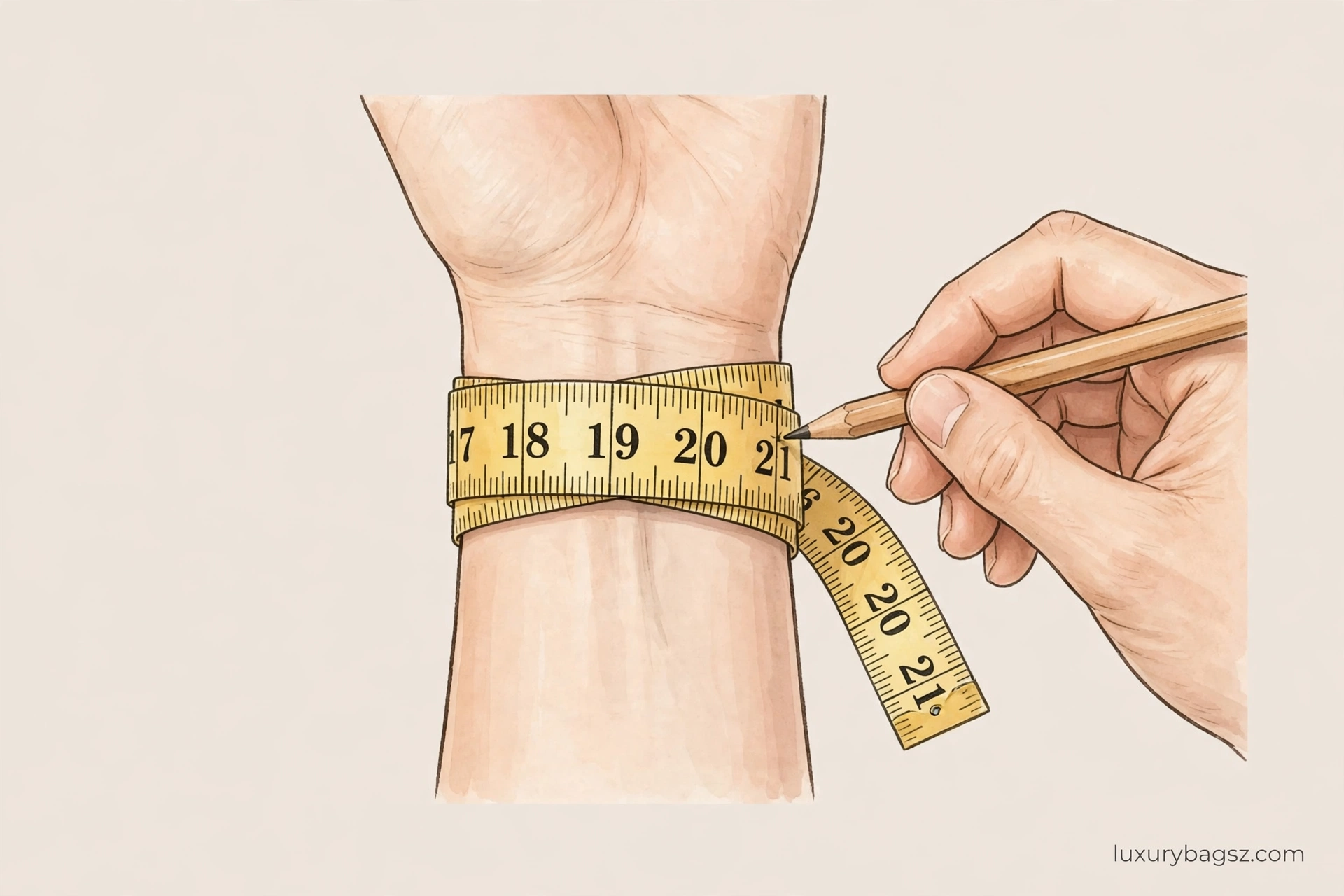
Use a soft tailor's tape, not a metal one, and not a piece of string you then measure with a ruler, unless you keep the string snug and flat. A metal tape kinks and a loose string adds phantom centimetres. Measure in the evening, when your wrist is at its largest, and measure twice.
Wrap the tape around the smallest point of your wrist, immediately below the wrist bone. That is where the bracelet will naturally sit. Keep the tape flat against the skin, snug but not digging in, and read the number in centimetres. Write it down before you do anything else.
Now apply the rule that matches your wear. For a daily-wear Classic, add 1.5 cm to your wrist measurement and round to the nearest whole size. For a snug or occasional fit, add 1 cm. For a loose, lower-arm fit, add 2 cm. Worked example: a 15.5 cm wrist plus 1.5 cm gives 17, which is size 17.
Test the result before you buy if you possibly can. A boutique will measure you and let you try the exact size, and that try-on is worth more than any table. If you buy pre-owned, ask the seller for the inner circumference measured with a tape inside the oval, not just the engraved size number, because engravings can be misread in photographs.
One more check costs nothing: measure both wrists. Most people have a dominant wrist a few millimetres larger than the other. Buy for the wrist you will actually wear the bracelet on, not for the wrist you measured first.

The Three Widths, and Which One Suits You
The Classic, at 6.1 mm wide, is the original 1969 form and the piece most people picture when they hear the name. It is substantial on the wrist, it dominates the pre-owned market, and it comes in yellow, rose and white gold, platinum and tri-gold, with plain, four-diamond, ten-diamond and fully paved versions.
The Small, at 3.65 mm wide, is roughly half the width of the Classic. It is produced in sizes 15 to 19 and suits smaller wrists or stacking, because two Smalls sit where one Classic would. It comes in yellow, rose and white gold with various diamond configurations, and it weighs roughly half what a Classic weighs at the same size.
The Medium, at 4.8 mm wide, is the newest rigid width, introduced in 2024 according to Opulent. It sits between Small and Classic, it is produced in the widest range of any Love, sizes 15 to 22, and it is the only width that offers size 22. It comes in yellow, rose and white gold, with plain, semi-paved and fully paved diamond versions.
Width changes how a size reads, even though the inner measurement is identical. A Classic in size 18 looks and feels bolder than a Small in size 18, because more gold meets the eye and the wrist. A Small in the same size can look almost delicate, and it slides more easily under a shirt cuff.
If this is your first Love, the Classic is the safest choice for resale and recognition. If you stack bracelets or wear a watch on the same wrist, the Small or Medium leaves more room. If your wrist needs size 20 or above, the Medium is your widest choice, and size 22 buyers have no other option.
Closures: Screws, Hinges, and the 2011 Change
The Classic closes with two working screws. On the original system, both screws unscrew completely and separate from the bracelet, so one half of the oval comes fully away from the other. That is the partner ritual the Love is famous for, and it is also how screws get dropped and lost.
In 2011, according to 1stDibs, Cartier redesigned the Classic closure so the screws stay attached to the bracelet even when fully loosened, held in a small casing. From the outside the bracelet looks identical. The difference is visible only when the screws are loosened, and it is a powerful dating check, covered in detail in the companion fake-spotting guide.
The Small and Medium widths use a different closure entirely: a single captive working screw paired with a hinge on the opposite side. The bracelet opens like a clasp rather than separating into two pieces. That makes it the easiest Love to put on alone, and the most practical choice for a buyer who will wear the bracelet without help every day.
The open Love cuff is a separate piece again. It slips on without a screwdriver at all, as Jonathan's notes, and it should never be confused with the closed bracelet when you compare prices or sizes. A cuff that slides on will always fit differently from a screwed oval of the same number.
Stacking, Watches, and the Oval on a Real Wrist
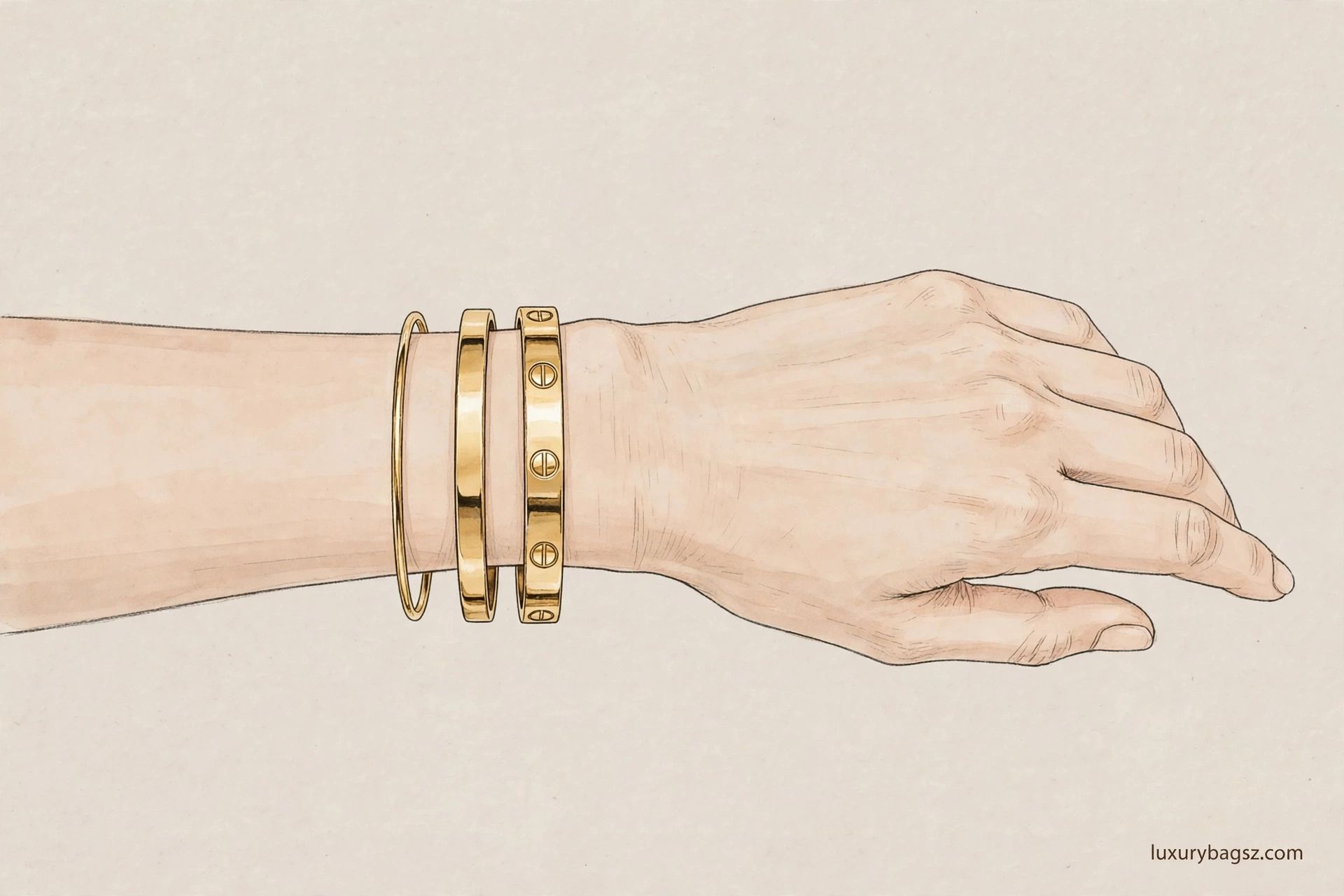
A Love bracelet worn beside a watch needs room the size chart does not mention. The watch case pushes the oval, the oval pushes back, and both pieces pick up scratches faster than either would alone. If you stack daily, choose the looser end of your fit range, and put the Love on the wrist without the watch if you can.
Stacking two Loves is a look Cartier itself styles, and it works best with mixed widths. A Classic beside a Small gives contrast without doubling the bulk, while two Classics can feel heavy and look uniform. The screw motifs line up visually, which is part of the appeal, but the two ovals will knock together, so expect surface marks over time.
Prices in 2026, and What Pre-Owned Really Saves
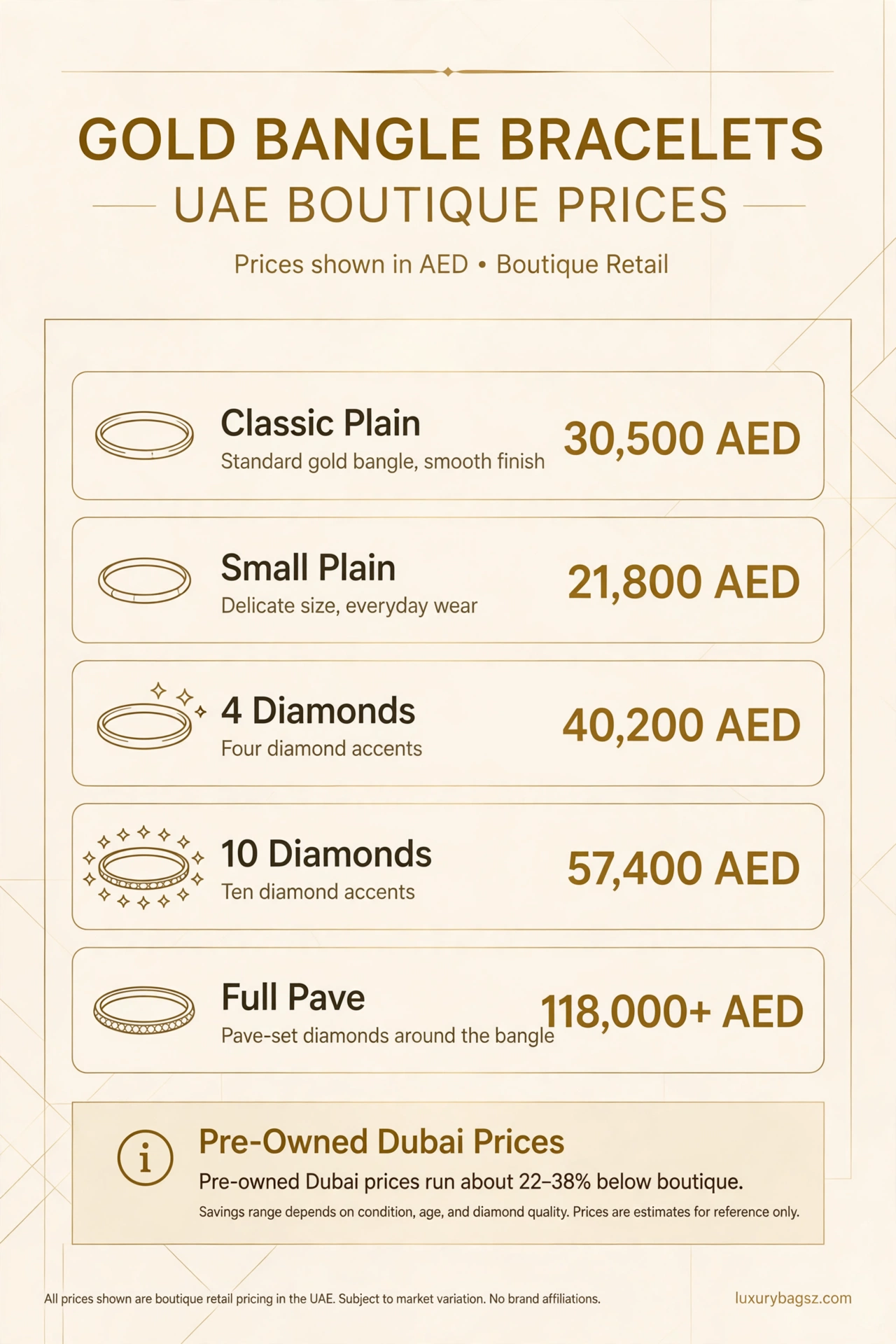
No competitor guide found in this research gives a current USD, GBP or EUR retail price table for the Love. That gap is stated plainly rather than filled with a guess. The dated prices below are in UAE dirhams from Libas Collective, May 2026, and the USD notes are ranges, not boutique prices.
| Version | UAE boutique, May 2026 (AED) |
|---|---|
| Love Bracelet, Classic, plain 18k gold | 30,500 |
| Love Bracelet, Small, plain 18k gold | 21,800 |
| Love Bracelet, 4 diamonds | 40,200 |
| Love Bracelet, 6 diamonds | 45,800 |
| Love Bracelet, 10 diamonds | 57,400 |
| Love Bracelet, full pavé | 118,000+ |
| Love Bracelet, ceramic with gold screws | 15,400 |
Jonathan's Fine Jewelers reports that a classic plain 18k gold Love retailed for well over $7,000 in 2026, with the small model for less and diamond and pavé versions considerably more. That is a floor, not a price list, and Cartier raises prices regularly, so confirm the boutique price on the day you buy.
Pre-owned, Libas reports Dubai prices roughly 22 to 38 percent below UAE boutique prices. A 2022 yellow gold Classic in excellent condition traded around AED 22,000 to 24,000 in 2026, against AED 30,500 new, a saving of roughly 25 to 28 percent. Jonathan's reports excellent-condition recent pieces with box and papers at roughly 70 to 85 percent of current retail.
Gold alone explains part of the price. With 18k gold around $101 per gram in October 2026, according to Jonathan's, the metal in a Classic Love is worth thousands of dollars before any Cartier premium. Never accept a melt-only offer on a genuine piece, and never let a seller price a Love as if it were scrap.
Weight by Size: What the Scale Should Say
Weight is the cheapest authentication tool you own, and the published figures are thinner than they should be. Opulent gives Classic 18k gold weights for sizes 17 to 19 only: size 17 around 30 to 32 grams, size 18 around 32 to 34 grams, and size 19 around 34 to 36 grams. 1stDibs gives a single broad range of 30 to 38 grams for a genuine Love, depending on size, design and metal.
No competitor found gives a full weight table by size, width and metal. The Small is roughly half the Classic weight at each size, according to Opulent, which puts a Small size 17 near 15 to 17 grams, but that is an estimate from the half-weight note, not a published table, and it should be treated as such.
Use weight as a screen, not a verdict. A reading more than two grams outside the expected range for the size, width and metal deserves closer inspection, because counterfeits usually come in lighter, with gold adulterated by cheaper metals. But a correct weight alone never proves a piece real, because good fakes now copy weight closely.
Weigh the bracelet on a digital jewellery scale, without the screwdriver, box or papers. Ask a pre-owned seller for the exact scale weight in grams before you pay, and compare it with the known weight for that exact model and size. A seller who refuses to weigh a piece worth thousands of dollars is telling you something.
Daily Wear, Care, and the Screwdriver Problem
The Love is designed to stay on, and many owners wear it in the shower, at the gym and overnight. Gold itself tolerates that, but the bracelet still picks up hairline scratches from daily contact, and a screw that is never checked can loosen. Check the screws every few weeks with the screwdriver, gently, and never force one that resists.
Polishing is where owners do the most damage. Light surface swirls polish out, but heavy machine buffing thins the gold, rounds the screw motifs and softens the engraving. Over-polishing is irreversible, and it lowers resale value more than honest wear does. Polish rarely, by hand or through Cartier, and accept that a worn Love shows its life.
The same dry-cloth-first routine used for other fine jewellery applies here, as our guide on how to clean Hermès fashion jewellery explains.
The screwdriver is small, proprietary and easy to lose, and it is essential for removing a Classic. Keep a spare in a safe place, and keep the original with the box and papers, because a complete set sells for more. A missing screwdriver does not prove a bracelet fake, but it does suggest careless ownership, and it costs you at resale.
Never use abrasive cloths, ultrasonic cleaners or harsh chemicals on a Love without jeweller advice.
Buying Pre-Owned: The Checks That Matter Most
Start with the seller, not the bracelet. Buy from a boutique, an established authenticated reseller, or a seller who accepts returns if the piece fails inspection. A price far below market is the oldest red flag in this market, because, as 1stDibs quotes, nobody needs to sell a genuine Love cheaply.
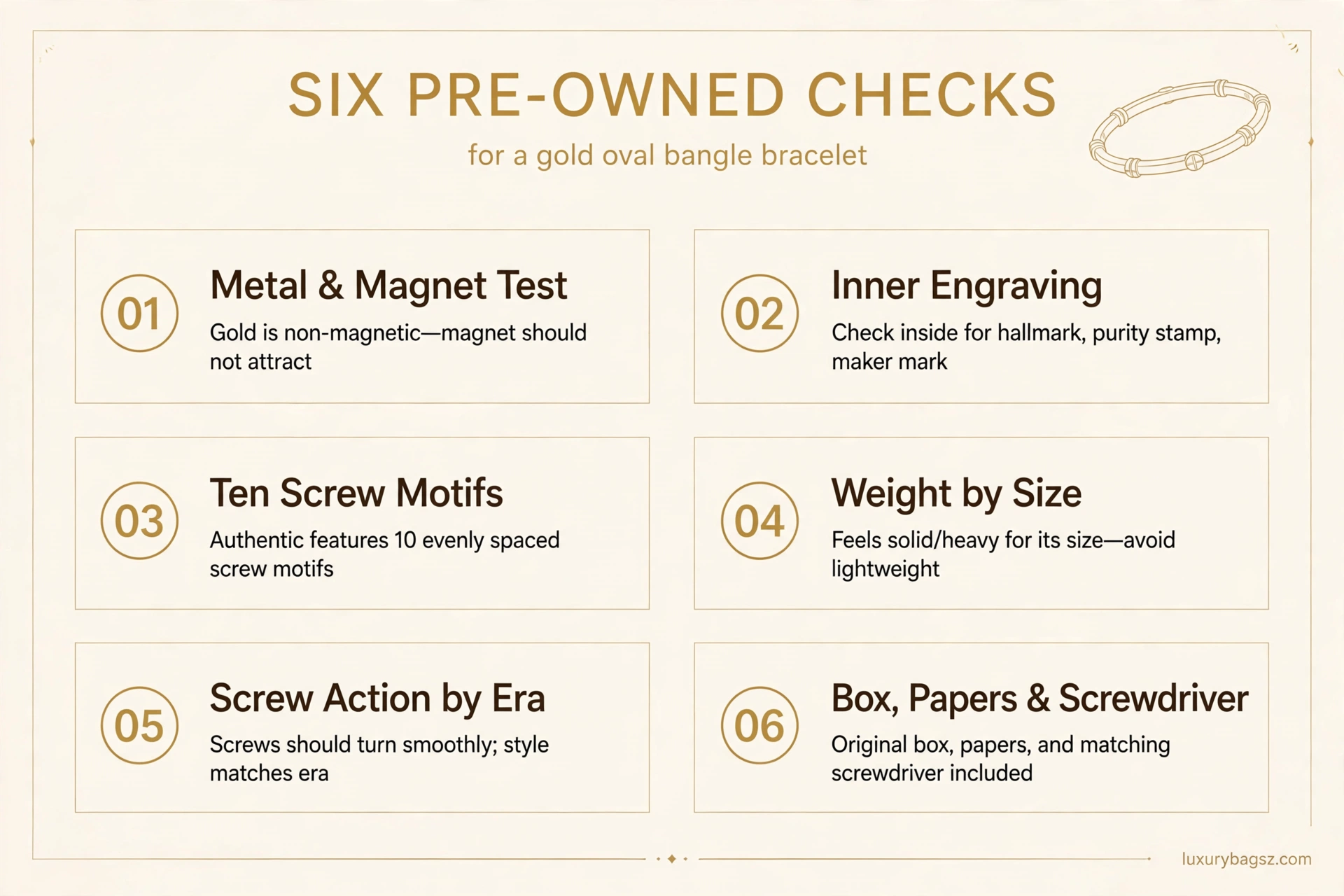
Demand photographs of the inner engraving, all ten screw motifs front and back, the closure mechanism open and closed, the screwdriver, the box, and the certificate with its serial number. Compare the certificate serial with the bracelet serial character by character. A mismatch is a stop sign, not a detail.
Check the metal first. Genuine Love bracelets are solid 18k gold, marked 750, or platinum, marked 950. Cartier does not plate the Love, and a sterling silver Love is a fake on sight. Gold and platinum are not magnetic, so any attraction to a household magnet is an immediate warning.
Check the engraving under magnification. Genuine engraving is crisp, evenly deep and in Cartier's own font, with even letter spacing. Shallow, uneven or generic-font engraving is a strong fake tell. Check all ten screw motifs, including the five on the inner face that counterfeiters often neglect, for identical depth and centring.
Check the weight, the screw action and the seam where the two halves meet. The seam should sit flush with no visible step, the screws should turn smoothly, and the weight should sit within two grams of the expected range for that size and width. A piece that fails three or more of these checks should be treated as counterfeit until proven otherwise.
LOVE Unlimited and the Flexible Newcomer
LOVE Unlimited arrived in 2025, according to Opulent, and it is the only flexible bracelet in the Love line. Instead of a rigid oval, it is built from linked, articulated pieces that move with the wrist, with the screw motif applied across the links. Several Unlimited pieces can also connect to each other for a longer stacked look.
That flexibility changes the sizing question entirely, and no competitor guide found gives a size range or a fit rule for Unlimited. This guide will not invent one. If you are considering Unlimited, try it on in a boutique and ask for the size system in writing, because rigid Love sizes do not transfer to a linked bracelet.
Pricing and pre-owned supply for Unlimited were not yet well established in 2026, according to Opulent. Treat any pre-owned Unlimited price as a new-market price, not a settled one, and expect wider variation than for a Classic of the same year. The Classic remains the most liquid and usually the right first purchase.
Choosing Your Size: A Decision Routine
Start with your evening wrist measurement, below the wrist bone, in centimetres. Add 1.5 cm for a daily-wear Classic, 1 cm for a snug fit, or 2 cm for a loose fit, and round to the nearest whole size. That number is your starting size, not your final answer.
Adjust for width and stacking. If you will stack with a watch or another bracelet, move one step looser if your starting size already feels close. If the Love will be your only wrist piece and you wear it only for occasions, the snug end of your range will read as intentional.
Adjust for wrist shape. A prominent wrist bone or a very oval wrist needs the looser end of the range, because the rigid oval must clear the bone without pressing it. A slim, round wrist can take the snug end, because the oval sits evenly all the way round.
Gifting, Engraving, and Special Editions
A Love bracelet is often bought as a gift, and gifting makes sizing harder, because you cannot measure the wearer's wrist without spoiling the surprise. If you must guess, choose from what you know: a partner who wears slim bracelets and small watches probably wears size 16 or 17, while a partner who wears chunky watches and loose bangles probably wears size 18 or 19.
Engraving is a question buyers ask often, and the answer needs care. Cartier will not accept changes to its hallmarks as part of a customer order, according to 1stDibs, which means the inner signature, size and serial are fixed. Personal engraving elsewhere on the piece is a separate matter, and it affects resale: a bracelet engraved with initials or a date appeals to its owner and narrows its market.
Special editions complicate sizing further. Ceramic Love bracelets, with a ceramic body and gold screws, were reported at AED 15,400 in the UAE in May 2026, well below the gold Classic. Ceramic wears differently from gold: it is lighter, harder, and less forgiving of knocks, and its sizing follows the same centimetre system. A ceramic Love in the wrong size is still a wrong size, and ceramic cannot be adjusted any more than gold can.
Diamond versions do not change the size system, but they change the price of a sizing mistake. A pavé Love returned for exchange is a straightforward boutique process when bought new, but a pre-owned pavé piece in the wrong size is a harder resale, because the buyer pool is smaller and the price is higher. For diamond versions, try the exact size on before paying, even if that means waiting for stock.
Frequently Asked Questions
What size Cartier Love bracelet should I buy?
Measure your wrist just below the wrist bone in centimetres, then add room for comfort. Opulent says add 1.5 to 2 cm, HEWI says 1 to 1.5 cm, and Libas says 1 cm. For daily wear, this guide suggests starting with 1.5 cm added and adjusting for stacking and wrist shape.
What are the most common Cartier Love bracelet sizes?
Sizes 17, 18 and 19 account for most boutique and pre-owned stock. Size 17 suits a wrist of roughly 15 to 15.5 cm, size 18 suits roughly 16 to 16.5 cm, and size 19 suits roughly 17 to 17.5 cm, under the stricter fit rules. Size 15 is rare pre-owned, and size 22 exists only in Medium.
Can a Cartier Love bracelet be resized?
No. Cartier does not resize the Love bracelet, because it is made as a single integral oval with precisely milled inner measurements. Altering the circumference would compromise its structure and its authentication. A wrong size must be exchanged, not altered.
What is the difference between Small, Medium and Classic Love bracelets?
Small is 3.65 mm wide, Medium is 4.8 mm wide, and Classic is 6.1 mm wide, according to Opulent. Size numbering is identical across widths, so a size 17 is the same inner measurement in all three. Medium, introduced in 2024, is the only width offered in size 22, while Small tops out at size 19.
Should I size up or down if I am between Love sizes?
The guides disagree, and this guide splits the answer. Opulent says size down, because a loose Love shifts and scratches. HEWI says size up, because a tight Love cannot be stretched. For daily wear, lean down; for occasional wear, lean up; and never buy a size that presses the wrist bone.
How much does a Cartier Love bracelet weigh?
A Classic 18k gold Love weighs around 30 to 32 grams in size 17, 32 to 34 grams in size 18, and 34 to 36 grams in size 19, according to Opulent. 1stDibs gives a broader 30 to 38 gram range across sizes and metals. The Small weighs roughly half the Classic at the same size.
How much does a Cartier Love bracelet cost in 2026?
No current USD retail price table was found in this research, so none is invented here. In the UAE in May 2026, Libas reported a plain Classic at AED 30,500 and a plain Small at AED 21,800. Jonathan's reports a plain Classic retailing for well over $7,000 in 2026. Confirm the boutique price on the day you buy.
Is the Cartier Love bracelet comfortable for daily wear?
Yes, when sized correctly. The oval rests against the wrist bone and slides slightly toward the elbow when you raise your arm. A correctly sized Love feels present but not tight. A too-small Love presses the bone and a too-large Love twists and knocks, so comfort is really a sizing verdict.
What is LOVE Unlimited?
LOVE Unlimited is a flexible Love bracelet introduced in 2025, built from linked, articulated pieces rather than a rigid oval. It carries the screw motif across its links and can connect to other Unlimited pieces. No size range or fit rule was found for it in this research, so try it on in a boutique rather than converting a rigid size.
Is a pre-owned Cartier Love bracelet worth buying?
Yes, when authenticated and correctly sized. Dubai pre-owned prices ran roughly 22 to 38 percent below UAE boutique prices in 2026, and excellent-condition pieces with box, papers and screwdriver trade at roughly 70 to 85 percent of retail. Always verify the inner engraving, weight and closure before paying.
Summary
Measure below the wrist bone, add 1.5 cm for daily wear, and round to a whole size. That rule, tested against the guides that disagree with it, will put most buyers in the right Love the first time. Sizes 17 to 19 cover most wrists, the Classic is the safest first width, and the Medium is the only answer for size 22.
Do not let a single table overrule your own wrist. Try the exact size on, raise your arm, wear it for ten minutes, and check that it neither presses the bone nor falls toward the hand. If you fall between sizes, lean down for daily wear and up for occasional wear, and buy from a seller who accepts returns.
A Love bracelet in the right size disappears onto the wrist and stays there for years. A Love in the wrong size reminds you of the mistake every day, and it cannot be resized. Spend the extra day on measurement, and the bracelet will repay it for decades.