Fashion Designers Inspired by Artists: When Paintings Become Clothes
Art on the Body, in Brief
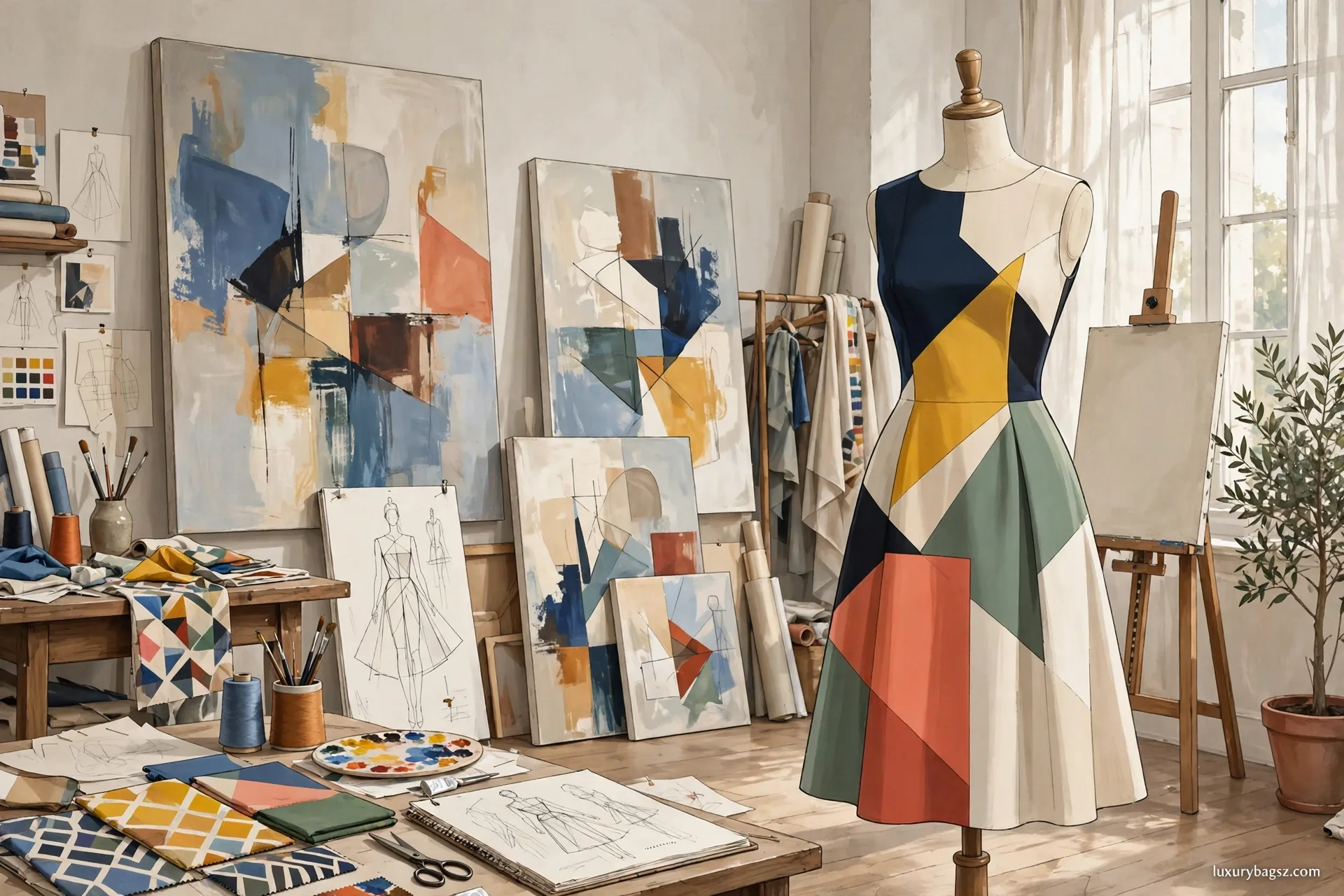
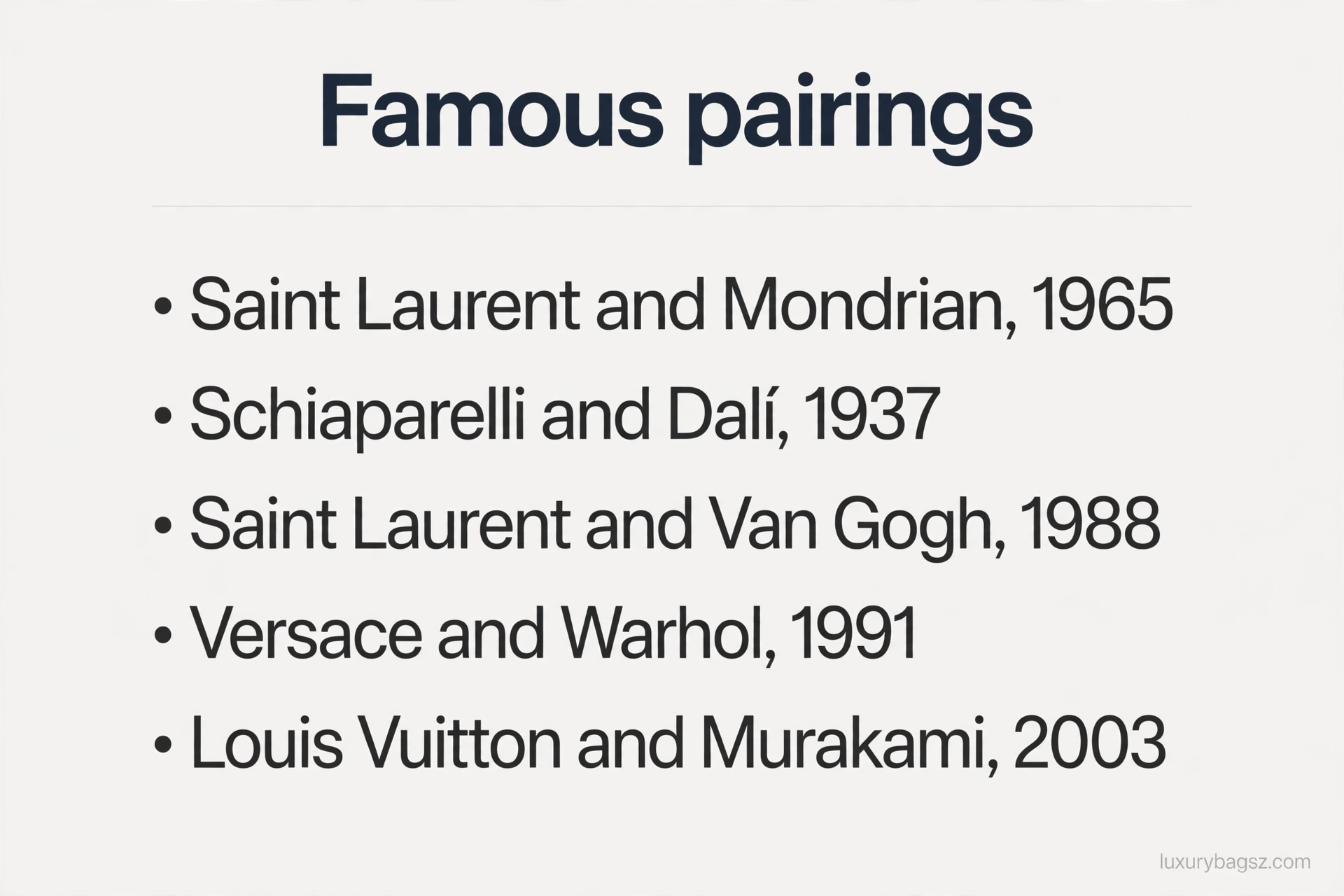
Fashion designers have borrowed from artists for a century, and the best borrowings do more than print a painting on a dress. Yves Saint Laurent turned Piet Mondrian's grids into shift dresses in 1965. Elsa Schiaparelli and Salvador Dalí turned surrealism into wearable wit in 1937, most famously the Lobster Dress. Saint Laurent returned to Van Gogh in 1988, Gianni Versace channelled Andy Warhol in 1991, and Louis Vuitton built a modern empire on artist collaborations from Murakami to Kusama and Richard Prince. The thread is simple: artists teach designers new ways to see colour, shape and the body, and designers give art a life beyond the gallery wall.
Key Takeaways

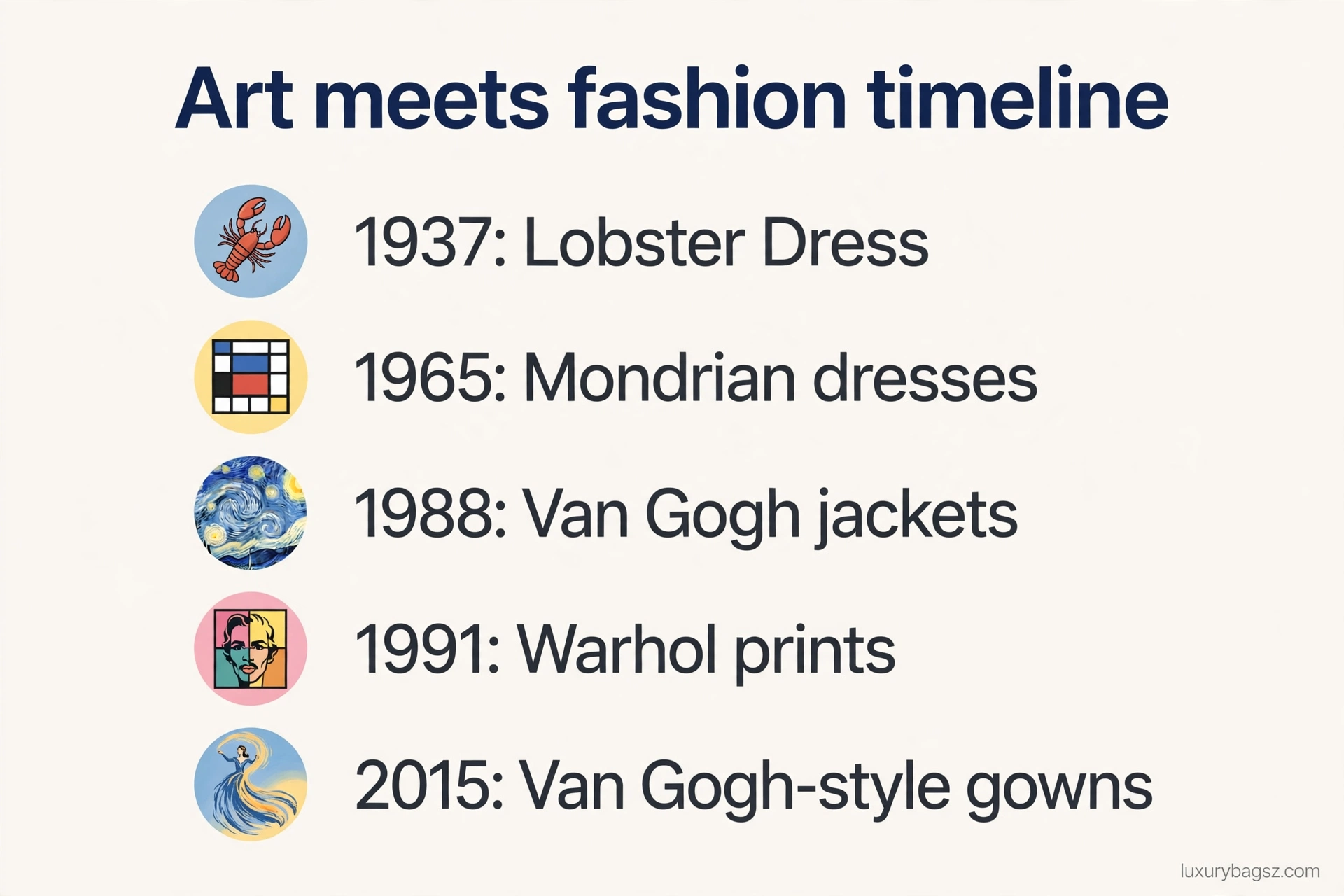
- The most famous example is Saint Laurent's Mondrian collection of autumn winter 1965, turning geometric painting into jersey shift dresses.
- Schiaparelli and Dalí's 1937 Lobster Dress is the founding surrealist fashion moment, born from friendship and shared wit.
- Saint Laurent revisited art throughout his career, including Van Gogh's Irises and Sunflowers in 1988.
- Versace's 1991 Warhol prints put Marilyn Monroe and James Dean silkscreens on gowns and leisurewear.
- Louis Vuitton's artist collaborations, from Murakami in 2003 to Kusama in 2012, made art fashion commercially huge.
- The difference between homage and copy matters: the best pieces translate an artist's logic, not just their image.
- Wear one art-led piece at a time, keep the rest simple, and check print placement before buying.
Why Designers Look to Painters
Designers look to artists because artists solve visual problems first. A painter decides how colour blocks balance, how a line moves the eye, and how a shape sits in space. A designer faces the same questions, with the added difficulty that the canvas is a moving body. Borrowing an artist's solution is not laziness. It is a shortcut to a visual language that already works, which the designer must then rebuild in fabric, cut and fit.
There is also a cultural reason. Fashion wants the prestige and meaning of art, and art wants the audience and energy of fashion. When a designer references a respected artist, the clothes inherit some of that artist's story. When an artist works with a designer, their images reach people who may never visit a gallery. That exchange has driven fashion for a hundred years, from Schiaparelli's Paris salon to today's museum exhibitions of fashion as art.
The risk is literal copying. A dress that simply pastes a painting on fabric can feel like merchandise rather than design. The pieces that last are the ones where the designer understood the artist's idea deeply enough to reinvent it, which is why the examples below still matter decades later.
Saint Laurent and Mondrian: A Painting Becomes a Dress
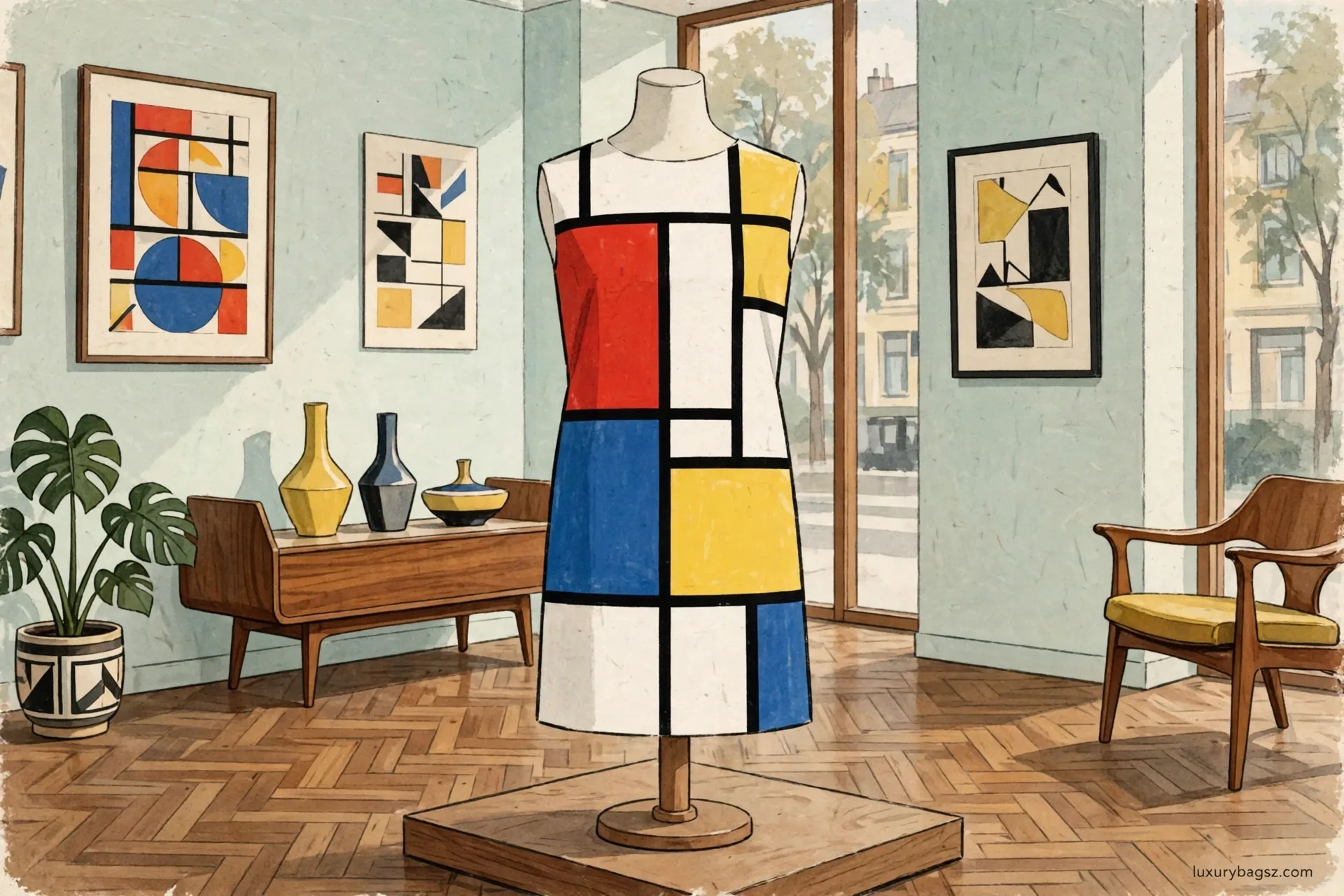
In autumn winter 1965, Yves Saint Laurent presented six Mondrian-inspired cocktail dresses that became the most famous art-fashion translation ever made. He took Piet Mondrian's geometric compositions, black lines, white grounds and blocks of primary colour, and rebuilt them as simple jersey shift dresses. The seams of the dresses followed the lines of the paintings, so the garment's construction and the artwork's geometry became one thing.
Saint Laurent himself framed the idea plainly, saying that a couturier's work is much like an artist's, and that he constantly found inspiration in contemporary painters including Picasso, Matisse and Mondrian. The Mondrian dresses proved the point. They were not paintings worn as costumes. They were dresses that thought like paintings, using the body's shape to complete the geometry rather than fighting it.
The dresses were also a commercial and cultural hit. They appeared on the cover of French Vogue in September 1965, spawned countless cheaper copies, and entered museum collections. For the wider Saint Laurent story, our Saint Laurent guide covers the house's history, bags and prices. The Mondrian moment, though, belongs to fashion history as a whole, because it showed that a dress could be both wearable and intellectually serious.
Schiaparelli and Dalí: Surrealism You Could Wear
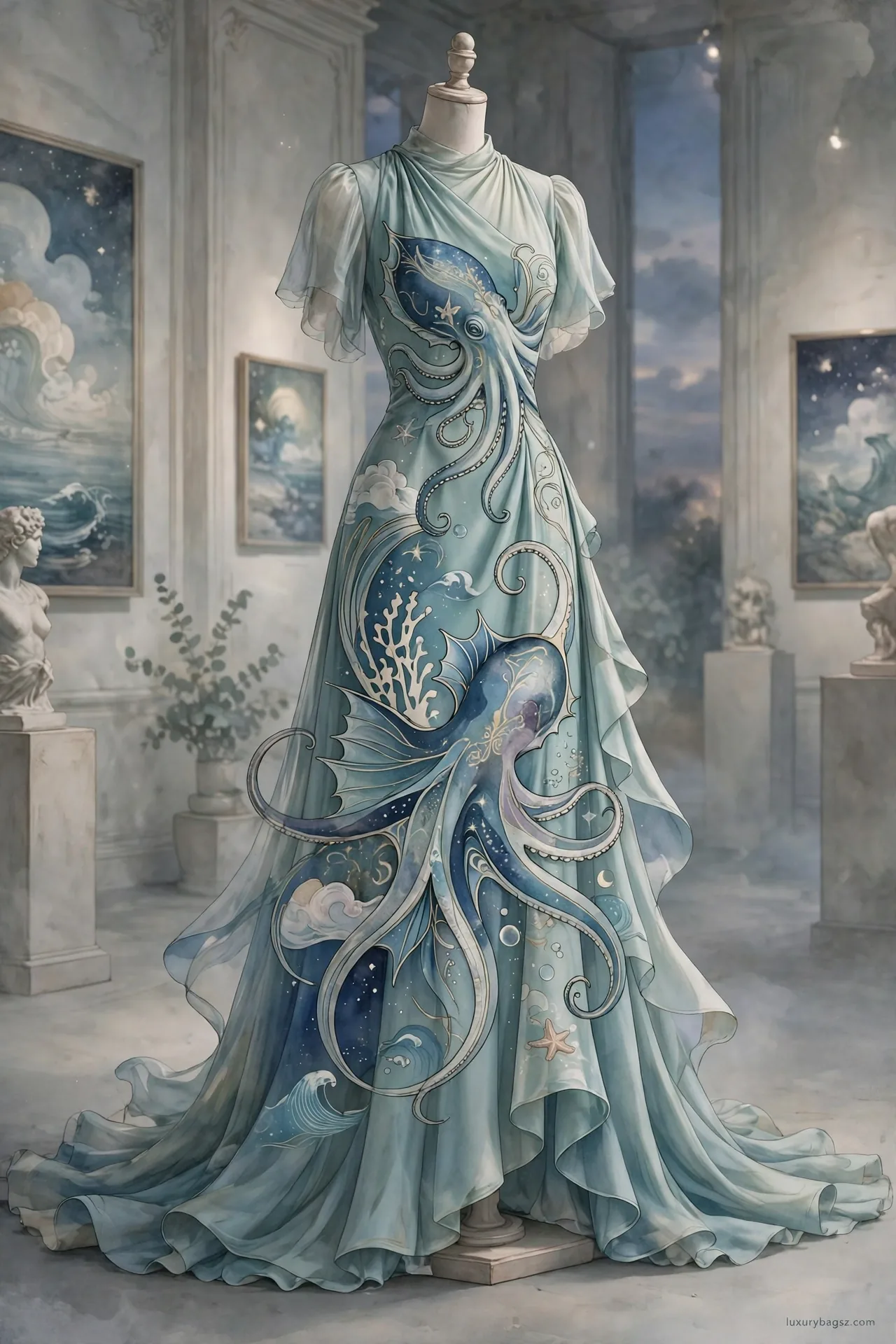
Three decades earlier, Elsa Schiaparelli had already shown what fashion and art could do together. Working in Paris from the late 1920s to the 1950s, Schiaparelli befriended Surrealist artists and turned their ideas into couture. Her collaboration with Salvador Dalí produced the Lobster Dress of 1937, a silk organza evening dress printed with a large lobster, inspired by Dalí's 1936 Lobster Telephone, made for Wallis Simpson after her marriage to the Duke of Windsor.
The lobster was deliberately provocative. In Dalí's world it carried erotic and unsettling associations, and placing it on an elegant evening dress created a witty clash between glamour and absurdity. Schiaparelli and Dalí went further with the Tears Dress, whose printed tears suggested ripped flesh, and with the Shoe Hat, a hat shaped like a high-heeled shoe. These were not jokes for their own sake. They were arguments that fashion could be surreal, intellectual and funny at the same time.
Schiaparelli's wider circle included Jean Cocteau, with whom she made a coat showing a vase of roses that doubled as two faces in profile. She also pioneered visible zippers, synthetic fabrics and her signature shocking pink. Her salon closed in 1954, but her revival in recent years, under Daniel Roseberry, has returned her surreal wit to the runway, including the hyperreal animal heads that made headlines. The lesson endures: the best art fashion surprises you, then makes you think.
Saint Laurent's Second Act: Van Gogh, Matisse, and Picasso
Saint Laurent did not stop with Mondrian. Throughout his career he returned to artists as a kind of private syllabus. In spring summer 1988 he paid tribute to Vincent van Gogh with richly embellished jackets inspired by Irises and Sunflowers, translating thick impasto brushwork into embroidery and beading. In other collections he honoured Henri Matisse, Pablo Picasso, the Impressionists and the Cubists, and in 1976 he staged a collection dedicated to Russian ballet and opera as a theatrical show.
The Van Gogh jackets matter because they show a different kind of translation from Mondrian. Where Mondrian was about line and flat colour, Van Gogh was about texture and emotion. Saint Laurent could not paint with a brush on a jacket, so he used beads, sequins and thread to build up a surface that caught light the way impasto catches it. That is the difference between copying an image and translating an idea, and it is why the jackets are still cited as a masterclass.
Other designers followed similar paths. Christian Dior looked to Claude Monet's irises in 1949, turning them into thousands of pastel floral appliqués. Jean Paul Gaultier reinterpreted Edgar Degas's ballerinas in 2003 couture. Vivienne Westwood drew on François Boucher and the Rococo across the 1990s, bringing painted gowns to life in voluminous silhouettes. Each found a different answer to the same question: how does a painting move?
Pop, Luxury, and the Collaboration Economy
The late twentieth century turned art fashion into big business. Gianni Versace, who shared Warhol's love of bold visual language, set aside his usual baroque style in spring summer 1991 and used Warhol-style silkscreen portraits of Marilyn Monroe and James Dean on evening gowns, leisurewear and workwear. It was pop art worn as pop fashion, glamorous and knowing at once.
Louis Vuitton then industrialised the idea. Under Marc Jacobs, the house collaborated with Takashi Murakami in 2003, covering the Monogram in 33 bright colours, and with Yayoi Kusama in 2012, covering it in polka dots. Our Murakami collection guide and our Kusama collection guide cover those collections in full. Our Richard Prince guide covers the 2008 Watercolor and Jokes canvases, which washed the Monogram out or printed jokes across it.
These collaborations succeeded because they were genuine exchanges, not licences pasted on bags. Murakami, Kusama and Prince each changed how the Monogram looked and meant, and the house gave them a global stage in return. That model now dominates luxury, from Fendi's work with artists to Prada's engagement with contemporary art through its foundation. The danger is dilution: when every brand has an artist collaboration, the idea stops surprising. The best ones still do, because the artist's hand is visible in the result.
Sculpture, Movement, and the Body as Art
Not all art inspiration is painting. Rei Kawakubo's Comme des Garçons spring summer 1997 collection leaned on sculpture rather than print, padding and distorting the body's silhouette into strange, beautiful forms. Viktor and Rolf's autumn winter 2015 couture turned paintings into wearable frames, with models wearing gowns that looked like artworks hung on the body. Alexander McQueen treated every collection as a performance or installation, drawing on Victorian Gothic, Romantic art and Scottish history.
This sculptural thread matters for shoppers, because it changes how clothes fit. A Kawakubo piece does not fit like a normal jacket, and a Westwood Rococo gown does not move like a modern dress. Our Westwood jewellery guide shows how Westwood's art-historical imagination worked even in small pieces, where a snail motif carried Rococo wit into everyday wear. The principle is the same at every scale: art gives fashion permission to be strange, and fashion gives art a body to live on.
Contemporary designers continue the conversation in quieter ways. Some borrow a colour palette from a single painting. Others borrow a brushstroke as a print. Others borrow an artist's attitude, such as Frida Kahlo's self-invention or Louise Bourgeois's emotional symbolism, which Prada has explored. The visible artwork matters less than the idea behind it, and the best pieces reward looking twice.
How to Wear and Buy Art-Inspired Fashion
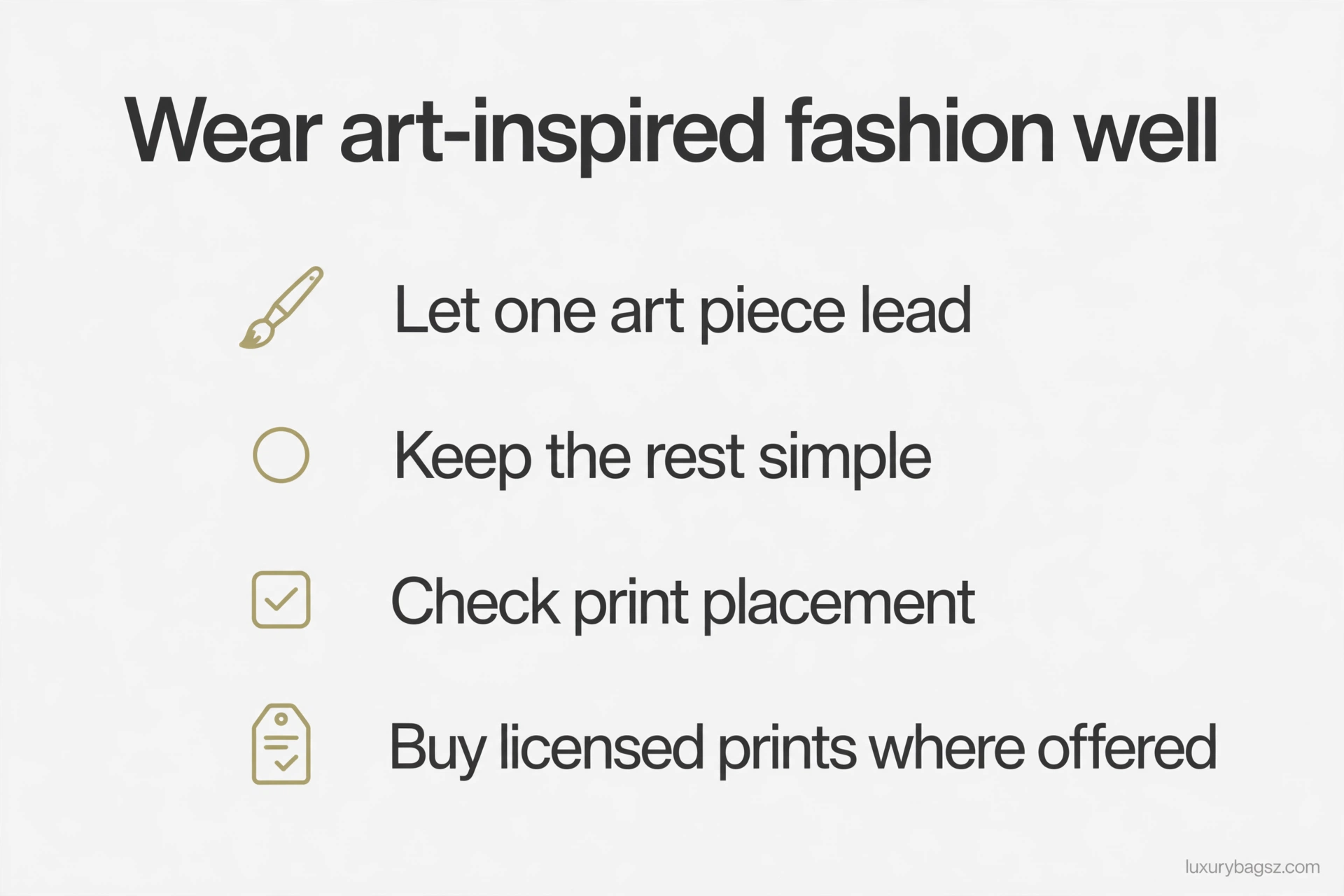
Wearing art-inspired fashion well is mostly about restraint. Let one art-led piece lead the outfit, whether it is a Mondrian-style shift, a bold printed scarf or a surreal accessory, and keep everything else simple. A geometric dress needs plain shoes and minimal jewellery. A surreal print needs a quiet background. Two competing artworks in one outfit cancel each other out.
When buying, check print placement first. A geometric print should align at the seams, not drift randomly across the body, and a figurative print should sit where it flatters rather than where it distracts. Check the fabric and finish too: a cheap copy of a Mondrian dress often uses thin jersey that loses its shape, while a good one holds its structure. For licensed collaborations, buy from official stores or listed stockists, because popular art prints are widely copied.
For vintage and pre-owned art pieces, condition matters more than usual. Bold prints show fading, and beaded or embroidered art jackets need professional care. Ask for photos in natural light, because studio lighting flatters bright colours, and check the label and era against the collection you think you are buying. A genuine 1960s homage and a modern reissue can both be lovely, but they should not be priced the same.
Is Fashion Art? The Question That Won't Settle
Fashion historian Valerie Steele has argued that haute couture is sometimes treated as art because it is exhibited in museums, yet it was not created within the art world, and that distinction still sparks debate. Schiaparelli believed dress designing was an art, not a profession. Saint Laurent believed a couturier's work resembled an artist's. Museums now stage fashion exhibitions that draw blockbuster crowds, and the Met Gala's 2026 dress code, "Fashion Is Art", shows how mainstream the question has become.
The honest answer is that fashion can be art, craft, commerce and costume at different moments, sometimes in the same garment. A Mondrian dress is art when it hangs in a museum and fashion when it walks down a street. That double life is not a flaw. It is the point, and it is why designers will keep looking at paintings for as long as people keep getting dressed.
Frequently Asked Questions
Which fashion designer was inspired by Mondrian? Yves Saint Laurent, whose autumn winter 1965 collection turned Piet Mondrian's geometric paintings into jersey shift dresses.
What is the Schiaparelli Lobster Dress? It is a 1937 silk organza evening dress by Elsa Schiaparelli, printed with a large lobster designed with Salvador Dalí, inspired by Dalí's 1936 Lobster Telephone.
Which designers were inspired by Van Gogh? Yves Saint Laurent most famously, with embellished jackets inspired by Irises and Sunflowers in 1988, and later designers including Viktor and Rolf, who reworked Van Gogh-style imagery in 2015 couture.
Did Versace work with Andy Warhol? Gianni Versace channelled Warhol's silkscreen style in spring summer 1991, printing Marilyn Monroe and James Dean portraits on gowns and leisurewear, rather than collaborating with Warhol directly.
What is the Louis Vuitton and Murakami collaboration? It is the 2003 Multicolore collection, in which Takashi Murakami recoloured the Louis Vuitton Monogram in 33 bright colours on white and black canvas.
Did Louis Vuitton collaborate with Yayoi Kusama? Yes, in 2012, covering Louis Vuitton bags and ready-to-wear in Kusama's signature polka dots.
Is fashion considered art? It is debated. Museums exhibit fashion as art, and designers such as Schiaparelli and Saint Laurent saw their work as artistic, but fashion is also commercial and functional, so it occupies both worlds.
How do I wear art-inspired prints without looking costume-like? Let one art piece lead, keep the rest of the outfit simple, check print placement at the seams, and choose good fabric that holds its shape.
Are art collaboration bags worth buying pre-owned? Popular collaborations such as Murakami and Kusama hold interest well in good condition, but buy the exact collection and colourway, check authenticity carefully, and use trusted sellers with returns.
Where can I see art-inspired fashion in person? In museum fashion exhibitions, in designer retrospectives, and in the permanent collections of museums including the Victoria and Albert Museum and the Metropolitan Museum of Art.
Final Verdict
Fashion designers inspired by artists succeed when they translate, not copy. Saint Laurent understood Mondrian's geometry well enough to build it into a dress. Schiaparelli understood Dalí's wit well enough to wear it. Versace understood Warhol's pop energy well enough to print it, and Louis Vuitton understood Murakami, Kusama and Prince well enough to let them change its most famous pattern.
If you want to wear this history, start with one strong piece, learn the story behind it, and wear it with confidence rather than explanation. Art-inspired fashion works best when it feels like a choice, not a costume. Choose the artist whose way of seeing matches your own, and let the clothes do the talking.