Bucket Bags: History, Designer Icons and the Best Styles to Buy
Bucket Bags in Brief: A Champagne Carrier Turned Wardrobe Staple
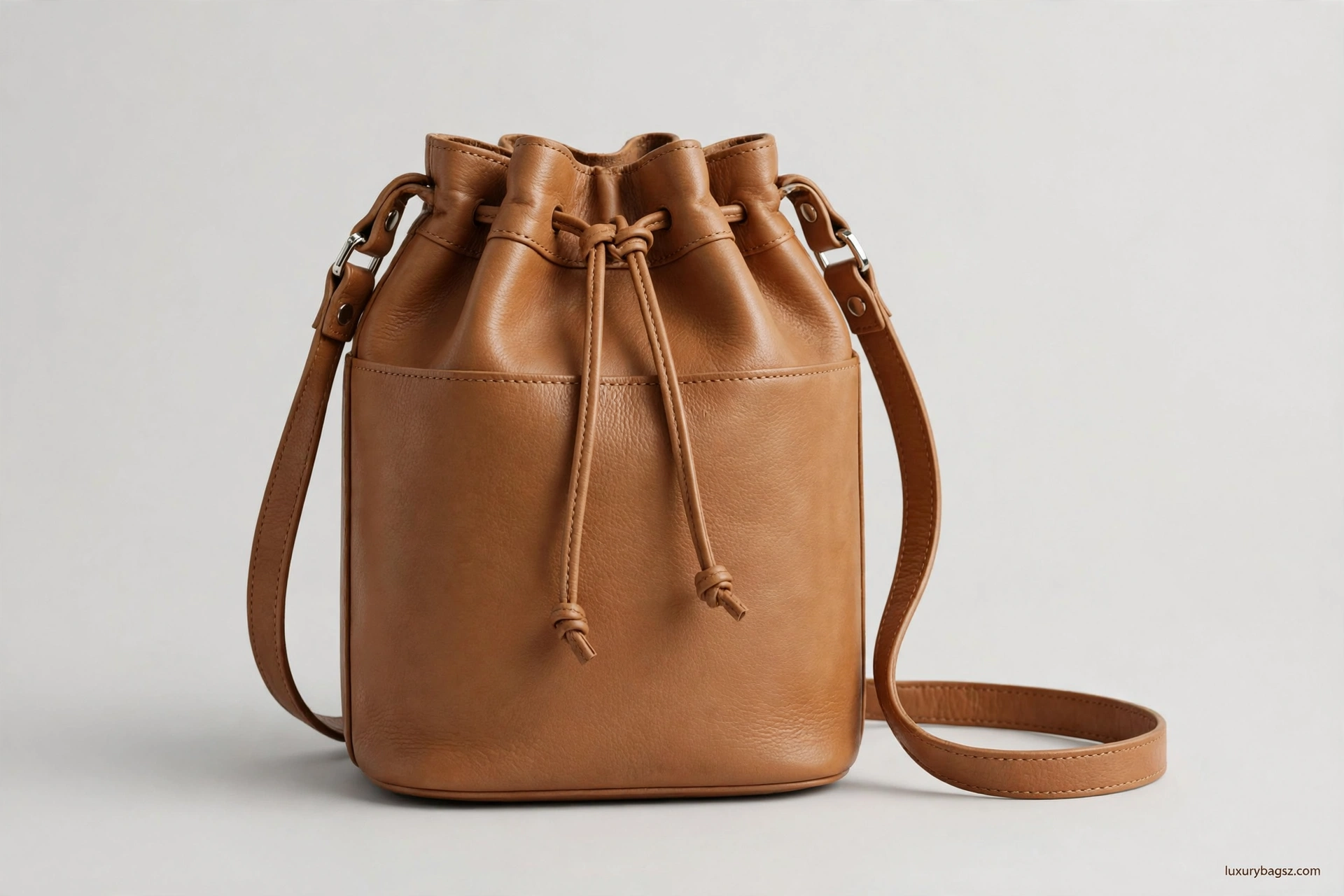
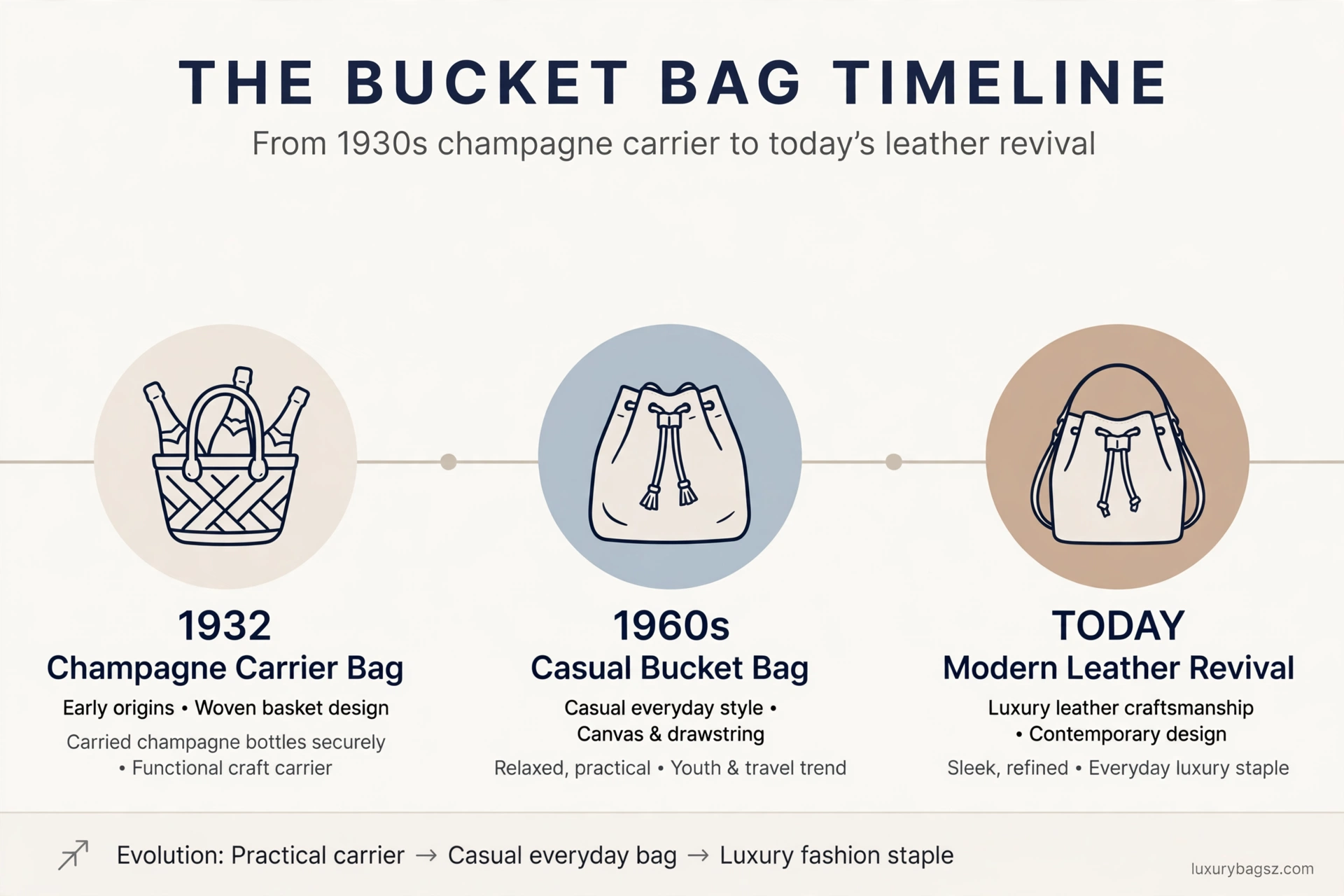
The bucket bag is a deep, open-topped bag with a drawstring or cinched closure and a flat base. Its modern story starts in 1932, when Louis Vuitton created the Noe to carry champagne bottles safely.
Today the shape ranges from mini evening versions to roomy daily carriers by houses old and new. The short answer is this: pick a structured leather mini or medium bucket for daily use, and check the closure first.
Key Takeaways
- The first famous bucket bag, the Louis Vuitton Noe of 1932, was made to carry five champagne bottles.
- Bonnie Cashin shaped the casual American bucket at Coach in the 1960s and 1970s.
- Mansur Gavriel sparked the modern revival in 2013 with a clean, lined leather bucket.
- A flat base and a secure closure matter more than decoration on this shape.
- Medium sizes suit daily use best, while mini buckets suit evenings and light days.
- Pre-owned buyers should check the drawstring, base corners and strap joins first.
Where the Bucket Bag Came From
The bucket shape is older than fashion itself, since drawstring pouches have carried coins and tools for centuries. As a named designer style, though, its landmark moment came in 1932 in Paris.
That year a champagne producer asked Louis Vuitton for a bag that could transport bottles without breakage. Our Louis Vuitton Noe and NeoNoe guide tells the full story of the design that followed.
The answer held four bottles upright with a fifth inverted in the middle. A drawstring held the necks firm, and a reinforced base took the weight. Practical design became a lasting silhouette.
Early pouches were carried by men and women alike, tied at the belt for coins and small tools. The fashionable bucket kept that honest, gathered shape and simply gave it better leather and a designed base.
Drawstring pouches also appear in nineteenth-century fashion as reticules, carried when dresses lost their pockets. The bucket bag fashionable DNA therefore mixes utility carriers with delicate evening pouches.
Regional makers add local character to the story, from Tuscan vegetable-tanned buckets to Japanese canvas versions. The shape travels well because every leather tradition can interpret it without changing its honest structure.
From Workhorse to Fashion Piece
Through the middle of the twentieth century, bucket shapes appeared as utility bags and casual carriers. The fashion turning point came when designers treated the deep, soft body as a style in itself.
At Coach, Bonnie Cashin brought her playful, hardware-led approach to bucket and duffle shapes in the 1960s. Her versions made the casual bucket feel designed rather than merely useful.
By the 1990s and 2000s the shape cycled in and out, often in soft leather with minimal branding. Each return kept the same core idea: a deep well, a cinched top and an easy shoulder strap.
Hermes and other saddlery-led houses also explored tall, open shapes through the century, since equestrian life needed carriers that stood upright and accepted awkward loads without tipping or spilling.
Some modern buckets add interior zipped pockets or removable pouches, answering the security criticism of the open well. If you carry a bucket on busy transport, those details are worth paying for.
Photographs from the 1970s show buckets carried with everything from denim to silk dresses. That range explains the design persistence better than trend reports: few bags dress up and down so easily.
The Mansur Gavriel Revival
The modern bucket boom dates to 2013, when New York label Mansur Gavriel launched a simple vegetable-tanned leather bucket with a contrasting interior. It sold out repeatedly and waiting lists followed.
Its appeal was restraint: no logos, clean lines and honest leather at a fair price for the quality. Our Mansur Gavriel brand guide covers how the label built that following.
Editors called it an early defining bag of the decade. Larger houses answered with their own versions, and the bucket moved from cult buy to permanent category across price levels.
The revival also changed who bought buckets. What had been a daytime casual shape became an office and evening option once leather quality rose and hardware grew more refined.
Price spread tells a story of its own: the same silhouette appears at under £200 in contemporary lines and above £2,000 in exotic leathers. Construction and material, not shape, explain the gap.
If security worries you, wear the bucket close under the arm with the opening facing your body, and keep valuables in an inner zipped pouch. Those two habits answer most open-top concerns.
The Designer List: Houses Known for Buckets
Louis Vuitton remains the reference point, with the Noe, Petit Noe and the updated NeoNoe in canvas and leather. The NeoNoe adds a central zipped pocket that the original lacked.
Hermes offers the Picotin, a bucket-adjacent open tote with a padlock detail, while Celine, Loewe and Saint Laurent each run seasonal bucket styles in calfskin and canvas.
Material shapes the character here. Our leather types guide explains why smooth calfskin holds a crisper well, while grained leather hides daily marks far better.
Gucci, Prada and Burberry have all run notable bucket lines in recent years, from canvas logo versions to plain leather. The breadth of choice is now wider than at any earlier point in the shape history.
Canvas and raffia buckets suit summer and holidays, while leather versions carry the other nine months. Many owners keep one of each rather than asking a single bag to cover every season.
Contemporary labels have also shrunk the bucket into evening minis with chain straps and satin finishes. They keep the gathered top as a design cue even when capacity becomes purely symbolic.
Sizes and What Fits Inside
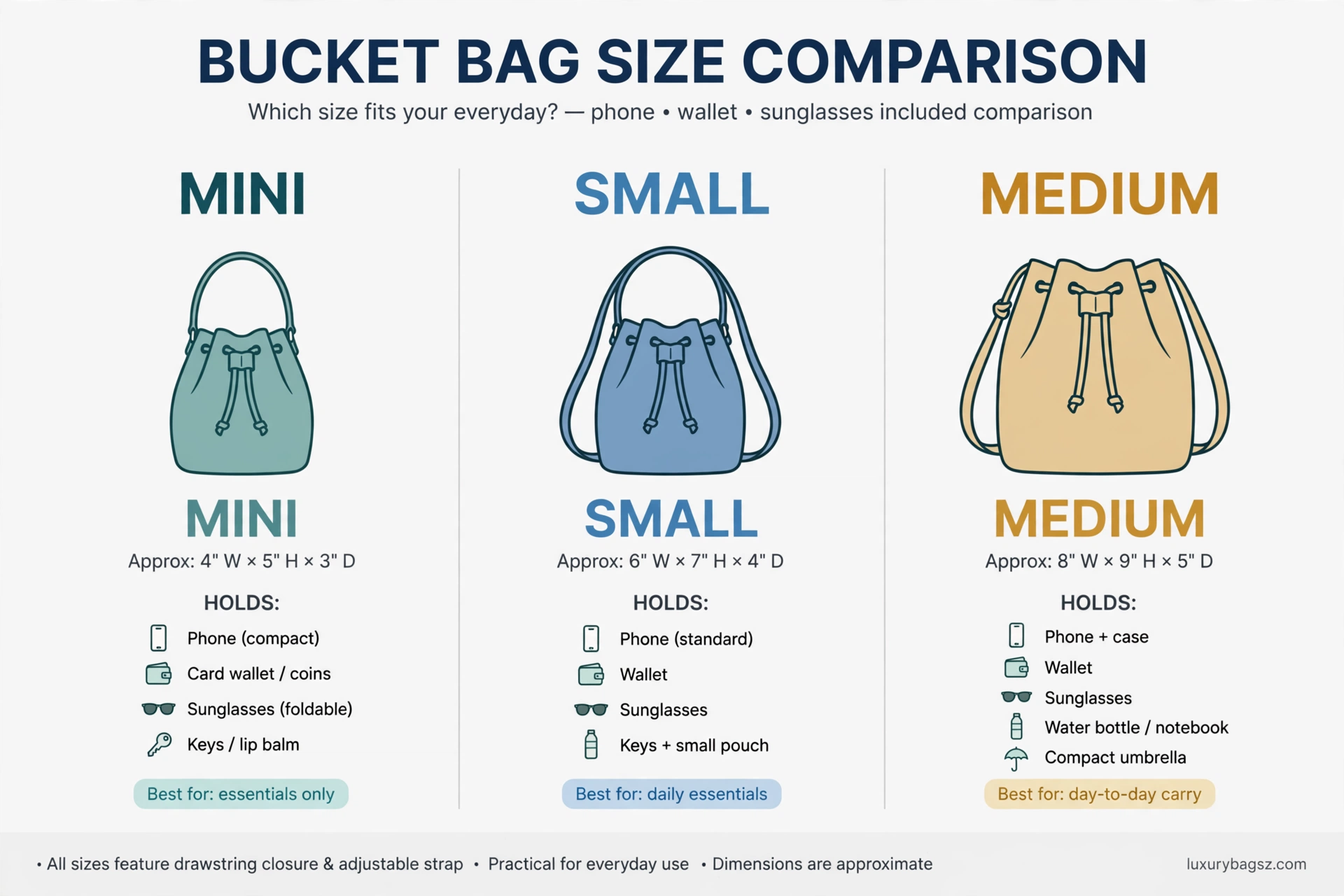
Mini buckets hold a phone, cards, keys and a lipstick, and they work best as evening or light-day bags. Their charm is real, but so is the editing they demand.
Small and medium buckets are the daily sweet spot, typically fitting a phone, a small wallet, keys, sunglasses and a compact pouch. A medium also takes a paperback or a small water bottle.
Large buckets suit work and travel days, though weight gathers at the base. Whatever the size, test the depth with your hand: very deep wells hide small items and slow you down.
Try the bag loaded, not empty, in store. Buckets change character when weighted: the well deepens, the strap settles and any tendency to swing or tip shows itself before you pay.
Watch the strap drop when wearing coats. A drop that suits a T-shirt can ride too high over winter layers, so adjustable straps earn their keep on this shape more than most.
For a first bucket, many stylists suggest tan or chocolate leather. Those shades show the shape modelling beautifully, pair with navy, black and denim, and develop a rich patina with use.

How to Choose a Good Bucket Bag
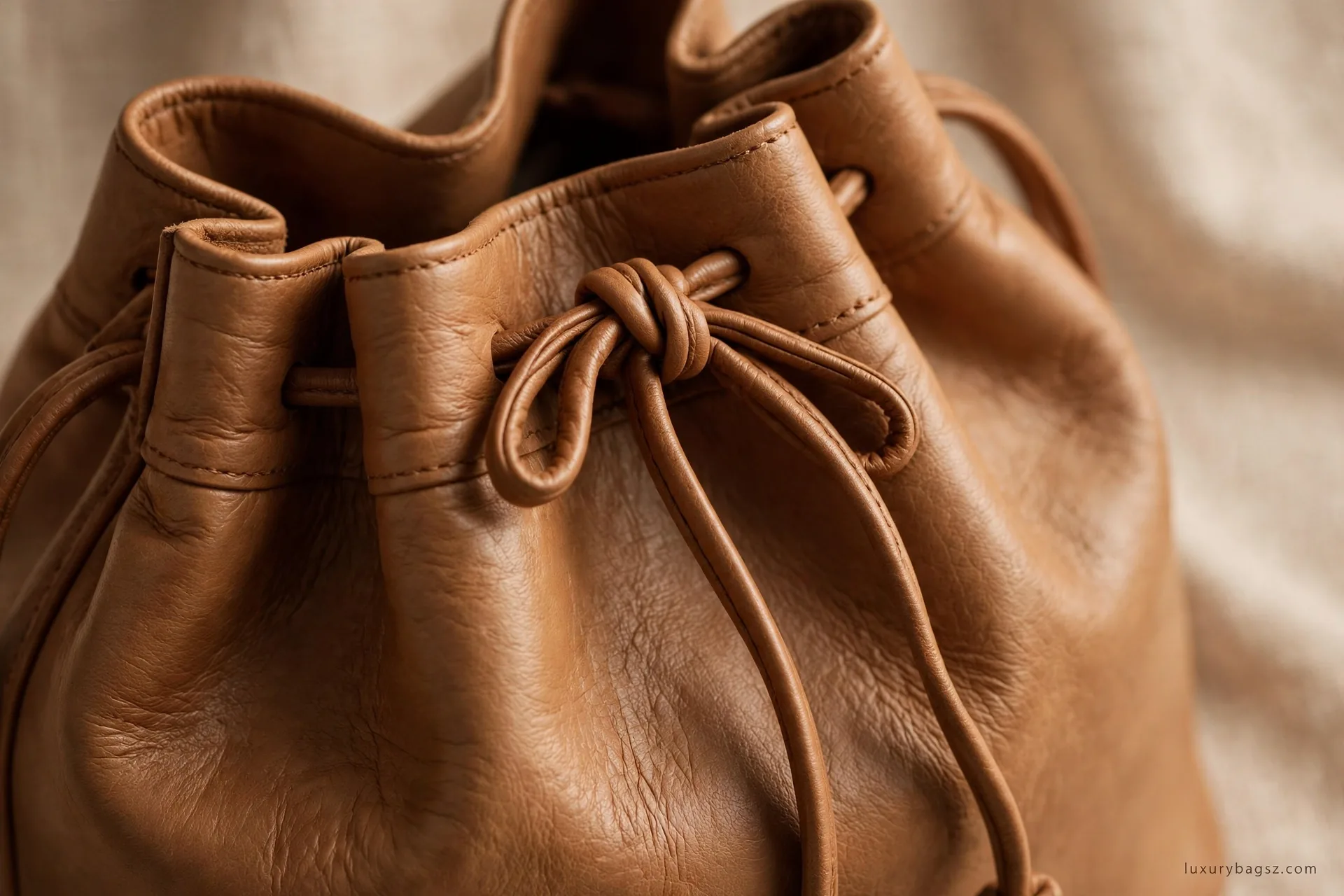
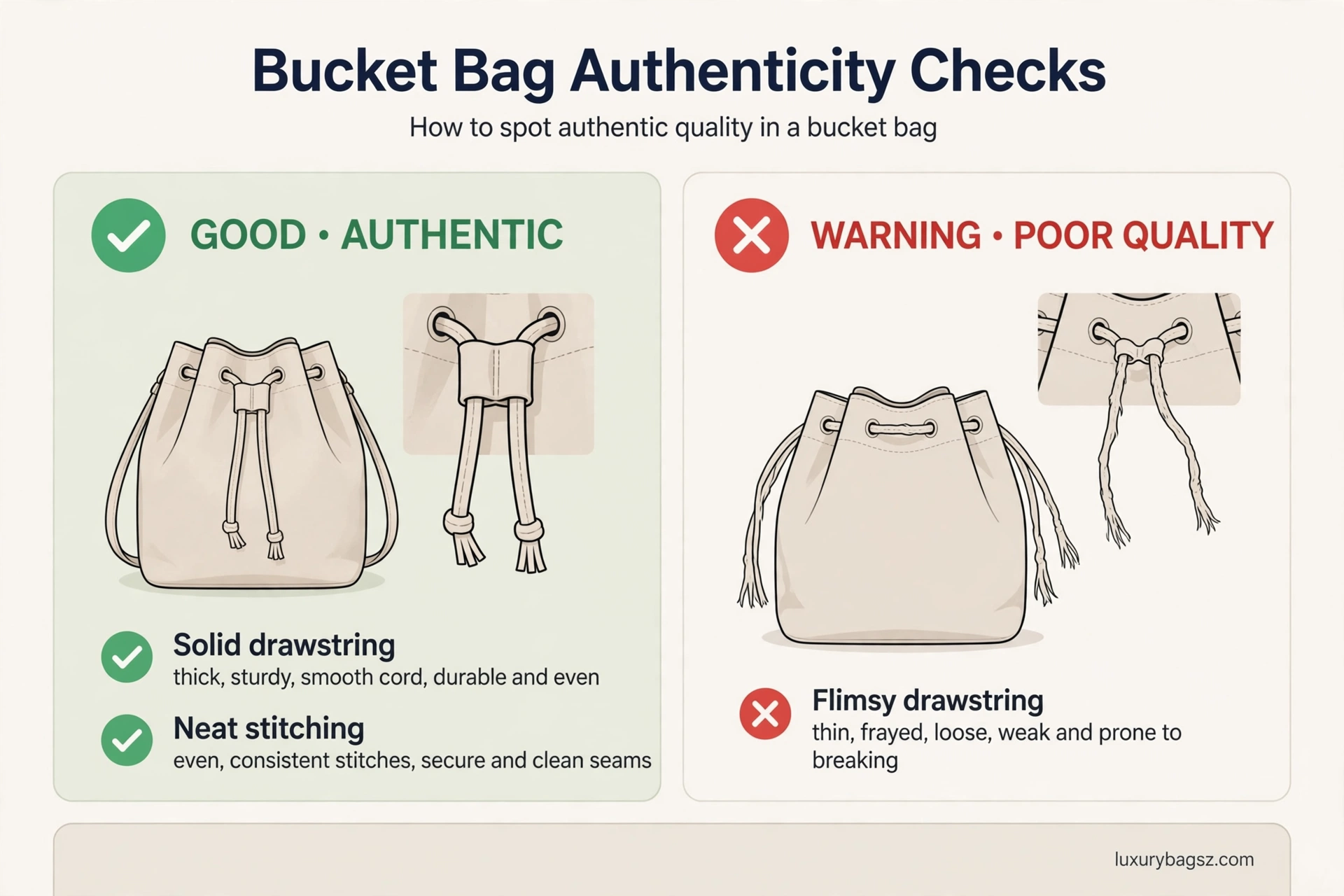
Start with the closure. A drawstring should slide smoothly and stay tied, a magnetic tab should meet cleanly, and an open top should sit close to the body when carried.
Next, check the base. A flat, reinforced base keeps the bag upright and protects the contents, while a sagging base strains the seams and looks tired quickly.
Buying pre-owned widens the choice at every budget. Our pre-owned buying guide sets out the checks that keep a second-hand purchase safe and fairly priced.
A simple test helps: place your phone, wallet and keys inside, then set the bag down. If it stands, closes neatly and lifts without twisting, the pattern and base are doing their jobs.
On resale, complete and clean interiors matter because buckets show their insides whenever they are carried open. A stained lining is hard to hide and should always cut the asking price.
When comparing two similar buckets, weigh them empty and check the strap width. A wider strap spreads load on the shoulder and makes a medium bucket feel noticeably lighter across a full day.
Styling a Bucket Bag Well
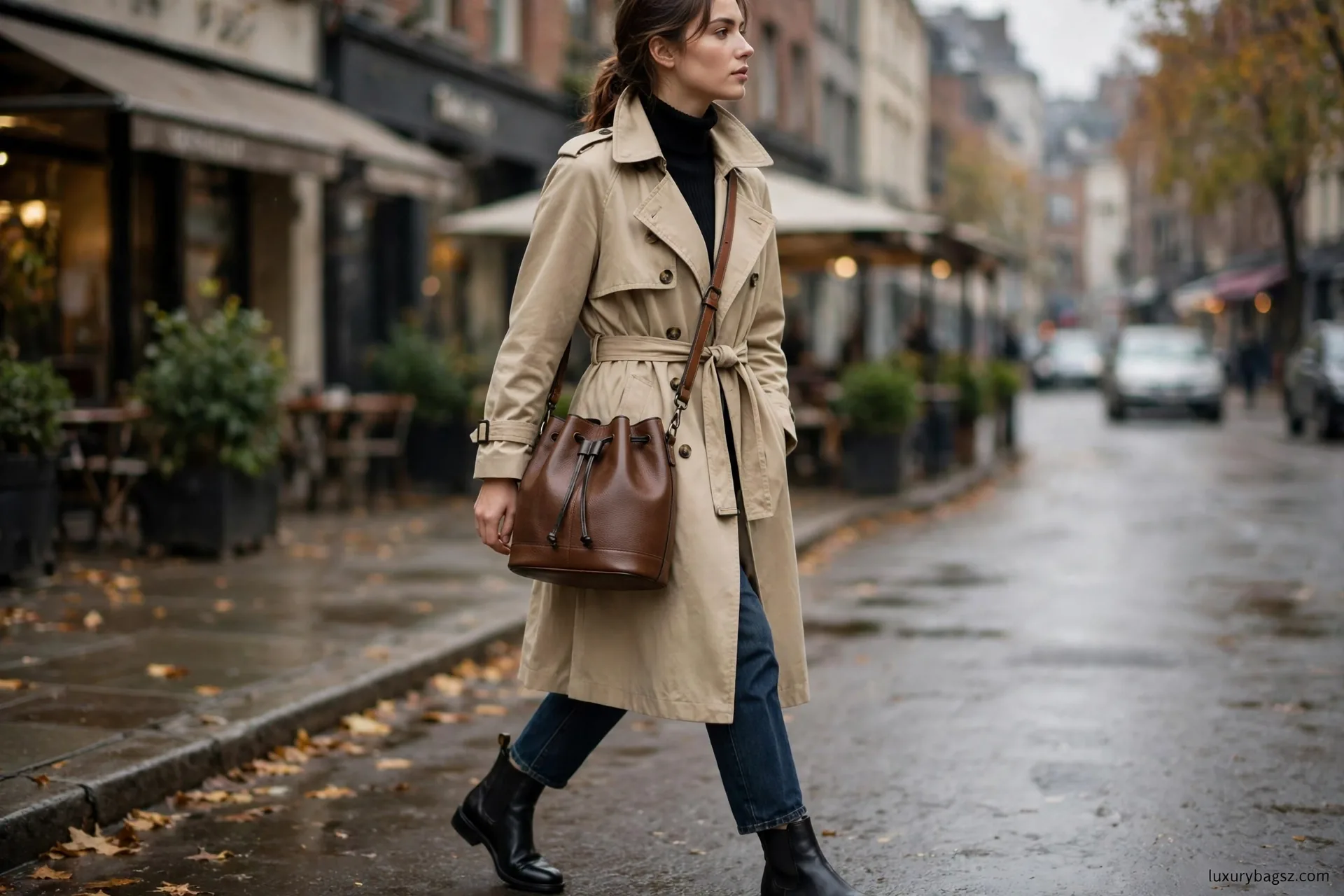
A bucket bag pairs naturally with relaxed tailoring: straight trousers, a knit and loafers let the soft shape provide the ease. Keep the strap length so the bag sits at the hip, not the waist.
For evening, a mini bucket in black or metallic leather works like jewellery. Carry it by the top handle if it has one, and let the drawstring detail do the decoration.
Crossbody wear suits travel and busy days, since the deep well keeps contents settled. Avoid overfilling: a bucket stuffed to the brim loses its lines and strains the closure.
Travel stylists favour the bucket for its forgiving capacity on sightseeing days. A scarf, a small camera and a guidebook disappear inside, while the silhouette still looks composed in photographs.
Minimalist wardrobes suit the bucket particularly well, since its curved profile softens straight tailoring and adds shape to simple knit dresses without extra accessories.
Evening buckets in metallic leather have become a quiet wedding-season staple. They hold the essentials, catch the light and avoid the formality of a clutch that must stay in the hand.
Care, Storage and Pre-Owned Checks
Store a bucket bag stuffed lightly so the well keeps its shape, and keep the drawstring loosely tied. Stand it upright rather than hanging it, which stretches the strap joins over time.
Wipe smooth leather with a soft, dry cloth and keep the bag from prolonged rain. Our leather care guide covers conditioning and storage in more depth.
On pre-owned examples, inspect the drawstring channel for fraying, the base corners for scuffs and the interior for marks. A tired drawstring is the most common bucket fault, and it is worth pricing in.
Finally, rotate the strap attachment points if the design allows it, and check them each season. Even wear at the joins is the quiet secret behind buckets that last a decade.
If you are between sizes, size up. A bucket worn slightly underfilled keeps its relaxed lines, while an overfilled smaller one bulges at the closure and ages quickly.
Keep one simple rule for longevity: never store a bucket hanging by its strap. The weight slowly stretches the joins, and the damage only becomes obvious once the strap sits unevenly.
Frequently Asked Questions
What was the first designer bucket bag?
The Louis Vuitton Noe of 1932 is the landmark early design, created to carry five champagne bottles for a champagne producer.
Why is it called a bucket bag?
The name describes the shape: a deep, round or oval well with a flat base, like a small bucket, usually closed with a drawstring.
Are bucket bags still in style?
Yes. The shape has settled into a permanent category, with mini, small and medium versions offered each season by many houses.
What fits in a medium bucket bag?
Typically a phone, a small wallet, keys, sunglasses, a compact pouch and a paperback, with room to spare for small extras.
Which designer makes the best bucket bag?
Louis Vuitton for heritage, Mansur Gavriel for clean modern design, and Loewe or Celine for refined seasonal versions are common picks.
Do bucket bags close securely?
Some do, with drawstrings, magnetic tabs or zipped inserts. Open-top versions are less secure, so check the closure before buying.
How much does a designer bucket bag cost?
Prices vary widely, typically from a few hundred pounds for contemporary labels to well over £1,500 for major houses in leather.
Is a bucket bag good for work?
A medium or large structured bucket can work well, provided the closure is secure and the base holds a laptop sleeve or organiser.
How do I stop things getting lost inside?
Use a small pouch or organiser insert. The deep well is the bucket bag trade-off, and a pouch solves it neatly.
What should I check on a pre-owned bucket bag?
Check the drawstring and its channel, base corners, strap joins, interior marks and any odour, and ask for clear photographs.
Final Verdict: The Bucket Bag Earns Its Place
Few shapes have travelled so far from so practical a start. The bucket bag began as a champagne carrier and became, through Cashin and Mansur Gavriel, a modern wardrobe staple.
Choose a medium structured leather version for daily life, insist on a sound closure and a firm base, and the bag will repay you with years of easy carrying.