

Why Americans Are Obsessed With Indonesian Boots: Bandung’s Handmade Secret
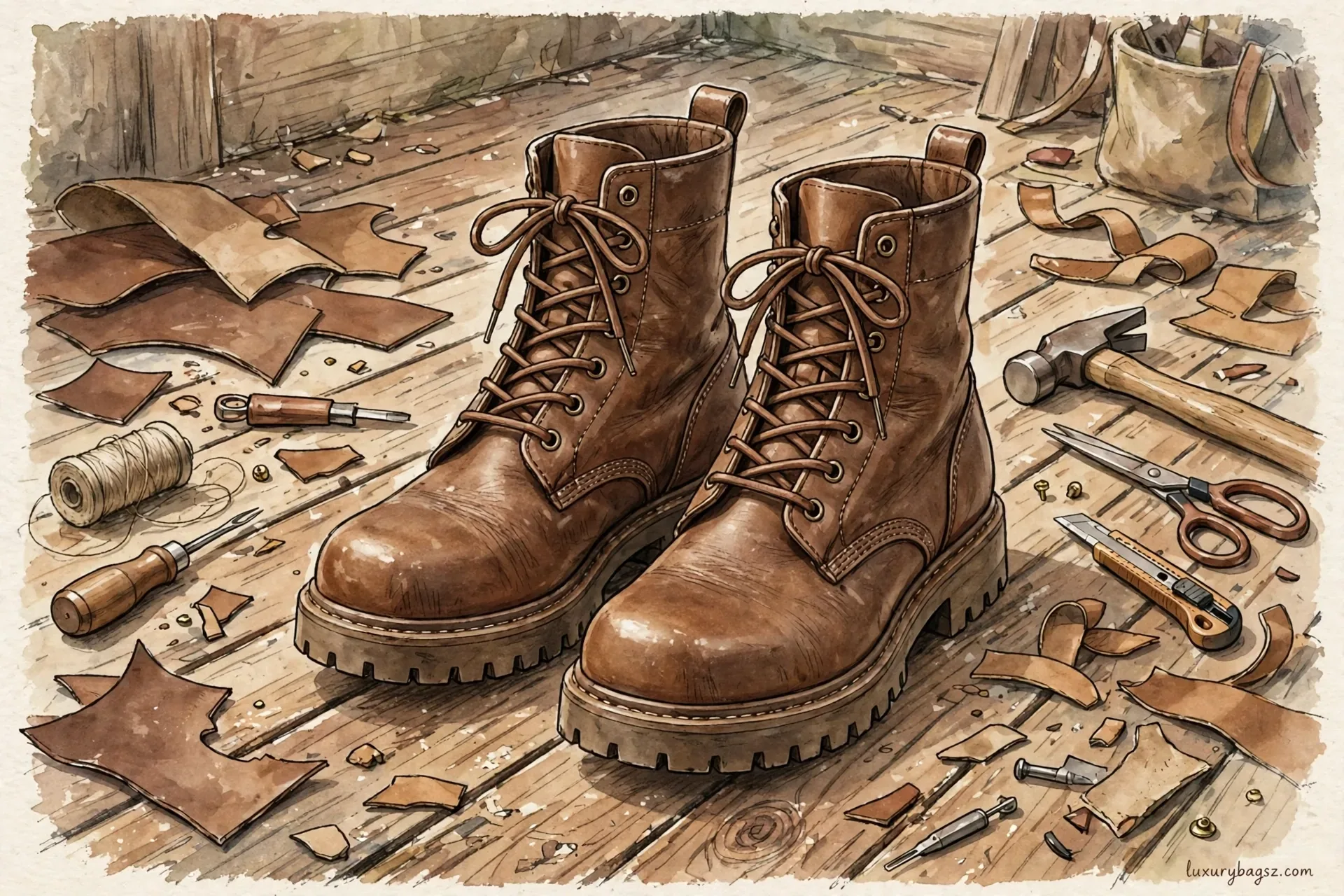
Bandung Boots, in Brief
Americans are obsessed with Indonesian boots because a small city in West Java, Bandung, still makes boots almost entirely by hand, to the buyer's exact foot measurements, for less than a comparable handmade pair would cost in the United States.
The obsession is not about a bargain. Most pairs cost over $500, take three to six months to arrive, and are usually ordered over WhatsApp. Buyers accept all of that because the boots are hand-welted, hand-lasted, heavily built, and fully customisable in a way mass-market boots are not.
At the centre of the story is Sagara Bootmaker and a cluster of small Bandung workshops, many with waiting lists months long. Roughly 60 to 70 percent of Sagara's customers are overseas, mainly Americans, who value patience, craft, and fit over speed.
Key Takeaways
- Bandung, about 150 kilometres from Jakarta, is the hub of Indonesia's handmade boot scene.
- The craft traces back to Dutch colonial shoemaking in the 19th century, carried on in the Cibaduyut shoemaking district.
- Bandung makers hand-welt, hand-last, and hand-sew much of the boot, where larger brands use machines.
- Boots are made to order to both feet's measurements, including instep, ankle, and left-right differences.
- Horsebutt leather, especially vegetable-tanned Italian horsebutt, is the current enthusiast favourite.
- Expect to pay over $500 for imported-leather pairs and wait three to six months, sometimes longer.
- Ordering usually runs through WhatsApp, email, or a stockist, with a deposit up front.
- Heavy, stiff boots need a real break-in; they are not a comfortable-out-of-the-box purchase.
How Bandung Became a Boot City
Indonesia's boot story starts with Dutch colonisation in the 19th century, when European shoemaking techniques arrived with colonial trade, soldiers, and administrators. Local craftsmen learned those methods, adapted them, and kept them alive long after the techniques faded from large factories elsewhere.
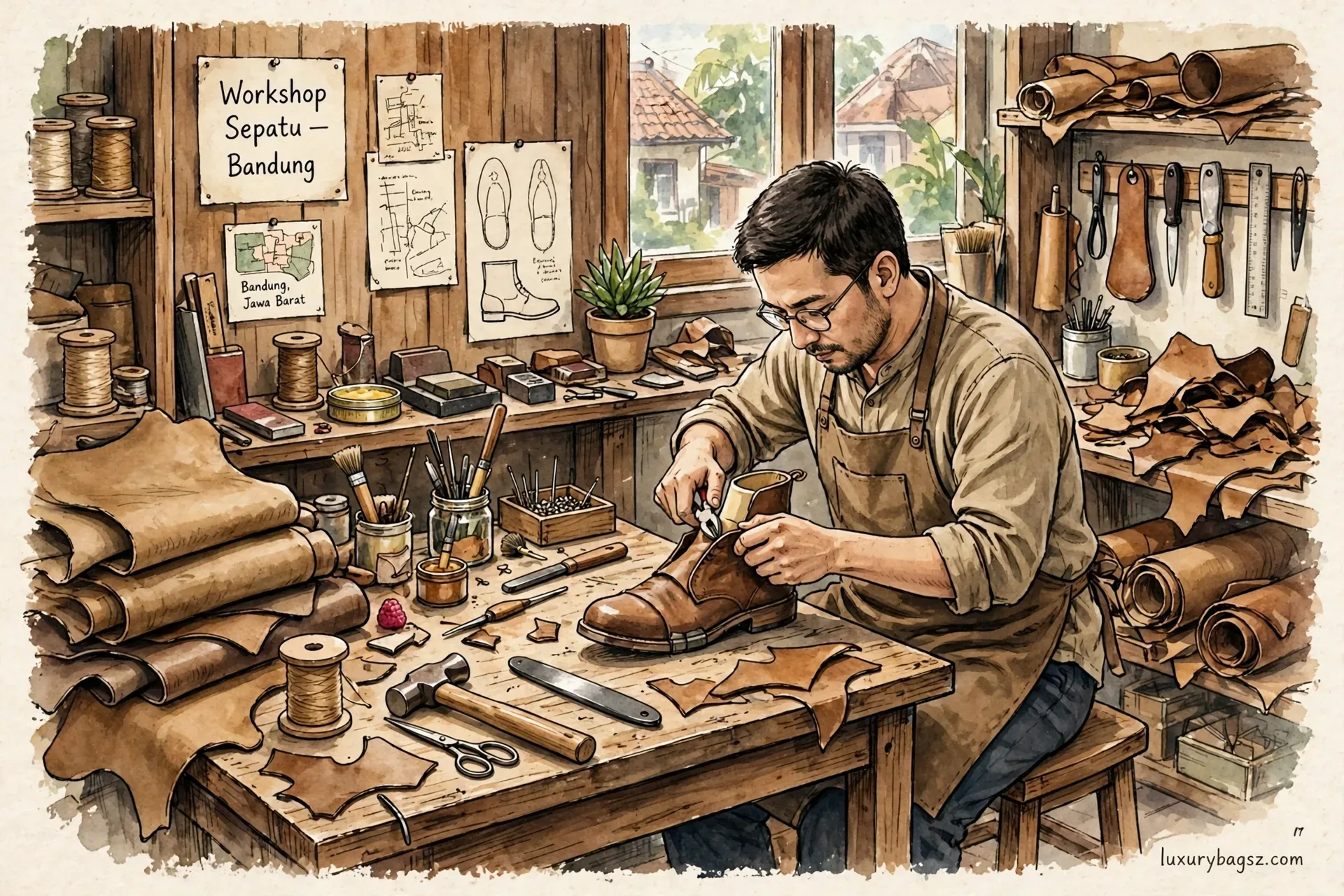
Bandung's Cibaduyut district became the shoemaking heart of that tradition, a neighbourhood of small workshops, leather suppliers, and repairers. When one maker interviewed for this story was studying industrial engineering, he found his way into Cibaduyut through a course assignment on small businesses, visited often, and eventually started making shoes himself.
That small-workshop ecology matters. Bandung is a city known for creatives and artisans, and its bootmakers often work in tiny teams, sometimes with the founder still at the bench every day. One well-known maker describes himself as a craftsman first and a brand owner second, working daily at his own table.
American enthusiasts discovered that world through forums, YouTube, and events like the Stitchdown Expo, where Indonesian makers now appear alongside American and European brands. The discovery felt like finding a parallel universe: 19th-century methods, still practised, in a city most boot lovers had never considered.
It is worth noting what Bandung is not. It is not a low-cost factory town churning out copies of American boots. Its makers design their own lasts, choose their own leathers, and build boots that are often heavier, thicker-soled, and more rugged than the American boots they are compared with.

Handmade in the Old Sense: Welting, Lasting, and Stitching
The core claim for Indonesian boots is that they are about as handmade as boots get. Larger quality brands use Goodyear welting, a machine process patented in the 1870s that replaced the older, slower hand welting. Bandung makers still hand-welt.
Hand welting means a craftsman stitches the welt, the strip that joins the upper to the sole, by hand, using an awl and thread, around the whole perimeter of the boot. It is slow, skilled work, and makers argue it gives a tighter, more flexible, and more easily resoled boot than machine welting, though the difference is debated among cobblers.
Hand lasting is the other key step. Lasting shapes the leather upper over a foot-shaped form, the last, and most factories do it with machines that pull and press the leather quickly. Bandung makers last by hand, adjusting tension by feel, which they say gives a closer, more even fit, especially around the ankle and instep.
Many Bandung boots also use hand-sewn stitchdown construction or hand-sewn Norwegian welts on some models. In a Norwegian welt, the welt is stitched through the upper and out to the sole edge, creating a distinctive raised seam and a very water-resistant join, prized on rugged service boots.
There are no heating rooms, laser cutters, or large automated lines in the classic Bandung workshop picture. Leather is cut by hand, uppers are stitched on older machines, and soles are attached and finished by hand. That is the romance, and also the bottleneck: a small team can only make so many pairs a month.
Whether hand methods are objectively better than machine methods is a fair question, and sources disagree. What is not in dispute is that they are rarer, slower, and more labour-intensive, and that rarity is a large part of why enthusiasts will wait months for them.
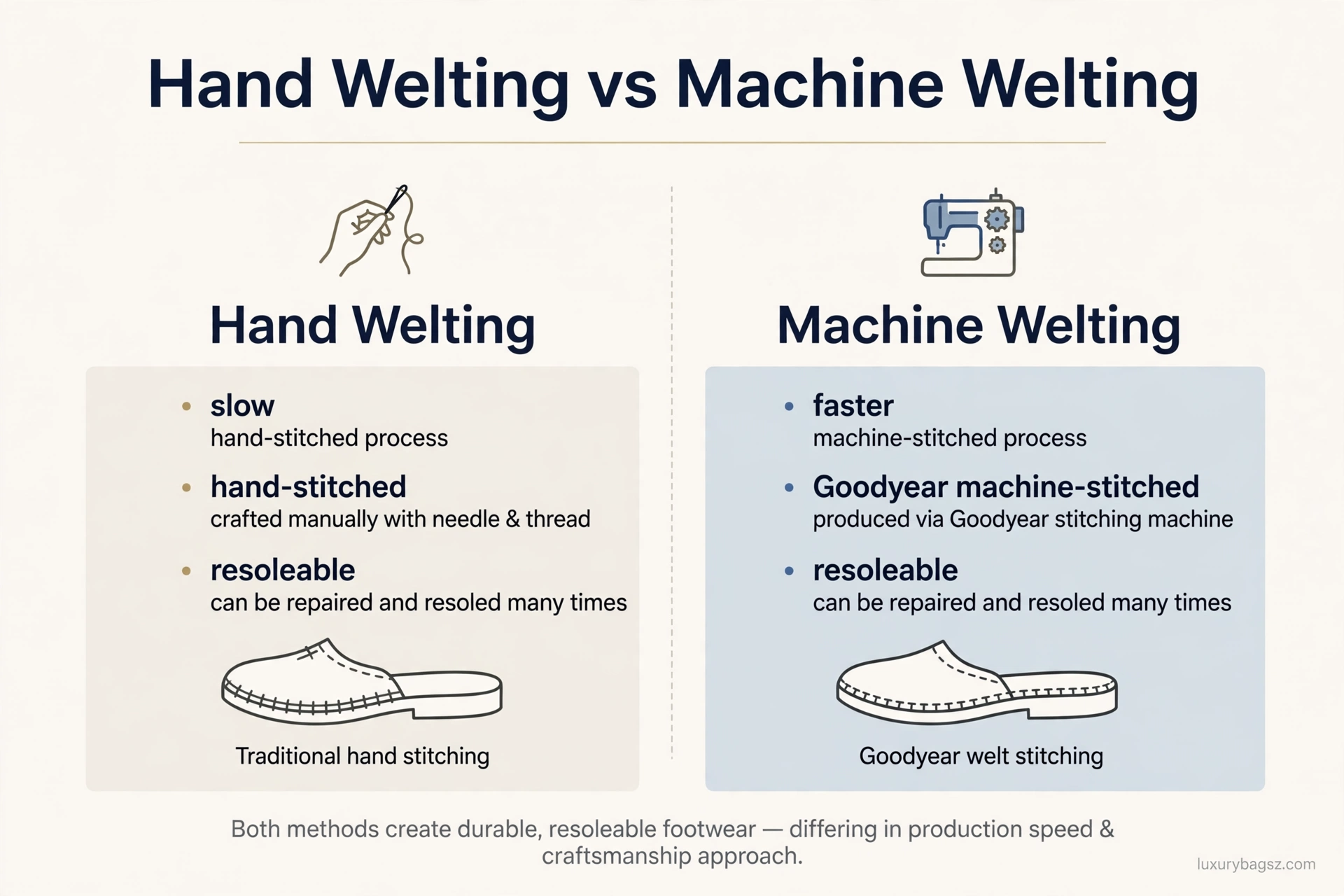
Hand Welting Against Goodyear Welting: An Honest Comparison
Goodyear welting dominates quality boots for good reasons. A machine stitches the welt to the insole quickly and consistently, the boot can be resoled many times, and the process scales to thousands of pairs. Most American, English, and Spanish quality boots use it.
Hand welting does the same job by hand, with a holdfast carved into the insole and a hand-sewn inseam. Fans argue the hand-sewn inseam is stronger and more flexible, because the craftsman can adjust tension stitch by stitch, and because the insole is not weakened by machine channelling in the same way.
Critics point out that a well-made Goodyear boot is also resoleable, also durable, and far more consistent from pair to pair. A hand-welted boot from a tired or rushed maker can be worse than a machine-welted boot from a careful factory, so the method alone does not guarantee quality.
For a buyer, the practical difference is smaller than the marketing suggests. Both constructions can be resoled, both can last decades with care, and both fail if the leather is poor or the fit is wrong. Hand welting matters most as a sign of how much hand work went into the pair, and how small the workshop is.
What hand welting does change is the buying experience. You are buying a pair made slowly by a few people, not a pair that rolled off a line, and for many American buyers that story, plus the custom fit, is worth the wait and the price.
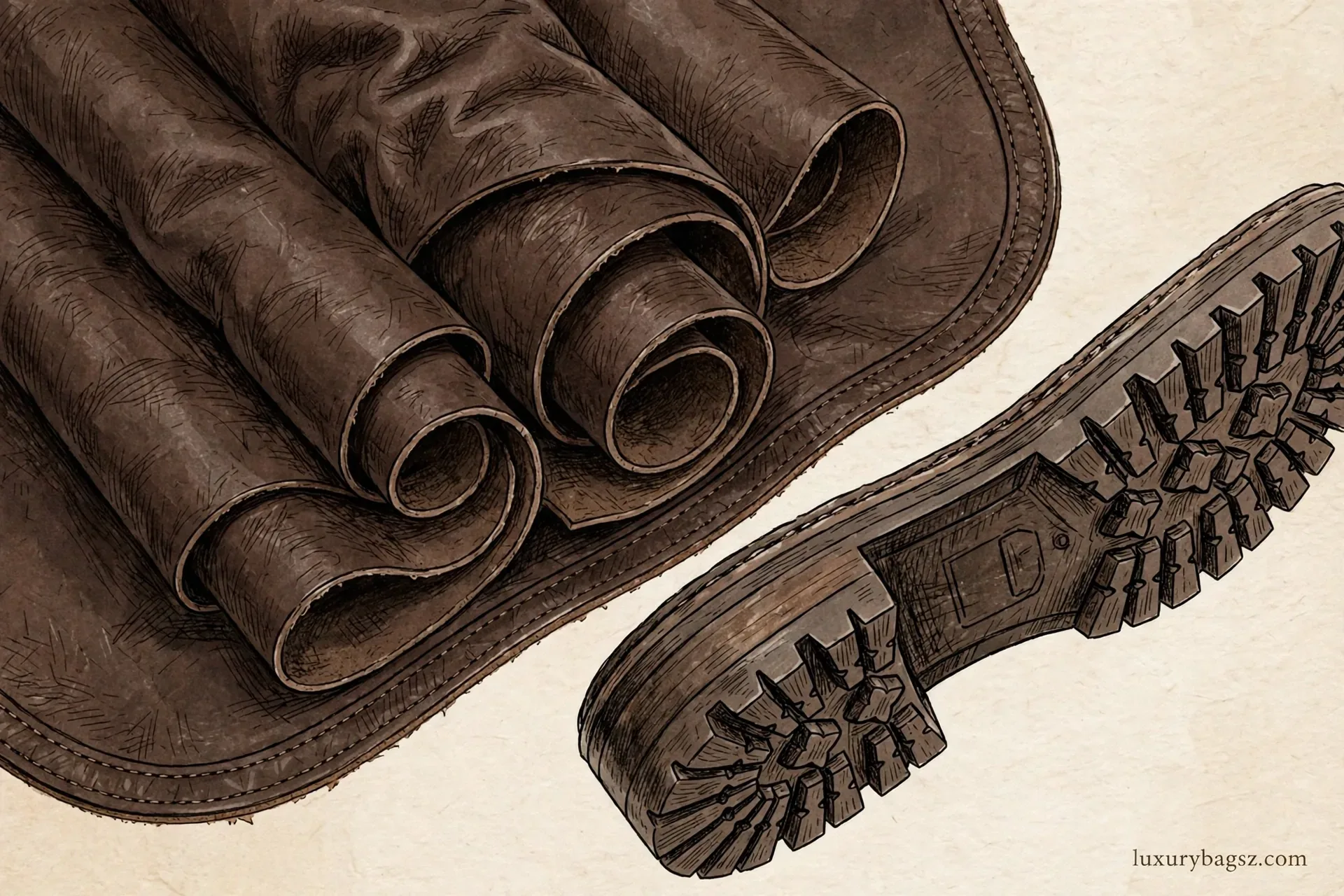
The Leathers Americans Ask For: Horsebutt, Shell, and Stead Suede
If one leather defines the current Indonesian boot craze, it is horsebutt. One Bandung maker reports that almost 70 percent of his customers now order horsebutt, usually vegetable-tanned horsebutt from the Maryam tannery in Italy.
Horsebutt is the rear part of the horsehide, dense, tough, and marked by a rolled creasing pattern rather than the sharp creases of calfskin. Fans say it shares some of shell cordovan's character, rolling rather than creasing, at a lower price than full shell cordovan, though it is not the same material and should not be sold as such.
Shell cordovan itself, the membrane layer from the horse's rump, also appears in Indonesian orders, but it is far more expensive and harder to source in large panels. It is best suited to smaller panels and dressier boots, while horsebutt suits rugged service boots, boondockers, and monkey boots.
Suede is the other Indonesian favourite, especially Janus calf suede from C.F. Stead in England, in unusual colours such as light grey. Bandung makers use it for boondockers and casual boots where a soft, matte texture suits the rugged shape, and where a scuffed, lived-in look is part of the appeal.
Imported leather is also why prices climb. Unless you order Indonesian leather, the leather itself must be imported, taxed, and shipped, and that cost sits on top of the labour. A pair in local leather can be cheaper, but most American orders specify imported hides, which pushes the total over $500.
Choose leather for how you will wear the boots, not for forum fashion. Horsebutt is heavy and stiff at first and needs a long break-in. Suede is softer and more forgiving but marks and stains more easily. Calfskin sits between the two and remains the safest first order.
Fit: Why Two Feet, Measured Properly, Change Everything
Feet are more than a shoe size, and Indonesian ordering forces buyers to learn that. A foot that measures size 12 in a shop may still need a different last shape, a lower instep, a narrower ankle, or a longer left foot than right.
Bandung makers typically ask for measurements of both feet: length, width, instep, ankle circumference, and sometimes heel and arch details, taken at home with a tape and a tracing. Some makers also ask for photos of your feet and of boots you already own that fit well.
The maker then modifies a last, the foot form the boot is built on, to match those measurements. That is not the same as bespoke shoemaking, where a last is carved from scratch for one person, but it is far closer than buying a standard size off a shelf.
Many American buyers say ordering Indonesian boots taught them their own feet for the first time: a low instep here, skinny ankles there, a left foot a quarter size bigger than the right. That knowledge then informs every later footwear purchase, even from other brands.
Fit is also where expectations need managing. A made-to-order last improves fit, but it is not a guarantee, especially on a first order made remotely. Allow for a break-in period, communicate honestly about tight spots, and ask before ordering what the remake or adjustment policy is if the fit is badly wrong.
How to Order: WhatsApp, Deposits, Waits, and Lotteries
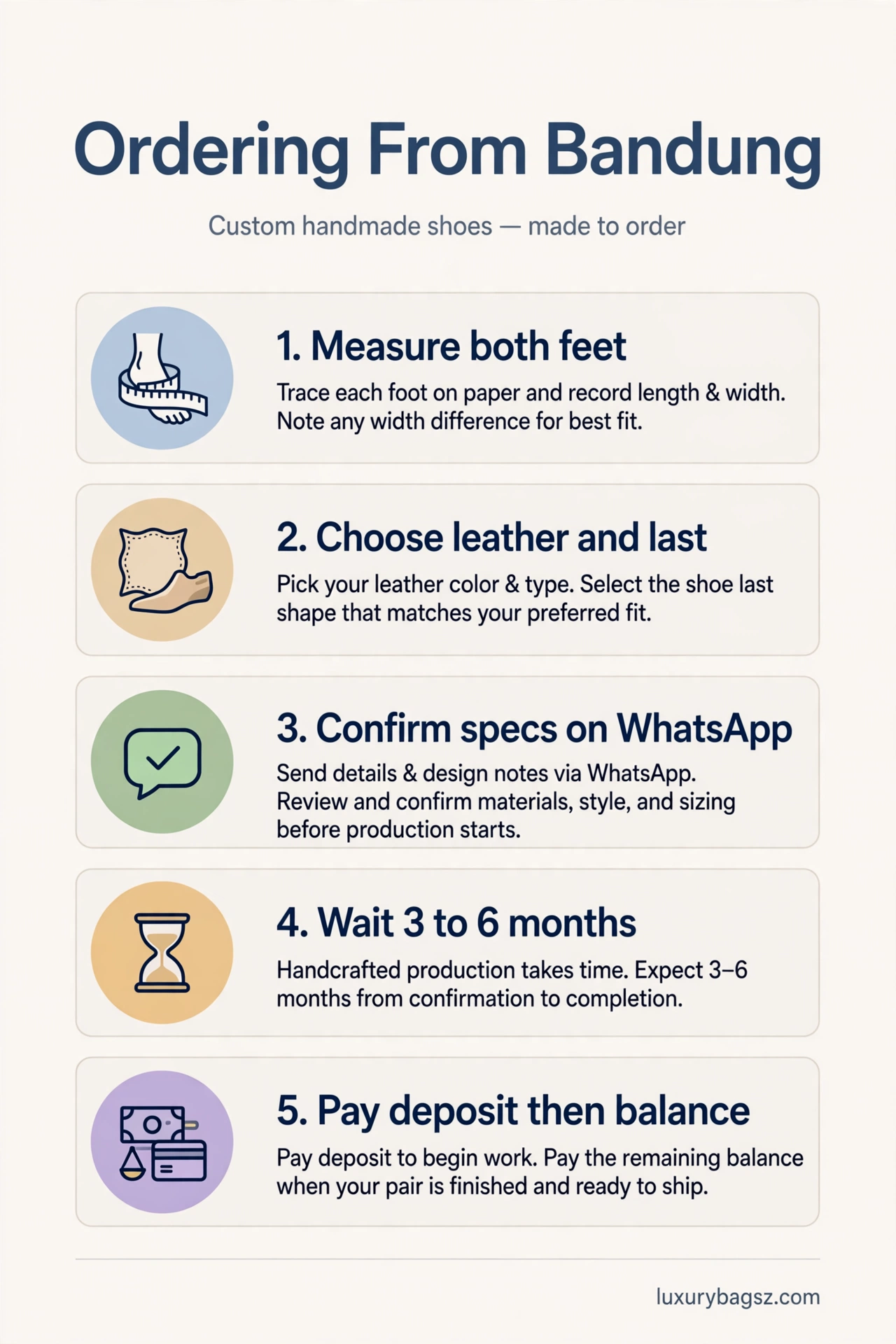
Ordering Indonesian boots is part of the experience, and part of the test. Most makers take orders through WhatsApp, email, or Instagram messages, not through a polished checkout, and communication runs on Indonesian business hours and workshop time.
The usual sequence is: choose a model and last, send foot measurements, choose leather, sole, hardware, and edge finish, confirm the specification in writing, pay a deposit, and wait. Balances are usually due before shipping, and shipping to the United States adds cost and customs time.
Waits of three to six months are normal, and some makers run longer, especially popular ones with small teams. One maker reports a four-to-six-month lead time as standard, and that is before shipping. If you need boots for a specific trip, order far earlier than feels necessary.
Some makers limit orders further, opening order books only a few times a year, or running lotteries for a place in the queue. That scarcity frustrates new buyers, but it also protects the workshop from over-promising and under-delivering, which is a common failure for small makers that grow too fast.
Ready-to-wear Indonesian boots are now appearing in the United States through stockists such as Standard & Strange, which launched a Sagara ready-to-wear line. That route lets you try a pair on, skip the wait, and still get the handmade construction, though you lose the custom measurements.
Before you pay, confirm five things in writing: the full specification, the total price including shipping, the deposit and refund terms, the expected completion window, and what happens if the fit is wrong. A maker that answers those clearly is a safer bet than one that only sends photos.
Price: What You Get for $500 and More
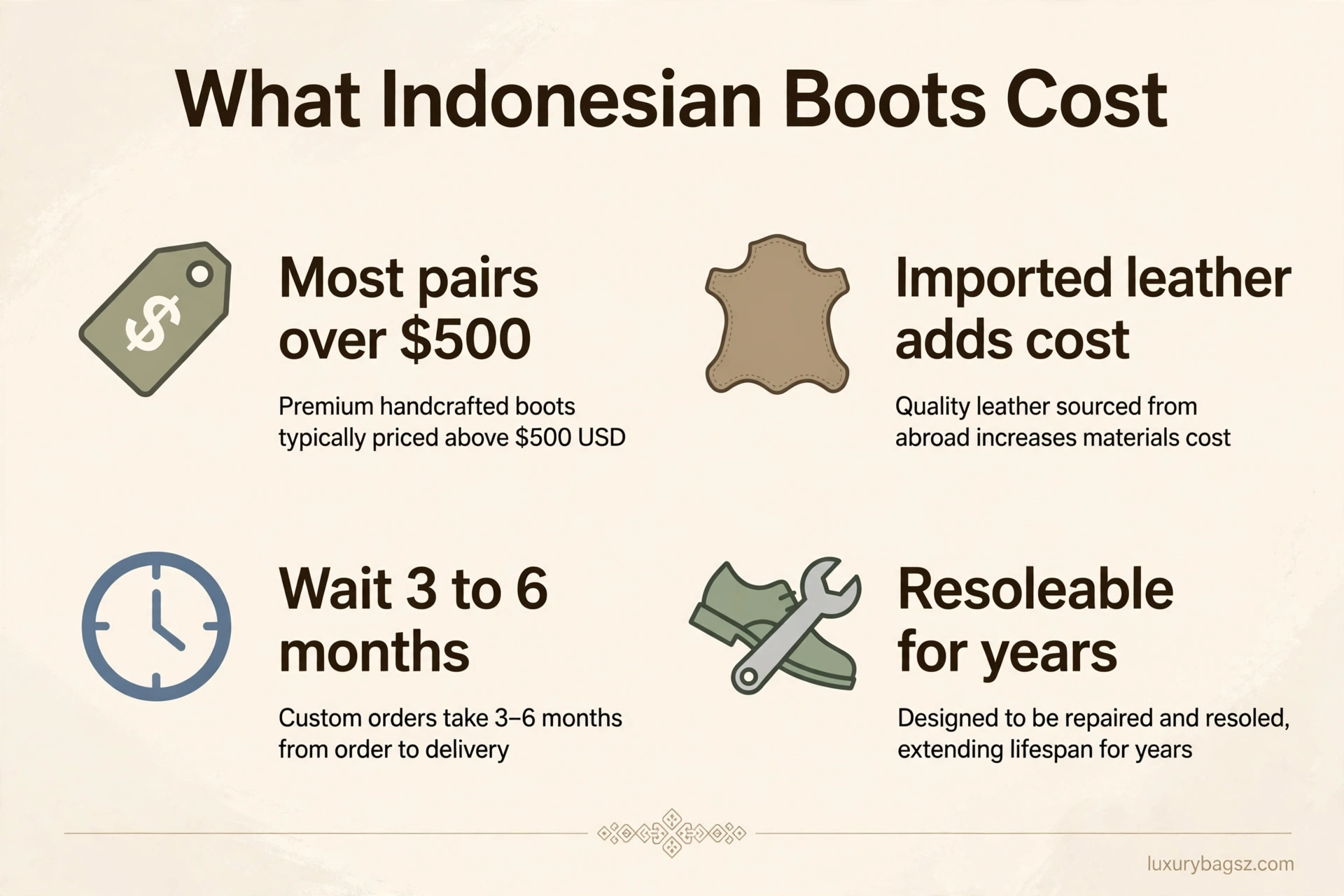
Most Indonesian boots with imported leather cost over $500, and many land between $600 and $900 once leather, sole, shipping, and any extras are counted. That sounds like a lot until you compare it with handmade boots made in the United States.
Hand-welted horsebutt boots made by a one-person workshop in the United States routinely run into four figures, if you can find a maker taking orders at all. Bandung makers can charge less because labour costs are lower, workshops are smaller, and overheads are modest, not because the work is simpler.
What the price buys is: a custom-modified last, hand welting and hand lasting, imported leather of your choice, a thick, resoleable sole setup, often with multiple midsoles, and a boot that can be resoled for years. Spread over a decade of wear with one or two resoles, the cost per wear can beat cheaper boots replaced every couple of years.
What it does not buy is speed, convenience, or a no-questions return policy. Most made-to-order pairs cannot be returned like a shop pair, because they were built for your feet and your specification. That is why confirming the specification in writing matters so much.
Be cautious about prices that look too low for the specification. A hand-welted horsebutt boot at a mass-market price usually means cheaper leather, machine work sold as hand work, or a maker cutting corners on finishing. If the price seems impossible, ask exactly what is hand-done and what is machine-done.
Break-In, Care, and Living With Heavy Boots
Indonesian boots are objectively heavier and stiffer than the average American boot, and the first weeks can be uncomfortable. Thick leather, multiple midsoles, and a sturdy sole stack take time to flex, and horsebutt in particular can feel board-like at first.
Break them in gradually: short wears at home, then half days, then full days, with thick socks at first if needed. Do not soak them, bake them, or force them with aggressive treatments; steady wear shapes the leather to your feet far more reliably than shortcuts.
Care follows the same routine as any good leather boot: brush off dust and grit after wear, wipe smooth leather with a soft dry cloth, and let the boots air at room temperature.
Condition smooth leather only when it feels dry, and protect suede before rain. For a detailed leather-boot care routine, see our guide to caring for Hermès leather boots, whose after-wear, conditioning, and storage steps apply to heavy work boots as well as dressier pairs.
Resoling is where the investment pays off. A hand-welted boot can be resoled by a good cobbler, and many owners resole with a different sole, such as a rugged Dr. Sole half sole from Taiwan, popular on Indonesian boots, to suit a new use. Keep the original specification note so the cobbler knows the construction.
Storage matters too. Use boot trees or shapers for tall boots, keep them upright in a cool, dry place, and never store them in sealed plastic, which traps moisture. Rotate with another pair if you can, so the leather fully dries between wears.
Finally, be honest about weight. If you walk long distances daily, a lighter boot may serve you better than the heaviest Indonesian service boot, however beautiful it is. The best boot is the one you reach for, not the one that impresses a forum.
Are Indonesian Boots Worth It, and Who Should Skip Them
Indonesian boots are worth it if you value handmade construction, custom fit, and rugged, resoleable boots, and if you enjoy the ordering process itself. For that buyer, the wait is part of the pleasure, and the finished pair feels personal in a way a shop pair rarely does.
They are also worth it if you have hard-to-fit feet. A maker who modifies a last for your instep, ankle, and left-right difference can solve fit problems that standard sizes never will, and that fit benefit lasts for the life of the boot.
Skip them if you need boots quickly, want an easy return, dislike stiff break-ins, or prefer light, flexible footwear. A quality Goodyear-welted American or English boot, bought in a shop and tried on, will serve those buyers better and faster.
Skip them too if the ordering process itself puts you off. If WhatsApp ordering, deposits, and months of waiting sound stressful rather than exciting, that feeling will not improve once you have paid. Buy ready-to-wear Indonesian boots from a stockist instead, or buy local and try before you pay.
Sources disagree on whether hand welting is objectively more durable than Goodyear welting, and that disagreement is healthy. Buy Indonesian boots for the whole package, craft, fit, leather choice, and story, not for a single construction claim, and you are unlikely to be disappointed.
Frequently Asked Questions
Why are Americans obsessed with Indonesian boots?
Because Bandung workshops still hand-welt, hand-last, and custom-fit boots to both feet's measurements, with imported leathers such as horsebutt, at prices below comparable handmade boots made in the United States.
Where in Indonesia are the best boots made?
Bandung, in West Java, about 150 kilometres from Jakarta, especially its Cibaduyut shoemaking district, is the hub. Most of the well-known makers, including Sagara, are based there.
How long do Indonesian boots take to arrive?
Usually three to six months from order to delivery, plus shipping time to the United States. Popular makers with small teams can run longer, and some open order books only a few times a year.
How much do Indonesian boots cost?
Most pairs with imported leather cost over $500, often $600 to $900 all in. Local-leather pairs can be cheaper, while shell cordovan or rare leathers push the price higher.
How do I order Indonesian boots from the United States?
Most makers take orders through WhatsApp, email, or Instagram. Send foot measurements, choose a model, leather, and sole, confirm the specification in writing, pay a deposit, and wait for completion.
What is horsebutt leather, and why is it popular?
Horsebutt is the dense rear part of horsehide. It rolls rather than creasing sharply, shares some character with shell cordovan at a lower price, and suits rugged service boots, though it needs a long break-in.
Are Indonesian boots better than American boots?
Not simply better; they are different. Indonesian boots are more handmade and more custom, but heavier, stiffer, and slower to get. American Goodyear-welted boots are easier to buy, try on, and return.
Do Indonesian boots fit better than shop boots?
Usually yes, because the last is modified to your measurements, including instep, ankle, and differences between your feet. It is not a guarantee, especially on a first remote order, so check the adjustment policy.
Are Indonesian boots resoleable?
Yes. Hand-welted and stitchdown boots are designed to be resoled, and many owners resole with different soles over the years. Keep your specification note for the cobbler.
Can I buy Indonesian boots ready to wear?
Yes, increasingly. Stockists such as Standard & Strange now carry ready-to-wear Sagara lines in the United States, letting you try a pair on and skip the wait, though you lose custom measurements.
Final Verdict
Americans are obsessed with Indonesian boots for a simple reason: Bandung offers something almost no one else does, a fully handmade, custom-fitted, heavily built boot at a price a working enthusiast can reach.
The wait is long, the ordering is old-fashioned, and the break-in is real, but the pair that arrives is yours in a way a shop boot never is. If that bargain excites you, order early, measure carefully, and enjoy the wait. If it does not, buy ready-to-wear and skip the queue without guilt.






