

Is Goodyear Welt the Best? Why Goodyear-Welted Boots Are Not Always High-End
The Short Answer on Goodyear Welts
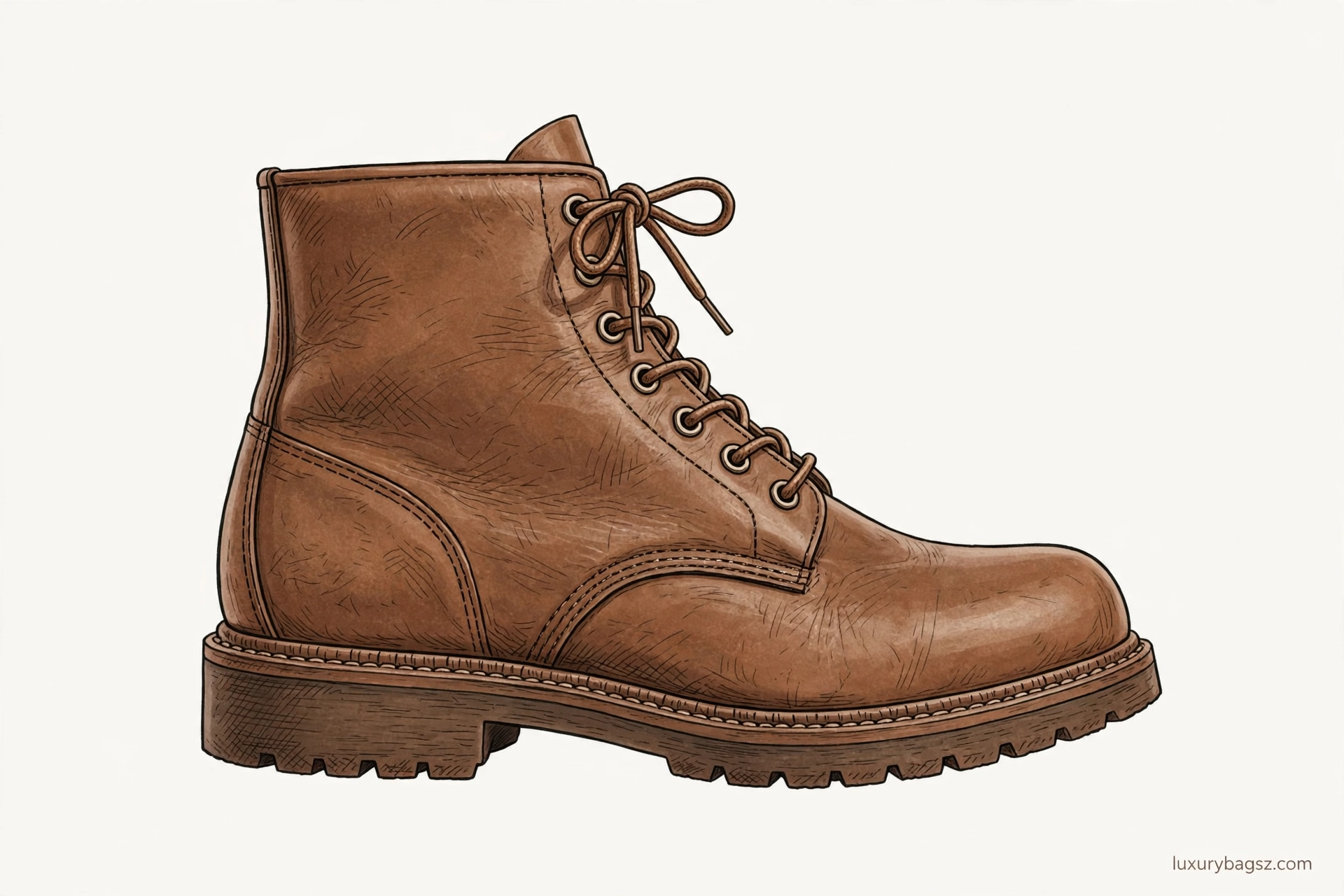
Goodyear welt is the best construction for most boots, but it is not a guarantee of a high-end boot. It is one way of joining an upper to a sole, and it says nothing on its own about leather quality, fit, or workmanship.
A welted boot earns its reputation honestly: the sole can be replaced, the stitching stays outside the footbed, and the boot handles wet ground better than a Blake-stitched shoe. Those are real advantages for boots worn hard.
Yet a cheap welted boot can still use thin corrected leather, a fibreboard insole, and a plastic welt. The label says Goodyear welt, but the boot underneath is ordinary. Judge the whole boot, not the one word on the box.
Key Takeaways
- A Goodyear welt is a leather strip stitched to the upper and insole, then stitched again to the outsole.
- It wins for boots, wet weather, heavy wear, and easy resoling by almost any cobbler.
- Blake stitch wins for a slim, flexible dress shoe with a shorter break-in.
- Cemented, or glued, soles are cheapest and usually cannot be resoled properly.
- A welt alone does not make a boot high-end: leather, insole, welt material, and stitching quality matter just as much.
- Watch for fake welts: decorative stitching on a glued sole is not a welt at all.
What a Goodyear Welt Actually Is
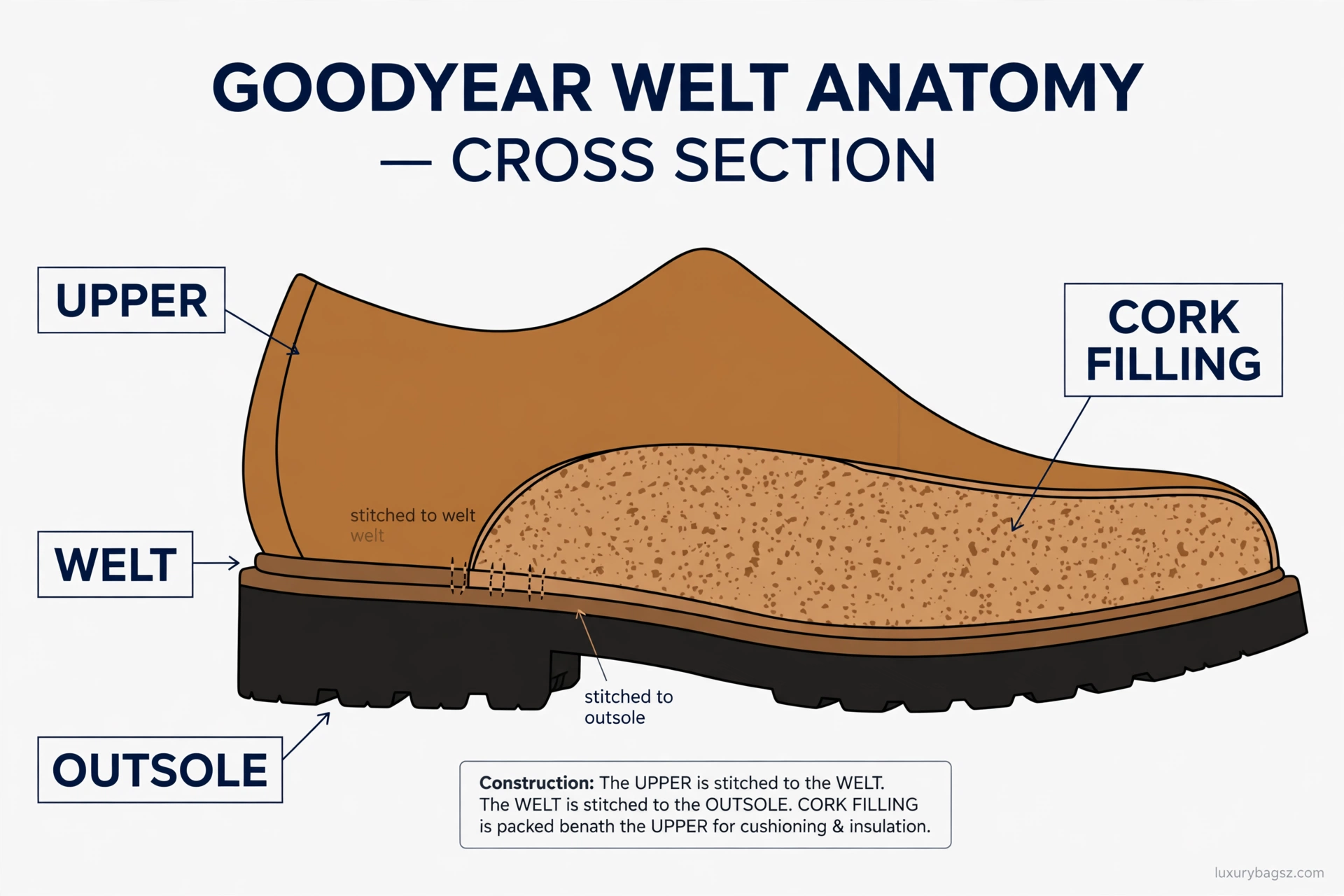
A welt is a narrow strip, usually leather, that runs around the edge of the shoe. In Goodyear construction, the upper and the insole are stitched to that welt first. The outsole is then stitched to the welt in a second row of stitching.
That buffer is the whole trick. Because the outsole is not stitched directly to the upper, a cobbler can cut the outsole stitches, fit a new sole, and leave the upper untouched. Your broken-in fit survives the repair.
Between the insole and outsole sits a cavity, often filled with cork. Over weeks of wear the cork moulds to your foot, which is why welted boots often feel better after a month than on day one.
The process was mechanised by Charles Goodyear Jr. in the 1870s. Before that, hand welting did the same job far more slowly. Machine welting made durable boots affordable at scale, and British makers built their reputations on it.

How It Differs From Blake Stitch
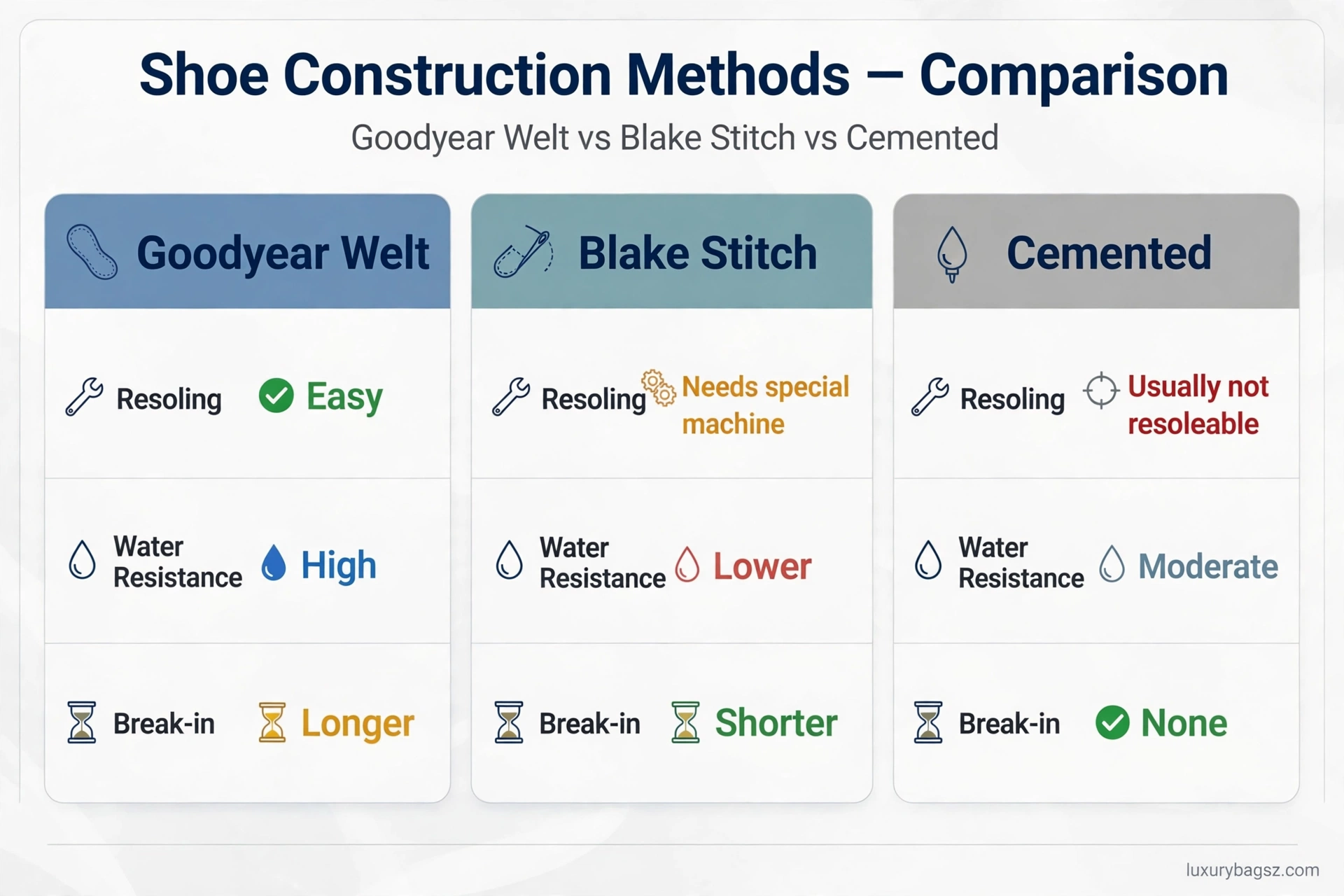
Blake stitching uses one row of stitches that passes straight through the insole, the upper, and the outsole. There is no welt, no second stitch row, and no cork cavity in the same sense.
That single row makes Blake shoes slimmer, lighter, and more flexible from the first wear. Italian dress shoes favour Blake for exactly that reason: a close-cut silhouette and immediate comfort matter more than mud resistance.
The trade-off is water. Stitch holes pass into the footbed, so wet ground can seep in more easily. Resoling also needs a cobbler with a Blake machine, so you may need to call ahead before you drop the shoes off.
Neither method is simply better. They solve different problems, and the honest guides say so plainly. Boots and wet weather favour the welt; sleek dress shoes favour Blake.
Goodyear Welt vs Cemented Construction
Cemented construction glues the sole to the upper with no stitching at all. It dominates sneakers and fast-fashion footwear because it is fast, cheap, and light.
A glued sole can be re-glued once or twice, but once the sole wears through, the shoe is usually finished. There is no stitched structure for a cobbler to rebuild, and the upper often fails soon after.
The real dividing line in footwear is stitched versus glued, not Goodyear versus Blake. Both stitched methods can last 15 to 25 years with resoling and care, given a full-grain upper and a decent outsole.
If you only remember one buying rule, make it this: a stitched sole is repairable, and a glued sole mostly is not. That single fact explains most of the price gap between cheap shoes and good boots.
For a slim, formal shoe, the comparison changes again, and our guide to what dress shoes are helps explain where a Blake-stitched dress shoe fits better than a chunky welted boot.
Where Goodyear Welt Genuinely Wins
Wet conditions are the clearest win. With no stitching through the footbed, water has a harder path inside, and the welt plus midsole act as a seal around the edge of the boot.
Heavy wear is the second win. Work boots, hiking boots, and daily-wear boots take repeated flexing, scuffing, and impact. A welted boot can be resoled several times, so the upper, which is the expensive part, keeps working.
Resoling access is the third win. Almost any cobbler can resole a Goodyear-welted boot with standard equipment. That matters if you live far from a specialist repair shop or travel with your boots.
Break-in is the price you pay. Expect two to four weeks before a welted boot feels truly yours, against one to two weeks for Blake. The cork bed needs time to mould, and the stiff sole needs time to flex.
Why a Welted Boot Can Still Be Low-End
Here is where the marketing breaks down. Some makers glue a sole on, then add a strip of plastic or rubber around the edge with decorative stitching. It looks welted in a photo. It is not welted in any way that helps you.
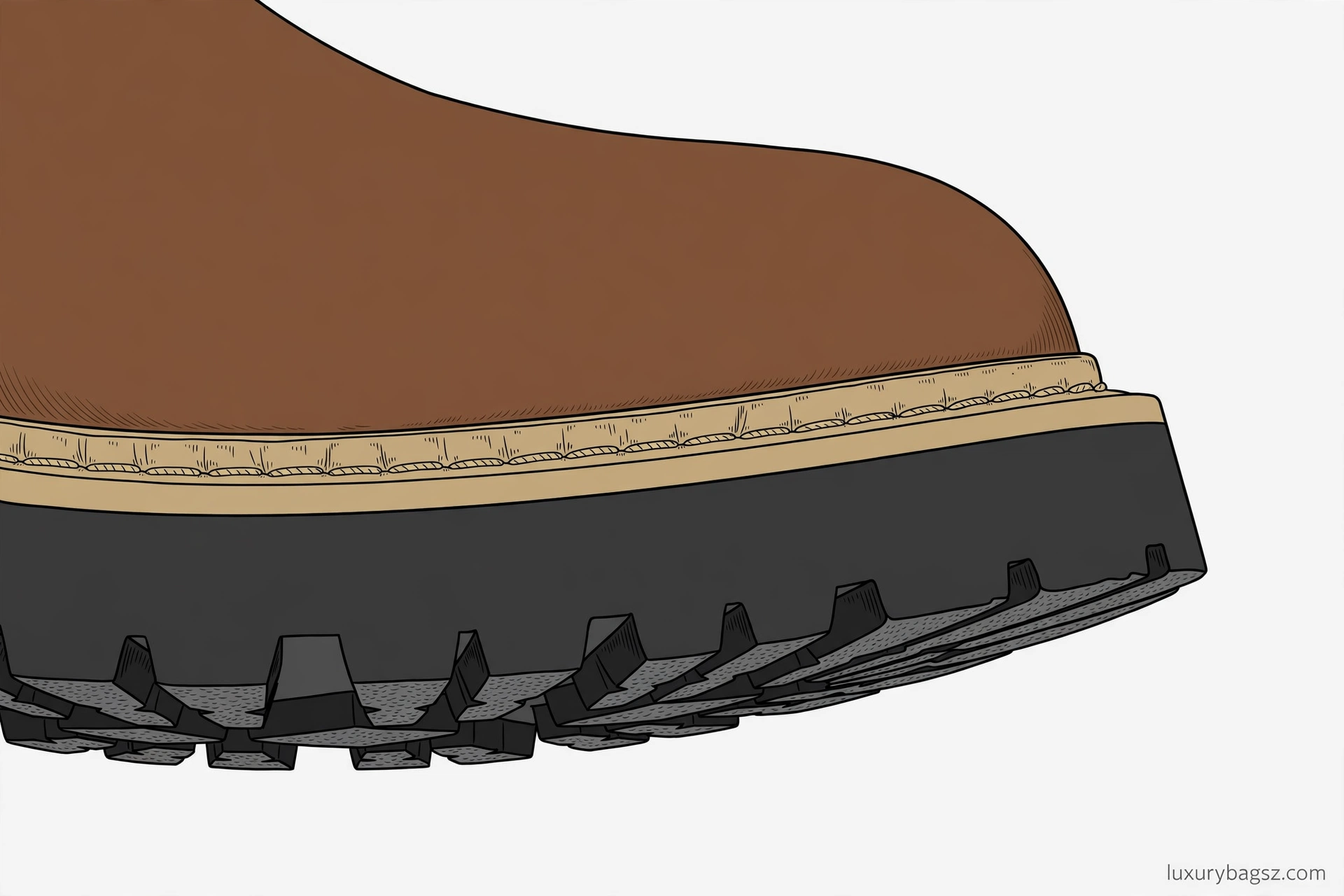
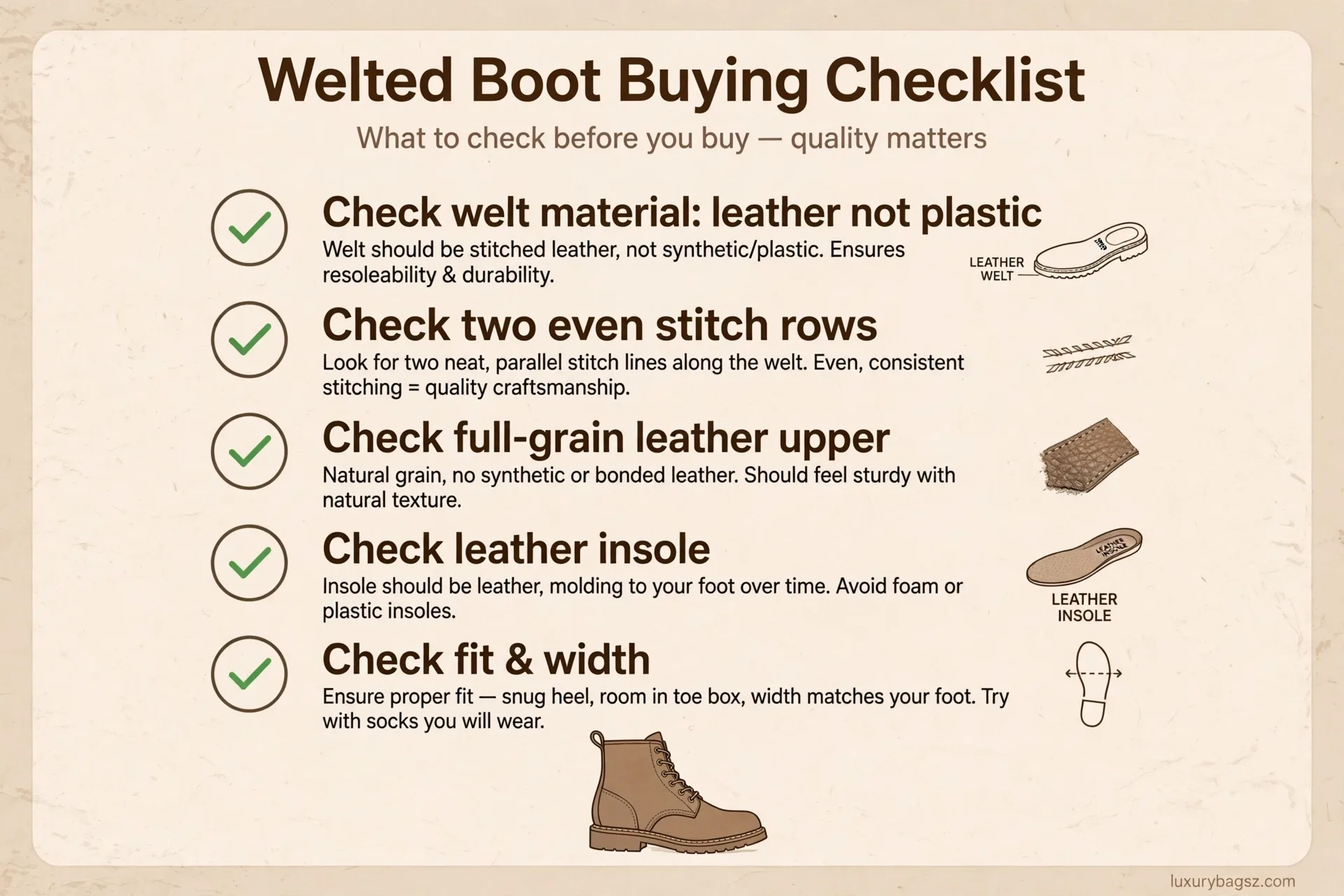
Check the welt material first. A real welt is usually leather, firm to the touch, and visibly stitched through. A plastic welt feels hollow, and its stitching often stops at the surface rather than joining anything.
Check the insole next. A fibreboard insole will crumble and lose shape, while a leather insole moulds and lasts. Many budget welted boots hide a fibreboard insole under a thin leather cover.
Check the upper leather too. Corrected grain, heavily coated to hide flaws, will not age like full-grain leather, no matter how good the welt is. The welt cannot rescue a weak upper.
The 360-Degree vs 270-Degree Welt Question
A 360-degree welt runs all the way around the boot, including around the heel. A 270-degree welt stops short of the heel, giving a slightly slimmer profile at the back.
The difference is mostly visual. A full welt looks chunkier and more work-boot-like, while a 270-degree welt looks a touch neater from behind. Water resistance is marginally better with a full welt, but the gap is small.
Do not let a seller upsell you on this detail alone. Leather quality, fit, and sole compound matter far more than whether stitching continues around the heel seat.
Some makers also offer storm welts, which are wider and turned up to shed water. For genuinely wet work, a storm welt plus a rubber or commando sole is a sensible upgrade, not a gimmick.
Resoling, Care, and Lifetime Cost
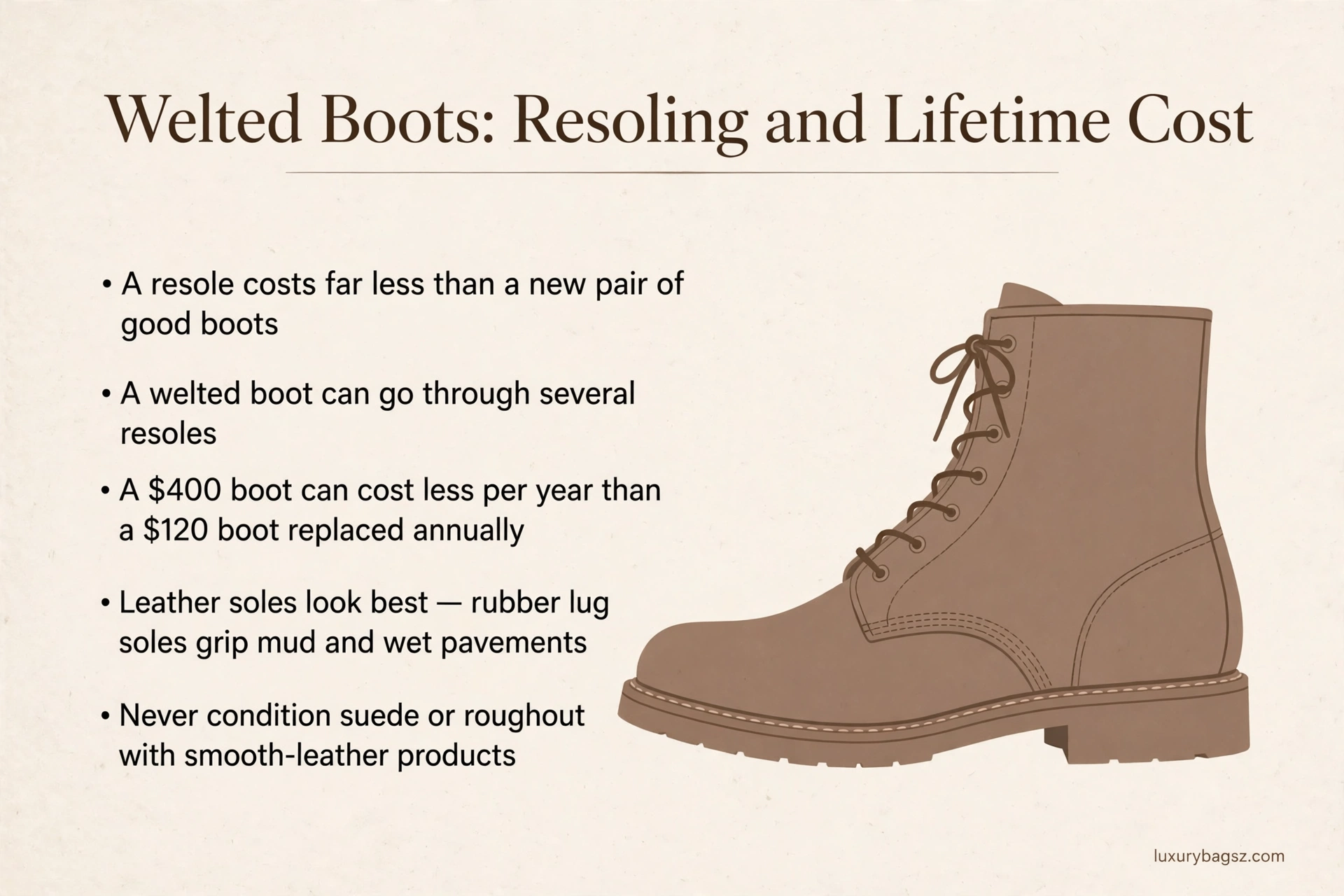
A resole typically costs far less than a new pair of good boots, and a welted boot can go through several resoles. That is how a $400 boot can cost less per year than a $120 boot replaced annually.
Ask your cobbler what sole they recommend for your use. A leather sole looks best and slides on office floors, while a rubber lug sole grips mud and wet pavements but wears faster on concrete.
Between resoles, keep the leather clean and conditioned. Our Hermes leather boots care guide covers the after-wear routine, and the Saphir Renovateur guide explains a conditioner many boot owners use on smooth leather.
Do not condition suede or roughout with smooth-leather products. Roughout needs its own brush and protector, and the wrong cream will flatten the nap and darken the finish permanently.
How to Check a Welted Boot Before You Buy
Start at the sole edge. You should see two distinct stitch rows: one joining the welt to the upper area, and one joining the welt to the outsole. Both should be even, tight, and free of skipped stitches.
Press the welt gently. Leather feels dense and firm, while plastic feels light and slightly springy. Look at the waist, the narrow middle of the sole, where cheap work often shows gaps or glue squeeze-out.
Try the flex test. A new welted boot will feel stiff, but it should bend at the ball of the foot, not fold in the middle. If it folds like a sneaker, the shank or midsole may be weak.
Check the maker's resole policy and whether they sell the boot in your exact size and width. A welt cannot fix a poor fit, and a boot that pinches on day one rarely becomes comfortable later.
So, Should You Buy Goodyear-Welted Boots?
Buy welted boots if you wear boots hard, walk in wet weather, or want a pair you can repair for a decade or more. For those uses, no other common construction matches the combination of durability and repairability.
Choose Blake instead if you want the slimmest possible dress shoe, the shortest break-in, and the closest feel to the ground. Choose a good cemented shoe only if budget is tight and you accept replacing it sooner.
Finally, read past the welt label. Ask what leather, what insole, and what welt material the maker uses. A maker that answers plainly is usually a maker worth trusting with your money.
Two Alternatives Worth Knowing
Blake Rapid adds a midsole to Blake stitching, then stitches the outsole to that midsole. You get Blake flexibility plus easier resoling, since the cobbler works on the midsole stitch rather than the insole stitch.
Stitchdown construction folds the upper outward and stitches it straight through the midsole and outsole. Work-boot makers use it for a tough, water-shedding boot that can still be resoled, though fewer cobblers stock the parts.
Neither replaces the Goodyear welt as the default boot choice. Both are useful reminders that good boots come in more than one construction, and that fit and leather still decide the winner.
Frequently Asked Questions
Is Goodyear welt the best shoe construction?
For boots, heavy wear, and wet weather, yes, it is the best common construction. For slim dress shoes, Blake stitch is often the better choice, and the best construction always depends on how you will wear the shoe.
Are Goodyear-welted boots always high-end?
No. Some budget boots carry a real welt but pair it with thin corrected leather, a fibreboard insole, or a plastic welt. Others fake the look entirely with decorative stitching on a glued sole.
How long do Goodyear-welted boots last?
With a full-grain upper, regular care, and resoling when needed, 15 to 25 years is realistic. The upper and the fit, not the welt alone, usually decide whether a boot reaches that age.
Can any cobbler resole Goodyear-welted boots?
Almost any cobbler can, which is a major advantage over Blake stitching. Blake resoles need a specific machine, so you should confirm the cobbler has one before you leave Blake shoes for repair.
Are Goodyear-welted boots waterproof?
They are more water-resistant than Blake shoes, but they are not waterproof on their own. Water can still enter over the top, through the laces, or through worn stitching, so treat them for rain if you need real wet-weather protection.
Do Goodyear-welted boots need a long break-in?
Yes, usually two to four weeks of regular wear. The cork footbed moulds to your foot during that time, and the sole softens, so early stiffness is normal rather than a fault.
What is a storm welt?
A storm welt is a wider welt that turns upward against the upper to shed water away from the seam. It is a sensible upgrade for wet work, especially when paired with a rubber or lug sole.
What is the difference between 270-degree and 360-degree welts?
A 360-degree welt runs fully around the boot, including the heel. A 270-degree welt stops before the heel for a slimmer look. The practical difference in water resistance is small.
How can I spot a fake welt?
Look for stitching that does not pass through anything, a plastic-feeling welt, and glue visible at the sole edge. A real welt is usually leather, firmly stitched, with two even rows of stitching.
Are Goodyear-welted boots worth the price?
They are worth it if you will wear them often and resole them. If you wear boots rarely, or you prioritise light weight and instant comfort, a cheaper stitched or cemented shoe may serve you better.
Final Verdict
Goodyear welt is the best default for boots, but it is not a magic label. It wins on resoling, wet-weather performance, and long-term value, and it loses on weight, break-in, and sleekness. Buy the whole boot: full-grain leather, a leather insole, a real leather welt, and a fit you trust. When those line up with a welt, you have a boot worth keeping for decades.






