

How Jeans Are Made: Stretch Selvedge Jeans, From Cotton to Cuff
Stretch Selvedge, Made Step by Step
Stretch selvedge jeans combine two ideas that once seemed opposed: the old, slow weaving that gives denim its finished edge, and a modern stretch yarn that lets the jeans move with you. The result fades like traditional selvedge but feels far more forgiving from day one.
Making them takes five broad stages: raw material, spinning, dyeing, weaving, and finishing, followed by cutting, sewing, and washing. Each stage changes how the finished jeans look, feel, and fade, so a shortcut anywhere shows up in the pair you wear.
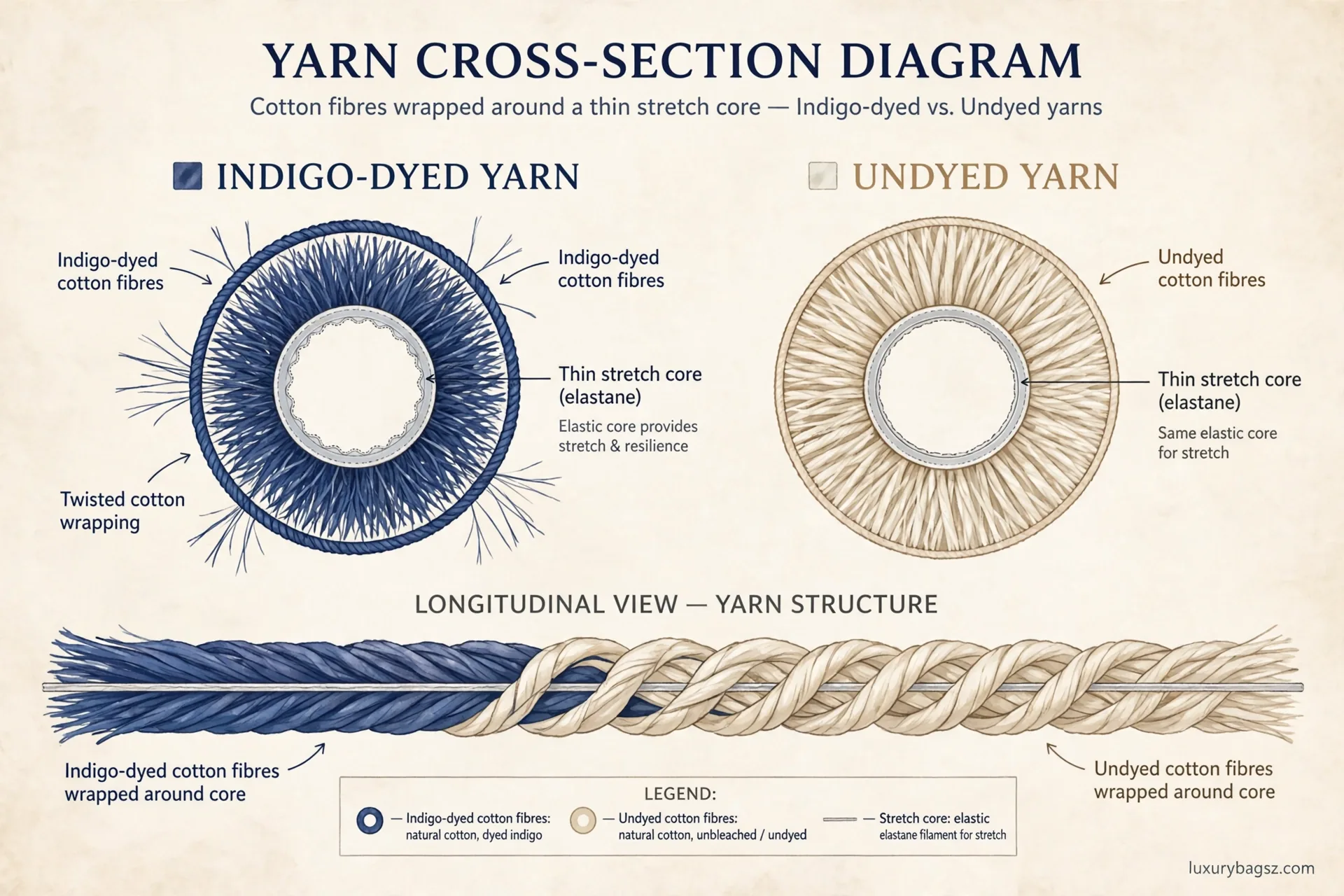
The key trick is core-spun yarn. Cotton is wrapped around a stretch core, usually elastane, so the outside of the yarn still looks and dyes like cotton, while the inside gives. Done well, you get cotton's fading character with real give. Done badly, you get baggy knees and a waistband that never recovers.
Key Takeaways
- Denim is made in five stages: raw cotton, spinning, dyeing, weaving, and finishing, then cutting and sewing.
- Selvedge means the fabric's edge is finished by the loom itself; it is a weaving method, not a quality grade.
- Stretch selvedge uses core-spun yarn: cotton wrapped around an elastane core, so it fades like cotton and stretches like a blend.
- Shuttle looms weave slowly, about 30 inches wide, which is why selvedge fabric costs more and wastes more cloth in cutting.
- Cutting must keep a straight outseam so the selvedge edge shows when you cuff, which forces pattern changes elsewhere.
- Chain-stitched hems give the hem stretch and the classic roped fade, while lockstitched hems are flatter and cheaper.
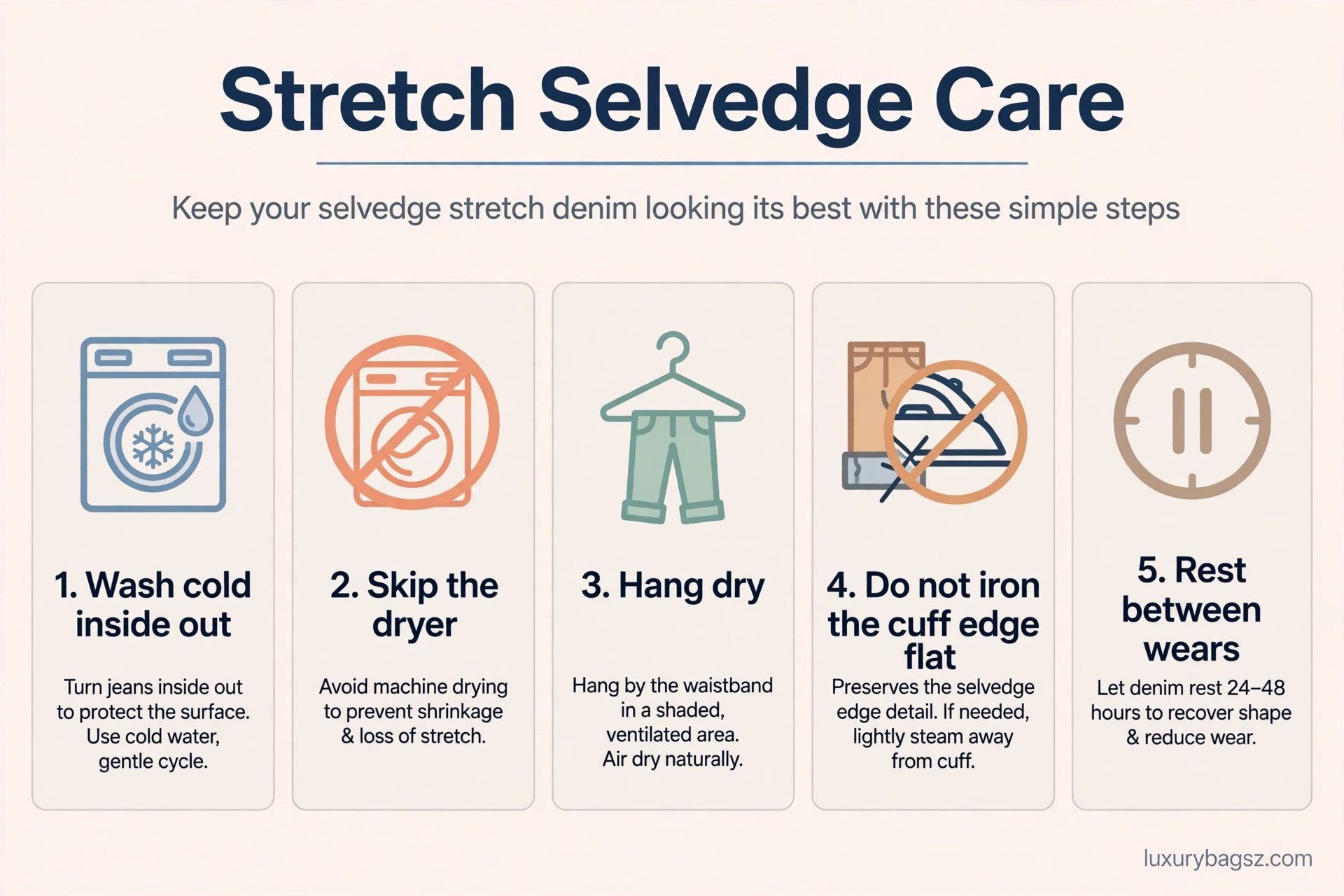
- Wash cold, inside out, and hang dry: heat is the fastest way to kill stretch recovery.
Raw Material: Cotton First, and Which Cotton Matters
Almost all denim starts with cotton, a natural fibre from the cotton plant. After harvest, the raw cotton is ginned to separate fibre from seed, cleaned, and pressed into bales of roughly 250 kilos. One bale holds enough cotton for around 400 pairs of jeans.
Where the cotton comes from affects feel and price. Longer-staple cottons, such as the better American, Egyptian, and Zimbabwean crops, spin into smoother, stronger yarn with less fuzz. Shorter-staple cotton is cheaper but hairier, and it can pill and fade less cleanly.
Organic cotton appears in some selvedge ranges, grown without synthetic pesticides and fertilisers. It does not automatically make better jeans, and the yarn still depends on spinning and weaving, but it does change the farming footprint, which matters to many buyers.
A few makers blend a small amount of other fibre into the warp or weft for a specific hand feel, but classic stretch selvedge keeps the cotton share high, typically 97 to 99 percent cotton with 1 to 3 percent elastane. Check the label: above about 3 percent stretch, the jeans behave more like stretch jeans with a selvedge edge than like selvedge with give.
Cotton quality is invisible in a finished pair until you wear it, which is why transparent makers name the mill and the cotton origin. A maker that hides both is asking you to trust the price alone, and price alone is a weak guide.
Spinning: How Stretch Gets Inside the Yarn
Spinning twists individual cotton fibres into yarn, and the method chosen shapes the denim's texture, strength, and fading. The two main methods are open-end spinning, which is fast and cheap, and ring spinning, which is slower and produces a stronger, more irregular yarn.
Ring-spun yarn is the choice for most good selvedge denim. Its slight unevenness creates slub, the subtle texture that gives selvedge its lively, irregular fades. Open-end yarn is smoother and more uniform, but it absorbs indigo more evenly and fades flatter.
Stretch yarn needs a different approach again: core spinning. During ring spinning, an elastane filament is fed through the centre while cotton fibres wrap around it. The cotton forms the visible surface, so the yarn still dyes, feels, and fades like cotton, while the core supplies stretch.
That wrapping is why core-spun stretch selvedge fades better than older stretch denims, where elastane sat exposed or the yarn was blended loosely. The cotton shell takes the indigo, the core stays hidden, and the fades still show the pale cotton heart of the yarn as the surface wears.
There is a trade-off, and honest makers admit it. Elastane weakens with heat, age, and repeated stretching, so a stretch pair will eventually lose some recovery, especially at the knees and seat. Rigid selvedge does not have that problem, which is why it lasts longer in pure fibre terms.
Dyeing: Rope Dyeing and Why Indigo Sits on the Surface
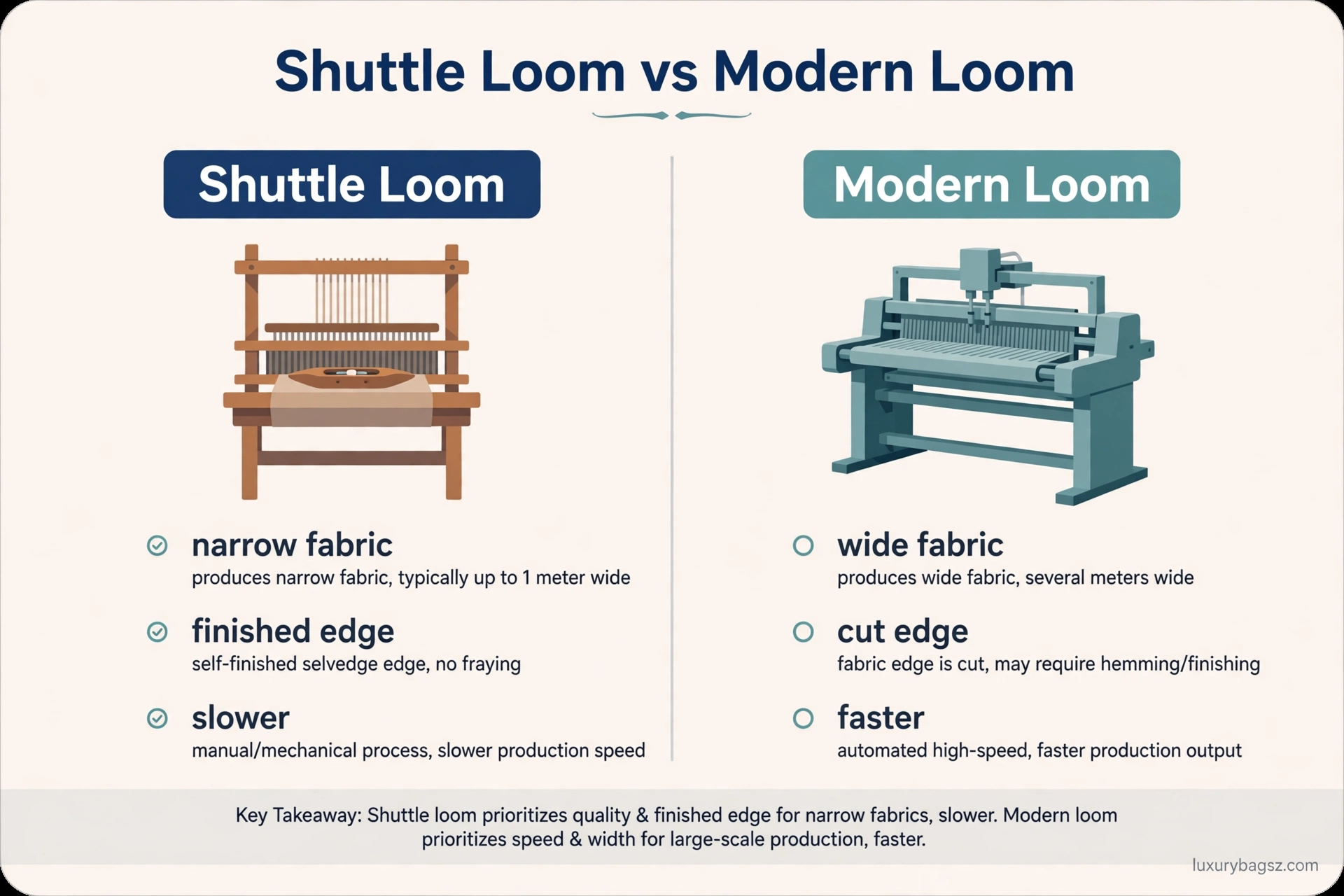
Before weaving, the warp yarns, the ones that run lengthwise, are dyed indigo, while the weft yarns, which run across, are usually left undyed. That contrast is why denim is blue on the outside and pale on the inside.
The best-regarded method is rope dyeing. Hundreds of warp yarns are twisted into a rope, dipped repeatedly into indigo vats, and oxidised in air between dips. Each dip adds a thin layer of dye to the yarn surface without soaking through to the core.
That ring-dye effect is the whole basis of denim fading. Because only the surface holds colour, wear rubs the blue away and reveals the white core, giving the sharp, high-contrast fades selvedge fans prize. More dips mean a deeper blue and, usually, a longer fading journey.
Slasher dyeing is the faster industrial alternative, where a flat sheet of warp yarns passes through the dye in one continuous run. It is cheaper and more even, but the dye penetrates more deeply, so fades tend to be softer and less dramatic.
Some makers also use loop dyeing or sulphur dyeing for black or grey selvedge, and those dyes behave differently: sulphur blacks fade to a greyer tone, while indigo blues fade toward pale blue and white. If you buy black stretch selvedge, expect a different fading story from blue.
Dyeing is also where a large share of water and chemical use sits, and where sources disagree on the exact footprint. Figures vary by mill, by dye method, and by whether wastewater is treated, so treat any single "litres per pair" claim as an estimate for one mill, not a universal fact.
Weaving: Shuttle Looms, Twill, and the Selvedge Edge
Weaving interlaces warp and weft yarns at right angles. Denim is a twill weave, most commonly a 3 by 1 twill, meaning three warp yarns pass over each weft yarn on the face of the fabric, creating the diagonal twill line you can see on any pair of jeans.
That twill can run to the right, to the left, or in a broken zigzag. Right-hand twill is the most common and tends to feel firmer. Left-hand twill feels softer and fades slightly differently. Broken twill resists the leg-twisting that a strong twill direction can cause after washing.
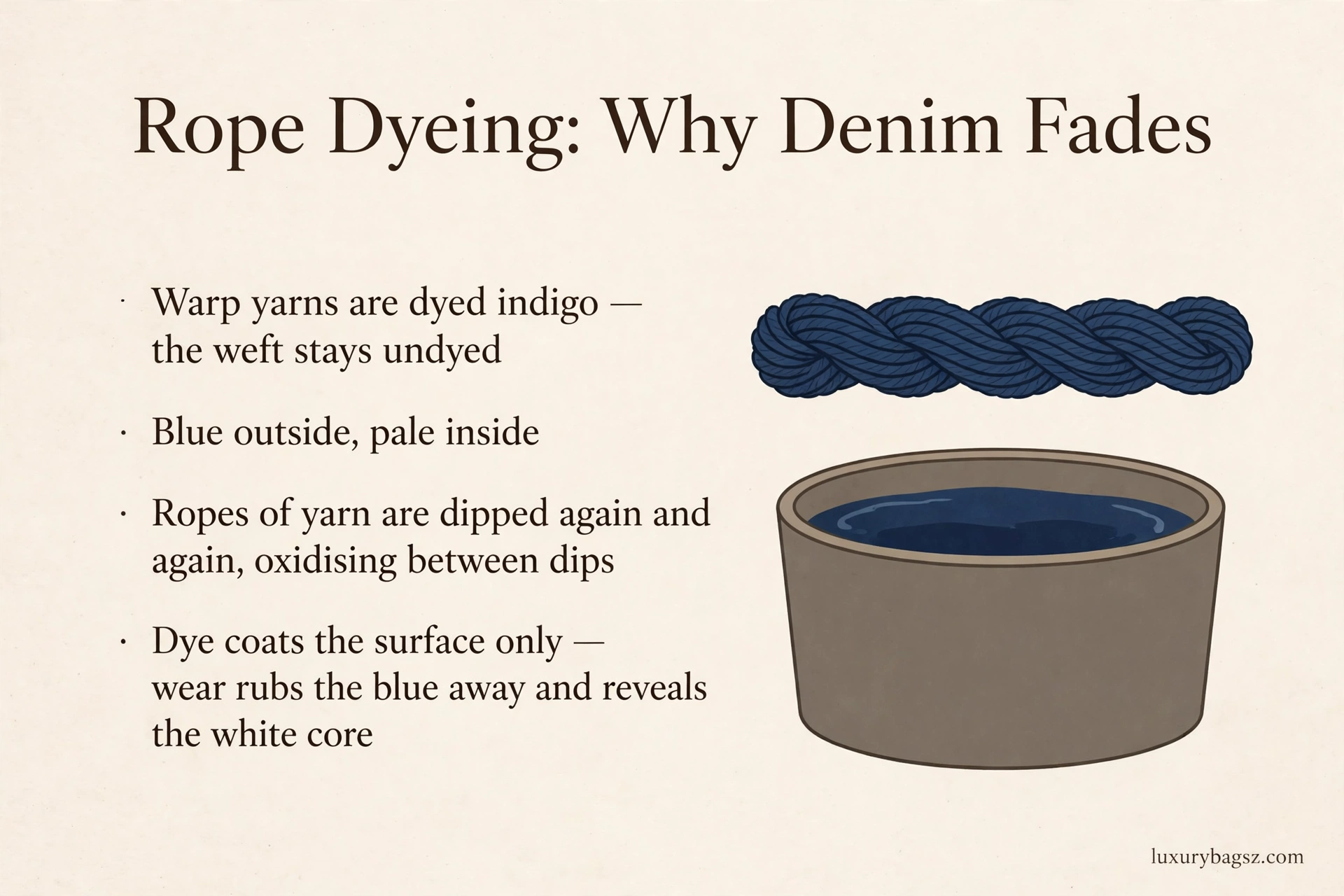
Selvedge weaving differs in the picking motion, the way weft yarn is inserted. On a shuttle loom, a small shuttle carrying the weft travels back and forth across the warp, then turns and comes back, so the weft is one continuous thread and the fabric edge seals itself.
That sealed edge is the selvedge, from "self-edge," and it stops the fabric unravelling without any extra finishing. Shuttle looms weave slowly and only about 30 inches wide, compared with modern projectile or air-jet looms that shoot each weft thread separately and weave 60 inches or wider at far higher speed.
No new shuttle looms have been made for decades, so mills maintain old machines, often in Japan, where selvedge weaving survived longest. That scarcity, plus the slower output, is a large part of why selvedge fabric costs more than ordinary denim, before any brand markup.
Stretch selvedge on a shuttle loom needs care, because elastane behaves differently under tension from pure cotton. Mills adjust loom speed and tension to keep the stretch core from snapping or pulling unevenly, and a poorly woven stretch selvedge can show wavy edges or uneven stretch across the cloth.

Cutting: Why Selvedge Jeans Have Straight Outseams
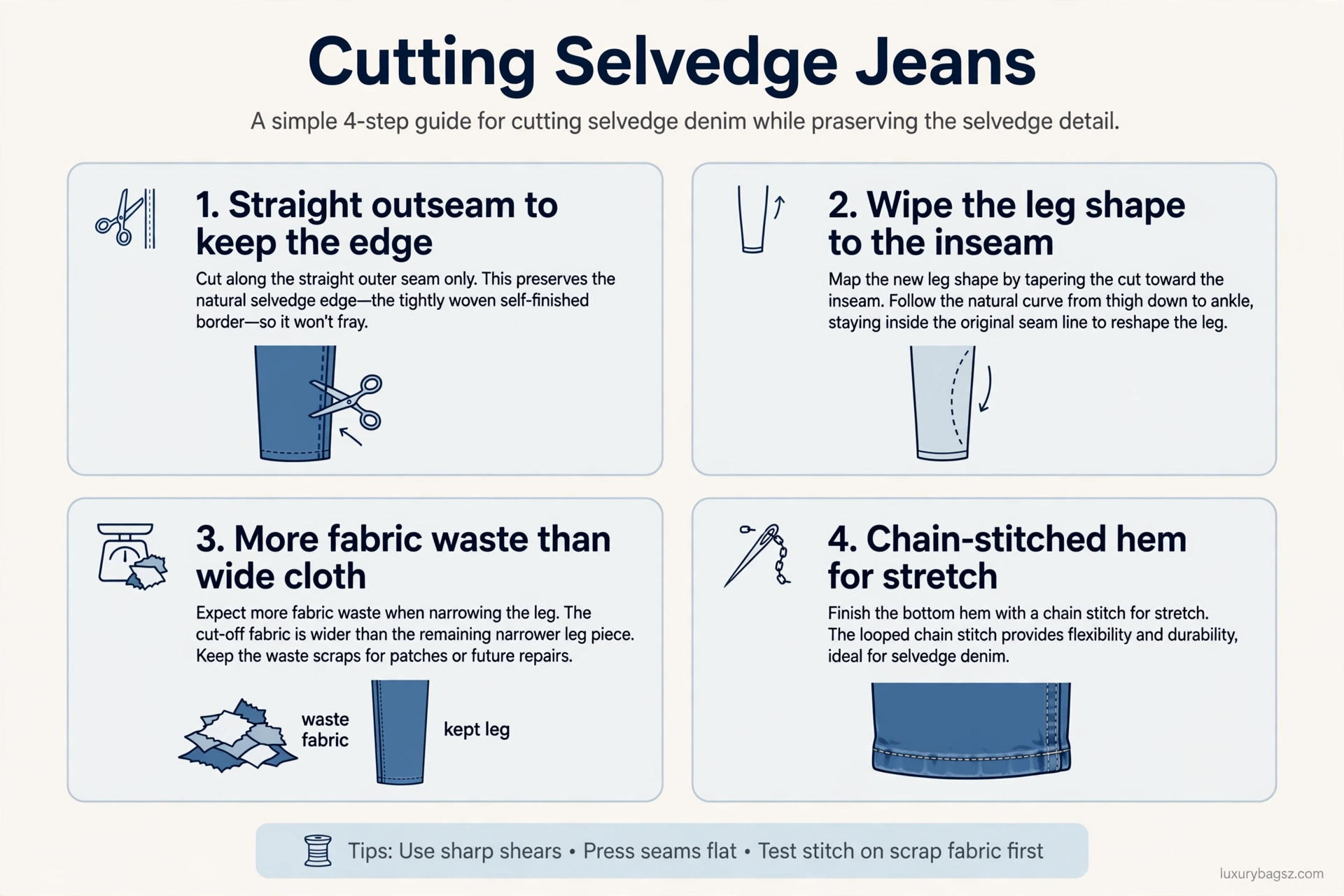
Cutting selvedge jeans is a puzzle that ordinary jeans do not face. Because the fabric is only about 30 inches wide and the selvedge edge must sit on the outseam, the pattern pieces for the leg must have a straight outer edge, or the selvedge line would be cut away.
Most jeans have a curved outseam that follows the leg's shape. Selvedge makers therefore "wipe" the leg shape toward the inseam, adjusting the inner curve to make up for the straight outer edge. The result fits much like a normal pair, but the pattern work is more skilled and less efficient.
That inefficiency shows up as waste. A pair of selvedge jeans needs roughly three yards of narrow fabric, and the straight-edge constraint leaves offcuts that wide-cloth cutting would avoid. More waste means higher fabric cost per pair, which is passed on in the price.
Stretch adds another cutting problem: the fabric moves. Cutters must lay stretch selvedge flat without pulling it, or the pieces will spring back to a different size once cut. Good workshops rest the cloth, cut with sharp blades, and check measurements piece by piece rather than trusting the marker alone.
The yoke, the V-shaped panel at the back waist, also does extra work in selvedge jeans, adding shape without darts that would interrupt the selvedge line. Waistbands may carry a slight curve for fit, and some makers end the selvedge partway up the leg so the fly area can be shaped more freely.
If you see a pair advertised as selvedge but the outseam has no finished edge when cuffed, check the claim. Some makers use selvedge fabric but cut it away, or use a selvedge-look edge that is not woven in. The cuff test remains the simplest check.
Sewing: Chain Stitches, Rivets, and the Details That Last
Sewing selvedge jeans uses mostly standard machines, but the stitch choices matter. A small workshop making selvedge jeans might run a dozen single-needle lockstitch machines plus one each for chain stitching, bartacking, overlocking, feed-off-the-arm sewing, and buttonholing, with a handful of operators handling a pair from cutting to finishing in about four hours.
The hem is the most talked-about stitch. Chain stitching, done on a vintage Union Special-style machine, creates a slightly puckered, roped hem that fades into wavy lines with wear. Lockstitching gives a flatter, cleaner hem but no roping effect. Neither is stronger in any simple sense; they fade differently.
Outseams on selvedge jeans are not overlocked like ordinary jeans. Instead, the panels are topstitched together and pressed so the selvedge edge shows cleanly. That topstitching is visible, so sloppy work shows immediately, which is one reason selvedge sewing tends to be tidier.
Rivets reinforce stress points: the front pocket corners, the back pocket corners, and the base of the fly. Copper or brass rivets are traditional, and hidden rivets, set inside the back pockets, keep the rivet from scratching furniture. Bar tacks, dense zigzag stitches, serve the same reinforcing job on pocket edges and belt loops.
Hardware matters too. A sturdy button fly or a quality zip, a well-set waist button, and belt loops that are bartacked at both ends all outlast their cheap equivalents. On stretch selvedge, the waistband needs a little extra attention, because elastane pulls the waistband in and out with every wear, stressing the button and the topstitching.
Finally, the jeans are inspected, pressed, and, for most stretch selvedge, given a light wash or rinse. A rinse removes sizing starch, softens the hand feel slightly, and pre-shrinks the fabric a little, while a full wash would already start the fading story before you buy.
Washing, Wearing, and Keeping the Stretch Alive
Stretch selvedge is easier to live with than rigid selvedge, but it is also easier to ruin with heat. Elastane loses recovery when it meets high temperatures, so the tumble dryer is the single biggest enemy of a stretch pair.
Wash cold, inside out, on a gentle cycle, and hang dry out of direct sun. That routine protects both the indigo fades and the stretch core. If the jeans feel loose after a wash, a short, low-heat tumble can temporarily tighten elastane, but repeated hot drying will permanently weaken it, so use that trick sparingly.
Expect a different break-in from rigid denim. Stretch selvedge feels comfortable within days, not weeks, and it will give a little at the waist, knees, and seat during the first wears. Buy a fit that feels snug but not tight, because a pair that is comfortable on day one may bag at the knees by month three.
Watch the knees and seat for bagging, the classic stretch complaint. A good core-spun fabric with 1 to 2 percent elastane recovers well; a cheaper blend with more elastane but poorer cotton wrapping bags faster. If bagging bothers you, rest the jeans a day between wears so the elastane can recover.
Sources disagree on whether stretch selvedge fades as well as rigid selvedge. Some makers claim core-spun yarn fades almost identically, while others say the stretch core softens contrast slightly. In practice, well-made stretch selvedge fades beautifully, just a touch softer than the sharpest rigid pairs, and most wearers will not notice the difference.
Buying Stretch Selvedge Without Overpaying
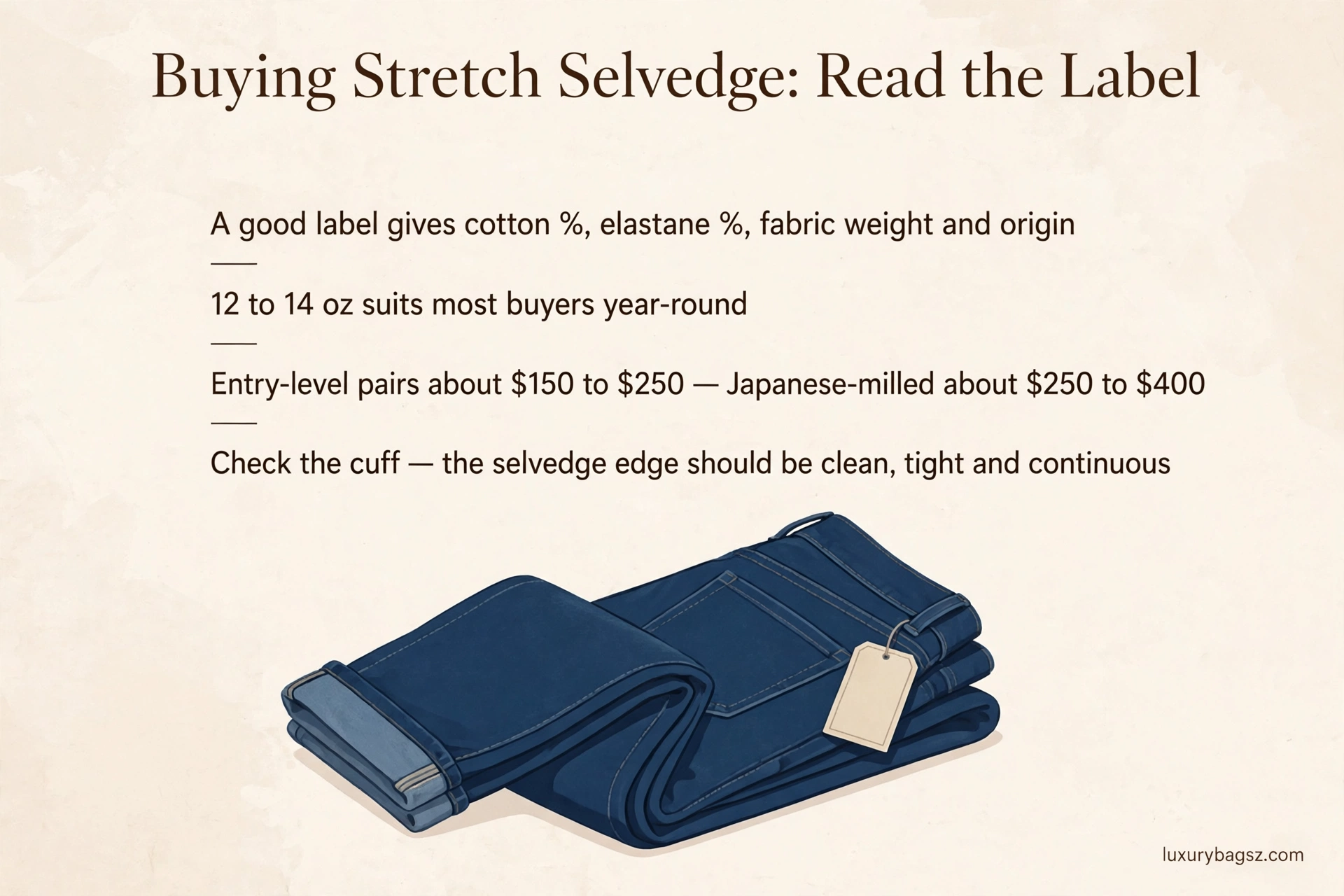
Start with the label, and read it fully. Look for the cotton percentage, the elastane percentage, the fabric weight in ounces, and the mill or country of origin. A label that gives all four is a good sign; a label that only says "selvedge stretch" is not telling you enough.
Weight guidance mirrors raw denim: 12 to 14 ounces suits most buyers year-round, lighter weights suit warm climates, and heavier weights hold fades longer but feel stiffer. Stretch makes heavier weights more wearable, so a 14-ounce stretch pair feels easier than a 14-ounce rigid pair.
Price bands are wide, and they reflect fabric, not just branding. Entry-level stretch selvedge from a decent maker can sit around $150 to $250, mid-range Japanese-milled pairs around $250 to $400, and small-workshop or rare-mill pairs above that. Paying more should buy better fabric, construction, or fit, not just a coloured edge.
Check the cuff before you buy, in person or in photos. The selvedge edge should be clean, tight, and continuous, with no fraying or waviness. Check the hem too: a chain-stitched hem with slight roping is a good sign, while a wavy, uneven hem can signal rushed sewing.
Finally, be honest about what you want. If you love sharp, high-contrast fades and plan to wear one pair for years, rigid selvedge may suit you better. If you want selvedge character with everyday comfort, stretch selvedge is the smarter buy, and its slightly shorter fibre life is a fair trade for jeans you actually wear.
Frequently Asked Questions
How are stretch selvedge jeans made?
Cotton is spun into core-spun yarn with an elastane centre, rope-dyed indigo, woven slowly on a shuttle loom with a finished edge, then cut with a straight outseam, sewn with chain-stitched hems, and lightly washed.
What is the difference between selvedge and stretch selvedge?
Selvedge describes shuttle-loom weaving with a finished edge. Stretch selvedge adds an elastane core inside the cotton yarn, so the jeans stretch and recover while keeping the selvedge edge and cotton fading character.
Does stretch selvedge fade like rigid selvedge?
Almost, but a touch softer. Core-spun yarn keeps cotton on the surface, so fades form well, yet the stretch core can soften contrast slightly compared with the sharpest rigid pairs.
How much stretch should selvedge jeans have?
Most good stretch selvedge has 1 to 3 percent elastane. Below 1 percent the stretch is barely noticeable; above 3 percent the jeans behave more like ordinary stretch jeans and may bag faster.
Why are selvedge jeans more expensive?
Shuttle looms weave slowly and narrowly, cutting wastes more fabric, and the sewing is often tidier and slower. You pay for scarce loom time, extra cloth, and skilled pattern work, not just the finished edge.
Can you cuff stretch selvedge jeans?
Yes, and cuffing is the classic way to show the selvedge edge. A single or double cuff works best; avoid ironing the cuff flat, which can crease the edge and stress the stretch core.
Do stretch selvedge jeans bag at the knees?
They can, especially cheaper blends. Good core-spun fabric with 1 to 2 percent elastane recovers well, and resting the jeans a day between wears helps the elastane spring back.
How do I wash stretch selvedge jeans?
Wash cold, inside out, on a gentle cycle, and hang dry. Avoid the tumble dryer, which weakens elastane over time, and avoid hot water, which accelerates both fading and stretch loss.
What weight of stretch selvedge should I buy first?
Start at 12 to 14 ounces. That weight holds fades well, works in most seasons, and feels easier in stretch form than the same weight in rigid denim.
Is stretch selvedge worth it over regular stretch jeans?
If you value fading character, a finished cuff edge, and usually better construction, yes. If you only want maximum comfort and easy care, ordinary stretch jeans are cheaper and simpler.
Summary
Stretch selvedge jeans are a clever compromise: old shuttle looms and ring-dyed cotton give them the edge and the fades, while a hidden elastane core gives them the give.
They will not outlast rigid selvedge fibre for fibre, and heat will shorten their stretch life, but for everyday wear they offer most of the character with far less break-in pain. Buy on fabric, weight, and stitching, wash them cold, and they will repay you with a pair that looks better every month.






