What to Know About Fendi: History, Bags, Prices and Buying Guide
Fendi at a Glance
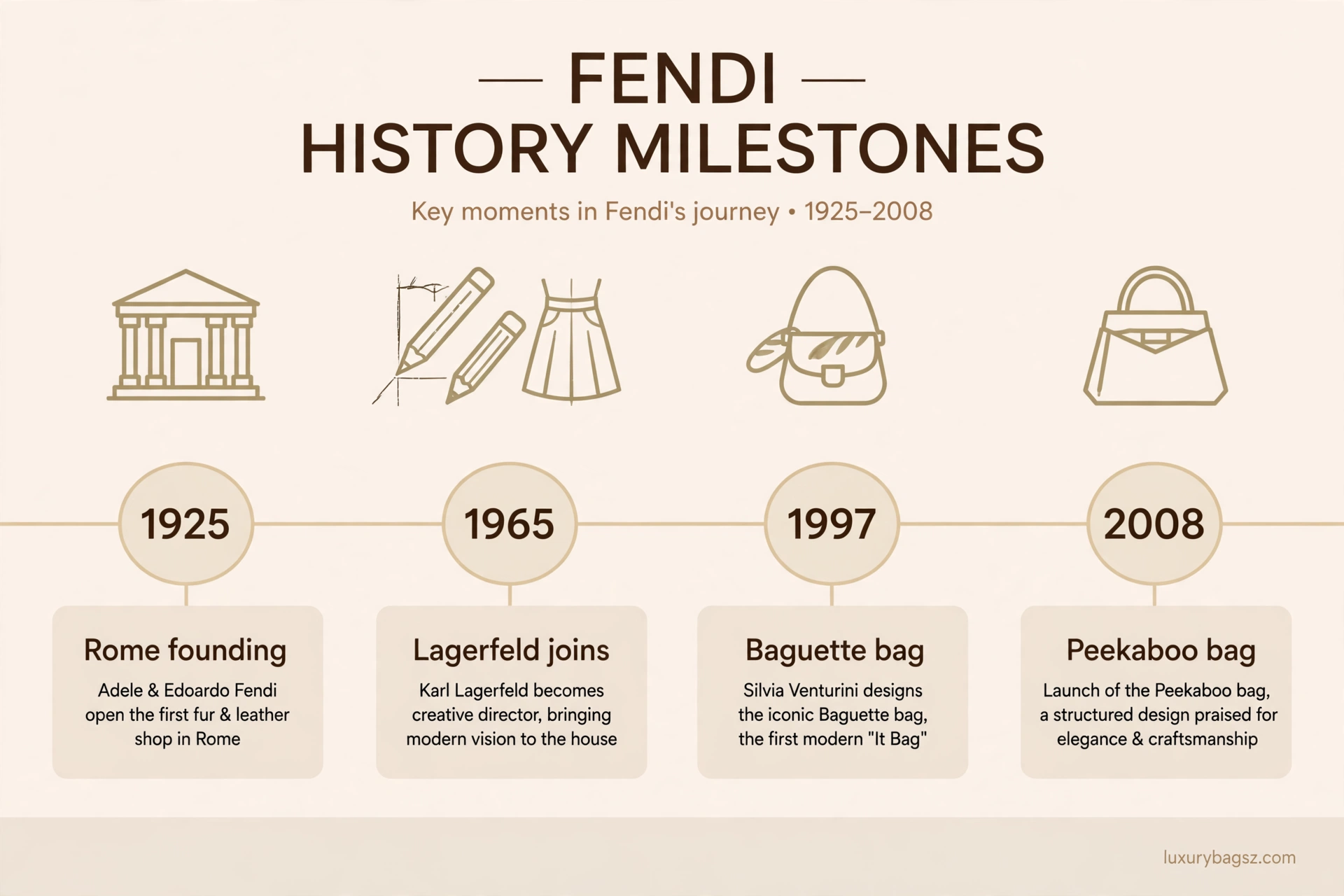
Fendi is Rome with a sense of humour: a fur and leather house founded in 1925 that turned craft into play, inventing the Baguette, the Peekaboo, and a double-F monogram that still reads instantly across a room. Its bags are clever, colourful, and endlessly reinvented, never safe or boring.
The house began as a small workshop in Rome, run by Edoardo and Adele Fendi, and grew through their five daughters. Karl Lagerfeld joined in 1965 and stayed for more than five decades, giving Fendi its Zucca logo and turning fur from heavy coats into light, detailed trims and ready-to-wear. The Baguette, Peekaboo and the rest each have their own full guide in our complete Fendi guide collection.
For buyers, Fendi offers a clear ladder. Start with a small leather good or a Zucca pouch, move to a Baguette, and save a Peekaboo for work and polished days. Prices run from the low thousands for small bags to far higher for leather Peekaboo and embellished pieces, and pre-owned supply is plentiful.
Key Takeaways

- Fendi was founded in Rome in 1925 by Edoardo and Adele Fendi, starting with leather goods and fur.
- Their five daughters — Paola, Anna, Franca, Carla, and Alda — later ran the business together.
- Karl Lagerfeld joined in 1965, created the double-F Zucca motif, and stayed until his death in 2019.
- Silvia Venturini Fendi designed the Baguette in 1997 and the Peekaboo, introduced in 2008.
- Fendi donated over 2 million euros in 2014 to restore Rome's Trevi Fountain, and showed on it in 2017.
- LVMH took a controlling stake in 2001, while the Fendi family stayed active in the house.
- New bags range from about $1,950 for smaller styles to far higher for large leather and limited pieces.
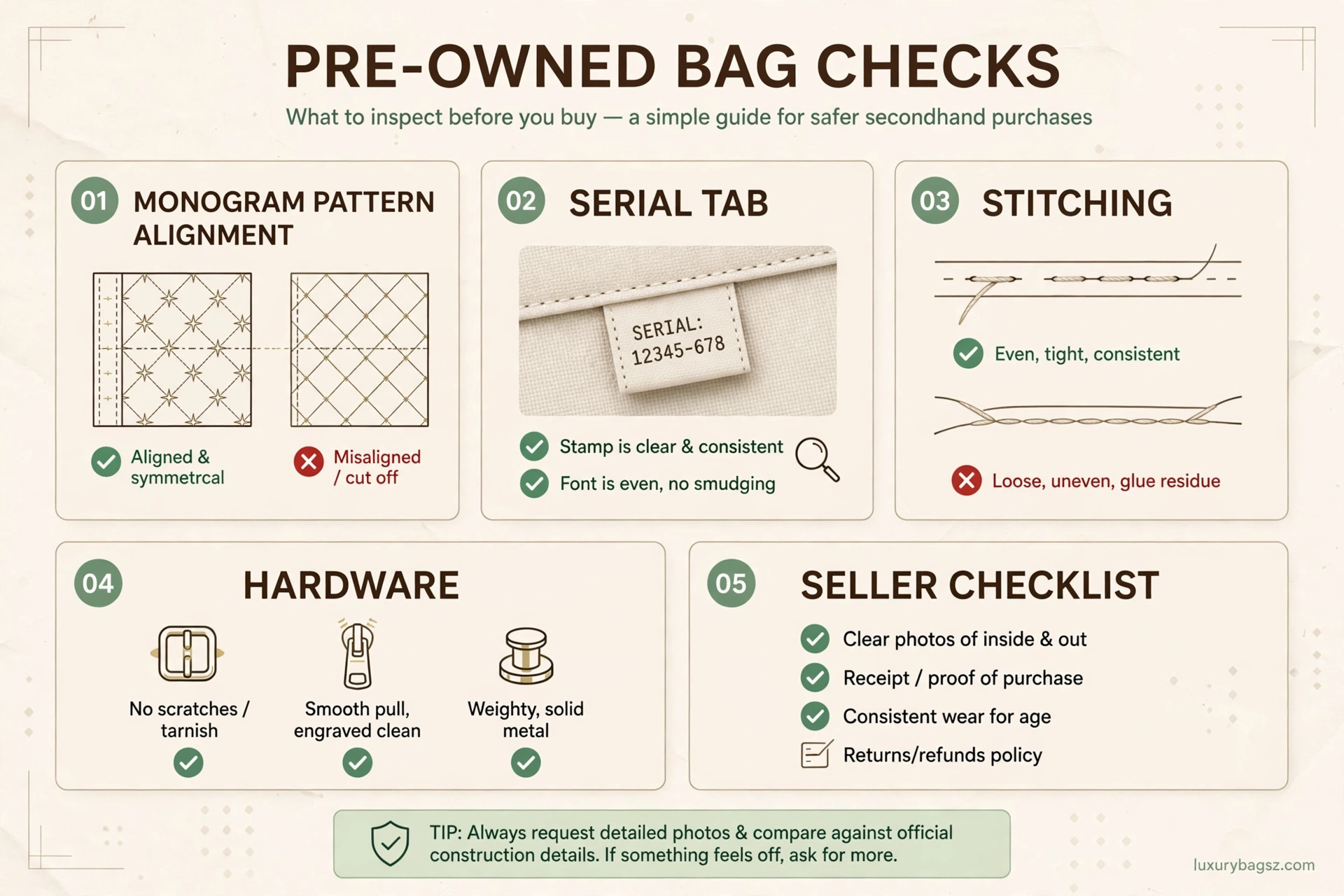
- Pre-owned, check Zucca alignment, the serial tab, stitching, hardware, and the seller together.
Rome, 1925, and a Family Workshop
Edoardo and Adele Fendi opened their Rome workshop in 1925, selling small and medium leather goods alongside fur pieces. Rome was a city of craft and history, and Fendi's early clients valued solid leather, careful finishing, and fur that felt luxurious rather than showy. The shop grew steadily on that reputation.
Fur was central from the start, but Fendi's approach was different. Rather than only large, heavy coats, the house used fur as detail, trim, and decoration, a habit that later defined its ready-to-wear. Leather goods paid the bills, fur gave the house its flair, and both shared the same workshop standards.
The business passed to the founders' five daughters, Paola, Anna, Franca, Carla, and Alda, who each took different roles, from design and licensing to client relations. Their fresh ideas opened new opportunities, and the sisters kept the house family-run for decades, a rarity among major luxury brands.
That family character still shapes Fendi today. Silvia Venturini Fendi, Anna's daughter and the founders' granddaughter, remains at the creative heart of accessories, and later generations of the family have joined the business. Fendi feels personal in a way that larger, more corporate houses often do not.
Karl Lagerfeld and the Double F
In 1965, the Fendi sisters invited German designer Karl Lagerfeld to lead creative direction. He was already known for work at Balmain and Chloé, and his arrival changed Fendi completely. At their first meeting, he is said to have sketched the double-F motif on paper, a playful mark that became the house's signature.
The double F, called Zucca, stands for Fun Furs, a joke that captures Fendi's spirit. It appears as a woven jacquard, a printed canvas, a buckle, and a hardware detail, and it lets a Fendi bag read instantly without a large written logo. The pattern should align cleanly at seams on genuine pieces.
Lagerfeld also reinvented fur itself. He moved fur from heavy coats into ready-to-wear, trims, and leather goods, using it in light, intricate, and colourful ways. Fendi's fur atelier became famous for delicate work, and that craft still underpins the house's reputation, even as fur use has become more debated.
His collaboration with Fendi lasted 54 years, until his death in early 2019, one of the longest partnerships in fashion. Silvia Venturini Fendi worked alongside him from 1992, learning the house's codes before taking accessories forward in her own right.
Silvia Venturini Fendi and the It Bag Era
Silvia Venturini Fendi joined the creative side in 1992, working with Lagerfeld on accessories. Five years later, she designed the Baguette, a small rectangular shoulder bag meant to tuck under the arm like a loaf of French bread. It was inspired by Parisian women carrying baguettes home, and it changed handbag history.
The Baguette became the original It bag, helped by Sex and the City, where Carrie Bradshaw carried string of them and corrected a mugger with the line, "It's not a bag, it's a Baguette." That moment turned a clever shape into a cultural icon, and demand for Baguette bags surged.
Silvia's second icon, the Peekaboo, followed in 2008, with a debut on the spring 2009 runway. It is a structured top-handle tote with a central partition and a flip-lock front, named for the childhood game, because its beauty shows inside and out. It suits work far better than the party-ready Baguette.
Note a point where sources differ: some guides date the Peekaboo to 2008, its design year, and others to 2009, its runway debut. Both describe the same bag; the design year and the show season simply differ. Buyers should not treat either date as a sign of a fake.
Materials: Leather, Zucca, Fur, and More
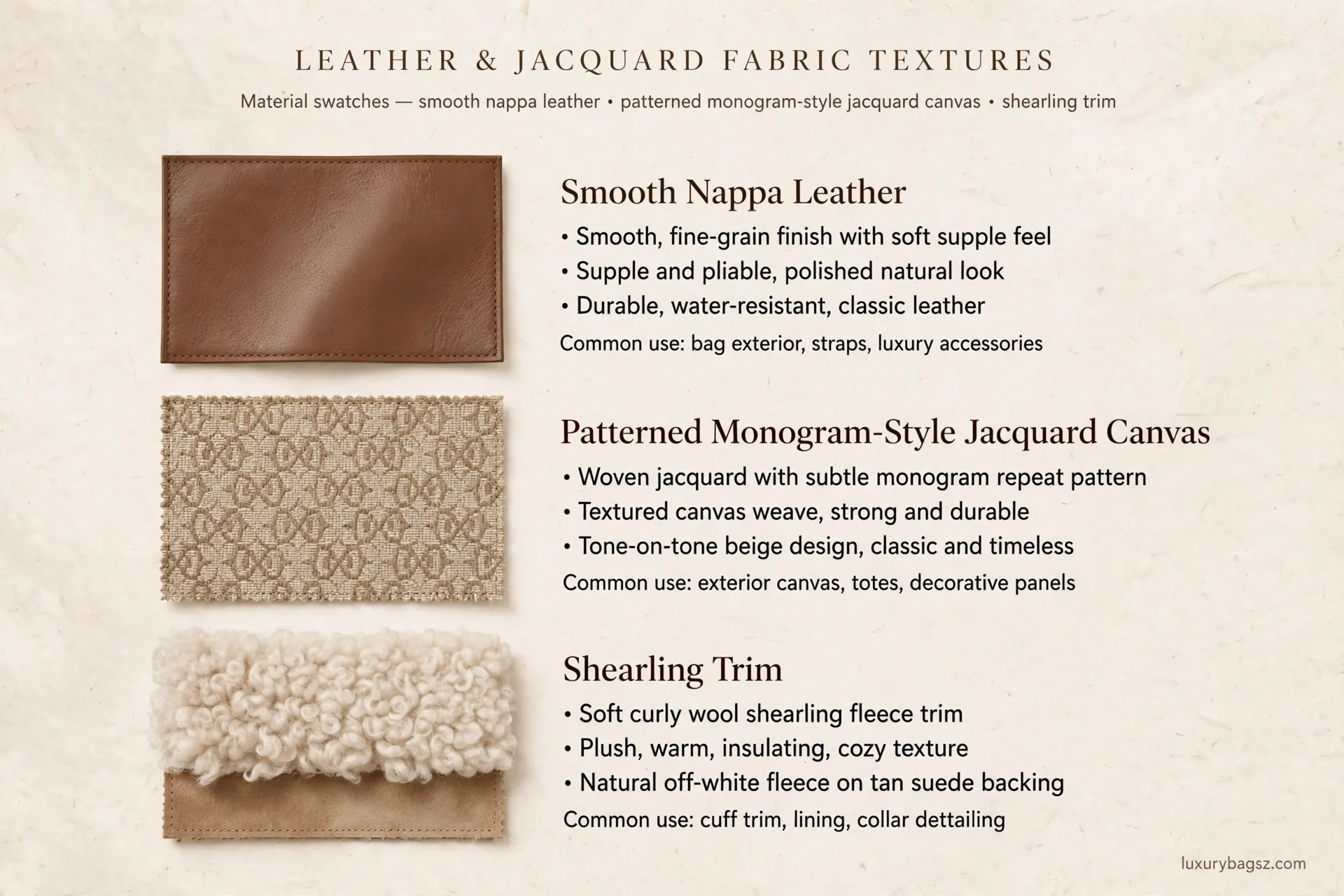
Fendi leather should feel buttery, stand up on its own, and smell like clean leather, not chemicals. Smooth nappa leather appears on Peekaboo and Baguette bags, giving a soft, luxurious hand. It scratches more easily than grained leather, so it suits careful owners and polished days.
Zucca jacquard canvas is Fendi's signature patterned material, woven with the double-F motif. Genuine jacquard shows a tight, even weave, with the pattern aligning where panels meet. Loosely woven, pixelated, or drifting patterns suggest a copy, and corners show wear first on vintage canvas.
Selleria leather, with its distinctive hand stitching, appears across Fendi's range, including Selleria versions of the Baguette and Peekaboo. It feels structured and refined, and it suits buyers who want craft to show in stitching rather than in a printed pattern.
Fur, shearling, sequins, studs, and appliqué appear seasonally, reinventing signature bags each collection. These embellished pieces are beautiful but harder to care for and resell unevenly. Our guide to leather types explains how each material ages and what care it needs.
How Fendi Bags Are Made
Fendi bags combine Roman craft with rigorous finishing, from cutting leather and jacquard to assembling, stitching, and fitting hardware. A Peekaboo demands precise structure, with its partition, flip-lock, and top handles all sitting correctly, or the bag loses its calm, briefcase-like balance.
A Baguette demands precise small-scale work. Its flap, buckle, and short shoulder strap must align, and its embellishments — beading, sequins, or appliqué — must sit securely. A Baguette that feels flimsy or shows loose decoration is either heavily worn or not genuine.
Zucca weaving and printing must be even across panels, and linings should match the expected material for the model. Genuine Fendi linings are usually plain canvas without FF designs on jacquard bags, a detail that catches many copies, which over-decorate the interior.
Across the range, check edges, stitching, and hardware. Edges should be smooth and evenly finished, stitches even and tight, and hardware solid with crisp lettering. These details separate genuine Fendi from copies more reliably than any single logo check.
The Iconic Bags, and Which One Suits You
The Baguette is Fendi's most famous bag: a small, rectangular flap bag with a short shoulder strap, endlessly reinvented in leather, jacquard, sequins, and fur. It suits evenings, dinners, and buyers who want a party bag with history. Our Baguette guide covers sizes and variants in detail.
The Peekaboo is the grown-up of the family: a structured top-handle tote with a central partition, a flip-lock front, and a calm, briefcase-like feel. It suits work, meetings, and buyers who need a polished bag that holds documents and a laptop sleeve. Choose it when your Fendi must earn its keep.
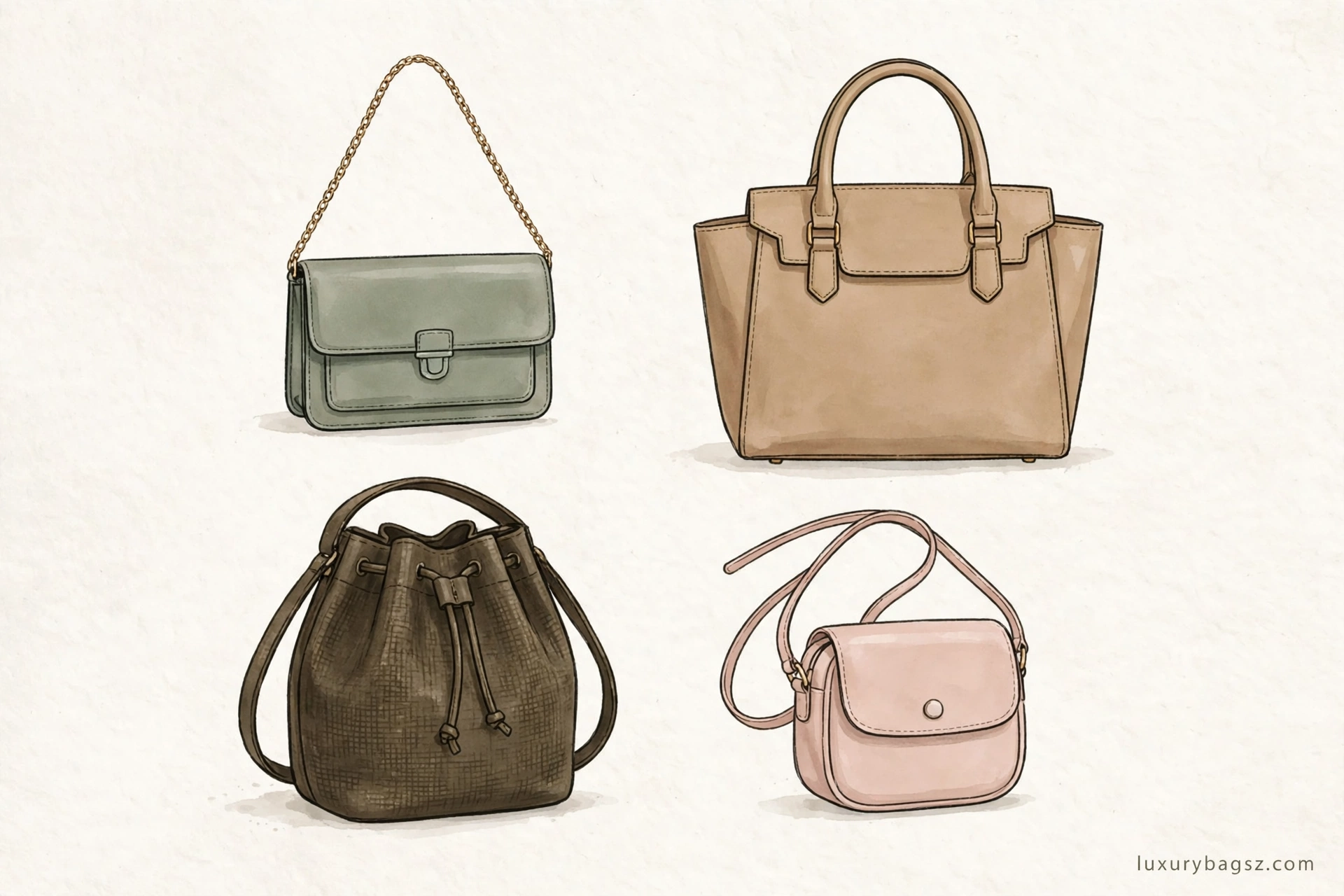
The By The Way is a smaller, softer bowling-style bag with a detachable strap, suited to everyday use and crossbody wear. The Mon Tresor bucket bag, with its drawstring top, suits relaxed days and buyers who want a softer shape. The Kan I, a flap bag with a chain strap and metal logo clasp, suits evenings.
Beyond those, look at the First clutch, introduced under Kim Jones, the Sunshine tote for work and travel, and the Mama Baguette, a newer, softer Baguette revival. Each suits a different life: clutch for evenings, tote for heavy loads, Mama Baguette for relaxed, deconstructed style.
Sizing: Baguette, Peekaboo, and By The Way
Baguette sizing runs from nano and mini to medium and large, and the jump between sizes matters. Nano and mini suit evenings and light days, holding a phone, card holder, keys, and lipstick. Medium suits most days, while large suits buyers who carry more and want a roomier flap bag.
Do not choose a Baguette by photos alone. The rectangular shape means a size that looks small online can feel generous in hand, and embellished versions weigh more than plain leather. Visit a boutique, load the bag with your normal carry, and check that the short strap sits comfortably under the arm.
Peekaboo sizing is more structured: mini, small, medium, and regular are the main choices, with mini suiting evenings and light days and medium suiting work. The partition divides the interior, so test with your laptop sleeve, documents, and pouch before buying, and check that the flip-lock opens and closes cleanly.
By The Way sizing is simpler, with small and medium covering most needs. Small suits everyday use, medium suits work and travel, and both work crossbody. Check strap drop and capacity together, because a bag that fits your phone and wallet is enough for most days.
Shoes, Clothing, and the Wider World
Fendi shoes span loafers, boots, heels, sneakers, and the Baguette-inspired shoe details that echo the bag range. The house's footwear suits buyers who enjoy playful, Roman style, with FF details and colourful finishes. Sizing varies by style, so try in store where possible.
Ready-to-wear under Lagerfeld and his successors mixed fur craft with modern tailoring, colourful prints, and playful details. It suits buyers who enjoy fashion as fun, not just decoration, and it rewards a wardrobe built on simple pieces with one bold Fendi detail.
Accessories include scarves, belts, sunglasses, and small leather goods, all carrying Fendi's playful language. A Zucca wallet or card holder offers an accessible entry point, with the same double-F pattern in compact form, and these pieces make excellent gifts because sizing is simple.
Fendi also extends into fragrance, eyewear, and home, but those lines tell you little about bag quality. Judge bags on leather, jacquard, stitching, and shape alone, and treat home and fragrance as separate worlds with their own standards.
Prices, and How Fendi Pricing Works
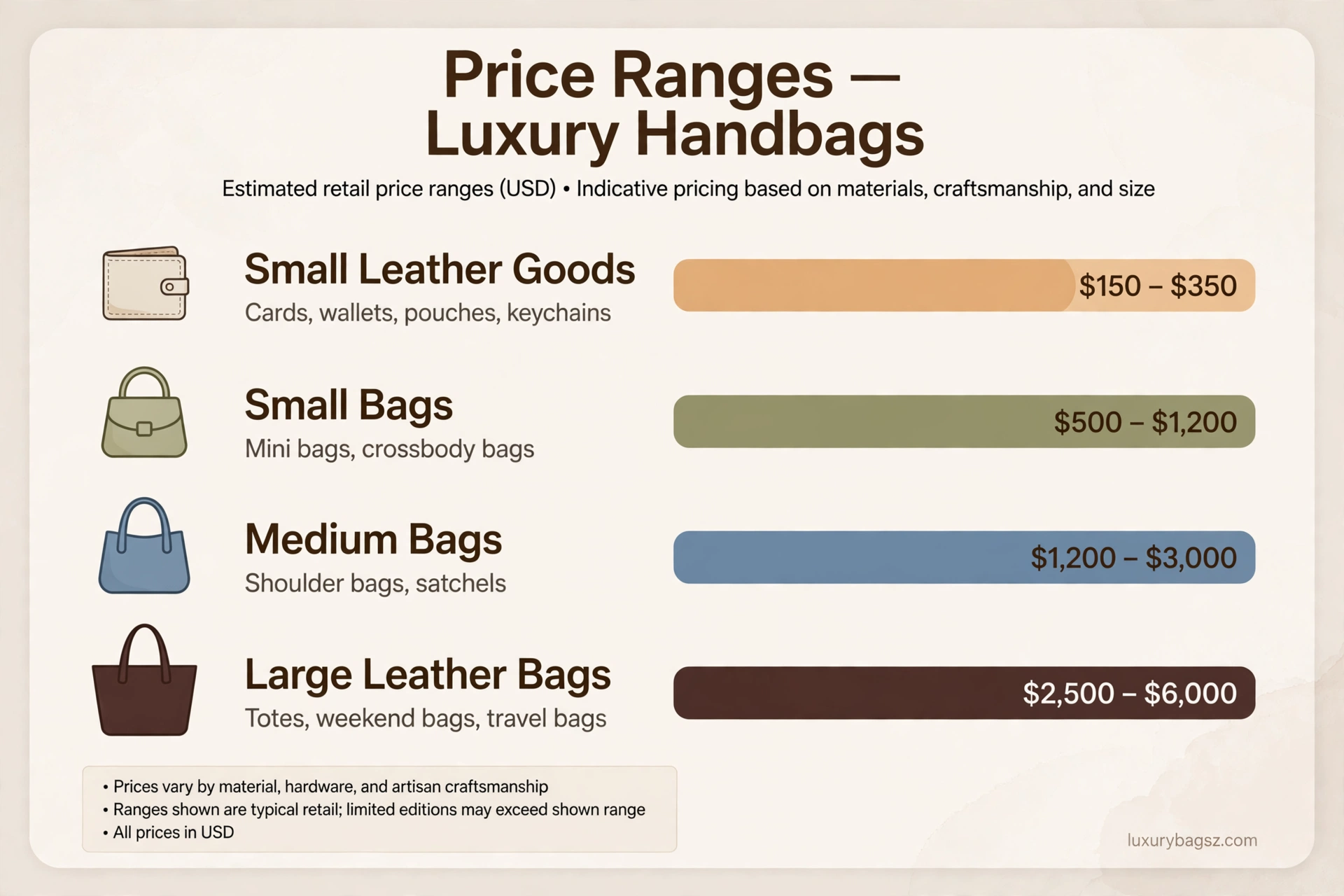
Small leather goods start in the low hundreds, and smaller bags, such as a By The Way, start around $1,950 at retail in recent guides. Baguette bags range widely, from about $2,300 for simpler versions to far higher for embellished and limited pieces, with some guides listing up to $34,700 at the top.
Peekaboo bags sit higher, with small leather versions around $5,900 in recent guides and larger versions higher still. Prices vary by market and rise over time, so check current boutique listings for the exact model. Treat any guide price as a snapshot, not a promise.
Pre-owned prices for classic Baguette and Peekaboo bags vary widely. Everyday Zucca shoulder bags and pouches from the Lagerfeld decades are often underrated buys, priced modestly for their craft, while rare and embellished pieces command far higher prices. Condition, not age, decides where a bag lands.
Cost per wear favours a black or neutral Baguette or Peekaboo in a size you truly use. A bag carried weekly for years costs little per outing, while a rarely carried embellished piece costs far more per wear, however beautiful it looks on a shelf.
Where to Buy, and the Boutique Experience
Fendi sells through its own boutiques, department stores, and its official online shop in many markets. Boutiques offer the fullest range, including Baguette embroideries and Peekaboo sizes, and staff can explain nappa versus Selleria and demonstrate strap options.
Boutique service is typically warm and knowledgeable, reflecting the house's Roman, family character. Staff can compare sizes loaded, advise on leather care, and check stock across stores. Ask to see the bag in daylight, check Zucca alignment and hardware, and confirm what is included before paying.
Online shopping suits buyers who know their model, size, and material, especially for Baguette bags with standard dimensions. Inspect promptly on arrival, keep packaging until you are sure, and confirm return terms, because Zucca colour and bag shape can surprise on screen.
For pre-owned, use reputable dealers, consignment stores, and auction houses with authentication. Avoid sellers who refuse detailed photos or pressure off-platform payment, and get an independent opinion for expensive leather pieces.
Fendi for Work, Travel, and Evenings
For work, a Peekaboo in smooth leather or a By The Way in a neutral colour covers most professional days. The Peekaboo looks formal and structured, while the By The Way offers lighter weight for commuters who walk far. Both hold a laptop sleeve, documents, and daily essentials.
For travel, Zucca canvas bags and By The Way styles are the most practical choices. They are lighter than leather, wipe clean more easily, and look less precious in airports. Pack with pouches for small items, and keep leather trim away from sharp objects in transit.
For evenings, a Baguette in leather, sequins, or embellished canvas adds polish without bulk. Choose a size for phone, keys, card holder, and lipstick, and leave the rest behind, because an overstuffed evening bag loses its clean lines and strains its flap.
For casual days, a Baguette crossbody with jeans and sneakers lets Fendi's playfulness add polish without formality. Keep the rest of the outfit plain, so the bag's shape and Zucca pattern stay the focus rather than competing with other logos.
Buying Pre-Owned Without Getting Caught Out
Pre-owned Fendi is plentiful, which helps prices but also attracts fakes. Start with Zucca alignment: pick one F and trace it across each seam, checking that the pattern meets cleanly. A drifting, mismatched pattern is the corner a copyist cuts first, and it deserves investigation.
Serial markings come next. Later Fendi bags carry a hot-stamped leather serial tab inside, with an alphanumeric code, and bags from 2004 onward may carry a holographic foil sticker. Ask for a clear photo of the tab, and check that the interior label reads FENDI Made in Italy.
Leather, stitching, and hardware follow. Leather should feel buttery and smell clean, stitching should be even and tight, and hardware should feel solid with crisp lettering. Vintage canvas shows its life at edges and corners first, so ask for close-ups of exactly those spots before falling in love.
Seller discipline matters as much as the bag. Our general guides on buying pre-owned safely and on authenticating pre-owned designer pieces cover seller checks in detail, and they apply to Fendi just as they do to other houses, because the seller is often the biggest risk.
Caring for Nappa, Zucca, and Embellished Bags
Nappa leather care is gentle by necessity. Wipe with a soft, dry cloth, blot spills promptly, and keep the bag away from rain, dark denim, and sharp objects. Stuff the bag to hold its shape, store it in its dust bag, and never hang it by its handles for long periods.
Zucca canvas needs lighter care: brush off dust, spot-clean with a damp cloth, and let the bag dry naturally away from heat. Avoid machine washing, which can distort the weave and handles, and keep canvas away from prolonged sun, which fades colour unevenly.
Embellished bags need the most care. Beading, sequins, and appliqué can loosen with rough handling, and fur trims need professional cleaning. Store embellished bags stuffed and separated from other bags, and take loose decoration to a professional rather than gluing it yourself.
For all materials, boutique repair can address handles, edges, and hardware, subject to assessment and cost. Our guide to caring for leather bags and shoes covers daily habits in detail. For pre-owned bags, factor likely repairs into the purchase price before committing.
Fendi Against Gucci, Prada, and Louis Vuitton
Against Gucci, Fendi offers Roman playfulness and craft, while Gucci offers warmer, more decorative glamour. Buyers who prefer witty details and reinvented icons lean Fendi; buyers who enjoy visible codes and colour lean Gucci.
Against Prada, Fendi offers warmth, colour, and humour, while Prada offers cooler, more intellectual minimalism. Buyers who prefer playful embellishment lean Fendi; buyers who enjoy understated nylon and Saffiano lean Prada.
Against Louis Vuitton, Fendi offers softer, more playful leather bags, while Louis Vuitton offers tougher canvas, monogram history, and travel heritage. Buyers who need a hard-wearing travel tote lean Louis Vuitton; buyers who want a party bag with history lean Fendi.
Choose Fendi if you value craft with humour, reinvented icons, and Roman style. Choose a rival if you want chain straps, cooler minimalism, or a tougher travel canvas as your first luxury buy.
Collecting Fendi: Baguette, Peekaboo, and Vintage
Vintage Baguette bags from the late 1990s and 2000s are now collectible, especially in Zucca canvas and leather with complete sets. Condition is decisive: Zucca alignment, corner wear, and hardware decide value far more than age alone, and excellent examples command premiums.
Peekaboo bags in classic leather colours collect steadily, particularly small and medium sizes in black and neutral tones. Complete sets with dust bag, cards, and receipt sell faster, and early Peekaboo examples attract buyers who followed the line from its launch.
Embellished Baguette bags, with beading, sequins, or appliqué, attract collectors for their craft, but they also vary more in value. Buy them for pleasure first and resale second, because seasonal embellishment dates faster than classic leather and canvas.
Collecting advice stays simple: buy what you love, prioritise condition and completeness, and learn one line well before branching out. A focused collection of Baguette and Peekaboo bags beats a scattered haul of impulse buys.
Common Mistakes, and How to Avoid Them
The first mistake is buying a Baguette that is too small for your daily load. The rectangular shape does not stretch, and a Baguette that will not close comfortably when full is a daily frustration. Measure your carry and choose based on your heaviest normal day.
The second mistake is trusting a bargain on a current Peekaboo or Baguette bag. Fendi's pricing and distribution make deep discounts on new core bags unlikely, and the cheapest listing is often the riskiest. Pay for a vetted seller, not just a low price.
The third mistake is confusing Mario Valentino with Valentino Garavani, a trap that also catches Fendi buyers in mixed listings. Check the brand name exactly: Fendi bags should read FENDI Made in Italy, not a similar-sounding name, and a vague brand label deserves investigation.
The fourth mistake is ignoring Zucca alignment, serial tab, and corner wear pre-owned. Patterns drift, tabs fade, and corners rub with use, and repairs cost money. Ask for close photos of each area, and price the bag honestly.
The fifth mistake is buying a heavily embellished bag as a first bag. Embellishment dates and resells unevenly, while black leather and Zucca canvas remain versatile. Start classic, add embellishment once the core is covered.
Colour, and How to Choose for Fendi
Fendi's colour palette centres on black, brown, and neutrals, with seasonal colours, prints, and embellishments layered on top. That range helps buyers: a black Baguette or Peekaboo matches almost everything, hides wear, and resells well.
Black nappa is the safest first choice, especially for evenings and formal days. It shows the Baguette shape to best effect, pairs with work and evening outfits, and hides scuffs better than pale colours. Its only drawback is that it shows dust and light lint, so wipe it regularly.
Brown Zucca offers a softer alternative to black, suiting buyers who want a classic monogram look. It pairs with denim, tan tailoring, and neutrals, and it hides wear almost as well as black, especially in canvas.
Bold colours and embellishments suit second bags and smaller sizes, where a vivid mini Baguette or a sequinned pouch can lift a plain outfit. Check bold colours in daylight, because screen colours mislead, and consider how often you will actually carry a bright bag.
Fendi Gifts and Entry Pieces
Small leather goods offer a gentle entry into Fendi. A Zucca card holder, zip wallet, or coin purse lets you test materials, hardware, and the house's aesthetic at a fraction of a bag's price, and these pieces make excellent gifts because sizing is simple.
Zucca pouches and accessories offer another entry point, with the same double-F pattern in compact form. A pouch works as a bag organiser, a travel case, or a small evening bag, and it suits a wide range of buyers.
Belts, scarves, and sunglasses round out the entry range, each carrying Fendi's playful language in compact form. A scarf with an FF print works with jeans and tailoring, while sunglasses offer the house's clean design in a giftable size.
Starting small is smart shopping. A well-chosen entry piece tells you whether Fendi's materials, colours, and feel suit your daily life, and it makes the later decision about a handbag far easier and less risky.
Fendi in 2026: Culture, Fashion, and What Comes Next
Fendi enters the current period as a house that is as much a Roman institution as a fashion brand. Its Trevi Fountain restoration, its Rome shows, and its family history reflect a pride in Italian roots that few rivals match, and that depth gives the brand a resonance beyond trends.
Fashion-wise, Fendi continues to balance its Baguette and Peekaboo core with runway collections that reinvent those shapes each season. Buyers should expect new Baguette embroideries, Peekaboo colours, and softer Mama Baguette styles, alongside the classic black pieces that anchor the range.
Leadership changes will keep shaping the range, as they always have at Fendi, from Lagerfeld to Kim Jones and beyond. For buyers, that means new interpretations of classic shapes, not the disappearance of those shapes, because the Baguette and Peekaboo are now house icons in their own right.
For a first-time buyer, the message is reassuring: the classic Fendi bag you buy today, in black leather or Zucca canvas, will still be recognisable, repairable, and resellable in years to come. Choose a classic shape, a practical material, and a size that fits your life, and Fendi's long history will work in your favour.
A First-Time Buyer's Checklist for Fendi
Define your use first: work, travel, evening, or everyday playfulness. That decision narrows the range from many shapes to a handful, and it prevents buying a structured Peekaboo for a life that needs a light Baguette.
Visit a boutique if you can, feel nappa and Selleria side by side, try Baguette and Peekaboo sizes loaded, and check colours in daylight. Handling the materials teaches more than hours of reading, especially for nappa softness and Zucca weave.
Set a budget that includes care and possible repairs, especially pre-owned. A cheaper bag with drifting Zucca, a faded serial tab, or rubbed corners can cost more after repairs than a better example bought at a higher price.
Finally, verify before you pay pre-owned: Zucca alignment, serial tab, stitching, hardware, interior label, and seller reputation. Use our general pre-owned guides, ask for extra photos when unsure, and walk away from listings that resist scrutiny. A genuine Fendi bag is worth waiting for.
Frequently Asked Questions
When was Fendi founded?
Fendi was founded in Rome in 1925 by Edoardo and Adele Fendi, starting with leather goods and fur.
What is Fendi famous for?
Fendi is famous for fur craft, the double-F Zucca motif, and bags including the Baguette, the Peekaboo, and the By The Way.
What is Zucca?
Zucca is Fendi's double-F motif, created by Karl Lagerfeld in 1965 and standing for Fun Furs. It appears as jacquard, canvas, buckles, and hardware.
When was the Baguette designed?
The Baguette was designed by Silvia Venturini Fendi in 1997, inspired by Parisian women carrying a loaf of bread under the arm.
What is the Peekaboo bag?
The Peekaboo is a structured top-handle tote with a central partition and a flip-lock front, introduced in 2008 and shown on the runway in 2009.
How much does a Fendi bag cost?
Prices vary by style, size, and material. Recent guides put smaller bags from about $1,950, Baguette bags from about $2,300, and Peekaboo leather bags higher.
Is Fendi worth the price?
For classic Baguette and Peekaboo shapes in neutral colours, Fendi offers strong craft, good resale, and lasting style. Embellished pieces should be judged on personal use.
How can you tell if a Fendi bag is real?
Check Zucca alignment at seams, the serial tab and interior label, leather feel, even stitching, hardware quality, and seller reputation. No single check proves authenticity alone.
What is the Mario Valentino trap?
Mario Valentino is a separate, Naples-based house, and MARIO VALENTINO markings have nothing to do with Rome's Fendi or Valentino Garavani. Check the brand name exactly.
How do you clean a Fendi nappa bag?
Wipe with a soft, dry cloth, blot spills promptly, keep it away from rain and dark denim, stuff it to hold its shape, and store it in its dust bag.
Final Verdict
Fendi suits buyers who want Roman craft with a sense of humour: a house since 1925 that turned fur into play, the double F into a signature, and two shapes — Baguette and Peekaboo — into modern icons. Start with a black Baguette or a neutral Peekaboo in a size that fits your real carry.
Visit a boutique to feel nappa and Selleria, compare sizes loaded, and check colours in daylight before you commit. That hands-on step prevents most regrets, whether you buy new, pre-owned, or past-season, and it sharpens your eye for Zucca alignment, serial tabs, and stitching details that separate genuine Fendi from copies. If you want cooler minimalism or tougher travel canvas, look elsewhere.
If you want a bag that feels clever, colourful, and timeless, Fendi is hard to beat, and a well-chosen piece will earn its place in your wardrobe for many years. Store it in its dust bag, stuff it to hold its shape, and let its leather or canvas serve you daily, because craft with humour earns its price through constant, joyful use.