

What Is a Hermès Himalaya Kelly? The Collector’s Guide to Sizes, Prices, and the Gradient
The Kelly in Himalaya, in Brief
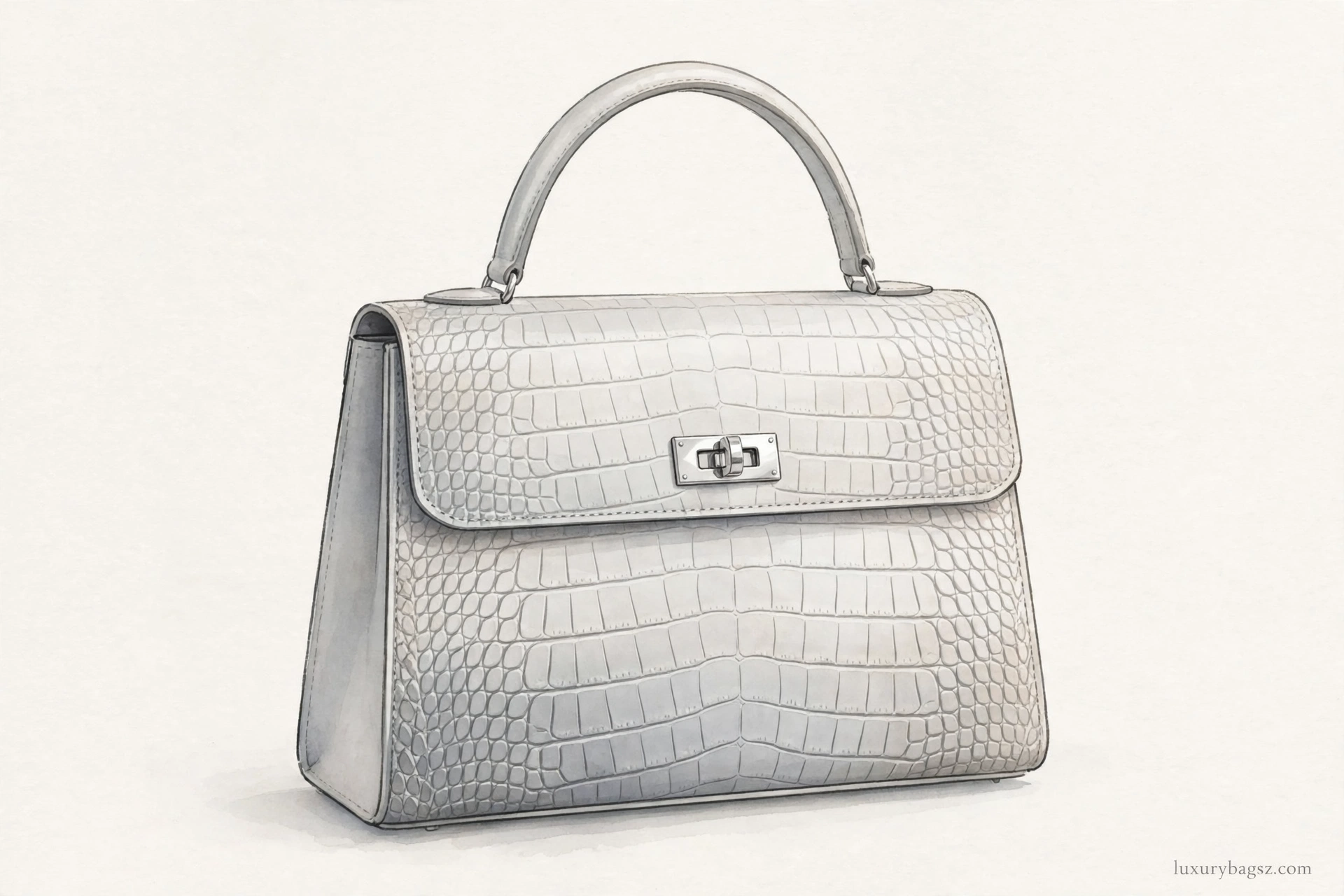
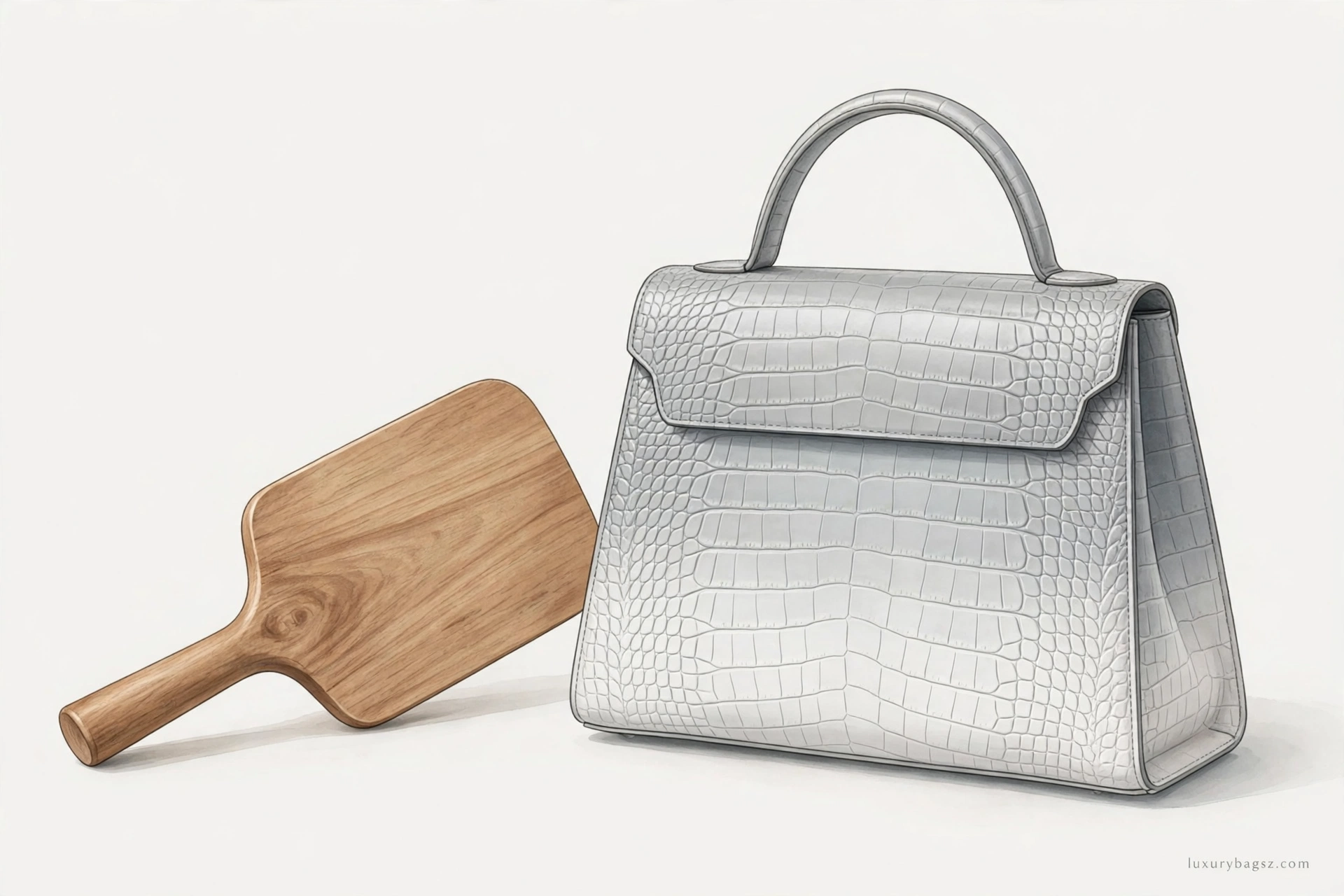
The Hermès Himalaya Kelly is a Kelly bag made from matte Niloticus crocodile, dyed in a pale gradient that fades from smoky grey to pearly white. The shading is meant to recall snowcapped Himalayan peaks, and that mountain likeness gives the bag its name.
It is one of the rarest Hermès bags in circulation. The dyeing process is slow, secretive, and hard to repeat, so only small numbers reach the market in any year. Demand, meanwhile, has never cooled.
Prices reflect that scarcity. Non-diamond examples regularly trade in six figures, and diamond-set versions have set handbag auction records. This guide covers the history, the making, sizes, hardware, prices, and pre-owned checks.
Key Takeaways

- Himalaya is a colour treatment on matte Niloticus crocodile, not a separate leather.
- The modern Himalaya Kelly arrived in 2013, five years after the Himalaya Birkin.
- Standard sizes are 25, 28, and 32, offered in Sellier and Retourne builds.
- Hardware is palladium or diamond-set 18-karat white gold; nothing else is standard.
- Non-diamond prices vary widely by size and condition; diamond versions cost far more.
- Record prices differ across sources because auction, private-sale, diamond, and non-diamond results get mixed together.
- Matte crocodile needs gentle care: no water, no harsh cleaners, and a soft cloth only.
What the Himalaya Kelly Actually Is
Himalaya describes a finish, not a species or a leather type. The skin is Niloticus crocodile, from the Nile crocodile, chosen for its fine, even scales. The pale gradient is then dyed onto that skin by hand.
The gradient runs from a smoky grey at the edges and base to a near-white centre. On a good example, the fade looks smooth and even, with no hard line where one tone stops and the next begins. Collectors prize balanced shading above all else.
The name can mislead. Himalaya says nothing about where the crocodile lived. It describes the look of the finished bag: pale peaks fading into grey, like snow on a mountainside.
From Natura to Matte White: A Short History
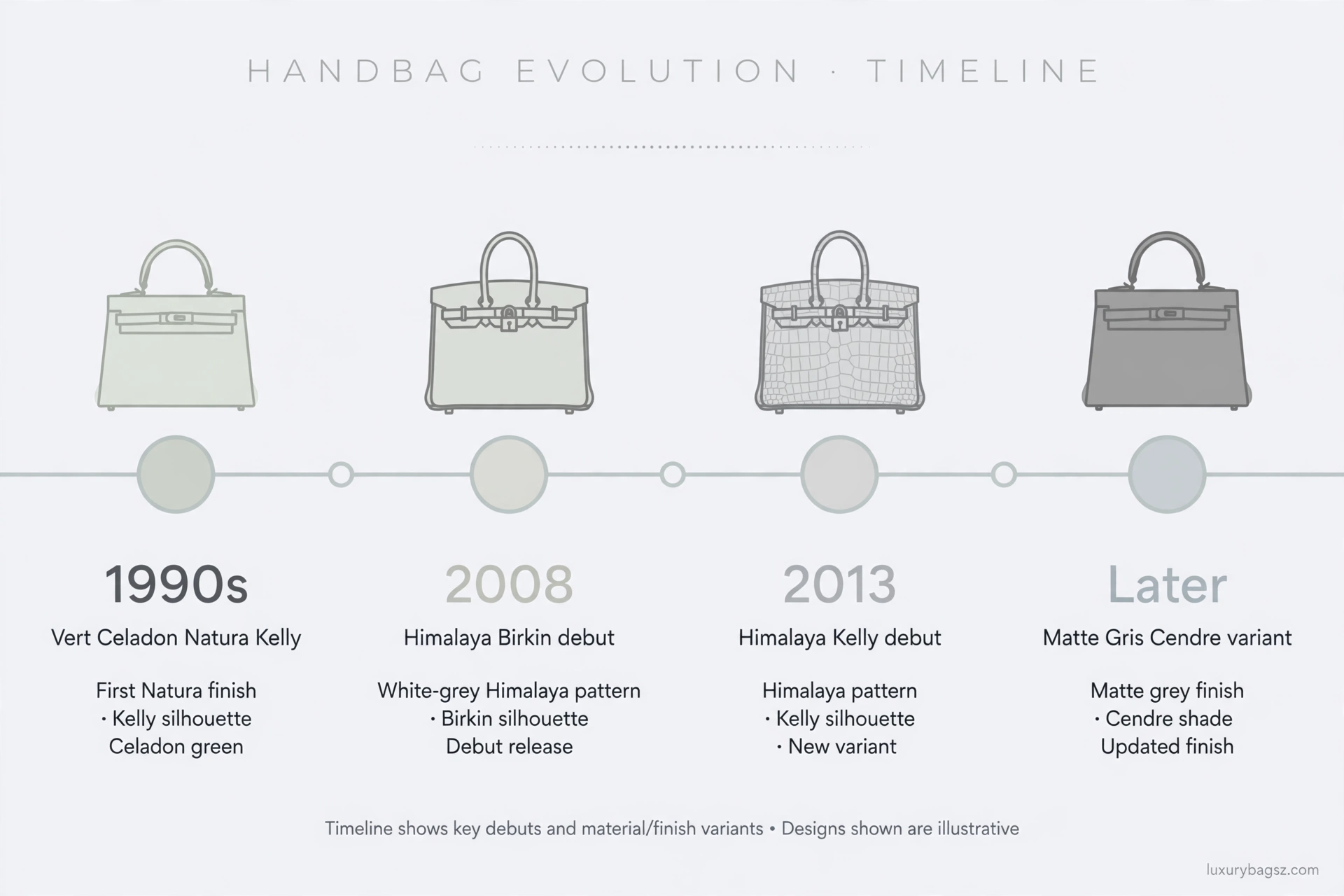
The Himalaya story starts before the modern bag. In the 1990s, Hermès made a green-brown ombré alligator finish called Vert Celadon Natura, produced only in the Kelly line. It nodded to early 20th-century exotic bags, when natural pigment was nearly impossible to strip from skins.
Around the turn of the millennium, Hermès revisited the idea and made no more than about 10 of these Kelly bags for private sale. Those early Natura pieces are a separate chapter, not modern Himalayas, and they should never be priced as if they were.
The modern Himalaya Birkin came first, in 2008. The Himalaya Kelly followed in 2013, bringing the same white-to-grey gradient to the Kelly's more structured shape. A later variant, Matte Gris Cendre Himalayan, is greyer overall and completes the circle back to the Natura idea.
How the Gradient Is Made
Making a Himalaya starts with choosing a naturally light skin, which is itself a hard task. Only pale skins can take the gradient evenly, and most crocodile skins do not qualify. That selection step alone limits how many bags can ever be made.
The hide is then dry salted to preserve it, soaked to clean it, limed for descaling, and de-limed to prepare it for pickling. It is chrome-tanned for durability, shaved and degreased to thin it out, re-tanned to soften it, and finally dried.
Only then does the dyeing begin. Hermès guards the dyeing method closely, and outsiders know little about it beyond its difficulty. The result is a matte finish with a soft, chalky depth, quite unlike the shine of a standard crocodile bag.
That labour explains the rarity better than any marketing claim. Each skin takes far longer to finish than a solid-colour crocodile skin, so output stays tiny even when demand is huge.
Sizes, Sellier, and Retourne
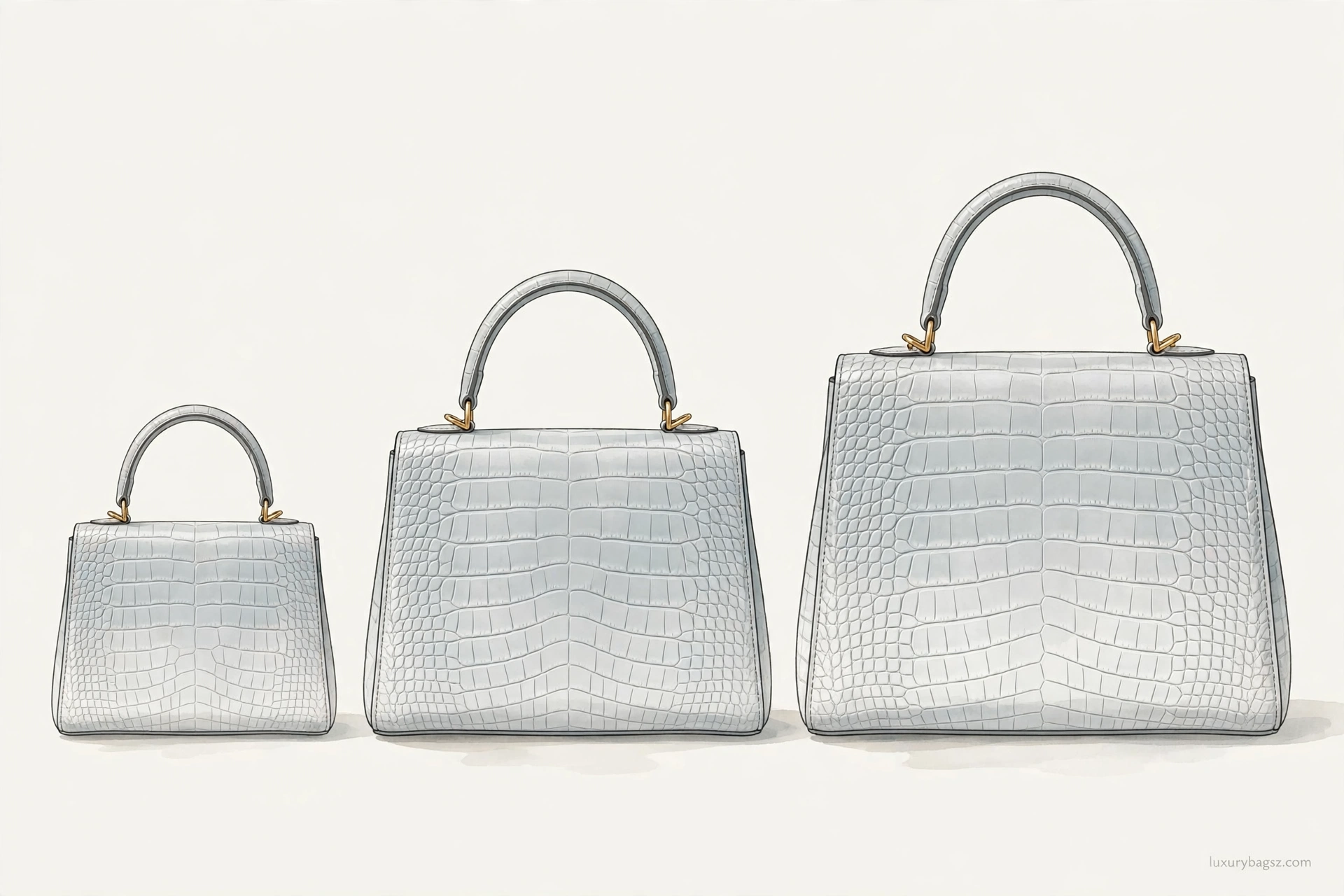
The Himalaya Kelly launched in three sizes: 25, 28, and 32, measured in centimetres across the base. The 25 is the most sought-after size today, matching a wider collector shift toward smaller Hermès bags.
A standard Kelly guide helps here: if you are new to the shape, start with our guide to the standard Kelly before weighing up Himalaya sizes. The 28 suits daily use better, while the 32 is the roomiest and usually the least expensive of the three on the secondary market.
Every Himalaya Kelly comes in one of two builds. Sellier has sharp, structured edges with visible outer stitching, while Retourne is sewn inside-out for softer, rounder edges. Neither build consistently commands a premium, so choose by the look you prefer.
The Kelly's top handle and detachable shoulder strap carry over unchanged. For a side-by-side with its famous sibling, see the Kelly and Birkin compared guide.
Hardware: Palladium and Diamonds
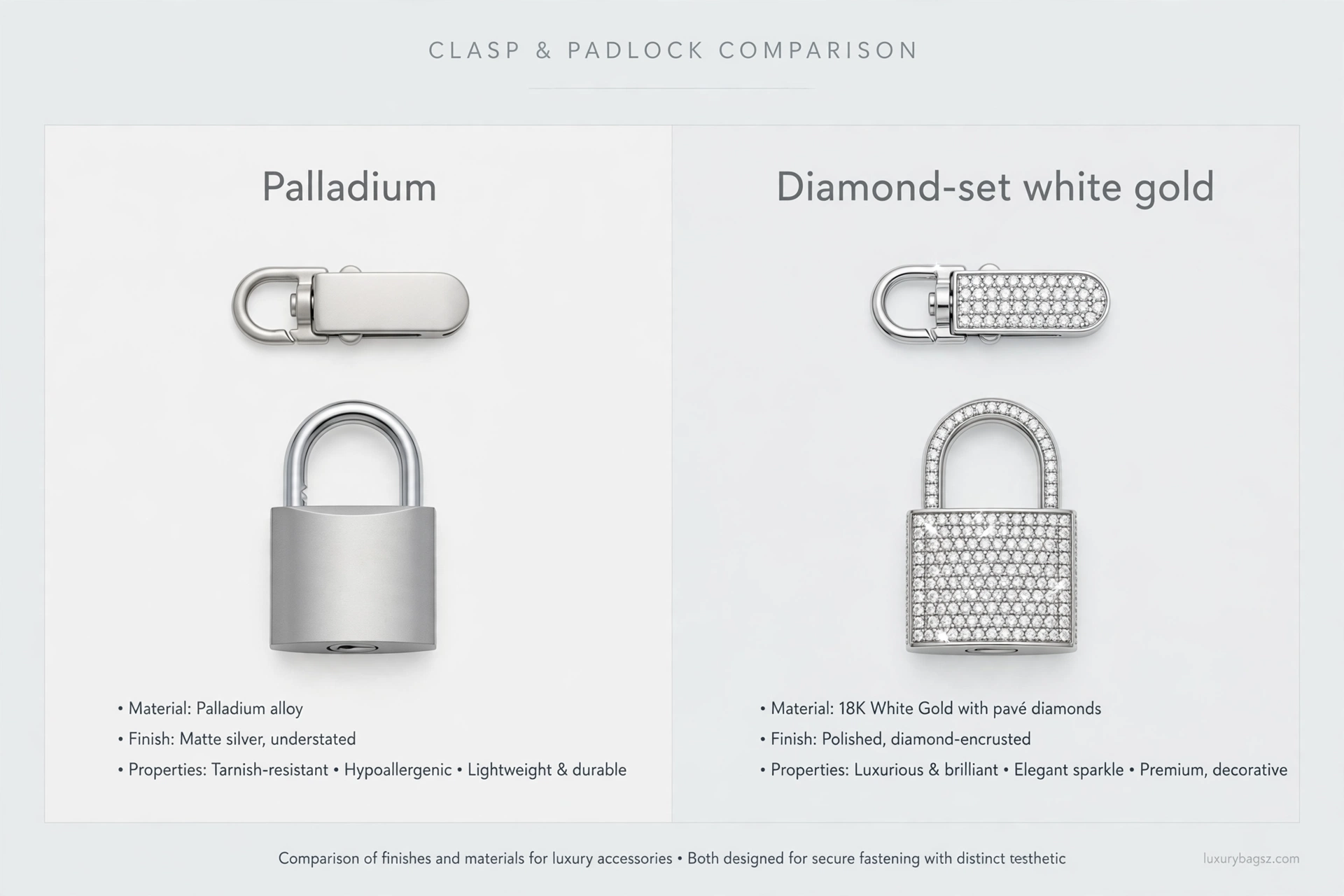
Standard Himalaya Kellys carry palladium hardware: the clasp, padlock, keys, and feet in a soft silver tone. Palladium is the expected finish, and anything else on a supposedly standard example is a warning sign.
Diamond versions replace the metal with 18-karat white gold set with diamonds. The stones appear on the clasp and the padlock, and published examples describe 298 diamonds totalling 3.50 carats on a Kelly 25. Carat weights vary by example, so never apply one bag's figure to another.
Diamond hardware changes the price completely. It adds a jewellery component on top of an already rare bag, which is why diamond Kellys sit in a different price band from palladium ones. Keep the two bands separate whenever you compare prices.
What It Costs, and Why Sources Disagree
Here is where plain speaking matters, because published record prices genuinely disagree. The disagreement is not sloppy reporting; it comes from mixing different categories of sale.
The clearest auction milestone is the Diamond Himalaya Retourne Kelly 28 that sold at Christie's Hong Kong on November 26, 2021, for HK$4 million, about $510,000. At the time, it broke the world auction record for a handbag. The previous Kelly record was a Himalaya Kelly 25 at HK$3.3 million, about $420,000, in November 2020.
Later results complicate the picture. Sotheby's reports a Kelly 28 Himalaya with diamonds at $425,000 in 2023, a Kelly 25 Himalaya at about $373,000 in Paris in 2022, and a Diamond Mini Kelly II 20 at $722,670 in a 2024 private sale. A private sale is not an auction record, and a Mini Kelly is not a standard Kelly, so none of these replaces the 2021 auction milestone.
For ordinary, non-diamond examples, Sotheby's averages since 2021 run about $187,000 for the Kelly 25, $149,000 for the Kelly 28, and $118,000 for the Kelly 32. Prices peaked in 2021 and 2022, then moderated, with recent averages lower than the peak years.
The moderation is visible across the whole Himalaya range. Sotheby's reports non-diamond Himalayans averaging about $196,000 during 2021 and 2022, compared with about $121,000 in 2025 and 2026. That is a real cooling, not a collapse, and smaller sizes held up best.
Rebag's own guide once listed a Niloticus Crocodile Himalaya Kelly 28 with palladium hardware at $195,000, measuring 11 inches wide, 8.5 inches high, and 4.5 inches deep. Treat any single listing price as a snapshot, not a market rate, since listings change and condition varies.
If you want the full picture on the sibling bag, read our guide to the most expensive Birkin and to what a Birkin costs. For why one bag holds value better than another, see what affects resale value.
Pre-Owned Checks Before You Pay
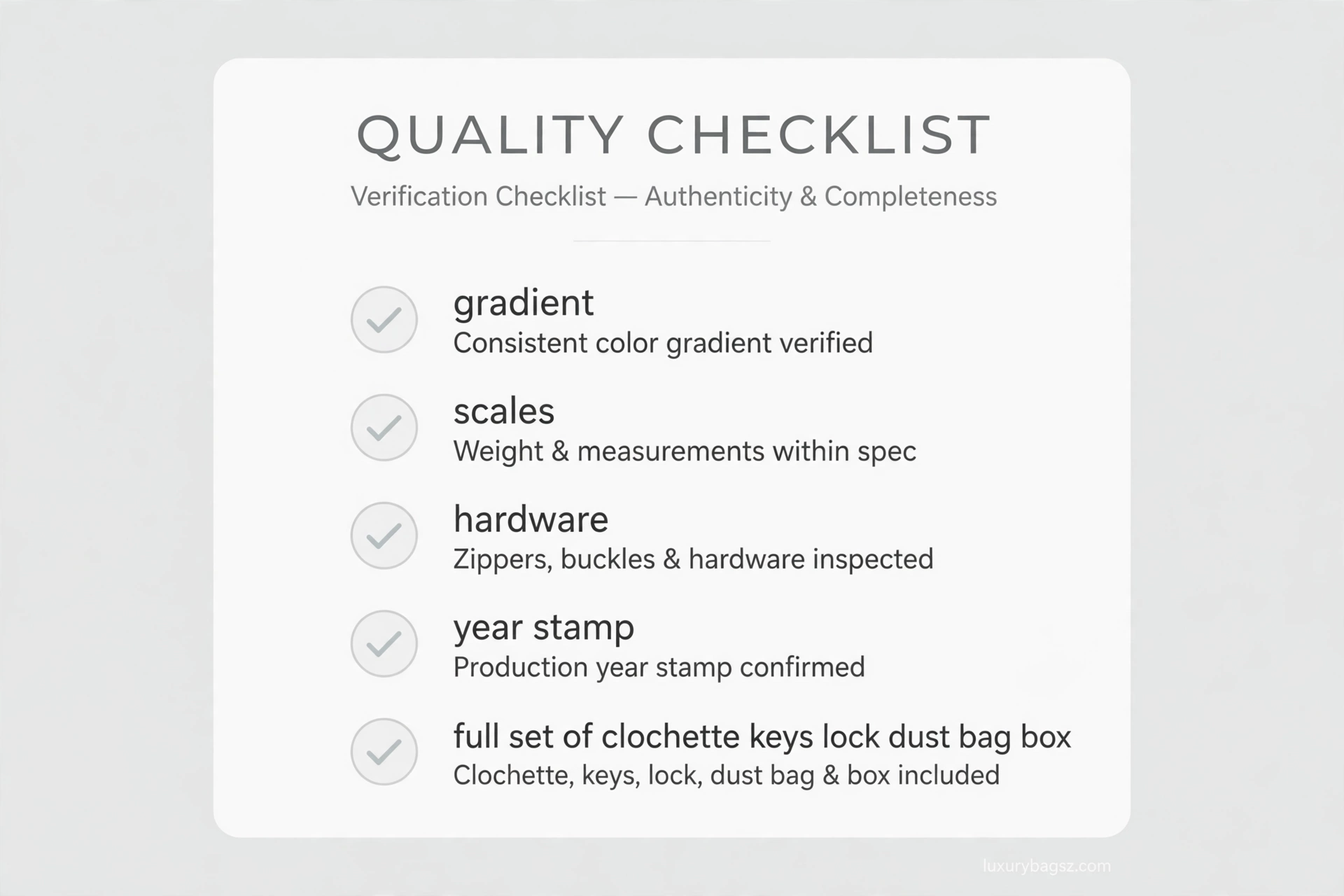
A Himalaya Kelly is exactly the kind of bag that attracts convincing fakes, so checks matter more here than on an ordinary bag. Start with the gradient itself: it should fade smoothly, with even scales and no blotchy patches or painted look.
Check the hardware next. Palladium should look soft and silver-toned, not bright chrome, and diamond versions should show fine, even stone setting. Read the blind stamp for the year code, and compare it with the bag's claimed date.
Ask for the full set: clochette, keys, lock, dust bag, and box. A missing set does not prove a fake, but it should lower the price and raise your caution. On a Himalaya, the clochette and lock should match the bag's hardware, and the dust bag should be the correct size for the bag.
Also check the scales themselves. Niloticus scales are small and even, and the gradient should sit within the scales, not on top of them like paint. A surface that looks coated, shiny, or unnaturally uniform deserves a second opinion before any money moves.
For the full method, read our guide to how to spot a fake Kelly.
Finally, get an independent opinion before paying six figures. Our guide to how to authenticate a pre-owned bag explains the process, and our guide to how to buy pre-owned safely covers payment and return protections.
Caring for Matte Crocodile
Matte crocodile is less forgiving than smooth calf leather. Water marks it, sunlight fades the pale gradient, and oils from hands darken it over time. Handle it with clean, dry hands, and keep it out of rain.
Clean only with a soft, dry cloth, wiped gently along the scales. Never use water, baby wipes, or harsh cleaners on matte crocodile, and never condition it with products made for smooth leather. If a mark appears, stop and ask a specialist rather than experimenting.
Storage matters as much as cleaning. Keep the bag stuffed to hold its shape, standing upright in its dust bag, away from heat and direct sun. Our guide to how to store a Kelly covers the Sellier and Retourne differences, and our reptile leather care guide covers alligator, crocodile, lizard, and snake skin.
Matte crocodile also differs from shiny crocodile in care. Shiny finishes tolerate a light buff, but matte finishes show every rub and watermark, so pressure must stay minimal. Think of matte as a suede among crocodiles: beautiful, delicate, and unforgiving of shortcuts.
Himalaya Kelly or Himalaya Birkin?
Buyers who can reach this level usually face one question: Kelly or Birkin? The gradient is the same, the skin is the same, and the rarity is the same. The difference is the shape, and the shape changes everything about how the bag lives.
The Kelly is structured, formal, and closed with a flap and clasp. It suits occasions where the bag stays in hand or on the arm, and it photographs beautifully because its lines stay crisp. The Birkin is open-topped, roomier, and easier to live with day to day.
Prices differ too. Non-diamond Kelly 25s and Birkin 25s have averaged similar figures since 2021, but larger Kellys trade lower than larger Birkins, and diamond Kellys have set the bigger auction headlines. Neither shape is the safer buy; condition and size matter more than the name on the flap.
Choose by how you carry. If you want structure and ceremony, take the Kelly. If you want space and ease, take the Birkin. Either way, you own one of the rarest bags Hermès makes.
Frequently Asked Questions
What is a Hermès Himalaya Kelly?
It is a Kelly bag in matte Niloticus crocodile, dyed in a white-to-smoky-grey gradient meant to recall snowcapped Himalayan peaks. Himalaya is a colour treatment, not a separate leather.
When did the Himalaya Kelly first appear?
The modern Himalaya Kelly debuted in 2013, five years after the Himalaya Birkin. An earlier green-brown Natura Kelly from the 1990s is a separate, earlier experiment.
What sizes does the Himalaya Kelly come in?
The standard sizes are 25, 28, and 32 centimetres. The 25 is currently the most sought-after, while the 32 is usually the least expensive on the secondary market.
What is the difference between Sellier and Retourne?
Sellier has sharp, structured edges with visible outer stitching. Retourne is sewn inside-out for softer, rounder edges. Neither build consistently costs more than the other.
What hardware does a Himalaya Kelly have?
Standard examples carry palladium hardware. Diamond versions use 18-karat white gold set with diamonds on the clasp and padlock, and they cost far more.
How much does a Himalaya Kelly cost?
Non-diamond examples have averaged roughly $187,000 for the 25, $149,000 for the 28, and $118,000 for the 32 since 2021, according to Sotheby's. Diamond versions run far higher.
What is the most expensive Himalaya Kelly ever sold?
A Diamond Himalaya Retourne Kelly 28 sold at Christie's Hong Kong in November 2021 for HK$4 million, about $510,000, then a world auction record. Later private sales, such as a Diamond Mini Kelly II at $722,670, belong to different categories.
Why are Himalaya Kellys so rare?
Only naturally light crocodile skins can take the gradient, and the dyeing process is slow and closely guarded. That combination keeps output tiny even as demand stays high.
Is a Himalaya Kelly a good investment?
Past prices rose sharply into 2021 and 2022, then moderated, so it is not a guaranteed gain. Buy it because you want the bag, and treat any future value as a bonus, not a promise.
How do I care for a Himalaya Kelly?
Keep it dry, out of direct sun, and away from oils and harsh cleaners. Wipe gently with a soft, dry cloth, store it stuffed and upright in its dust bag, and leave any mark to a specialist.
Final Verdict
The Himalaya Kelly earns its reputation honestly: a painstaking gradient on rare pale crocodile, made in tiny numbers, in the house's most structured shape. Its prices are real, but so is the confusion around them, so compare like with like before you judge any figure.
If you ever buy one, buy the example in front of you, not the legend. Check the gradient, the hardware, the stamp, and the set, get an independent opinion, and care for the matte crocodile gently. That is how a bag like this stays beautiful for decades.






