

Place Vendôme Jewellery: A Beginner’s Guide to Paris’s High Jewellery Square
Place Vendôme in Brief: One Square, Every Great Name
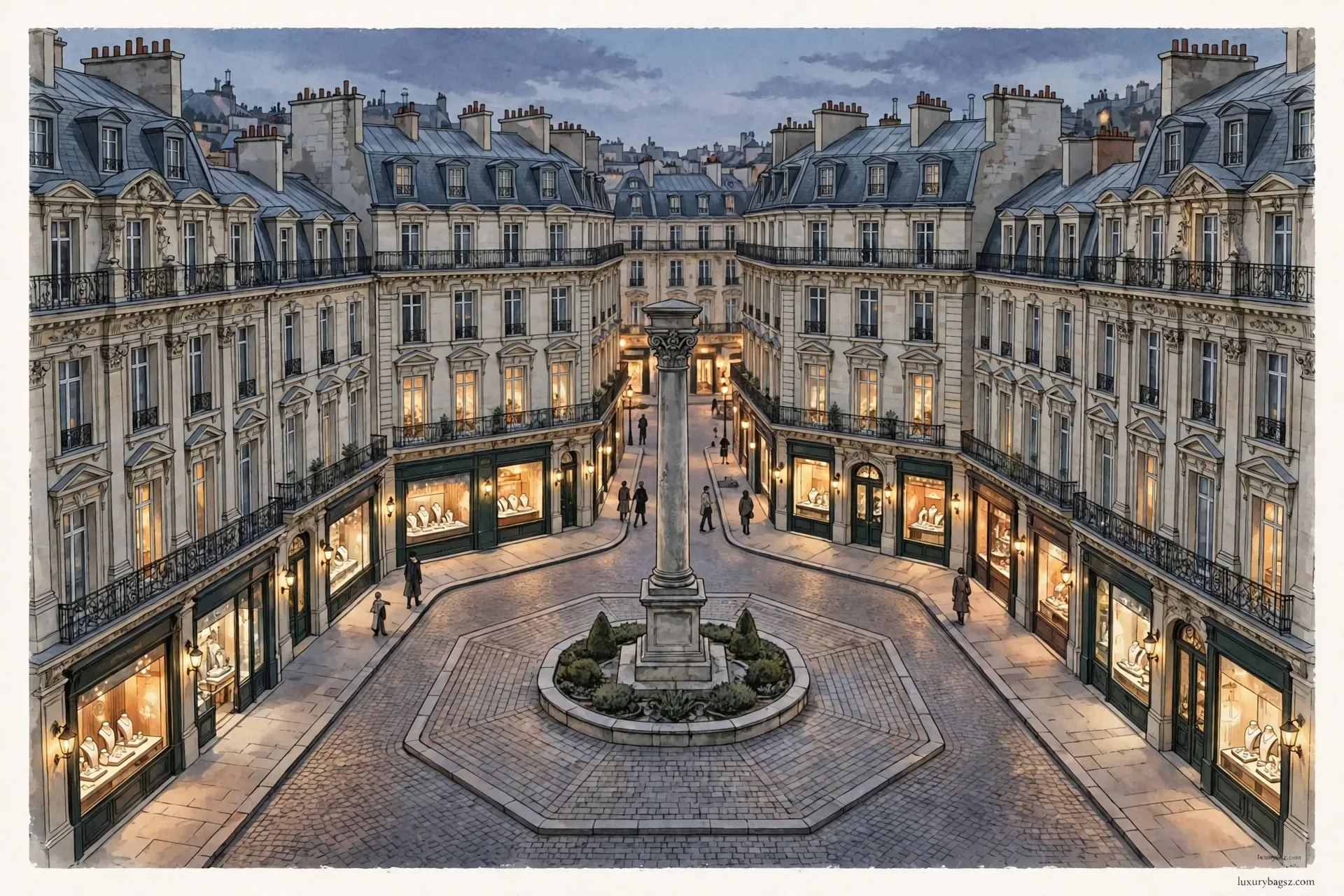
Place Vendôme is a small octagonal square in Paris that became the centre of the world's high jewellery trade, and it still is: the great houses keep their flagship boutiques and workshops there, within a few doors of each other. For a jewellery lover, it is both a shopping address and an open-air museum. You can see the windows, and in some cases the salons, of houses whose pieces fill museum cases and auction catalogues.
Key Takeaways
- Place Vendôme's jewellery trade grew from the late 19th century as jewellers followed wealthy clients to the square.
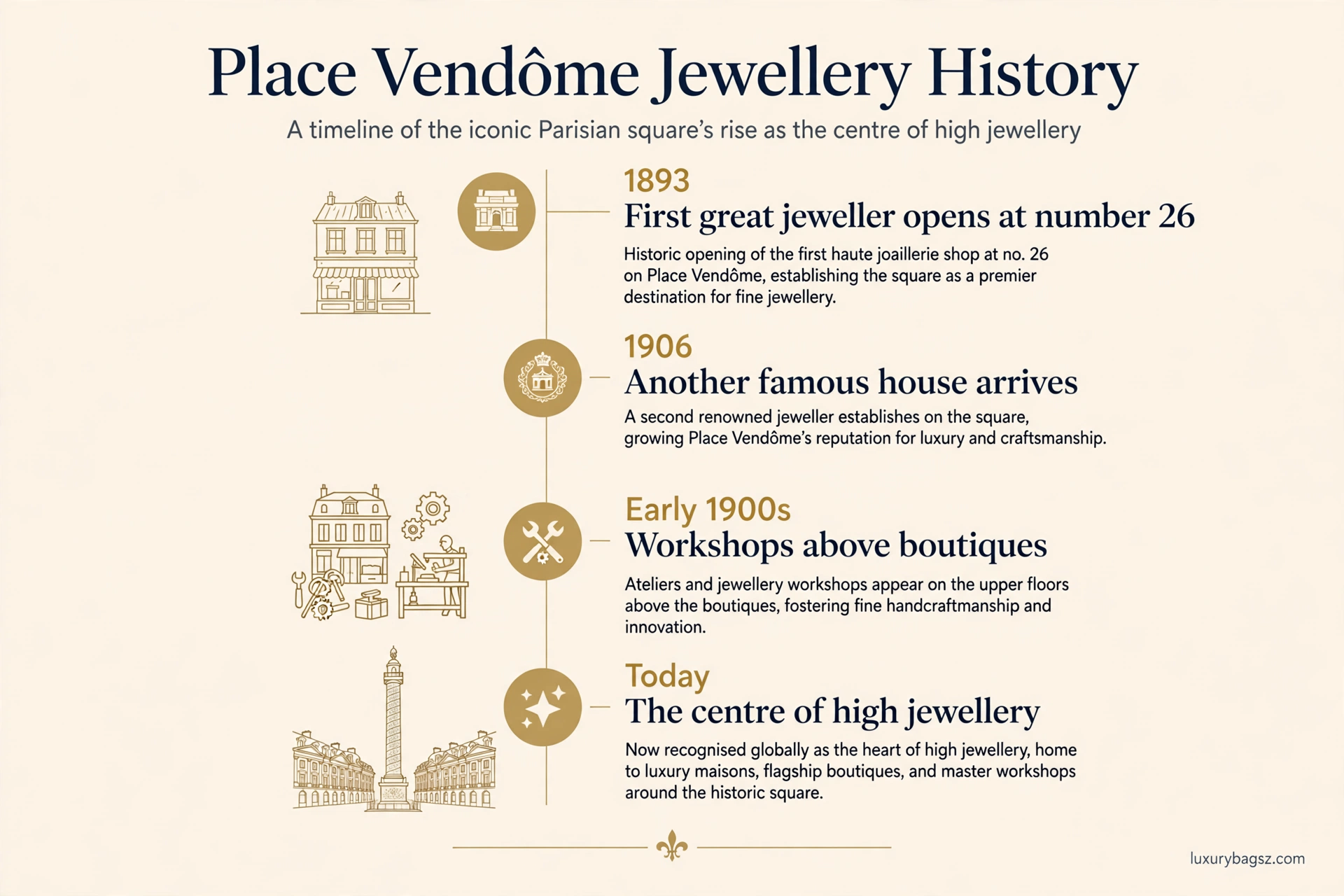
- Boucheron was the first great jeweller to open on the square, in 1893, at number 26.
- High jewellery means one-off or tiny-run pieces made by hand in house workshops.
- The square's houses include heritage names and newer high jewellery brands side by side.
- Visitors can browse windows freely; salon visits for high jewellery are usually by appointment.
- The Vendôme column at the centre and the Ritz hotel anchor the square's luxury identity.
What Place Vendôme Is
Place Vendôme sits in Paris's first arrondissement, just north of the Tuileries Garden. Its uniform stone facades were designed in the late 17th century, giving the square its calm, enclosed elegance. Today almost every facade hides the same trade. Behind them are jewellery flagships, private salons, gem-buying offices and workshops, stacked above the boutiques. No other address concentrates so much of one craft. Saying a house is "on the Place" remains the trade's shorthand for belonging to high jewellery's top tier.
How Jewellers Took Over the Square
The square began as a prestige residential and financial address. Jewellers arrived as their clients did, following the grand hotels and wealthy visitors who gathered nearby. Through the 19th century, Paris became the world's jewellery capital, and its best houses wanted the address clients already associated with luxury. Workshops followed the boutiques, keeping making and selling together. By the early 20th century the pattern was set: a house proved itself elsewhere, then took a Place Vendôme address as its coronation. That pattern still shapes the square today.
The Houses That Made It Famous
Boucheron opened at number 26 in 1893, the first of the great jewellers on the square, and its story is told in our Boucheron brand history. Van Cleef & Arpels arrived in 1906 and built its legend on the square's salons; our history of Van Cleef & Arpels covers the Mystery Set and the Alhambra's later rise. Cartier's flagship presence and Chaumet's historic home at number 12 complete the classic picture, and our history of Cartier shows how the house grew alongside the square.
What High Jewellery Actually Means
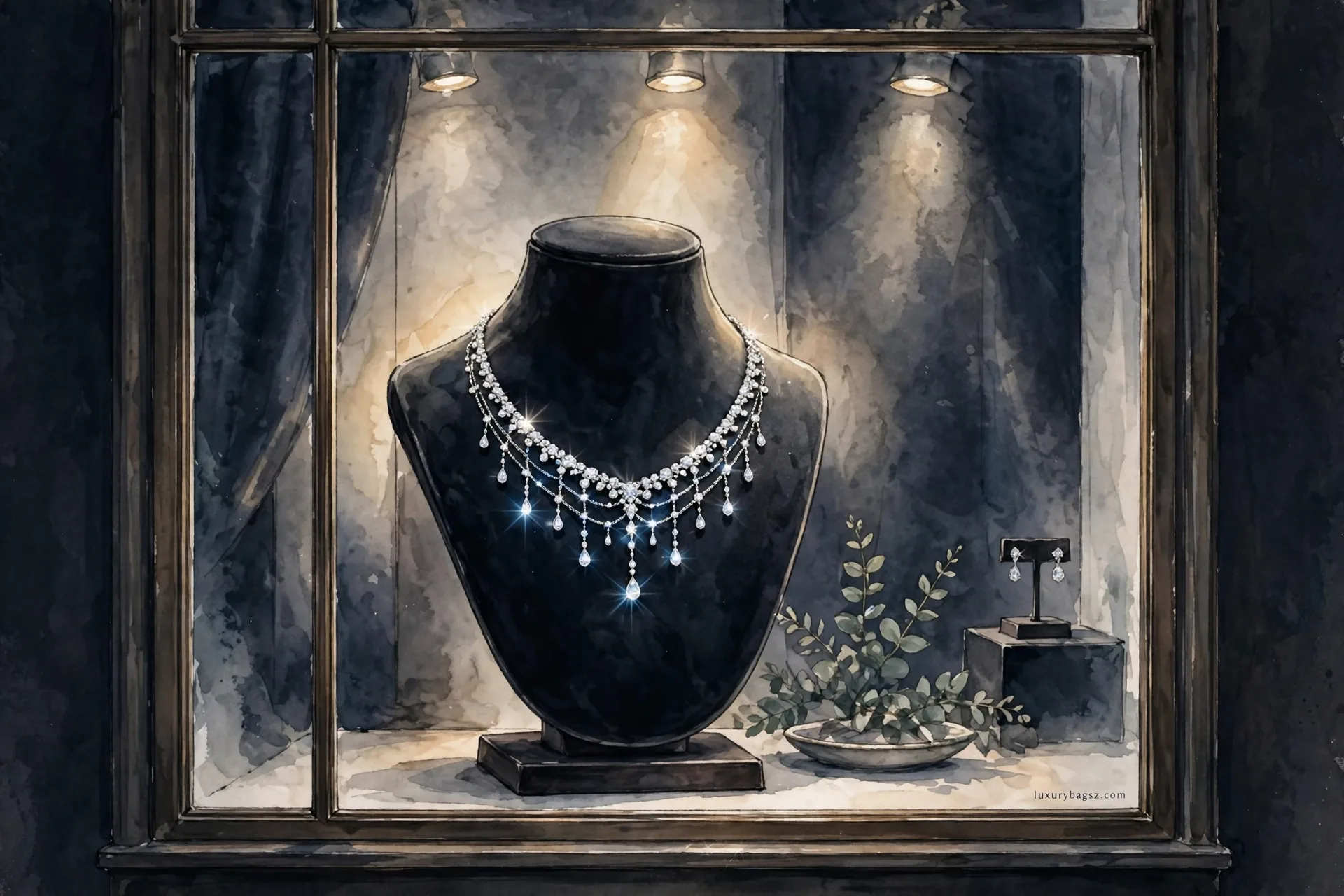
High jewellery, or haute joaillerie, means unique pieces and very small series, designed around exceptional stones and made by hand in the house's own workshop. A single necklace may take hundreds of workshop hours: stone selection, wax modelling, casting, setting, polishing and finishing all pass through specialist hands. Prices follow that labour and those stones, running from tens of thousands into the millions for important pieces. Most are never displayed in windows; clients view them in private salons.

Heritage Houses and Newer Names
The square mixes centuries-old houses with newer high jewellery names that earned their place more recently, which keeps its windows from feeling like a museum only. Our Messika high jewellery brand guide covers one modern house that built its name on diamonds and joined the square's company. Watchmakers share the facades too, since the same clients buy both crafts. The blend of jewellery and watches underlines that the square sells rarity itself, not one product type.
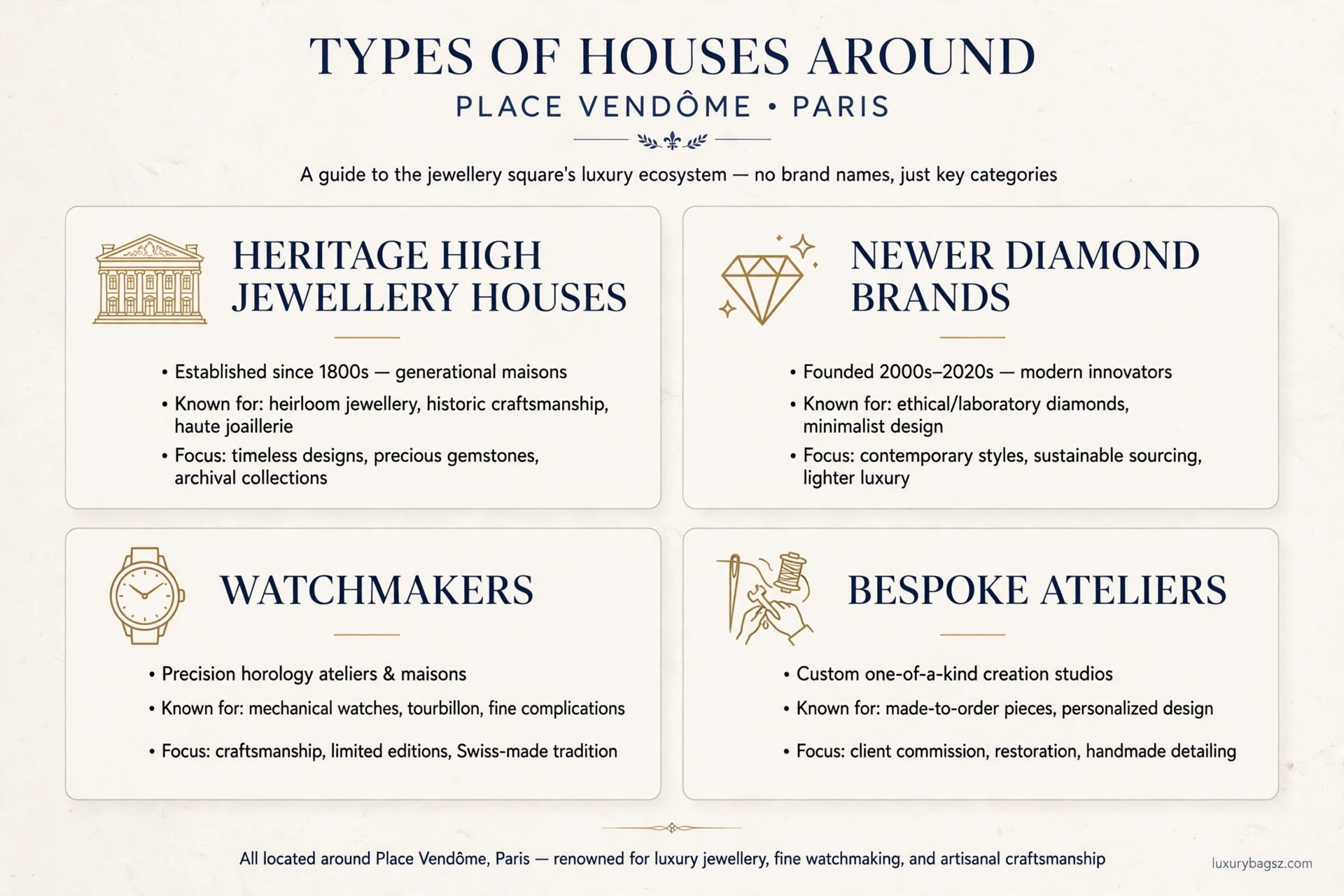
The workshop presence also explains the square's service culture. Repairs, resizing and bespoke work are handled where the piece was made, often by the same benches, which is a standard few shopping districts anywhere can still match.
The Workshops Above the Boutiques
The least visible part of the square is the most important: ateliers on the upper floors where high jewellery is still designed and made steps from where it is sold. Keeping workshops on site lets houses control every stage and offer clients bespoke commissions, alterations and restorations without pieces leaving the building. Some houses present workshop visits or exhibitions during special events. For most visitors, the knowledge that making happens overhead is enough to change how the windows read.
Visiting Place Vendôme as a Jewellery Lover
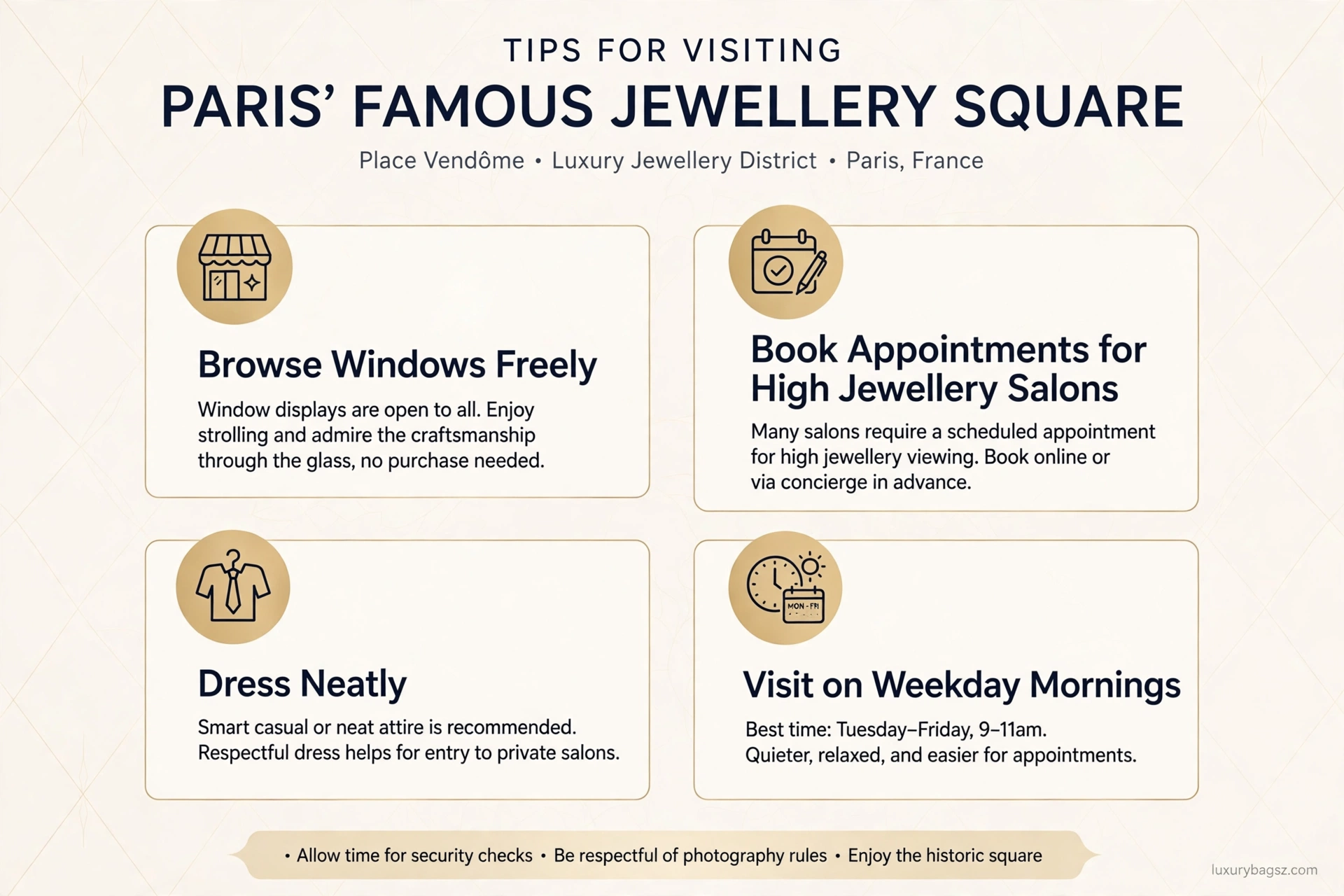
Window browsing is free, unhurried and genuinely rewarding; the displays are designed as small exhibitions and change with collections and seasons. For boutique visits, dress neatly and expect a welcome in the accessible lines' salons. High jewellery viewings are generally arranged by appointment, sometimes with a client history at the house. Combine the square with the surrounding streets: Rue de la Paix continues the jewellery trade north from the square, and the Ritz, on the square itself, is the classic stop for tea afterwards.
Why the Square Still Matters
New luxury districts rise in many cities, yet houses still queue for Place Vendôme addresses. The concentration of rivals, workshops and knowledgeable clients cannot be copied quickly. The square also shapes taste far beyond Paris. Collections launched there set the stones, motifs and price ceilings that the wider market follows, as our fine jewellery trends guide tracks each season. For a beginner, learning the square's names and stories is the fastest education in high jewellery there is: one address, read carefully, teaches the whole field.
Door by Door: The Addresses That Matter
Number 26 is where the story starts. Frédéric Boucheron chose the Hôtel de Nocé in 1893 for a practical reason jewellers understand: the corner receives sunlight from morning to evening, and natural light is how stones are judged. The house still trades on the same corner.
Number 12 is Chaumet, at the square since the early 1900s and the house of Empress Joséphine before that. Its identity is the tiara; the historic salons keep the heritage pieces, and the tiara remains Chaumet’s signature in a way no other house contests.
Number 22 is Van Cleef & Arpels, opened in 1906 and later expanded to neighbouring doors. Ask after the Mystery Set, the technique patented in 1933 that sets stones so closely no metal shows between them; it is the square’s most famous piece of pure craftsmanship.
Cartier’s great Paris presence spreads between the square, at number 23, and its historic home on Rue de la Paix just north. Chanel at number 18 is the fashion house that became a high jeweller, placed opposite the Ritz where Coco Chanel herself lived for decades.
Learn five addresses and you can read the whole square: 26 for the pioneer, 12 for the imperial tiara maker, 22 for the technician-poets, 23 for the kings’ jeweller, and 18 for the couturier who joined them.
The Ritz Effect
The square’s jewellery trade cannot be separated from its hotel. The Ritz opened on Place Vendôme in 1898, five years after Boucheron arrived, and put the world’s richest travellers to sleep a few doors from the world’s best jewellery windows.
Coco Chanel lived at the Ritz for over thirty years, and the hotel’s bars and suites became informal annexes of the jewellery salons, where clients celebrated purchases and dealers heard the news that moves stones between owners.
For visitors today the hotel completes the ritual: windows first, a salon appointment if you have one, and tea or a drink at the Ritz to finish, in the room where that sequence has been performed for more than a century.
It also explains the square’s prices and patience. Jewellery on the Place is sold to people who are staying steps away, unhurried, and comparing the best with the best. The whole district is engineered around that calm.
Buying on the Square: How a Purchase Actually Works
For fine jewellery lines, walking in works as it does in any flagship: browse, ask, try, buy. The difference is the depth of stock and the staff’s knowledge; expect to be shown the piece’s story, stones and certificates as a matter of routine.
For high jewellery, the appointment system described in this guide’s visiting advice is real. Pieces are brought to a private salon, sometimes from the workshop upstairs, and the conversation includes the stone’s origin, the making process and the house’s after-sales care in unusual detail.
Visitors from outside the European Union should ask about tax-free shopping paperwork at purchase, since the refund on a high jewellery piece is a serious sum. Keep the certificates, invoices and export stamps together; the papers become part of the piece’s value for life, as our authentication guide explains.
After-sales is where the square justifies itself: resizing, restoration and bespoke adaptation handled by the house that made the piece, often in the building where it was made. Buyers pay for the address partly to buy that permanence.
The Column and the Square’s Theatrical Past
The column at the centre is a war memorial wearing jewellery-district clothes: raised by Napoleon after Austerlitz and modelled on Trajan’s Column in Rome, its spiral relief was cast from captured cannon bronze.
Paris’s revolutions reached it anyway. The column was pulled down during the Paris Commune in 1871, then rebuilt a few years later when calmer politics returned; the painter Courbet, blamed for its fall, was billed for the rebuilding.
The facades hold their own deception: Hardouin-Mansart’s uniform fronts were built as a royal stage set before the buildings behind them existed in final form, which is why the square reads as one architectural gesture rather than a street of houses.
Knowing this changes a visit. The square was always theatre, built to display power; the jewellers simply inherited the stage and changed the exhibit from the king’s glory to their own.
Just Off the Square: The Rest of the Neighbourhood
The jewellery district is bigger than the octagon. Rue de la Paix, running north from the square, holds Cartier’s historic flagship at number 13 and a second rank of great names, and it was a luxury address before the square’s trade completed its takeover.
On that same street sits Mellerio, founded in 1613 and often described as the world’s oldest jewellery dynasty, still family-held after four centuries. A beginner who walks only the square misses the dynasty that predates it.
Rue Saint-Honoré to the west and the Opéra quarter complete the system: fashion houses, watch flagships and the department stores that feed the district its daily crowd. High jewellery clients move through all of it in an afternoon.
Plan a visit as a triangle, then: the square for the great salons, Rue de la Paix for the historic flagships, and the surrounding streets for everything the square’s formality leaves out. That triangle, walked slowly, is the real Place Vendôme education.
Famous Pieces Born on the Square
Each great house keeps a signature creation that beginners can use as a key. Boucheron’s is the Question Mark necklace, first made in 1879, which fastens with no clasp at all, its curve holding itself around the neck; the house still makes versions today.
Van Cleef & Arpels answers with the Zip necklace, conceived in the late 1930s and realised in 1950: a working zip in gold and stones that converts between necklace and bracelet. It is jewellery as engineering joke and masterpiece at once.
Chaumet’s key is the tiara, made for empresses and still the house’s emblem, now joined by the Joséphine collections that translate tiara shapes into rings and earrings ordinary buyers can own.
Cartier contributes the Panthère, the spotted cat that has prowled its designs since the early 20th century, and the Trinity rings whose three gold bands predate the square’s modern era. Learn these five objects and most windows on the square become legible.
Collection Season: The Square in January and July
Twice a year the square becomes a stage set for the trade itself. During the Paris haute couture weeks, traditionally in January and July, the houses unveil their new high jewellery collections to clients and press in the salons and flagships.
Windows change for the season, security rises politely, and the district fills with the clients, stylists and auction specialists who follow the calendar. It is the most atmospheric time to visit and the hardest time to get an appointment without a history at a house.
Between seasons, the windows settle back into the houses’ standing icons, which is honestly the better beginner’s view: the signatures described in this guide, displayed without the year’s theatre around them.
Whichever week you come, the lesson of the square is the same one it has taught since 1893. Concentration creates standards. Every house on the Place makes its jewellery in the sight of its rivals, and the whole world’s fine jewellery is better for that arrangement.
Frequently Asked Questions
Where is Place Vendôme?
In the first arrondissement of Paris, just north of the Tuileries Garden and the Rue de Rivoli, with Rue de la Paix running from its northern side.
Why is Place Vendôme famous for jewellery?
Jewellers followed wealthy clients to the square from the late 19th century. Their flagships, salons and workshops concentrated there until the address itself became a mark of high jewellery status.
Which jeweller opened first on Place Vendôme?
Boucheron, in 1893, at number 26. Its founder chose the sunniest corner of the square, and the house remains at the same address.
What is the difference between fine and high jewellery?
Fine jewellery uses precious materials in produced collections. High jewellery means unique or tiny-run pieces, exceptional stones and hundreds of hours of handwork in house workshops.
Can anyone walk into the boutiques?
The accessible fine jewellery salons welcome browsers, though service is personal and unhurried. High jewellery pieces are usually viewed by appointment in private salons.
Are the workshops really on the square?
Yes. Many houses keep ateliers on upper floors above their boutiques, where high jewellery is designed, made and restored on site.
Is Place Vendôme only for buyers?
No. Window displays function as free exhibitions, and the square itself, with its column and facades, is one of Paris's great pieces of urban design.
What is the Vendôme column?
The bronze column at the square's centre, modelled on Roman triumphal columns and topped by a statue of Napoleon. It is the square's landmark and meeting point.
Which other streets nearby matter for jewellery?
Rue de la Paix, running north from the square, hosts more jewellery and watch flagships, including historic houses that chose it before or alongside the square.
When is the best time to visit?
Weekday mornings are calmest for window browsing and boutique visits. December brings the square's most elaborate displays and lights.
Conclusion: The Square That Teaches Jewellery
Place Vendôme earns its fame honestly: two centuries of houses, workshops and clients concentrated in a few hundred metres of Paris stone. Visit it as a student as much as a shopper, and the windows stop being price tags and become a readable history of what jewellery can be.






