Boucheron Brand History: The First Jeweller of Place Vendôme
Boucheron in Brief: The Sunniest Corner of Place Vendôme
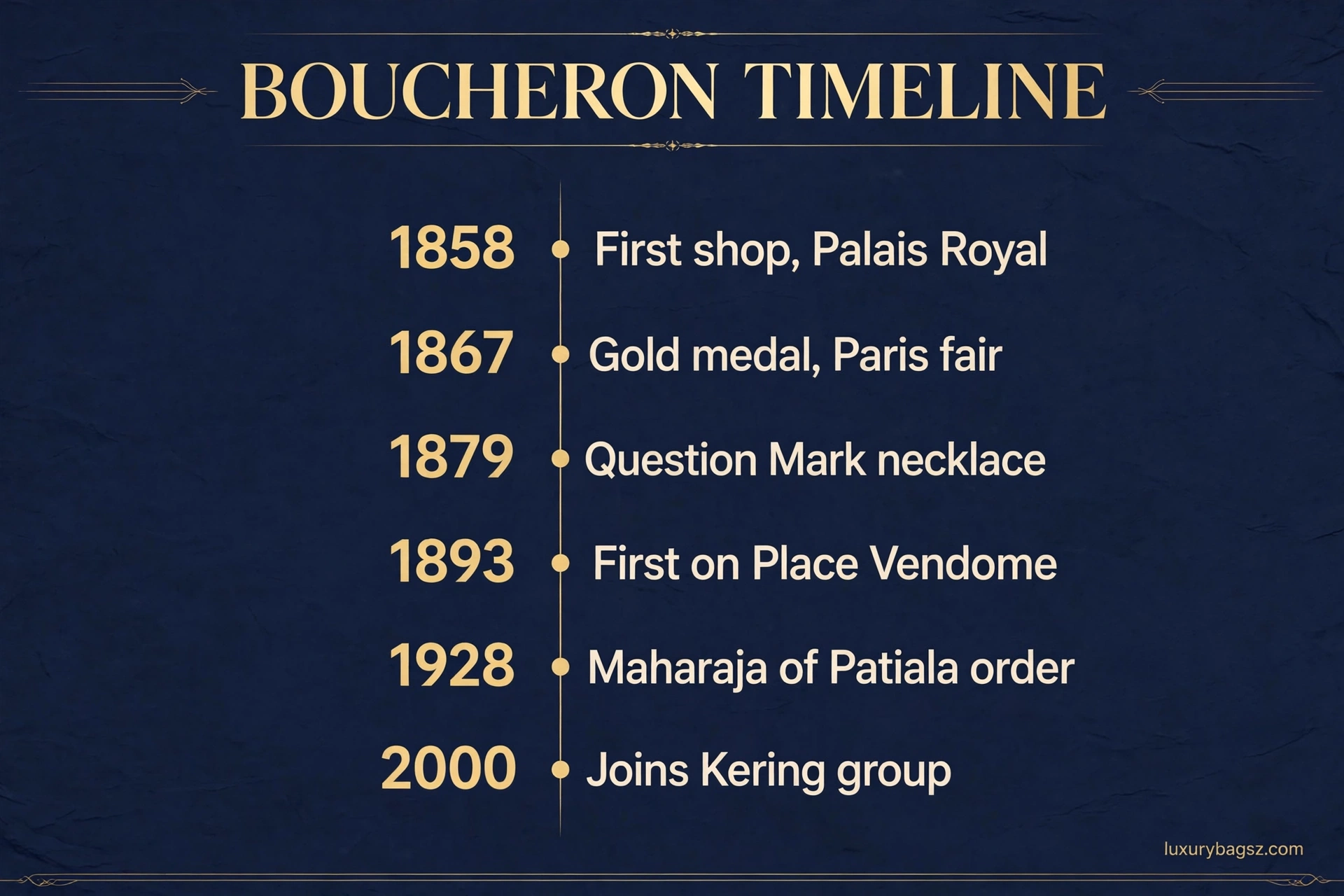
Boucheron is a French high jewellery and watch house founded in Paris in 1858 by Frédéric Boucheron. In 1893 it became the first major jeweller to open on Place Vendôme, at number 26, where the maison remains today. That single fact explains much of its standing: Boucheron did not follow Parisian high jewellery to its most famous square. It arrived first.
The direct answer for buyers is this: Boucheron is best known for inventive, wearable high jewellery, from the clasp-free Question Mark necklace of 1879 to the Serpent Bohème motif and the Quatre ring. If you want heritage with a free, modern spirit, rather than formality for its own sake, Boucheron deserves a place on your shortlist.
This guide covers the founder, the Place Vendôme move, the iconic designs, the twentieth-century story, the modern maison under Kering, and the checks that matter when buying new or pre-owned.
Key Takeaways
- Frédéric Boucheron founded the maison in Paris in 1858, opening first in the Galerie de Valois at the Palais Royal.
- He won a gold medal at the Paris Exposition Universelle in 1867.
- The Question Mark necklace, created in 1879, has no clasp and is held by its own spring tension.
- In 1893 Boucheron became the first jeweller on Place Vendôme, at 26 Place Vendôme, chosen, so the story goes, for its sunlight.
- The Maharaja of Patiala placed a legendary order in 1928, said to involve 149 pieces.
- Boucheron joined the Kering group in 2000, and Claire Choisne has been creative director since 2011.
Frédéric Boucheron: From Draper's Son to Jeweller
Frédéric Boucheron was born in 1830, the son of a merchant draper. That family background matters, because he understood fabric, fashion, and clients before he understood gems. At fourteen he began an apprenticeship with Parisian jeweller Jules Chaise, then worked for Tixier-Deschamps, learning both craft and commerce.
In 1858, when Deschamps retired, Frédéric opened his own shop under the arcades of the Palais Royal, then the centre of Parisian luxury trade. His early jewels were fashionable and lavishly gem-set, and they sold well enough that he opened his own workshop in 1866. By the time of the Second Empire, he was recognised as one of the most innovative jewellers in Paris, with clients among royalty, nobility, and high society.
Frédéric surrounded himself with talented designers and artisans, including Jules Debut, Paul Legrand, and Lucien Hirtz, and craftsmen such as chaser and engraver Louis Armand Rault and enameller Charles Riffault. That workshop culture, where design and making sat side by side, became a Boucheron hallmark and remains central to the maison's identity today.
The Question Mark Necklace: Freedom in a Clasp-Free Design
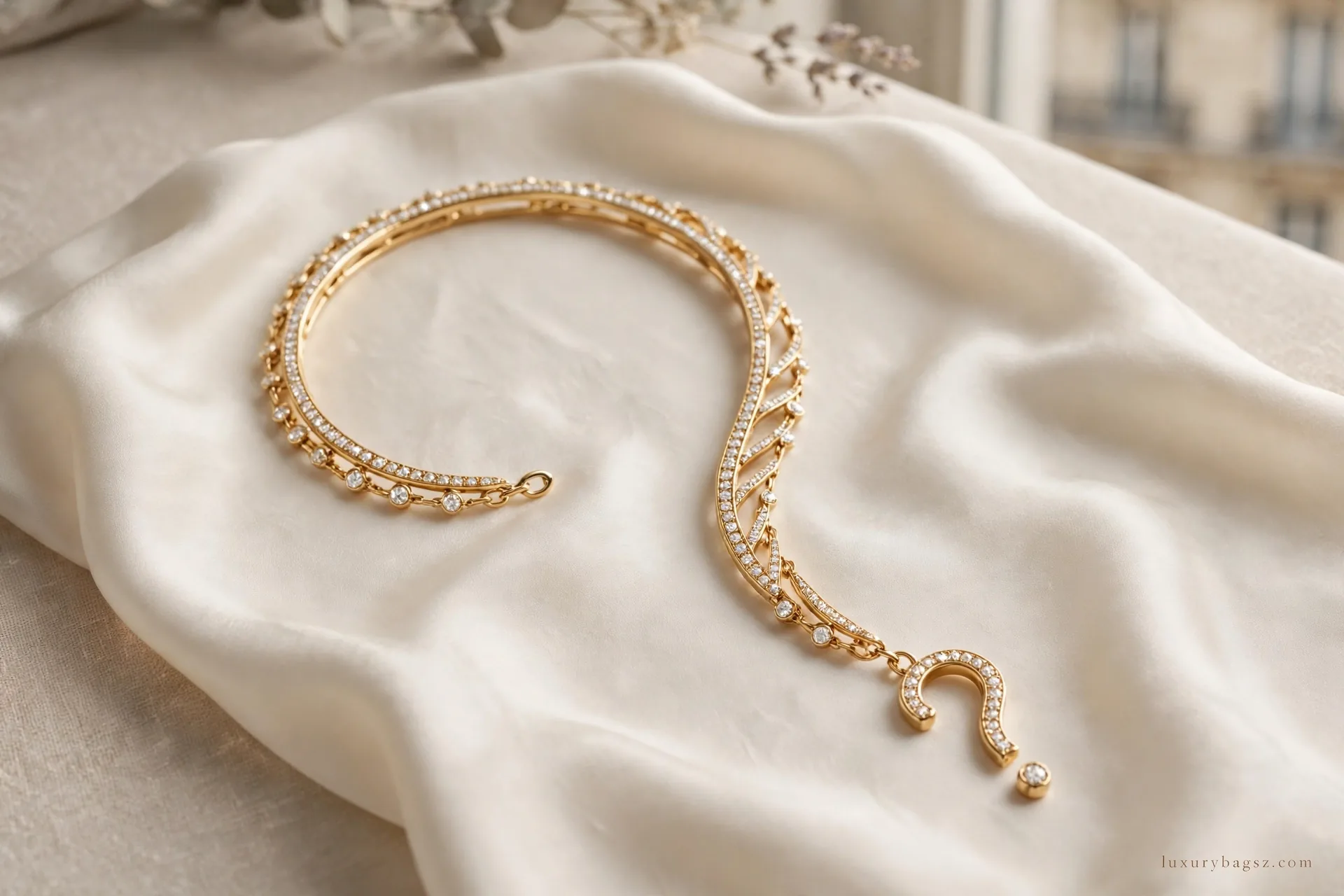
Boucheron's most famous early invention is the Point d'Interrogation, or Question Mark, necklace, created in 1879, with some sources dating the first version to 1883. The idea was radical: a necklace with no clasp, worn open around the neck and held by its own hidden spring tension. A woman could put it on herself, without a maid's help, which in the late nineteenth century was a genuine liberation.
The design also showed Boucheron's approach to nature and movement. Early versions drew on motifs such as a peacock feather, and the open curve echoed the line of the neck rather than fighting it. The necklace won the Grand Prix for innovation at the 1889 Paris Exposition Universelle, confirming that Boucheron's invention was not a novelty but a new way of thinking about jewellery.
Modern reinterpretations of the Question Mark necklace remain a signature, including versions in white gold with tourmalines, diamonds, and rock crystal. When you see one, look for the curve, the balance, and the way it sits without a visible fastening. That effortless wearability is the point, and it is what separates Boucheron from houses that treat high jewellery as sculpture first and adornment second.
Place Vendôme: Why Number 26 Matters
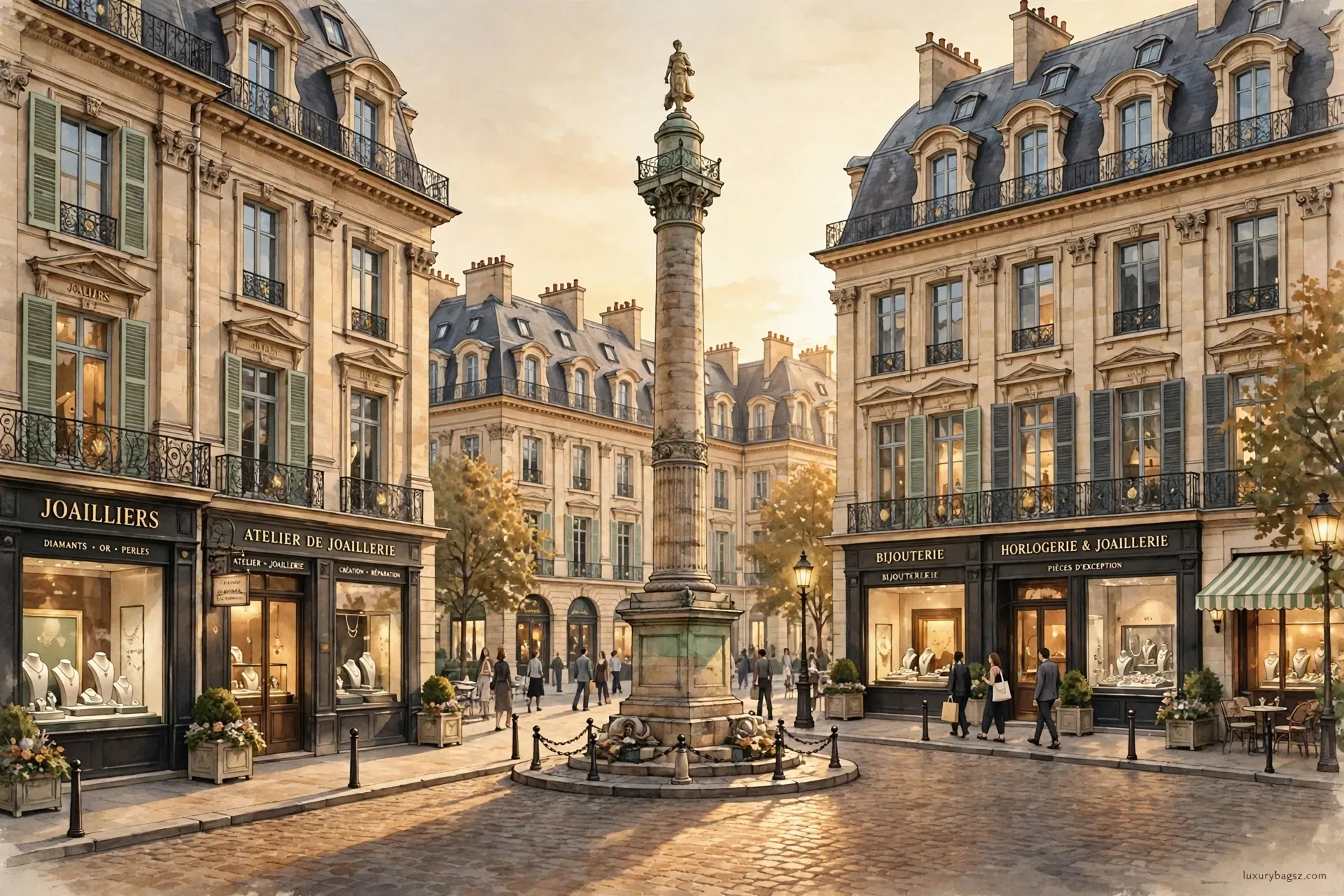
In 1893 Frédéric Boucheron moved from the Palais Royal to 26 Place Vendôme, in the Hôtel de Nocé, becoming the first jeweller to settle on the square. At the time, Place Vendôme was only beginning to attract luxury trade spilling over from Rue de la Paix, between the new Opéra Garnier and the Tuileries gardens. Boucheron's move was a bet on the future of Parisian luxury geography, and it paid off.
Legend says he chose the corner site because it was the sunniest corner of the square, so his diamonds would sparkle most brilliantly in the windows. Whether or not the story is literally true, it captures his commercial instinct: jewellery must be seen in good light, and a boutique must invite clients in rather than intimidate them. The maison remains at 26 Place Vendôme today, after a recent renovation of the entire building.
International expansion followed quickly: Moscow in 1893, later moved to St Petersburg, London in 1903, and an office in New York in 1903, with a first New York boutique arriving much later, in 2024, on Madison Avenue. That long gap is itself instructive. Boucheron built its American clientele through Paris and through client offices long before it opened a full boutique across the Atlantic.
Royal Clients, Crown Jewels and the Maharaja's Order
Boucheron's early reputation was built on exceptional clients and exceptional stones. In 1887 Frédéric Boucheron was the only French jeweller invited to the Louvre auction of the French Crown Jewels, where he bought thirty-one diamonds, including Mazarin stones of 18 and 16 carats. He kept a Book of Stones, recording the finest gems that passed through the maison, a practice that underlines how seriously Boucheron took stone selection.
Royal and aristocratic clients followed, including the Countess of Castiglione, members of the Russian royal family, and later stars such as Edith Piaf. The most famous order came in 1928, when the Maharaja of Patiala arrived at Place Vendôme with guards carrying trunks of gems and commissioned a vast suite of jewellery. Sources vary on details, with some saying 149 pieces and others describing the order in broader terms, but all agree it was one of the largest commissions in jewellery history.
These stories matter for collectors because they explain why antique Boucheron, especially Belle Époque, Art Deco, and mid-century gold pieces, remains highly sought after. A signed Boucheron piece carries not only a maker's name but a documented place in jewellery history, which is part of what makes signed pieces valuable.

Art Nouveau, Art Deco and the Twentieth Century
After Frédéric's death in 1902, his son Louis took over, and the maison moved with the times. At the 1900 Paris fair, Boucheron embraced Art Nouveau alongside Lalique and Vever, making colourful, nature-inspired jewels in semi-precious stones and enamel. Louis, a trained engineer, also brought technical innovation, debuting a new contemporary style at the 1925 Exposition des Arts Décoratifs.
Boucheron revived plique-à-jour, a translucent open-backed enamel technique neglected since the Renaissance, and acquired the patent for it. The maison was also celebrated for sculptural gold modelling, engraving on diamonds, and exquisitely engraved and inlaid steel. Those skills explain why Boucheron gold jewellery, textured, sculptural, and bold, became a speciality after the Second World War, when precious materials were scarce and makers had to rely on design and goldsmithing.
The serpent motif, drawn from a nineteenth-century signature, was translated into the Serpent Bohème collection in 1968, during a period of social and cultural change. That translation, from archive motif to modern, wearable collection, is a pattern Boucheron repeats often, and it is why its archive remains a living resource rather than a museum.
The Icons Today: Serpent Bohème, Quatre and Plume de Paon
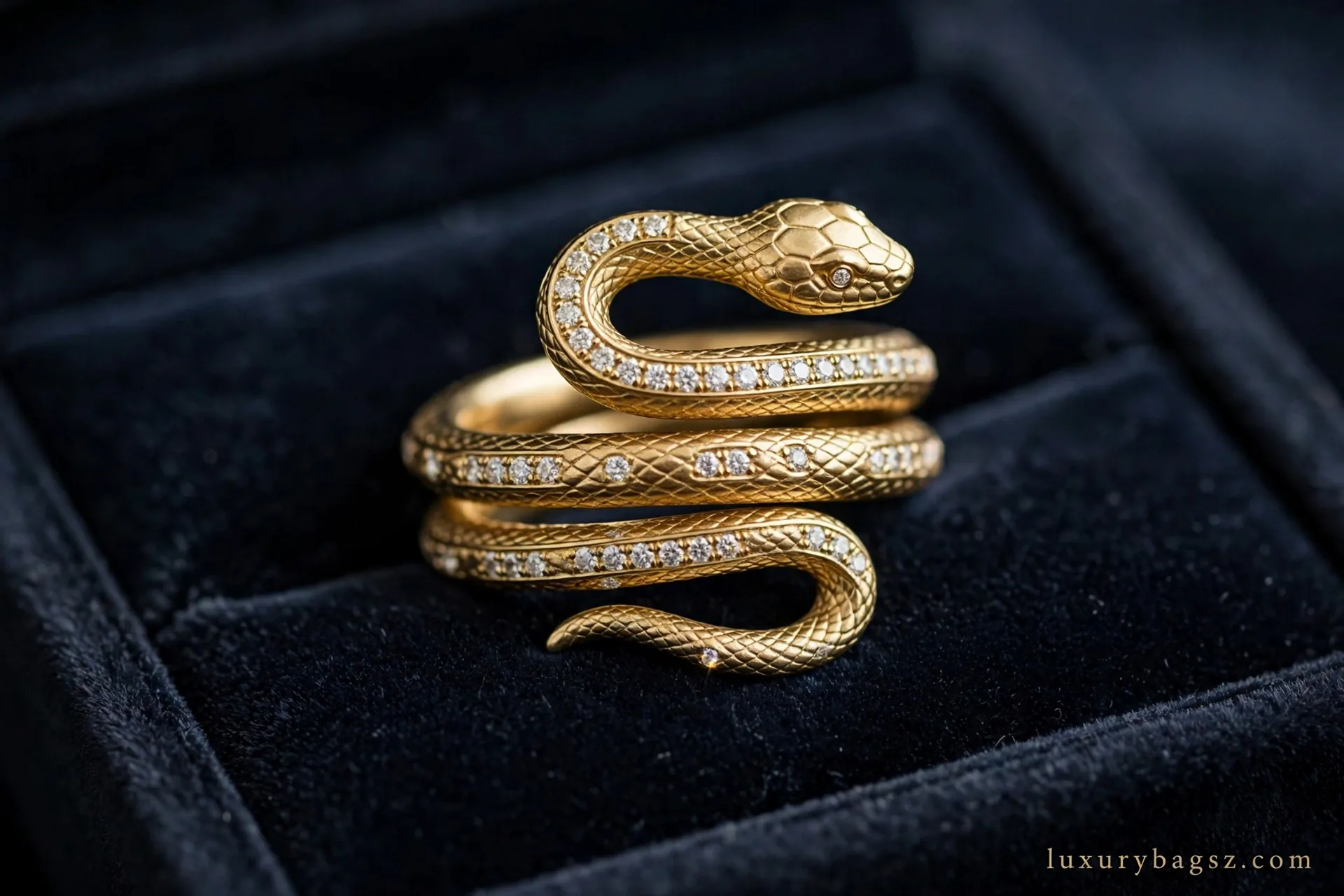
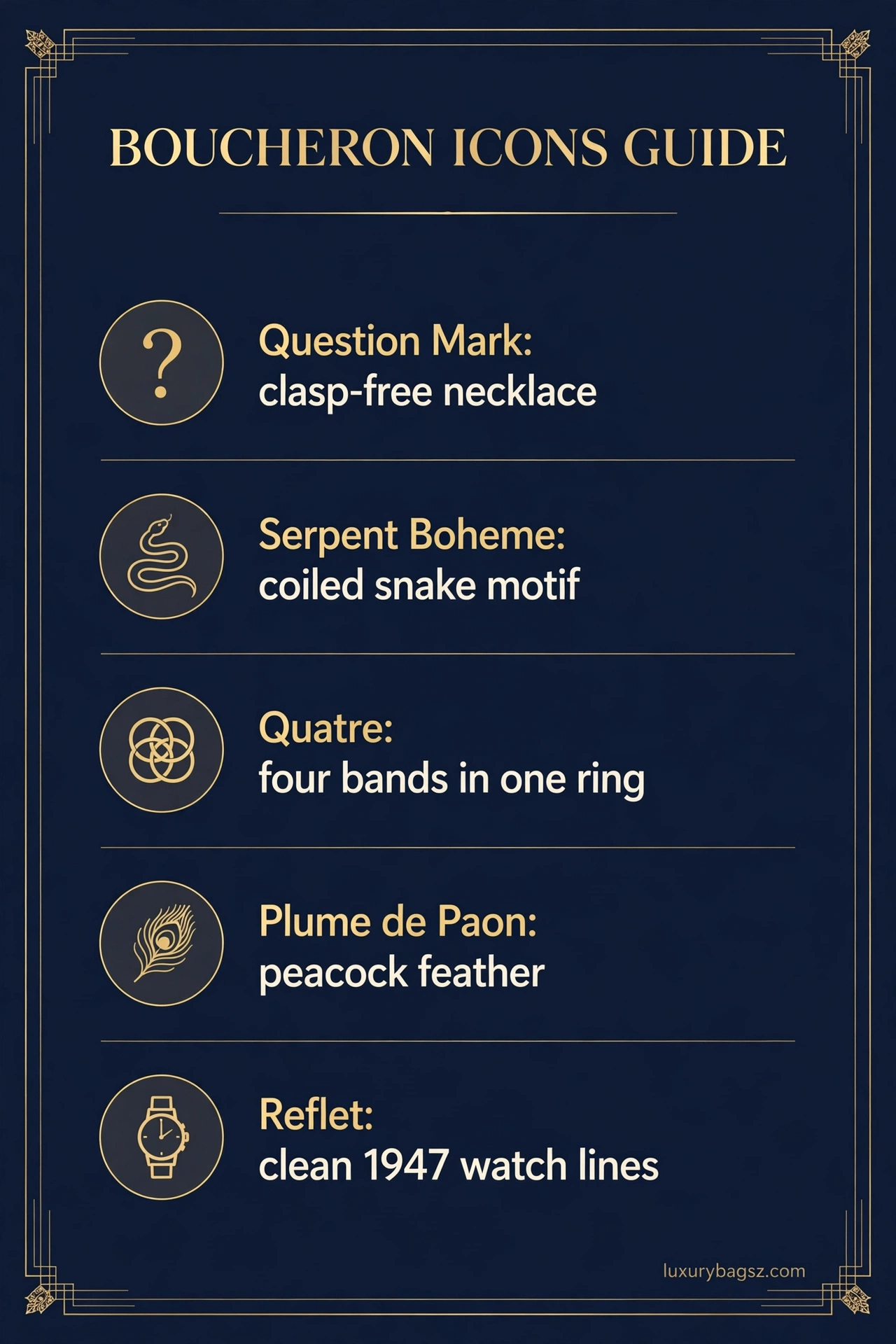
Today's Boucheron rests on a small set of repeatable motifs. Serpent Bohème, with its coiled snake head, drop details, and pavé or plain gold versions, is the most recognisable, worn as rings, earrings, pendants, and bracelets. It suits daily wear because it is sculptural without being heavy, and it layers well with simpler gold pieces.
Quatre, launched in 2004, combines four bands in one ring: yellow gold grosgrain, white gold double godron, pink gold, and diamond pavé, among other variations. The idea is a ring that already contains contrast, so it needs no companion. Plume de Paon, the peacock feather, draws directly on Boucheron's nineteenth-century feather motif, with flowing, asymmetrical lines that suit evening wear. Lierre de Paris, the ivy motif, and the Reflet watch, created in 1947 with clean, architectural lines, complete the modern icon set.
For buyers, icons have a practical advantage: they are easier to research, compare, and resell than one-off designs. Our guide to what makes signed jewellery valuable explains why maker marks, design recognition, and condition matter, and Boucheron icons score well on all three.
Buying Boucheron: Boutique, Pre-Owned and Care
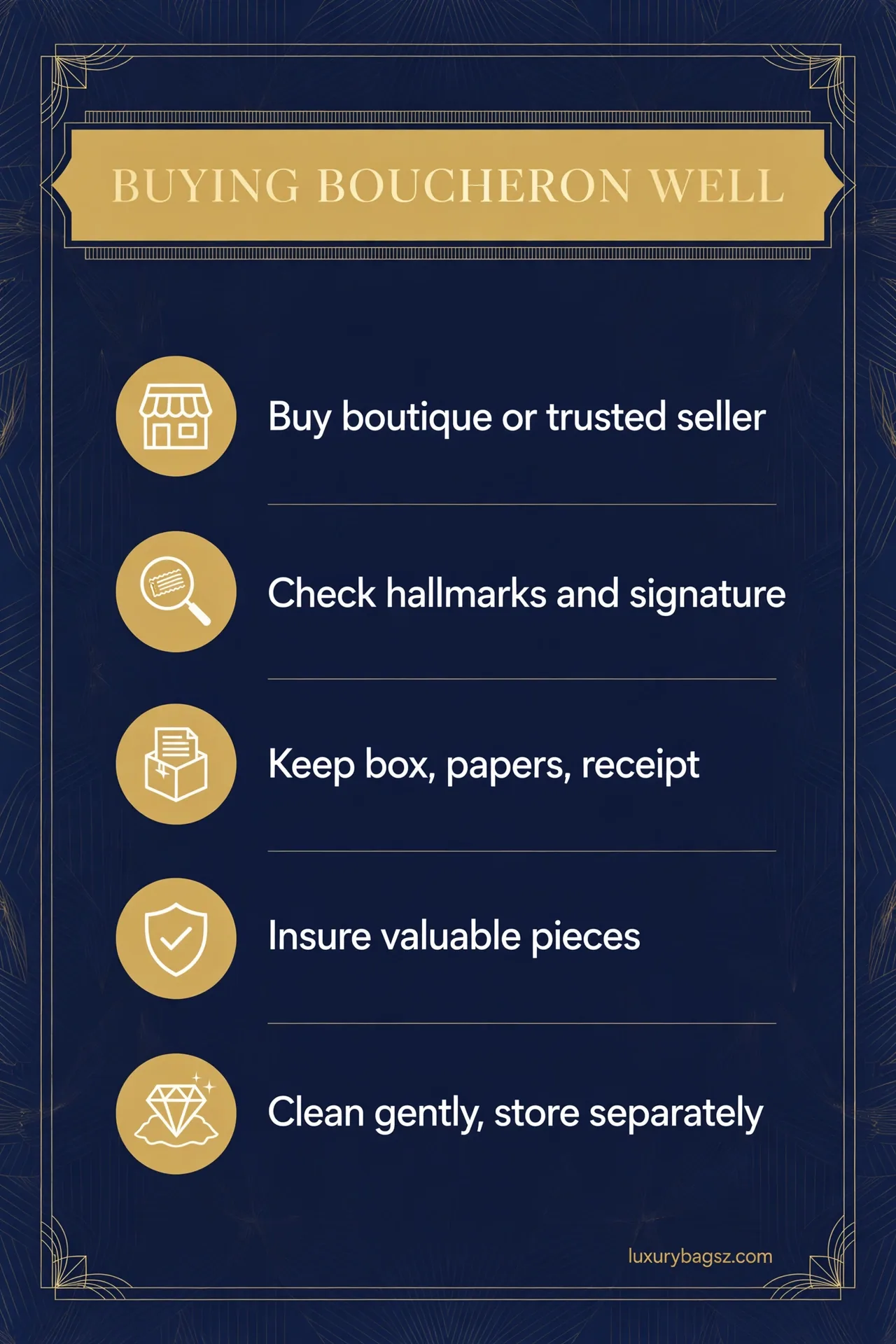
Buy Boucheron from its boutiques, its website, or authorised retailers, and keep box, papers, and receipt. For pre-owned pieces, buy from reputable sellers with clear photographs of hallmarks, signatures, clasps, and any wear. Check the signature and hallmarks against known genuine pieces, and examine the finish, especially on textured gold, where poor copies often look flat or overly uniform.
Care is gentle and regular. Clean gold and diamond pieces with warm water, mild soap, and a soft brush, as described in our guide on how to clean gold and diamond rings, and follow our guide to care for gemstone jewellery for coloured stones, which may need different treatment. Store pieces separately, have clasps and settings checked annually, and insure valuable items.
Creative director Claire Choisne, in post since 2011, has pushed Boucheron towards innovation in materials and wearability, including experimental high jewellery collections and a sustainability framework called Precious for the Future, introduced in 2022. That modern direction means new Boucheron often feels freer and more contemporary than its nineteenth-century origins might suggest, which is exactly the house's historical pattern.
Value, Collectability and What to Avoid
Antique and vintage Boucheron, especially Art Deco and mid-century gold, animal brooches, and serpent designs, are among the most rewarding signed jewellery on the market for collectors. Condition, signature clarity, provenance, and originality decide value far more than size alone. A small, perfectly preserved Belle Époque piece can outvalue a larger, damaged later piece.
Modern icons such as Serpent Bohème and Quatre hold up well as wearable purchases, but they rarely appreciate like rare antique pieces. Buy them because you will wear them, not as an investment. Before selling, read our guides on how to price designer jewellery for resale and how to resell luxury jewellery, which cover realistic pricing, photography, and seller choice.
Avoid three traps. First, do not buy an unsigned piece as Boucheron on a seller's word alone; the signature and hallmarks must be present and correct. Second, do not buy a damaged high jewellery piece hoping for a cheap repair, because restoration can be costly and may affect value. Third, do not confuse Boucheron with other Place Vendôme houses; each has its own codes, and a generic Parisian look is not proof of maker.
Frequently Asked Questions
1. When was Boucheron founded? Boucheron was founded in Paris in 1858 by Frédéric Boucheron, who opened his first shop in the Galerie de Valois at the Palais Royal.
2. Why is Boucheron famous for Place Vendôme? In 1893 it became the first major jeweller to open on Place Vendôme, at 26 Place Vendôme, where the maison remains today.
3. What is the Question Mark necklace? A clasp-free necklace created in 1879, held by hidden spring tension, so it can be worn open around the neck without a fastening.
4. What is Serpent Bohème? A modern Boucheron collection based on a coiled serpent motif, translated from a nineteenth-century signature into rings, earrings, pendants, and bracelets in 1968.
5. What is the Quatre ring? A ring combining four bands in one design, including different gold colours, textures, and diamond pavé, launched in 2004.
6. Who owns Boucheron today? Boucheron is owned by Kering, the French luxury group, which acquired the maison through Gucci Group in 2000.
7. Who is Boucheron's creative director? Claire Choisne has been creative director since 2011, leading the maison's high jewellery and icon collections.
8. What was the Maharaja of Patiala order? A legendary 1928 commission in which the Maharaja of Patiala brought trunks of gems to Place Vendôme and ordered a vast suite of jewellery, said to involve 149 pieces.
9. Is antique Boucheron collectable? Yes. Belle Époque, Art Deco, and mid-century gold Boucheron pieces, especially signed animal and serpent designs, are highly sought after by collectors.
10. How do I care for Boucheron jewellery? Clean gently with warm water and mild soap, store pieces separately, check clasps annually, and insure valuable items.
Summary: First on the Square, Still Inventing
Boucheron endures because it arrived first and never stopped inventing. From a draper's son opening a Palais Royal shop in 1858, to the sunniest corner of Place Vendôme, to a clasp-free necklace that freed its wearer, the maison has always paired heritage with freedom.
Buy Boucheron when you want jewellery with a story you can wear daily, whether that is a Serpent Bohème ring, a Quatre band, or a vintage gold piece with a clear signature. Check it carefully, care for it gently, and wear it with confidence. That combination of history and wearability, more than any single jewel, is what makes Boucheron, after more than 165 years, still feel modern.