

How to Tell Crocodile From Alligator Leather: Pores, Scales, and the Marks That Matter
Crocodile or Alligator? The Pores Give It Away First
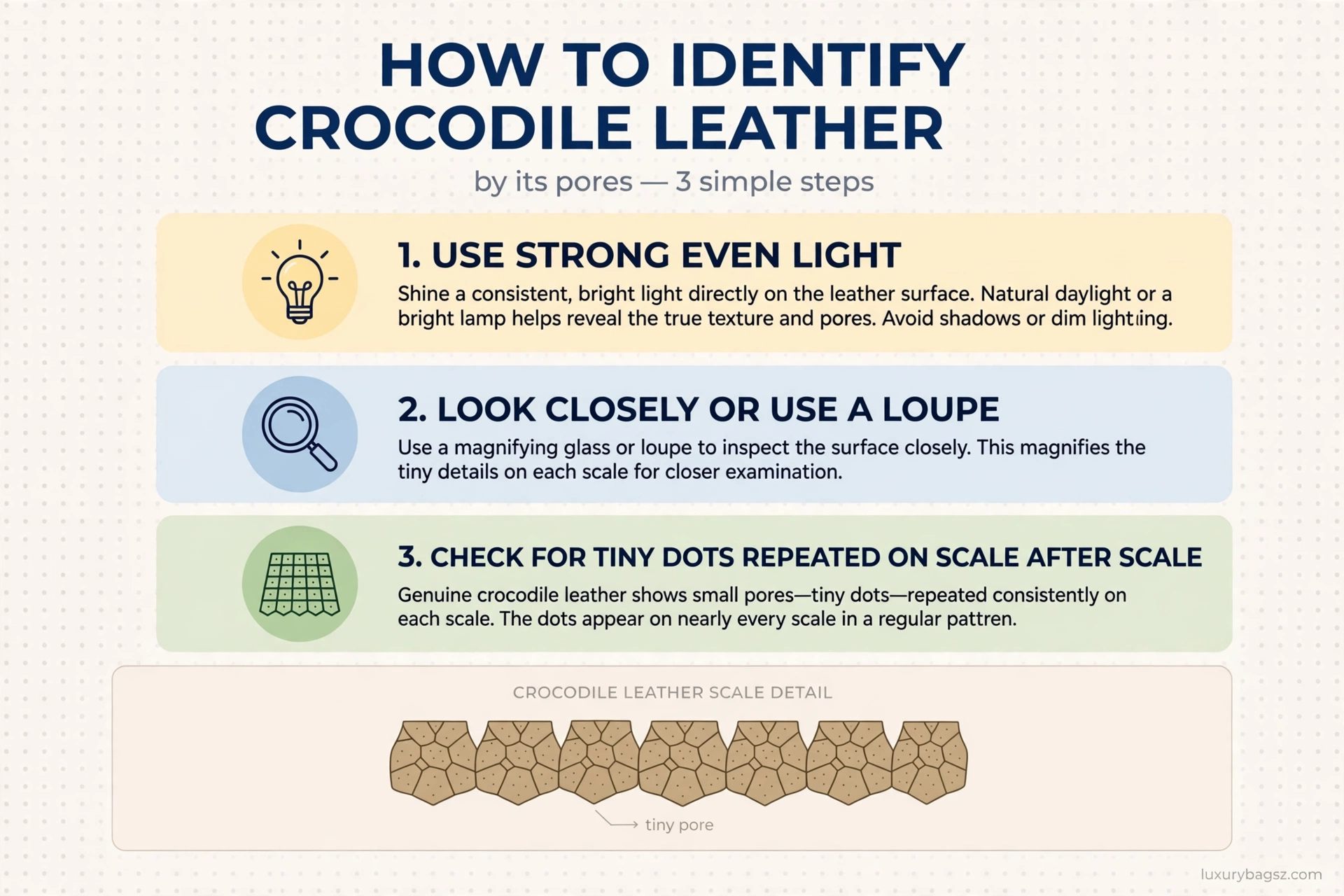
Look for tiny pores on the body scales first. Crocodile leather usually shows a small dot or depression on each scale, left by a sensory organ in the living animal. Alligator belly leather does not show those same body-scale pores, so its scales look cleaner and smoother.
That single clue settles many identifications, but it never settles all of them. Small panels, heavy finishes, and mixed cuts can hide the markers, and caiman is often passed off as one of the two classic leathers. Use the pore test together with the scar, the scale transition, and the maker marks below.
Where the skin itself cannot answer, paperwork and maker marks must. A bag that claims to be crocodile or alligator should be consistent across every check, not just one pretty panel.
Key Takeaways

- Crocodile body scales usually carry a tiny pore on each scale; alligator belly scales do not.
- The alligator umbilical scar, a webbed star-like mark on the belly, identifies alligator alone.
- Alligator belly scales shift abruptly to smaller side scales; crocodile scales taper more gradually.
- Hermès marks Porosus with ^, Niloticus with .., alligator with a square, and caiman with a circle.
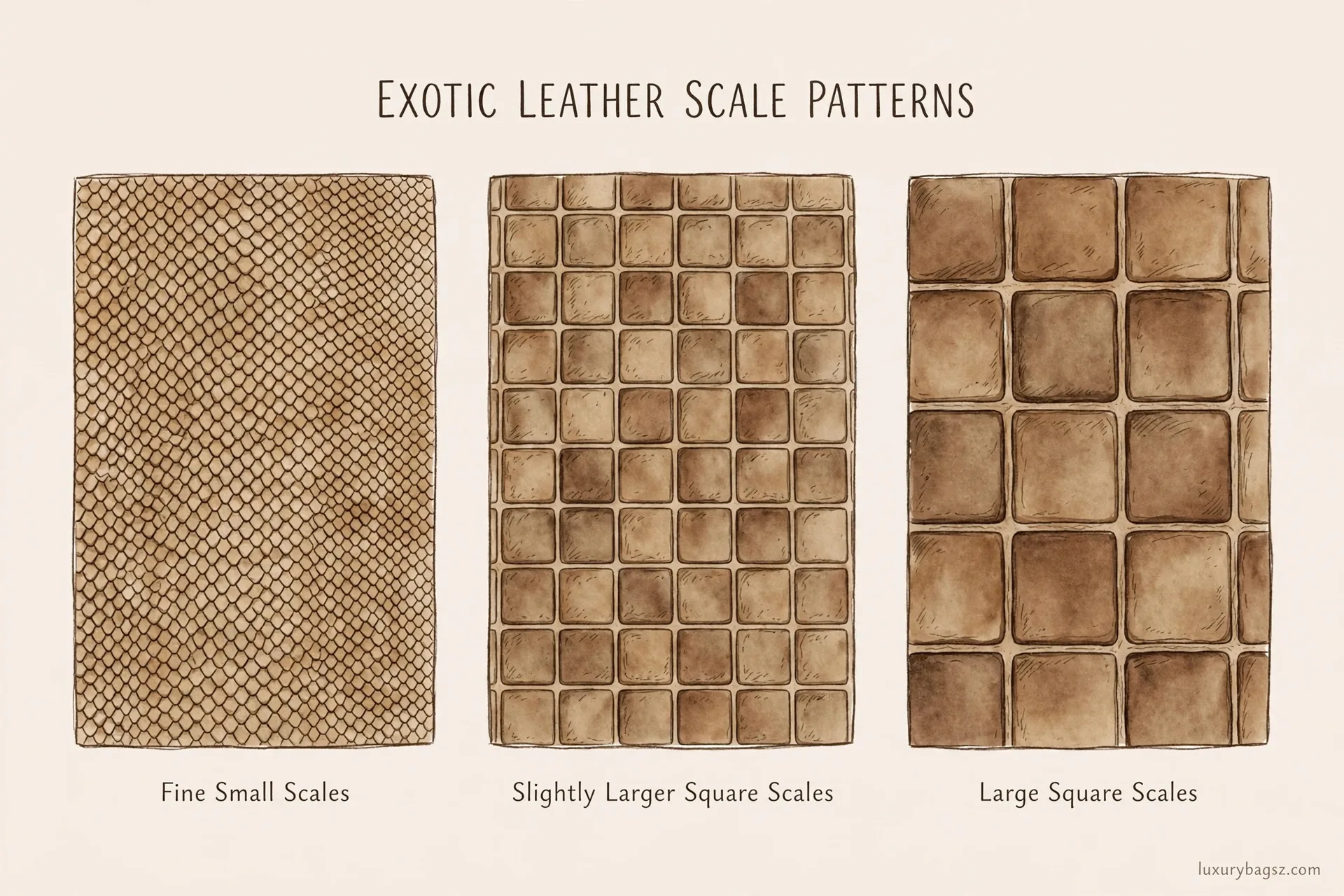
- Porosus scales run small, square, and even; Niloticus scales run slightly larger; alligator scales run large and square.
- Small panels, heavy shine, and mixed cuts can hide every visual marker, so eyesight alone is not proof.
- Caiman feels stiffer, dyes unevenly, and cracks more readily than the two classic leathers.
Start With the Pore Test
Hold the bag under strong, even light and look closely at the belly scales. On crocodile, you should see a repeated tiny dot near the edge of scale after scale. A loupe or a phone camera zoomed in helps, since the dots are small and easy to miss in dim light.
Check several areas, not one lucky scale. Dye, polish, and wear can fill or hide a single pore, but a real crocodile panel repeats the dots across the surface. If the dots appear only here and there, treat the result as unclear rather than confirmed.
Alligator belly leather should look clean by comparison. Its scales carry no matching row of body-scale pores, which gives the surface a smoother, less busy look. That absence is a real clue, but only when you have enough belly leather in view to judge it.
Find the Umbilical Scar, the Alligator Fingerprint
The umbilical scar is the single most distinctive alligator marker. It sits at the centre of the belly as an elongated, webbed, star-like group of tiny scales. No crocodile carries the same mark, so finding it identifies the leather as alligator.
Makers often place this panel where it shows, precisely because buyers recognise it. Look at the centre of a large front or back panel first, and on the inside of smaller goods where the belly cut may have landed. A scar placed dead centre usually means the cutter wanted you to see it.
Absence proves nothing, though. The scar occupies one small part of each hide, so many genuine alligator bags simply do not include it. A bag without a scar may still be alligator, and only the other checks can narrow that down.
Read the Scale Shape and the Belly-to-Side Transition
Scale shape alone misleads more buyers than any other clue. Guides that claim alligator is always perfectly square and crocodile always irregular oversimplify a natural material. Both skins vary, and the cut changes how regular the pattern looks.
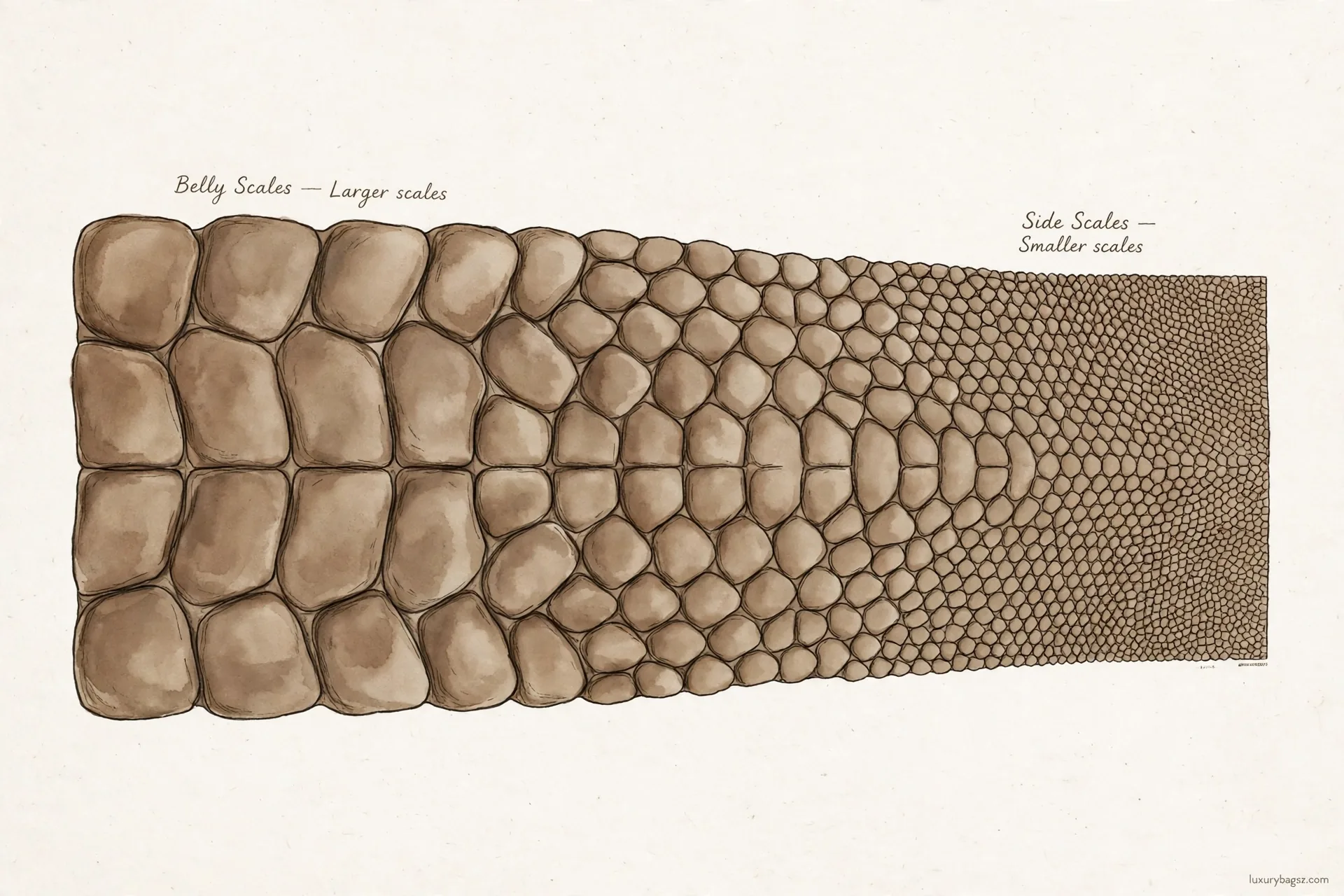
The transition tells you more than any single scale. Alligator belly scales tend to stay uniform, then shift fairly abruptly into smaller, rounder side scales. Crocodile scales taper more gradually from the belly toward the flanks, with slightly more polygonal shapes along the way.
Feel the panel too, where handling is allowed. Alligator belly leather is pliable and smooth, while caiman, the common stand-in, feels stiff from bony plates in the skin. Crocodile belly leather is also pliable, so softness separates the classics from caiman, not from each other.
Check the Maker Stamp Marks
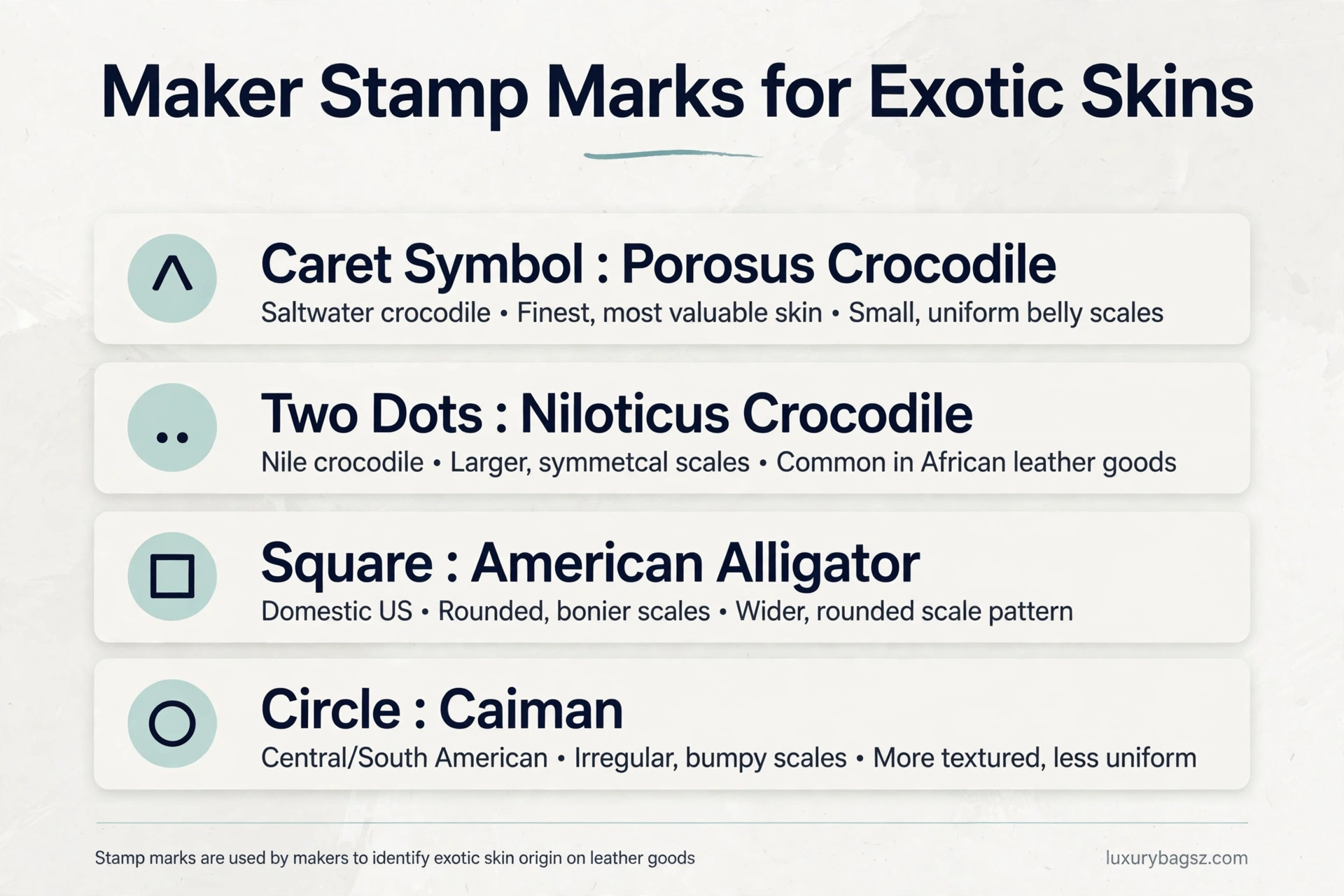
On Hermès goods, the brand stamp carries a small foil mark that names the skin. Porosus crocodile carries a ^ caret, Niloticus crocodile carries a .. diaeresis, American alligator carries a square, and caiman carries a circle. The mark sits beside the brand stamp, usually on a front panel or an interior lining.
This is the most reliable quick check on a Hermès piece, because it comes from the maker rather than from your eye. Match the mark to the skin you see: a caret beside fine, pored scales supports Porosus, while a square beside large, clean scales supports alligator. A mismatch is a warning, not a detail to brush past.
Other makers use their own systems, and many do not stamp the species at all. Never assume a mark from one house applies to another. For a famous exotic shape such as the Birkin bag, the stamp, the scales, and the paperwork should all tell the same story.
Know the Three Classic Skins by Name
Porosus crocodile comes from the saltwater crocodile, farmed in Australia for Hermès and found across the Indo-Pacific. Its scales are small, square, and notably even, with a tiny pore on each one. It takes two finishes: matte, and lisse, a shine built up by polishing with an agate stone after dyeing.
Niloticus crocodile comes from the Nile crocodile of Africa, with Hermès sources in Zimbabwe. Its scales run slightly larger than Porosus, and its pores can be fainter or harder to spot on some samples. It still counts as crocodile, and the .. mark beside the stamp separates it from its saltwater cousin.
American alligator, Alligator mississippiensis, is farmed in Texas and found across the American southeast. Its scales are large, square, and rougher-ridged than crocodile, and the leather feels thicker and more resistant to scuffs. Our guide to leather types puts these exotics beside the everyday leathers they are often confused with.
Where Eyesight Alone Fails
Small goods defeat visual identification most often. A watch strap, a card holder, or a narrow bag panel may show too few scales to judge pores, transition, or scar. Louisiana wildlife guidance makes the same point: large leather areas are far easier to identify than small ones.
Heavy finishes cause the second failure. A thick shine can fill pores, flatten texture, and even out dye, leaving a panel that looks generic. Matte finishes are kinder to identification, since they leave the scale surface closer to its natural state. If the finish hides the markers, say so and move to paperwork rather than guessing.
Mixed construction causes the third. A bag can carry alligator or crocodile on the front and back with caiman on the sides or strap, a cost-saving move that has been documented for decades. Check every panel, including sides, handles, and straps, before accepting a species claim for the whole bag.
Buying Checks Beyond the Skin
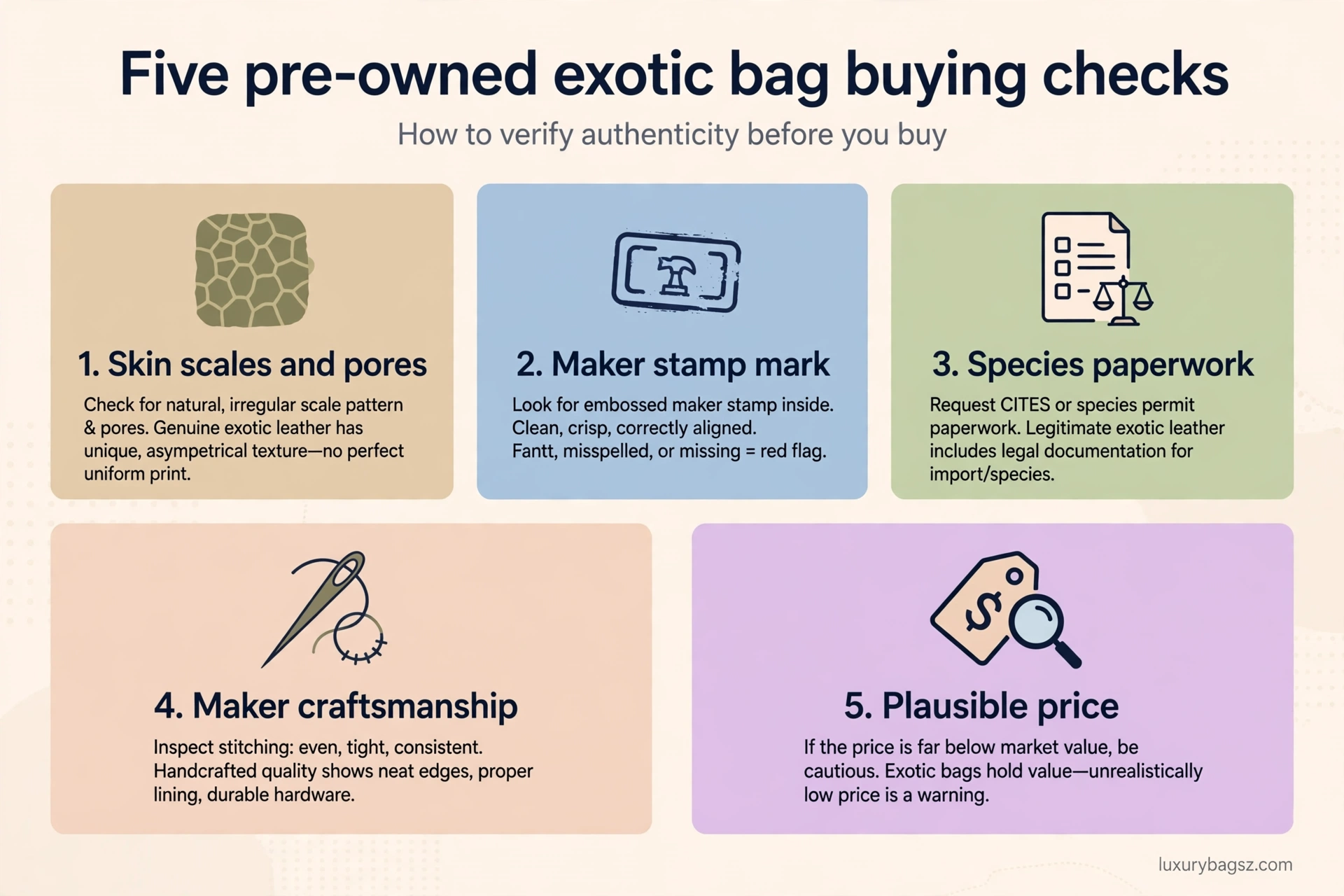
Start pre-owned exotic shopping with the seller, not the scales. Buy from a reputable reseller or a maker boutique, and ask for clear photos of the scales, the stamp, and any species paperwork before paying. Crocodile and alligator are regulated under CITES, so legitimate trade usually leaves a paper trail worth asking about.
Run the full authentication routine alongside the skin checks. Stitching, hardware, edge finishing, and stamp quality should match the maker's standard, and the price should sit in a plausible range for the species claimed.
Our guide on how to authenticate a pre-owned bag covers that wider routine, and the fake Birkin checks show how a single wrong detail can undo a convincing skin.
Treat three red flags as walk-away signals. Splotchy, uneven dye points toward caiman, whose bony plates resist even dyeing. A species claim with no supporting mark or paperwork deserves doubt, not benefit of the doubt. And a price far below market for a claimed Porosus bag almost always means the skin, the maker, or both are not what the listing says.
Caring for Exotic Leather Once You Own It
Exotic leather rewards gentle, infrequent care. Keep it away from water, direct heat, and prolonged sun, and wipe it with a soft, dry cloth after wear. Never soak it, and never use a product made for smooth calf leather without checking it suits exotics first.
Conditioning is a light-touch job on these skins, and over-conditioning can darken or dull the finish. Our guide to reptile leather sets out the safe routine by skin type, and the wider guide to leather bags and shoes covers storage, stuffing, and dust bags that keep any structured bag in shape.
Store an exotic bag stuffed, upright, and in its dust bag, away from other hardware that could scratch the scales. Scales catch and lift when rubbed against zips and buckles, and a lifted scale on an exotic panel shows far more than a scuff on plain leather.
Frequently Asked Questions
What is the easiest way to tell crocodile from alligator leather?
Look for tiny pores on the body scales. Crocodile usually shows a small dot on each scale, while alligator belly leather does not. Check several areas under good light before deciding.
Does alligator leather always show an umbilical scar?
No. Every alligator has one, but it sits on only a small part of the hide, so many genuine alligator bags do not include it. Finding the scar confirms alligator, but missing it proves nothing.
Is alligator leather always more square than crocodile?
No, that rule is too simple. Both skins vary naturally, and the cut changes how regular the pattern looks. Judge the belly-to-side transition and the pores rather than one scale's shape.
What do the Hermès stamp marks mean?
A ^ caret means Porosus crocodile, .. means Niloticus crocodile, a square means American alligator, and a circle means caiman. The mark sits beside the brand stamp on the bag or its lining.
Which is more valuable, crocodile or alligator?
Porosus crocodile usually commands the highest prices, with Niloticus close behind and American alligator also highly valued. Condition, maker, colour, and size move the price as much as species.
What is the difference between Porosus and Niloticus crocodile?
Porosus is saltwater crocodile with small, even, square scales and clear pores. Niloticus is Nile crocodile with slightly larger scales and pores that can be fainter on some samples.
How can I spot caiman passed off as crocodile or alligator?
Caiman feels stiffer, dyes unevenly because of bony plates in the skin, and cracks more readily in creases. Its scales also run tall and rectangular rather than square.
Can I identify exotic leather from a small panel?
Often not reliably. Small panels may show too few scales to judge pores, transition, or scar. In that case rely on maker marks, paperwork, and professional authentication.
Do crocodile and alligator leathers need different care?
The basics match: keep them dry, out of direct heat and sun, and wipe with a soft dry cloth. Avoid soaking and heavy conditioning, and follow an exotic-specific routine rather than a generic leather one.
Should I buy an exotic bag without species paperwork?
Ask for it first, and be cautious without it. Regulated exotic trade usually leaves a paper trail, and a missing trail plus a low price is a strong reason to walk away or seek expert authentication.
Final Verdict
Tell crocodile from alligator by stacking clues, never by trusting one. Pores point to crocodile, the umbilical scar proves alligator, the scale transition backs either call up, and the maker stamp ties the skin to a name. Where those clues disagree or disappear, paperwork and expert authentication must fill the gap.
That discipline protects both your money and the animal behind the leather. A bag whose skin, stamp, and story all agree is worth its price; a bag that leans on a single pretty panel is not.






