How to Spot a Fake Saint Laurent Bag: 10 Checks
Spotting a Fake Saint Laurent in Brief
Begin with the evidence that proves least: the cards. A Saint Laurent card can be genuine beside a fake bag, and counterfeiters now copy real serial formats and real serial numbers, so paper and printed codes support a verdict — they never carry one.
The bag itself fails or passes on letterforms, serial tags and hardware engraving, not on first impressions. Check in this order: heat stamp, serial tag, hardware, stitching and leather, then dust bag and cards.
If two or more checks fail, walk away. If doubt remains, pay for professional authentication before you pay the seller.
Saint Laurent lettering is unforgiving, which is why it is my first check. The interior stamp’s letterforms — the height of the letters, the spacing, the smaller PARIS beneath — are drawn, not typed, and copies almost always borrow a similar font rather than the real one. Because I own preloved bags myself, including pieces I have checked stitch by stitch before buying, I know how that stamp should look aged as well as new. Next I read the serial tag and test its format against the production month and year it claims.
The Check Order: Stamp, Serial, Hardware, Stitching, Extras
Start with the heat stamp, because fakes get its letterforms wrong most often. Then read the serial tag, because its format and digit shapes separate careful copies from careless ones. Then check the hardware engraving, which needs only your eyes and fingers.
Only then check stitching and leather, comparing against a genuine bag of the same model rather than a general idea of quality. Finish with the dust bag and cards, which are useful supporting evidence and never proof on their own.
LegitGrails, the strongest guide read for this article, uses exactly this order, and it is the order this guide follows throughout. Skipping ahead to the cards is the most common buyer mistake.
The Heat Stamp: SAINT LAURENT PARIS Letterforms
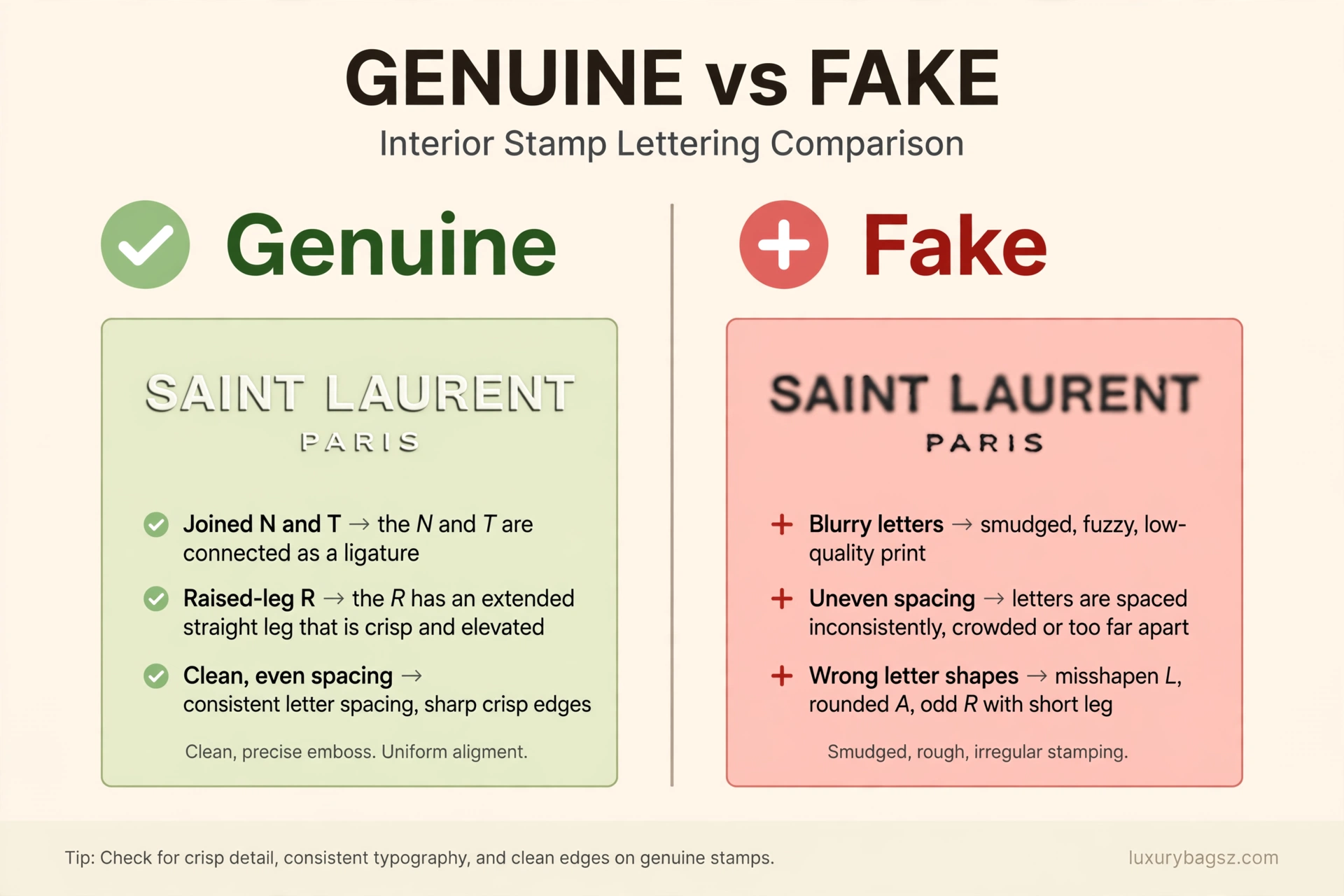
The interior stamp on a current bag reads SAINT LAURENT, with a smaller PARIS underneath, then the country of manufacture, usually MADE IN ITALY. All three lines use the brand's own letterforms, and the PARIS line is set much smaller, in square letters with small serifs.
Look at three details. The N and T of LAURENT are joined when the wordmark runs in a straight line. The R has a slightly raised leg. The PARIS line and the MADE IN ITALY stamp beneath it are, per LegitGrails, the places counterfeiters most often get the letter shapes wrong.
Blurry lettering, uneven spacing, wrong fonts and misalignment are all fake tells. Compare the stamp against genuine photos of the same model, because letterforms vary slightly by bag and by year.
The Cassandre Monogram: Y, S and L Anatomy
Two logos appear on a Saint Laurent bag. The interlocking YSL monogram on the flap or clasp is the Cassandre monogram, drawn for the house by the graphic designer Cassandre in 1961. The SAINT LAURENT PARIS wordmark arrived with the 2012 rebrand, when the house dropped Yves from the ready-to-wear name and kept the YSL monogram for accessories.
The monogram should always be polished and precise. The left arm of the Y is slightly thicker and sits under the S, while the right arm sits on top of it. The S swoops behind the bottom half of the Y, crosses over the L and tucks behind it, and its stroke changes weight through the middle. The upright of the L starts wider at the top and narrows as it meets the foot.
Some authentic bags have four small mock nails in the corners: two at the tops of the Y, one at the bottom left of the S, and one at the bottom right of the L. Where present they should look round and full, but they are not foolproof, because not all genuine bags feature them.
Serial Tags: Current Format and Older Tags
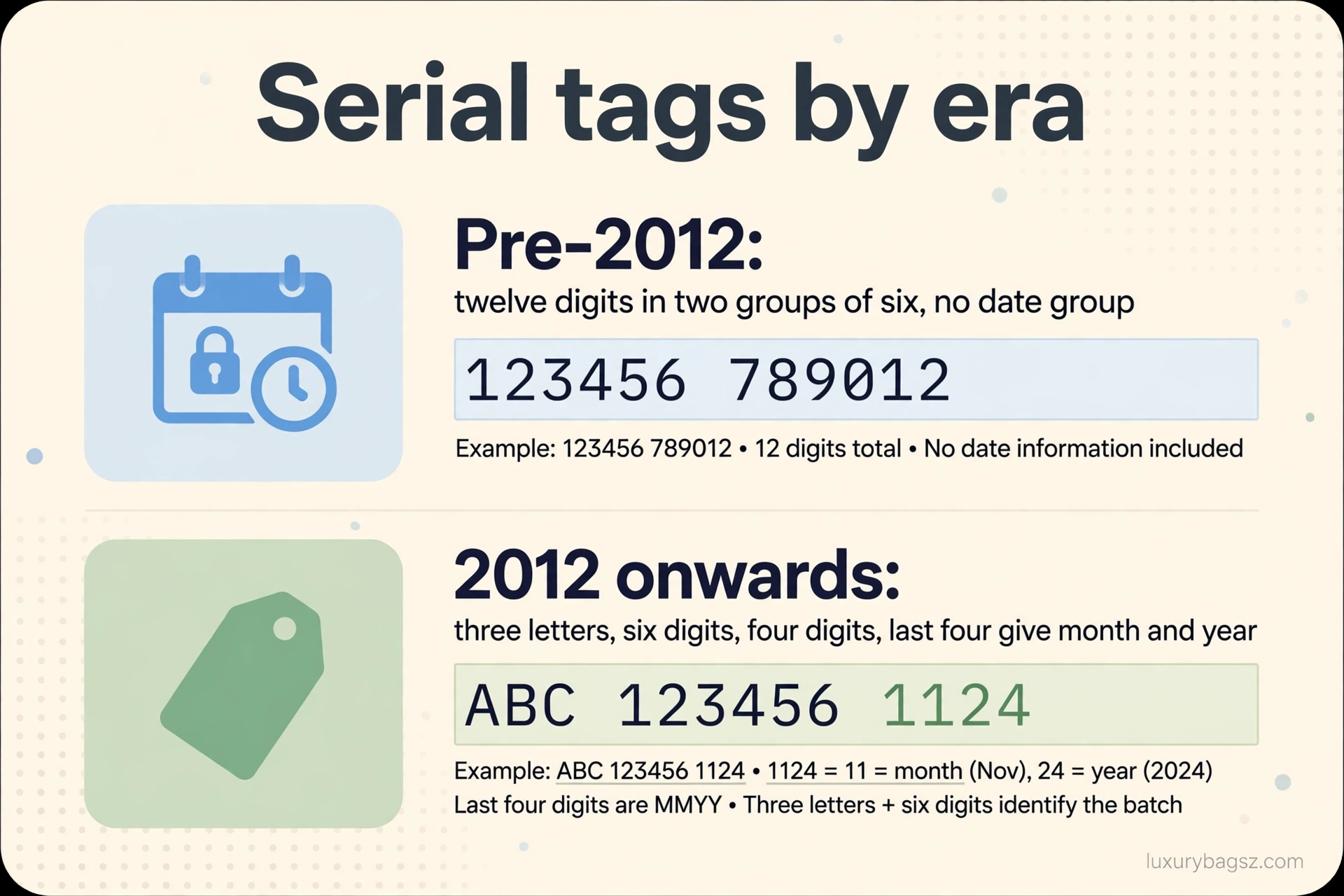
The serial sits on a separate small leather tag, usually sewn into the lining near the top zip and cut from the same leather as the bag, so it is easy to miss on a dark interior. On a current bag it reads three letters, a six-digit style number and a four-digit date group, for example MAL657228 0721.
Read the last four digits straight through: the first two are the month and the last two the year, so a tag ending 0419 was made in April 2019. The six middle digits are the model's style number, shared by every bag of that style. Older bags made before the 2012 rebrand use a different tag of twelve digits in two groups of six, with no date group in it.
A serial that decodes cleanly does not prove the bag is real. Counterfeiters copy real serials and real formats, and LegitGrails prints a counterfeit tag ending 0518, a perfectly valid May 2018, beside its genuine examples.
What separates them is digit shape and depth: on current bags the digits are tall and each one is struck separately, so they do not sit on a perfectly straight line. A row that looks printed or sunk in as one block is a warning sign.
| Era | Tag | Date group |
|---|---|---|
| Pre-2012 (Yves Saint Laurent) | Twelve digits, two groups of six | None |
| 2012 onwards (Saint Laurent Paris) | Three letters, six digits, four digits | Last four: month then year |
No verified microchip or NFC-era detail for Saint Laurent was found in the sources read for this guide, so the era table covers only what is verified: the rebrand and the tag change. Do not trust any seller claim about a YSL microchip without independent confirmation.
Stitching and Quilting: Loulou Y-Quilt and Niki Chevron
Genuine Saint Laurent stitching is precise and even, with no loose threads or uneven lines, and uniform colour and spacing. On quilted bags, every quilting line is a row of stitches, so the same rule applies: straight rows, even spacing and no wandering lines.
On the Loulou the quilting forms Y-shaped lines, and the College, Puffer and Becky are quilted too. On the Niki the quilting is chevron topstitching. Compare quilting against a genuine bag of the same model, because the pattern differs by model.
One caution: some genuine bags have no edge stitching and are finished at the edges instead, so a missing edge stitch is not a fault on its own. LegitCheck's stitching guidance is internally contradictory across its own steps, describing authentic stitching as both denser and thinner than fakes in different places, so treat stitching density as model and area dependent, never as a standalone verdict. Each step follows the Luxury Bagsz authentication process, which sets out the checks in full.
Hardware: Plaques, Chains, Zippers and Screws
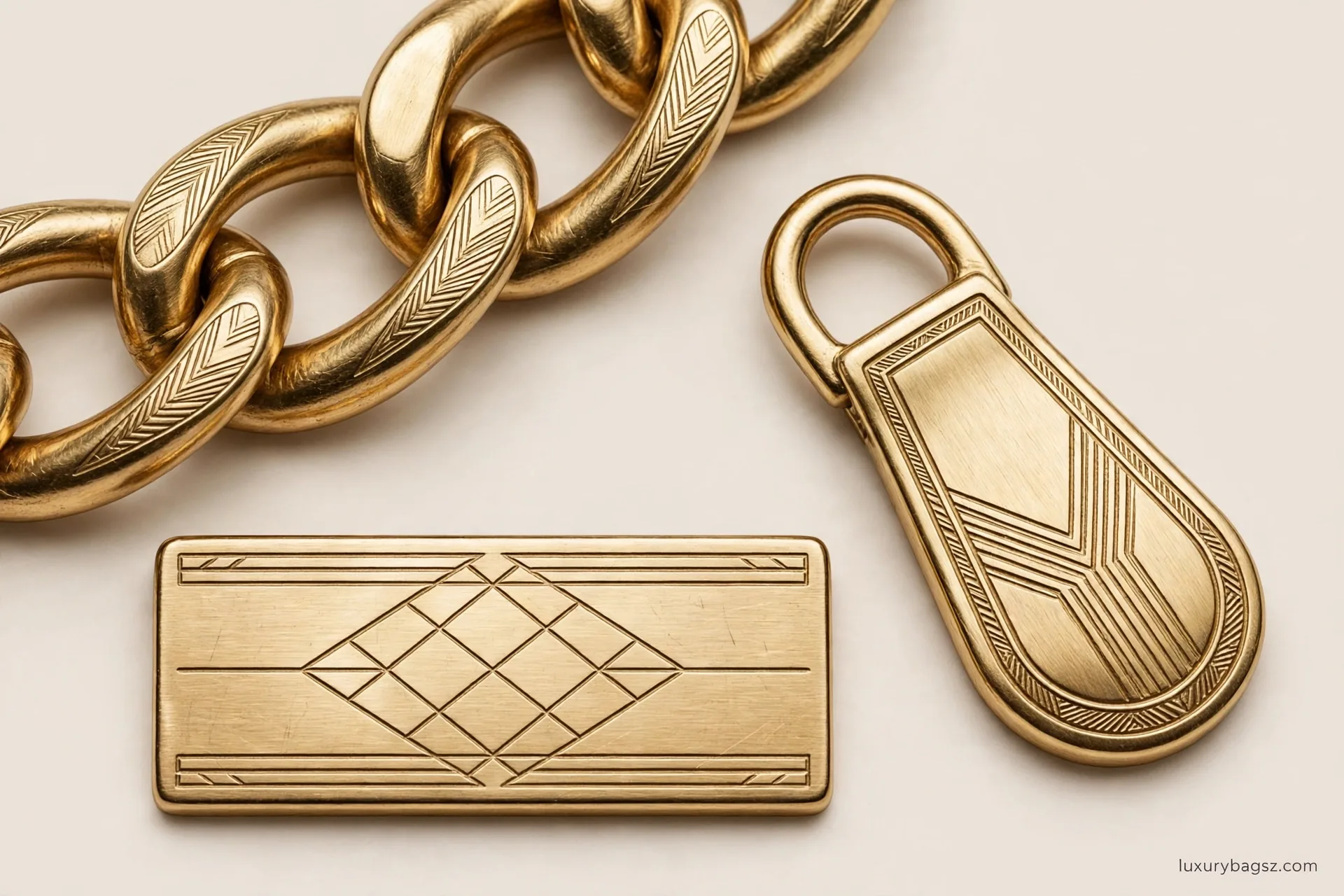
Genuine hardware is solid metal with an even finish, and the edges of the YSL plaque are polished round. Engraving should be clean and engraved into the metal, not painted on, with flat groove floors and crisp outlines.
Saint Laurent mostly uses Lampo zippers. On current bags the back of the zipper pull is engraved SAINT LAURENT PARIS in small, dense letters that should still be legible. Some genuine Niki bags pair a Lampo pull with YKK teeth, which is normal and not a fault.
On round or curved hardware the N and T of LAURENT are not joined, because the letters follow the curve. Only straight-line engraving joins them. This shape qualifier resolves the apparent disagreement between sources: one source says N and T should touch slightly at the top, and LegitGrails says they are not joined on curved hardware. Both are true, for different hardware shapes.
For chain straps, check the metal plate. On the Kate it reads SAINT LAURENT on the front and is fixed on the back with one or two hollow hex screws. A cross-head screw there is a counterfeit sign. Metal strap clasps are often engraved on both sides, and the smaller the lettering, the more often a counterfeit blurs it, so look hardest at PARIS.
Saint Laurent's hardware finishes run across the house, and the Arty ring shows the same antique gold and silver options found on the bags. Leather straps should have neatly stitched edges, and any lettering stamped on them should match the interior stamp.

Loulou Checklist: Puff, Quilting and Pouch
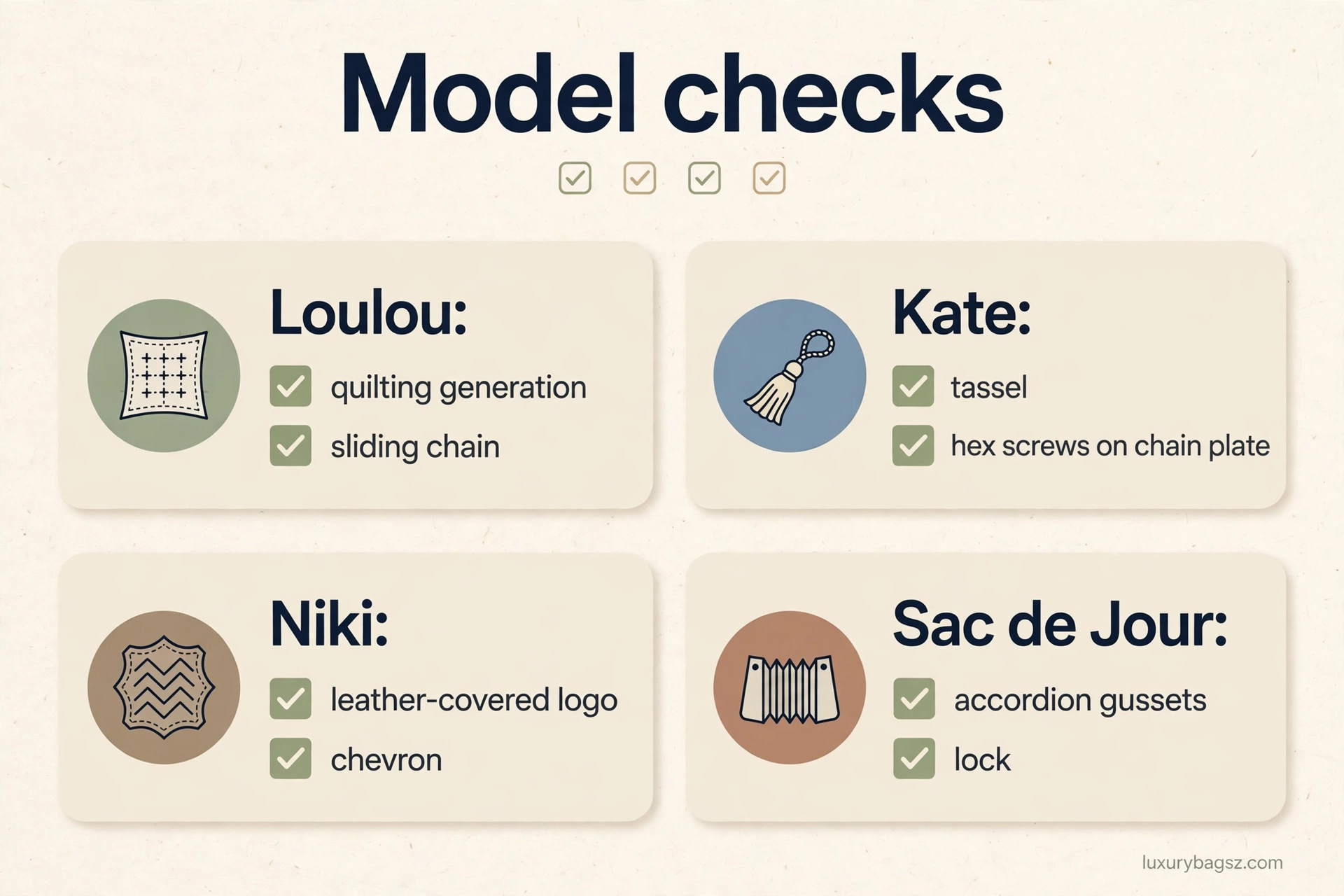
For a Loulou, establish the generation first. The original is puffy Y-quilted matelassé lambskin, while the December 2024 redesign is sleeker, structured and chevron-topstitched, with a removable leather pouch and pocket mirror added. A puffy bag sold as new is either old stock or misdescribed.
Check the quilting: Y-shaped lines, even spacing, consistent puff on the original, and flat, even chevron topstitching on the redesign. Check the sliding chain for smooth movement, and check the interior: cotton-lined, two compartments divided by a middle zip pocket, with a full-length zip slot at the back.
Check the white style card against the serial tag: its six digits should match the middle six digits of the serial. A mismatch means look closer, while a match proves nothing, because counterfeit cards print style numbers too.
Kate Checklist: Tassel, Chain Plate and Clutch Trick
For a Kate, check the tassel first: it is not removable, so a tassel that detaches or feels loosely attached is suspect. Check the structured flap for clean lines and even stitching, and check that the bag holds its boxy shape rather than slouching.
Check the chain plate: SAINT LAURENT on the front, hollow hex screws on the back, never cross-head screws. Check the chain itself for even links and clean engraving, and check the single compartment with its small back pocket for cards or cash.
Remember the clutch trick: the Kate's chain is detachable but not adjustable, and tucking it inside turns the bag into a clutch. A Kate whose chain cannot be tucked inside, or whose chain is fixed in place, fails this check.
Niki Checklist: Leather-Covered Logo and Sliding Strap
For a Niki, check the logo first: Classic Niki initials must be tonal leather-covered, not metal. A metal logo on a Classic Niki is a fake tell, while on a Tripouch a metal Cassandre is correct, so check the model before judging the logo.
Check the chevron alignment across the flap and body, the crinkled vintage leather for a consistent distressed finish, and the sliding strap for smooth movement and a firm lock. Check the magnetic snap, which is strong on genuine bags, and the large flat back pocket.
Niki distressed leather is the hardest material to judge from photos, because genuine distressing varies from bag to bag. Ask for close photos of the logo, the chevron and the strap mechanism, and compare them against genuine photos of the same size.
Sac de Jour Checklist: Accordion, Lock and Seams
For a Sac de Jour, check the accordion gussets first: they should expand evenly and hold their shape, with the bag standing upright rather than leaning. Check the lock and key, which should carry a clean logo and operate smoothly.
Check the lining, which is ultra-suede on genuine bags, and the seams, which are glossy wax-coated raw seams. Check the leather smell, which should be genuine leather rather than chemical, and check the overall structure, because a Sac de Jour that collapses has lost its defining shape.
Hardware finishes vary by model and season. Loulou hardware spans antique silver, silver, matte black, bronze and bronze rope, while Kate hardware runs silver, gold and black metal. No complete verified finish-by-model table exists, so treat any seller claim about a definitive finish list with caution.
Dust Bags and Cards: What They Prove
A genuine dust bag is usually black, with SAINT LAURENT printed in white in the brand's own letterforms. Where PARIS appears under it, PARIS is set much smaller than SAINT LAURENT. The care label inside repeats the logo, and one digit in its short printed row of numbers shows a small break in the stroke, the same detail as on the CONTRÔLE card.
Counterfeit dust bags often feel cheap, print SAINT LAURENT and PARIS at the same size, or feel rough and low-quality. But a dust bag can also come from a different bag, so even a genuine one tells you nothing about the bag inside it.
The cards follow the same rule. New bags come with a black SAINT LAURENT PARIS card, a smaller CONTRÔLE card printed with the digits 1 to 0, a white card listing the style name, style number and materials, and a care booklet. The two black cards carry no number tied to the individual bag, and counterfeiters copy both.
On a genuine CONTRÔLE card, the logo follows the brand's letterforms, including the R with a raised leg, and one or two printed digits show a small break in the stroke. Which digit varies from card to card. Counterfeit cards show a plain R and unbroken digits. A missing card does not make a bag fake, because pre-owned bags lose paperwork all the time.
Seller Checks, Photos and Price Red Flags
Ask for clear photos of the heat stamp, the serial tag, the hardware engraving and the quilting before you pay. A seller who refuses serial photos, or who pressures you to complete quickly, is using the same tactics warned about for other brands.
Watch for stolen photos and bait-and-switch listings, where the photos show a real bag and the parcel contains a fake. Ask for a photo of the bag beside a handwritten note with today's date, which is hard to fake from stolen images.
Price alone never proves a fake, per LegitGrails: a price far below the market is a warning sign, but counterfeits are also sold at full price. Compare against the pre-owned market for the same model and generation, not against boutique prices, and treat any unexplained deep discount as a reason to check harder, not as a bargain.
The same discipline applies across brands. Our Classic Flap vs Boy comparison shows how pre-owned checks differ by model, and the principle is identical: judge the bag first, the paperwork last.
Professional Authentication Compared
Online photo authentication is the fastest option. LegitGrails offers Saint Laurent authentication from clear photos of the logo, the heat stamp, the serial tag and the hardware, with a result in under 30 minutes and a certificate with every order.
In-person authentication suits high-value purchases, where an authenticator can handle the bag, check the leather feel and weigh the hardware. It costs more and takes longer, but it catches the material details that photos can hide.
Choose photo authentication for standard pre-owned purchases, and in-person authentication for expensive bags or any purchase where the photo checks disagree. Either way, get the result in writing before you pay, because a written report is what a marketplace dispute needs.
What to Do If Your Bag Is Fake
Stop using it as genuine and keep every record: the listing, the photos, the messages and the payment proof. Contact the seller first and ask for a refund, stating the failed checks plainly and calmly.
If the seller refuses, report the listing to the marketplace and open its dispute process within its timeline, because late claims are often rejected regardless of merit. A professional authentication report strengthens any claim, so get one in writing.
For future purchases, use professional authentication before paying whenever the price is high. Saint Laurent boutiques do not settle pre-owned disputes, so do not rely on a boutique visit to resolve a fake claim.
Frequently Asked Questions
Do YSL bags come with an authenticity card?
Yes, but not with a certificate you can verify. New bags come with paper inserts, including a black SAINT LAURENT PARIS card and a CONTRÔLE card, but neither carries a number tied to your bag.
How do I check a YSL serial number?
Read the last four digits of a current tag: the first two are the month and the last two the year, so 0419 means April 2019. A clean decode proves nothing alone, because counterfeiters copy real formats.
Where is the serial number on a YSL bag?
On a small leather tag sewn into the lining, usually near the top zip, often in the same colour as the interior. Current tags read three letters, six digits and four more digits.
Does a dust bag prove a YSL bag is real?
No. A dust bag can come from a different bag, and counterfeit bags often come with convincing ones. Treat it as a minor detail next to the stamp, serial and hardware.
What is the YSL CONTRÔLE card?
A small black card printed with the digits 1 to 0, packed with new bags. It carries no number tied to your bag, and genuine cards show a small break in the stroke of one or two printed digits.
How do I spot a fake Loulou?
Establish the generation first, then check Y-quilt or chevron quilting, the sliding chain, the two-compartment interior and the white card against the serial tag.
How do I spot a fake Kate?
Check the non-removable tassel, the chain plate with hollow hex screws, the structured flap and the single compartment. A cross-head screw on the chain plate is a fake sign.
How do I spot a fake Niki?
Check the tonal leather-covered logo, chevron alignment, sliding-strap mechanism and serial tag format. A metal logo on a Classic Niki is a fake tell.
Should I pay for professional authentication?
Yes, for any expensive pre-owned purchase. Photo authentication gives a result in under 30 minutes with a certificate, while in-person authentication suits high-value bags.
What should I do if I bought a fake YSL?
Keep all records, ask the seller for a refund, report the listing and open a marketplace dispute within its timeline. A written professional authentication report strengthens your claim.
Conclusion
Spotting a fake Saint Laurent bag comes down to letterforms, serial tags and hardware engraving, checked in that order. The heat stamp's PARIS line, the serial tag's digit shapes and the chain plate's screws catch the fakes that general impressions miss.
Model checklists for Loulou, Kate, Niki and Sac de Jour catch the rest, and the cards myth is the trap to avoid: no card in the box proves a bag real. Check the bag first, get professional authentication in writing for expensive purchases, and a pre-owned Saint Laurent becomes a pleasure rather than a gamble.