Chanel Classic Flap vs Boy Bag: Which One Should You Buy?
Classic or Boy: The Short Answer
Buy the Classic Flap if you want the softest, most formal Chanel icon, and the one that holds its value best at resale. Buy the Boy if you want a sharper, more modern bag that is easier to wear every day and costs thousands less at the boutique.
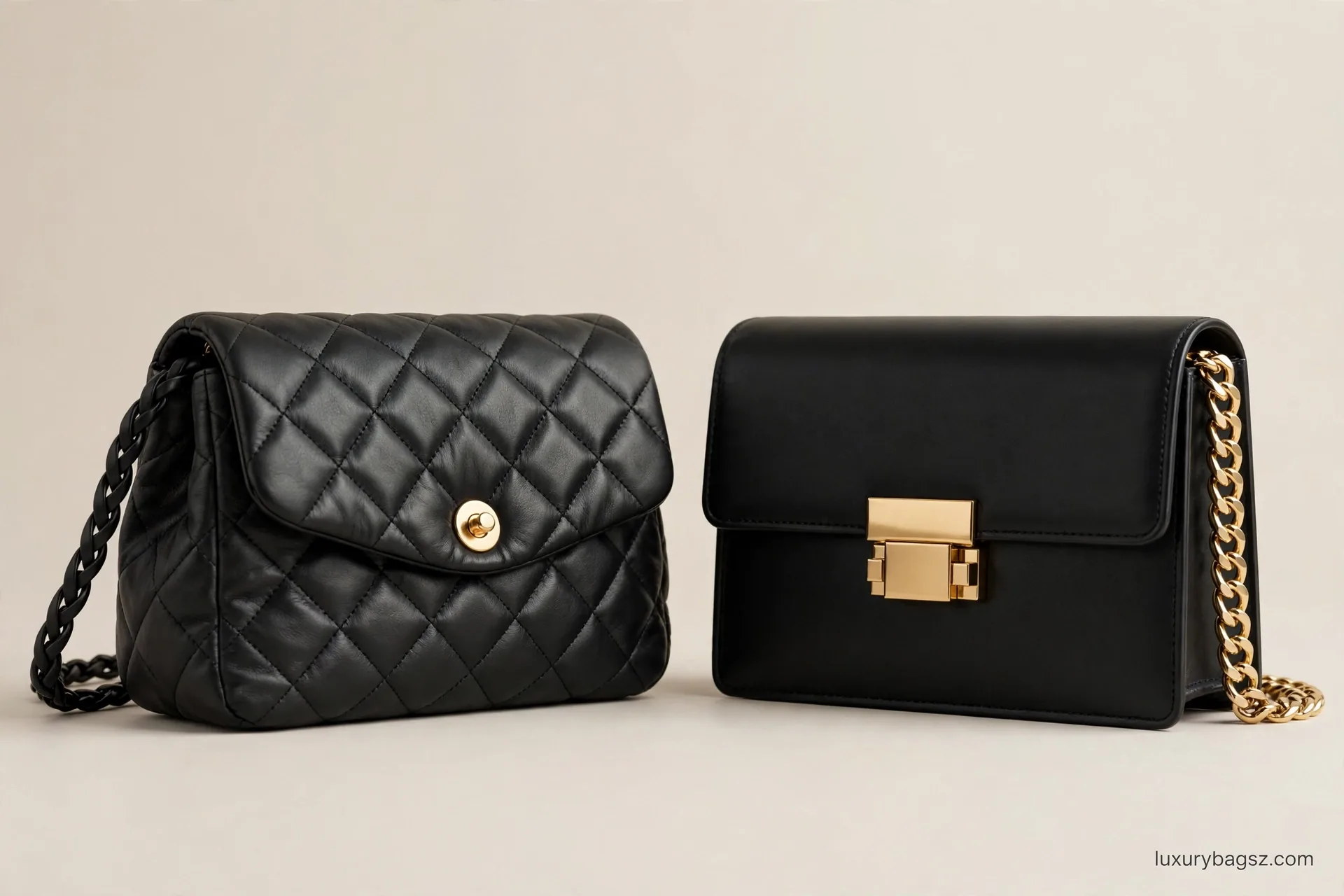
The two bags look like cousins, but they are built differently. The Classic Flap is soft, curved and quilted, with a leather-woven chain. The Boy is flat, rectangular and structured, with a chunky metal chain and a bold rectangular clasp.
Size for size, the Boy is usually the roomier bag, because its boxy body wastes less space than the Classic’s soft curves. But the Classic’s Medium is the safer all-rounder, and it is the size most buyers reach for first.
Prices have moved a long way from the figures in older guides. In 2026 trackers, a Classic Medium sits near $11,700, while a Boy New Medium sits near $7,600. That gap of roughly $4,000 is the single biggest practical difference between the two bags.
Key Takeaways
- Classic Flap = soft, curved, formal, best resale. Boy = structured, modern, easier daily wear, lower price.
- Classic Medium (25.5 x 15.5 cm) is the most popular all-rounder. Boy Old Medium (25 x 15 cm) is its closest rival.
- The Boy is usually roomier size for size, thanks to its boxy shape and deeper body.
- In 2026, the Classic costs roughly $4,000 more than the Boy at comparable sizes.
- Both bags are faked constantly. Check quilting, chain, clasp, serial or microchip, and corners before paying.
- Try both on if you can. Chain comfort and body fit decide more buyers than any size chart.
Two Bags, Two Personalities
The Classic Flap begins with the 2.55, the bag Coco Chanel designed in February 1955. It had a rectangular Mademoiselle lock, a chain strap, and a quilted body inspired by equestrian jackets.
Karl Lagerfeld reworked that bag in the 1980s. He kept the quilting and the chain, but he replaced the Mademoiselle lock with the interlocking CC turn-lock. That updated bag is the Classic Flap, now also known by its style code 11.12.
The Boy arrived much later, in 2011. Lagerfeld named it after Boy Capel, Coco Chanel’s great love, and built it as a deliberate contrast to the Classic. Where the Classic is soft, the Boy is hard-edged. Where the Classic whispers, the Boy states its case plainly.
One guide, PurseBlog, lists the Boy’s creation year as 2012 rather than 2011. Most other guides say 2011, and this guide follows the majority while noting the disagreement. The difference does not change how the bag wears, but it matters if you are dating a pre-owned piece.
Chanel has reinvented its own codes before, and the Cambon bag is another example of a house style built around a bold, graphic look rather than quiet quilting. The Boy belongs in that bolder tradition, while the Classic belongs in the quiet one.
Shape and Structure at a Glance
The Classic Flap is a soft bag. Its body gives when you press it, its flap curves over the front, and its quilting puffs up between the stitch lines. Even in caviar leather, which is firmer than lambskin, it keeps a rounded, yielding shape.
The Boy is a structured bag. Its body holds a flat rectangle even when empty, its flap is a straight line across the front, and its corners stay sharp. It looks like a small briefcase next to the Classic’s soft pouch, and that is exactly the point.
This difference changes how each bag ages. The Classic softens further with wear and can slouch a little at the sides. The Boy keeps its shape for years, but its sharp corners are the first place to show scuffs.
It also changes what each bag suits. The Classic suits tailored outfits, evening wear, and formal rooms. The Boy suits jackets, denim, and outfits that already have a harder edge.
Neither shape is better in itself. The question is which shape matches the clothes you already own.
The bag you reach for daily is the one that fits your wardrobe, not the one with the better reputation. The Boy family is wider than the flap bags alone. Chanel also makes Boy wallets on chain, clutches, and totes, and the same sharp, structured language runs through all of them. If you love the Boy look but want something smaller, the wallet on chain is worth trying before you commit to a full-size bag.
The Classic family is wider too, though in a quieter way. Seasonal Classics appear in tweed, denim, and velvet, and in colours from soft pink to deep green. The core black bags hold value best, but a seasonal Classic can be the bag that makes an ordinary outfit feel special.
Limited versions of both bags appear every season, and they split buyers sharply. Some become sought-after collectors’ pieces. Others lose value fast once the season ends. Unless you collect Chanel deliberately, buy the core version first and treat limited versions as a second purchase.
One last shape note: the Classic’s soft body means it can look slightly different from bag to bag, even in the same size and leather. Quilting puff varies, and lambskin softens with handling. If you buy in a boutique, compare two examples of the same bag before choosing, since no two are identical.
Sizes Compared, Side by Side
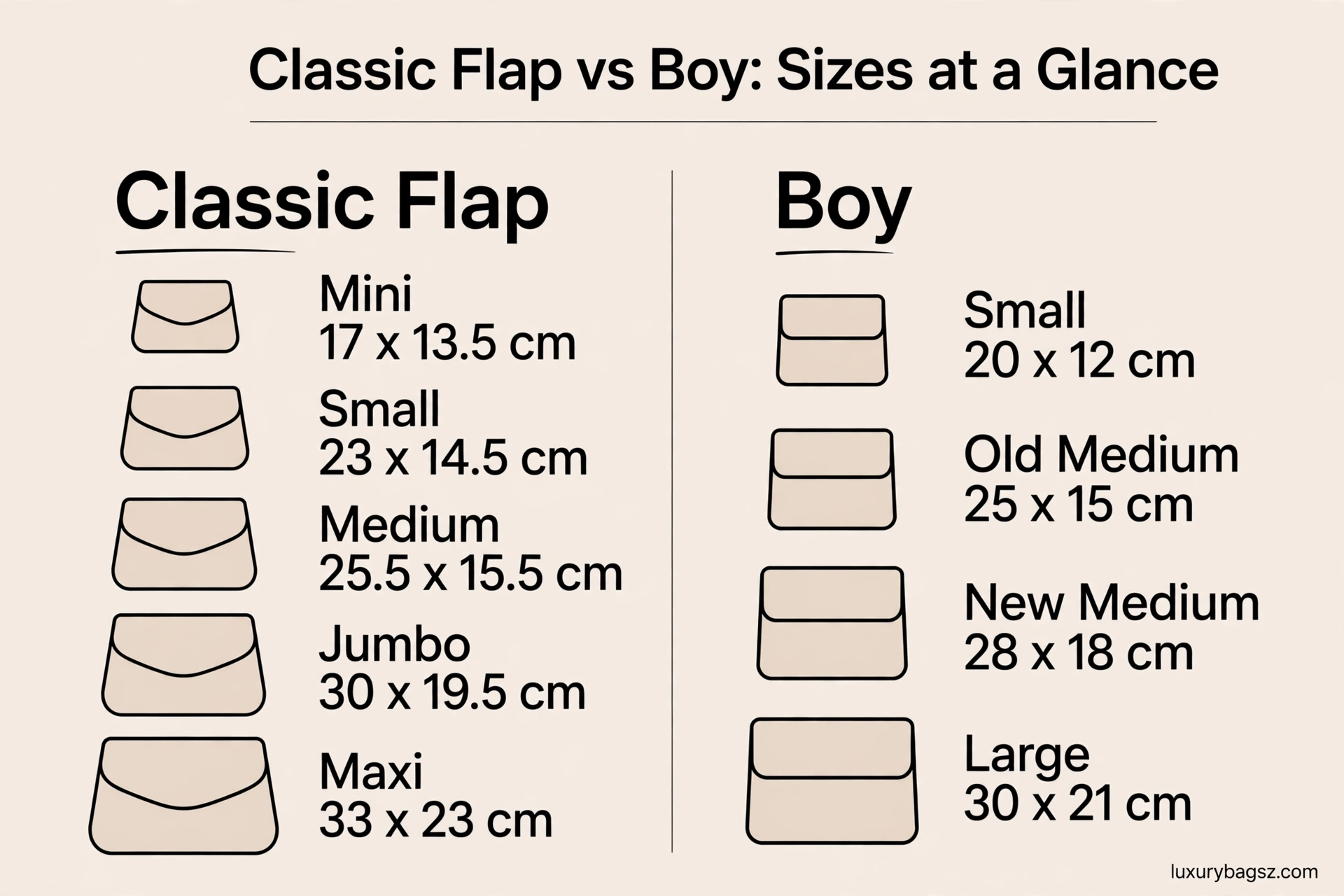
No competitor guide gives a complete side-by-side size table for both bags, so here is one, reconciled from the guides that publish dimensions. All figures are width x height x depth, and Chanel does not publish official dimensions, so treat every figure as a guide figure, not a factory measurement.
| Bag and size | Dimensions (cm) | Dimensions (inches) |
|---|---|---|
| Classic Mini Square | 17 x 13.5 x 8 | 6.6 x 5.3 x 3.1 |
| Classic Mini Rectangular | 20 x 12 x 6 | 7.8 x 4.7 x 2.3 |
| Classic Small | 23 x 14.5 x 6 | 9 x 5.7 x 2.3 |
| Classic Medium (M/L) | 25.5 x 15.5 x 6.5 | 9.9 x 6 x 2.5 |
| Classic Jumbo | 30 x 19.5 x 10 | 11.7 x 7.6 x 3.9 |
| Classic Maxi | 33 x 23 x 10 | 12.9 x 9 x 3.9 |
| Boy Small | 20 x 12 x 8 | 7.9 x 4.7 x 3.1 |
| Boy Old Medium | 25 x 15 x 9 | 9.8 x 5.9 x 3.5 |
| Boy New Medium | 28 x 18 x 9 | 11 x 7 x 3.5 |
| Boy Large | 30 x 21 x 10 | 11.8 x 8.3 x 3.9 |
Two warnings belong with this table. First, the Classic’s “Medium” is often called M/L, meaning Medium/Large, and it is the same bag, not a separate size. Second, Boy depth figures disagree across guides by about 1 to 1.5 cm.
BagVanity, for example, gives the Boy Medium as 9.8 x 6.7 x 3.1 inches, while PurseBlog gives 9.8 x 5.9 x 3.5 inches. One guide also lists the Boy New Medium depth as 7.5 cm rather than 9 cm. If you buy pre-owned, measure the actual bag rather than trusting any single table.
Strap Drop and How Each Bag Carries
The Classic Flap chain can be worn doubled over the shoulder or long across the body. Doubled, the drop is about 23 cm on the Small and Medium, about 33 to 34 cm on the Jumbo, and about 30 cm on the Maxi. Worn long, the single drop runs roughly 43 cm on the Medium and up to about 61 cm on the Maxi.
That flexibility is one of the Classic’s best features. Doubled, it sits neatly under the arm for evenings. Long, it crosses the body for hands-free days. The leather woven through the chain also stops the metal from digging into the shoulder as much as a bare chain would.
The Boy chain is a different experience. It is chunkier, heavier, and all metal, with no leather woven through it. It gives the bag its industrial edge, but it also means the strap feels harder on the shoulder, especially when the bag is full.
Here is an honest gap in the published information: most guides do not publish Boy strap-drop figures at all. This guide will not invent them. If crossbody wear matters to you, try the exact Boy size on in a boutique, or ask the seller to measure the drop on the actual bag.
As a rule, the Classic is the more comfortable shoulder bag when full, and the Boy is the more comfortable crossbody only if you like a shorter, firmer drop.
Petite buyers often prefer the Classic Small or Boy Small, since longer chains can make a bag hang below the hip. Chain length also changes how a bag sits on different bodies. On a petite frame, a long Classic chain can push the bag below the hip, where it swings as you walk. Doubling the chain fixes that, but it also shortens the drop, so the bag sits higher under the arm instead.
The Boy chain cannot be doubled in the same way, because its chunky links and fixed length are part of the design. That is worth knowing before you buy, since the drop you see in the boutique is the drop you will live with. Ask to try it crossbody and on the shoulder before deciding.
Weight settles the comfort question for many buyers. Chanel does not publish official weights for either bag, so this guide gives no weight figures. As a rough rule, expect the Boy to feel heavier than a Classic of the same size, because of its metal chain and structured body.
If you carry a bag on the same shoulder every day, alternate shoulders when you can. A heavy bag on one shoulder strains the neck over time, whatever the chain. The Classic’s softer chain helps, but no chain removes the weight of a full bag, so pack light when you can.
Clasps and Hardware
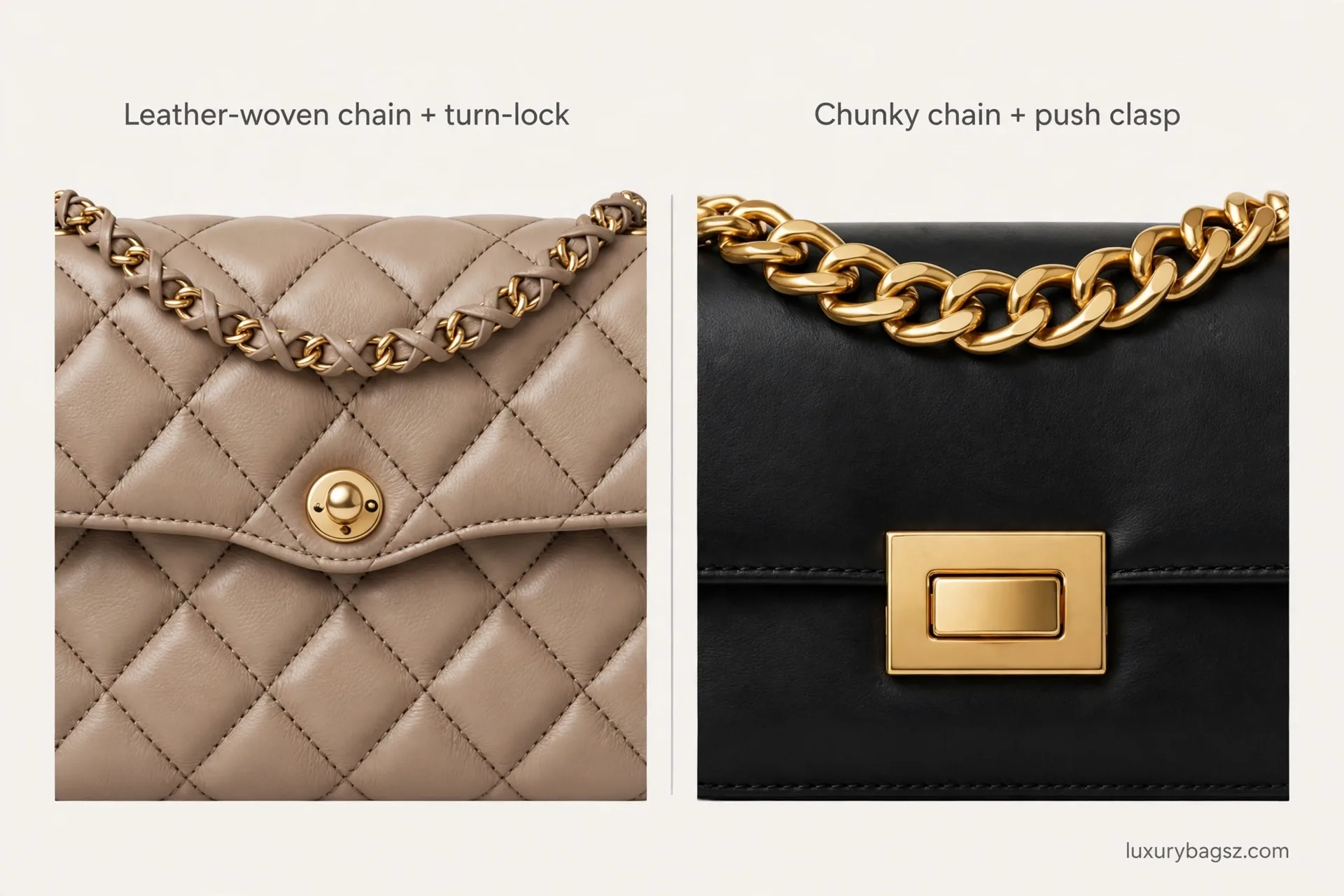
The Classic Flap closes with the CC turn-lock. You twist the interlocking letters, the flap lifts, and the bag opens. It is a quiet, elegant action, and it is also the detail counterfeiters copy most, so a real one should feel crisp and sit perfectly centred.
The Boy closes with a bold rectangular push clasp, sometimes called a sliding or Boy clasp. You press it, and the front plate releases. It feels more mechanical than the Classic’s twist, and it suits the bag’s harder character.
Hardware colour is where the Boy pulls ahead for some buyers. The Classic comes mainly in gold and silver hardware. The Boy adds ruthenium, a dark gunmetal tone, and matte black hardware, both of which read modern and understated.
That matters more than it sounds. Gold hardware suits warm outfits and classic styling. Ruthenium and matte black suit cool outfits, dark denim, and buyers who want luxury without shine. If you wear mostly silver jewellery, the Classic in silver is the safer match.
Check the clasp before you buy, new or pre-owned. A Classic turn-lock should twist smoothly and snap shut with no wobble. A Boy clasp should press and release cleanly, with no sticking. A clasp that grinds, wobbles, or sits crooked is a reason to walk away.
Interiors: Double Flap vs Single Flap
Open a Classic Flap in a main size and you find two flaps, not one. The outer flap carries the CC lock. Under it sits a second, inner flap, and only then do you reach the main compartment. That double-flap design is part of the Classic’s character, and it also adds a layer of security.
The minis are the exception. The Mini Square and Mini Rectangular are single-flap bags, because a second flap would eat too much of an already tiny interior. If a seller claims a Mini has a double flap, check the bag carefully, because that claim does not match the standard design.
The Boy has a single flap and a simpler interior. Inside you typically find a main compartment, a zip pocket, and a flat pocket, with no second flap in the way. It is faster to get in and out of, which matters if you reach for your phone often.
That simplicity has a cost. The Classic’s inner flap gives you a hidden pocket for things you want separated, like a spare key or a folded note. The Boy’s open interior means small items can drift to the bottom unless you use a pouch.
Neither interior is objectively better. If you like compartments and a ritual to opening your bag, the Classic wins. If you want to grab and go, the Boy wins.
What Actually Fits Inside
Start with the phone test, because it decides more purchases than any other. A Classic Mini Rectangular fits most phones, but little else. A Classic Mini Square may not fit larger phones at all, so check your exact phone model before buying either mini.
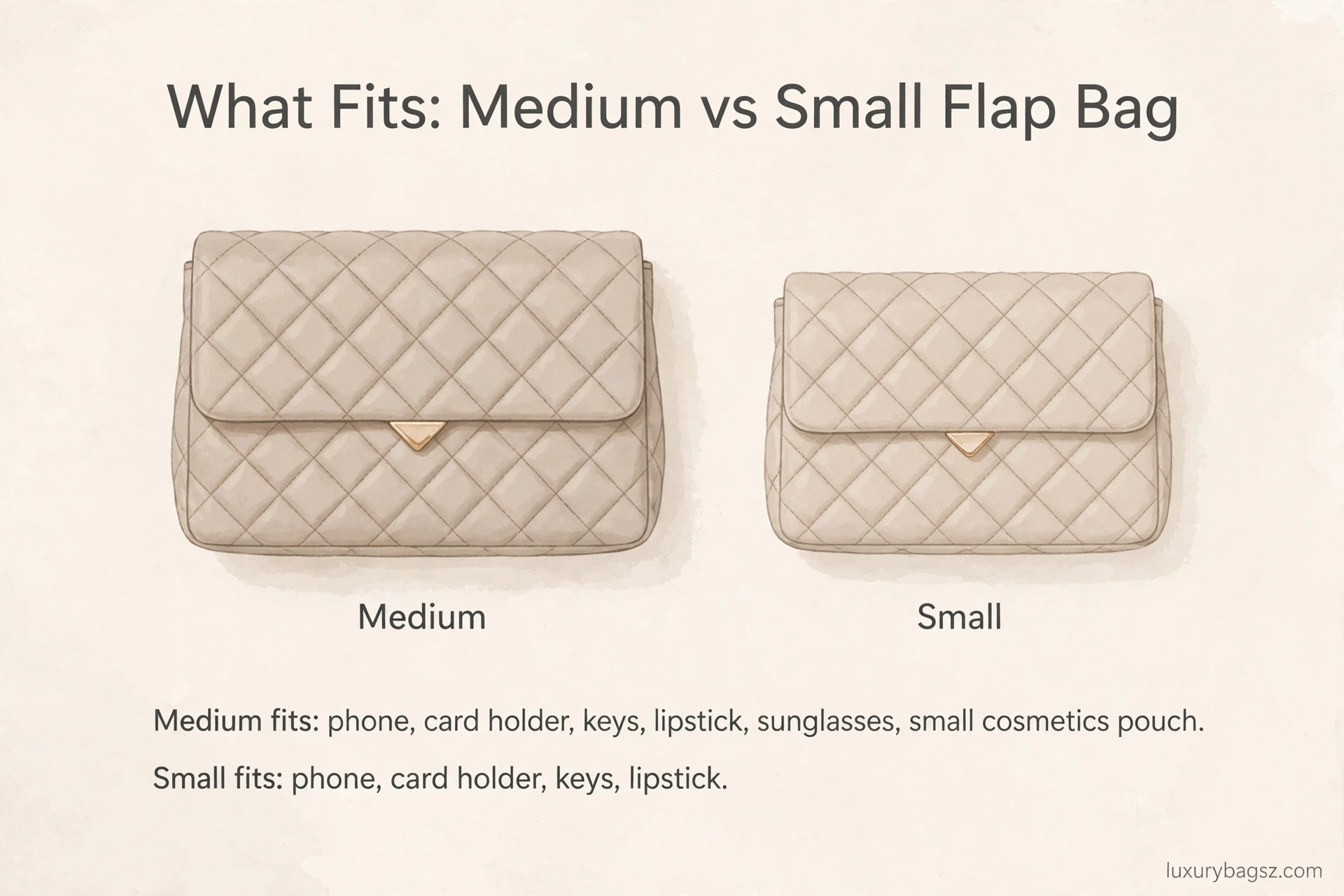
A Classic Small or Medium fits a phone, a card holder, keys, lipstick, and a slim sunglasses case. The Medium adds room for a small cosmetics pouch, but it will not hold a full wallet plus sunglasses plus a pouch at once without bulging.
A Boy Small fits a phone, a card holder, and keys comfortably, and it is deeper than the Classic Small, so it swallows a sunglasses case more easily. A Boy Old Medium fits a phone, sunglasses, a card holder, and a small makeup pouch. A Boy New Medium fits all of that plus a fuller wallet.
The Jumbo and Maxi are the only sizes that behave like day bags. A Jumbo fits a small book or tablet, a full wallet, sunglasses, and a cosmetics pouch. A Maxi fits more still, but it gets heavy, and a heavy Classic on a leather-woven chain is tiring by evening.
The honest rule is this: buy one size larger than you think you need if you carry sunglasses, and buy the size that fits your phone with room to spare if you do not. A bag that only just closes is a bag you will resent within a month.
Leather and Colours
The Classic Flap is most famous in two leathers: lambskin and caviar. Lambskin is buttery, soft, and shows the quilting at its puffiest, but it scratches and scuffs easily. Caviar is grained, firmer, and far more forgiving of daily knocks, which is why many first-time buyers choose it.
The Boy is usually made in calfskin, often smooth or lightly grained, and it also appears in lambskin and patent versions. Its structured shape suits firmer leathers, and a Boy in soft lambskin will lose its sharp edges faster than one in calfskin. If you want the Boy look to last, firmer leather is the safer choice.
Colour changes the character of each bag completely. A black Classic with gold hardware is the formal icon. A black Boy with ruthenium hardware is the modern uniform. Beige, navy, and seasonal colours suit both bags, but bright colours show wear faster on the Boy’s sharp corners.
Think about your existing wardrobe before choosing a colour. A bag in a colour you love but never wear is worse than a black bag you carry daily. Black, beige, and navy are the colours that hold resale value best, and they are also the colours that go with the most outfits.
One more leather note: patent and exotic versions of both bags exist, but they need different care and they wear differently.
Patent can crack in heat and cloud over time. If you are buying your first bag in either family, stick to lambskin, caviar, or calfskin. Seasonal colours deserve a careful look before you pay a premium for them. A seasonal pink or green can be beautiful, but it narrows the outfits the bag suits, and it narrows the resale market too. Core colours sell faster and hold value better, while seasonal colours suit collectors and second-bag buyers.
Two-tone and embellished versions appear often, from tweed Classics to studded Boys. They photograph beautifully, but they are harder to repair and harder to resell. If this is your only bag in either family, a plain leather version in a core colour is the wiser first purchase.
Hardware and leather combinations also change how a bag wears. Gold hardware warms up black caviar, while ruthenium cools down black calfskin. Silver hardware suits both families. Choose the combination that matches the jewellery you wear most, since the bag and your jewellery are seen together.
Denim transfer is the most common colour accident for both bags, especially light colours carried against dark jeans. A light beige bag and dark denim are a risky pairing. If you wear dark denim daily, choose a darker bag, or carry the bag on the shoulder away from the denim.
Prices in 2026, With the Disagreements Stated
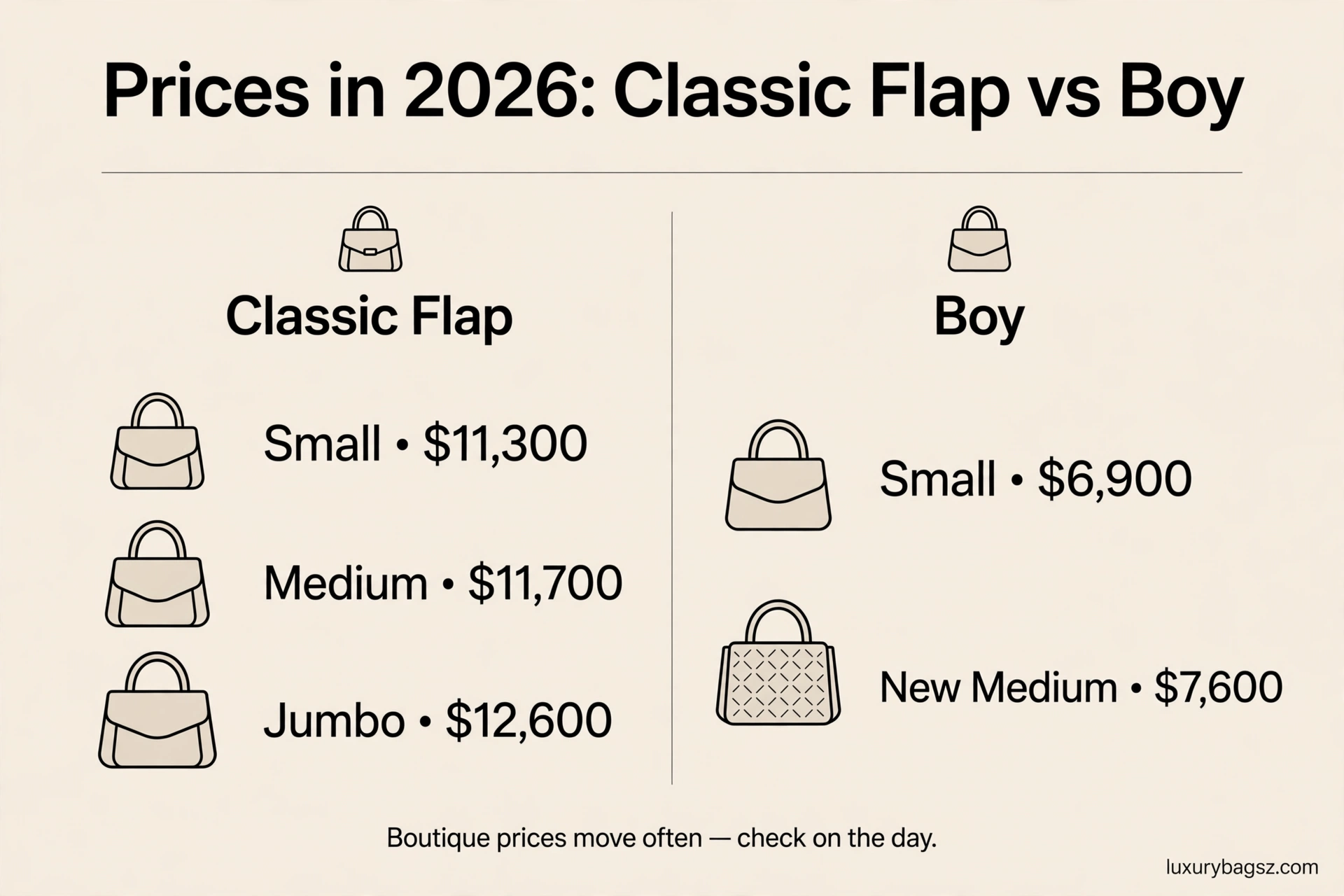
Prices are where older guides mislead most, so read this part with dates attached. The figures below come from 2026 price trackers, and they are US boutique prices for standard leathers. Exotic skins, limited colours, and special hardware cost more.
| Bag and size | 2026 boutique price (USD, approx.) |
|---|---|
| Classic Mini Square | $5,400 |
| Classic Mini Rectangular | $5,600 |
| Classic Small | $11,300 |
| Classic Medium | $11,700 |
| Classic Jumbo | $12,600 |
| Classic Maxi | $13,200 |
| Boy Small | $6,900 |
| Boy Old Medium | about $6,700 to $6,900 |
| Boy New Medium | about $7,600 to $7,800 |
| Boy Large | about $8,200 |
Now the disagreement. Older guides quote far lower figures: BagVanity puts the Classic near $5,800 and the Boy near $4,200, while PurseBlog’s Boy prices start at $4,300 for the Small. Those figures are years out of date, and anyone quoting them as current prices is misleading you.
Chanel raised prices again in April 2026, by roughly 3.5 percent on these bags. That is why a Classic Medium that older guides list near $5,800 now sits near $11,700. Always check the date on any price you read, and confirm the current boutique price on the day you buy.
The gap between the two bags is the story. At comparable sizes, the Classic costs roughly $4,000 more than the Boy. That gap buys you the more iconic bag and stronger resale, but it does not buy you more room. If budget matters, the Boy gives you the Chanel flap experience for far less money.

Resale and Investment Reality
Neither bag is a guaranteed investment, and any guide that promises one is selling you something. Both bags hold value better than most luxury purchases, but they do so for different reasons.
The Classic Flap holds value best. Black caviar Classics in Medium are the easiest Chanel bags to resell, and well-kept examples regularly trade near or above their original boutique price on the pre-owned market. That is because demand for the Classic never fades, and Chanel’s price rises keep lifting pre-owned values behind them.
The Boy holds value well, but not as well as the Classic. Trackers put Boy resale retention around 70 to 85 percent of boutique price for standard sizes and colours. Unusual colours and seasonal versions trade lower, while black with ruthenium or gold hardware trades best.
Condition decides more than the model does. A scuffed Classic sells for less than a pristine Boy, every time. Corners, chain, clasp, and interior condition are what buyers inspect first, and they are what set the price.
If resale is your main reason for buying, buy the Classic in black caviar, Medium, with gold or silver hardware, and keep the dust bag, box, and receipt.
If you are buying to wear daily, buy the bag you love, because the bag you carry is the one that earns its price. What hurts resale most is easy to list: heavy corner wear, a scratched clasp, a stained interior, and a missing dust bag. Each one knocks value off, and together they can move a bag from premium to bargain. Keep the extras, even if you never use them, because buyers pay for completeness.
Boutique price rises help existing owners, but only up to a point. When boutique prices climb, pre-owned prices usually follow, yet buyers also become pickier, and worn examples stop rising. A pristine bag gains from price rises. A worn bag often does not, whatever the model.
Timing matters if you plan to sell. Classic bags sell fastest in the months before holidays and wedding season, when gift buyers appear. Boy bags sell steadily all year, with less seasonal swing. If you are selling, list when buyers are looking, not when you happen to be clearing a shelf.
Authentication services exist for buyers who want a second opinion, and they are worth the fee on any pre-owned purchase above a few thousand dollars. A written opinion from a reputable service will not make a fake real, but it gives you a basis for a return if the bag fails.
Wearing It: Body Fit, Comfort, and Occasion
Petite buyers, roughly under 5 feet 4 inches, usually suit the Classic Small or Medium, or the Boy Small or Old Medium. Larger sizes can overwhelm a smaller frame, and a long chain can drag the bag below the hip, which looks unbalanced and feels awkward.
Taller buyers can carry the Jumbo, Maxi, and Boy New Medium or Large without the bag looking oversized. The Boy’s rectangular shape is especially flattering on taller frames, because its straight lines echo a longer silhouette rather than fighting it.
Comfort when full is where the Classic wins. Its leather-woven chain spreads weight better than the Boy’s bare metal chain, and its soft body moulds to the hip instead of pressing a hard edge into it. A full Boy New Medium on a metal chain is noticeably heavier on the shoulder by the end of a day.
Occasion matters too. The Classic is the better evening bag, the better wedding bag, and the better bag for formal work. The Boy is the better daytime bag, the better travel companion, and the better bag for outfits with denim, boots, or a leather jacket.
Try both bags on with the clothes you actually wear. Stand, sit, and walk with each one.
A bag that looks perfect on a shelf can feel wrong on your shoulder, and that feeling will not improve with time. For travel, the Boy has the edge. Its structured body protects its contents better in a tote or under a seat, and its flat shape packs neatly. The Classic travels well too, but it needs stuffing to hold its shape, and its soft body picks up pressure marks from neighbouring items.
For work, the choice depends on what you carry. A Jumbo or Maxi Classic holds documents and a tablet, but it looks formal. A Boy New Medium holds the same daily kit in a sharper shape, and it suits creative workplaces better. Neither bag replaces a proper work tote if you carry a laptop.
For evenings, the Classic is the clear winner. A Mini Rectangular or Small Classic with the chain doubled is the classic evening look, and it suits dresses in a way the Boy’s hard rectangle rarely does. The Boy Small can work for evenings, but it reads modern rather than dressy.
Rain is another practical test. Caviar and calfskin handle a shower better than lambskin, which spots in rain. If you walk a lot in wet weather, the Boy in calfskin or the Classic in caviar will worry you less than a lambskin Classic, which is best kept for dry days.
Buying Pre-Owned: Checks for Each Bag
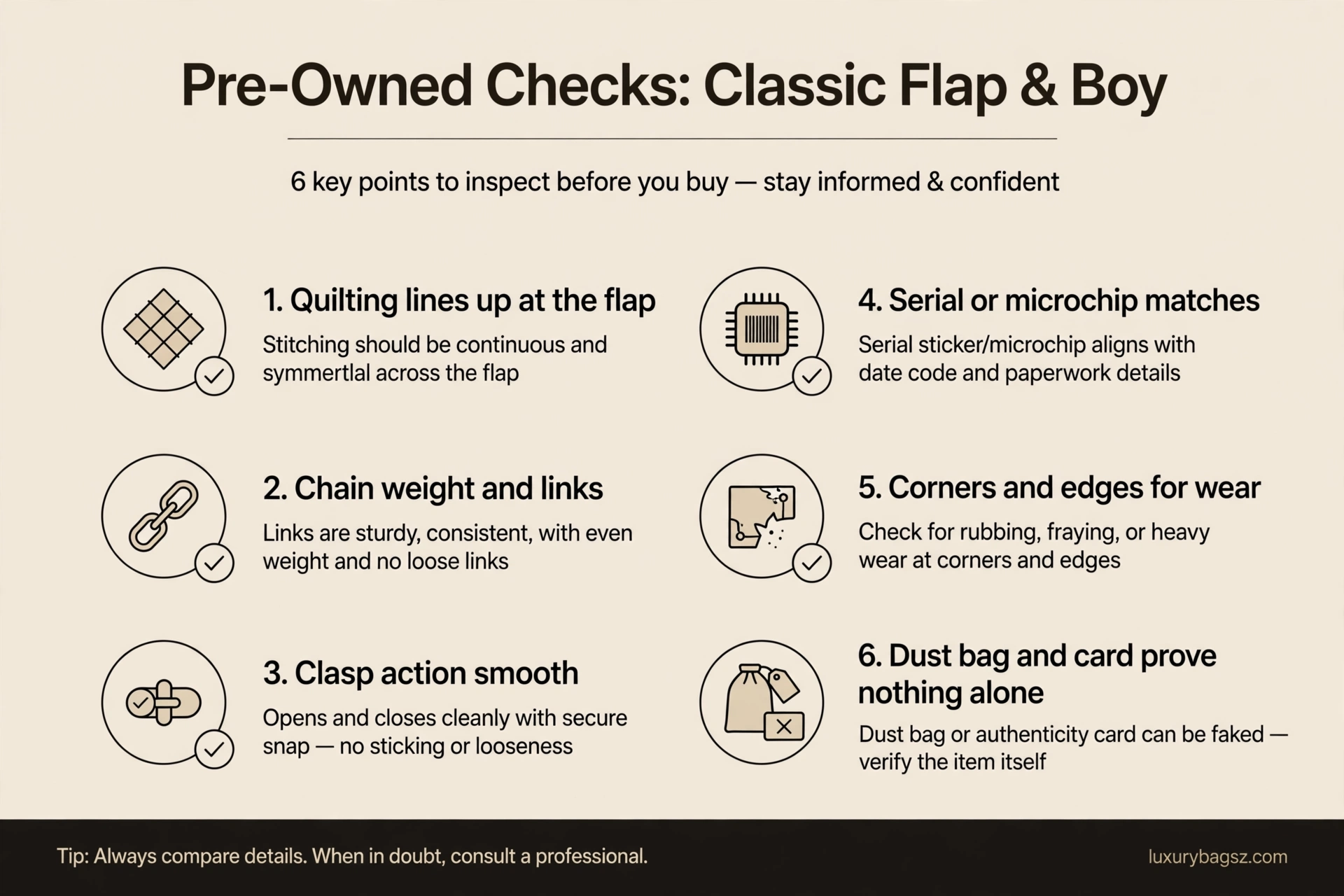
Pre-owned is where the price gap narrows, and where the risks grow. Both bags are among the most counterfeited in the world, so run these checks before you pay, and buy from a seller who accepts returns if anything fails.
First, check the quilting. On a real Classic, the diamond quilting lines up across the flap and the body, and the puffs are even. On a real Boy, the quilting, where present, is neat and the flat panels are smooth. Misaligned quilting is a strong warning sign.
Second, feel the chain. A real Classic chain has weight and its leather weaving is tight and even. A real Boy chain is heavy, chunky, and smooth in the hand. A light, hollow, or rough chain is a reason to stop and ask questions.
Third, work the clasp. The Classic turn-lock should twist crisply and sit centred. The Boy push clasp should press and release cleanly. A grinding, wobbling, or crooked clasp is a red flag on either bag.
Fourth, check the serial or microchip. Older Chanel bags carry a serial sticker and card; newer bags carry a microchip instead. The code should match the bag’s era, and the card alone proves nothing, since cards are faked as often as bags.
Fifth, inspect the corners and edges. The Boy’s sharp corners scuff first, so heavy corner wear should lower the price even if the rest of the bag is clean. The Classic’s edges and flap corners wear too, and softening at the sides is normal but should be priced in.
Sixth, treat extras with suspicion. A dust bag, box, and card add a little value, but they prove nothing on their own. Our guide to telling a Chanel VIP gift bag real or fake shows how easily extras can mislead, and the same caution applies here.
Care and Wear Over Time
Lambskin needs the gentlest care of any Chanel leather. Keep it away from rain, handbags with sharp hardware, and dark denim that can transfer dye. Wipe it with a soft, dry cloth, and store it stuffed, upright, and out of sunlight.
Caviar is the easiest Classic leather to live with. It resists scratches and rain far better than lambskin, and it needs little more than a wipe and sensible storage. That is why so many daily-wear buyers choose caviar even though lambskin looks softer.
The Boy’s calfskin sits between the two. It is tougher than lambskin but still marks if it meets keys or rough surfaces. Its sharp corners need the most attention: corner protectors are unglamorous, but they save a Boy’s resale value.
Chains need care too. The Classic’s leather-woven chain can dry out, so keep it away from radiators and direct sun. The Boy’s metal chain can scratch other items in a bag, so store it with the chain tucked inside the bag or wrapped in cloth.
For full routines by leather type, our guide on how to clean Chanel bags covers lambskin and caviar care in detail. The short version is this: gentle cleaning, prompt attention to marks, and storage that keeps the bag’s shape will protect both bags for years.
The Decision: Who Should Buy Which
Buy the Classic Flap if you want the most iconic Chanel bag, the strongest resale, the softest feel, and the most formal look. It is the right choice for a first luxury bag, a milestone gift, or a bag you plan to keep for decades.
Buy the Boy if you want a modern shape, a lower boutique price, a roomier interior size for size, and hardware in ruthenium or matte black. It is the right choice for daily wear, for edgier outfits, and for buyers who find the Classic too traditional.
If you can only buy one and you want the safest choice, buy the Classic Medium in black caviar with gold or silver hardware. It is the most popular size, the easiest to resell, and the hardest to regret.
If you already own a Classic, the Boy is the best second Chanel bag, because it covers every occasion the Classic does not. And if you already own a Boy, the Classic fills the formal gap the Boy leaves. Many collectors end up with both, for exactly that reason.
Whichever you choose, buy the size that fits your life, not the size that photographs best.
A bag that fits your phone, your keys, and your daily routine is the bag you will love in a year. A bag that only just closes is a bag you will sell. If you are building a collection, buy in this order: a black Classic Medium first, a Boy Old Medium second, and a seasonal colour third. That order gives you the icon, the modern daily bag, and then the fun piece, without duplicating any job the first two already do.
In the boutique, check three things before you pay: the quilting alignment, the clasp action, and the chain length on your own shoulder. Boutique lighting flatters every bag, so step away from the counter, try the bag with your coat on, and open and close it several times.
Finally, give yourself a cooling-off rule for bags at this price. If you are unsure after trying both, leave the boutique and decide the next day. A bag you still want tomorrow is a bag you will wear. A bag you forget by tomorrow was never the right one.
Frequently Asked Questions
Is the Classic Flap better than the Boy bag?
Neither is better in itself. The Classic is more iconic, more formal, and holds resale value better. The Boy is more modern, roomier size for size, and cheaper at the boutique. Choose by your wardrobe and your budget, not by reputation alone.
What size Classic Flap is most popular?
The Medium, also called M/L, at 25.5 x 15.5 x 6.5 cm. It is the all-rounder that fits a phone, card holder, keys, lipstick, and a slim sunglasses case. It is also the size that resells most easily in black caviar.
What size Boy bag is most popular?
The Old Medium, at 25 x 15 x 9 cm, is the classic Boy size and the most versatile. The New Medium, at 28 x 18 x 9 cm, is the roomier modern version. If you carry sunglasses and a fuller wallet, the New Medium is the better pick.
How much does a Classic Flap cost in 2026?
In 2026 trackers, roughly $5,400 for the Mini Square, $5,600 for the Mini Rectangular, $11,300 for the Small, $11,700 for the Medium, $12,600 for the Jumbo, and $13,200 for the Maxi. Always confirm on the day, since Chanel raises prices regularly.
How much does a Boy bag cost in 2026?
In 2026 trackers, roughly $6,900 for the Small, about $6,700 to $6,900 for the Old Medium, about $7,600 to $7,800 for the New Medium, and about $8,200 for the Large. Older guides quoting $4,200 to $5,200 are out of date.
Can you wear a Classic Flap crossbody?
Yes, on the main sizes. Wear the chain long and the Small, Medium, Jumbo, and Maxi all cross the body. The minis have a shorter, fixed-style drop and are mainly shoulder or evening bags rather than true crossbody bags.
Is the Boy bag heavy?
It is heavier than the Classic size for size, because its chain is chunky all-metal and its body is structured. The difference is small when the bag is empty and noticeable when it is full. If shoulder comfort matters most, the Classic wins.
Which bag holds its value better?
The Classic Flap, especially in black caviar, Medium, with gold or silver hardware. The Boy holds roughly 70 to 85 percent of boutique price for standard sizes and colours. Condition matters more than model in both cases.
How do you tell a fake Classic Flap or Boy?
Check quilting alignment, chain weight and finish, clasp action, serial or microchip against the bag’s era, and corner wear. No single check proves a bag real. If the price is far below market or the seller refuses returns, walk away.
Should I buy new or pre-owned?
Buy new if you want the full boutique experience, a guaranteed authentic bag, and the latest price. Buy pre-owned if you want to save thousands, find a discontinued size like the Boy Old Medium, or try a colour you are unsure about. Either way, verify the bag before you pay.
Final Verdict
The Classic Flap and the Boy are not rivals fighting for the same buyer. They are two answers to two different questions. The Classic answers the question of which Chanel bag to buy if you want the icon. The Boy answers the question of which Chanel bag to buy if you want the modern one.
If you want one bag to do everything, buy the Classic Medium in black caviar. If you want a bag for daily life that costs far less and carries more, buy the Boy Old Medium or New Medium. And if you love both, you are not alone: the two bags complement each other better than any other pair in Chanel’s line.
Buy the size that fits your phone with room to spare, check the bag properly if you buy pre-owned, and choose the shape that matches the clothes you already wear. Do that, and whichever bag you pick will be the right one.