Chanel Serial Numbers and Microchips Explained
Serial Numbers in Brief
A Chanel serial number is a production code, not a certificate of authenticity. It tells you roughly when a bag was made and which system it belongs to, and it lets you check whether the bag's claimed age matches its code. It does not, on its own, prove a bag real, because codes and stickers are copied by counterfeiters.
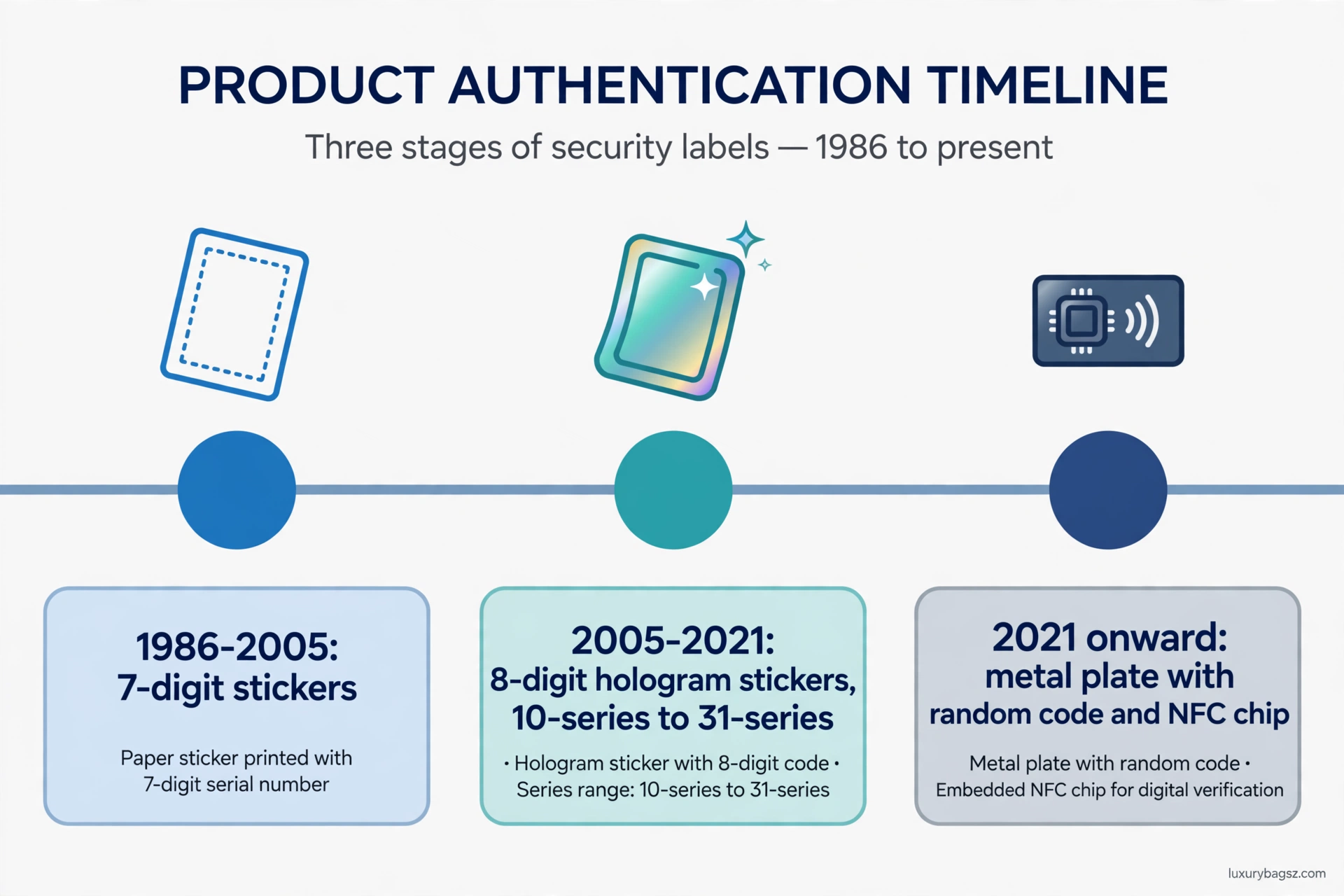
Three systems cover nearly every Chanel bag you will meet. Seven-digit stickers ran from 1986 to 2005. Eight-digit hologram stickers ran from 2005 to 2021. Since 2021, bags carry a small metal plate with a random eight-character code and an embedded NFC microchip. If you can place a bag in the right system and the right era, you have already eliminated a large share of fakes and mislabelled listings.
Before I judge a single stitch on a Chanel, I place the bag in its numbering system. A seven-digit sticker belongs to 1986–2005, an eight-digit hologram sticker to 2005–2021, and a metal microchip plate to the years since — and the bag in front of me has to agree with the system it claims. On a chipped bag I read the plate through the Entrupy app and check its lettering by eye. In ten-plus years of examining bags, that era match has ended more arguments than any other single check: a code from the wrong decade cannot be argued into the right one.
What a Serial Number Is, and What It Is Not
A Chanel serial number is an internal production code. Chanel used it for quality control and production tracking, not as a consumer authenticity guarantee, and there is no public Chanel lookup where a buyer can type in a code and get a verdict. Any website that claims to verify a Chanel code instantly from a public database is overselling what it can do.
That distinction matters because counterfeiters copy codes. A fake bag can carry a plausible-looking sticker with a plausible-looking number, and a genuine bag can carry a code that looks odd to an untrained eye because codes changed format over the years. The code is one check among many: it must agree with the bag's style, hardware, materials and claimed era, and it must be weighed with the lock, chain, quilting and stamp checks, not treated as a verdict on its own.
The Three Systems at a Glance
Nearly every Chanel bag falls into one of three systems. From 1986 to 2005, bags carried seven-digit serial stickers. From 2005 to 2021, bags carried eight-digit hologram stickers, running from the 10-series in 2005–2006 through the 31-series in 2021. Since spring 2021, bags carry a metal plate with an eight-character random alphanumeric code and an embedded NFC chip.
The changeover matters for dating. A bag claimed to be from 2019 should not carry a microchip plate, and a bag claimed to be from 2023 should not carry a hologram sticker. Keep this timeline in mind through every later part: system first, then series, then the bag's other details.
Reading the Code: The 7-Digit Era, 1986–2005
Seven-digit stickers cover bags made from 1986 to 2005, and their first digit roughly tracks the era. The fullest published series guide gives: 0-series for the earliest years, then 1-series, 2-series and 3-series through the early 1990s, 4-series and 5-series through the mid-to-late 1990s, 6-series for 2000–2002, 7-series for 2002–2003, 8-series for 2003–2004, and 9-series for 2004–2005.
Two cautions apply. First, series years overlap at the edges, because production years do not change on a single day and different guides round differently. Second, one competing decoder differs slightly on some years — for example, it puts the 6-series at 2000–2004 rather than 2000–2002. Treat series years as a range, not a birth certificate, and treat a code that is wildly out of range for the claimed era as the real warning sign.
Reading the Code: The 8-Digit Hologram Era, 2005–2021
Eight-digit hologram stickers are the system most pre-owned buyers will meet, and their series years are better documented. The fullest published guide gives: 10-series 2005–2006, 11-series 2006–2008, 12-series 2008–2009, 13-series 2009–2010, 14-series 2010–2011, 15-series 2011, 16-series 2012, 17-series 2012–2013, 18-series 2013–2014, 19-series 2014, 20-series 2014–2015, 21-series 2015–2016, 22-series 2016–2017, 23-series 2016–2017, 24-series 2017–2018, 25-series 2018, 26-series 2018–2019, 27-series 2019, 28-series 2019–2020, 29-series 2019, 30-series 2020–2021, and 31-series 2021.
Again, guides disagree slightly: a competing decoder puts the 28-series at 2019–2020 and the 6-series years differently, as noted in the 7-digit era section. Use the series as a cross-check against the claimed era, not as a precise year stamp. And remember the small-leather-goods exception: while handbags ended sequential codes with the 31-series in 2021, small leather goods continued with 32-series codes into 2022 before random codes arrived, so a 32-series code on a wallet is plausible while the same code on a handbag deserves questions.

Where the Sticker or Plate Sits by Bag Type
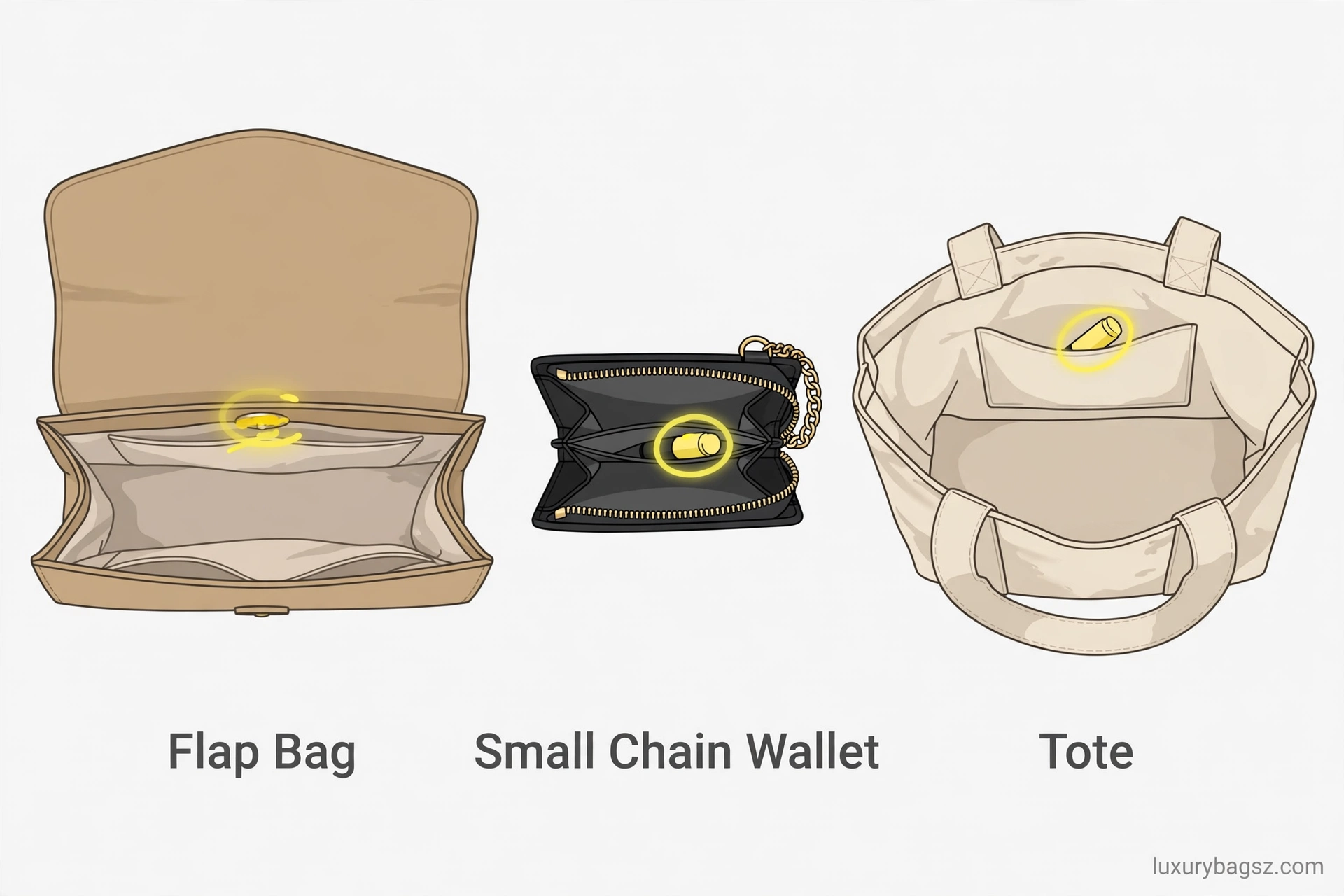
Location is a practical check that competitor guides cover only in general terms, so here is the working map. On Classic Flap bags, the sticker sits inside, usually under the interior flap or in an interior pocket. On a Wallet on Chain, the post-2021 plate sits inside the zip pocket. On totes and shopping bags, check interior pockets and the lining seams.
If you cannot find a sticker or plate, ask the seller for a photo of the exact spot rather than assuming it is missing. Stickers can hide under flaps and pocket folds, and plates are small. A seller who cannot photograph the code location is a seller to be careful with, since a genuine seller with the bag in hand can find it in minutes.
Hologram Sticker Features Worth Checking
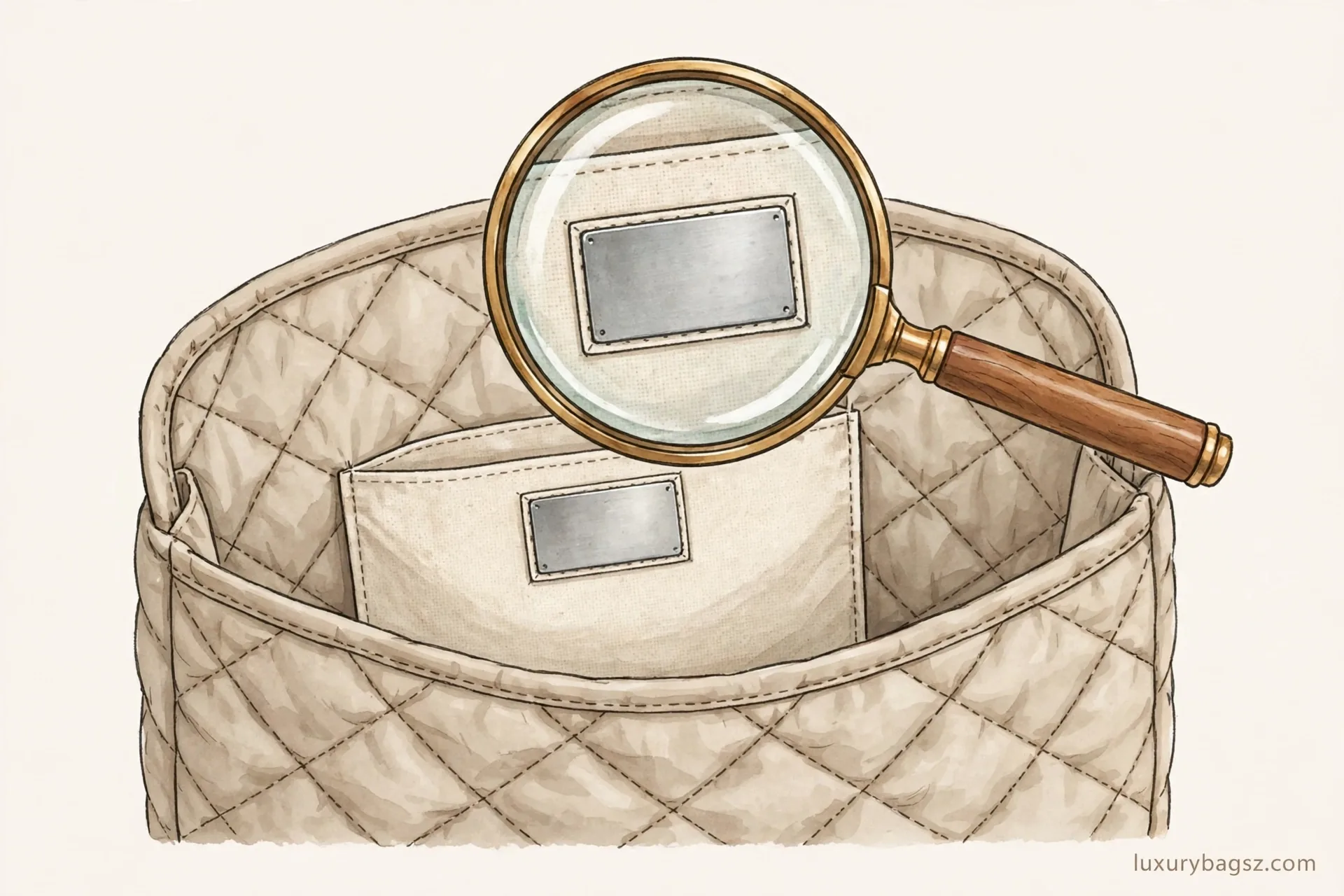
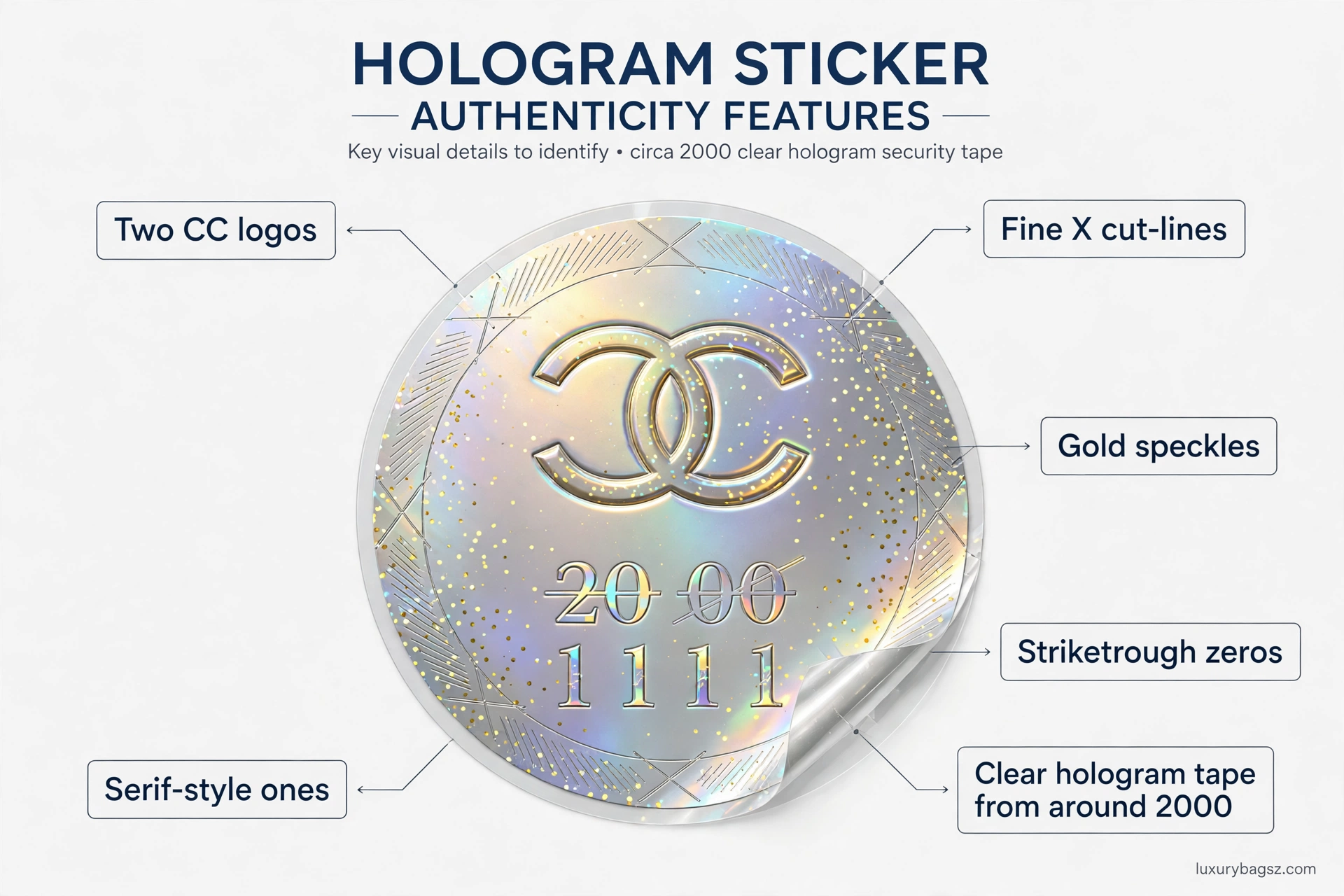
The eight-digit sticker is a hologram, and its features are worth checking in a clear photo. It carries two CC logos, fine X cut-lines across its surface, gold speckles or dots, strikethrough zeros, and serif-style ones. From around 2000, stickers were protected by a clear hologram tape laid over them.
Check these features together, not one at a time. A sticker that lacks the CC logos, has no cut-lines, or looks freshly printed on a bag claimed to be twenty years old deserves questions. But stickers age: they peel, fade and fall off, and a worn sticker on an old bag is normal. A missing sticker alone does not prove a bag fake, and a perfect-looking sticker alone does not prove a bag real.
The 2021 Changeover: Microchip Plates
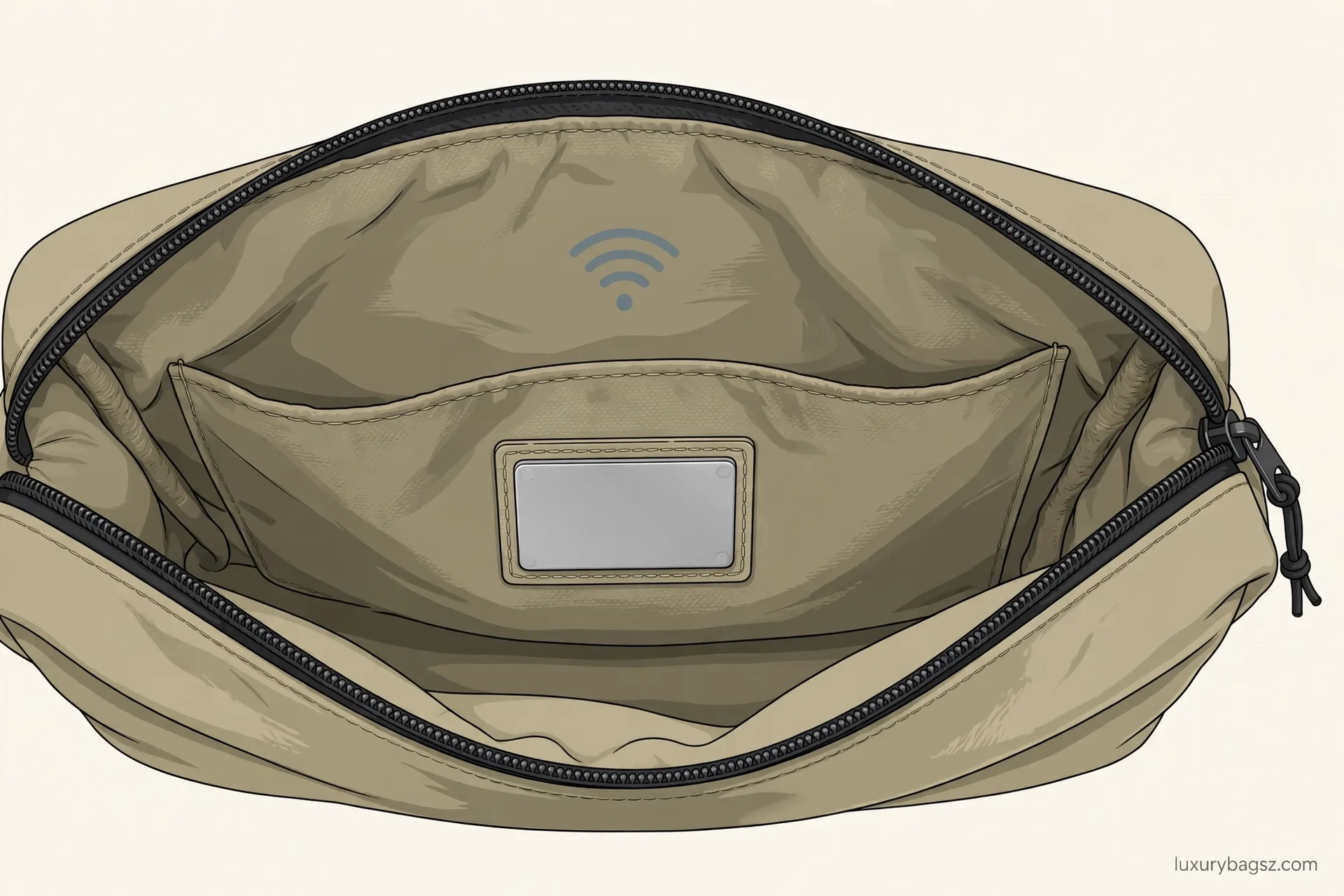
Since spring 2021, Chanel has replaced the serial sticker with a small metal plate carrying an eight-character random alphanumeric code, with an NFC microchip embedded behind it. The changeover month is given as spring, and one guide specifies April 2021; treat the changeover as spring 2021 rather than a single day, since production transitions do not switch overnight.
The plate itself carries checks. Its metal should match the bag's hardware tone, since a plate in the wrong finish suggests a replacement or a mismatched assembly. One guide notes that metal-plate codes begin with a letter, in the form A followed by seven characters. The plate sits in the position for the bag's style — inside the zip pocket on a Wallet on Chain, for example — and a plate in an odd position deserves questions.
What the Chip Can and Cannot Do for You
Guides agree on the central point: only Chanel can read the chip's full history. Buyers cannot read the chip themselves with a phone tap in any useful way, and no phone app can verify a Chanel bag from its chip. A seller who claims you can "tap to verify" is overselling the technology, and a bag whose chip cannot be tapped is not thereby fake.
Two questions deserve direct answers, since competitor guides leave them fuzzy. First, should tapping a phone on the bag work? No, not as a verification method — the chip's data is readable only by Chanel's own equipment. Second, what does a post-2021 bag carrying both an authenticity card and a microchip mean? One source flags that combination as suspicious, since the card system ended with the sticker system, but the flag is not fully developed in the opened guides, so treat it as a question to ask the seller, not as a final verdict on its own.
The Card: What It Proves and What It Does Not
Every sticker-era bag originally came with a small authenticity card carrying the same number as its sticker. The card should match the sticker exactly, and a mismatched card is a reason to stop and ask questions. But the card matters less than sellers claim: cards are faked as often as bags, they are sold separately, and a card alone proves nothing.
A missing card follows the same logic as a missing sticker. It does not automatically mean fake — cards get lost over decades of ownership — but it should lower the price and trigger harder checks on the lock, chain, quilting and stamp. Price a bag without its card below a complete set, and never accept a card as a substitute for checking the bag itself.
Buyer Workflow: When Code, Card and Era Do Not Line Up
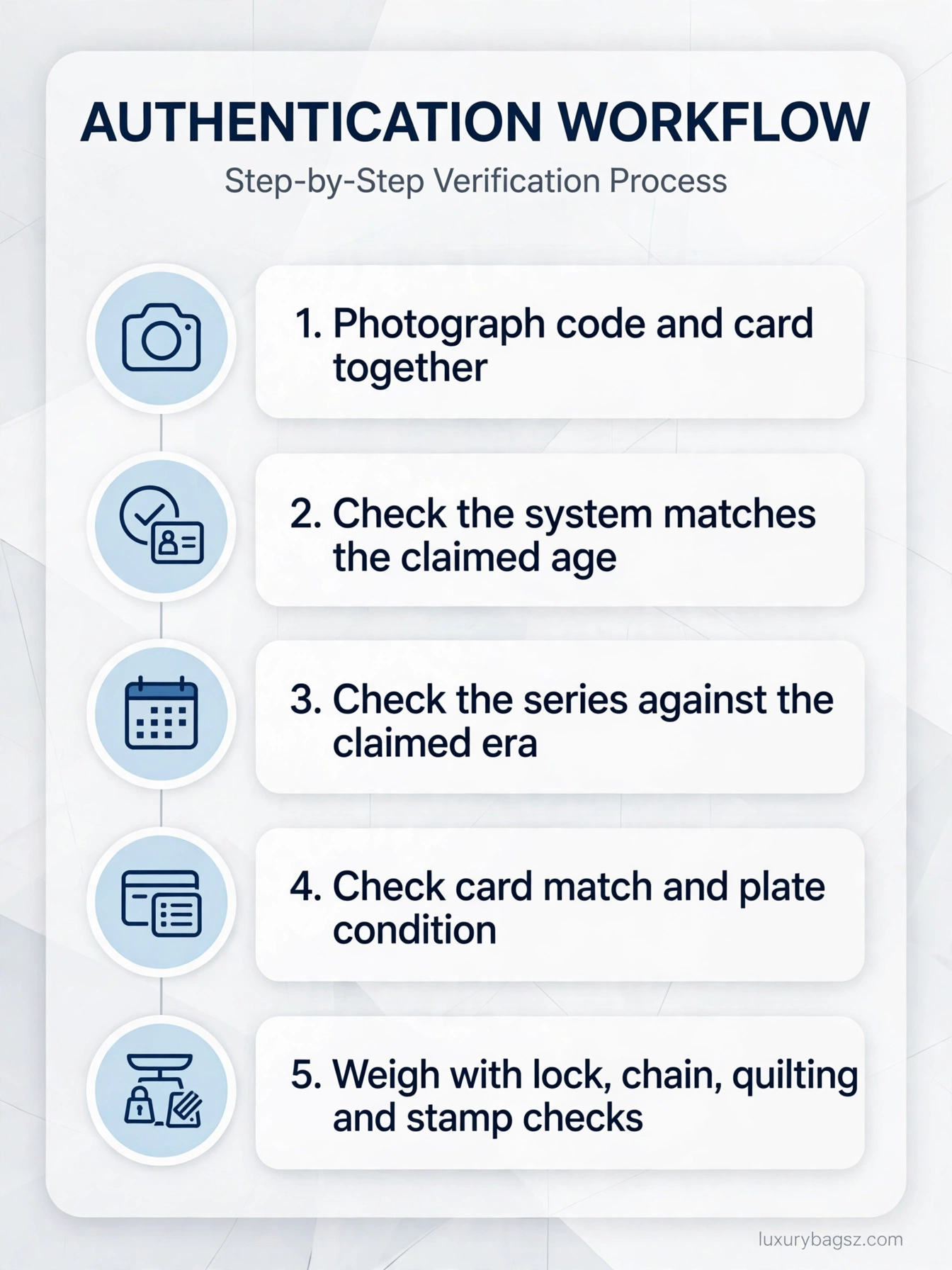
This workflow is the gap no competitor guide fills in one place. Run it in order when anything disagrees. First, photograph the code and the card together, and write down the claimed era, style and size. Second, check the system: does a sticker belong on a bag of this claimed age, or should it carry a plate? A system mismatch ends the purchase unless the seller has a convincing, documented explanation.
Third, check the series against the claimed era using Parts 3 and 4, allowing a year either way for edge overlap. Fourth, check the card match and the sticker or plate condition. Fifth, weigh the result with the bag's other checks: a code mismatch plus a wrong lock or wrong screws is a pattern, and a pattern is a reason to walk away. If only the code is doubtful and everything else is consistent, get a professional authentication opinion before paying, and buy only where you can return the bag if it fails.
Style Codes vs Serial Codes: Do Not Confuse Them
One confusion trips up buyers searching for specific bags: style codes are not serial codes. A style code identifies the bag's model — for example, the Grand Shopping Tote original carries A20995 and the reissue carries A50995, and the Classic Flap is known by 11.12. A serial code identifies an individual bag's production batch.
The practical rule is simple. If you are searching for a GST and find "A20995," you have found a model, not a proof of authenticity. If a seller gives you a style code when you asked for the serial code, ask again for the serial sticker or plate. And if a listing's "serial number" looks like a short model code rather than a seven-digit, eight-digit or eight-character production code, treat the listing as mislabelled until proven otherwise.
Hardware and Zipper Tells That Support a Code Check
A code check is stronger when the bag's hardware agrees with its era. Vintage hardware was 24k gold-plated roughly before 2008, so a bag claimed to be from the 1990s with pale, thin plating deserves a closer look. Screws tell a similar story: flat-head screws are expected on older bags and star screws on newer ones, while Phillips screws — the cross-shaped type — are a warning sign.
Zippers carry era marks too. Makers seen on genuine bags include Lampo, EP, a three-Cs-in-a-circle mark, Opti, Éclair, DMC and YKK. An unfamiliar zipper mark is a reason to look closer, not proof of fake on its own. The CC overlap rule supports the same check: on a genuine CC lock, the right C overlaps the left C at the top and the left C overlaps the right C at the bottom. A code that matches the era but hardware that does not is still a bag to question.
Resale Impact: What Missing Codes Cost You
No competitor guide quantifies how a missing sticker, missing card or damaged plate affects pre-owned price, and this guide will not invent a figure. The honest statement is directional: a complete bag with matching sticker and card sells faster and for more than the same bag without them, and a damaged plate on a post-2021 bag raises the same questions as a missing sticker on an older one.
For scale on value retention, one guide cites the Rebag Clair Report 2025: the Classic Flap retains roughly 80–92% of its value, the Wallet on Chain roughly 70–80%, and the Boy roughly 50–65%. Our full Classic Flap vs Boy bag comparison shows how the Classic's value story compares with a modern shape. For authentication services, one guide cites an Entrupy certificate at $75 CAD with a 30-point inspection, and another cites an Entrupy accuracy claim of 99.86% — attribute that claim to its source rather than adopting it as fact, and compare services yourself on price, turnaround and whether your platform accepts their opinion.
Frequently Asked Questions
What is a Chanel serial number?
An internal production code used for quality control and production tracking, not a consumer authenticity guarantee. It helps date a bag and check whether its claimed era matches, but a code or card alone never proves a bag real.
How do I read a Chanel serial code?
Match the system to the era first: seven-digit stickers 1986–2005, eight-digit hologram stickers 2005–2021, microchip plates from 2021 onward. Then match the series to the claimed era using Parts 3 and 4, allowing a year either way for edge overlap.
What do the serial series numbers mean?
The first digits roughly track production era: for example, 10-series for 2005–2006 through 31-series for 2021 on handbags. Series years overlap at the edges and guides disagree slightly, so use them as a range, not a birth certificate.
Where is the serial number on a Chanel bag?
It depends on the style: inside under the flap or in an interior pocket on Classic Flaps, inside the zip pocket on a Wallet on Chain, and in interior pockets or lining seams on totes. Ask the seller for a photo of the exact spot if you cannot find it.
What is the Chanel microchip?
A small NFC chip embedded behind a metal plate, fitted since spring 2021, carrying an eight-character random alphanumeric code. Only Chanel can read the chip's full history; buyers cannot verify a bag by tapping a phone on it.
Can I tap my phone on a Chanel bag to verify it?
No, not in any useful way. The chip's data is readable only by Chanel's own equipment, and no phone app can verify a Chanel bag from its chip. A seller who claims tap-to-verify is overselling the technology.
Does a missing serial sticker mean a bag is fake?
No. Stickers peel, fade and fall off, so a missing sticker alone does not prove a bag fake, but it should lower the price and trigger harder checks. The same applies to a missing card: cards are faked often, and a card alone proves nothing.
What is the difference between a style code and a serial code?
A style code identifies the model — for example, GST A20995 for the original and A50995 for the reissue — while a serial code identifies an individual bag's production batch. A seller who gives a style code when you asked for the serial code has not answered your question.
How much does a missing sticker or card affect resale value?
No competitor guide quantifies it, and this guide gives no invented figure. Directionally, a complete bag with matching sticker and card sells faster and for more than the same bag without them, and a damaged plate raises the same questions on post-2021 bags.
Should I pay for professional authentication?
On any expensive purchase, yes, if the code is doubtful or the bag is high value. Compare services on price, turnaround and whether your platform accepts their opinion, and buy only where you can return the bag if it fails.
Summary
Chanel serial numbers reward a simple discipline: system first, series second, and everything else weighed alongside. Place the bag in the right system — seven-digit sticker, eight-digit hologram, or microchip plate — then check the series against the claimed era, then check the card match, the plate condition, and the hardware's agreement with the era.
Never let a code overrule the bag itself. A matching code on a bag with the wrong lock, wrong screws or wrong quilting is still a bag that fails. And never let a missing sticker or card end the conversation on its own — it lowers the price and raises the questions, but the bag's full pattern of checks is what decides. Buy that way, and the code becomes what it was meant to be: a useful clue, not a false promise.