How to Price Designer Jewellery for Resale
Price From Sold Pieces, Not the Boutique Tag
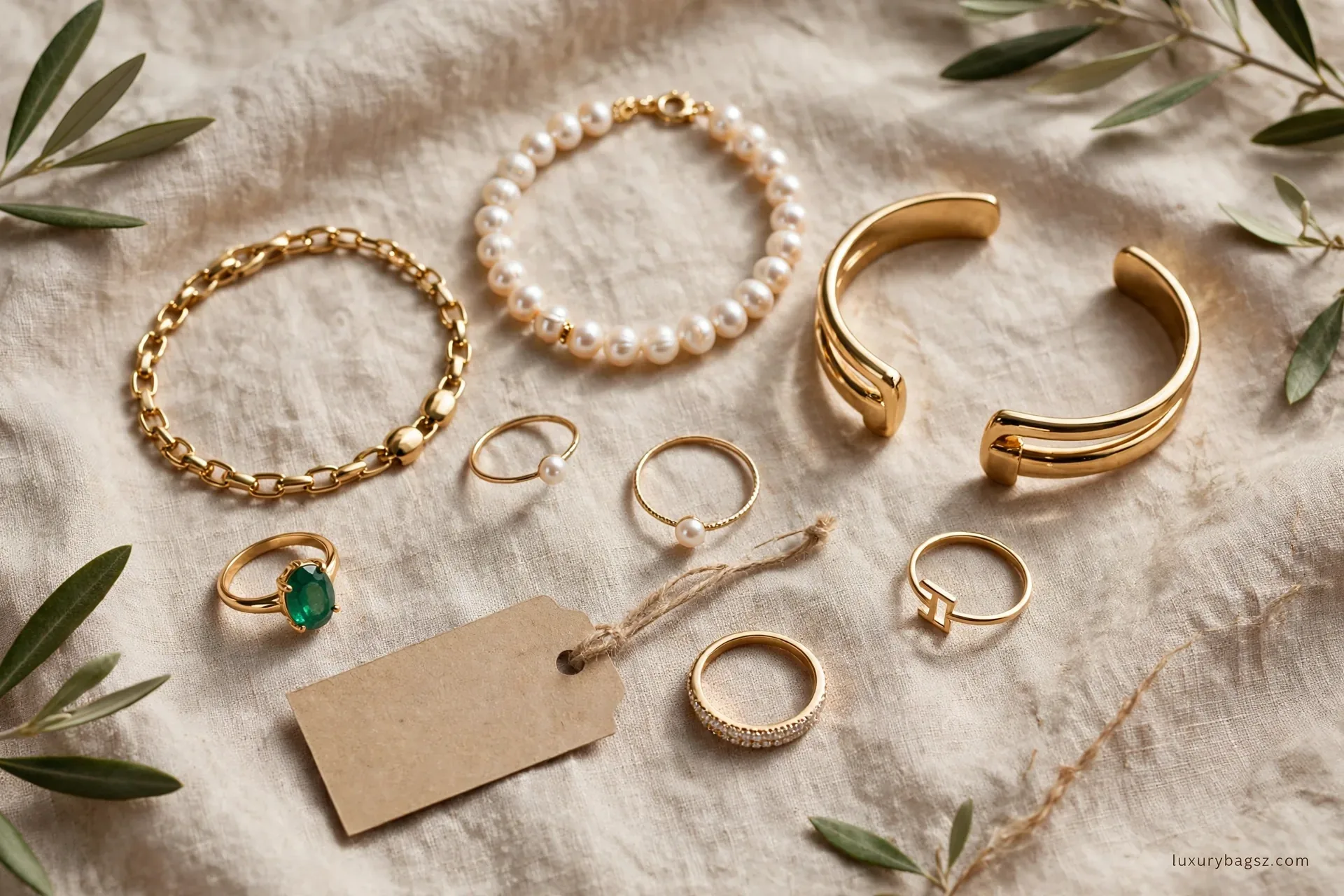
A realistic resale price comes from what comparable pieces have actually sold for, weighed against brand and design, metal and stones, condition, completeness, selling route and timing. Retail price is a poor guide, as a pre-owned piece without boutique service or warranty normally sells well below what it cost new.
Brand and collection drive value most, with widely recognised designs that are still made holding up best. The worth of the gold, silver or stones underneath sets a floor rather than the final figure, while strong condition and having the original box, papers and any accessories lift a piece within its range.
Always work back from what you will keep after commission, payment charges, insured postage and any tax. A higher headline figure that leaves less in hand is the worse deal.
Pricing Designer Jewellery at a Glance
Pricing designer jewellery for resale is a skill, not a guess, and it starts with a humbling truth: resale value is rarely retail value.
A piece bought new from a boutique loses a significant portion of its retail price the moment it becomes pre-owned, however little it was worn, because the buyer is paying for a pre-owned piece without boutique service, warranty, and presentation, and because the reseller, marketplace, or dealer must earn a margin. Understanding that gap, and pricing inside it realistically, is the difference between a piece that sells and a piece that sits.
This guide walks through each factor in order, shows you how to research comparable sales, how to adjust for condition and completeness, and how to set a price that sells without giving the piece away.
A note on scope: this guide covers designer jewellery, from brands such as Cartier, Tiffany & Co, Van Cleef & Arpels, David Yurman, and comparable houses, in silver, gold, and diamond and gemstone forms. It does not cover high jewellery or exceptional gemstones, where individual appraisal by a specialist is essential, nor does it cover watches, which follow a different market.
For ordinary designer jewellery, the method here will get you to a realistic, defensible price.
Key Takeaways
- Resale value is usually well below retail: expect a pre-owned discount, with the size of the discount varying by brand, collection, and demand.
- Brand and collection matter most: iconic, currently produced designs from top houses retain value best; obscure or discontinued designs vary widely.
- Metal and stone value sets a floor, not a price: a piece is worth more than its melt value when its design is desirable, and close to melt value when it is not.
- Condition and completeness move price significantly: original box, papers, and screwdriver, where applicable, plus excellent condition, all add value.
- Research recently sold listings, not asking prices, for the same or closely comparable pieces, and adjust for condition, completeness, and channel.
- Always price net of fees, shipping, and taxes: the price you list is not the money you keep, and the difference can be large.
Start With What You Have: Identification Before Valuation
Accurate pricing starts with accurate identification. Before researching prices, identify the piece fully: brand, collection, design name, metal and karat, stones and their approximate size and quality, dimensions or size, hallmarks, and any serial or reference numbers. Photograph the piece, its hallmarks, its stones, and its box and papers, so that you have a complete record for research, for dealer consultations, and for listing.
Identification errors are expensive. A bracelet misidentified as a more valuable collection, a ring misidentified as 18 karat when it is 14 karat, or a diamond misidentified as larger than it is will all produce a wrong price, and a wrong price either deters buyers or leaves money on the table. If you are unsure about any detail, have a jeweller identify the piece before pricing it.
A jeweller's identification, including metal testing and stone assessment, is a modest cost that prevents large pricing errors.
Also gather the piece's paperwork: purchase receipts, certificates, appraisals, and service records. Paperwork does not by itself set the price, but it supports identification, proves provenance, and adds value for buyers, particularly for diamond pieces where certificates matter.
A piece with complete paperwork generally commands a higher price than the same piece without it, and the difference is part of your pricing calculation, covered later in this guide.
Brand and Collection: The Primary Value Driver
Brand is the primary driver of designer jewellery resale value, because buyers pay for design recognition, desirability, and liquidity, not just for metal and stones. Iconic designs from top houses, such as Cartier Love and Juste un Clou, Tiffany Return to Tiffany and Tiffany Setting, Van Cleef & Arpels Alhambra, and David Yurman Cable Classics, retain value best, because they are widely recognised, actively traded, and in continuing demand.
A buyer knows what they are getting, and a reseller knows they can sell it again, which supports the price.
Lesser-known designs, even from top houses, retain value less well, because their buyer pool is smaller and their recognition is lower. A beautiful but obscure design may be worth little more than its metal and stone value, however much it cost at retail, because few buyers are searching for it.
Similarly, fashion jewellery from designer houses, as opposed to fine jewellery in solid precious metals, generally retains little resale value, because its value was in fashion and branding at the time of purchase, not in enduring materials or iconic design.
Collection status matters too. Currently produced iconic designs benefit from boutique prices that anchor pre-owned prices: buyers compare pre-owned against new, and a pre-owned piece priced at a sensible discount to new is attractive. Discontinued designs vary: some become collectible and rise, particularly if they are iconic and scarce, while others fade, because no new buyers are discovering them.
Research the collection's current status before assuming that discontinuation helps or hurts your piece.
Metal and Stone Value: The Floor Under Your Price
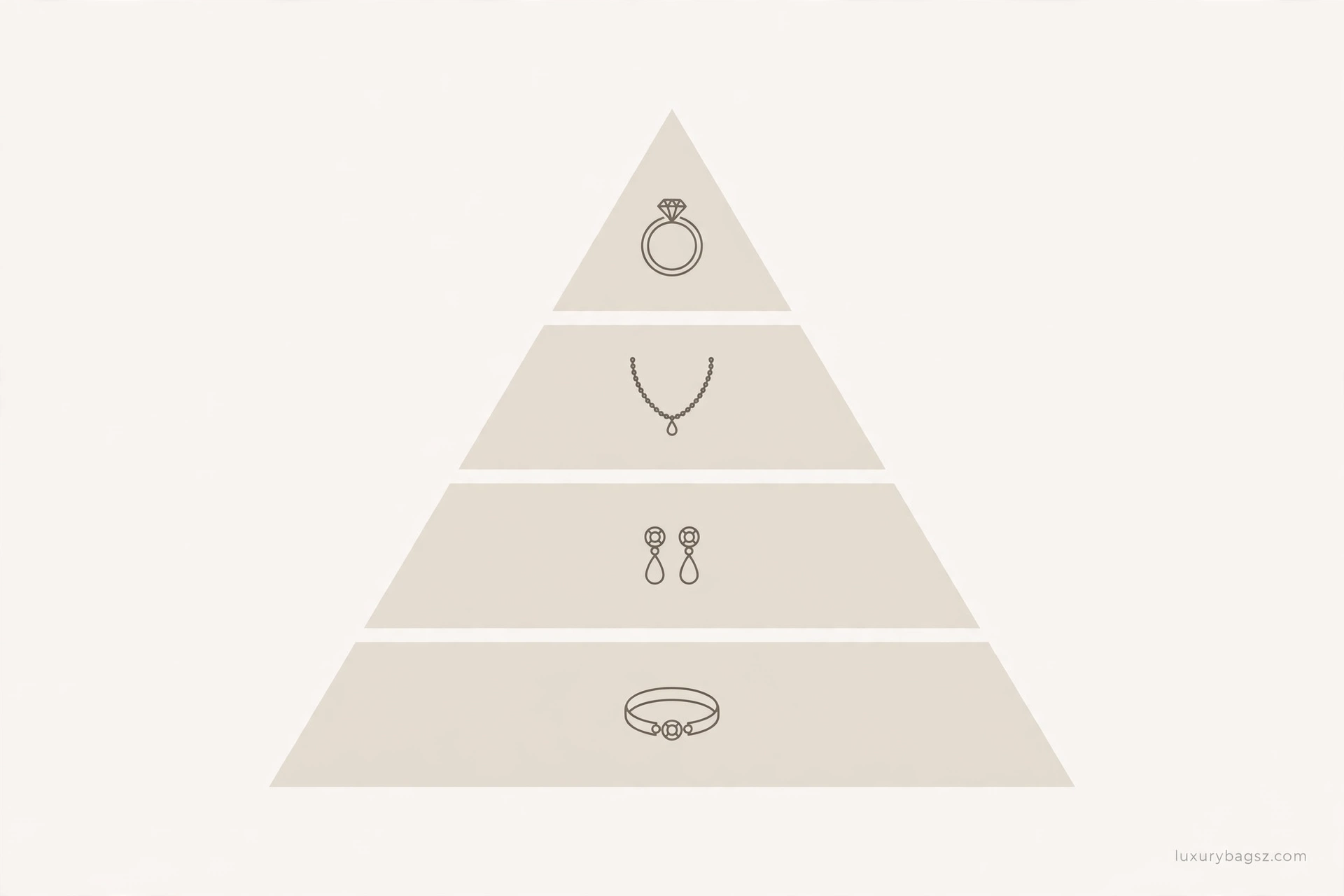
Metal and stone value sets a floor under your price, not the price itself. For a gold bracelet, that floor is roughly the value of its gold content at current metal prices, less refining costs where applicable. For a silver piece, the metal floor is low, because silver prices are modest and silver pieces are light, which is why silver designer jewellery depends almost entirely on design value for its resale price.
For a diamond piece, the floor includes the diamond's wholesale value, which depends on carat weight, colour, clarity, cut, and market conditions, plus the metal value.
Calculating metal value requires knowing the piece's weight and karat, which a jeweller can measure and test. Do not guess weight or karat: a small error in either produces a large error in metal value, especially for gold.
Online metal calculators can estimate melt value once weight and karat are known, but treat their outputs as estimates, not as offers: refiners and dealers pay below melt value to cover their costs and margins, and a piece sold for melt value alone is a piece whose design value was zero.
Stone value is harder to estimate without expertise. Diamond wholesale prices vary by the four Cs and by market conditions, and coloured gemstones vary even more widely, by type, colour, origin, treatment, and size. For pieces where stones are a major part of value, obtain a jeweller's or appraiser's assessment of stone value before pricing.
An appraisal for insurance replacement value is not a resale value: insurance values are typically higher than resale values, because they reflect retail replacement cost, not pre-owned market price. Ask specifically for a resale or fair-market estimate if you need one.
Researching Comparable Sales: Sold, Not Asking
Comparable sales research is the heart of realistic pricing, and its cardinal rule is to research sold prices, not asking prices. Asking prices are hopes; sold prices are facts. A piece listed for months at a high price has not established that price; it has established that buyers will not pay it. A piece that sold quickly may have been priced too low, but a cluster of recent sales at similar prices establishes a market range you can trust.
Search reputable marketplaces, auction houses, and dealer sites for the same piece, or the closest comparable piece, sold recently, ideally within the last three to six months. Record the sale price, the piece's condition, its completeness, including box and papers, its metal and stones, and its selling channel, because all of those affect price.
Aim for at least three to five comparable sales; a single sale may be an outlier, but a cluster reveals the market.
Adjust comparables for differences. A comparable in excellent condition with full box and papers is worth more than your piece in good condition without papers, and a comparable sold through a high-fee marketplace at a high headline price may have netted its seller less than a lower-priced direct sale. Note those adjustments explicitly, so that your final price reflects your piece, not someone else's.
If no direct comparable exists, use the closest design from the same brand and collection, and widen your range to reflect the uncertainty.
Condition: How Wear Moves Price
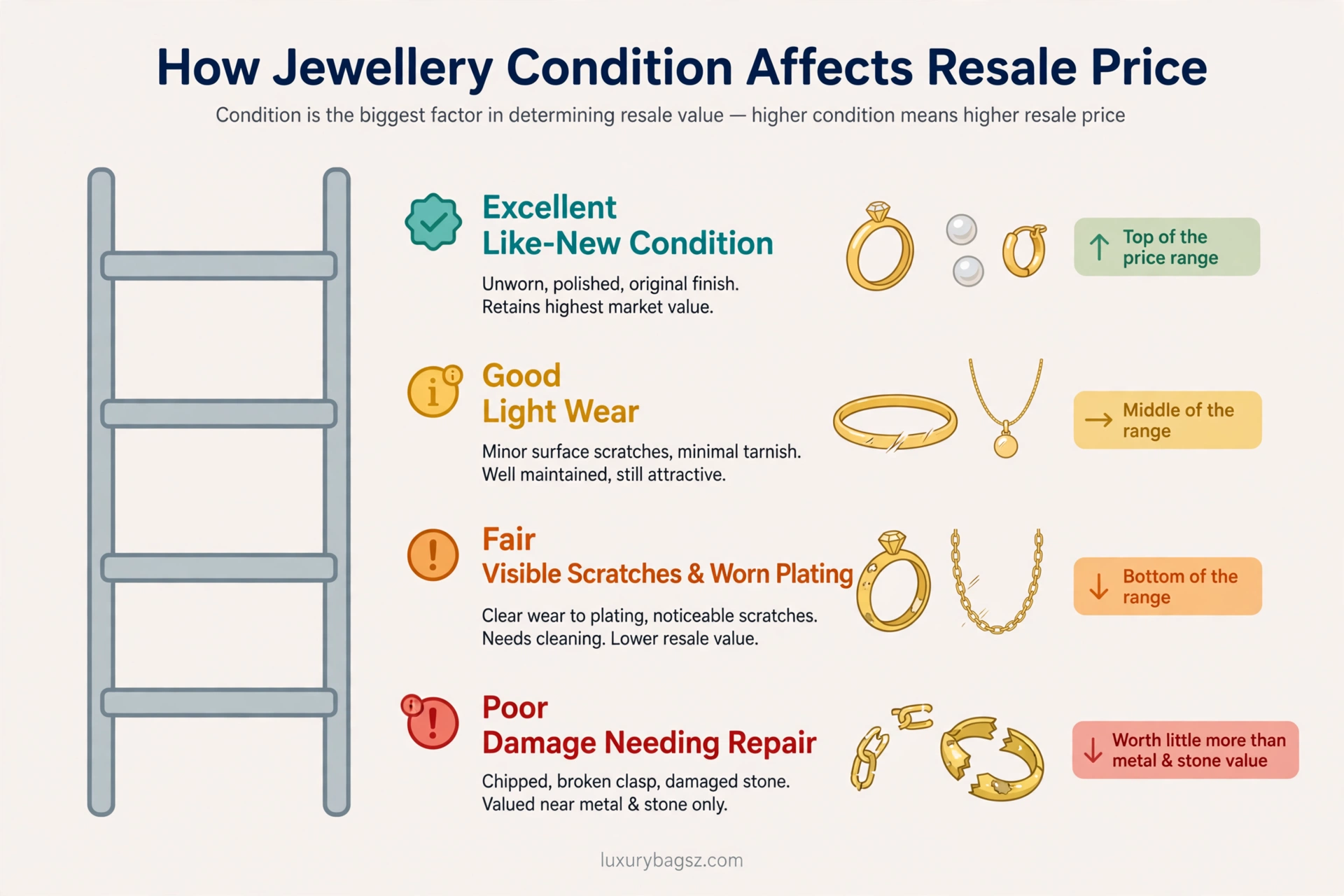
Condition moves price significantly, and buyers judge it strictly. A piece in excellent, like-new condition, with no visible wear, scratches, or damage, and with original finishes intact, commands the top of its comparable range. A piece in good condition, with light wear consistent with careful use, sits in the middle of the range.
A piece in fair condition, with visible scratches, worn plating, damaged clasps, or replaced parts, sits at the bottom, and a piece in poor condition, with damage that needs repair, may be worth little more than its metal and stone value until repaired.
Assess condition honestly, under good light and magnification, covering every part: the front, back, interior, clasp, hinge, stones, and settings. Note scratches, dents, worn plating, loose stones, bent prongs, damaged clasps, and any repairs or replacements.
Photograph condition accurately for listings: buyers who discover undisclosed wear on arrival will return the piece, leave negative feedback, or demand a partial refund, all of which cost more than honest pricing upfront.
Repairs affect price in two ways. A well-executed, disclosed repair that restores function, such as a rebuilt prong or a replaced clasp, may preserve most of the piece's value, though rarely all of it. An undisclosed repair, discovered by a buyer, destroys trust and value together. A poor repair, such as a visibly mismatched clasp or a badly re-set stone, reduces value below the unrepaired state, because the buyer must pay to correct it.
Disclose all repairs, price for them, and consider whether repairing before sale, at a jeweller's cost, will net more than selling as-is, after deducting repair costs and the time involved.
Completeness: Box, Papers, and Accessories
Completeness, the original box, pouch, papers, certificates, and accessories such as a Love bracelet screwdriver, adds value, and the amount varies by piece. For high-value diamond pieces, certificates and papers matter most, because they support stone identification and value. For iconic bracelets, the screwdriver, box, and papers together signal a complete, well-cared-for piece and attract buyers who value that completeness.
For silver pieces, box and papers matter less in absolute terms, but they still help a listing stand out.
Quantifying completeness value is a matter of comparable research: compare sold prices for complete versus incomplete examples of the same piece, and note the difference. That difference is your completeness premium, and it varies widely: for some pieces it is modest, for others it is substantial, particularly where the accessory, such as a specific screwdriver, is hard to replace. Do not assume a fixed premium; research it for your piece.
If your piece lacks its box or papers, do not buy fake packaging to complete it. Fake boxes and papers, presented as original, are misrepresentation, and buyers and marketplaces treat them seriously. Sell the piece honestly as incomplete, price it accordingly, and let its design, metal, stones, and condition carry the value. Honest incompleteness sells; dishonest completeness, when discovered, does not.
Channel Choice: Dealer, Marketplace, Auction, or Private
Selling channel affects both headline price and net proceeds, and the right channel depends on your piece, your timeline, and your tolerance for effort. Dealers and jewellers offer speed and certainty, buying outright or on consignment, but they must resell at a profit, so their offers are typically below marketplace prices.
That discount buys convenience, immediate payment, and no listing, shipping, or buyer-dispute risk, and for lower-value pieces it is often the sensible choice.
Marketplaces, including specialist pre-owned luxury platforms and general marketplaces, reach more buyers and can achieve higher headline prices, but they charge fees, require listing effort, photography, and buyer communication, and expose you to returns and disputes.
Auction houses suit higher-value, unusual, or collectible pieces, where competitive bidding can exceed expectations, but they charge seller's commissions, operate on schedules, and offer no guarantee of a sale or a price. Private sales, to someone you know or through a collector network, can achieve good net prices with low fees, but they require trust, authentication, and payment security.
Compare channels on net proceeds, not headline price. A marketplace sale at a high headline price, less fees, shipping, and taxes, may net less than a dealer offer with no fees or effort. Calculate net proceeds for each channel you are considering, factor in your time and risk tolerance, and choose the channel whose net, speed, and certainty best fit your situation.
There is no universally best channel, only a best channel for your piece and priorities.

Fees, Shipping, Taxes, and Net Proceeds
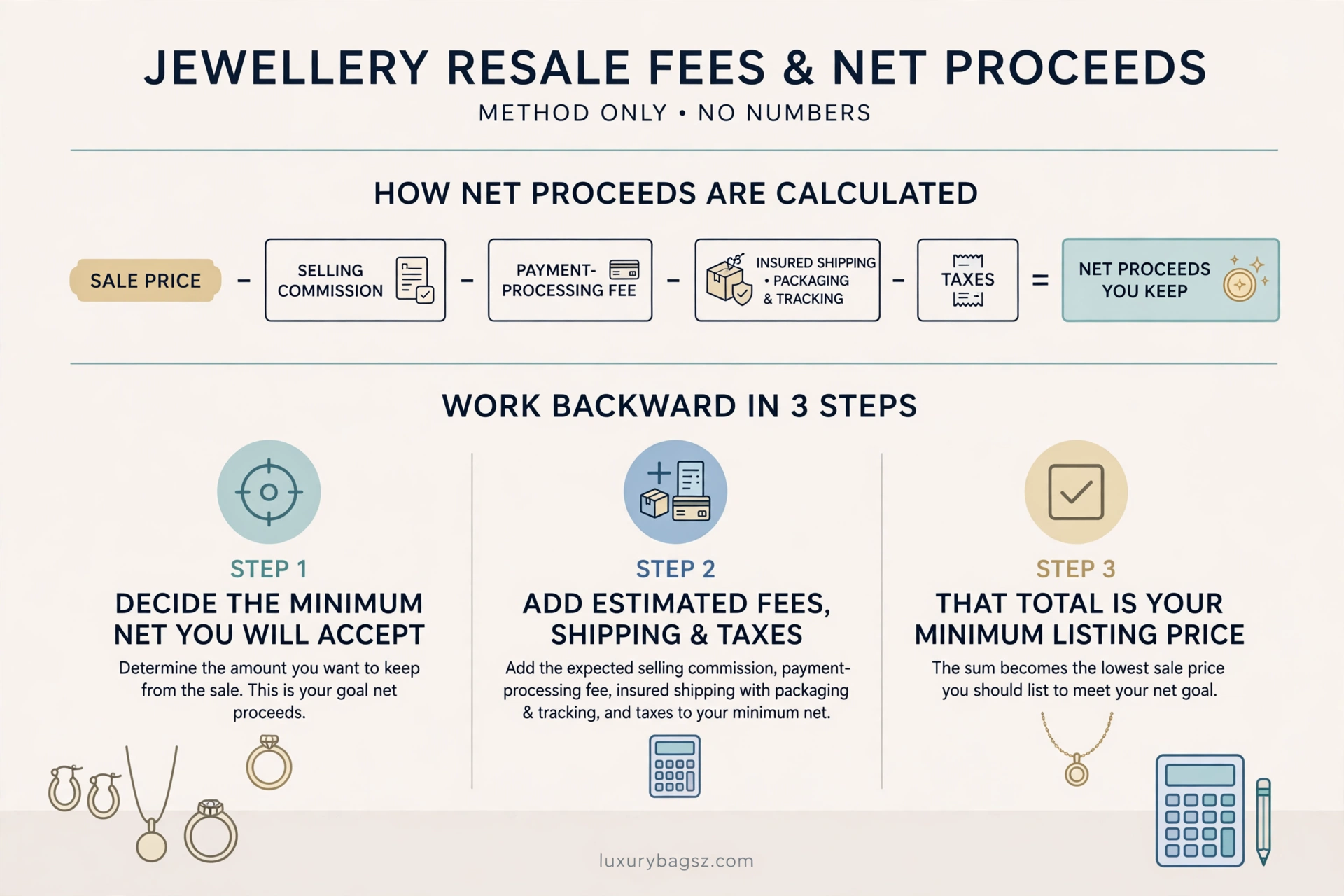
Fees are the most common pricing surprise, because sellers price to a headline and forget what they keep. Marketplace fees typically include a selling commission, a payment-processing fee, and sometimes a listing fee, and together they can take a substantial percentage of the sale price.
Shipping, including insured shipping for valuable jewellery, packaging, and tracking, adds further cost, and taxes, depending on your jurisdiction and the marketplace's rules, may add more. Calculate all of these before setting your price, not after a sale.
Work backward from your target net proceeds. Decide the minimum net amount you will accept, add estimated fees, shipping, and taxes, and that total is your minimum listing price. Then compare that minimum against your comparable range: if your minimum exceeds the top of the comparable range, your piece will not sell through that channel at that net, and you need a different channel, a lower net expectation, or a different timing.
Pricing backward from net prevents the common disappointment of a sale that looks good until fees arrive.
Also factor in payment security and return risk. Marketplaces and payment providers offer buyer protections that can result in returns, and a return costs shipping both ways plus time. Price with a small margin for that risk where your channel allows returns, and protect yourself with accurate descriptions, detailed photographs, insured tracked shipping, and signature on delivery for valuable pieces.
Those protections cost money, but they cost less than a lost or disputed shipment.
Timing, Seasonality, and Market Trends
Timing affects jewellery resale prices, though less dramatically than for fashion items. Gift-giving seasons, including the winter holidays, Valentine's Day, and Mother's Day, generally bring more buyers and firmer prices for romantic and giftable jewellery, such as bracelets, rings, and necklaces. Engagement season, which peaks around the winter holidays and Valentine's Day, brings more buyers for diamond rings.
Conversely, quiet periods may bring fewer buyers and softer prices, though iconic designs sell year-round.
Metal and diamond market trends also matter. Gold price rises support gold jewellery prices, particularly for pieces whose value is close to metal value, while gold price falls pressure them. Diamond market trends, including lab-grown diamond price movements, affect natural diamond resale sentiment, particularly for smaller stones, where lab-grown alternatives are most competitive.
Follow broad market trends, but do not overreact to short-term moves: designer jewellery prices move more slowly than commodity prices, because design value buffers them.
Brand events matter too. Price increases at boutiques, new collection launches, celebrity associations, and media coverage can all lift pre-owned demand for affected designs, while negative news or oversupply can soften it. If your piece's brand has recently raised retail prices, pre-owned prices for iconic designs often rise in response, because the pre-owned discount to new becomes more attractive.
Time your listing to those moments where you can, without delaying so long that you miss the market altogether.
Setting the Price: Ranges, Anchoring, and Negotiation
Set your price as a range first, then as a listing price. Your comparable research should yield a range, for example from the lowest recent comparable sale to the highest, adjusted for your piece's condition and completeness.
Your listing price should sit inside that range, positioned according to your priorities: at the top if you can wait and your piece is complete and excellent, in the middle if you want a timely sale, and toward the bottom if you need a quick sale or your piece has condition or completeness drawbacks.
Anchoring matters in negotiation. A listing price at the top of the range anchors buyer expectations high and leaves room to negotiate down, but it also deters buyers who will not engage with an apparently overpriced listing. A listing price in the middle attracts more interest and more offers, and often achieves a similar net after negotiation, with less time on market.
A listing price at the bottom sells quickly but leaves money on the table if buyers would have paid more. Choose your anchor deliberately, based on how quickly you need to sell and how much negotiation you are willing to handle.
Build negotiation into your price where your channel allows offers. If you expect buyers to offer ten to fifteen percent below asking, and you will accept that, list accordingly, so that your accepted price still meets your net target. If you will not negotiate, say so clearly, with a firm price, and price at a level that is fair without negotiation, so that buyers do not feel they must haggle to get value.
Either approach works; mixing them, listing high while refusing all offers, frustrates buyers and stalls sales.

Listing Honestly: Description, Photographs, and Disclosure
Honest listing is both ethical and profitable, because accurate listings sell with fewer returns, disputes, and negative reviews. Describe the piece fully: brand, collection, design, metal and karat, stones, size, condition, completeness, and any repairs, replacements, or wear, in plain language.
Disclose what you do not know as well as what you do: if you are unsure about a stone's exact size or a repair's history, say so, and price for that uncertainty.
Photograph the piece thoroughly: overall views, close-ups of hallmarks, stones, clasps, and any wear or damage, and photographs of the box, papers, and accessories. Use natural, even light, avoid filters that change metal colour or stone appearance, and include a scale reference where size matters. Buyers who can see condition clearly are more confident, offer more fairly, and return less often.
Photographs that hide wear, by contrast, invite disputes that cost more than honest pricing.
Keep records of your listing, correspondence, sale, shipping, and delivery, including tracking and insurance details. If a dispute arises, those records are your evidence. If a buyer claims a piece is not as described, respond promptly, professionally, and with reference to your listing and photographs. A reputation for honest, accurate listings is an asset that pays across every future sale, and it starts with the listing you write today.
Realistic Expectations: What Sellers Commonly Get Wrong
Sellers commonly overestimate resale value in predictable ways. The first is retail anchoring: assuming a piece should resell near its retail price because it was expensive, little worn, or recently bought. Retail price includes boutique service, warranty, presentation, and newness, none of which transfer fully to a pre-owned sale, and pre-owned buyers discount for all of them.
The second is sentimental anchoring: valuing a piece by what it meant to you, rather than by what comparable pieces sell for. Sentiment is real, but buyers do not pay for it.
The third error is ignoring fees and channel costs, pricing to a headline that nets far less than expected. The fourth is cherry-picking comparables: choosing the highest asking price found online, rather than the cluster of recent sold prices, and pricing to the outlier. The fifth is delaying: holding a piece for a better market that never arrives, while its condition, completeness, or fashion relevance declines.
A realistic price, set from sold comparables, net of fees, and listed promptly, usually outperforms an optimistic price held for months.
Set expectations accordingly. Iconic designs in excellent condition with full completeness achieve the best pre-owned results, often a substantial fraction of retail, but rarely retail itself. Ordinary designs in good condition achieve moderate results, well below retail but well above metal value. Obscure designs, damaged pieces, and fashion jewellery achieve the lowest results, often close to metal or material value.
Knowing which category your piece falls into, before listing, prevents disappointment and helps you choose the right channel and price.
Iconic designs such as those covered in the Cartier Love bracelet fake guide, the Cartier Juste un Clou guide, and the Van Cleef & Arpels Alhambra guide illustrate why recognisable designs hold value better than obscure ones.
Reading Dealer Offers and Negotiating Without Underselling
Dealer offers are often the first real price a seller hears, and reading them correctly prevents both underselling and unrealistic rejection. A dealer's outright purchase offer will typically be below marketplace prices, because the dealer must resell at a profit, cover overheads, authentication, and inventory risk, and allow for the time a piece may sit before selling.
That discount is not dishonesty; it is the dealer's business model, and it buys you speed, certainty, and freedom from listing, shipping, and buyer disputes. Judge a dealer offer against your net proceeds from other channels, not against retail price or against a marketplace headline price before fees.
Consignment offers work differently: the dealer sells the piece on your behalf and takes a commission, often with a longer timeline and a higher eventual price than an outright offer, but with no guarantee of sale or timing.
Before accepting consignment, agree in writing on the asking price, the minimum acceptable price, the commission, the consignment period, insurance and liability while the piece is in the dealer's care, and what happens if the piece does not sell. A consignment agreement without those terms is a risk, however reputable the dealer.
Negotiation, with dealers or private buyers, works best from evidence. Present your comparable sales, your piece's condition and completeness, and your net-proceeds calculation, and anchor your counter-offer in that evidence rather than in sentiment or retail price.
Know your walk-away price before negotiating, the minimum net you will accept, and be prepared to walk away politely if it is not met; a piece that does not sell today can sell tomorrow through another channel, while a piece sold below your walk-away price cannot be unsold.
Get multiple offers where time allows, because a single offer, however plausible, is not a market, and two or three offers reveal the range in which your piece genuinely trades.
Inherited Jewellery: Emotion, Estates and Practical Steps
Inherited and gifted designer jewellery brings emotional and practical considerations that purchased pieces do not, and pricing it well means separating the two. Emotionally, an inherited bracelet or ring may carry memories, family stories, and sentimental value that no buyer can pay for, and that realisation is often the hardest part of selling.
Practically, the piece still has a market value determined by brand, metal, stones, condition, and comparables, exactly as described in this guide, and that market value is what a buyer will pay, regardless of sentiment. Acknowledging both truths, sentiment is real but unpriced, market value is priced but impersonal, helps sellers make clear decisions rather than holding pieces indefinitely at unrealistic prices or selling them hastily at a loss.
Estate and shared-ownership situations add steps. Where jewellery belongs to an estate or is shared among family members, agree ownership, decision-making, and proceeds division in writing before selling, and consider whether all parties prefer a sale, a buyout by one family member at market value, or retention.
Where a piece may have tax or legal implications, which vary widely by jurisdiction and estate circumstances, seek professional advice rather than relying on general guidance, because this guide is not tax or legal advice and cannot substitute for it. Keep records of valuations, appraisals, and sales, as estates and tax authorities may require them, and use a reputable valuer or dealer for estate pieces where values are significant or disputed.
Practical steps for inherited pieces mirror ordinary resale, with extra attention to identification and documentation. Identify the piece fully, including any hallmarks, certificates, or appraisals that came with it, and have a jeweller verify metal and stones where paperwork is missing, because inherited pieces often lack complete records.
Research comparables as described in this guide, obtain multiple dealer or marketplace opinions where the piece is valuable, and choose a channel that suits the estate's timeline and the family's preferences.
Selling inherited jewellery is never only a transaction; it is also a moment of transition, and handling it with clear pricing, honest disclosure, and respect for the piece's story serves both the family and the buyer who will give the piece its next chapter.

Frequently Asked Questions
How much is designer jewellery worth second-hand compared to retail?
It varies widely by brand, collection, and demand, but pre-owned designer jewellery commonly sells well below retail, with iconic designs in excellent condition retaining the most value. Research recently sold examples of your exact piece for a realistic range, rather than applying a single percentage.
Should I get an appraisal before selling?
An appraisal helps for identification, metal and stone assessment, and insurance, but an insurance replacement appraisal is not a resale price, which is typically lower. Ask for a resale or fair-market estimate if you need a selling price, and use sold comparables alongside it.
Is it better to sell to a dealer or on a marketplace?
Dealers offer speed and certainty at a lower price, because they must resell at a profit. Marketplaces can achieve higher headline prices but charge fees and require effort and risk management. Compare net proceeds, not headline prices, for your piece.
Do box and papers really affect price?
Yes, particularly for high-value pieces and iconic designs, where completeness signals care and supports buyer confidence. The premium varies by piece; research complete versus incomplete comparable sales for your design to quantify it.
How do I price a piece with no comparable sales?
Use the closest design from the same brand and collection, widen your range to reflect uncertainty, and consider a jeweller's or dealer's opinion. Pieces with no comparables are harder to price and harder to sell, so price conservatively and disclose fully.
Should I repair a piece before selling?
Sometimes. A repair that restores function and is disclosed may preserve value, but repair costs must be weighed against the price gain. Get a repair estimate, compare it against the as-is comparable range, and repair only if the net gain justifies it.
How does gold price affect my jewellery's resale price?
Gold price supports the metal-value floor, particularly for pieces whose design value is modest. Iconic designs are buffered by design value and move less with gold prices, while plain gold pieces track metal prices more closely.
Are lab-grown diamonds affecting natural diamond resale?
Lab-grown diamond price declines have affected sentiment for smaller natural diamonds, where lab-grown alternatives are most competitive, but larger, high-quality natural diamonds and iconic designer settings retain value better. Research comparables for your stone size and design specifically.
What fees should I expect when selling online?
Marketplace commissions, payment-processing fees, listing fees where applicable, insured shipping, packaging, and taxes, depending on jurisdiction and platform. Calculate all of them before setting your price, working backward from your target net proceeds.
When is the best time to sell designer jewellery?
Gift-giving seasons, including winter holidays, Valentine's Day, and Mother's Day, generally bring more buyers, and boutique price increases can lift pre-owned demand for iconic designs. Iconic pieces sell year-round, so do not delay a well-priced listing indefinitely waiting for a perfect moment.
Final Verdict
Pricing designer jewellery for resale comes down to a disciplined method: identify the piece accurately, weigh brand and collection first, establish metal and stone value as a floor, research recently sold comparables, adjust honestly for condition and completeness, choose your channel by net proceeds, and list at a price inside the comparable range that reflects how quickly you need to sell.
Done that way, your price will be defensible to buyers, realistic for the market, and fair to the piece itself. The boutique price was what the piece cost new; the resale price is what the market will pay for it pre-owned, and respecting that distinction is how a piece sells, rather than sits.