

Cartier Juste un Clou Buyer Guide: Models, Sizes, Prices and Pre-Owned Checks
The Nail in Brief
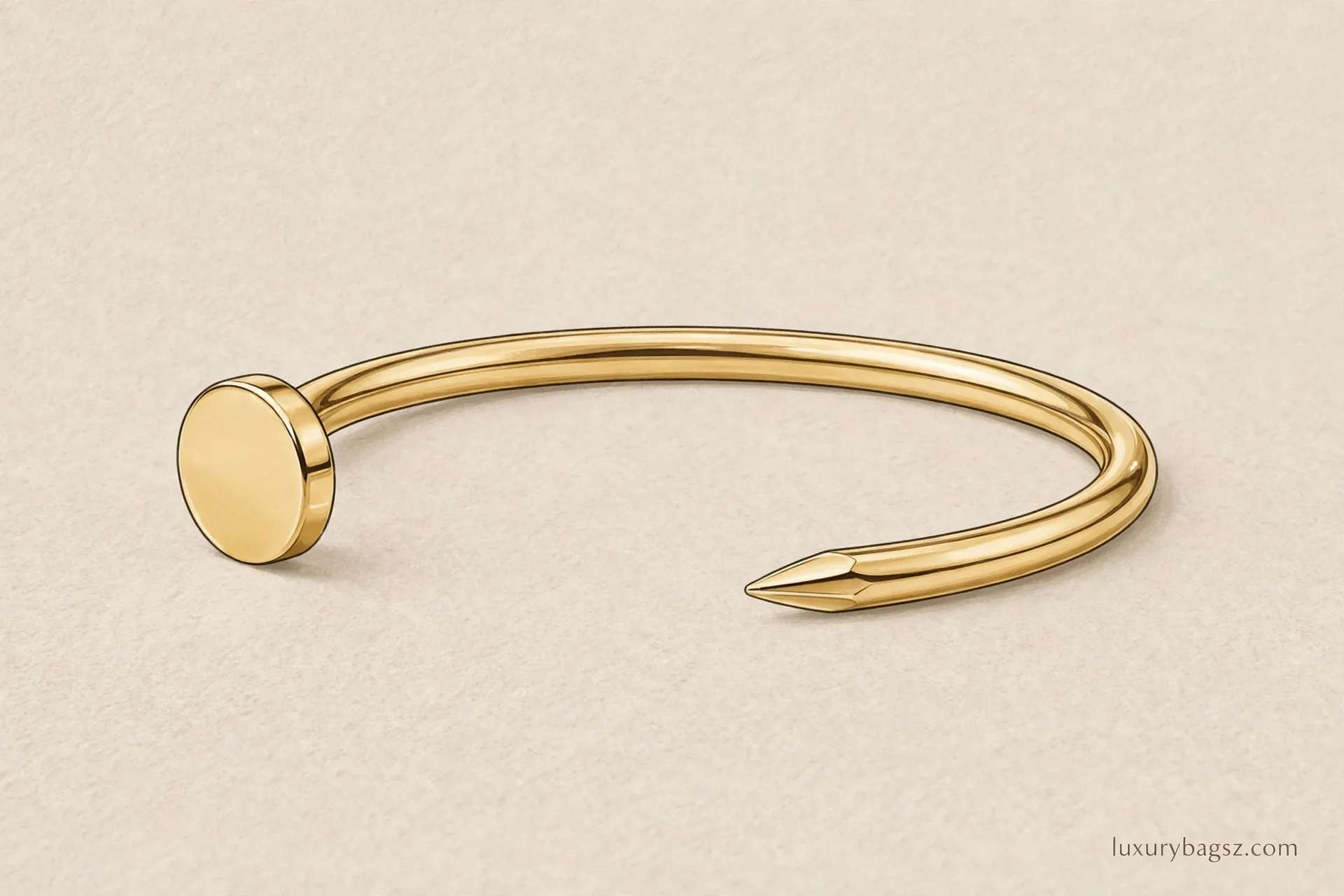
The Juste un Clou is a nail bent into a bracelet. Designed by Aldo Cipullo in 1971, two years after his Love bracelet, it wraps a single length of gold around the wrist, with a flat nail head on one side and a pointed tip on the other. It is the Love's opposite: open where the Love is sealed, edgy where the Love is romantic, and removable in seconds where the Love needs a screwdriver.
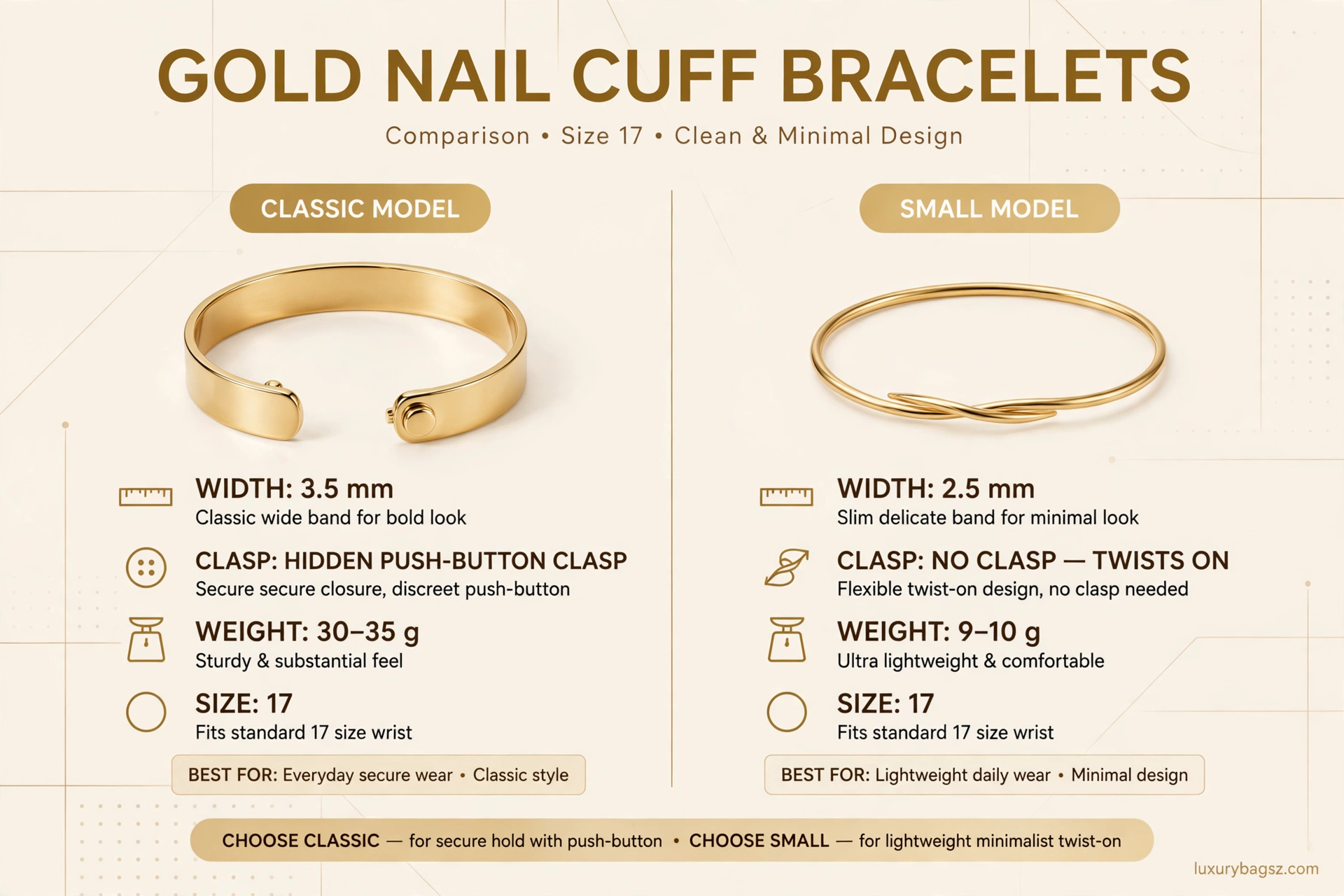
Buy the Classic if you want the original presence: about 3.5 mm wide, a hidden push-button clasp under the nail head, and roughly 30 to 35 grams in size 17. Buy the Small if you want the lighter, quieter version: about 2.5 mm wide, roughly 9 to 10 grams in size 17, and no clasp at all, because it twists gently onto the wrist.
Sizing is where buyers go wrong. TurboOrchid says size down one centimetre from your Love size, because the Clou's oval profile sits slightly looser. Libas says match your wrist circumference exactly, with no slack added, because the cuff's gap does the work. This guide gives you both rules, a measuring routine, and the between-size answer for each model.
Key Takeaways
- Juste un Clou means "just a nail" in French, designed by Aldo Cipullo in 1971, dropped from the catalogue in the 1980s, and relaunched in 2012.
- Classic: about 3.5 mm wide, hinge plus hidden push-button clasp, roughly 30 to 35 grams in size 17. Small: about 2.5 mm wide, no clasp, twists on, roughly 9 to 10 grams in size 17.
- Sizes run 15 to 21, numbered by wrist circumference in centimetres, and Cartier does not easily resize a Clou.
- Sizing rules conflict: size down one cm from your Love size (TurboOrchid) versus match your wrist exactly (Libas). The Small fits with slightly more movement than the Classic.
- In the UAE in May 2026, a plain Classic retailed at AED 33,400 and a plain Small at AED 22,900, with Dubai pre-owned discounts of roughly 21 to 27 percent.
- Fakes are common because the design is mechanically simpler than the Love, so weight, ridges, clasp click and engraving all need checking.
A Nail from 1971, and Why It Still Feels Modern
Aldo Cipullo designed the Juste un Clou for Cartier New York in 1971. He took an ordinary hardware nail, bent it around the wrist, and finished it in polished 18k gold. The head stayed flat on one side, the point stayed sharp on the other, and the ridges below the head stayed visible, like the real thing.
The Clou disappeared from Cartier's catalogue in the 1980s, according to Libas, as taste shifted back toward classical jewellery. It returned in 2012, refined and resized, and it has been one of Cartier's fastest-growing collections since. That gap matters for dating: a genuine 1970s Clou and a post-2012 Clou are different pieces, with different closures, markings and values.
Classic Versus Small: The Two Models Side by Side
The Classic is the original silhouette. It measures roughly 3.5 mm wide, it has a working hinge and a concealed push-button clasp integrated beneath the nail head, and it feels substantial on the wrist. In size 17 it typically weighs between 30 and 35 grams, according to TurboOrchid, which is close to a Classic Love of the same size.
The Small arrived later. TurboOrchid dates it to 2018, though other sources describe the thin, no-clasp version without a consistent date, so treat 2018 as TurboOrchid's date rather than a settled fact. It measures about 2.5 mm wide, it has no mechanical clasp, and it is made from flexible gold that twists gently to slip onto the wrist. In size 17 it weighs around 9 to 10 grams.
The weight gap is the story. A Classic at 30-plus grams announces itself every time you move your wrist. A Small at 10 grams nearly disappears, which is why it stacks so well and why buyers who find the Classic too heavy often love the Small. Do not compare the two on price alone, because you are buying very different amounts of gold.
What the Nail Looks Like, Part by Part
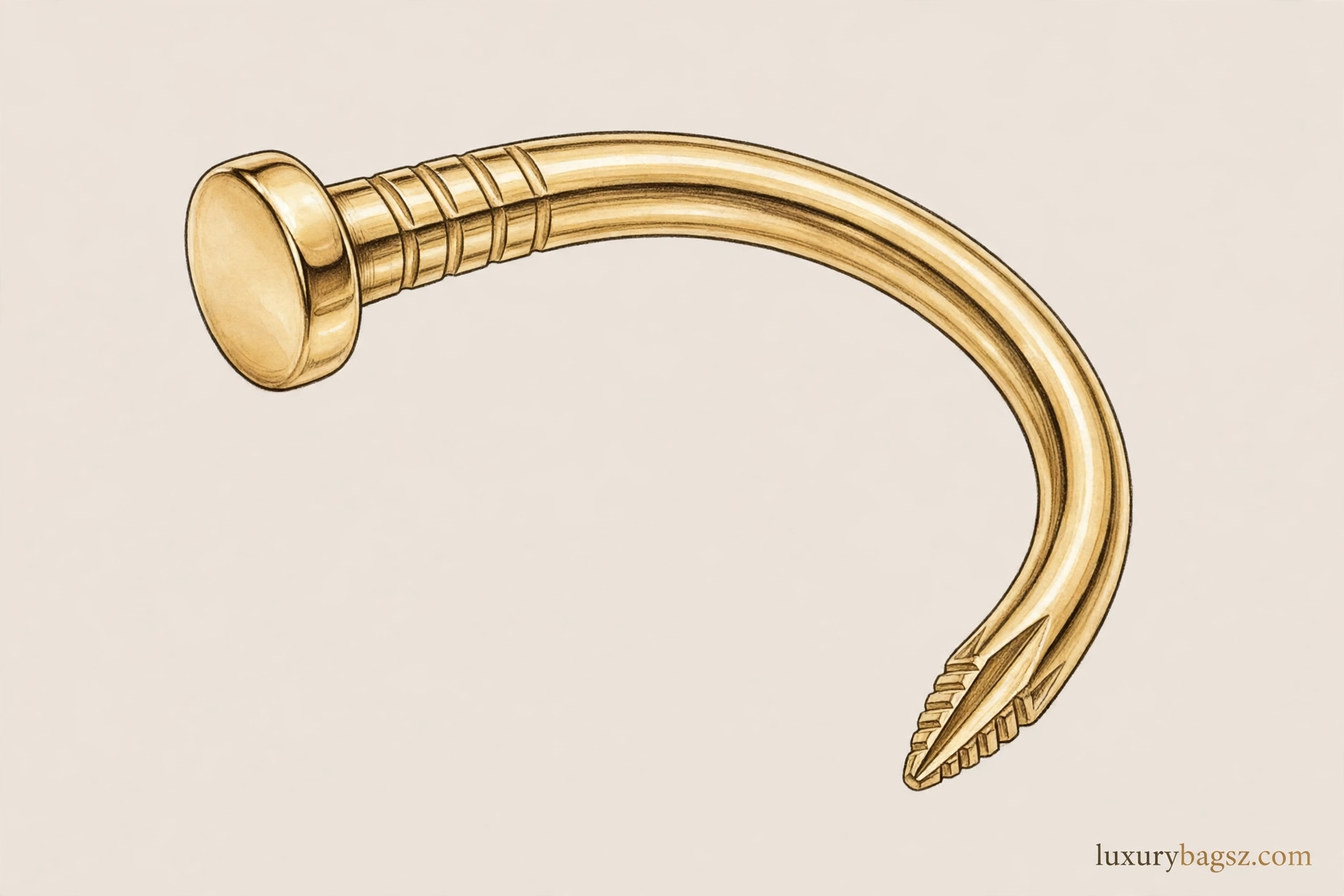
Start at the head. The nail head is a flat, round disc, wider than the shank, with five distinct horizontal grooves stamped around its circumference just below it, according to TurboOrchid. On a genuine piece those grooves are deeply incised, parallel and crisp. On a fake they are often rounded, shallow or uneven, because counterfeit moulds soften fine detail.
Follow the shank around the wrist. It is a smooth, rounded rod of solid gold, not a hollow tube, with a consistent diameter from head to tip. The inside surface is smoothed so it does not catch on clothing, according to Libas, which matters for daily wear. A rough or sharp inner edge suggests poor finishing or a fake.
End at the tip. The pointed end carries ridges of its own, and on the Classic it snaps into the hidden clasp beneath the head with a crisp, audible click. The tip should sit neatly against the head when closed, with no visible gap and no overlap. A tip that sits proud or twists sideways suggests a bent shank or a worn hinge.
Sizing: The Two Rules, and How to Measure
Cartier sizes the Clou in numbered increments from 15 to 21, reflecting wrist circumference in centimetres, according to TurboOrchid. The number is not a length of gold. It is a fit size, and the open cuff means it behaves differently from a closed bangle of the same number.
TurboOrchid's rule is to size down one full centimetre from your Love size. If you wear a size 17 Love, you will generally fit best in a size 16 Clou. The reasoning is that the Clou's oval profile sits slightly looser on the wrist than the flat Love, so the same number would feel looser on a Clou.
Libas's rule is different: match the bracelet size to your wrist circumference exactly, with no slack added, because the cuff naturally has a small opening. Going one size larger creates a noticeable gap, and going one size smaller can pinch. Libas's rule and TurboOrchid's rule will often land on the same size, but they disagree on why, and they disagree for buyers between sizes.
Measure with a soft tape just above the wrist bone, without pulling tight, according to TurboOrchid. If your wrist measures exactly 15 cm, a size 15 gives a close, tailored fit, while a size 16 gives a more relaxed drape. Measure in the evening, when your wrist is largest, and measure the wrist you will actually wear the bracelet on.
For the Small model, keep your wrist measurement snug when choosing, because the thin version twists onto the wrist without a clasp and tends to have slightly more movement than the Classic. A Small that feels loose in the boutique will feel looser after a week, as the flexible gold settles. For the Classic, the clasp holds the fit, so the size you try is the size you keep.

The Clasp, the Hinge, and the Click Test
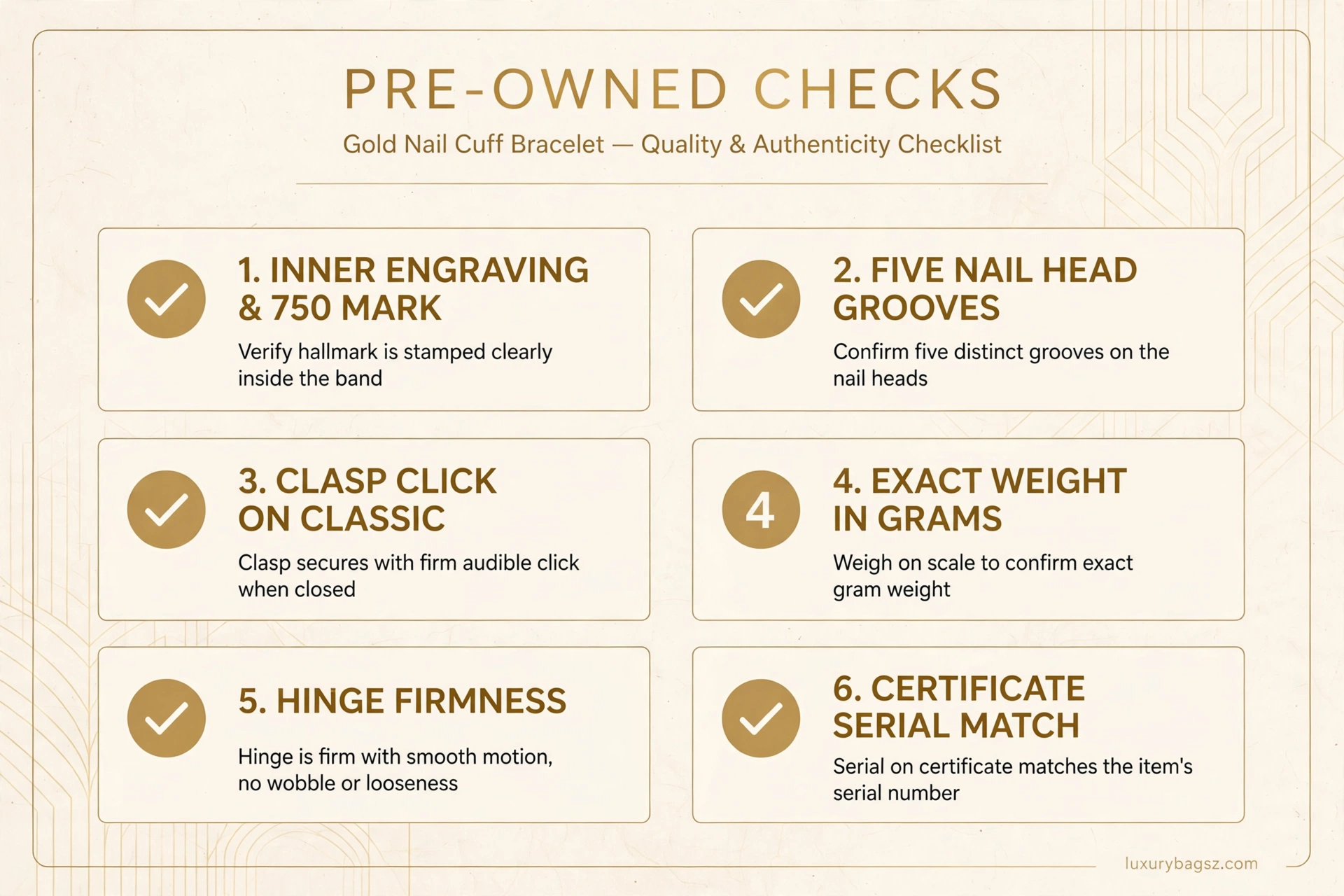
The Classic's closure is hidden under the nail head, and it is the best quick test you have. Press the small hidden release button under the head, and the nail tip should pop free smoothly. When you close it, the tip should snap into place with a crisp, audible click. That click is Cartier engineering, and its absence is information.
The hinge should feel firm, not loose, wobbly or stiff. On a genuine Classic, the hinge moves cleanly and holds the tip in alignment with the head. On a counterfeit, the hinge often shows uneven gaps or feels gritty when opening, according to TurboOrchid. A hinge that grinds or catches has either worn badly or was never made well.
The Small has no clasp to test, which makes its inspection different. Twist it gently onto the wrist and check that it springs back to shape without staying bent. Flexible gold should flex and recover. Gold that stays deformed, or that feels stiff and springy in the wrong way, suggests the wrong alloy or a tired piece that has been bent too often.
Libas's comparison table simplifies the Classic closure to "open cuff, no closure," which contradicts TurboOrchid's push-button clasp description. This guide follows TurboOrchid, because the hidden clasp is described in detail, with a release button and a click, while Libas's line reads as shorthand for the cuff's open look. If a seller tells you a Classic has no closure at all, ask them to show you the underside of the head.
Hallmarks and Engraving: What Should Be Inside
Turn the bracelet over and examine the inner surface near the head and the tail. A genuine Clou carries clean, crisp, evenly spaced stamping: the Cartier script logo in its signature cursive, the metal purity mark, the size, and a unique serial number. Look also for the small copyright symbol before the Cartier name, which TurboOrchid lists as a check.
The metal mark reads 750 or Au 750, meaning 18k gold, 75 percent pure. The size is engraved as a two-digit number, such as 16 or 17. The serial number usually follows one of two formats, according to TurboOrchid: two letters followed by four numbers, or three letters and three numbers. Libas adds that Cartier's serial format changed in 2010 and again in 2018, so a serial alone dates a piece only with an authenticator's help.
Font and spacing matter as much as the words. Genuine Cartier script is sharp and precise, not laser-etched too shallowly or stamped unevenly. The Legit Check guide, seen only as a snippet in this research, adds that interior stamping font and spacing, the oval rather than round shape, and the roundness of the nail head are all worth checking. Snippet-only claims are flagged as such, not presented as fully verified.
Weight, Metal, and the Hollow Fake
Cartier makes the Clou from solid 18k gold, never from hollow tubing or plated base metal. That single fact gives you the most useful pre-owned test, because hollow fakes are dramatically lighter than solid gold. A Classic that weighs under 25 grams in size 17 is likely hollow or made from non-precious metals, according to TurboOrchid.
The benchmarks are narrow and usable. A Classic in size 17 typically weighs between 30 and 35 grams. A Small in size 17 weighs around 9 to 10 grams. Those are TurboOrchid's figures, and they are the only weight benchmarks found for the Clou in this research. No full weight table by size was found, so do not extrapolate a size 15 or size 21 weight from the size 17 figure and treat it as fact.
Always ask the seller for the exact scale weight in grams before buying. Weigh the bracelet alone, without packaging, on a digital jewellery scale. A seller who lists "approximately 30 grams" for a Classic but will not give an exact figure is asking you to trust a round number on a purchase worth thousands.
Metal testing closes the gap that weight leaves. Gold is not magnetic, so a magnet test catches plated base-metal fakes quickly. A professional XRF test, which reads the exact gold content without scratching the piece, is worth the fee on any Clou bought outside a boutique.
For the same reason, our guide to telling a fake Hermès Chaîne d'Ancre bracelet stresses metal and construction checks over paperwork alone, and the same caution applies here.
Wearing It Every Day: Comfort, Gap, and Stacking
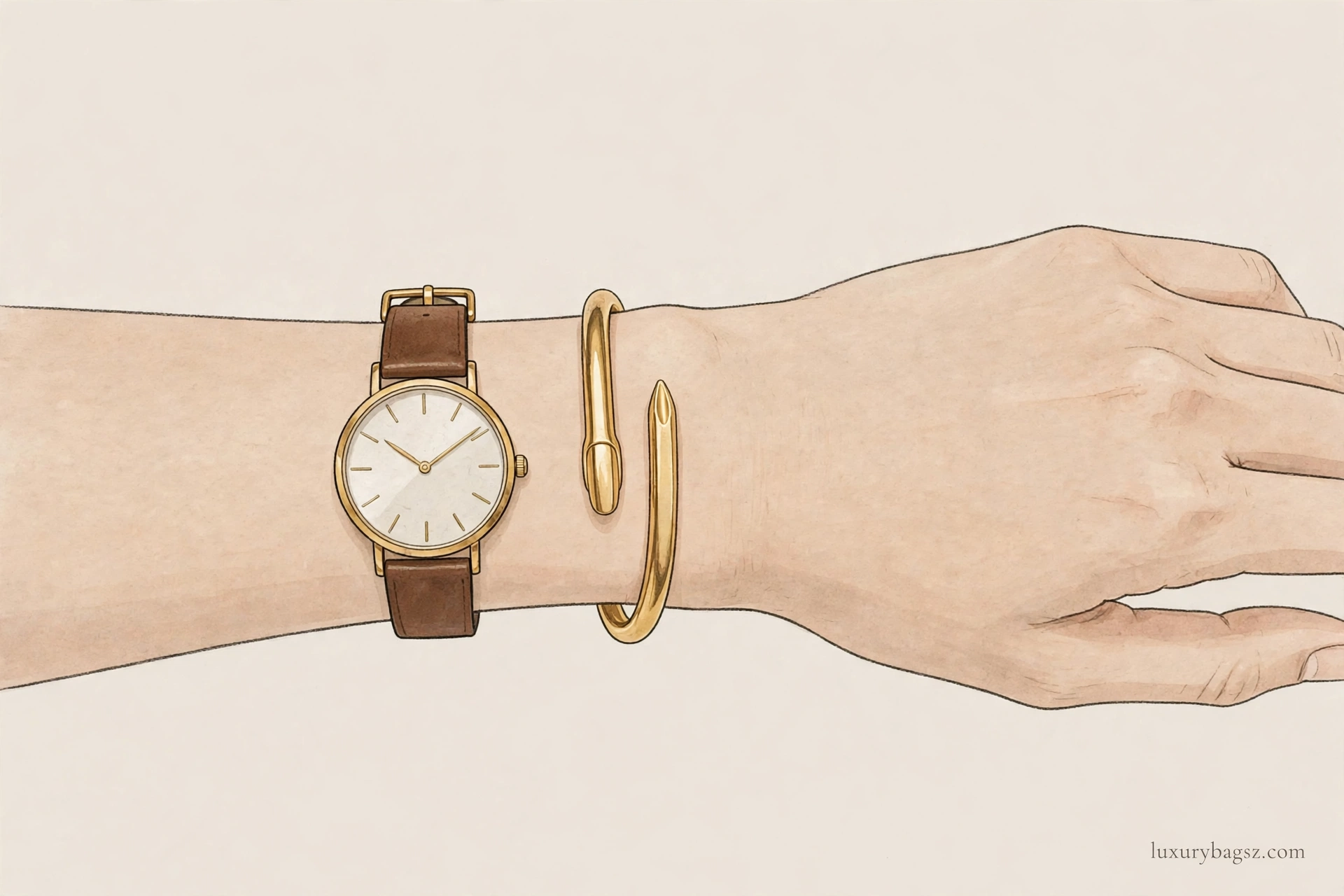
The Clou is the Cartier bracelet you can take off. It slides on at the wrist's narrow edge, rotates into place, and lets you remove it at the gym, at airport security, or before rolling out a yoga mat, as Libas notes. That freedom is the Clou's great advantage over the Love, and it is also its great risk, because a bracelet you can remove is a bracelet you can lose.
Libas reports that Cartier's after-sales team in Dubai sees roughly four times as many lost Clou cases as lost Love cases each year. That figure is Libas's claim, not a Cartier-published statistic, but it matches the design logic: an open cuff can work its way off a wrist that a screwed Love cannot leave. Check the gap and the fit every time you put it on, especially after exercise or in cold weather, when wrists shrink.
The gap on the inside of the wrist is normal. It is the opening that lets the cuff on and off, and it should be small and even when the bracelet is worn. A gap that widens over months suggests the Small model's flexible gold is tiring, or the Classic's shank has been bent. A gap that closes suggests the bracelet has been squeezed, which also changes the fit.
Prices in 2026, and What Pre-Owned Really Saves
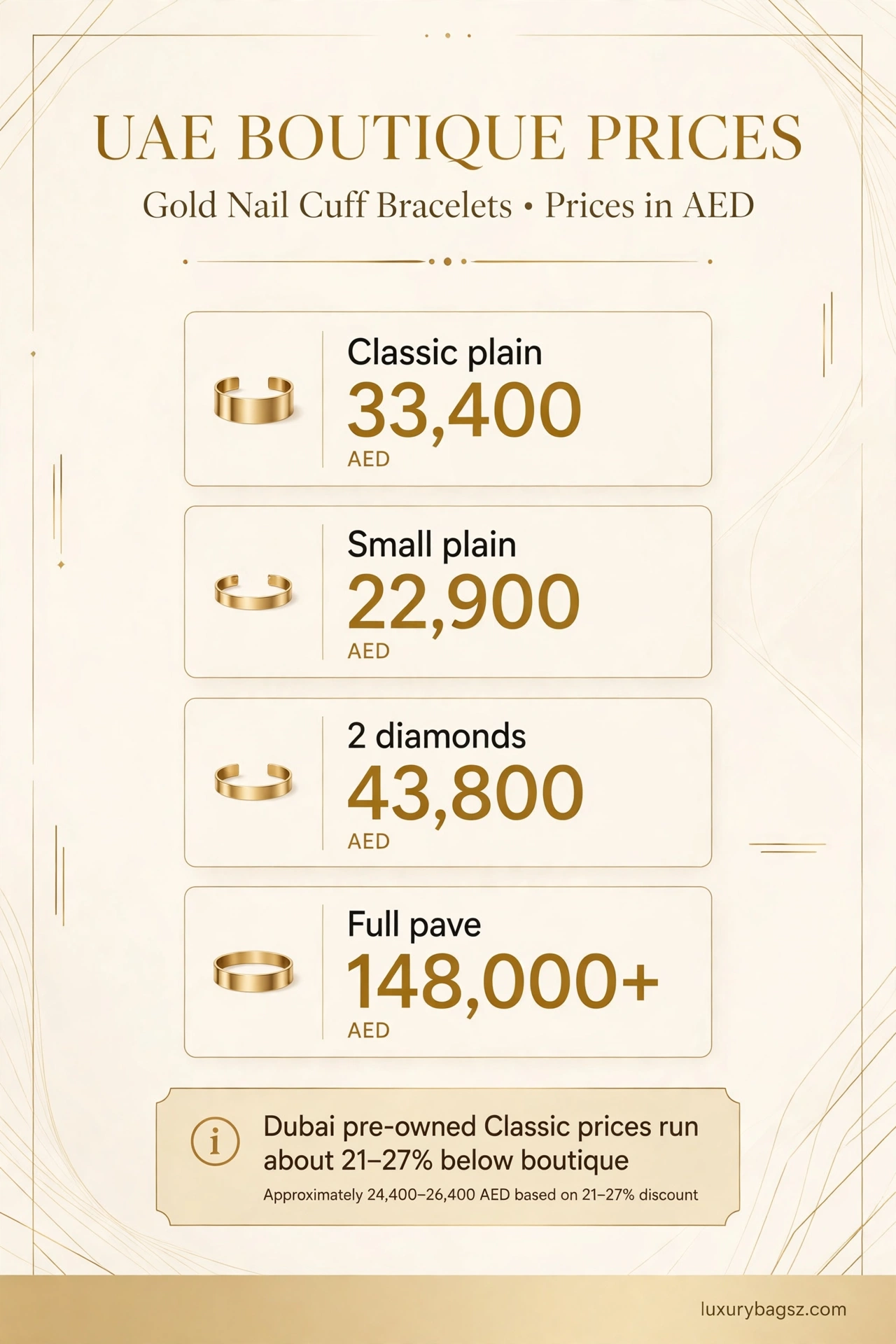
As with the Love, no current USD, GBP or EUR retail price table was found for the Clou in this research, so none is invented here. The dated prices below are in UAE dirhams from Libas Collective, May 2026, and they are the only boutique prices found with a date attached.
| Version | UAE boutique, May 2026 (AED) |
|---|---|
| Juste un Clou Bracelet, Classic, plain 18k gold | 33,400 |
| Juste un Clou Bracelet, Small Model, plain 18k gold | 22,900 |
| Juste un Clou, 2 diamonds | 43,800 |
| Juste un Clou, full pavé | 148,000+ |
| Juste un Clou Earrings (pair), 18k gold | 13,200 |
| Juste un Clou Ring, 18k gold | 9,800 |
In Dubai's pre-owned market, a 2023 yellow gold Classic Clou typically traded around AED 24,500 to 26,500 in 2026, roughly 21 to 27 percent below boutique, according to Libas. Libas also reports that the Clou holds value especially well because production volume has historically been lower than the Love's, making the secondary market thinner and demand tighter.
TurboOrchid gives no retail prices, only the general claim that genuine Clou bracelets retain a strong percentage of retail on the secondary market, especially with original paperwork and boxes. That claim is directionally consistent with Libas's figures, but it is not a price, and this guide does not turn it into one.
Compare the Classic Clou with the Classic Love on price, not just on looks. In May 2026 in the UAE, the Classic Clou at AED 33,400 cost more than the Classic Love at AED 30,500, while the Small Clou at AED 22,900 cost more than the Small Love at AED 21,800. The nail is not the cheaper Cartier bracelet, even though it looks simpler.
Condition: Scratches, Polish, and the Ridges That Must Stay Sharp
Look for pieces with crisp original factory contours, even if they show minor surface swirls. Check the five grooves below the head first, then the ridges on the tip, then the edge of the head itself. If the grooves look soft or the head edge looks rolled, the bracelet has been over-polished, and its resale value should reflect that.
Check the hinge and clasp for wear as well. A Classic whose tip no longer clicks firmly, or whose hinge wobbles, has either been worn hard or repaired badly. A Small whose shank no longer springs back to shape has been bent too often. Both faults are reasons to negotiate the price down or to walk away, depending on how much they affect wear.
Care Over Time, and the Open Cuff's Weaknesses
Water is a judgement call, not a rule. Gold itself tolerates water, but the Clou's hinge and clasp on the Classic collect soap and lotion residue, and repeated wetting and drying can dull the finish. Take it off for swimming and for cleaning chemicals, and dry it fully if it does get wet. No competitor guide found gives a definitive Cartier statement on showering with a Clou, so this guide gives practical advice rather than a claimed house rule.
The Small model's flexibility is its long-term weakness, and no competitor guide found discusses it directly. A thin gold cuff that twists on and off daily will fatigue over years, and the gap may widen or the shank may lose its spring. That risk is stated here as a reasoned caution, not as a measured failure rate, because no source in this research measured it.
For the Classic, the weakness is the hinge and the push-button mechanism. Keep both clean, never force a stiff clasp, and have a jeweller look at it if the click softens. A clasp that fails open is how a Clou gets lost, and a lost Clou is rarely recovered.
Jewellery care for mixed pieces is covered in our guide on how to clean Hermès fashion jewelry, where the same dry-first, gentle-cleaning rule protects gold finishes.
Buying Pre-Owned: The Photographs to Demand
Do not buy a Clou from a listing with three photographs. Demand the full set, and walk away from a seller who will not provide it. The photographs you need are specific, and each one answers a different authentication question.
Ask for a close photograph of the inner engraving, showing the Cartier script, the 750 mark, the size number and the serial number, all legible. Ask for a close photograph of the nail head from above and from the side, showing the five grooves and the roundness of the head. Ask for a close photograph of the tip and its ridges, and of the underside of the head where the Classic's clasp sits.
Ask for a photograph of the hinge, open and closed, and a photograph of the full bracelet from both sides, so you can check the shank for bends and the overall oval shape. The Legit Check snippet adds that the shape should be oval, not round, which is a useful check on a full-length photograph even though that guide was only seen as a snippet here.
Ask for the exact scale weight in grams, the certificate with its serial number, and a photograph of the box and pouch. Check that the certificate serial matches the bracelet serial character by character. Check that the box colour matches the era, because boxes are faked too, and a wrong box is a warning even when the bracelet looks right.
The Wider Clou Family: Rings, Earrings, and Necklaces
Libas notes that the wider Clou family exists, but neither competitor guide found sizes, prices or compares the non-bracelet pieces in any detail. This part gives the dated prices that were found, and states plainly what was not found, rather than filling the gap with guesses.
In the UAE in May 2026, Libas reported Clou earrings in 18k gold at AED 13,200 for a pair, and a Clou ring in 18k gold at AED 9,800. Those are boutique prices for plain gold versions. Diamond versions cost more, but no dated diamond prices for rings or earrings were found in this research.
Love or Clou: Which Cipullo Bracelet Should You Buy
Choose the Love if you want the most universally recognised Cartier piece, a tighter fit that stays put, and a romantic symbolic story. Choose the Clou if you want a more architectural, slightly edgier look, a comfortable open cuff that slides on and off without a screwdriver, and a piece that reads as a Cartier insider choice rather than the obvious one.
Choose the Classic Clou if you want presence, weight and a mechanical clasp you can test with a click. Choose the Small Clou if you want lightness, stacking ease and a quieter look, and if you accept that a flexible cuff needs more careful handling over years. Choose pre-owned for either model if you want to save roughly a fifth to a quarter off boutique prices in Dubai, without giving up authenticity, provided you run the pre-owned checks.
If you can only buy one Cipullo bracelet and you want the safest resale, buy the Love Classic, because it is the most liquid Cartier bracelet in the world. If you want the bracelet you will actually enjoy wearing every day, try both on, and buy the one whose weight, gap and clasp feel right on your own wrist.
Pairing the Clou With a Love, and Gifting It Well
Many buyers end up owning both Cipullo bracelets, and the pairing works when the sizes are chosen independently. Do not assume your Clou size equals your Love size. TurboOrchid says size down one centimetre from your Love size, while Libas says match your wrist exactly, and those rules can land on different numbers for the same wrist.
Gifting a Clou is easier than gifting a Love in one respect: the open cuff forgives a small sizing error better than a screwed oval does, because the gap absorbs a few millimetres. It is harder in another respect: a Clou bought in the wrong size can slide off and be lost, while a Love in the wrong size merely pinches or twists.
Diamond Clou versions deserve a final sizing note. A two-diamond Classic and a full pavé Classic cost far more than plain versions, with Libas reporting AED 43,800 for two diamonds and AED 148,000 or more for full pavé in the UAE in May 2026. At those prices, a sizing mistake is expensive, and a pre-owned diamond Clou in an unusual size is a slower resale.
Frequently Asked Questions
When was the Juste un Clou designed?
In 1971, by Aldo Cipullo for Cartier New York, two years after his Love bracelet of 1969. The Clou disappeared from Cartier's catalogue in the 1980s, according to Libas, and was relaunched in 2012, refined and resized.
What is the difference between the Classic and Small Juste un Clou, and how does it differ from the Love bracelet?
The Classic is about 3.5 mm wide, has a hinge and a hidden push-button clasp under the nail head, and weighs roughly 30 to 35 grams in size 17. The Small is about 2.5 mm wide, has no clasp, twists onto the wrist, and weighs roughly 9 to 10 grams in size 17.
The Love is a closed oval that screws shut with two screws and needs a screwdriver, designed as a sealed symbol of commitment. The Clou is an open nail cuff that slides on and off, designed as an architectural, edgier statement. The Love is more recognised; the Clou is more of an insider piece.
How do Juste un Clou sizes work, and can one be resized?
Sizes run from 15 to 21, numbered by wrist circumference in centimetres. TurboOrchid says size down one centimetre from your Love size, because the Clou's oval profile sits slightly looser. Libas says match your wrist circumference exactly, with no slack added. Measure just above the wrist bone with a soft tape.
Cartier does not offer sizing adjustments for the Clou, according to TurboOrchid, and modifying the metal outside Cartier voids future boutique servicing and hurts resale value. Buy the exact size you need, and buy from a seller who accepts returns if the fit is wrong.
How much does a Juste un Clou cost in 2026?
In the UAE in May 2026, Libas reported a plain Classic at AED 33,400 and a plain Small at AED 22,900, with a two-diamond Classic at AED 43,800 and full pavé at AED 148,000 or more. No current USD retail price table was found, so none is invented here. Dubai pre-owned Classic prices ran roughly 21 to 27 percent below boutique.
How do you tell a real Juste un Clou from a fake?
Check the crisp Cartier script, the 750 mark, the size number and the serial number inside; the five deep, parallel grooves below the nail head; the Classic's push-button clasp and crisp click; and the exact scale weight, 30 to 35 grams for a Classic size 17 and 9 to 10 grams for a Small size 17. No single check proves a piece real.
Is the Juste un Clou comfortable for daily wear?
Yes, with the right size. The open cuff slides on and off in seconds, which is convenient, but it also means the bracelet can be lost more easily than a screwed Love. Check the gap every time you put it on, and take it off for heavy manual work and cleaning chemicals.
Does the Juste un Clou hold its value, and should you buy new or pre-owned?
Yes, according to both competitor guides, especially with original paperwork and boxes. Libas reports Dubai pre-owned Classic prices roughly 21 to 27 percent below boutique in 2026, and notes that lower production volume than the Love keeps the secondary market thinner and demand tighter.
Buy new if you want a guaranteed authentic piece, the full boutique experience, and the latest size. Buy pre-owned if you want to save roughly a fifth to a quarter off boutique prices. Either way, demand the full photograph set listed in the pre-owned section, the exact weight, and a matching certificate serial before you pay.
Final Verdict
The Juste un Clou is the bravest piece of fine jewellery ever made from an ordinary object, and it still works because it never apologises for what it is. A nail, in solid gold, worn openly, with its head and point showing. No other Cartier bracelet makes quite the same statement, and no other one is so easy to wear.
Buy the Classic if you want the full weight and the satisfying click of the hidden clasp. Buy the Small if you want lightness and stacking ease. Size it carefully, because Cartier will not resize it, and check it properly, because its simple shape makes it a favourite target for fakes.
Try it on beside the Love before you decide. The Love is the promise; the Clou is the punctuation mark. Whichever sentence you want your wrist to say, make sure the size, the weight and the ridges all check out first.






