

Van Cleef & Arpels Alhambra: The Complete Collector’s Guide to Lines, Materials and Value
Alhambra in Brief
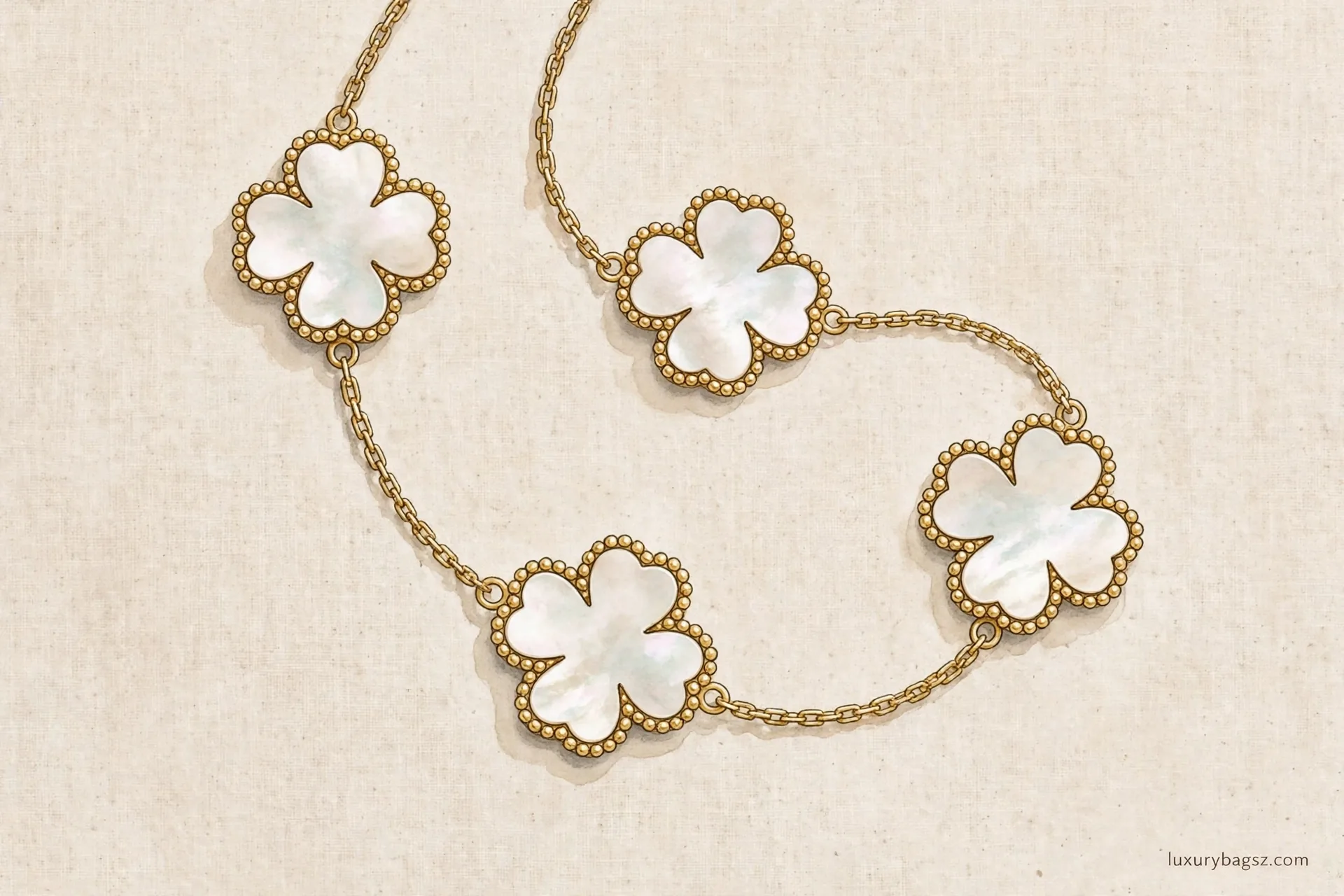
Alhambra is not one piece. It is a family of four-leaf clover motifs, edged in tiny gold beads, made in several sizes, many materials, and pieces from pendants to long necklaces. The classic entry point is the Vintage line, with motifs of about 15 mm, in a 10-motif necklace, a 5-motif bracelet, or a single-motif pendant.
The collection launched in 1968 with a long necklace of 20 creased yellow-gold clover motifs, and the clover shape itself appears in the Maison's archives as early as 1906. The popular story about Jacques Arpels and the Alhambra palace in Granada is widely repeated, but Borro notes it is not part of the Maison's official chronology. Treat it as good colour, not verified history.
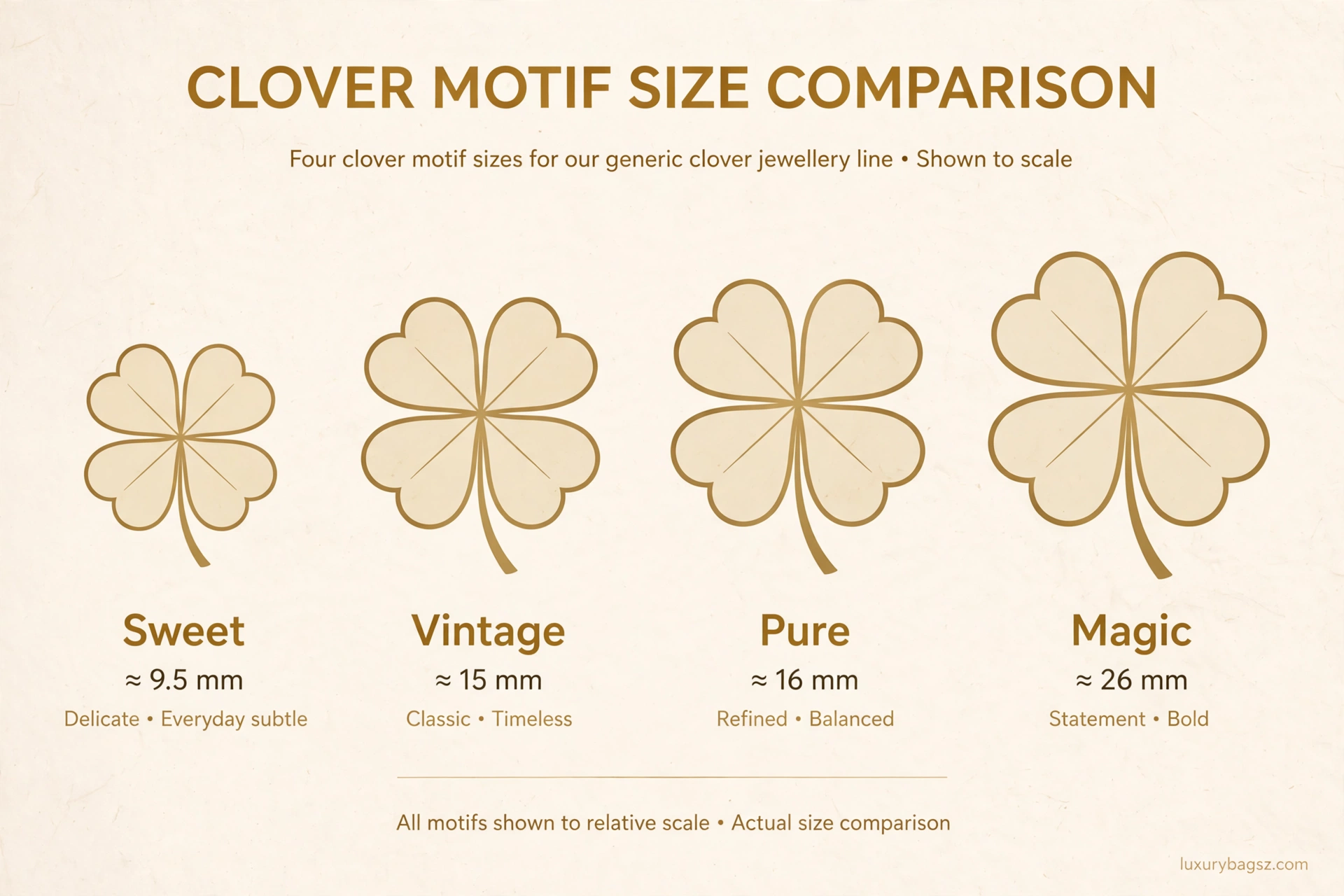
Choose Vintage for everyday versatility, Sweet at about 9.5 mm for delicacy and stacking, Magic at up to about 26 mm for a statement, and Pure at about 16 mm for a cleaner, bead-free look. Buy the material for your life, not just your eye: mother-of-pearl is beautiful and fragile, malachite can crack, and turquoise discolours with water and oil.
Key Takeaways
- Alhambra launched in 1968 with a 20-motif long necklace in creased yellow gold; clover motifs appear in Maison archives from 1906.
- Lines by motif size: Sweet about 9.5 mm, Vintage about 15 mm, Pure about 16 mm, Magic up to about 26 mm, plus Lucky charm mixes and Alhambra watches.
- The Jacques Arpels palace anecdote is repeated widely but is not in the official chronology, according to Borro.
- No current boutique price table was found in the competitor guides, so this guide gives dated resale ranges instead of inventing retail prices.
- Material condition is everything pre-owned: mother-of-pearl chips and dulls, malachite cracks, turquoise discolours, carnelian and onyx lose polish.
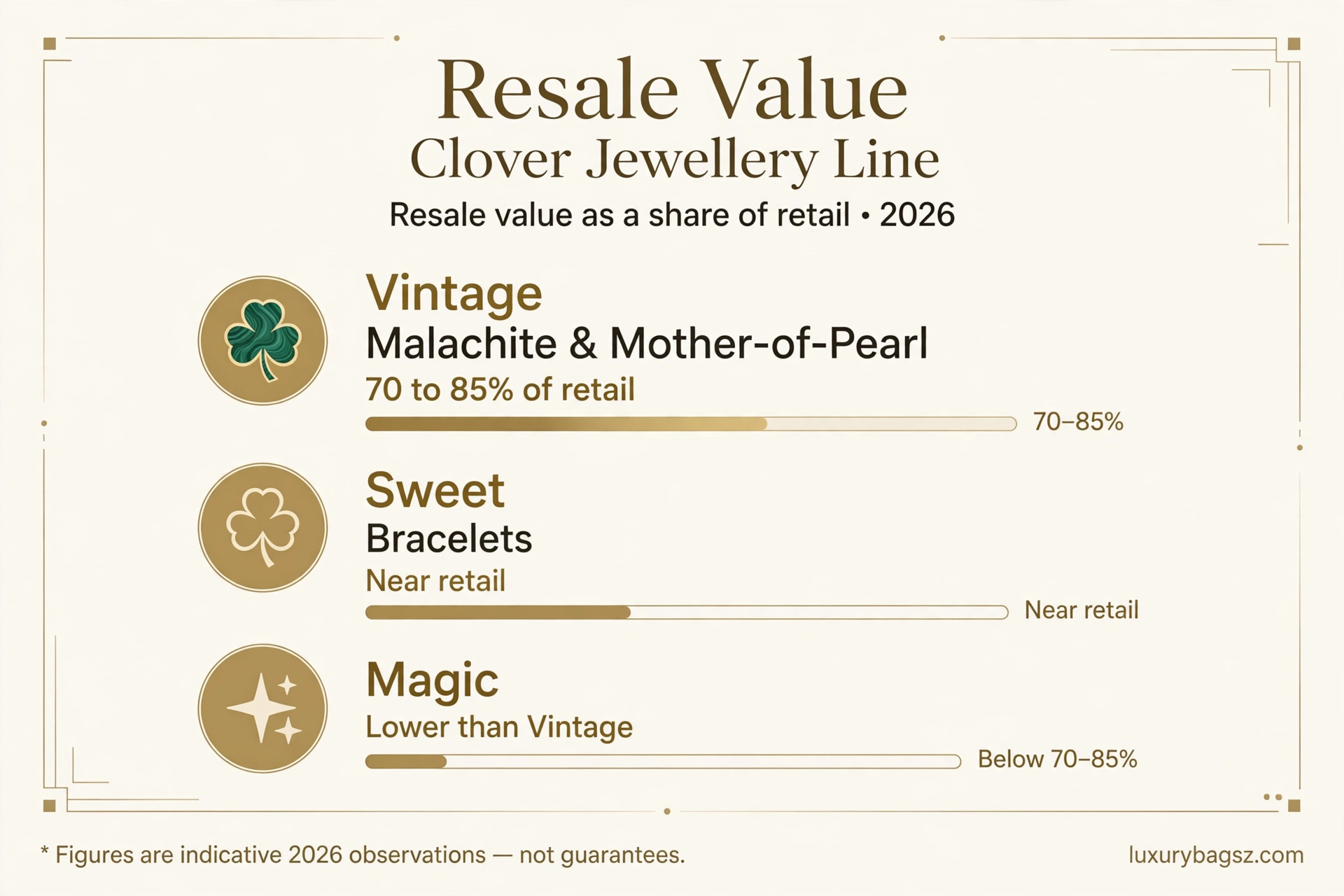
- Vintage malachite and mother-of-pearl pieces traded at roughly 70 to 85 percent of retail in The Luxury Closet's 2026 analysis, with Sweet bracelets near retail.
One Name, a Whole Family
Ask for "an Alhambra" in a boutique and the assistant will ask you which one. That is the first lesson of this collection. Alhambra is a motif, a beaded frame, and a set of proportions, applied across necklaces, bracelets, earrings, pendants, rings and watches, in gold, diamonds, hard stones and mother-of-pearl.
Confusing one line for another is a common and costly mistake, as Borro warns. A Sweet bracelet and a Vintage bracelet look similar in a small photograph, but they differ in motif size, price, and resale behaviour. A Magic pendant and a Vintage pendant differ even more. Learn the lines before you learn the prices.
The through-line is the clover itself: four rounded leaves, softly curved, framed by a row of tiny gold beads in most lines. That frame is the quickest visual identifier, and its evenness is also one of the best authentication checks. If the beads look uneven, the piece deserves a closer look.
History: 1906 Archives, 1968 Launch, a Story to Handle Carefully
The four-leaf-clover motif appears in Van Cleef & Arpels archives as early as 1906, decades before the collection carrying its name reached retail. According to the Maison's official account, the clover shape circulated through the house's design vocabulary long before it became a standalone icon. That archival depth is part of why Alhambra holds value: it is a genuine twentieth-century design, not a recent marketing invention.
The Alhambra line as collectors know it launched in 1968 with a long necklace of 20 creased, textured yellow-gold clover motifs joined by beaded borders. It was an immediate success, according to TrueFacet, and the design has been reinterpreted ever since in new sizes, stones and finishes. The beaded edge and the hammered, creased gold surface remain diagnostic details on any piece claiming 1968-era lineage.
Then there is the palace story. Signed Vintage Jewelry attributes the design's inspiration to Jacques Arpels, grandson of co-founder Estelle Arpels, who reportedly drew on Moorish four-leaf-clover lattice patterns he saw walking through the Alhambra palace in Granada. Borro states plainly that this anecdote is not part of the Maison's own official chronology, though it is widely repeated in collector literature.
The Lines, Compared by Motif Size
TrueFacet's line guide, using the Maison's official motif size guide, gives the clearest size picture found in this research. The Maison notes that dimensions are approximate because each piece is handmade, so treat every figure as "about," not exact.
| Line | Motif size | Character |
|---|---|---|
| Sweet Alhambra | About 9.5 mm | Miniature clover, plus hearts and butterflies |
| Vintage Alhambra | About 15 mm | The classic everyday size, closest to 1968 |
| Pure Alhambra | About 16 mm | Simplified, minimal border, contemporary read |
| Magic Alhambra | Up to about 26 mm | Boldest, asymmetric, mixed sizes and materials |
| Lucky Alhambra | Varies | Clover mixed with hearts, butterflies, leaves, stars |
| Alhambra watches | Varies | Clover-motif dial or case detail |
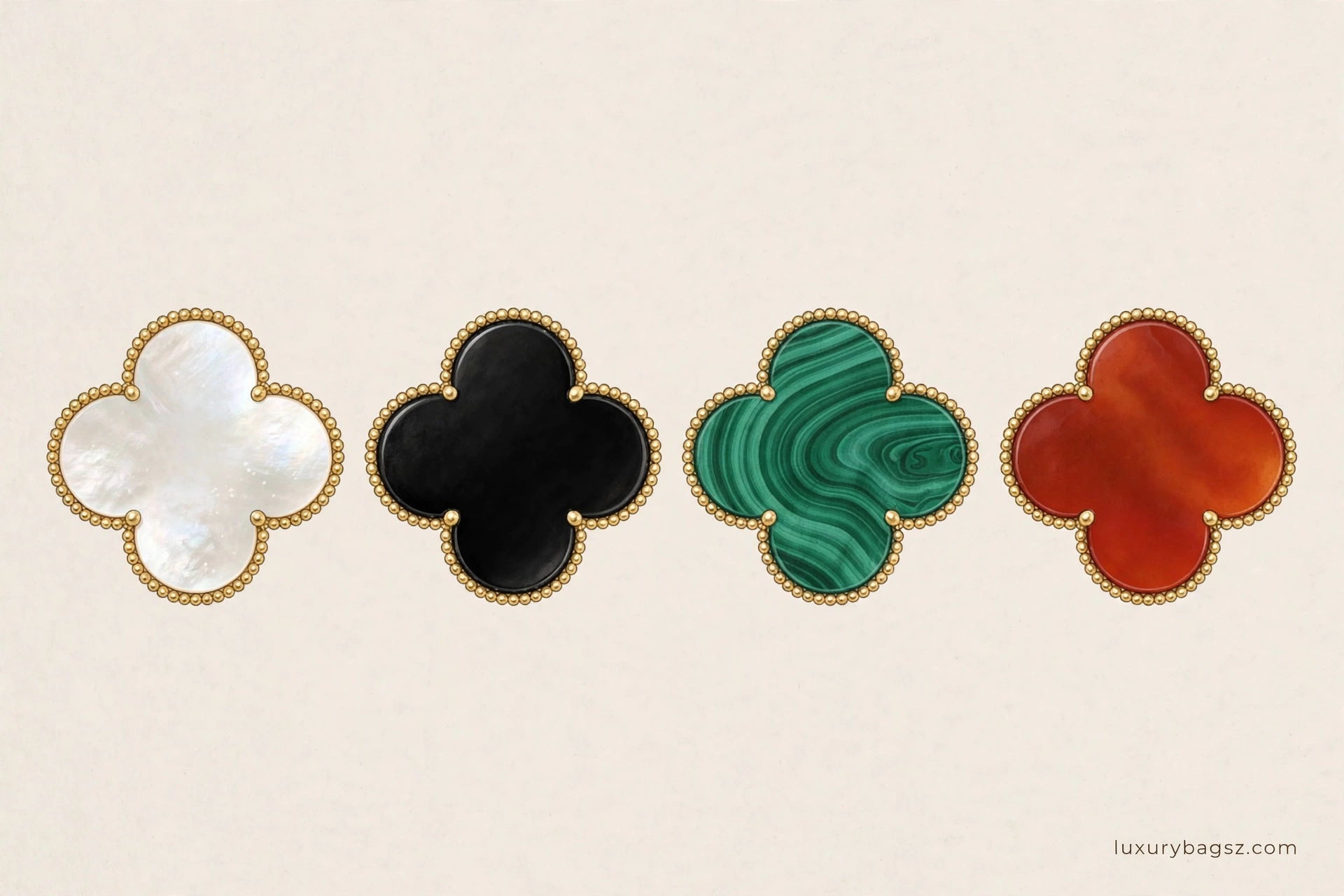
Vintage is the line that stays closest to the 1968 original. Every motif is the same size and edged in golden beads, set with a natural material such as mother-of-pearl, onyx, malachite, carnelian or diamonds. The 10-motif necklace, the 5-motif bracelet and the single-motif pendant are the most familiar pieces.
Sweet turns the motif into a miniature and adds hearts and butterflies across bracelets, pendants, earrings and watches. At about 9.5 mm, Sweet pieces are the most discreet way to wear the design and a popular choice for a first piece, for younger wearers, or for stacking with other bracelets.
Magic is deliberately asymmetric, combining motifs in a mix of sizes and materials, from carnelian and tiger's eye to white and grey mother-of-pearl, white gold and diamonds. Its largest motif measures about 26 mm, which makes a single Magic pendant or a pair of earrings a statement on its own.

Pure, Byzantine, Lucky, and the Lines Guides Skip
Pure Alhambra, listed at about 16 mm in the house size guide, drops the beaded edge for a cleaner silhouette. It reads as more contemporary than Vintage, and it suits buyers who like the clover shape but find the beading too traditional. TrueFacet mentions Pure only briefly, and Borro lists it as a simplified, minimal-border format, so detail on Pure's full range is thinner than for Vintage or Sweet.
Byzantine Alhambra is the all-gold branch, appearing in the Maison's Heritage Gallery alongside guilloché gold, enamel and gemstone versions. TrueFacet mentions Byzantine only in passing, and no competitor guide found gives a full Byzantine size or price picture. If a seller offers a "Byzantine" piece, ask for Maison documentation, because the name is used loosely in the secondary market.
Lucky Alhambra mixes the clover with other symbols drawn from nature: hearts, butterflies, leaves and stars, in a variety of materials and colours. Pieces such as the Lucky 12-motif long necklace read as a curated charm necklace rather than a uniform row of clovers. TrueFacet treats Lucky briefly, and Borro lists it as playful, with a smaller secondary market than Vintage or Sweet.
Materials: What Each Stone Does, and What It Costs You
Material choice is one of the strongest drivers of both retail price and resale demand, and it is also the strongest driver of care burden. The Maison's materials include mother-of-pearl in white and grey, carnelian, malachite, onyx, lapis lazuli, tiger's eye, turquoise, rock crystal, chalcedony, diamonds, and gold in white, yellow and rose tones, plus limited-edition Sèvres porcelain pieces.
White mother-of-pearl is the most classic choice and brightens the face, according to TrueFacet. It is also the most condition-sensitive material in the collection. It scratches easily, chips at motif edges, and dulls or discolours with prolonged moisture or chemical exposure, including perfume and cleaning products. A mother-of-pearl piece that looks perfect has usually been worn carefully or recently serviced.
Malachite gives saturated green colour, but it is a relatively soft, brittle stone despite its dense look. It is prone to banding irregularities and can crack under impact. Carnelian and onyx show wear through polish loss and edge chipping, and colour consistency across multiple motifs in one piece is a useful, if informal, condition indicator.
Turquoise and other porous stones discolour with water or oil exposure and may have been treated or stabilised, which affects long-term value differently from untreated stone. Diamond-pavé versions carry the highest retail prices and tend to hold value well when stone counts and settings are intact. Gold beading should be checked for dents, thinning from repeated polishing, and signs of prior repair.
Choosing Your First Piece: Size, Occasion, and Metal
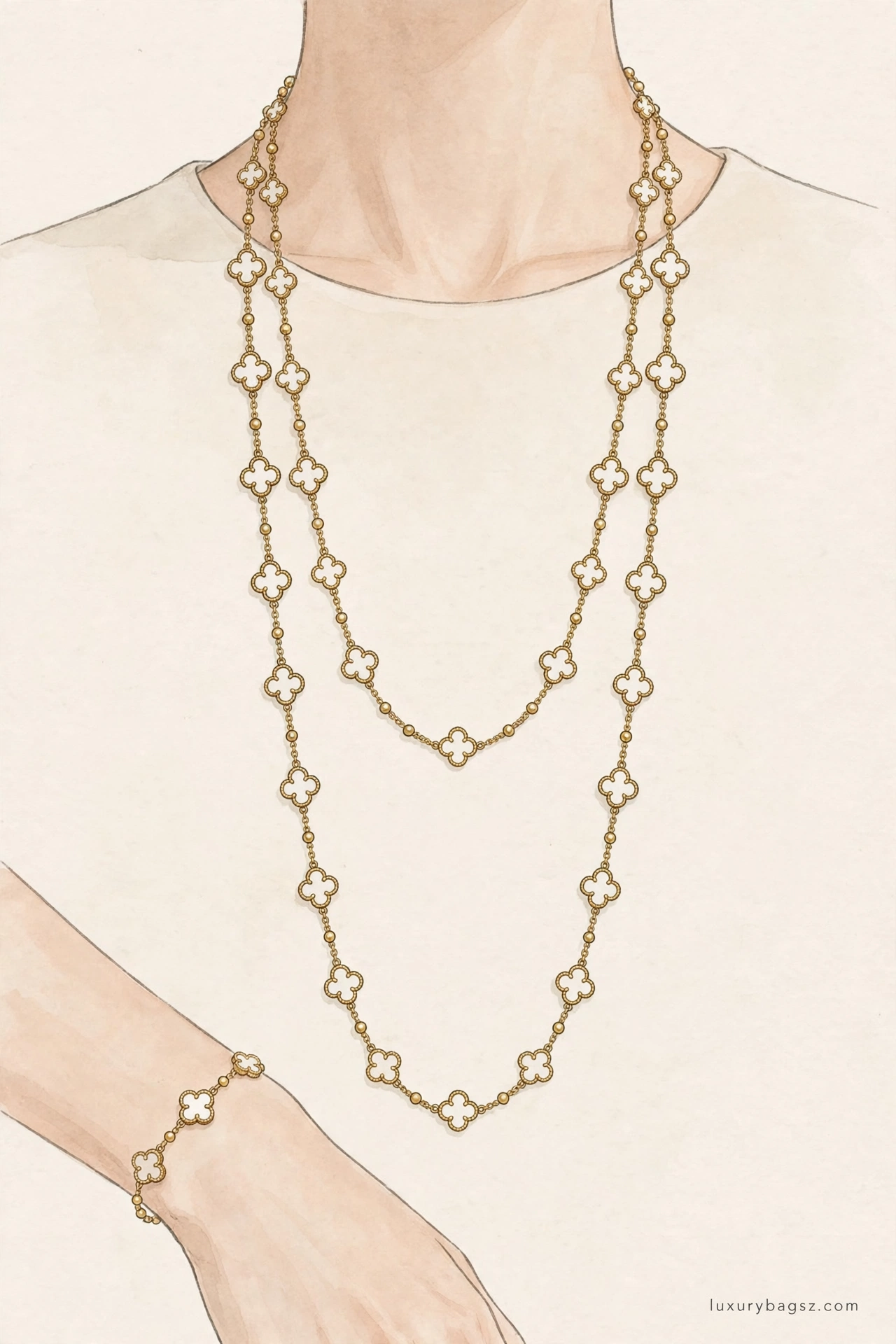
Start with how you will wear it. For everyday wear and layering, Vintage is the most versatile line. A 10-motif necklace can be worn long or doubled, and a 5-motif bracelet sits comfortably beside a watch. For subtle wear or stacking, Sweet keeps the look delicate and works well in multiples. For a statement, Magic's larger motifs carry an outfit on their own.
No competitor guide found gives necklace lengths for the 10-motif versus 20-motif necklaces, bracelet lengths, chain adjustability, or earring drop. That gap is stated here rather than filled with guesses. In a boutique, ask for the actual length of the exact piece, and try the necklace doubled and long, because the same piece wears very differently both ways.
For a first piece, the single-motif Vintage pendant is the lowest-risk entry: one motif to inspect, one material to care for, and the easiest piece to resell. The 5-motif bracelet is the next step, and the 10-motif necklace is the commitment piece. Buy in that order unless you already know you want the necklace, because each step teaches you what the collection feels like on your own body.
Styling and Stacking That Actually Works
Alhambra pieces are made to be combined, and TrueFacet says so directly, but no competitor guide found gives a concrete stacking system. This part gives one, built from the lines' sizes and materials, rather than from vague encouragement to mix and match.
Pair a Vintage necklace with Sweet bracelets, not with another Vintage bracelet of the same material. The size contrast keeps the look intentional, while two identical Vintage pieces in the same stone can read as a set that was never meant to be worn together. Pair Vintage earrings with a single Magic pendant when you want one bold element, and keep everything else quiet.
Do not stack hard stones against each other on the same wrist. Onyx against malachite, or carnelian against another hard stone, will scratch and chip both pieces over time. Put a plain gold bracelet or a soft pouch between hard-stone pieces when you store them, and avoid wearing two stone bracelets on the same wrist for a full day.
The Newer Pieces: Pink Enamel and Perlée
More recently, Van Cleef & Arpels introduced Vintage and Magic creations in a translucent pink enamel, developed with a technique inspired by the seventeenth-century gold-ruby process, in which fine gold particles rather than pigments create the colour. TrueFacet mentions this development only briefly, and no competitor guide found gives prices, durability notes, or a full range list for the pink enamel pieces.
Treat pink enamel as a new, lightly documented branch. Ask the boutique for care instructions specific to enamel, because enamel chips differently from stone and cannot be repolished the way gold can. Pre-owned pink enamel pieces should be inspected motif by motif for chips at the edges, where enamel is most vulnerable.
Perlée's relationship to Alhambra is another gap. Borro notes that Magic and Perlée pieces trade at lower ratios relative to retail than Vintage, but neither guide explains how Perlée, a beaded gold collection in its own right, relates to Alhambra's beaded frames. Do not assume a Perlée piece is an Alhambra piece, or vice versa, because the names are sometimes used loosely in listings.
Guilloché gold, tiger's eye, wood and pavé versions appear in Sotheby's rare-piece coverage, seen only as snippets in this research, with rare styles at $40,000 to $125,000 or more at auction. Those figures describe rare and collectible pieces, not core Vintage pieces, and they should never be used to price an ordinary 10-motif necklace.
Value: Retail, Resale, and Collateral Are Three Different Numbers
Borro's most useful contribution is a distinction that most guides blur: retail replacement value, fair market or resale value, and liquidation or collateral value are three different numbers for the same piece. Retail replacement is what a new equivalent costs today, and it is typically the highest figure, most relevant for insurance. Fair market value is what a willing buyer actually pays a willing seller, based on comparable sales.
Collateral value is more conservative still, reflecting what an asset could realise under a time-constrained sale.
The Luxury Closet's 2026 resale analysis, as reported by Borro, gives indicative benchmarks. Vintage Alhambra pieces in malachite or mother-of-pearl traded at roughly 70 to 85 percent of current retail in the market conditions it analysed, with exceptional examples exceeding retail entirely.
Sweet Alhambra bracelets could approach or match retail in strong condition, while Magic Alhambra and Perlée pieces traded at lower ratios relative to retail.
Those figures are indicative market observations, not guaranteed valuations. Asking price, achieved price, dealer margin and financing valuation remain four separate numbers, and a listing price is not a sale price. Two visually identical bracelets can command meaningfully different offers if one comes with a full paper trail and the other does not.
No competitor guide found gives boutique prices for the core pieces, the 10-motif necklace, the 5-motif bracelet, the single pendant, or the earrings, in any currency. This guide does not invent those prices. For insurance, get a current boutique quote for the exact piece. For resale, compare recent achieved sales of the same line, material and condition, not asking prices.
Authentication: Signature, Beading, and Flush Stones
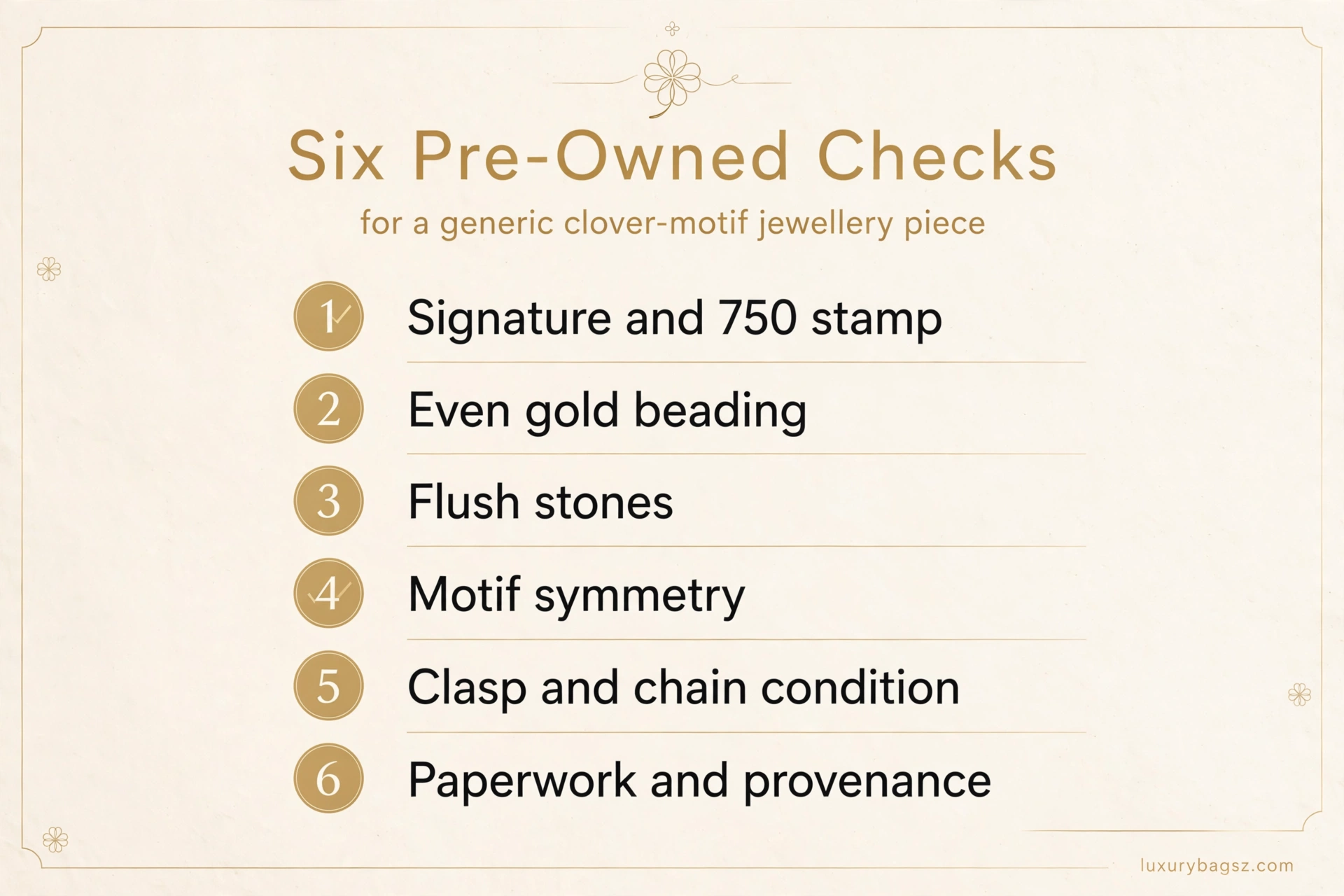
Genuine pieces should carry the Van Cleef & Arpels signature or maker's mark, a 750 stamp confirming 18k gold fineness, and applicable French or national hallmarks depending on where the piece was made and sold. Many modern pieces also carry a serial or ID number that can, in some cases, be cross-referenced with the Maison. Engravings should be crisp and evenly spaced, according to TrueFacet.
Examine motif symmetry across all clovers in a piece, and the consistency of the gold beading pattern. The gold beads around each motif should be even, round and consistent from one motif to the next. Natural materials should be well matched in colour and polish, sitting flush within the frame, with no visible gaps. Stones that sit proud, tilt, or vary in colour across a single necklace deserve suspicion.
Check the clasp, hinge and bracelet-link construction, which tends to be noticeably more refined on genuine pieces than on convincing fakes. Check that the clasp closes securely and that the chain shows no kinks, stretched links or repairs. For bracelets, check that every link moves smoothly and that the clasp mechanism matches the line and era.
These checkpoints are a preliminary inspection, not a substitute for examination by Van Cleef & Arpels directly or by a qualified independent appraiser. For any purchase above a few thousand dollars, an in-person professional inspection is the standard a careful buyer should insist on. Neither competitor guide found shows real-versus-fake photograph comparisons or serial-number formats by era, so this guide does not claim to give them either.
Care by Material: What to Do, and What to Avoid
Organic materials such as mother-of-pearl are softer and more porous than gemstones, so put on perfume, lotion and hairspray before your jewellery, take pieces off for swimming and exercise, and wipe them with a soft, dry cloth after wearing. Store each piece separately in a soft pouch so motifs do not scratch one another, as TrueFacet advises.
For all Alhambra materials, the same dry-first rule applies: a soft, dry cloth after wearing, and no harsh chemicals, ultrasonic cleaners or abrasive cloths without jeweller advice. Our guide on how to clean Hermès fashion jewelry explains why gentle cleaning protects gold finishes and delicate inlays alike, and the same caution covers Alhambra's beading and stone settings.
Servicing and single-motif replacement costs were not given by either competitor guide, and this guide does not estimate them. A chipped mother-of-pearl motif, a cracked malachite motif, or a lost diamond needs Maison or specialist work, and the cost depends on the material, the line and the availability of matching stone. Ask for a service quote before you buy a damaged piece, because the repair can cost more than the discount.
Never let a general jeweller repolish Alhambra beading aggressively. Thinning the gold beads changes the frame's look and lowers value, just as over-polishing damages a Cartier bracelet's screw motifs. Light cleaning is safe. Heavy buffing is not, and it is irreversible.
Buying Pre-Owned: A Checklist That Goes Stone by Stone
Do not accept a general condition grade on an Alhambra piece. Condition assessment here is material-specific, and a generic "good condition" label from a seller is not sufficient for a serious purchase. Inspect each stone type on its own terms, motif by motif, and ask for the findings in writing.
Demand photographs of every motif, front and back, not just the prettiest one. Demand close photographs of the signature, the 750 stamp, the serial number where present, the beading around at least two motifs, and the clasp and chain. Demand photographs of any damage the seller mentions, and of the edges of mother-of-pearl motifs, where chips hide.
Check paperwork, but do not let it overrule the piece. Original boxes, receipts and certificates add confidence, but the piece itself should always be inspected by an expert, as TrueFacet notes. A certificate that does not match the piece's serial number, or a box from the wrong era, is a warning, not a detail.
Check provenance where it matters. Original receipts, prior appraisals, Maison service records, or an unbroken ownership chain compound the effect of a confirmed signature, because they remove authentication risk for the next buyer. A signed, well-documented, excellent-condition piece with intact stones and clear provenance supports a materially stronger offer than a similar but undocumented piece.
Vintage Versus New: Dating an Alhambra Piece
Dating an Alhambra piece matters because the hard-stone variations were introduced later in the collection's history rather than at its 1968 launch, according to The Jewellery Editor as reported by Borro. An early-production clover in malachite is a different proposition, historically and financially, from a recent-production one, even if both carry authentic signatures.
Start with the construction. The 1968 long necklace used creased, textured yellow gold with beaded borders, and that hammered surface remains a diagnostic detail on pieces claiming 1968-era lineage. Later pieces use smoother gold finishes, different clasp mechanisms, and different chain styles, and the Maison has revised its clasps and chains over decades.
Check the signature and hallmarks against the era, with professional help. Genuine pieces carry the Maison signature, a 750 stamp, and applicable French or national hallmarks, and many modern pieces carry a serial or ID number that can sometimes be cross-referenced with the Maison. Hallmark styles and maker's marks vary by country and era, and no competitor guide found gives a full era-by-era hallmark table, so this guide does not invent one.
Check the materials against the timeline. Mother-of-pearl has been present throughout, but the hard-stone range expanded over time, and limited materials such as Sèvres porcelain belong to specific limited editions. A piece in a material that did not exist in the claimed era is misdated, whatever its signature says.
Provenance is the strongest dating evidence after the piece itself. Original receipts, prior appraisals, Maison service records, and an unbroken ownership chain all help date a piece, and they compound the effect of a confirmed signature. Two visually identical bracelets can command meaningfully different offers if one comes with a full paper trail and the other does not, because documentation removes authentication risk for the next buyer.
Frequently Asked Questions
When was the Alhambra collection launched?
In 1968, with a long necklace of 20 creased yellow-gold clover motifs with beaded borders. The clover motif itself appears in Van Cleef & Arpels archives as early as 1906, decades before the collection launched.
What are the Alhambra lines and their motif sizes?
Sweet is about 9.5 mm, Vintage is about 15 mm, Pure is about 16 mm, and Magic's largest motif is about 26 mm, according to the Maison's official motif size guide as reported by TrueFacet. Lucky mixes clovers with hearts, butterflies, leaves and stars, and Alhambra watches carry clover-motif dials or case details.
Is the Jacques Arpels palace story true?
It is widely repeated but not part of the Maison's official chronology, according to Borro. The story says Jacques Arpels drew on Moorish lattice patterns he saw at the Alhambra palace in Granada. Treat it as good colour, not verified corporate history, and separate it from the documented 1906 archive presence and 1968 launch.
How much does an Alhambra necklace cost?
No current boutique price table for the core pieces was found in the competitor guides, so this guide does not invent one. For resale context, The Luxury Closet's 2026 analysis, as reported by Borro, put Vintage malachite and mother-of-pearl pieces at roughly 70 to 85 percent of retail, with Sweet bracelets near retail. Get a current boutique quote for the exact piece.
Which Alhambra material is best for daily wear?
Onyx and carnelian tolerate daily wear better than mother-of-pearl or turquoise, though they still lose polish and chip at edges. Mother-of-pearl is the most classic choice but also the most fragile, scratching, chipping and dulling with moisture and chemicals. Turquoise discolours with water and oil and may be treated.
How do you tell a real Alhambra from a fake?
Check the Van Cleef & Arpels signature, the 750 gold stamp, applicable hallmarks, and a serial number where present, all crisp and evenly spaced. Check that the gold beading is even and round on every motif, that stones sit flush with no gaps, and that motif symmetry holds across the piece. For expensive pieces, get an in-person professional inspection.
Can Alhambra pieces be stacked?
Yes, and they are made to be combined. Pair a Vintage necklace with Sweet bracelets for size contrast, and pair Vintage earrings with a single Magic pendant for one bold element. Do not stack hard stones against each other on the same wrist, and store each piece separately so motifs cannot scratch one another.
How do you care for mother-of-pearl Alhambra?
Put perfume, lotion and hairspray on before the jewellery, take pieces off for swimming and exercise, and wipe them with a soft, dry cloth after wearing. Keep mother-of-pearl away from prolonged moisture and cleaning chemicals, and store each piece separately in a soft pouch.
What is the difference between Vintage and Sweet Alhambra?
Vintage is the classic line at about 15 mm per motif, closest to the 1968 original, with uniform beaded motifs in materials such as mother-of-pearl, onyx and malachite. Sweet is the miniature line at about 9.5 mm, adding hearts and butterflies, and is the most discreet way to wear the design.
Is Alhambra a good investment?
It holds value better than most fashion jewellery, but it is not a guaranteed return. Vintage pieces in excellent condition with full paperwork trade strongest, Sweet bracelets can approach retail, and Magic and Perlée trade lower relative to retail, according to The Luxury Closet's 2026 analysis. Condition, material and documentation decide more than the line name alone.
Alhambra, Line by Line
Alhambra rewards buyers who learn the lines before they learn the prices. Vintage at 15 mm, Sweet at 9.5 mm, Magic up to 26 mm, Pure at 16 mm, each with its own materials, its own care burden, and its own resale behaviour. Buy the line that fits your life, the material that fits your habits, and the piece you will actually wear.
Separate the documented history from the repeated anecdote, inspect every motif rather than accepting a general grade, and never let a listing price stand in for a sale price. Do that, and a single-motif pendant bought today can become the start of a collection that still looks right in twenty years.
Start small, wear it often, and let the next piece earn its place. The clover has lasted since 1968 because it is simple, lucky, and easy to live with. A collection built slowly, in the order this guide suggests, keeps it that way.
Alhambra pieces are small, so the checks are small too — and unforgiving. I look at engravings and hallmarks the way I look at a bag’s date code: they should be crisp, correctly placed and consistent with the line’s size. Learn the lines first, as this guide does, and the prices start to explain themselves.






