

History of Louis Vuitton: From Trunk Maker to the World’s Biggest Luxury House
Louis Vuitton in Brief: The Trunk Maker Who Invented Modern Travel
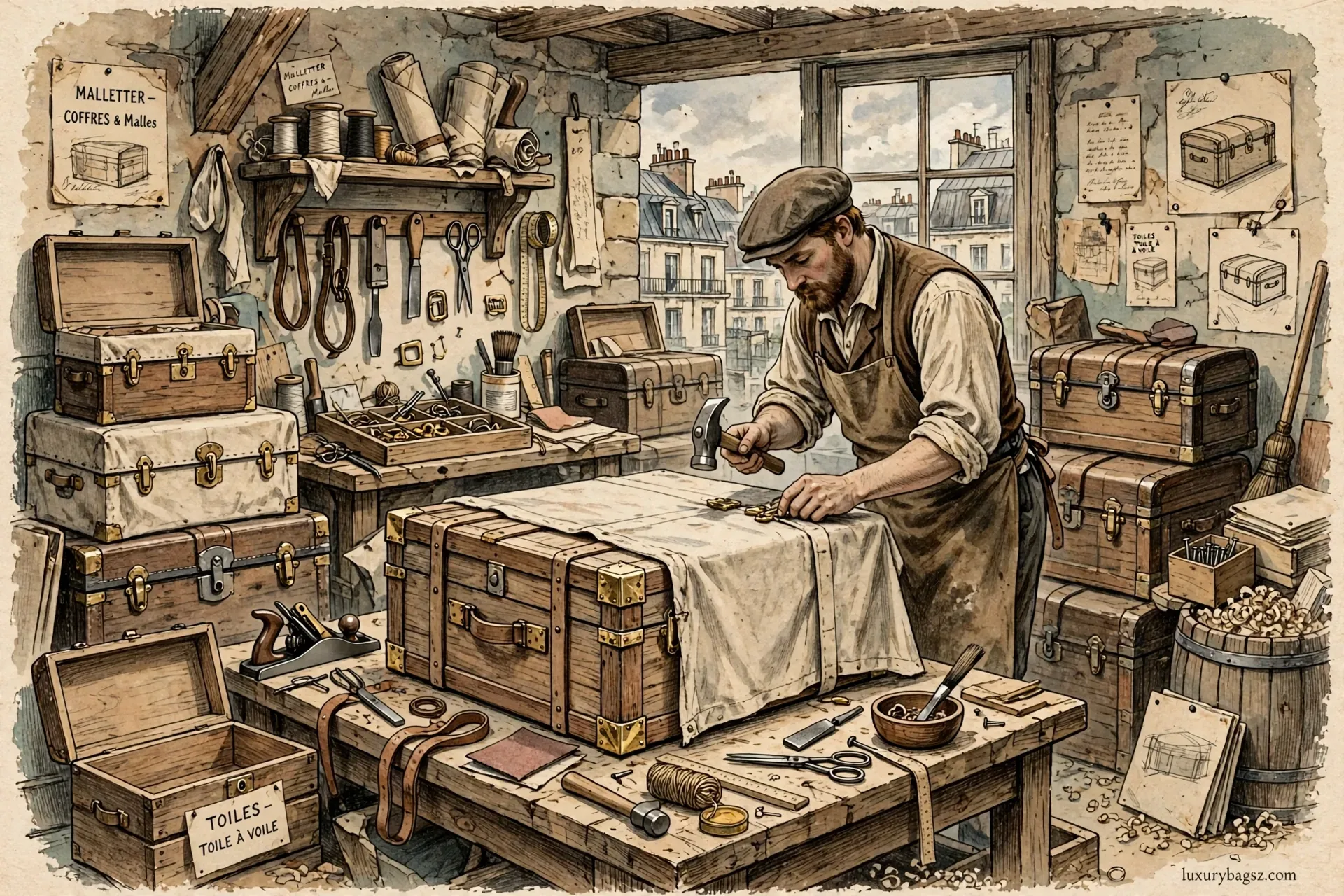
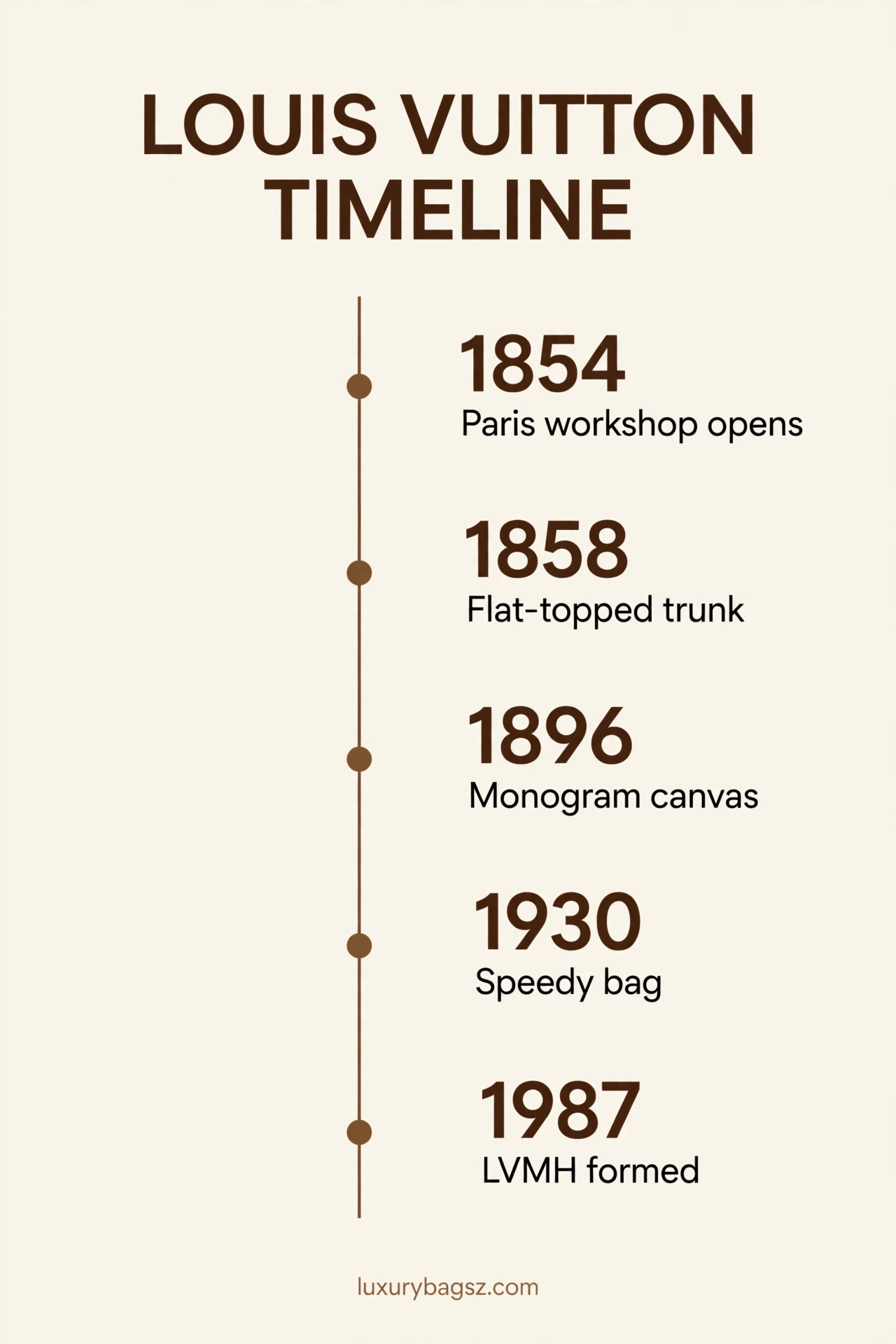
Louis Vuitton began in Paris in 1854, when a trunk maker of the same name opened his own workshop on Rue Neuve-des-Capucines, near Place Vendôme. His promise, painted on his shop sign, was that he would "securely pack the most fragile objects" — and his flat-topped, canvas-covered trunks did exactly that, replacing heavy, dome-topped leather trunks that could not be stacked on trains and steamships.
From that practical innovation grew the world's largest luxury house. Louis's son Georges created the Monogram canvas in 1896, partly to defeat counterfeiters, and the pattern became the most recognisable in fashion. The 20th century added the Speedy, the Noé, the Alma, and the Neverfull, and the house joined LVMH in 1987, becoming the flagship of the world's biggest luxury group.
Today Louis Vuitton sells everything from trunks to ready-to-wear, yet its story still starts with travel: lighter luggage, smarter packing, and designs that survive journeys. For buyers, that history is practical knowledge, because the same canvas patterns, date codes, and construction details that defined the house also help you spot fakes and choose the right bag.
Key Takeaways

- Louis Vuitton founded his Paris trunk workshop in 1854, after 17 years as an apprentice and packer.
- The flat-topped trunk of 1858, covered in waterproof Trianon grey canvas, could be stacked, unlike dome-topped trunks.
- Georges Vuitton created the Monogram canvas in 1896, combining the LV initials with flowers and quatrefoils.
- The Speedy (1930), Noé (1932), and Alma (1934) brought trunk craft to handbag scale; the Neverfull followed in 2007.
- Louis Vuitton merged with Moët Hennessy in 1987 to form LVMH, and remains its flagship house.
The Boy Who Walked to Paris
Louis Vuitton was born in Anchay, eastern France, on 4 August 1821, to a farming and artisan family. His mother, a milliner, died when he was ten, and at thirteen he left home for Paris, a journey of some 290 miles that reportedly took him more than two years, working along the way. Sources differ on the exact details of the journey — some say he left at thirteen, others at sixteen — but the broad shape is consistent: a poor, determined teenager arriving in Paris with carpentry skills and little else.
In Paris he became an apprentice to Romain Maréchal, a master box maker and packer, learning to build custom trunks and pack delicate belongings for wealthy clients. Packing was a serious skill in an age when aristocrats travelled with wardrobes, artworks, and furniture, and a good packer was trusted with valuables. Vuitton spent seventeen years perfecting the trade, and in 1853 he became personal box maker and packer to Empress Eugénie, wife of Napoleon III, a post that brought him into the highest circles of French society.
That apprenticeship shaped his business sense. He understood what travellers actually needed — protection, lightness, and stackability — because he had packed their belongings himself. When he opened his own workshop in 1854, the same year he married Clémence-Émilie Parriaux, he was not guessing at a market. He was solving a problem he had lived with for nearly two decades.
The Flat-Topped Trunk Revolution
The trunk of the 1850s was a poor traveller. Dome-topped leather trunks shed rain but could not be stacked, wasted space on trains and ships, and weighed a great deal. In 1858, Louis Vuitton introduced a rectangular trunk with a flat lid, made from lightweight poplar wood and covered in waterproof canvas, initially a grey hemp canvas known as Trianon grey. It could be stacked, it was lighter, and it protected contents better — a genuine innovation, not a styling exercise.
The design caught on quickly with the travelling elite, and in 1859 Vuitton moved his growing workshop to Asnières-sur-Seine, outside Paris, where he bought a large plot and built ateliers that still operate today. He exhibited at the 1867 Paris Universal Exhibition, winning a bronze medal, and opened his first store abroad in London in 1885. By the time he died in 1892, at seventy, Louis Vuitton was an international name in travel goods.
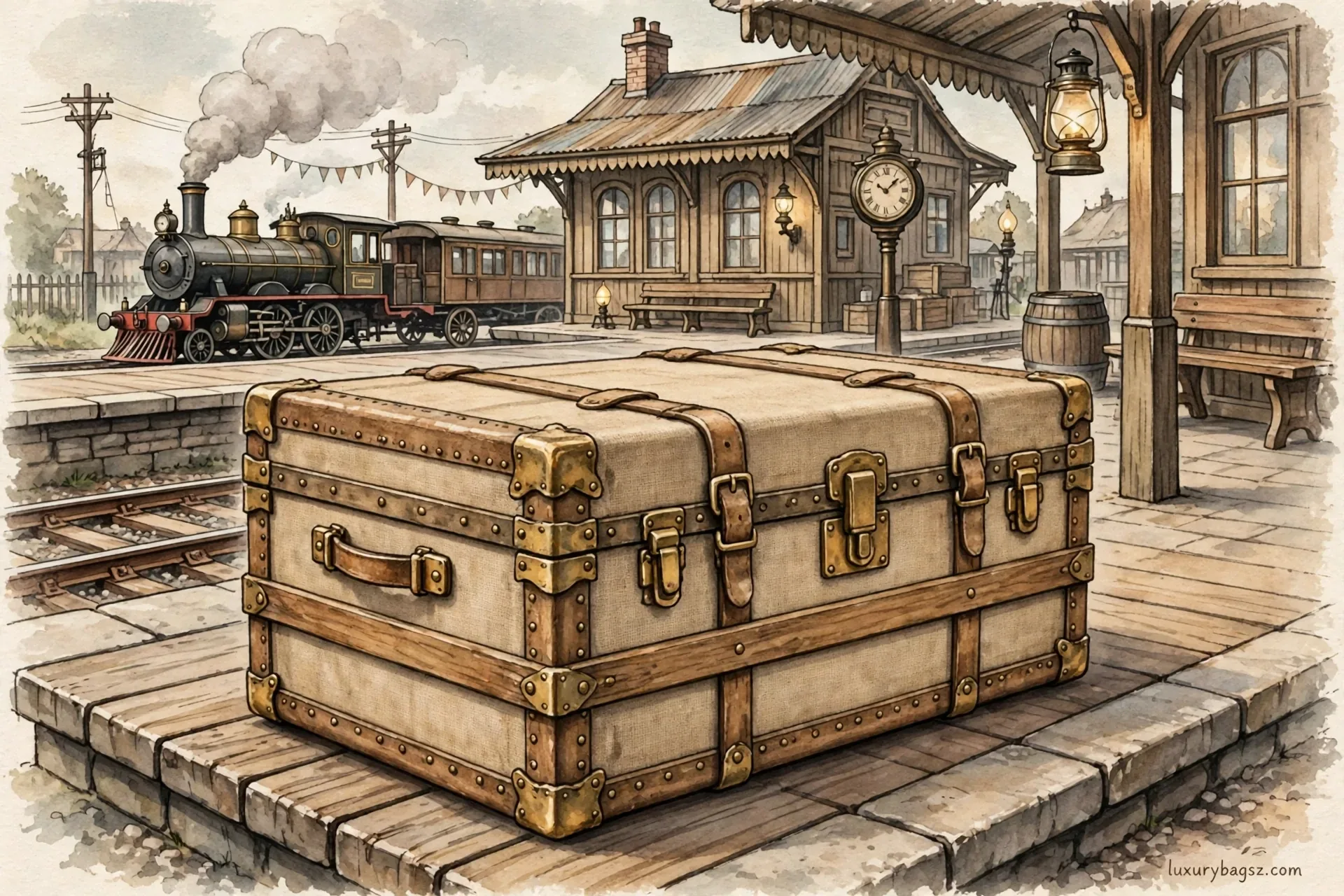
Our guide to what to know about Louis Vuitton covers the house's full range today, but the trunk remains the key to understanding it. Every later Louis Vuitton bag, from the Speedy to the Neverfull, inherits trunk DNA: structured shapes, durable canvas, careful hardware, and a design that prioritises the journey over the season. When you buy a Louis Vuitton bag, you are buying a small trunk, refined for the hand rather than the hold.
Georges Vuitton and the Monogram
Louis's only son, Georges, took over after his father's death and proved as inventive as his father. His great creation was the Monogram canvas of 1896, which combined the interlocking LV initials with a four-pointed flower, a diamond with a dot, and a quatrefoil flower, in brown on a tan background. The pattern was beautiful, but it was also a security device: a distinctive, hard-to-copy design that made counterfeiting harder at a time when copies were already flooding the market.
Georges also invented the unpickable lock, patented a new clasp system, and expanded the house internationally, opening stores and travelling to promote the brand. He understood that a luxury house needed both craft and theatre, and he gave Louis Vuitton both. Under Georges, the house survived the First World War, the Depression, and changing travel habits, and by the 1930s it was ready to shrink its trunk expertise to handbag scale.
Later patterns followed the same logic. Damier canvas, with its checked pattern, had actually appeared in 1888, before the Monogram, and was revived in later decades. Damier Azur brought a lighter, summer version, and Epi leather offered a textured, logo-free alternative for buyers who wanted Louis Vuitton quality without a visible pattern. Each pattern has its own care needs and its own counterfeiting risks, which is why pattern knowledge matters when buying pre-owned.
From Trunks to Handbags: Speedy, Noé, and Alma
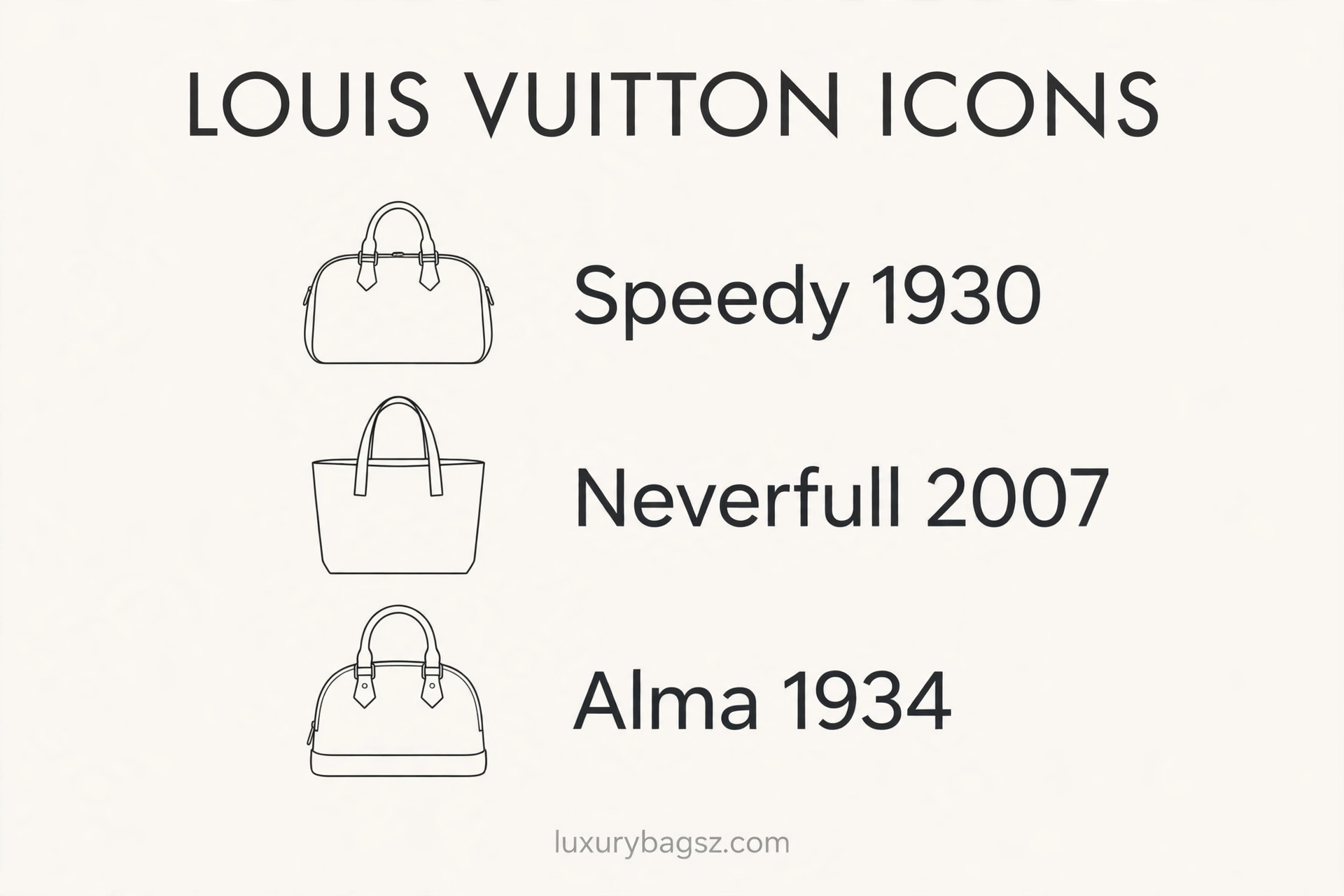
The handbag era began in the 1930s. The Speedy arrived in 1930 as a smaller version of the Keepall travel bag, originally called the Express, and became the house's most famous handbag: a structured, rounded shape with rolled handles, a zip top, and a padlock. Its genius is its simplicity — it carries a great deal, suits almost any outfit, and its canvas versions are famously hard-wearing. The Speedy 25, 30, 35, and 40 sizes let buyers choose between a compact daily bag and a generous travel companion.
The Noé followed in 1932, originally designed to carry champagne bottles, with a drawstring closure and a bucket shape that later became a fashion staple in its own right as the Néonoé. The Alma arrived in 1934, a structured, dome-shaped bag said to have been inspired by a commission for Coco Chanel, with a double zip and elegant curved silhouette. Together, these three bags established Louis Vuitton as a handbag house, not just a trunk maker.
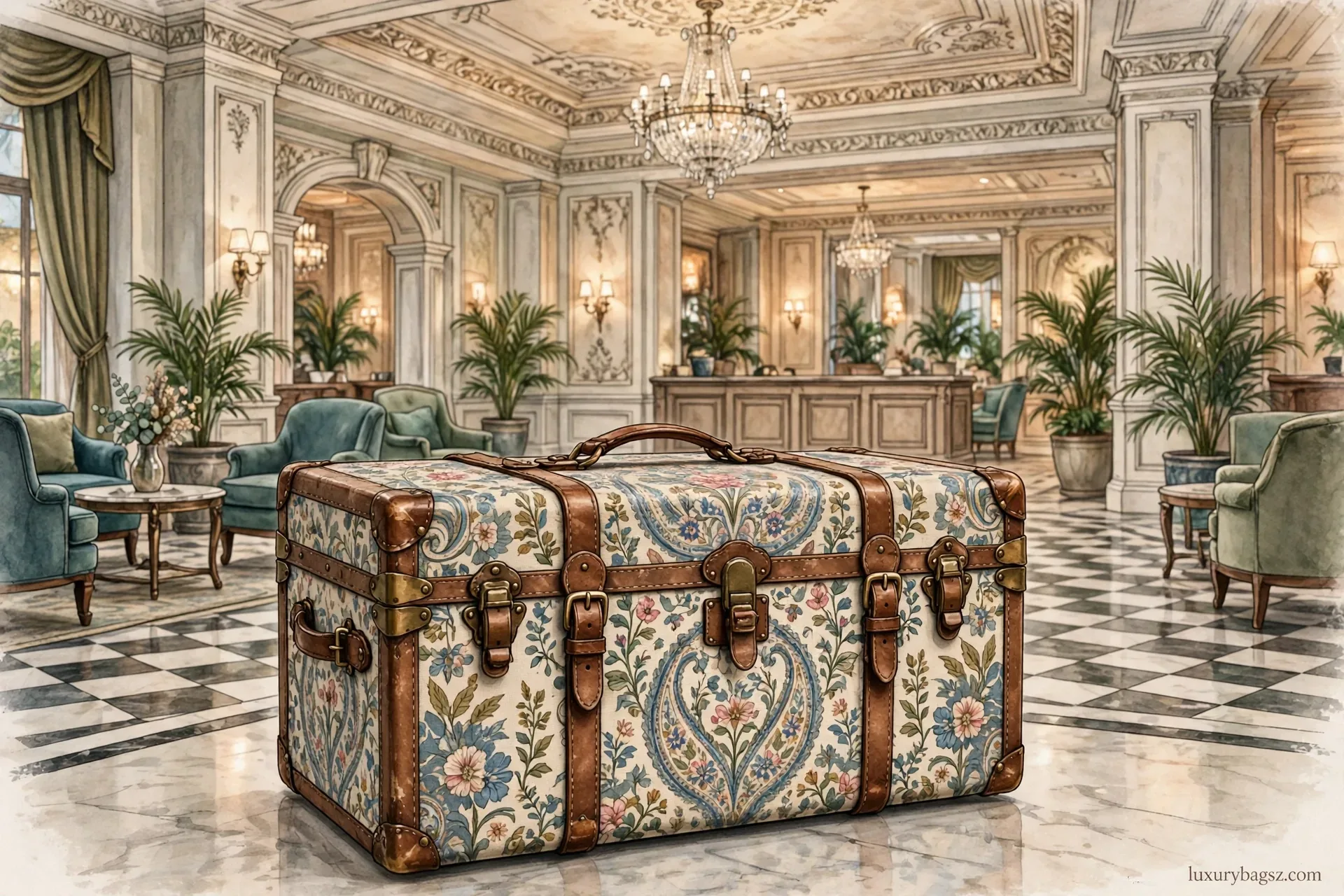
The house kept innovating after the war, under Georges's son Gaston-Louis, who led the company into the aviation age and oversaw its growth through the mid-20th century. The wartime years remain the most sensitive part of the house's history: research published in the 2000s documented the company's operations under the German occupation, a chapter the house itself long said was lost to fire. It is a reminder that even beloved brands have histories that deserve honest examination, not just celebration.
The Icons You Can Buy Today
For a first-time buyer, three icons cover most needs. The Speedy is the all-rounder: structured, secure, and available in Monogram, Damier Ebene, Damier Azur, and Epi leather. Our Louis Vuitton Speedy sizes guide compares the 25, 30, 35, and 40, including what each one actually fits. The 25 suits petite frames and light loads; the 30 is the most popular daily size; the larger sizes suit travel or work.
The Neverfull, introduced in 2007, is the open tote: lightweight, capacious, and instantly recognisable, with a detachable pouch and side laces that cinch the shape. Our Louis Vuitton Neverfull sizes guide explains the PM, MM, and GM sizes. It suits shoppers who carry a laptop, a book, and a water bottle, but it is open-topped, so it suits cities and offices more than crowded markets. The Alma, covered in our Louis Vuitton Alma sizes guide, is the structured, formal choice, from the Nano to the GM.
Beyond these, the Pochette Métis, the Capucines, and the Twist show the house's modern range, while artist collaborations — from Stephen Sprouse's graffiti bags to Takashi Murakami's Multicolour collection and Yayoi Kusama's dots — have become collectible in their own right. Our guide to the Louis Vuitton Murakami Multicolour collection explains one of the most sought-after collaborations. Buy the icon that fits your routine, not the one that trends online, and you will carry it far longer.
LVMH, Marc Jacobs, and the Modern House
In 1987, Louis Vuitton merged with Moët Hennessy to form LVMH, now the world's largest luxury group, and the house became its flagship. The merger gave Louis Vuitton capital to expand globally, opening stores across Asia, America, and Europe, and turning a family firm into a global corporation. Some purists worried the house would lose its soul; in practice, the trunk ateliers at Asnières kept making special orders, and the brand's quality control remained central to its image.
A second transformation came in 1997, when Marc Jacobs became artistic director and launched ready-to-wear for the house for the first time. Jacobs brought artist collaborations, playful reinterpretations of the Monogram, and a fashion-week presence that made Louis Vuitton a runway name, not just a luggage name. Later creative directors, including Nicolas Ghesquière for womenswear and Virgil Abloh and then Pharrell Williams for menswear, continued that blend of heritage and contemporary culture.
The house also maintained its no-discount policy: Louis Vuitton famously never holds sales, preferring to control prices through its own stores. That policy supports resale values, since new prices rarely fall, but it also means waiting lists and price rises are a normal part of buying new. For most shoppers, the practical consequence is simple: buy from a boutique or a trusted pre-owned dealer, and treat unusually cheap "new" bags as suspect.
Buying Pre-Owned Louis Vuitton Safely
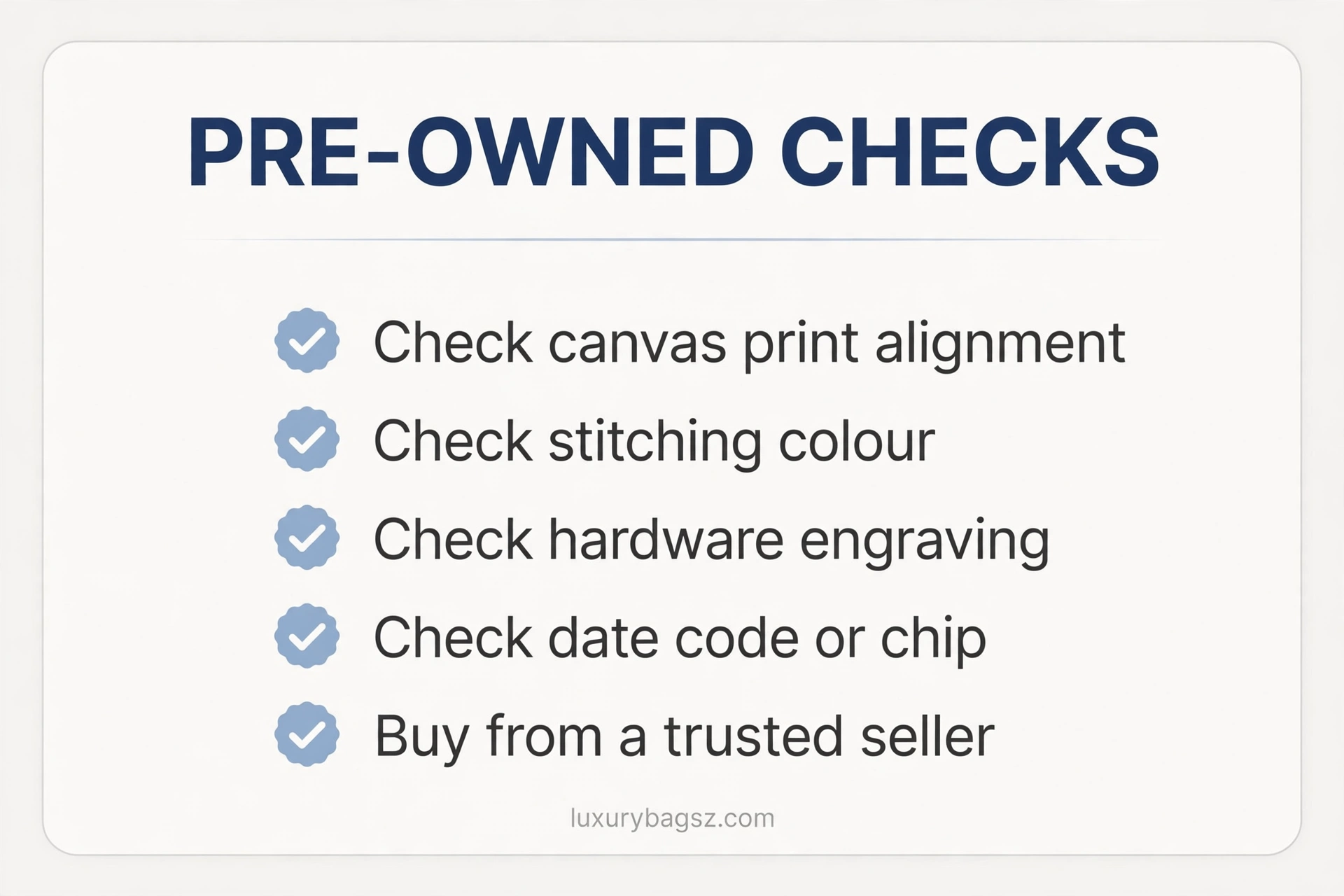
Louis Vuitton is the most counterfeited luxury brand in the world, so pre-owned checks are essential. Start with the canvas and pattern: genuine Monogram canvas has a crisp, even print, with the LV initials and flowers aligned symmetrically and the pattern matching neatly at seams. Fakes often show blurry printing, misaligned motifs, or a greenish or orange tint that genuine canvas does not have. Damier canvas should show a clean, even check, with no bleeding between squares.
Next, check stitching, hardware, and date codes. Genuine Louis Vuitton stitching is even, slightly slanted, and done in a mustard-yellow thread that matches the vachetta leather trim. Hardware should feel solid, with clean engraving, and zips should run smoothly. Older bags carry date codes stamped inside; newer bags, from around 2021, use microchips instead. Our guide to Louis Vuitton date codes and microchips explains how to read both systems.
Vachetta leather, the untreated cowhide used for handles and trim, darkens to a honey patina with age and sunlight — a process collectors call patina, and fakes often imitate badly with an even, orange dye. Check that the patina looks natural and consistent with the bag's age. Our fake Louis Vuitton bag checks cover twelve tests, and for the Speedy specifically, our fake Speedy guide adds model-specific details. When in doubt, use an authentication service before paying.
Caring for Canvas, Vachetta, and Leather
Louis Vuitton canvas is famously low-maintenance: wipe it with a soft, damp cloth, let it dry naturally, and avoid harsh cleaners or soaking. Do not machine-wash a canvas bag, and keep it away from prolonged direct sunlight, which fades the print. For stains, a gentle wipe is usually enough; for stubborn marks, a specialist leather cleaner is safer than household products, which can strip the canvas coating.
Vachetta needs more care. New vachetta is pale and marks easily, especially with water, so many owners protect it with a leather protector spray before first use, or simply accept that it will darken and mark with wear. Keep vachetta away from rain, denim dye transfer, and hand cream, and store the bag stuffed and in its dust bag. Epi and Taiga leathers are more forgiving: wipe clean, condition occasionally, and store upright.
The broader lesson of Louis Vuitton's history is that good design outlasts fashion cycles. A Speedy from the 1990s still looks right today, because its proportions were right from the start. Buy the size and pattern you will carry for years, check authenticity carefully, and care for canvas and vachetta with simple, consistent habits. A Louis Vuitton bag bought well is not a seasonal purchase; it is a travelling companion, in the same spirit as the flat-topped trunk that started it all.
It also pays to think about how a bag will age before you buy it. Monogram canvas hides scuffs and rain spots better than Damier Azur, which shows marks and colour transfer more readily, while Epi leather resists scratches but shows little of the patina character that canvas lovers prize. If you carry a bag daily in all weather, canvas is the forgiving choice; if you want a smarter, evening-ready look and will store the bag carefully, leather may suit you better. Match the material to your routine, not just to the photograph, and the bag will reward you for far longer.
There is also a collecting logic worth understanding. Louis Vuitton's limited editions and artist collaborations — Murakami, Kusama, Sprouse — behave differently from core bags: they spike with nostalgia, fall out of fashion, and sometimes spike again, while a Monogram Speedy simply holds steady. If you buy a collaboration, buy it because you love the design, not because you expect a return, and keep its box, dust bag, and receipt, which matter far more for limited pieces than for core ones. For everyday use, the core range remains the wiser spend: it is easier to authenticate, easier to repair through the house, and easier to sell if your tastes change. That balance — a steady core, with a playful collaboration only when you truly love it — mirrors the house itself, which has always paired trunk-maker discipline with artistic daring.
Frequently Asked Questions
When was Louis Vuitton founded?
Louis Vuitton founded his Paris trunk workshop in 1854, on Rue Neuve-des-Capucines, after seventeen years as an apprentice box maker and packer.
Who founded Louis Vuitton?
Louis Vuitton (1821–1892), a French trunk maker from Anchay, founded the house. His son Georges and grandson Gaston-Louis succeeded him.
What was Louis Vuitton's first innovation?
The flat-topped trunk of 1858, made from lightweight poplar and covered in waterproof Trianon grey canvas, which could be stacked unlike dome-topped trunks.
When was the Monogram canvas created?
Georges Vuitton created the Monogram canvas in 1896, combining the LV initials with floral and quatrefoil motifs, partly as an anti-counterfeiting device.
When was the Speedy created?
The Speedy was introduced in 1930, as a smaller, handbag-sized version of the Keepall travel bag, and remains the house's most famous handbag.
When was the Neverfull created?
The Neverfull tote was introduced in 2007, as a lightweight, open-topped everyday bag with a detachable pouch.
Is Louis Vuitton part of LVMH?
Yes. Louis Vuitton merged with Moët Hennessy in 1987 to form LVMH, and remains the group's flagship house.
Does Louis Vuitton ever go on sale?
Louis Vuitton famously does not hold sales or discount its products, selling through its own boutiques at controlled prices.
How can I tell if a Louis Vuitton bag is real?
Check canvas print alignment, stitching, hardware engraving, date code or microchip, and vachetta patina against verified examples, and buy from a reputable source.
How do I clean a Louis Vuitton canvas bag?
Wipe canvas with a soft, damp cloth and let it dry naturally. Avoid harsh cleaners, soaking, and prolonged direct sunlight.
Final Verdict: A Trunk Maker's Idea That Still Travels
Louis Vuitton's history is a lesson in solving a real problem well: a lighter, stackable trunk became a Monogram empire, and a trunk maker's craft became the world's most recognisable handbag range. The Speedy, the Neverfull, and the Alma endure because they were designed for journeys, not for seasons. Choose the size that fits your life, verify authenticity with care, and your Louis Vuitton bag will travel with you for decades — just as its founder intended.






