Louis Vuitton Monogram History: 130 Years of the World’s Most Copied Canvas
130 Years of Monogram in Brief
The Louis Vuitton Monogram was created in 1896 by Georges Vuitton, son of founder Louis Vuitton, as a tribute to his father and as a defence against counterfeiting. It combines interlaced LV initials with stylised floral motifs, quatrefoils and diamond shapes in brown and tan, drawing on Neo-Gothic ornament and the Japonisme craze sweeping Paris. It began life on trunks, moved onto soft bags in the twentieth century, survived becoming the most copied pattern on earth, and in 2026 celebrates its 130th anniversary with new capsule collections and a renewed focus on its five icon bags.
Key Takeaways

- The Monogram was created in 1896 by Georges Vuitton, four years after his father's death in 1892.
- Its original job was anti-counterfeiting: earlier Louis Vuitton canvases had been widely copied.
- The motifs mix interlaced LV initials with floral shapes inspired by Neo-Gothic art, Japanese family crests and tiles in the Asnières family home.
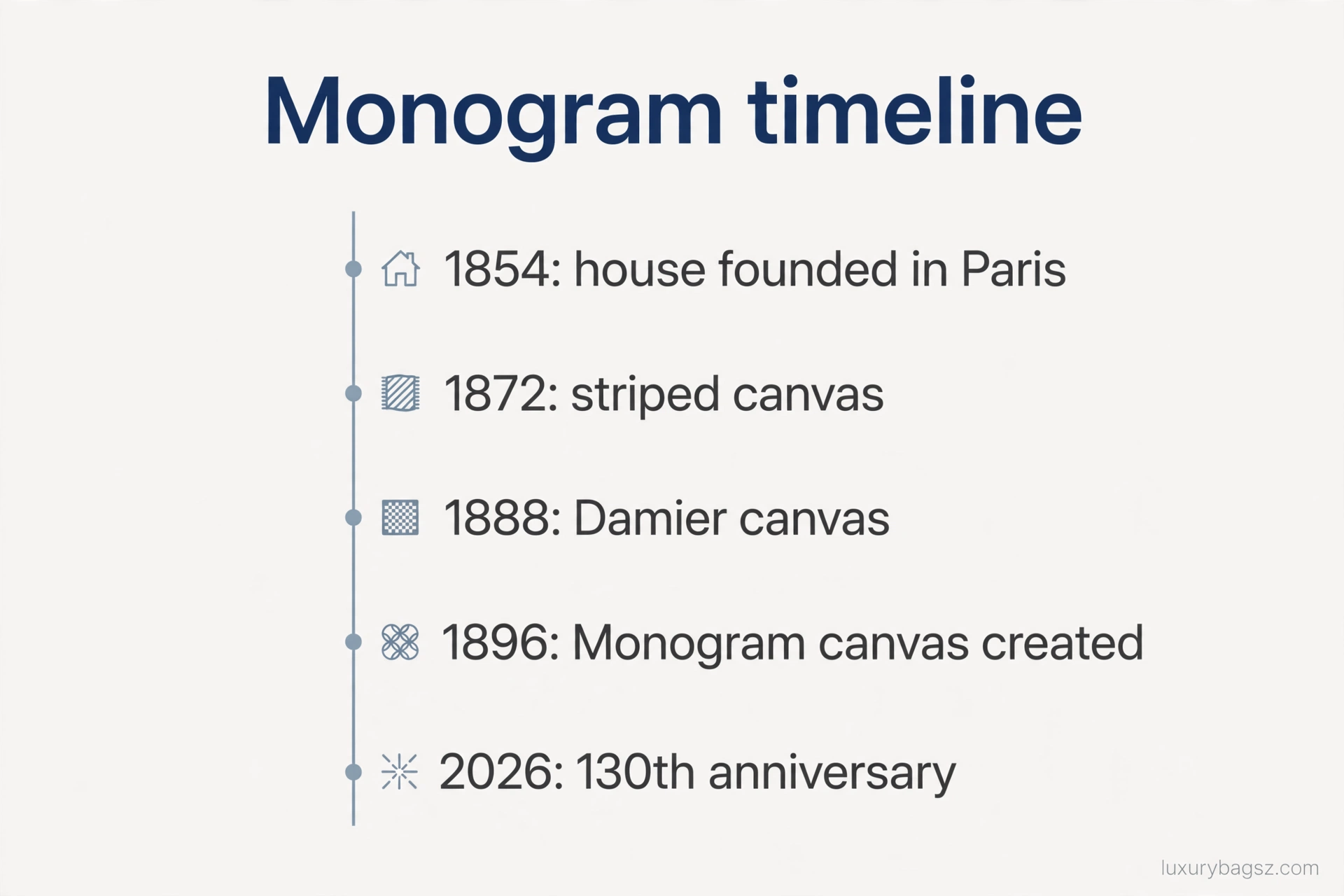
- It followed the striped canvas of 1872 and the Damier canvas of 1888, keeping Damier's brown and tan palette.
- The five anniversary icon bags are the Speedy, Keepall, Noé, Alma and Neverfull.
- Artist collaborations from Murakami to Kusama and Richard Prince kept the Monogram culturally alive.
- Pre-owned buyers should check date codes, canvas, trim, hardware and the exact model, because fakes are everywhere.
Before the Monogram: A Trunk Maker's Problem
Louis Vuitton founded his Paris house in 1854 as a trunk maker, and his first breakthrough had nothing to do with pattern. Travellers used domed leather trunks that shed rain on carriage roofs but could not be stacked. Vuitton built a flat-topped trunk in lightweight, waterproof grey Trianon canvas that stacked neatly for trains and steamships. It was practical, modern and quickly successful, which created a new problem: success invited copying.
The house answered with pattern after pattern. A striped canvas arrived in 1872, then the Damier checkerboard canvas in 1888, complete with a small "Marque L. Vuitton Déposée" mark woven into the checks. Each was meant to mark genuine goods. Each was copied in turn. By the 1890s the house needed something harder to imitate and easier to recognise at a glance, and that job fell to the founder's son.
For the wider story of the house, our Louis Vuitton guide covers its history, bags and prices in one place. The Monogram, though, deserves its own telling, because it outgrew every other pattern the house ever made and became a logo before the word logo was common.
1896: Georges Vuitton Draws His Father's Initials
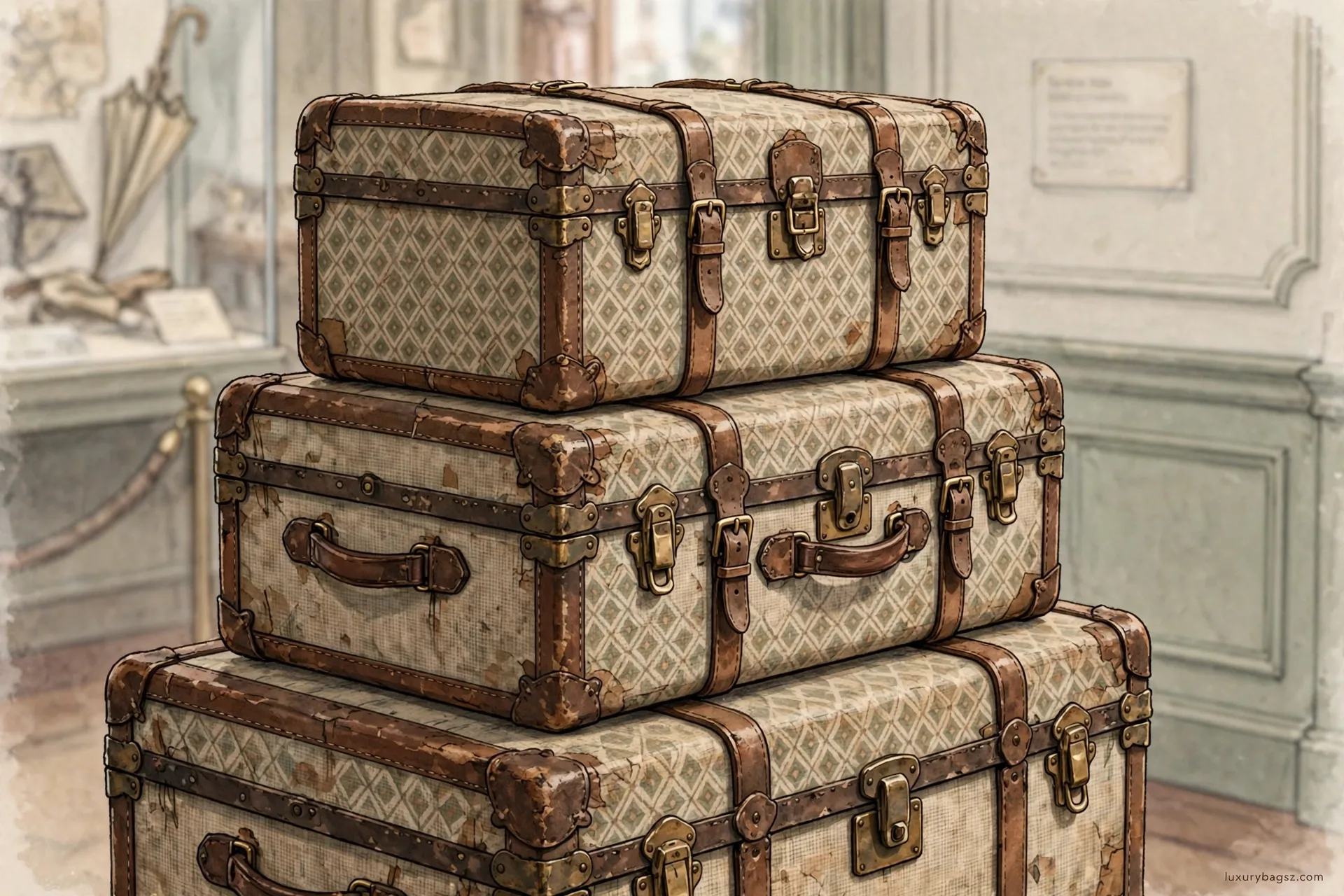
In 1896 Georges Vuitton designed the Monogram canvas, reportedly patenting it the following year. He interlaced his father's initials, L and V, with three floral motifs, part botanical and part geometric, plus quatrefoil flowers and diamond shapes. The design kept the brown and tan palette of Damier, so it still looked like Louis Vuitton, but it was far more distinctive and far harder to reproduce convincingly with nineteenth-century printing.
The inspiration is where sources add colour, and they do not all agree on the details. Some point to Neo-Gothic cathedral ornament, others to Japanese mon family crests that fascinated Paris during the Japonisme movement, and others to the kitchen tiles of the Vuitton family home in Asnières. The honest answer is that all three currents were in the Paris air at the time, and Georges drew on that visual language rather than copying any single source. What matters is the result: a repeat pattern that works as decoration, as identification and as a technical print all at once.
There is also a pleasing irony that every history of the Monogram notes. A pattern designed to defeat counterfeiters became the most counterfeited design in fashion. That is not a failure of the design. It is proof of how desirable it became, and it is why buying checks matter as much today as they did in 1896.
From Trunks to Handbags: The Slow Takeover
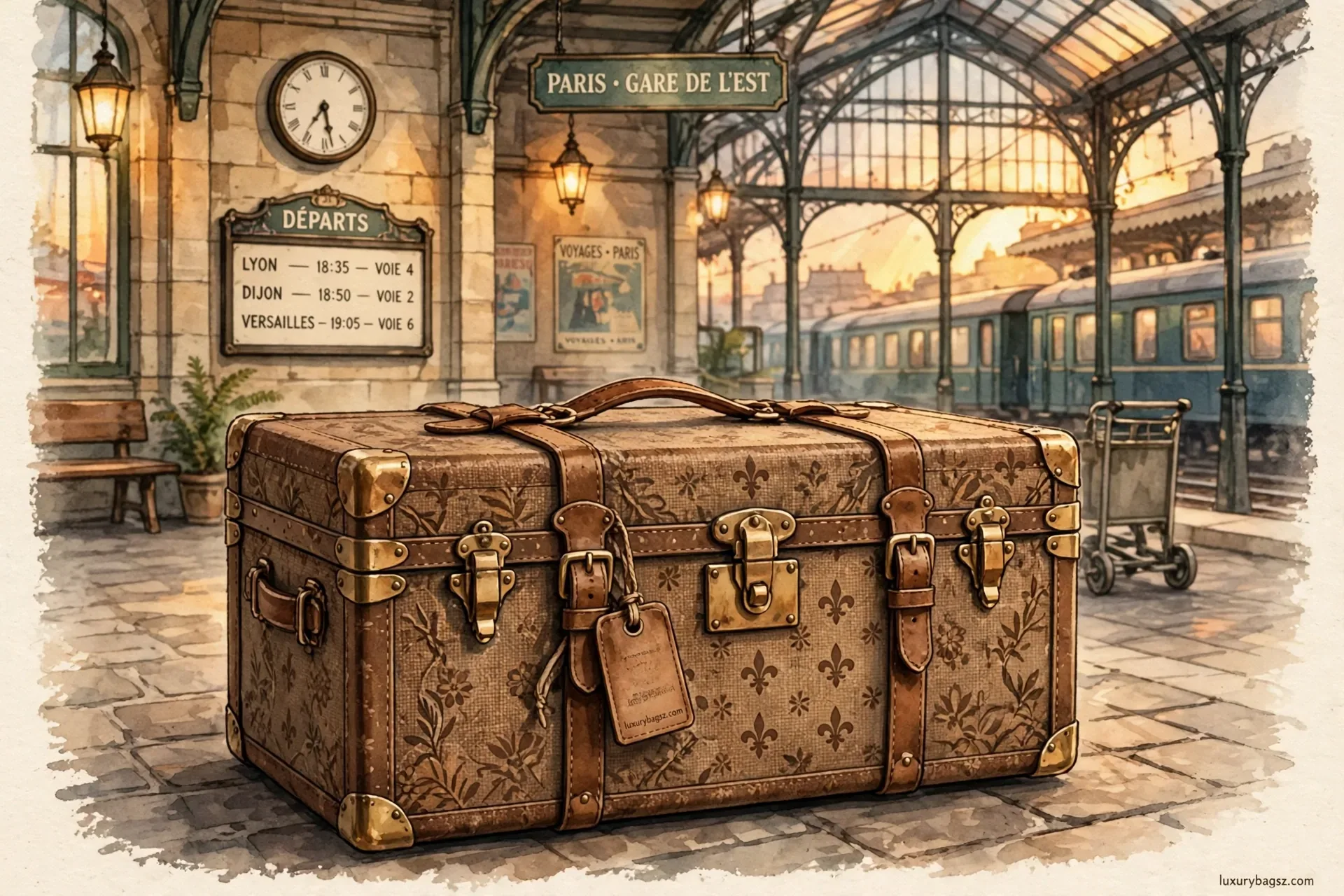
For its first decades the Monogram lived mainly on trunks and travel goods, which was its natural home. Early versions were woven on Jacquard looms, and around 1902 a pochoir stencil technique refined the depth and durability of the motif. The pattern was a travel signature, seen on station platforms and in hotel lobbies, rather than an everyday fashion statement.
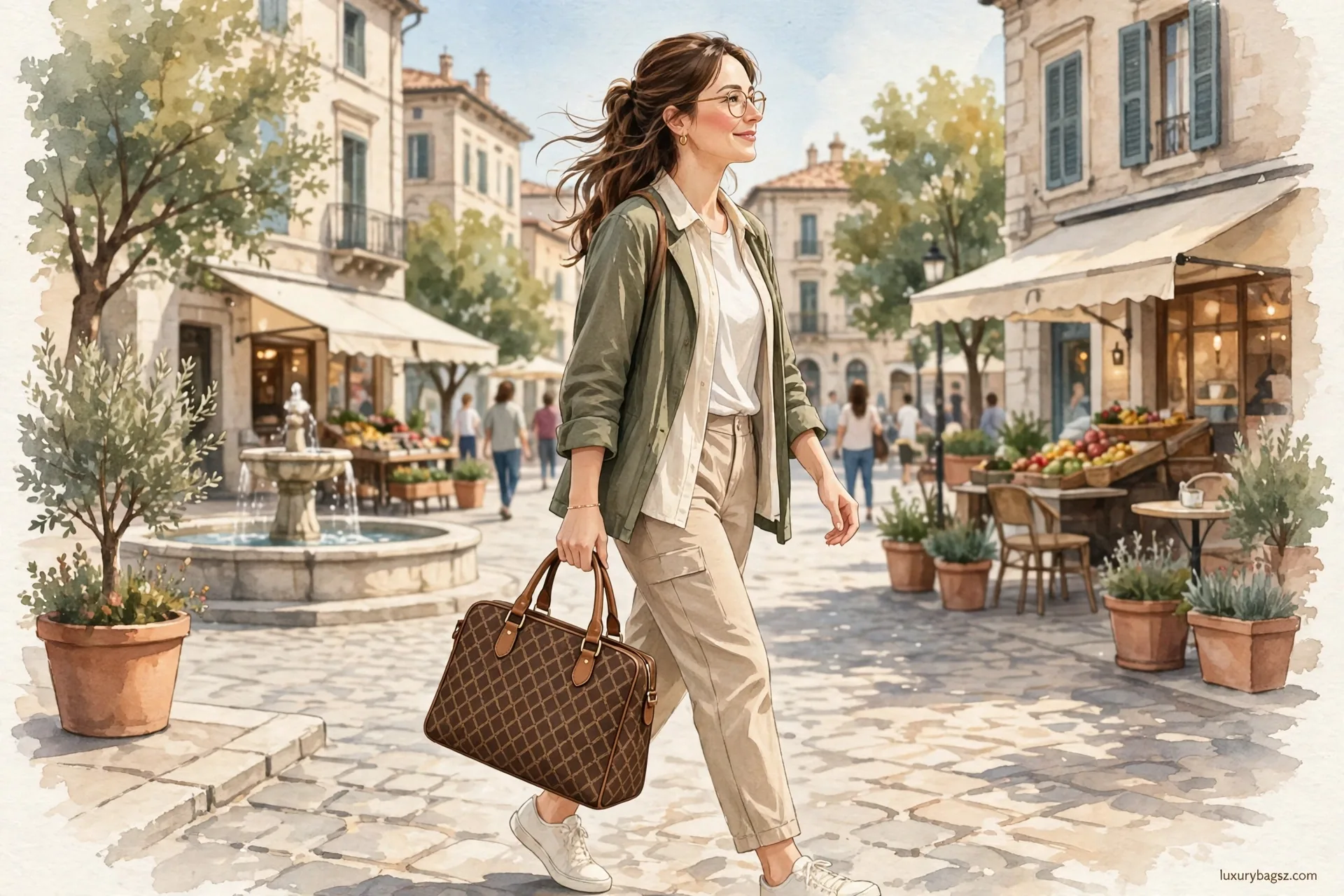
The decisive shift came in 1959, when Louis Vuitton introduced a lighter, softer and more water-resistant coated canvas. That change freed the Monogram from rigid trunks and let it move onto soft luggage and daily bags. The Speedy, originally created in 1930 as a smaller travel piece, the Keepall of 1930, the Noé bucket of 1932, the Alma, and much later the Neverfull of 2007, all carried the pattern into ordinary life. A trunk pattern became a handbag pattern, and then simply a pattern people wore.
The 130th anniversary celebrations opening in January 2026 honour exactly those five icons. Louis Vuitton is also releasing capsule collections that revisit the 1896 canvas, including Monogram Origine, a linen and cotton jacquard reworking in soft pastel hues inspired by the archives, alongside VVN, Time Trunk and Monogram Emblème capsules. The past is being rewoven, not just reprinted.
The Five Icons, and What Each One Does
The anniversary's five icons are not interchangeable, and choosing between them is the most practical decision a Monogram buyer makes. Our Speedy sizes guide compares the 25, 30, 35 and 40, while our Neverfull sizes guide explains the PM, MM and GM. In brief, the Speedy is a structured handheld classic, best for essentials and a small book. The Keepall is a weekender, built for short trips. The Noé is a drawstring bucket, relaxed and easy to carry. The Alma is a structured dome, the most formal of the five. The Neverfull is an open tote, the most practical daily carrier of the group.
Sizes change the character of each bag more than newcomers expect. A Speedy 25 is a neat evening and daytime companion, while a Speedy 40 is a travel bag. A Neverfull PM suits light days, while a GM swallows a laptop, a layer and a water bottle. Always check the exact size in a listing, because sellers sometimes describe a bag only as "Speedy" or "Neverfull" and leave the buyer to guess.
Condition also differs by model. Open totes show corner wear and interior marks first. Structured domes show handle and piping wear. Drawstring buckets show wear at the cord and the base. Knowing which wear points matter for your chosen model saves disappointment, and it is the first thing to look for in listing photos.
Artists, Anniversaries, and Reinvention
The Monogram might have faded into heritage respectability if the house had left it alone. Instead, it kept handing the pattern to artists and designers, and each handover refreshed it. The 1996 centenary collaborations invited designers including Vivienne Westwood to reinterpret the Monogram, and Marc Jacobs, creative director from 1997 to 2013, made artist collaboration a house strategy.
Two collaborations define the modern era. Takashi Murakami's Multicolore of 2003 splashed the Monogram in 33 bright colours on white and black, turning a brown heritage canvas into pop art. Our Murakami collection guide covers its bags, colours and pre-owned checks. Yayoi Kusama's 2012 dots covered the Monogram in her signature polka dots, and our Kusama collection guide explains that collection in full. Richard Prince's 2008 Watercolor and Jokes canvases washed the pattern out or printed jokes across it.
Later creative directors continued the thread in different directions. Nicolas Ghesquière has led women's collections since 2013, Virgil Abloh brought streetwear energy to menswear from 2018 to 2021, and Pharrell Williams has led menswear since 2022. The Monogram has appeared on hoodies, sneakers and skateboards as well as trunks and totes, which would have startled Georges Vuitton, but it is also why a 130-year-old pattern still feels current.
Reading the Pattern: Motifs, Colours, and Fakes
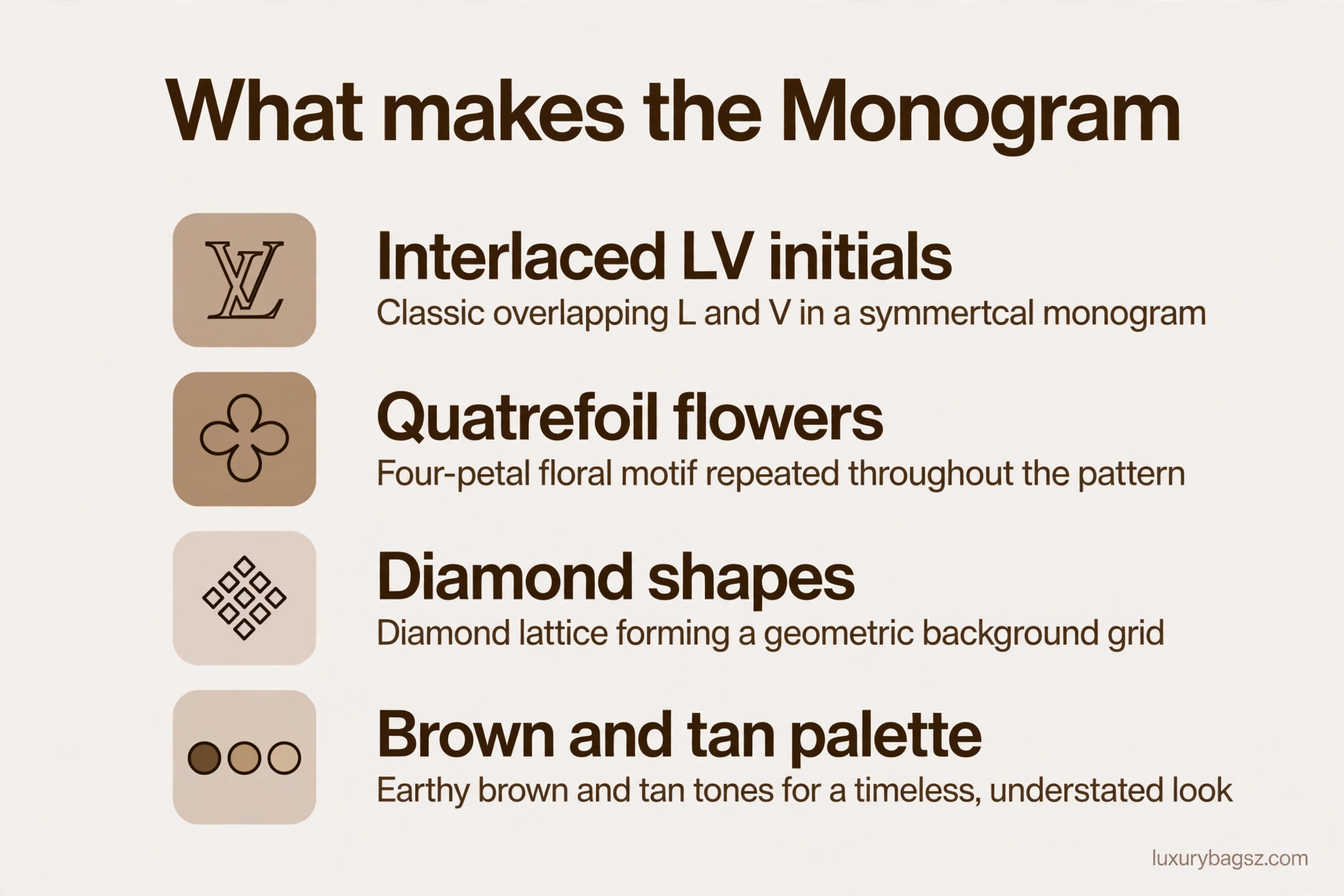
Learning to read the Monogram helps both appreciation and authentication. The repeat contains the interlaced LV initials, a four-petalled flower, a quatrefoil, and a diamond shape with a dot. The flowers are stylised rather than realistic, which is why the pattern reads as both floral and geometric. The classic palette is brown motifs on tan canvas with darker brown trim, though the house has produced the pattern in many colours, materials and finishes over the decades.
Sources disagree on small details, and that disagreement is worth stating plainly. Some accounts describe the floral motifs as inspired by Japanese crests, others emphasise Gothic tiles, and counts of motifs vary by whether the LV itself is counted as a motif. None of that changes the authentication basics. On a genuine bag the print should be crisp, symmetrical and evenly spaced, the canvas should feel coated and substantial, and the alignment should be consistent across seams rather than randomly cut.
Fakes fail on exactly those points. Blurry or misaligned prints, wrong shades of brown, stiff or plasticky canvas, uneven stitching and hardware that feels light are all warnings. No single check proves a bag, and date codes alone prove nothing, because counterfeiters copy genuine codes. Judge the whole bag, and for high-value purchases use a reputable authenticator before the return window closes.
Buying Monogram Pre-Owned: A Practical Checklist
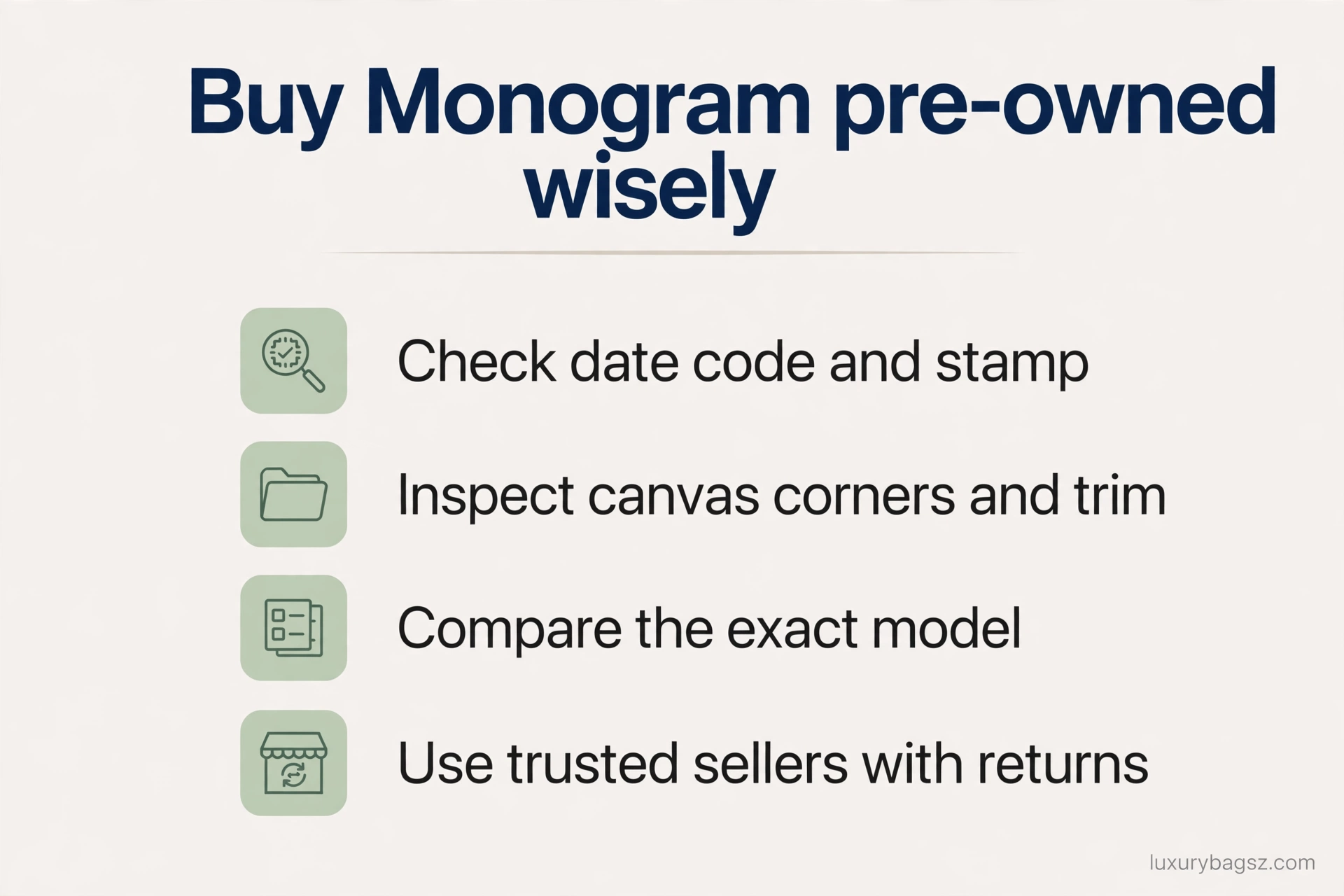
Pre-owned is where most Monogram buying happens, because the pattern has been in production for 130 years and the range is enormous. Start by fixing the exact model and size you want, then compare at least three listings for that exact bag. A Speedy 30 price tells you nothing about a Neverfull GM, and a rare colourway price tells you nothing about classic canvas.
Our fake bag checks give twelve checks in full, but the short version is this. Ask for photos of the front, back, sides, base, corners, handles, hardware, date code or microchip, interior and any wear. Check that the print matches the model and era, that vachetta trim has aged naturally, and that the seller's description matches the photos rather than a generic template. Be wary of listings that show only one distant photo, refuse close-ups, or price a rare bag far below every comparable listing.
Care is straightforward. Wipe coated canvas gently with a soft, dry cloth, keep the bag out of prolonged sun and rain, store it stuffed and in its dust bag, and never hang it by its handles. Vachetta trim darkens with age and handling, which is normal patina, not damage, but water stains on vachetta are hard to reverse. A well-kept Monogram bag can look superb for decades, which is part of why the pattern has lasted 130 years.
Why It Still Matters
The Monogram matters because it solved a problem that every brand still faces: how to be recognisable without shouting. Georges Vuitton made a pattern that worked as decoration first and branding second, and that is why it survived fashion cycles that killed louder logos. It has been a trunk canvas, a handbag icon, a pop-art playground and a streetwear print, without ever losing its brown-and-tan core.
It also matters as a warning. The most copied pattern in fashion is the one invented to stop copying, and the copies get better every year. That makes knowledge, not just desire, the real luxury for a Monogram buyer. Learn the motifs, learn the icons, and buy the exact bag you have researched.
For new buyers, the smartest first step is handling the canvas in person when possible. Visit a boutique or a reputable pre-owned store, feel the coated canvas, check how the trim ages, and compare sizes side by side. Photographs help, but touch and scale settle doubts that pictures leave open, especially for first-time buyers choosing between the Speedy and the Neverfull.
Frequently Asked Questions
When was the Louis Vuitton Monogram created? It was created in 1896 by Georges Vuitton, son of founder Louis Vuitton, and reportedly patented in 1897.
Why was the Monogram created? It was created as a tribute to Louis Vuitton and as a defence against counterfeiting, after earlier striped and Damier canvases had been widely copied.
What do the Monogram motifs mean? The pattern combines interlaced LV initials with stylised floral motifs, quatrefoils and diamond shapes, inspired by Neo-Gothic ornament, Japanese crests and the Vuitton family home tiles.
What came before the Monogram? A striped canvas in 1872 and the Damier checkerboard canvas in 1888, both of which were also copied, which prompted the new design.
Which bags are the Monogram icons? The five anniversary icons are the Speedy (1930), Keepall (1930), Noé (1932), Alma and Neverfull (2007).
When is the Monogram's 130th anniversary? In 2026, marked by celebrations from January 2026 and capsule collections including Monogram Origine, VVN, Time Trunk and Monogram Emblème.
Is the Monogram the most copied pattern in fashion? It is widely described as the most counterfeited design in fashion, an irony given that it was invented to stop copying.
What is Monogram canvas made of? Modern Monogram canvas is a coated canvas, lighter and more water-resistant since 1959, with leather trim, traditionally vachetta that darkens with age.
How can I tell a real Monogram bag from a fake? Check print crispness and alignment, canvas feel, stitching, hardware quality, date code or microchip, and whether the model and era match, and use a reputable authenticator for high-value buys.
Is a Monogram bag a good investment? Classic Monogram bags in good condition tend to hold value well, but prices vary by model, size, colourway and condition, so buy the bag you love in the condition you can accept, not on a promised return.
Final Verdict
One hundred and thirty years on, the Monogram remains the rare pattern that is both a museum piece and a daily bag. It began as a son's tribute and a practical defence against fakes, and it became the visual language of an entire house. Its strength was never novelty alone. It was discipline: the same motifs, the same palette, endlessly reinterpreted but never abandoned.
If you are buying into it, start with a classic icon in a size that fits your life, learn the motifs well enough to spot a bad copy, and buy from a seller with clear photos and returns. The Monogram rewards that care. It is, after all, a pattern designed to be recognised, and the best way to honour it is to recognise the real thing.