How to Read Louis Vuitton Date Codes and Microchips

Date Codes and Microchips at a Glance
A Louis Vuitton date code is a production code, not a serial number: it records where and when a bag was made, and the same code appears on many bags. My Louis Vuitton date code checker decodes every era’s format with worked examples. From the early 1980s until March 2021, codes were stamped inside the bag; since March 2021, new production carries an embedded RFID microchip and no printed code. The single most useful skill is era-matching. Read the code’s format, decode its date, and check that the date agrees with the model’s launch date, its materials and its hardware. A correct code proves little, since counterfeiters copy valid codes, but a code that contradicts the bag’s era can disprove it outright.Key Takeaways
- Date code = factory letters + date numbers; never a unique serial, and there is no public lookup.
- 1990–2006: two letters + four numbers, 1st and 3rd digits = month, 2nd and 4th = year.
- 2007–March 2021: same pattern, but 1st and 3rd digits = week, 2nd and 4th = year.
- March 2021 onward: embedded RFID microchip, readable only by Louis Vuitton’s own equipment.
- Factory letters were shared across countries, so a made-in stamp alone never proves or disproves a bag.
- A post-2021 bag with a printed date code, or a pre-2021 model with a code from before its launch, are both major warnings.
Era-matching is the test I lean on hardest with Louis Vuitton. I decode the date code’s factory letters and numbers, then hold the result against the bag’s launch date, materials and hardware — a code that contradicts the era disproves the bag outright, however neat the stamp looks. On anything made after March 2021 there should be no printed code at all, and I verify the embedded microchip through Entrupy instead. Codes are copied as easily as logos, which is why, after examining more than 500 bags, I treat a correct code as permission to keep checking, never as a verdict.
What a Date Code Is, and Is Not
A date code tells you two things: the factory, represented by letters, and the production date, represented by numbers. Louis Vuitton created it for internal quality control, to track production batches and identify issues, not as a consumer authenticity guarantee. That distinction matters because buyers treat codes as proof. A code is one checkpoint among many, and professional authenticators have always weighed it alongside canvas, stitching, hardware and heat stamp. A bag with a perfect code and poor stitching is still a suspect bag. Equally, a missing or faded code is not automatic proof of a fake. Codes on Alcantara linings wear away, linings get replaced, and some early and small items never had codes. The code’s absence shifts weight to the other checks; it does not end the story by itself.The Era Formats in One Table
| Era | Format | How the numbers read |
|---|---|---|
| Pre-1980s | No codes | Nothing to decode |
| Early 1980s | Three or four numbers | First digits = year, last = month |
| Late 1980s | Numbers, then two letters | Numbers as above, letters = factory |
| 1990–2006 | Two letters + four numbers | 1st and 3rd = month, 2nd and 4th = year |
| 2007–March 2021 | Two letters + four numbers | 1st and 3rd = week, 2nd and 4th = year |
| March 2021 onward | Microchip | No printed code |
Worked Examples Across the Eras
Early example: 836 means June 1983, with 83 as the year and 6 as the month. A four-digit early code like 8412 means December 1984, on the same logic. Late-1980s example: 874VX means April 1987, made in France, with the factory letters trailing the numbers. 1990–2006 examples: VI1025 means December 2005, in France, since the 1st and 3rd digits (1 and 2) give month 12 and the 2nd and 4th (0 and 5) give year 05. Similarly, 0965 reads as June 1995, and AR1004 reads as October 2004, in France. 2007–2021 examples: SD2058 means week 25 of 2008, from an SD workshop, since the 1st and 3rd digits (2 and 5) give week 25 and the 2nd and 4th (0 and 8) give year 08. SD2159 means week 25 of 2019, FL3179 means week 37 of 2019, and 1230 means week 13 of 2020. Test yourself on any code by checking the result makes sense: a month above 12, or a week above 53, means you have used the wrong era’s rule, or the code itself is wrong. That simple sanity check catches more decoding errors than any factory table.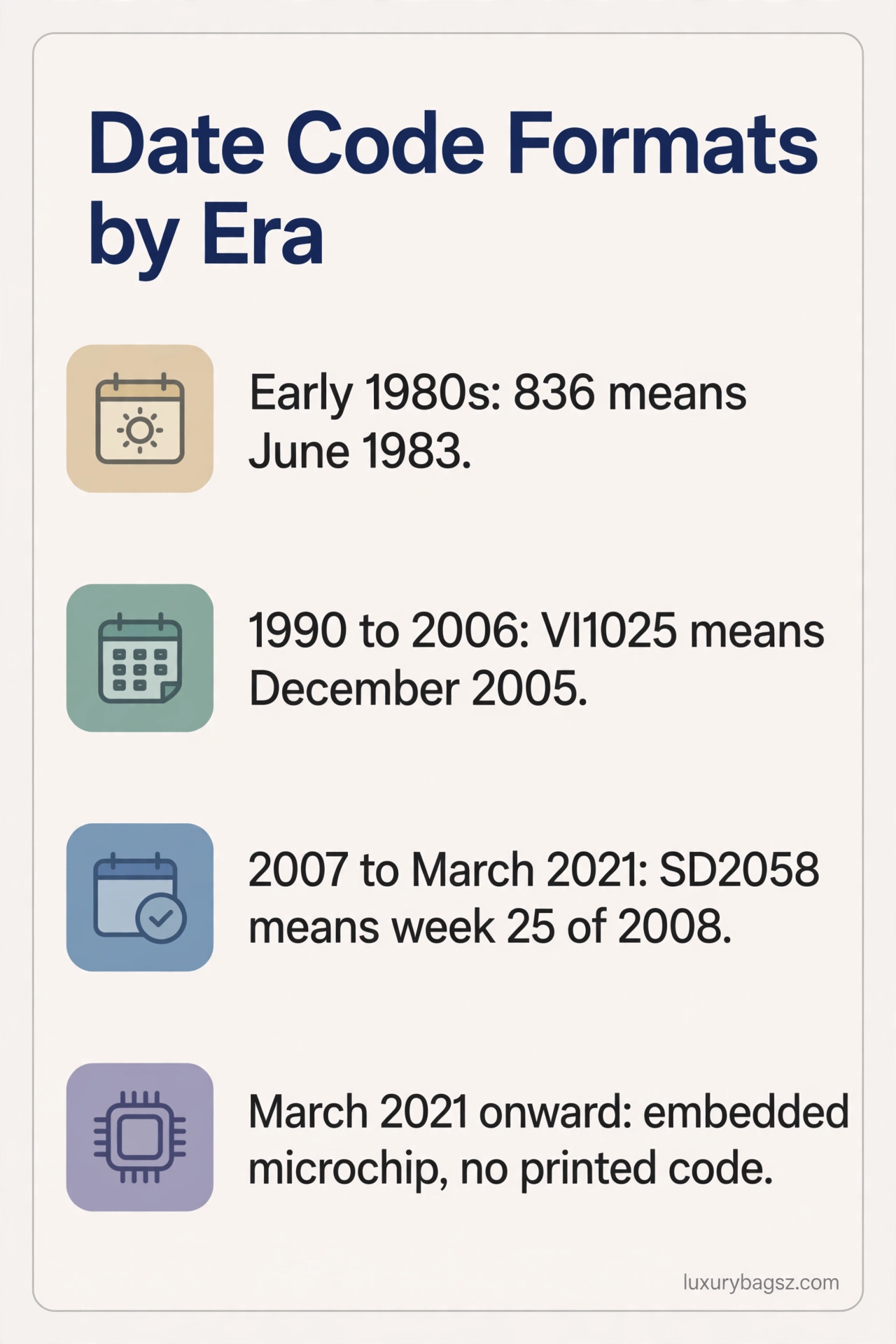

The Factory-Letter Table, With Its Warnings
Glampot publishes a common factory-letter reference, reproduced here in condensed form because no competitor excerpt gave a complete table: France includes AA, AR, AS, BA, CO, FL, LW, MI, SD, SL, TH, VI and VX among many others; Italy includes BC, BO, CE, MA, RC and RE; Spain includes CA, GI, LO and LM; Germany includes LP and OL; Switzerland includes DI and FA; the USA includes FC, FH, LA, OS and TX. The warning matters more than the table: some letter pairs are shared across countries. France and the USA share prefixes, including SD and FL, so a made-in USA stamp with an SD code, or a made-in France stamp with an FL code, is not automatically inconsistent. Simplistic country tables that assign each pair to one country mislead buyers. What does count is gross inconsistency: a code whose factory letters belong to no plausible country for the stamp, or a stamp and code pointing to entirely different production stories, deserves a closer look. But a single-letter mismatch against a simplified internet table proves nothing, and authenticators say so plainly.Where to Find the Code, by Model
Codes sit on a small leather tab stitched into an interior seam, often inside a pocket, or stamped directly onto the lining, especially on Alcantara or microfibre interiors where the stamping can fade. On wallets and clutches, look under the flap; on belts, sometimes on the underside. By model, the usual spots are: Speedy, inside the interior pocket; Neverfull, on the pouch tab or interior tab depending on edition; Pochette Metis, on a tab inside the zipped pocket; wallets and small leather goods, under a flap or inside a pocket; luggage, on an interior patch or tab. These are usual spots, not guarantees, since placement varied by era and style. If you cannot find a code, pull pocket linings gently inside out and look along seams with good light, since tabs hide in folds. Never cut a lining or force a seam to find a code; a damaged lining harms the bag and proves nothing.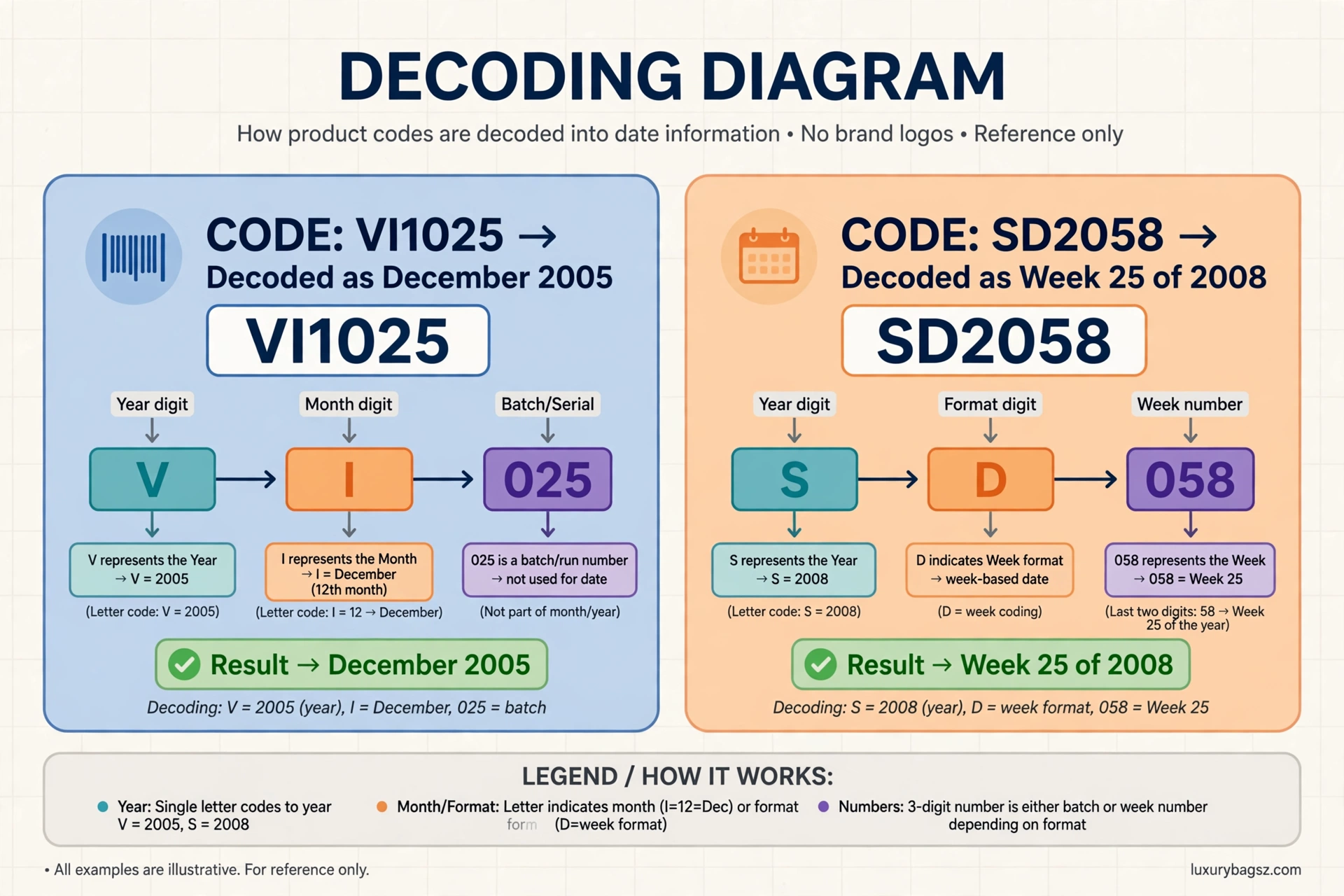
The March 2021 Switch, as a Rollout, Not a Day
Glampot dates the switch to 1 March 2021, while other guides say starting in March 2021, spring 2021, or phased out over the following couple of years. The honest picture is a gradual rollout: some pieces produced in 2021 still carry a date code, and codes disappeared progressively over the following couple of years. That rollout matters for judging 2021 to 2023 bags. A 2021 bag with a code is not automatically fake, and a 2022 bag without one is not automatically genuine; the model’s own switch timing, its materials and its hardware must agree with the claimed year. No guide in the excerpts breaks the rollout down by model or line, which is a genuine gap. Until such a breakdown exists, treat any claim that a specific model switched on a specific date with scepticism, and judge transition-era bags on the whole bag, not on the code alone.What the Microchip Holds, and What It Does Not
The chip is a small, passive RFID chip sewn into the lining or a seam, invisible from outside, with no battery. It holds the item’s own data: model number, materials, production date and location, and supply-chain journey. It does not hold the owner’s personal information. Louis Vuitton employees can read it with proprietary equipment and staff applications, for example when a bag comes in for repair, when they can confirm production history instantly. That repair use is one of the few consumer-visible benefits of the chip system. For buyers, the key fact is negative: you cannot read the chip’s data yourself. That single limitation reshapes authentication for every bag made after March 2021, and it is why physical checks matter more, not less, in the chip era.Chip Readability: The Disagreement Stated Plainly
Sources disagree about phone readability, and the difference matters. One guide says RFID tags can be scanned with an NFC reader, while Glampot says phone apps may detect that a chip is present but cannot read or verify the data. ProAuthenticators agrees with Glampot: some apps claim detection, but they cannot read the crucial Louis Vuitton-specific information. This guide follows Glampot and ProAuthenticators: presence-detection is not verification. A phone that beeps near a bag has detected something, not authenticated anything, and that distinction is exactly what dummy chips exploit. Counterfeiters now embed dummy chips, according to Glampot, so a detected chip can be a fake’s chip. Any seller who offers a phone beep as proof of authenticity is either mistaken or misleading you, and the correct response is to return to physical checks and professional authentication.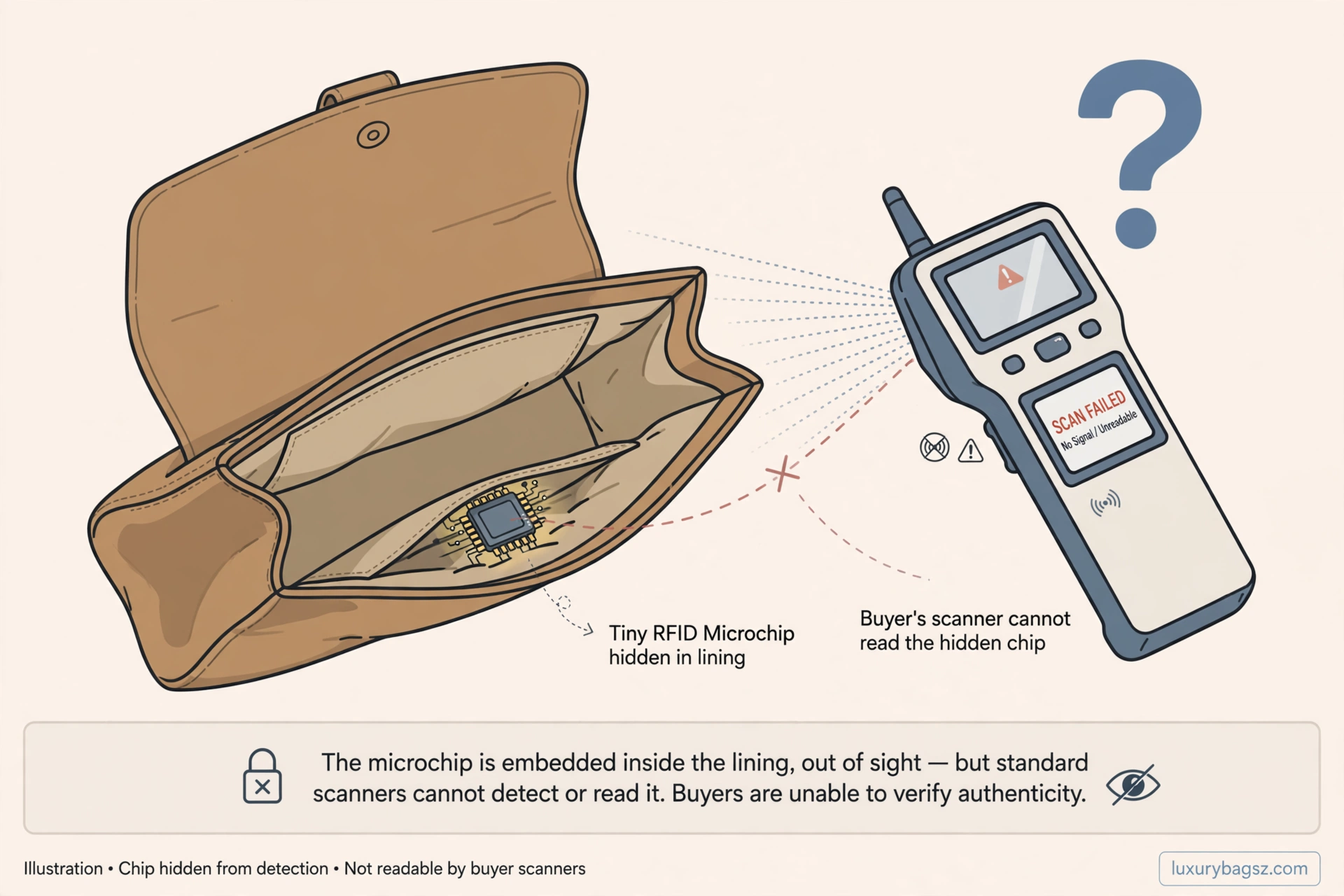
Era-Matching: The Test That Catches Fakes
Era logic is the most decision-useful test in this guide. A Neverfull sold as 2003 production cannot exist, since the tote launched in 2007. A Speedy 25 sold as 1950s stock cannot exist, since that size dates to 1965. An Epi bag claimed as 1970s stock cannot exist, since Epi arrived in 1985. Apply the same logic to codes: a bag claimed as 2022 production with a printed date code contradicts the chip era, while a bag claimed as 2015 production without any code needs an explanation, such as a replaced lining, before it can be believed. Hardware and materials must point to the same years too. A 1990s-claimed bag with hardware finishes from a later era, or a 2010s-claimed bag with a 1990s code format, fails era-matching even if each detail looks plausible alone. Any one contradiction ends the story.Where Codes Hide, Fade and Disappear
Authentic bags with Alcantara linings may have codes that are very faint or have worn away altogether, especially on older bags or where a lining has been cleaned or replaced. A missing code on such a bag is common, not condemnation. Relining is a specific case: a bag professionally relined by Louis Vuitton may carry a DK code, according to one guide, marking the relining itself. A replaced lining can also remove the original code entirely, so a relined bag’s missing code has an innocent explanation that the seller should state plainly. Other exceptions include early-1980s and older pieces that pre-date the system, luggage and rare limited editions that sometimes lack standard codes, and small accessories that never carried them. Ask the seller about lining replacement or repair history before judging a missing code.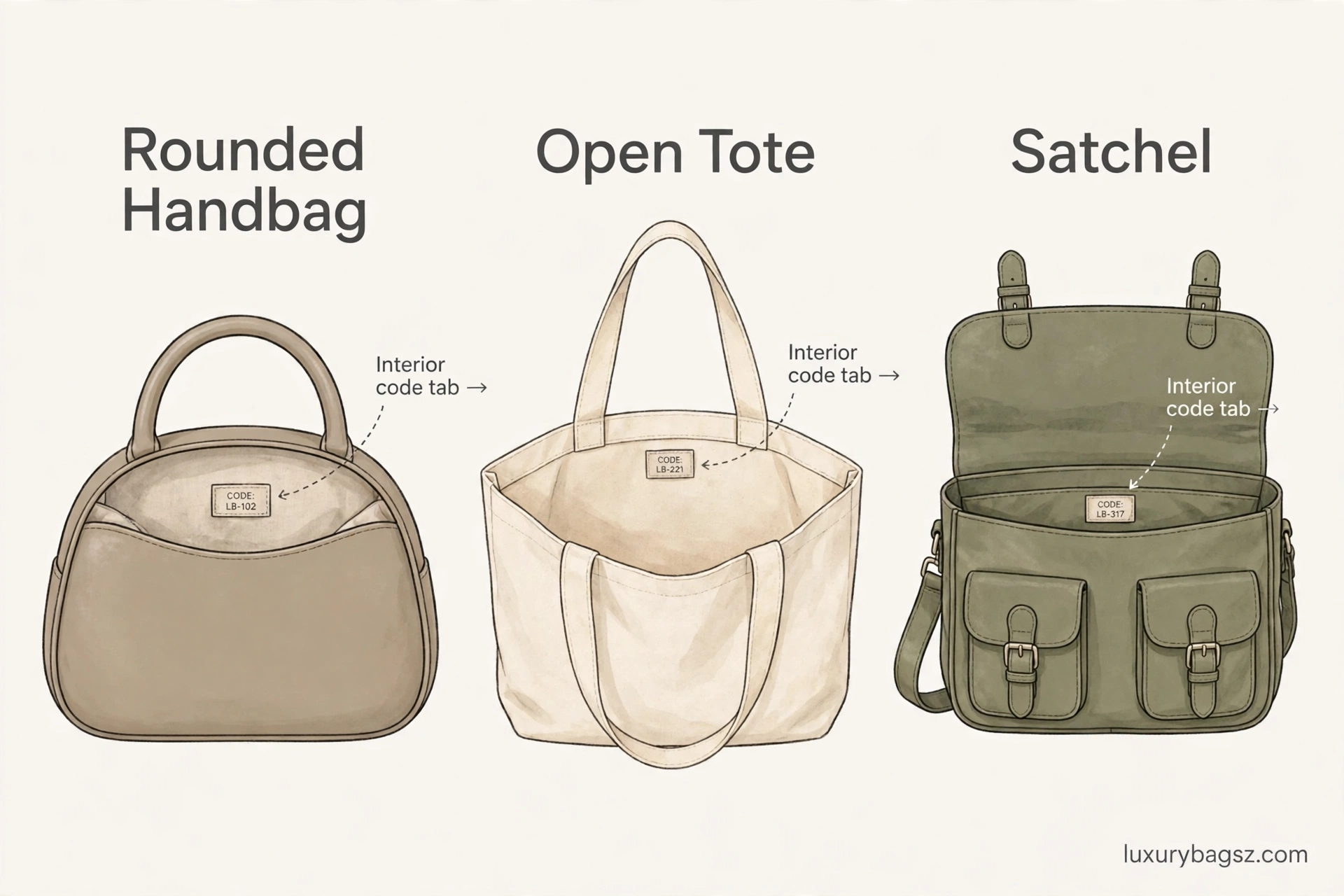
Buying a Chipped-Era Bag: A Workflow
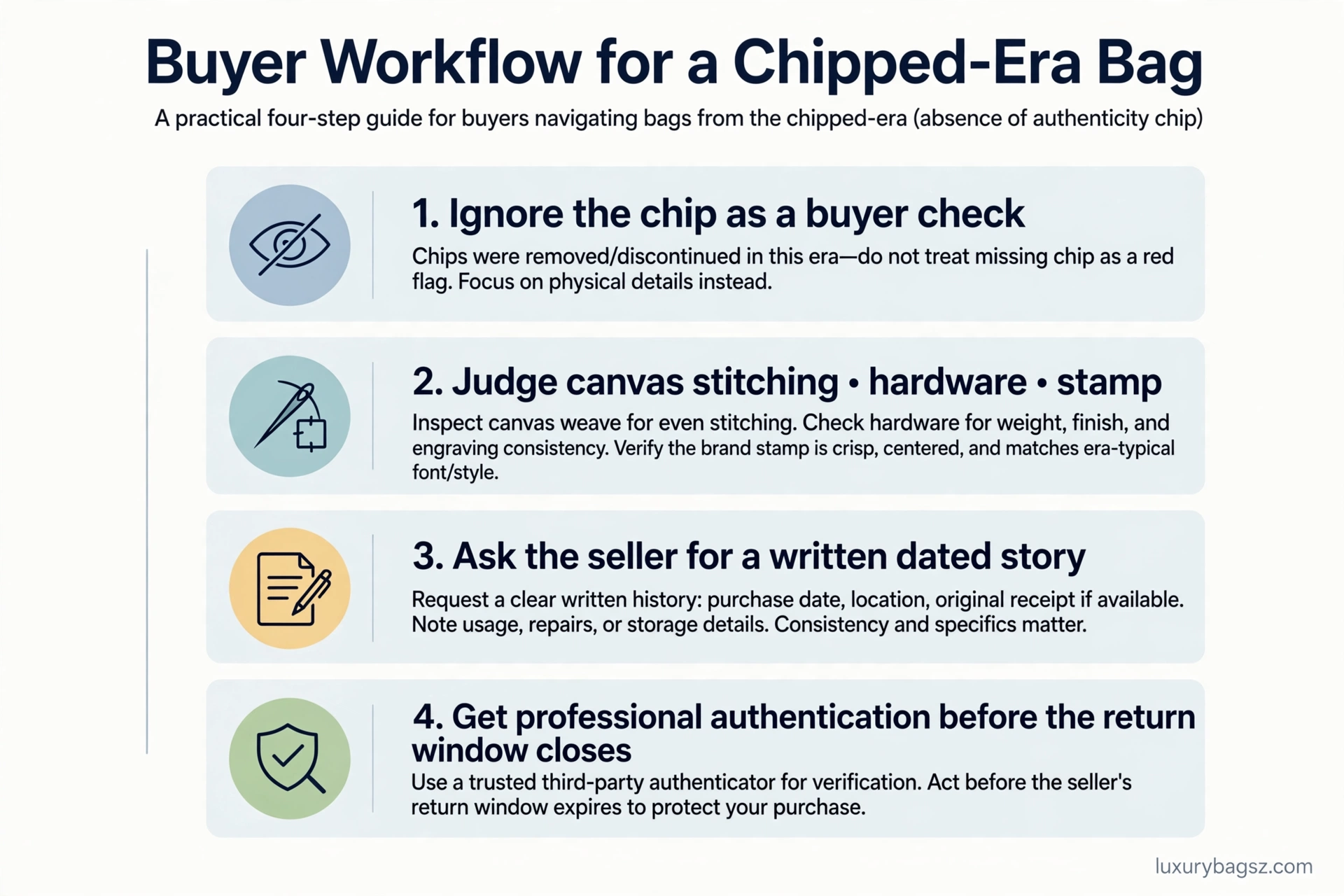
First, ignore the chip entirely as a buyer check, since you cannot verify it. Judge the bag on canvas, stitching, hardware, heat stamp, vachetta and model-specific details, exactly as for a code-era bag, and use standard fake-spotting checks. Second, ask the seller for the bag’s story in writing: purchase date, boutique or reseller, and any repair history. A seller who can give a coherent, dated story is more reliable than one who leans on the chip as proof. Third, for higher-value bags, pay for professional authentication before the return window closes. Services that examine the bag in hand cost far less than the price difference between a real and a fake bag, and a certificate also helps when you later resell. Fourth, ask whether a Louis Vuitton store scan is possible, but do not assume it. Stores are not obliged to authenticate a non-owner’s bag, and a store’s willingness varies, so a seller’s refusal to attempt a store visit is not proof of a fake, only a missing bonus.Resale Impact of No-Code Bags
Buyer scepticism toward no-code bags is real, and sellers should expect it. A chipped-era bag without a printed code looks, to an uninformed buyer, like a bag with something missing, and that misunderstanding can slow a sale or invite low offers. Document a chipped bag well for resale: keep the receipt, photograph the bag thoroughly, keep any professional authentication certificate, and state the chip era plainly in the listing. Educating the buyer in the listing itself prevents the accusation that a missing code means a fake. Code-era bags have the opposite problem: a perfect code adds little value, since codes are copied, while a faded or missing code on a code-era bag subtracts value unless a relining explanation is documented. In both eras, paperwork and condition matter more than the code itself.