

Watch Complications: The Retrograde Explained, How It Works and Watches That Use It Best
The Retrograde in Brief: The Hand That Flies Back
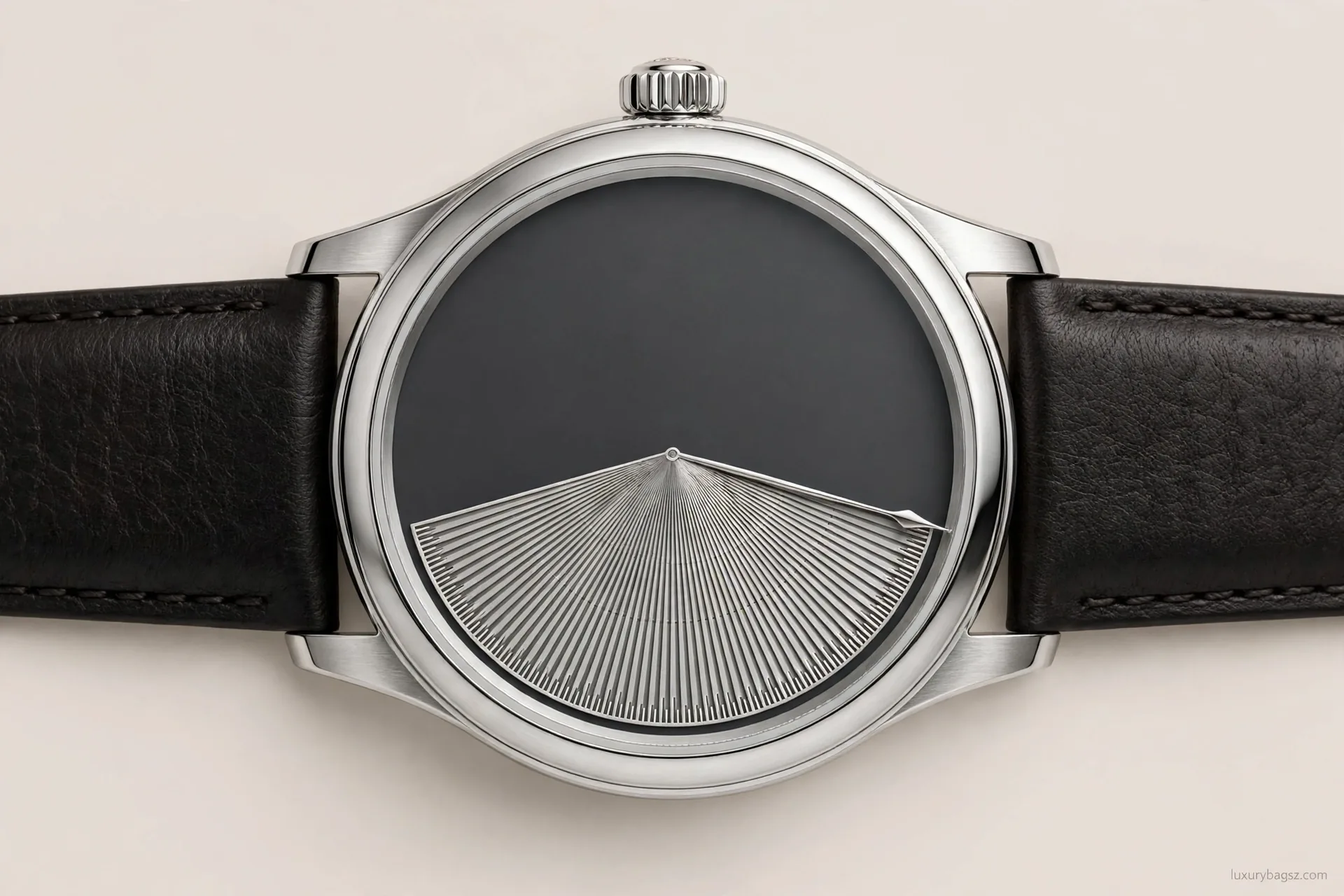
A retrograde display shows time, date or another measure along an arc instead of a full circle. The hand travels along the arc, and when it reaches the end, it snaps instantly back to the start and begins again. The short answer is that the retrograde is a display complication, not a new way of measuring time. Underneath sits a normal movement; the magic is in cams and springs that turn steady rotation into that theatrical sweep and flyback.
Key Takeaways
- A retrograde hand sweeps an arc, then jumps back to zero instead of turning a full circle.
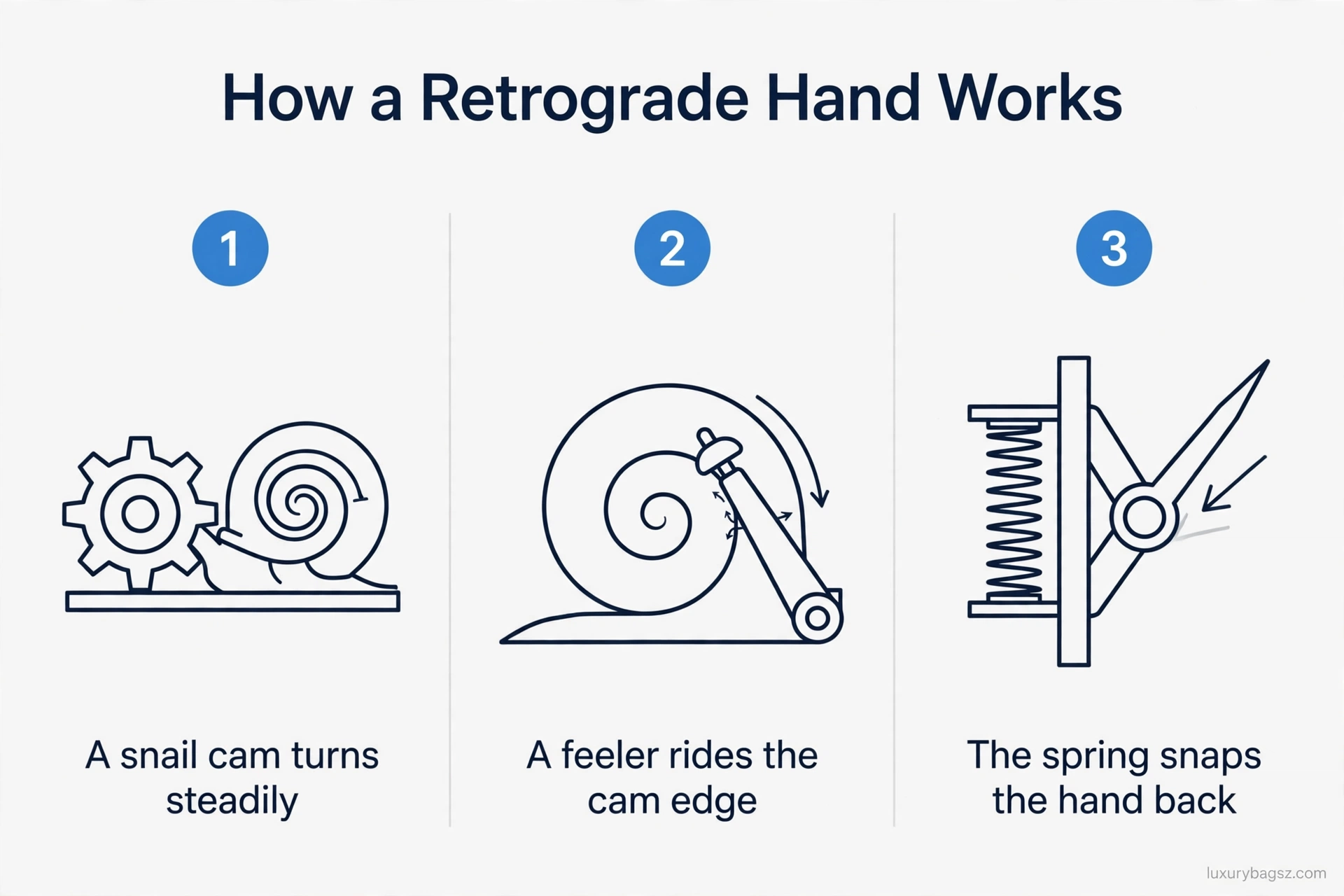
- The mechanism typically uses a snail cam, a feeler and a spring to store and release energy.
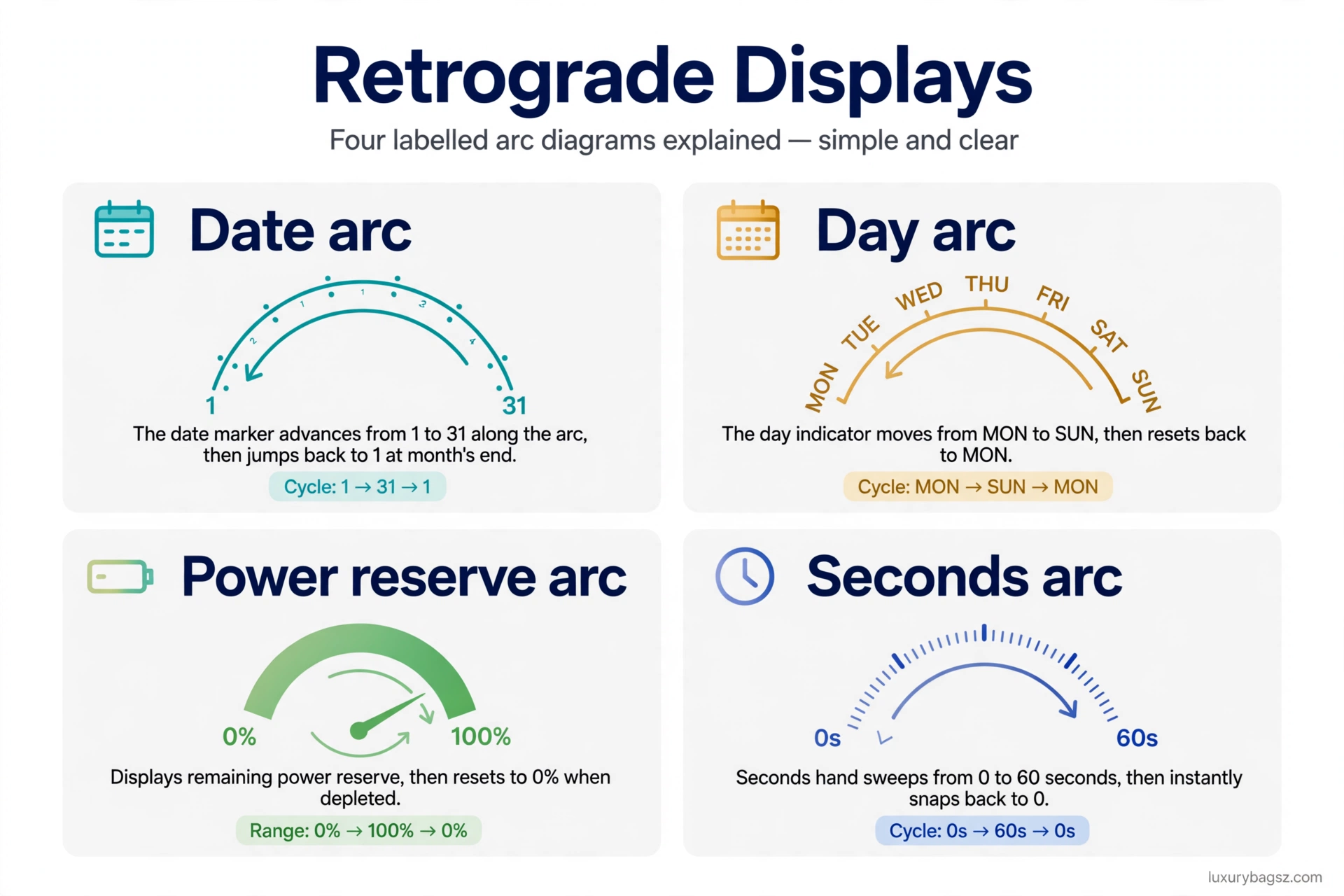
- Retrograde displays most often show the date, day, power reserve or seconds.
- Biretrograde watches carry two retrograde displays, often day and date together.
- The complication adds servicing complexity, so condition and service history matter when buying.
- It is loved for theatre and dial architecture, not for any gain in accuracy.
What Retrograde Actually Means
The idea is older than it feels. Retrograde indications appear on clocks and pocket watches from earlier centuries of watchmaking, because the arc solves a real layout problem: showing a long scale without shrinking numerals around a cramped full circle. Retrograde simply means moving backwards. In watchmaking, it describes an indicating hand that does not rotate through 360 degrees like a normal hand, but travels along a sector and returns at once to its origin. The scale is usually a fan or arc printed or applied on the dial. Numbers spread along that arc: dates 1 to 31, days of the week, hours of power reserve, or 60 seconds in miniature. Because the hand only ever occupies the arc, the rest of the dial stays free. Designers use that freedom for balance, placing arcs top and bottom or left and right to build symmetrical, architectural dials.
How It Works: Cams, Feelers and Springs
The classic mechanism uses a snail cam: a spiral-shaped cam whose radius grows steadily as it turns. A feeler, or finger, rides along the cam's edge, pushed by a spring, and moves the hand as the radius grows. When the feeler reaches the cam's highest point, it falls off the edge, back to the smallest radius. The spring drives that fall, and the hand flies back to the start of its arc in a fraction of a second. That snap is stored energy being released, which is why the mechanism needs careful adjustment. Too little spring force and the return is lazy; too much and parts wear or the hand overshoots its mark.
The Retrograde Date, the Commonest Form
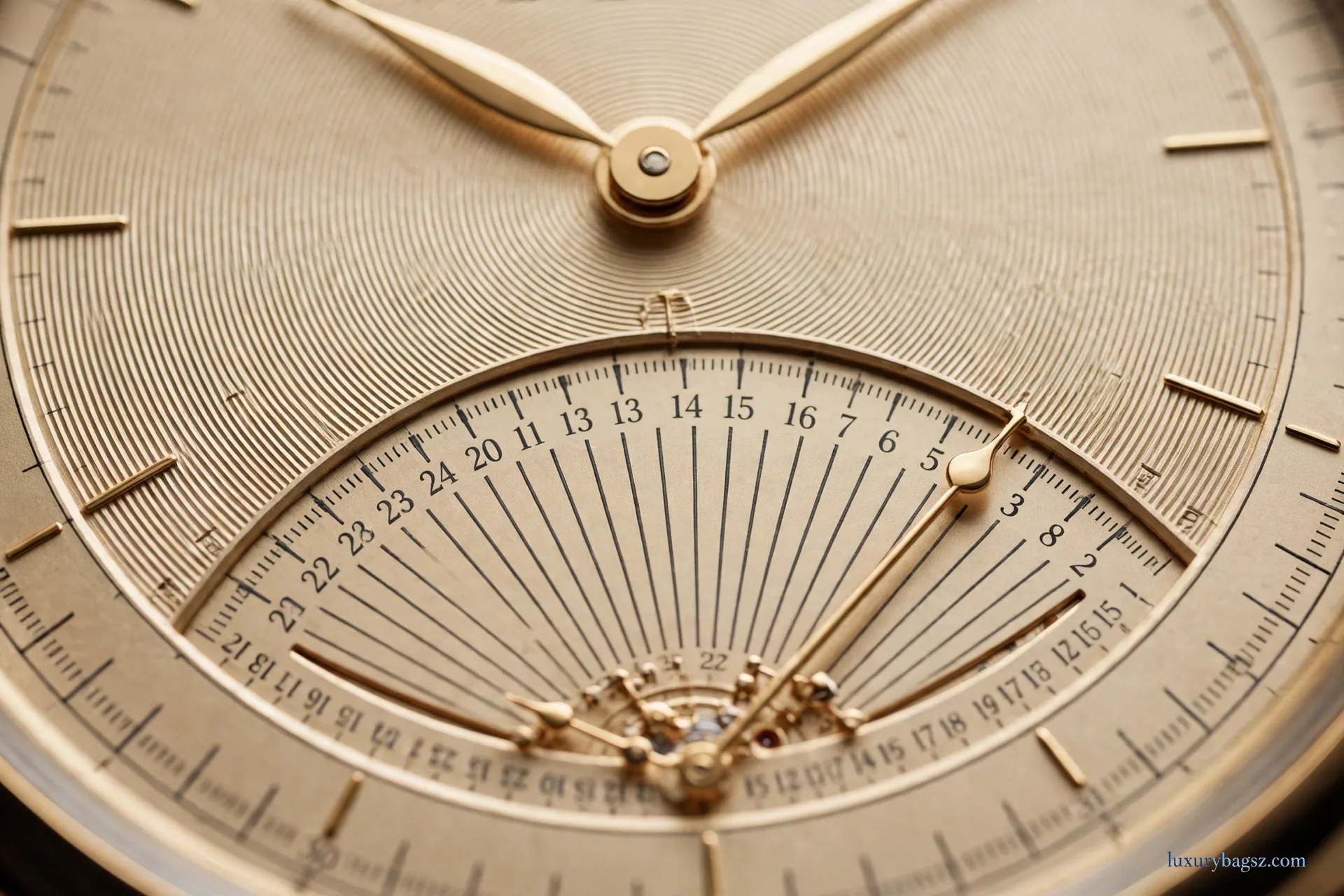
Reading one becomes second nature within days. Your eye learns the arc the way it learns a fuel gauge, and many owners say the date's position tells them roughly where they are in the month faster than a numeral alone does. The date is the most popular retrograde display. Instead of a small window showing one numeral, the date spreads along an arc, and you see the month progressing like a gauge. At the end of a 31-day month, the hand flies back to 1. In shorter months the wearer advances the date by hand, as with many calendar watches, unless the movement is a more advanced calendar. A retrograde date is easier to read at a glance than a date window and gives even a simple watch a technical character. It is often the first complication collectors choose beyond time and a standard date.
Day, Power Reserve and Seconds
Retrograde day displays pair naturally with dates, one arc for each, giving a complete calendar picture without windows. Several makers built their identity on this day-and-date pairing. Power reserve suits the arc perfectly, because a reserve is a gauge by nature: full at one end, empty at the other. Our F.P. Journe collecting guide shows how a fine maker integrates a retrograde reserve into a dial without clutter. Retrograde seconds are rarer and more playful. A hand sweeping a short arc every 30 or 60 seconds and snapping back adds constant motion, though it asks more of the movement than a date that jumps once a day.

Biretrograde and Brand Signatures
Placement varies creatively within the form. Some biretrograde dials stack their arcs like a smile and a frown, others split them left and right of the centre, and each arrangement changes the watch's character as much as its case shape does. A biretrograde watch carries two retrograde indications, most often day and date on opposing arcs. The symmetry is striking, and the pairing became a signature for certain houses in the 1990s and after. Some brands made the display a house code. Our Bulgari facts guide sets out a house that has used retrograde displays across collections, treating the arc as part of its design language rather than a novelty. That signature status matters to buyers. A retrograde from a maker known for the complication usually means better execution, better parts support and stronger resale interest than the same idea from a dabbling brand.

Why Collectors Love It, and Its Honest Limits
The appeal is theatre plus architecture. The flyback moment, especially a date hand jumping at month's end, is a small mechanical event you can watch, and arcs let designers compose dials no circular display allows. There is also an honesty to it in fine watchmaking: the complication exists because makers can do it beautifully, in the same spirit as shaped dress watches covered in our Cartier Tank watch guide, where design intelligence is the value. The limits are practical. Retrograde modules add parts, friction and servicing cost, and they bring no accuracy benefit. A poorly adjusted example can stick mid-arc or return weakly, spoiling the entire effect.
Buying Checks for a Retrograde Watch
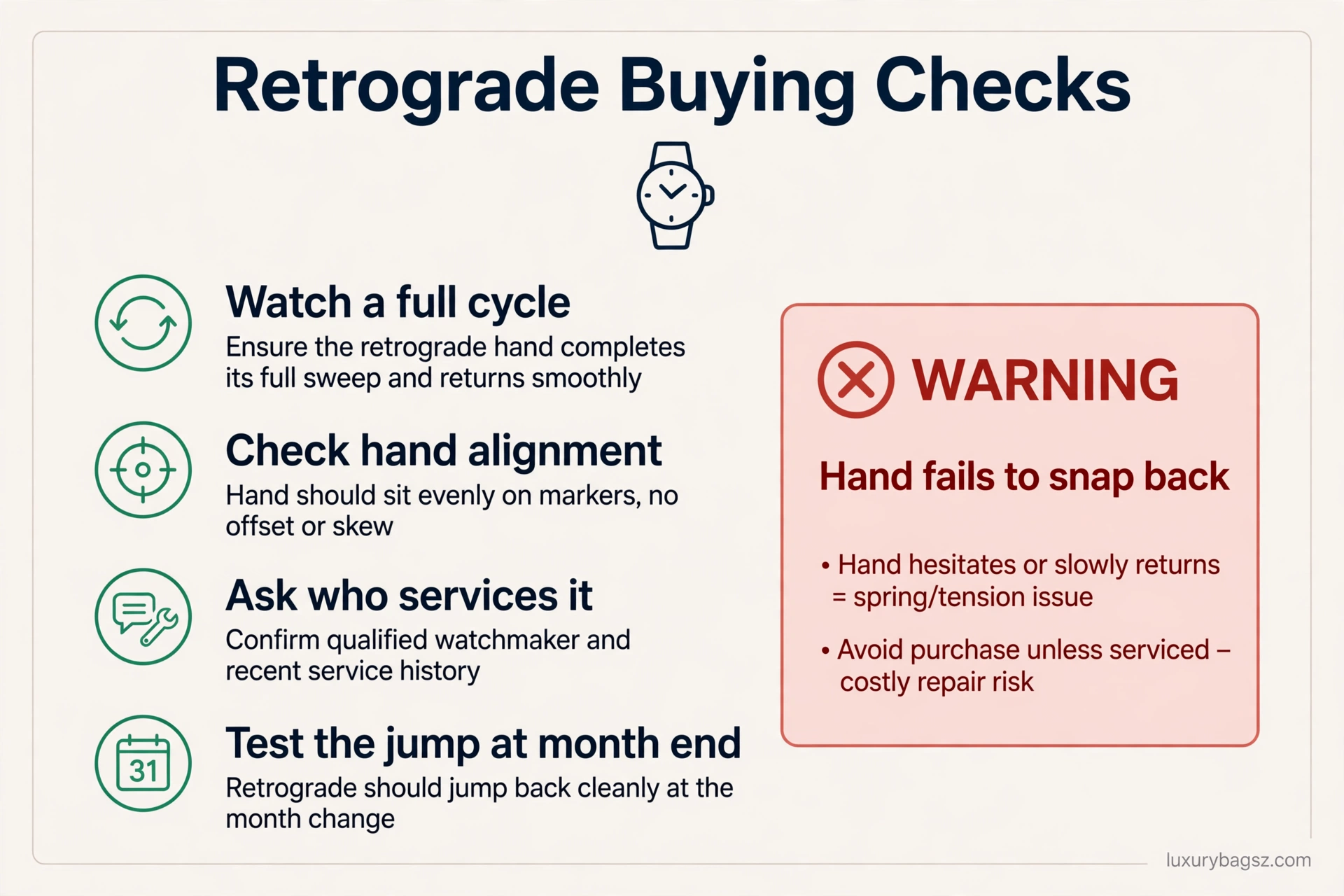
Also check how the watch is set. Some retrograde calendars advance through crown positions or pushers, and a seller should be able to demonstrate the routine. Confusion here is common and innocent, but damage from forcing is not. Watch the hand complete its cycle. On a date model, advance the date through the end of a month and watch the flyback: it should be instant, clean and land exactly on 1. Check alignment along the whole arc. The hand should point precisely at each marker, not drift between them, since misalignment suggests wear or a past, careless service. Ask who made the module and who can service it. Proprietary retrograde mechanisms may need the original maker or a specialist, so factor longer, costlier servicing into the price you are willing to pay.
Living With One: Setting and Care
Expect the jump itself to make a faint mechanical sound on some models. That small click is the mechanism working as designed, not a fault, and many owners come to listen for it at the turn of a month. Set a retrograde date following the maker's guidance, and avoid forcing the hand backwards through its jump. If the manual warns against date changes near midnight, obey it; calendar mechanisms are busiest then. Keep the watch serviced on schedule. The cam and feeler surfaces depend on correct lubrication, and dry running wears the very edges that make the snap back crisp. Daily care stays simple. Our how to clean a watch guide covers safe case and strap cleaning, and the rest is storage: dry, away from magnets and knocks, with the complication's health checked at every service.
Frequently Asked Questions
What is a retrograde watch?
It is a watch where a hand travels along an arc and snaps back to the start at the end of its range, instead of rotating in a full circle. Date, day, power reserve and seconds are the usual displays.
How does a retrograde mechanism work?
Typically a snail cam turns steadily while a spring-loaded feeler rides its growing radius, moving the hand. At the cam's edge the feeler falls back, and the spring snaps the hand to zero.
What does biretrograde mean?
It means the watch has two retrograde displays, most commonly day and date on separate arcs. The paired arcs often sit symmetrically and become a recognisable brand signature.
Is a retrograde watch more accurate?
No. The retrograde is a way of displaying information, not measuring it better. Accuracy comes from the base movement underneath the display module.
Are retrograde watches expensive to service?
They can be. Extra cams, springs and adjustment add labour, and proprietary modules may need the original maker. Ask about service cost and intervals before buying.
What can go wrong with a retrograde display?
A hand may stick, return weakly or misalign with its markers, usually through wear or poor past servicing. Testing a full cycle, including the jump, reveals most problems.
Which retrograde display is most useful?
The date is the most useful for most owners, followed by power reserve on a manual-wind watch. Retrograde seconds are mainly for visual pleasure.
Do retrograde watches hold value?
Examples from makers known for the complication, in good serviced condition, fare best. The display alone does not guarantee value; brand, condition and originality decide.
Can I set the date backwards on a retrograde watch?
Follow the maker's instructions. Many calendar mechanisms should not be adjusted near midnight or forced backwards, and a watchmaker's guidance is worth more than experimentation.
Is retrograde a good first complication?
Yes, especially a retrograde date. It is legible, characterful and widely available at many prices, provided you buy a well-made example and budget for proper servicing.
Conclusion: Theatre With Real Engineering Behind It
The retrograde earns its place because it is both things at once: an elegant piece of dial theatre and a genuinely clever mechanism of cams, feelers and springs working under pressure. Buy one from a maker that treats it as a speciality, test the snap back yourself, and keep it serviced. Do that, and the little jump at the end of every arc stays satisfying for decades.






