

Rolex Cosmograph Daytona Guide: History, References, Prices and Buying Checks
The Daytona at a Glance
The Rolex Cosmograph Daytona is a racing chronograph introduced in 1963. It measures elapsed time with three subdials and reads average speed from a tachymeter bezel. That tool-watch job is the whole point of the watch.
Buy the current steel reference 126500LN if you want the modern Daytona most people picture. It is 40 mm, runs the in-house calibre 4131, and carries a black ceramic bezel. Expect a long wait at retail and a large premium on the secondary market.
Vintage Daytonas are a different hobby. Four-digit references are manual-wind, scarcer, and priced by dial detail. Do not buy one as a first Daytona unless you have expert help and a verified full set.
Key Takeaways

- Launched in 1963 as ref. 6239, first called Le Mans, then renamed Daytona in 1965.
- Paul Newman dials need refs. 6239, 6241, 6262, 6263, 6264 or 6265 plus an original exotic dial.
- Generations: manual-wind to 1988, Zenith-based to 2000, calibre 4130 to 2023, calibre 4131 today.
- Current steel 126500LN retails around $16,900 in 2026 and trades roughly $32,000 to $38,500 pre-owned.
- All current Daytonas are 40 mm and use calibre 4131, per the current buyer's guides.
- Never buy on a single photo: check serial, papers, service history, and the chronograph function.
- A Daytona is a chronograph first; if you never time anything, a simpler Rolex may suit you better.
What the Daytona Is For
The Daytona is a chronograph, which means it is a stopwatch on the wrist. Two pushers start, stop, and reset the timing hand. Three small subdials record elapsed hours, minutes, and running seconds separately.
The tachymeter bezel turns elapsed time into average speed. Time a car over a measured mile, read the bezel, and you have its speed. At 60 miles per hour, the run takes 60 seconds, so the scale reads 60.
That racing job explains the busy dial. Every mark earns its place by helping a driver time laps. If you want a clean, quiet dial, this is the wrong Rolex family.
Modern buyers rarely race, and that is fine. The Daytona survives because the tool look became a design icon. Just buy it knowing what the dial is doing, not only how it photographs.
1963 and the Le Mans Name
Rolex introduced the first Cosmograph chronograph, ref. 6239, in 1963. Its predecessor, ref. 6238, had no tachymeter bezel. The new bezel made the watch a genuine racing tool rather than a dressy chronograph.
Rebag notes the watch was first known as the Le Mans, after the French 24-hour race. The name changed to Daytona in 1965. Early dials vary: some carry the Daytona name in red, while others omit it entirely.
Those early inconsistencies now drive collector value. A small dial wording difference can move a vintage price by a large amount. Never assume two early Daytonas are the same watch because the cases match.
The lesson for modern buyers is simple. Daytona history rewards detail. Learn the reference and dial before you learn the price, because price follows detail here more than in most Rolex lines.
The Paul Newman Story, Without the Myth
Paul Newman wore a Daytona with an exotic dial, given by his wife Joanne Woodward. The case was engraved with the words Drive Carefully Me. He wore it for years, on and off the track, and that daily wear made it famous.
Rebag sets strict rules for the Paul Newman name. The case must be ref. 6239, 6241, 6262, 6263, 6264, or 6265. It needs a plexiglass crystal and a manual Valjoux 722 or 727 movement. The exotic dial must be original to the watch.
An exotic dial has a contrasting colour with a matching outer minute track. Its subdials use block markers and a crosshairs design. The running seconds subdial at 9 o'clock is marked 60, 15, 30, and 45.
Newman's own ref. 6239 sold at auction in 2017 for $17,752,500. At the time, that was the highest price ever paid for a watch at auction. Ordinary exotic-dial Daytonas trade far below that figure, and most sit in auction territory.
Four Generations of Movements
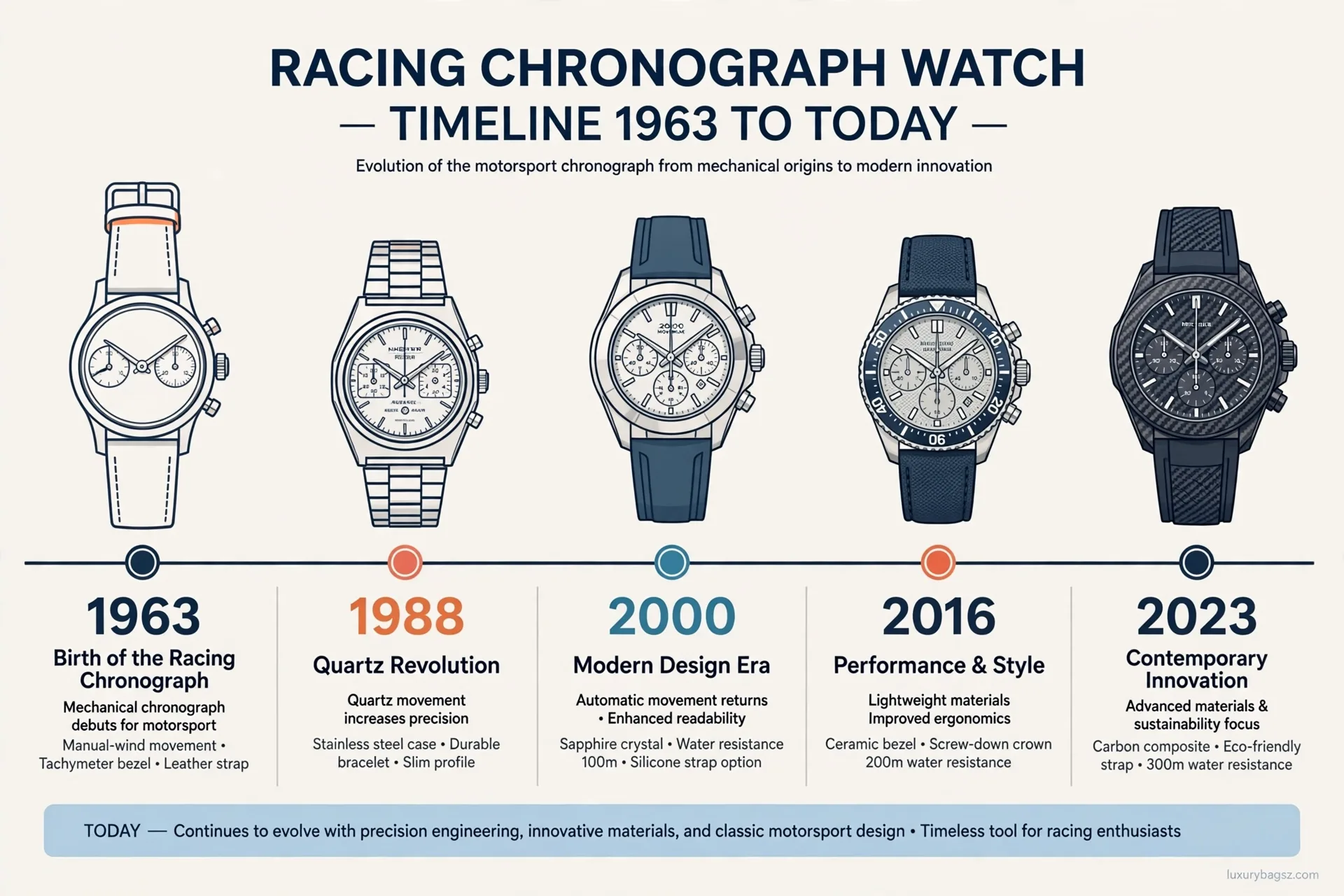
Vintage four-digit Daytonas, from 1963 to 1988, are manually wound. You wind them by hand each day, and the crown feel is part of the experience. They are also the references where dial originality matters most.
From 1988 to 2000 came the Zenith era, ref. 16520. Rolex used a heavily modified Zenith El Primero base, calibre 4030. Collectors call these Zenith Daytonas, and clean steel examples trade roughly $35,000 to $55,000.
In 2000, Rolex launched its first fully in-house automatic chronograph, calibre 4130, in ref. 116520. It offered about 72 hours of power reserve. The steel 116520, with its polished metal bezel, remains an active pre-owned choice.
Current references use calibre 4131, an update of the 4130, also with about 72 hours of reserve. The change is evolution, not revolution. Buy the generation whose bezel, dial, and price you prefer, not the newest movement alone.
Reading the Dial Like a Driver
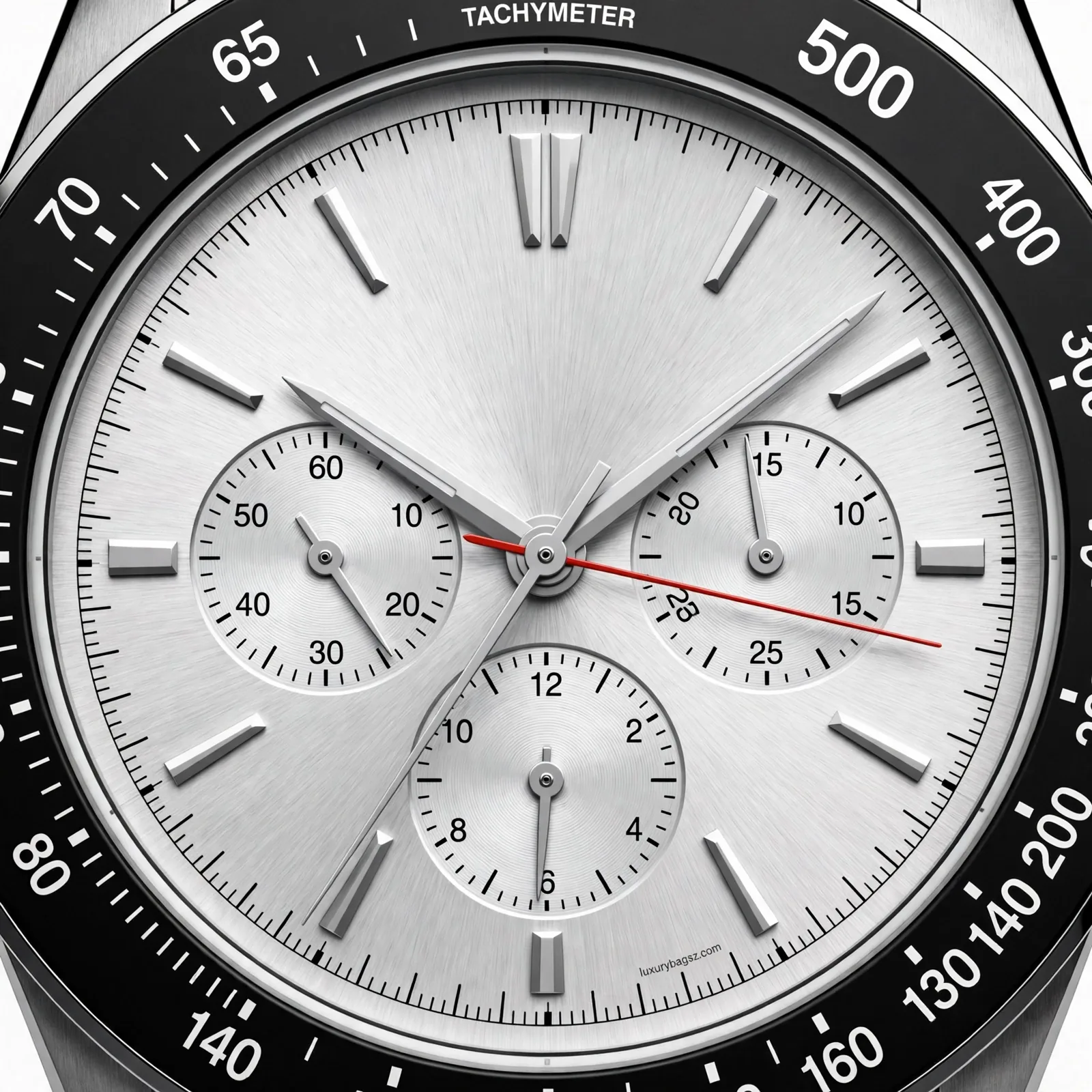
Start with the three subdials. At 3 o'clock sits the elapsed-minutes counter, at 6 o'clock the elapsed-hours counter, and at 9 o'clock the running seconds. The large central hand only moves when the chronograph runs.
The tachymeter scale rings the bezel on modern steel models in black ceramic. Older steel models used a polished metal bezel with an engraved scale. Ceramic resists scratches better, while metal looks softer and more vintage.
Panda dials pair a white dial with black subdials. Reverse pandas flip that pairing. Both nicknames describe contrast, not a separate model. Dial colour moves secondary prices, with white-dial steel models often trading above black-dial ones.
Check legibility before you fall for a nickname. A busy dial under dim light can frustrate daily wear. Try the exact dial in person when you can, because photos flatten contrast.
The Current Lineup, Reference by Reference
Every current Daytona is 40 mm and runs calibre 4131. The steel entry point is ref. 126500LN, with a black ceramic bezel and a choice of black or white dial. It is the reference most buyers mean when they say Daytona.
Two-tone Rolesor models, ref. 126503, mix Oystersteel with 18k yellow gold. Full gold options include yellow gold ref. 126508 on an Oyster bracelet and Everose gold ref. 126515LN on an Oysterflex strap. White gold ref. 126509 also rides on an Oyster bracelet.
Platinum ref. 126506 tops the range, with an ice-blue dial and a chestnut-brown ceramic bezel. Ice-blue dials are reserved for platinum Rolex models, so the colour itself signals the metal. The Le Mans ref. 126529LN in white gold remains the hardest current Daytona to source.
Gold Daytonas behave differently on the secondary market. Many trade near or below retail, unlike steel. Do not assume a gold Daytona holds value the way a steel one does, because the buyer pools differ sharply.
Size, Fit, and Daily Wear
At 40 mm, the modern Daytona suits most wrists, but it wears thick. The chronograph movement and ceramic bezel give it real presence under a cuff. Slim wrists should try it with a jacket before committing, not only with a T-shirt.
The Oyster bracelet balances the case well and feels secure for daily wear. Oysterflex straps, on gold models, feel lighter and sportier but read more casual. A strap Daytona suits weekends better than boardrooms for many buyers.
Water resistance is rated at 100 metres on modern Daytonas. That covers swimming in principle, but chronograph pushers should not be used underwater. Have gaskets checked at service, since a rating on paper means little on an unserviced watch.
Weight matters over a long day. Steel feels substantial without tiring most wrists. Gold and platinum add noticeable heft, which some buyers love and others tire of within a week.
What a Daytona Costs in 2026
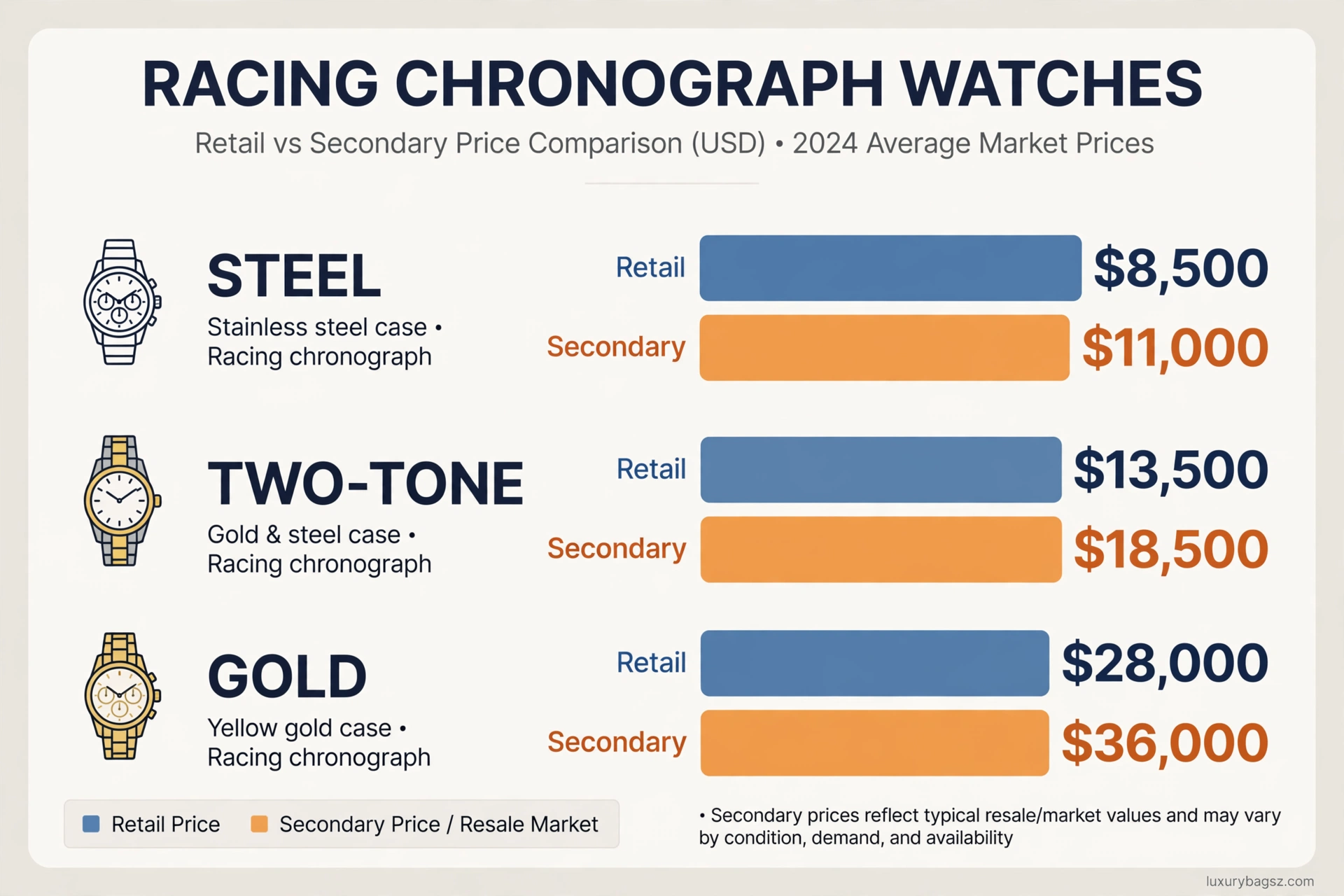
Sources disagree on exact secondary prices, so treat every figure as a range, not a promise. WatchGuys puts the 2026 retail of the steel 126500LN near $16,900, after a January 2026 rise of about 5.6 percent for steel models. Its secondary range is roughly $32,000 to $38,500.
The discontinued steel 116500LN trades roughly $30,000 to $36,000, while the pre-ceramic 116520 sits near $25,000 to $29,000. That gap shows how much buyers pay for the ceramic bezel and the current reference number.
Gold tells a calmer story. The yellow gold 126508 retails near $42,400 and trades near or below retail on the secondary market. The white gold Le Mans 126529LN retails near $51,400 and remains exceptionally hard to source at any price.
Wait times are long for steel. Some guides report five to eight years at authorised dealers, and many dealers will not add new names at all. Gold models usually wait one to three years, which partly explains their softer secondary prices.
Steel, Gold, or Platinum: Choosing the Metal
Steel is the default Daytona choice for most buyers. It is the most liquid, the most recognised, and the hardest to buy at retail. If you want one watch that other collectors instantly understand, steel is it.
Two-tone Rolesor suits buyers who want warmth without full gold prices. It reads dressier than steel and slightly less sporty. On the secondary market, Rolesor Daytonas often trade below their steel siblings, so they can be smart value buys.
Full gold suits buyers who wear gold jewellery or want a softer, richer presence. Yellow gold is classic, Everose is warmer and more modern, and white gold looks like steel until someone reads the price. That stealth quality is exactly why some collectors pick white gold.
Platinum is for collectors who want the top of the range and accept the weight and price. The ice-blue dial is unmistakable to those who know. For most first-time buyers, platinum is a later purchase, not a starting point.
Vintage Daytonas: Where Money Is Made and Lost
Vintage Daytonas reward patience and punish haste. Dial originality, case condition, and matching parts decide value far more than the reference number alone. A refinished dial or replaced bezel can cut value sharply.
Polishing history matters. Over-polished lugs lose their sharp edges and look soft under light. Collectors pay more for honest, unpolished cases with visible wear than for shiny, rounded ones. Ask who polished the watch, and when.
Box and papers help, but they do not prove originality by themselves. Papers can be mismatched, and boxes can be bought separately. Match the serial on the papers to the watch, and verify the dial against known examples for that reference.
Auction results mislead newcomers. A record price for a celebrity-owned watch says nothing about an ordinary example of the same reference. Price your target against recent sales of comparable condition, not headlines.
Pre-Owned Checks Before You Pay
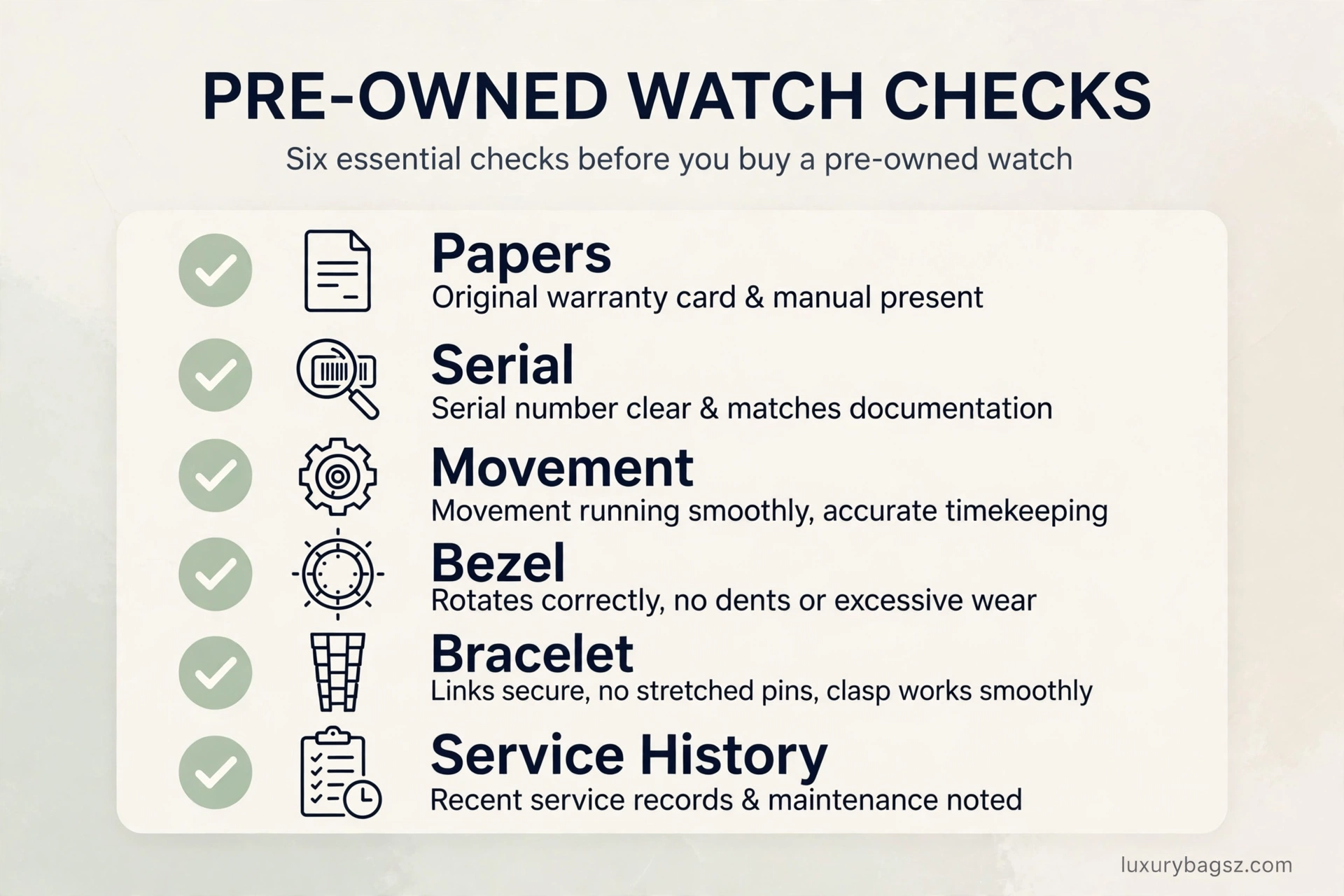
Start with the serial and reference numbers, and date the watch before trusting any listing claim. Our guide to a serial number check explains where to find the numbers and how to read them. Mismatched numbers are a walk-away signal.
Test the chronograph fully. Start, stop, and reset it several times, and watch each subdial return exactly to zero. A sticky pusher or a hand that misses zero needs service, and service on a chronograph costs real money.
Compare the watch against known fakes. Our guide to fake Rolex checks covers weight, printing, and movement tells. For Datejust-specific tells, see our fake Datejust checks, which share several Daytona lessons.
Insist on a full set when the price assumes one: box, papers, booklets, and spare links. A loose watch should cost less than a complete one. Buy from a dealer with a written return policy and independent authentication, not from a seller who rushes you.
Care, Service, and Running Costs
Clean the case and bracelet gently with a soft cloth and lukewarm water, and dry it fully. Our guide to how to clean a watch covers cases, crystals, and bracelets by material. Never use harsh chemicals or an ultrasonic cleaner on a vintage piece.
Service a modern Daytona roughly every ten years, or sooner if timing drifts or pushers feel wrong. A full Rolex service is a significant cost, so budget for it rather than treating it as a surprise. Keep service receipts with the papers.
Store the watch away from magnets, direct sun, and damp rooms. A watch winder helps only if you wear the watch often enough to need it ready. Otherwise, let it rest and wind it by hand when you pick it up.
Insure the watch at its replacement value, not its retail price. Steel Daytonas trade far above retail, so a retail-based policy leaves a large gap. Photograph the serial and keep the valuation current each year.
Who Should Buy Which Daytona
First-time buyers should target the steel 126500LN or the pre-ceramic 116520. The first is the modern icon, while the second offers the in-house movement at a lower secondary price. Both are easy to resell if your taste changes.
Collectors chasing history should study four-digit references before spending. Start with books and auction archives, and buy the best dial you can afford rather than the cheapest case. Condition beats rarity when rarity comes with damage.
Daily wearers who time little should be honest with themselves. A Daytona is heavier and busier than a Datejust or an Oyster Perpetual. If you never use the chronograph, the extra thickness buys you looks alone, which may still be enough.
Budget buyers should consider Rolesor or gold on Oysterflex. They offer the Daytona design at softer secondary prices. Just confirm you like the metal on your wrist, because resale will not rescue a colour you dislike.
Dial Variants Collectors Chase
Beyond Panda and reverse Panda, Daytona dials include champagne, gold, meteorite, and diamond-set versions. Each variant changes the watch's character and its buyer pool. A meteorite dial, for example, appeals to collectors who want a natural pattern no two watches share.
Exotic dials remain the most studied variant family. Collectors compare minute tracks, subdial fonts, and marker shapes against known originals. A single wrong font can separate an original dial from a refinished one, and refinished dials trade at a steep discount.
The Le Mans dial deserves its own note. The 2023 white gold Le Mans reference pairs a black ceramic bezel with a distinctive dial layout. Its scarcity makes it hard to price from listings alone, so recent auction results matter more than asking prices.
Gold dial variants on gold cases can look washed out in photos yet rich in person. Always judge gold-on-gold dials under natural light before deciding. Photos flatten gold tones and hide the depth that justifies the metal.
Off-catalogue pieces, such as rainbow-bezel Daytonas, sit outside the standard range. They appear through special orders and carry prices set by rarity rather than catalogue logic. Treat any off-catalogue claim as needing extra paperwork and expert verification.
Dial condition beats dial rarity for most buyers. A rare dial with water damage or heavy fading is a restoration project, not a trophy. A common dial in crisp, original condition is easier to wear, insure, and eventually resell.
When comparing dials, photograph the watch under the same light as your reference images. Different lighting changes how black, white, and champagne dials read. Consistent light keeps your comparison honest and prevents an expensive misread.
Finally, remember that dials get swapped. A correct dial in the wrong case still counts as a mismatch to collectors. Match dial, case reference, and production era together, and ask for service records that note any dial work.
A Week With a Daytona
Day one with a Daytona is about the chronograph novelty. You will time everything, from coffee brewing to commutes, and the pushers will feel satisfyingly firm. That novelty fades by day three, which is when the real test begins.
By midweek, weight and thickness become the story. The 40 mm case and ceramic bezel feel present on the wrist all day, especially under a tight cuff. Most wearers adapt quickly, but some find the watch competes with a shirt sleeve.
Legibility splits opinion over a week. The high-contrast Panda dial reads instantly, while darker dials need a steadier glance. If you check the time while driving or walking, dial contrast matters more than any specification sheet suggests.
The bracelet settles over several days as links find your wrist shape. A new Oyster bracelet can feel stiff at first, then moulds to daily movement. Give any new Daytona a full week before judging comfort, since first-day stiffness misleads.
Weekend wear reveals the Daytona's range. It suits a smart jacket on Saturday and a T-shirt on Sunday, without looking overdressed in either setting. Gold models lean dressier, while steel models cross both worlds most easily.
By week's end, ask one question: did you reach for the chronograph, or just admire the dial? Both answers are valid. A Daytona bought for looks is still a Daytona, but knowing your answer helps you choose the next watch wisely.
Buying Mistakes to Avoid
The first mistake is paying a steel premium for a watch you have not tried on. Steel Daytonas trade far above retail, so the financial commitment is large. A dealer visit costs nothing compared with reselling a watch that never fit your wrist.
The second mistake is trusting a single price source. Secondary prices vary by dial, condition, and region, and one listing is not a market. Compare several recent sales of the same reference and dial before making an offer.
The third mistake is ignoring service history on a chronograph. A Daytona that has never been serviced may run, yet its chronograph may drag or reset imperfectly. Service costs should sit inside your budget, not arrive as a shock after purchase.
The fourth mistake is buying vintage on a story rather than on paperwork. A seller's tale about a famous previous owner adds nothing without documents. Original dials, matching serials, and service records matter more than any anecdote.
The fifth mistake is choosing metal for resale rather than for wear. Steel holds value best, but a gold Daytona you love and wear beats a steel one you keep boxed. Resale only helps if you actually sell, and most owners keep their Daytona for years.
Daytona Servicing Explained
A modern Daytona service starts with a full movement check, including chronograph timing across all three counters. The watchmaker tests start, stop, and reset under magnification, since small errors hide in daily wear. Any drag or hesitation gets noted before the case opens.
The case and bracelet receive separate attention. Ultrasonic cleaning suits modern steel bracelets, while vintage cases need gentler hand cleaning. Polishing is optional and should be agreed in advance, since it removes metal and softens edges.
Gaskets are replaced at every full service, and the watch is pressure-tested afterwards. That test matters more than the service receipt alone, because a Daytona without fresh gaskets should not be trusted near water. Ask for the pressure-test result in writing.
Turnaround for a Rolex service typically runs several weeks, depending on the service centre's queue. Chronograph work takes longer than a simple time-and-date service, since the chronograph train adds parts and testing. Plan the wait around holidays or travel, not during them.
Costs vary by service centre and by what the watch needs. A routine service differs sharply from a service that replaces a worn chronograph wheel or a damaged bezel. Get an estimate before authorising work, and approve any extra parts separately.
Keep every service receipt with the original papers. A documented service history supports resale and proves the chronograph was maintained, not merely worn. Buyers pay more for a serviced Daytona with paperwork than for an unserviced one with a story.
After service, test the chronograph yourself before leaving the dealer. Start, stop, and reset it several times, and check that all hands return exactly to zero. Report any fault immediately, while the service warranty covers it.
Finally, note the service date inside your own records, not only on paper. A simple note of the date and the service centre helps future buyers and reminds you when the next service falls due. Good records are part of good ownership.
Daytona Collecting Strategy
A sensible Daytona collection starts with one modern steel model. It teaches you the size, the chronograph, and the market before you risk vintage money. Many collectors never move beyond that first steel watch, and that is a complete collection.
The second step, for those who continue, is usually a contrasting dial or metal. A white-dial steel Daytona pairs with a black-dial one, while a gold model adds warmth the steel pair lacks. Contrast beats duplication, since two similar Daytonas compete for the same wrist time.
Vintage collecting should wait until you can read dials confidently. Study auction catalogues, compare fonts and markers, and handle as many vintage examples as dealers allow. Knowledge bought slowly costs far less than a refinished dial bought quickly.
Set a budget rule before you start: no Daytona purchase without a verified serial, a return policy, and a service plan. That rule filters out most bad deals automatically. Sellers who resist any of the three are telling you something useful.
Track prices quarterly, not daily. Daytona prices move with fashion, currency, and dealer stock, and daily tracking breeds panic buying. Quarterly notes reveal real trends and keep your decisions calm and evidence-based.
Trade up rarely and deliberately. Selling two good Daytonas for one rarer one only works when the rarer watch is verified and complete. Rushed trades usually lose money on both sides of the deal, through dealer margins and haste.
Above all, collect Daytonas you enjoy wearing. A collection kept entirely in a safe is a portfolio, not a hobby. The Daytona was built for racing drivers' wrists, and it rewards owners who actually wear it.
Daytona Myths, Corrected
One myth says every vintage Daytona is a fortune. In truth, only original, well-preserved examples command large prices. Common references with replaced dials or heavy polishing trade far below headline figures, and some barely beat modern steel prices.
Another myth says steel always beats gold as an investment. Steel has traded above retail recently, but gold models offer value, wearability, and lower entry prices on the secondary market. Investment outcomes depend on the exact reference and timing, not on metal alone.
A third myth says the Daytona is hard to service anywhere. Rolex service centres handle Daytonas routinely, and independent specialists exist for vintage models. Service costs real money, but availability is not the problem; budgeting for it is.
A fourth myth says ceramic bezels never scratch. Ceramic resists scratches far better than metal, yet it can chip on a hard impact. A chipped ceramic bezel needs replacement, not polishing, so treat it as tough but not indestructible.
A fifth myth says waitlists are the only way to buy steel. Pre-owned dealers offer immediate availability at a premium, and that premium is simply the price of skipping the wait. Neither route is morally better; they are different prices for different patience levels.
A sixth myth says Paul Newman dials are common because so many listings claim them. Genuine exotic dials are scarce and strictly defined by reference, movement, and dial details. Most listings using the name loosely fail at least one of those tests.
A seventh myth says a Daytona makes you a racing fan by association. It does not, and it need not. Many owners love the design without following motorsport, and that is fine. The watch works as design, as tool, and as collection piece alike.
An eighth myth says newer is always better. The 126 generation improves on the 116 in details, but many collectors prefer the earlier watch's proportions or dial. Newer suits buyers who want the latest movement; it does not invalidate earlier generations.
Daytona Ownership Checklist
Before paying, run through a short ownership checklist. Confirm the reference, dial, and serial match the papers. Test the chronograph, check the bezel, and inspect the bracelet for stretch. Each check takes minutes and prevents months of regret.
After buying, photograph the watch, the serial, and the papers, and store copies separately from the originals. That record helps with insurance claims and future resale. Update the photos after any service that changes parts.
Set a service reminder for ten years, or sooner if timing drifts. Note the date in your calendar now, while the purchase is fresh. A reminder costs nothing and protects a movement that costs far more to repair neglected.
Review your insurance annually against current secondary prices. Steel Daytonas move with the market, and a valuation from purchase day soon lags reality. An annual update keeps your cover matched to replacement cost.
Wear the watch regularly, but rotate it with rest days. Daily wear keeps the movement running, while rest prevents bracelet wear from becoming the only story. Balance is the simplest care routine there is.
Clean the watch gently after wearing it in heat or dust. A soft cloth and lukewarm water remove most grime without chemicals. Dry it fully before storage, since trapped moisture dulls finishes over time.
Keep the box, papers, and spare links together in one safe place. A complete set sells for more and reassures buyers, while scattered papers invite doubt. Completeness is a habit, not a last-minute search.
Finally, enjoy the Daytona for what it is: a racing tool turned design icon. Time a lap, a run, or a coffee brew, and remember why the tachymeter bezel exists. A watch used well is a watch owned well.
Frequently Asked Questions
When was the Rolex Daytona introduced?
In 1963, as ref. 6239, first called the Le Mans and renamed the Daytona in 1965. It was Rolex's racing chronograph, with a tachymeter bezel for measuring average speed.
What makes a Daytona a Paul Newman Daytona?
The case must be ref. 6239, 6241, 6262, 6263, 6264 or 6265, with a plexiglass crystal, a Valjoux 722 or 727 movement, and an original exotic dial with block markers and crosshairs subdials.
What is the current steel Daytona reference?
Ref. 126500LN, launched in 2023. It is 40 mm, runs calibre 4131, and has a black ceramic bezel, with black or white dial options.
How much does a steel Daytona cost in 2026?
Retail is around $16,900, while secondary prices run roughly $32,000 to $38,500 depending on dial and condition. Figures vary by source, so treat them as ranges.
What is the difference between the 116500LN and the 126500LN?
The 116500LN is the previous ceramic-bezel steel Daytona on calibre 4130. The 126500LN is the current model on calibre 4131, with revised case and dial details.
Is the Daytona a good investment?
Steel Daytonas have traded above retail for years, but past premiums do not guarantee future ones. Condition, dial, and completeness matter more than the reference name alone.
How long is the Daytona waitlist?
Guides report roughly five to eight years for steel at many authorised dealers, with some dealers closed to new names. Gold models usually wait far less time.
Can you swim with a Daytona?
Modern models are rated to 100 metres, but do not press the chronograph pushers underwater. Have gaskets checked at service before relying on the rating.
What should I check before buying a pre-owned Daytona?
Serial and reference numbers, papers matching the watch, chronograph reset to zero, polishing history, and a dealer return policy. Walk away from mismatched numbers.
Should I buy a vintage or modern Daytona first?
Modern first, for most buyers. Vintage Daytonas demand dial expertise and carry higher risk, while a modern steel or pre-ceramic model is easier to verify and resell.
Final Verdict
The Daytona earns its fame honestly: a racing tool that became a design icon without losing its job. Steel is the classic buy, gold is the value play, and vintage is the expert's game. Choose by wrist, budget, and patience, not by headlines.
Verify the reference, test the chronograph, and buy the seller as much as the watch. A Daytona bought carefully is a watch for decades. One bought in haste is an expensive lesson in dial detail.
Keep this guide beside you when you shop, and check each claim against the watch in front of you rather than against a listing photo. The right Daytona feels inevitable once it is on your wrist: the size fits, the dial reads clearly, and the chronograph resets exactly to zero.
Wait for that watch, even if the wait is long, because the wrong Daytona at any price is still the wrong watch. Patience is the cheapest upgrade in Daytona collecting, and it costs nothing to practise.






