

Luxury Heritage Shoe Brands: The Houses Built on Craft
Heritage, Defined: Time, Craft and Repairs That Last
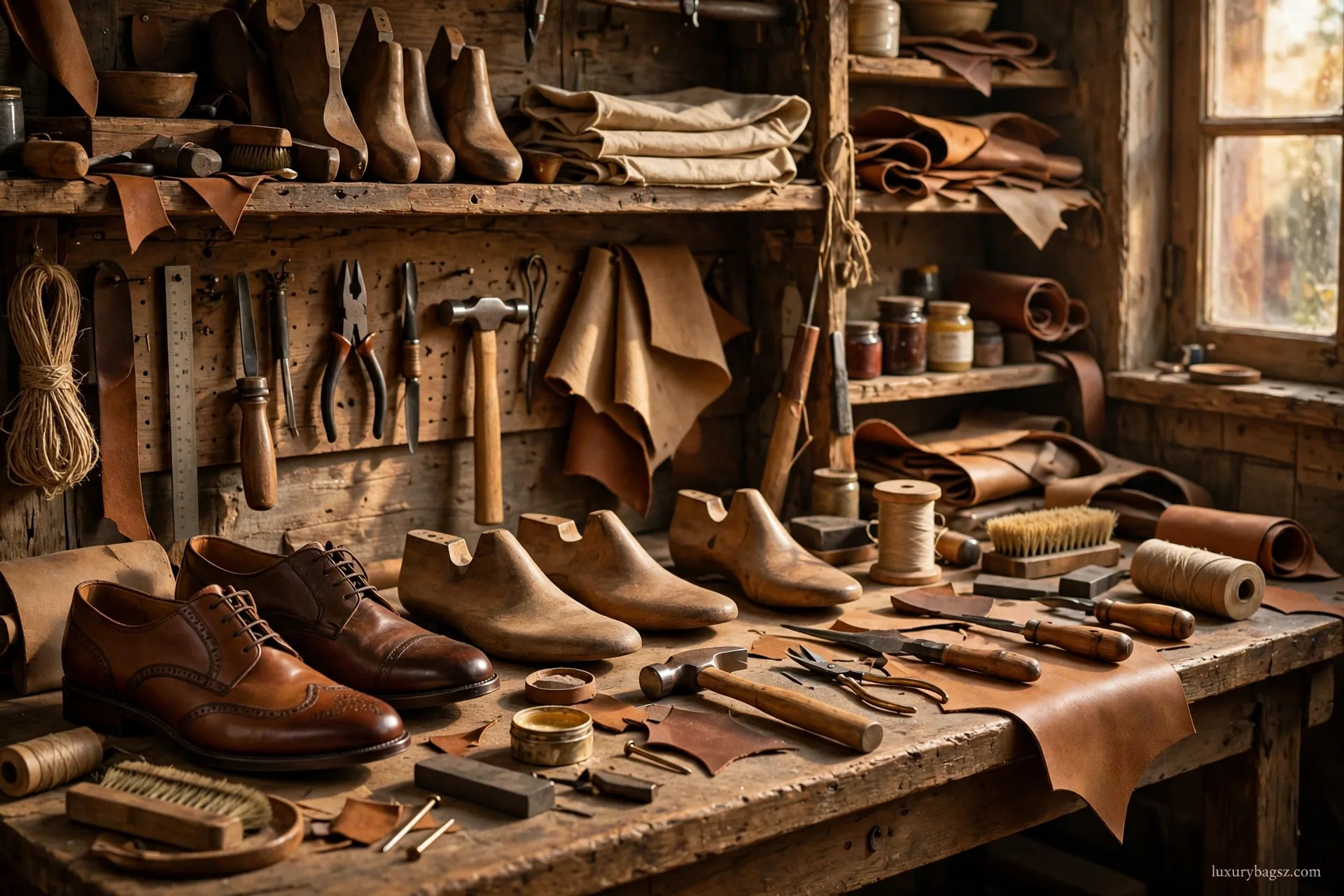
A luxury heritage shoe brand is one whose reputation rests on decades of making shoes the slow way: bench-made construction, repairable soles, first-grade leathers and patterns refined over generations. Heritage is not a logo or a founding date on a label; it shows in stitching you can inspect and repairs the house will still carry out in twenty years.
Buy heritage for fit, longevity and repairability. The premium is justified when construction is genuinely better, and wasted when it is only a story, so this guide focuses on the checks that separate the two.
Key Takeaways
- Heritage means bench-made craft, repairable builds and patterns refined over decades.
- Stitched soles and full-grain leather are the visible proof behind the story.
- Bespoke and made-to-order sit at the top; ready-to-wear heritage still beats fashion builds.
- These shoes reward care: trees, rest days and timely resoling give decade-long service.
- Buy the classic styles each tradition does best, not seasonal experiments.
- Pre-owned heritage shoes are strong buys because they were built to be repaired.
What Heritage Actually Signals
Heritage signals continuity: the same lasts, patterns and standards carried across generations of makers. A house that has fitted the same style for fifty years has solved its comfort problems long ago.
It also signals service. Heritage makers expect their shoes back for resoling and refurbishment, and design them to survive it. That expectation shapes every construction choice.
Finally, it signals restraint. Classic colours, conservative shapes and slow change are features here, not a lack of imagination, because the shoes are bought to be worn for decades.
Bench-Made, Made-to-Order and Bespoke
Ready-to-wear heritage shoes are made on standard lasts in set sizes, but with bench methods: hand-lasting, stitched welts and hand finishing that machines alone do not match.
Made-to-order lets you choose leather, colour and details on a standard last. Bespoke goes further, building a personal last from your measurements; our explainer on why buy bespoke shoes sets out when that step is worth its price.
The craft pipeline behind all three is guarded by long apprenticeships, as our look at how to become a bootmaker shows for the bootmaking branch of the trade.
The Styles Heritage Does Best
Loafers, lace-ups, classic pumps and riding boots are the heritage stronghold: styles where fit, leather and construction decide everything and trends decide nothing.
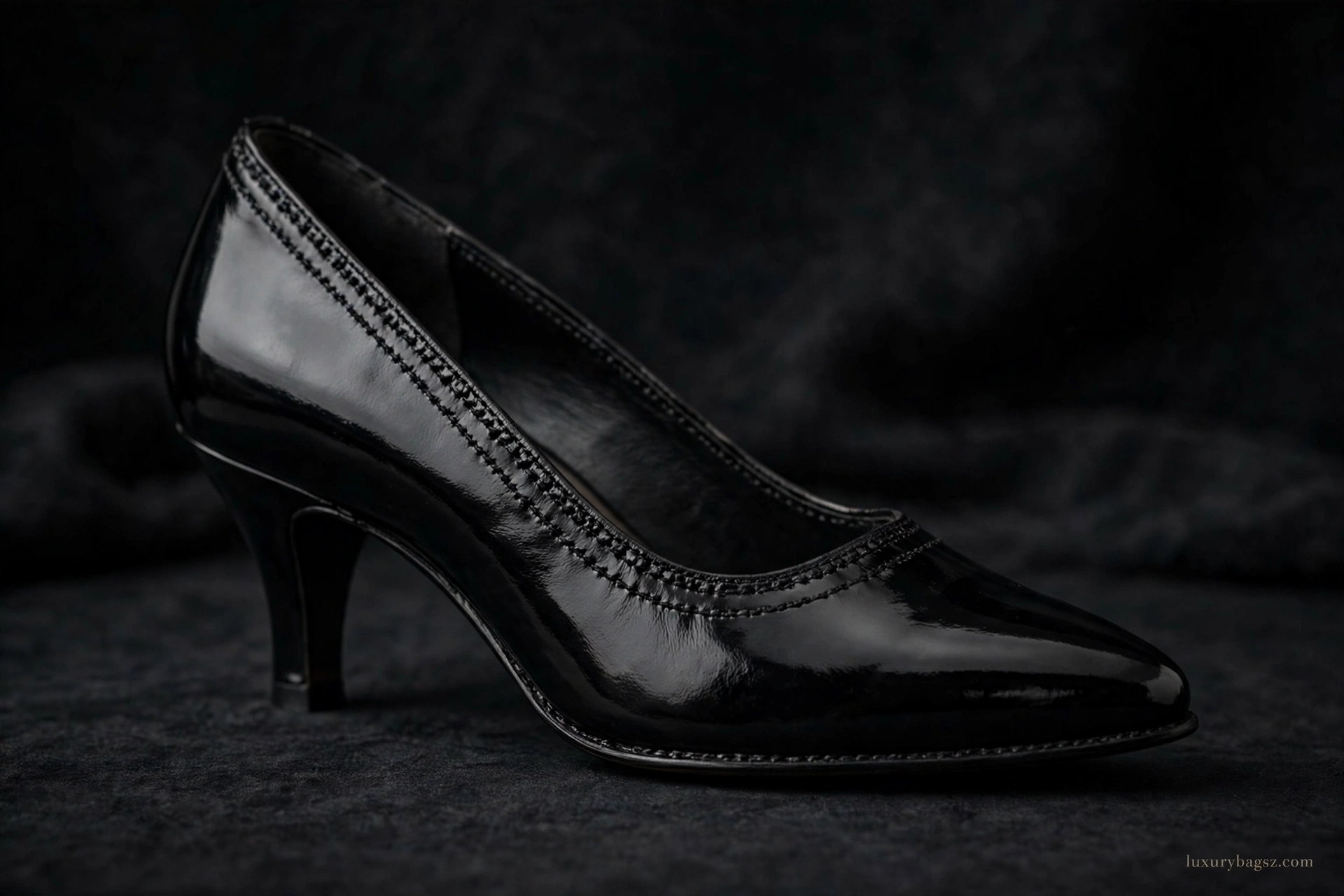
Women's heritage ranges lean on these foundations, adding heeled versions of classic shapes rather than chasing seasonal silhouettes. A black patent pump from a heritage maker is a different object from its fashion equivalent: heavier, quieter, built to be resoled.
Boots deserve special mention. Heritage bootmaking, with stitched soles and shaped shafts, produces the pairs most likely to reach a tenth winter in good order.
Heritage Houses and Fashion Icons
Heritage and fashion fame overlap but are not the same thing. Some houses in our roundup of iconic designer women's shoes earned their status through craft traditions; others through a single brilliant silhouette.
The practical difference is what you are paying for. Heritage money buys construction and service life; icon money buys design recognition. The strongest wardrobes usually hold both kinds.
Neither is the wiser purchase in the abstract. A bench-made loafer worn for a decade and a famous pump worn for a hundred evenings can both be money well spent.
Fit: The Heritage Advantage
Heritage houses typically offer more width fittings and half sizes than fashion brands, because their customers buy for fit first. A personal fitting, in store where possible, is part of the product.
Expect new bench-made shoes to feel firm. Quality leather on a shaped last moulds over the first wears, and a fit that starts snug-but-kind usually ends perfect.
If you are between fittings, choose the one that holds the heel without crushing the toes. Length can rarely be fixed later; width in good leather gives a little.
The Checks That Prove the Craft
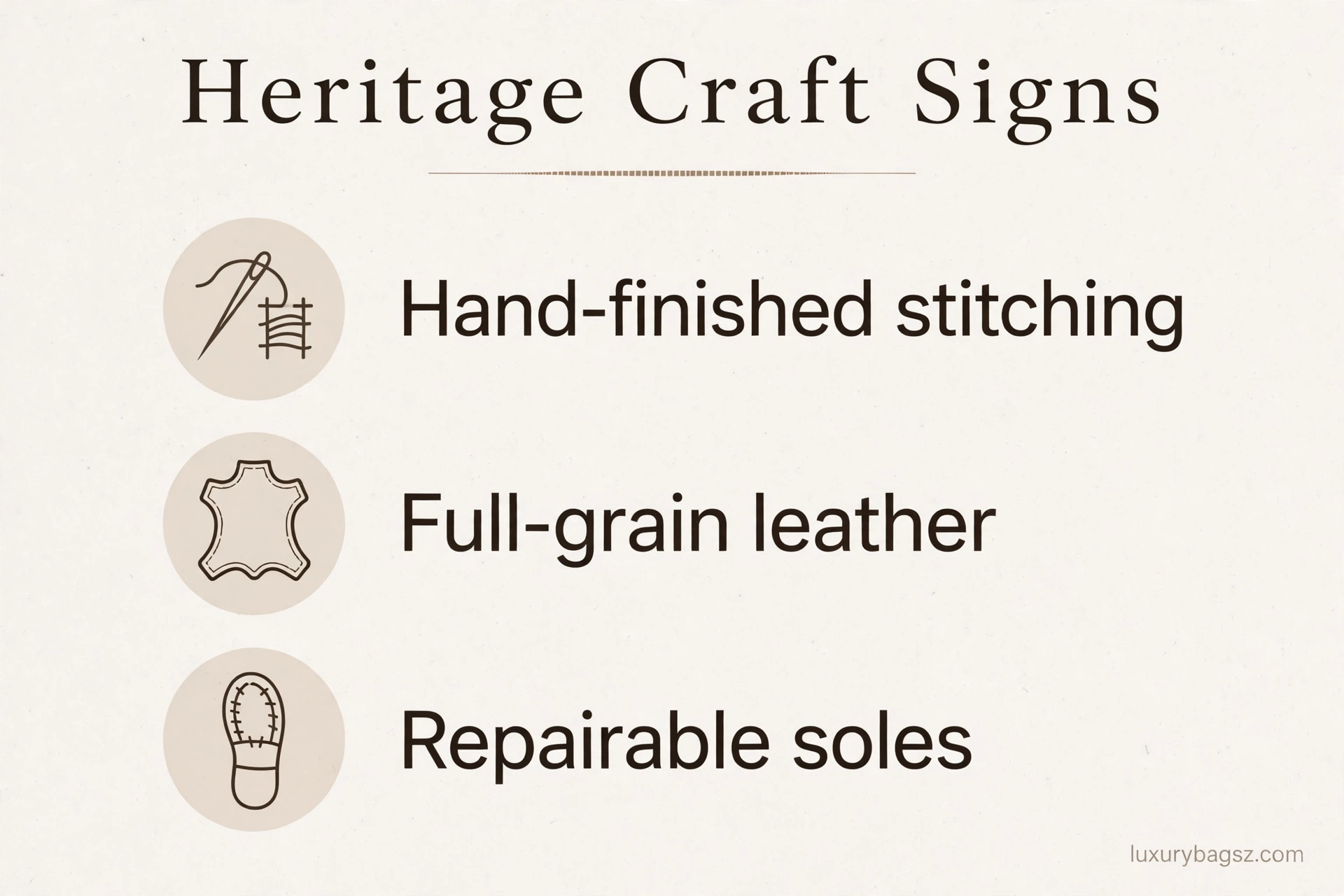
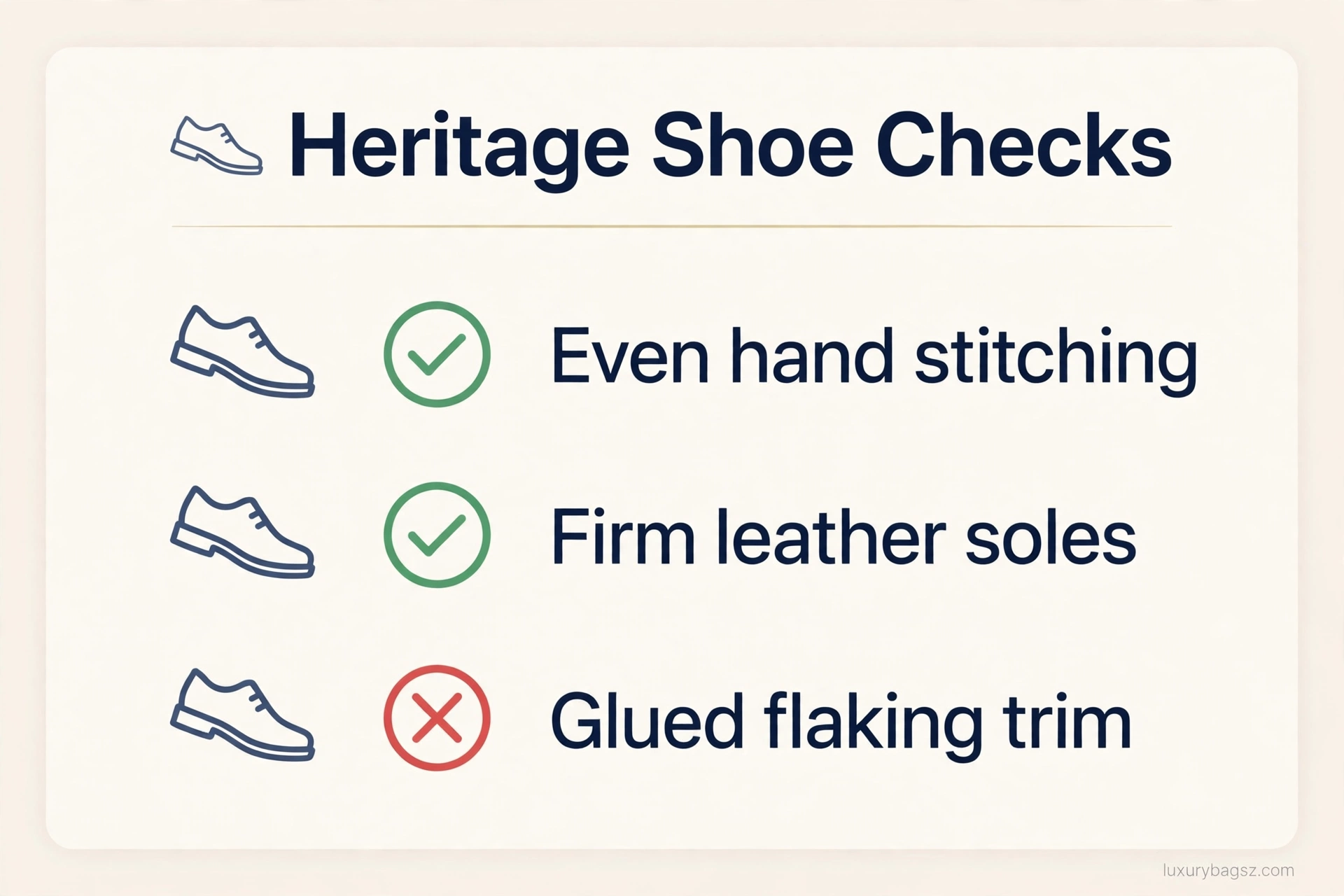
Run these before paying the premium: even, dense stitching; a stitched rather than glued sole; full-grain leather with a natural, uncoated feel; and a lining in leather, not fabric or plastic.
Ask directly about resoling and refurbishment services. A house that offers them, with prices, is telling you the shoes were built for it; our guide on how boots are made shows the construction details to look for.
Weight is a rough clue too. Bench-made shoes feel substantial in the hand, because leather, cork and stitching weigh more than foam and glue.
Care That Returns the Investment
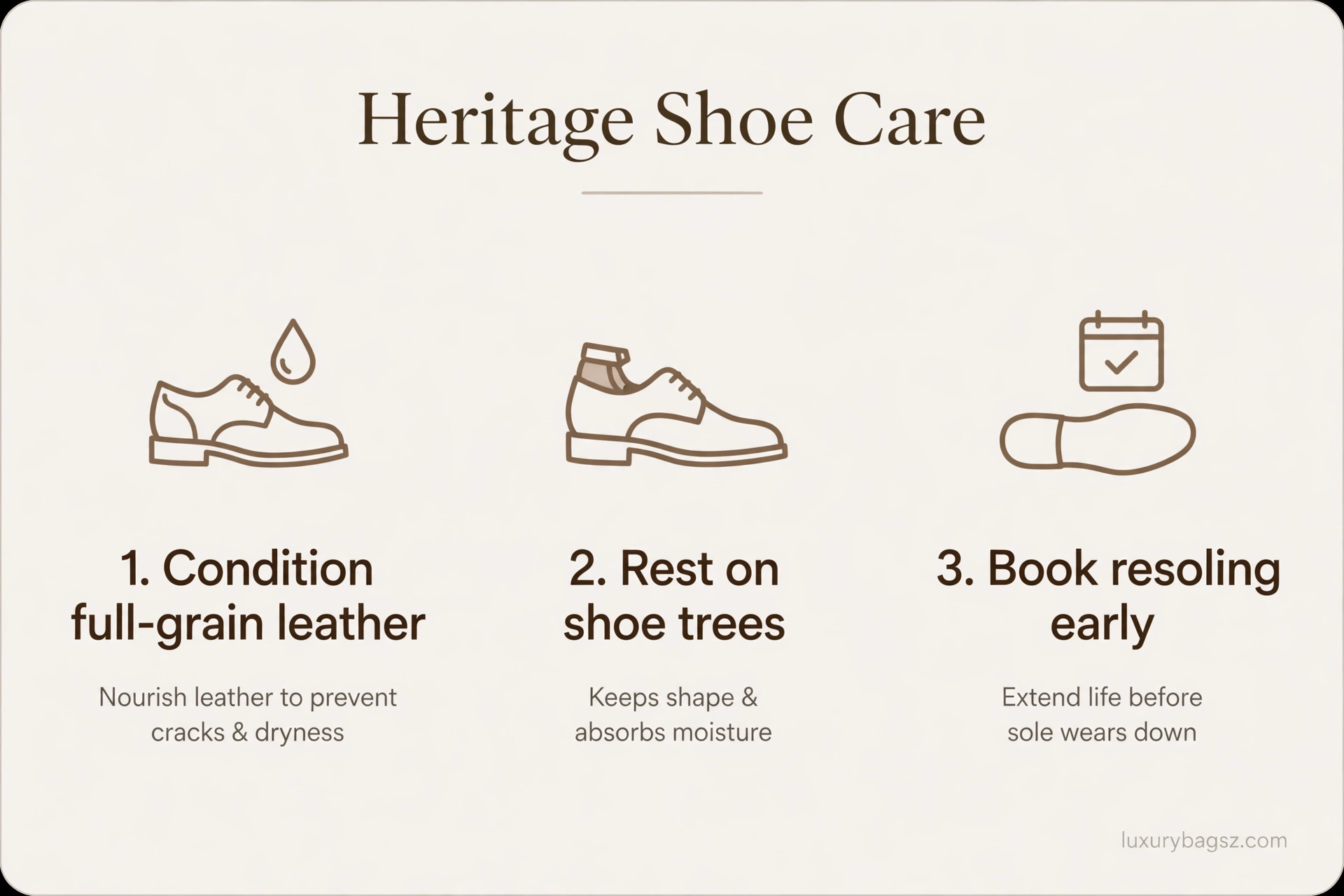
Heritage shoes repay simple habits: cedar trees after every wear, a rest day between wears, and conditioning a few times a season. Our guide on how to build a shoe care kit lists the short kit that covers it all.
Resole before the sole wears through, and use the maker's own refurbishment where offered. Factory services restore shape and structure as well as soles.
Store them boxed or on trees, away from heat and light. Looked after this way, a twenty-year service life is a realistic expectation, not a slogan.
Prices and Buying Routes
Ready-to-wear heritage shoes typically run from around $600 to $1,500 depending on style and leather. Made-to-order adds a premium, and full bespoke commonly starts in the low thousands and rises with fittings and materials.
Pre-owned is the connoisseur's route in: because the shoes were built to be repaired, a used pair with sound uppers can be refurbished into years of further service.
Newer houses can join this tradition too when the craft is real; the profile in our aquazzura footwear story shows a modern label building its name on Italian making rather than marketing alone.
The Map of Heritage: Northampton, Paris and Italy
Heritage has addresses. Northamptonshire in England is the bench-made heartland, where firms such as Church’s, Tricker’s, Grenson and Crockett & Jones have made Goodyear-welted shoes for well over a century, and where the county’s name on a sole still functions as a quality shorthand buyers trust.
London adds the bespoke summit: John Lobb’s St James’s workshop has fitted clients one pair at a time since the nineteenth century and holds royal warrants to show for it. Paris carries its own branch of that story, alongside Berluti, whose patina-finished leathers turned shoe polishing into a house art.
Italy speaks in two dialects: the Marche region’s bench-made factories, where houses in the Santoni tradition hand-finish factory shoes to near-bespoke standards, and the fashion-heritage names such as Ferragamo and Tod’s, where invention, the wedge heel, the driving shoe, became heritage of a different kind.
The traditions differ in temperament: English shoes are built like furniture, French like sculpture, Italian like tailoring. Choosing between them is taste; the construction standards that unite them are the checks this guide has already given you.
Construction Words, Translated for Buyers
Heritage listings speak a dialect, and three terms decide most of the value. Goodyear welting stitches a strip of leather, the welt, between upper and sole, so the sole can be unstitched and replaced without disturbing the upper. It is the construction behind the repairability this guide keeps praising.
Blake stitching passes a single seam through insole, upper and sole: slimmer, more flexible, less water-resistant and still resoleable by a cobbler with the right machine. Much fine Italian work is Blake-built, so treat it as a different virtue rather than a lesser one.
Cemented construction glues the sole on. It is light and cheap, dominates fashion footwear, and ends the shoe’s repairable life, because a glued sole cannot be cleanly replaced. The word a heritage listing never uses about its best shoes is cemented, and a listing that will not say how its soles attach has answered the question.
Hand-welted goes one step beyond Goodyear, with the welt sewn by hand rather than machine, found in bespoke and the highest bench-made work. You now own the vocabulary; the checks in this guide do the rest.
The Casual Turn: Heritage Makers and Modern Life
Heritage houses no longer sell only lace-ups and loafers. Most now offer trainers, Chelsea boots in soft suedes and hybrid styles, applying bench-made standards to the shoes people actually wear daily. Judged by this guide’s rules, the good ones keep stitched or properly constructed soles and full-grain uppers; the cynical ones rent the name to ordinary glued trainers.
Women’s heritage has widened the same way: riding and Chelsea boots, loafers and Mary Janes from the old makers now anchor wardrobes that mix them with everything from tailoring to dresses. Our boots every woman needs guide shows how those classic shapes carry a modern rotation.
The opportunity for buyers is real. A heritage-made casual shoe, repaired once and worn for years, undercuts the cost per wear of replacing fashion trainers annually, and ages with more grace. The trap is assuming the crest guarantees the construction; check each line as if the name were unknown.
Heritage, in the end, is not a museum category. It is a standard of making that any style can meet, and the houses that survive another century will be the ones that keep meeting it in the shoes people currently live in.
Factory Refurbishment: The Service That Proves the Point
The surest evidence that a house means its heritage claims is a published refurbishment service, and most true heritage makers run one. A factory resole or full refurbishment typically strips the shoe to its upper, replaces soles and heels, renews cork bedding where fitted, refinishes the leather and returns the pair in weeks, at a fraction of replacement cost.
Send shoes back before the damage is structural: a sole worn through to the welt, or uppers cracked from neglect, can move a pair beyond what refurbishment can save. The makers’ own rule of thumb is to resole when the sole feels thin and spongy at the ball of the foot, not after it holes.
Keep the paperwork. A pair with a documented factory refurbishment carries that record into its resale value, because the next buyer is purchasing verified remaining life rather than hoping for it.
Independent cobblers extend the same logic to houses without local services, and a good one will tell you honestly when a shoe is cemented, worn out or otherwise beyond economic repair. That honesty, available for heritage construction and pointless for glued fashion shoes, is the whole argument of this guide expressed as a single conversation.
Frequently Asked Questions
What makes a shoe brand a heritage brand?
A long record of bench-made production, repairable construction, first-grade materials and patterns refined over decades, backed by services such as resoling and refurbishment.
Are heritage shoes worth the higher price?
When the construction is genuine, yes: better fit options, decade-long service and low cost per wear. If the premium buys only a story and glued soles, it is not worth it.
What is the difference between bespoke and made-to-order?
Made-to-order customises a standard last and pattern. Bespoke builds a personal last from your measurements and fits the shoe to your feet alone, at a much higher price.
How long do heritage shoes last?
With rotation, trees and timely resoling, ten to twenty years is realistic for quality leather styles. The uppers, not the soles, set the final limit.
Can heritage shoes be resoled?
Yes; that is the point of stitched construction. Most heritage houses offer resoling or full refurbishment, and good independent cobblers can service them too.
Do heritage brands make women's shoes?
Yes. Women's ranges from heritage makers focus on classic pumps, loafers, flats and boots, with more width fittings than typical fashion brands offer.
How should new bench-made shoes feel?
Firm and close, without pain. Good leather moulds over early wears, so a snug start is normal; crushing toes or a slipping heel means the fitting is wrong.
Are pre-owned heritage shoes a good buy?
Often excellent, because they were built to be repaired. Check upper leather for cracks, then budget for the maker's refurbishment to reset soles and shape.
What leather is best for longevity?
Full-grain leather, which keeps its natural surface and ages by polishing rather than peeling. Avoid heavily coated finishes if decades of wear are the goal.
How do I start with heritage shoes?
Begin with one classic in black or dark brown, a loafer, pump or boot you will wear weekly. Get properly fitted, buy trees with them, and let cost per wear make the case.
Final Verdict: Buy the Making, Not the Myth
Heritage is worth paying for when you can see it and service it: stitched soles, honest leather, fittings that respect your feet, and a house that will resole its own work. Buy that, care for it simply, and the shoes will outlast every trend in the wardrobe around them.






