How to Spot a Legitimate Designer Bag Reseller
How to Spot a Legitimate Designer Bag Reseller
What Makes a Reseller Legitimate?
A legitimate designer bag reseller can prove who they are, show you the exact bag in their hands, and put a clear authenticity remedy in writing before you pay. If any one of those tests fails, you are buying a promise, not protection.
Legitimacy is a chain you can check: real business identity, trading history, independent reviews, photos of the actual bag, and a guarantee that pays you back if authentication fails.
Use the same checks, in the same order, for every seller type. Let the result decide whether you proceed, test small, or walk away.
Key Takeaways
- Reseller type decides who holds the bag, sets the price, authenticates it and loses money if it is fake.
- Verify in order: business identity, trading age, review patterns, scam searches, then a dated custom photo.
- Only a lifetime money-back guarantee protects you after the return window closes.
- A certificate with no refund remedy is paperwork, not protection.
- Failed early checks mean walk away. Failed late checks mean pause, not pay.
- Never judge by followers, badges, a physical shop or one glowing review alone.
The Reseller Types, Mapped Properly
Most safety advice compares only websites, boutiques and marketplaces. That misses most of the market. A personal shopper, a pawn shop and an auction house handle your money, and your risk, very differently.
Work out the type first, and see our wider guide to where to buy designer fashion for how these routes compare on price and choice.
| Type | Holds bag | Sets price | Authenticates | If fake, loss on |
|---|---|---|---|---|
| Consignment platform | Platform | Seller, platform rules | Platform team | Platform, under guarantee |
| Buy-out dealer | Dealer | Dealer | Dealer / third party | Dealer, under contract |
| Specialist vintage dealer | Dealer | Dealer | Dealer, brand expertise | Dealer, if written |
| Personal shopper | Shopper / source shop | Source shop, plus fee | Source shop | Often you |
| Instagram / WhatsApp dealer | Dealer | Dealer | Dealer, often unverified | Usually you |
| Auction house | House | Bidders, from reserve | House specialists | Often you, under terms |
| Pawn / buy-sell shop | Shop | Shop | Staff, varies widely | Shop, under consumer law |
| Peer marketplace | Private seller | Private seller | Platform, only if bought | You, if paid outside |
Consignment Platforms and Buy-Out Dealers
A consignment platform sells for the owner, takes commission, and should inspect and photograph every bag itself. A buy-out dealer owns the stock, so their own money is at stake, which can mean stricter buying checks.
For both, ask who authenticated the bag and whether the platform or dealer, not the owner, refunds you for a fake.
Specialist Vintage Dealers and Personal Shoppers
A good vintage specialist is narrow by design: one or two houses, deep knowledge of stamps, hardware and era details. Test that depth with era-specific questions.
A personal shopper sources to order and may never authenticate anything. Your protection is the source shop receipt. If no receipt will be shared, treat the bag as unauthenticated.
Social Dealers, Auctions, Pawn Shops and Peer Sellers
Social dealers can be legitimate small businesses, but borrowed photos, deleted posts and payment by transfer make fakes easy to hide. The dated custom photo check matters most here.
Auction houses add time pressure and conditions that limit authenticity claims. Pawn shop expertise varies from expert to none. Peer marketplace authentication helps only if you stay inside the platform.
The Legitimacy Check, Step by Step
Run these five steps in order. Early steps are cheap and fast, and filter out most bad sellers before you spend time on photos or price. Do not skip ahead because a bag is rare.

Step 1: Registered Business Identity and Address
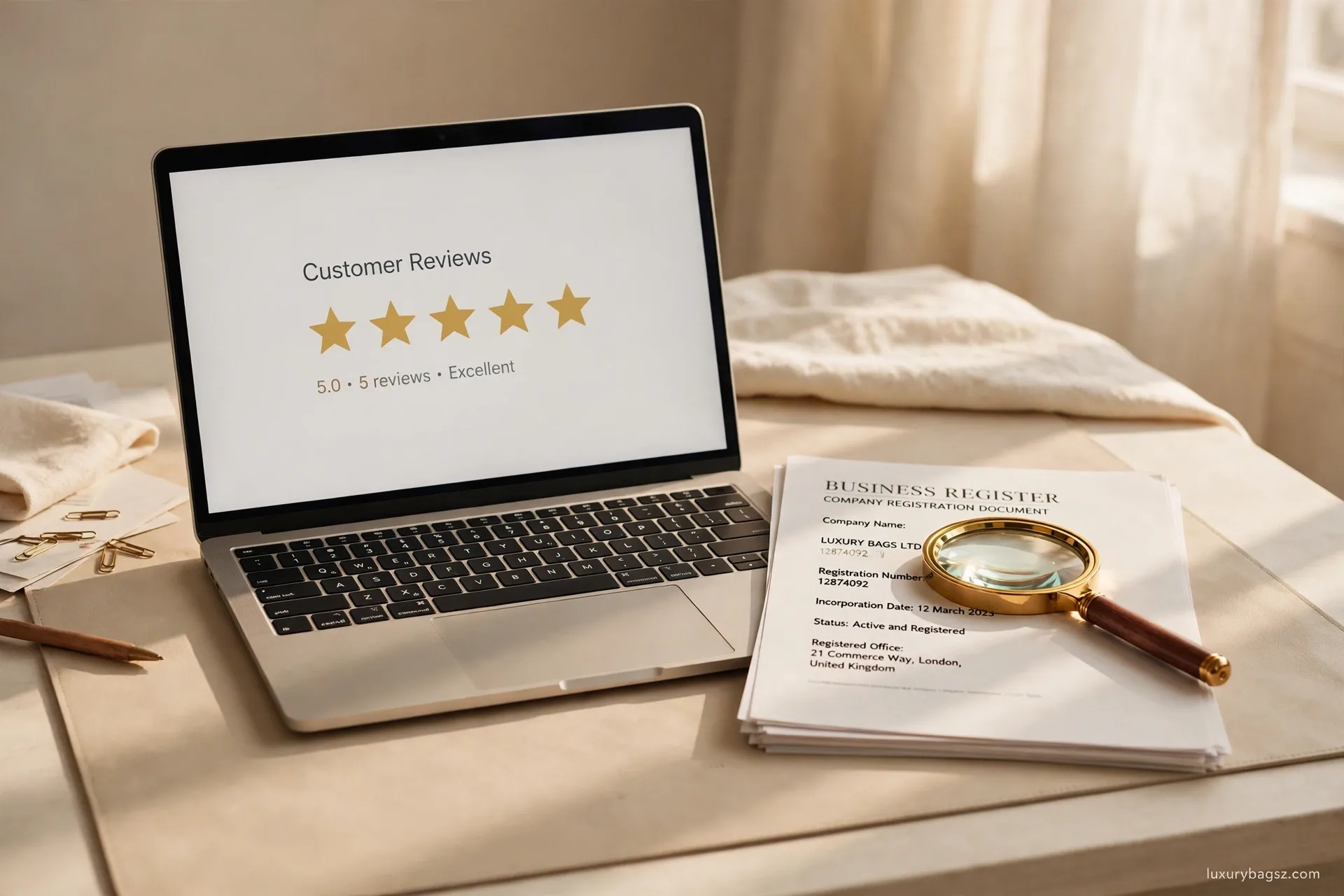
Find the legal business name, registration number and real trading address. Check them on the official company register, not just the website footer. They should match across register, website and invoice.
For a sole trader, ask for the trading name and address they operate under. A seller who will not say who they legally are has failed at the first hurdle.
Step 2: Account and Domain Age
Check how long the domain and selling account have existed. A domain registered last month, or a recently renamed handle, needs an explanation. Newness does not prove dishonesty, but it raises the burden of proof.
Step 3: Independent Reviews, Read for Patterns
Read reviews on a site the seller does not control. Ignore the star average and read the words, especially low scores. Look for patterns: repeated condition complaints, refunds refused, or bags questioned by other authenticators.
One angry review can be unfair. The same complaint from different buyers in different months is evidence. Note the replies too: a calm, specific fix is a good sign.
Step 4: Search the Name With Scam, Fraud and Counterfeit
Search the business name, owner name and handle, each time adding scam, fraud and counterfeit in turn. Search the phone number and email too, on forums and social platforms as well as a search engine.
Read findings properly. Dates, models, screenshots and outcomes matter. A resolved complaint with a refund shown can clear a seller. An unanswered counterfeit claim cannot be ignored.
Step 5: Ask for a Custom Photo With a Dated Note
Ask for the date code or heat stamp beside a handwritten note with today’s date and your name, plus one unposted angle, such as the zip pull. This defeats stock photos and photos stolen from another listing.
A seller holding the bag can do this in minutes. Warehouse excuses suggest they may not hold it at all, and our notes on how to authenticate a pre-owned bag show which details those photos must reveal.
Guarantee Wording, Decoded
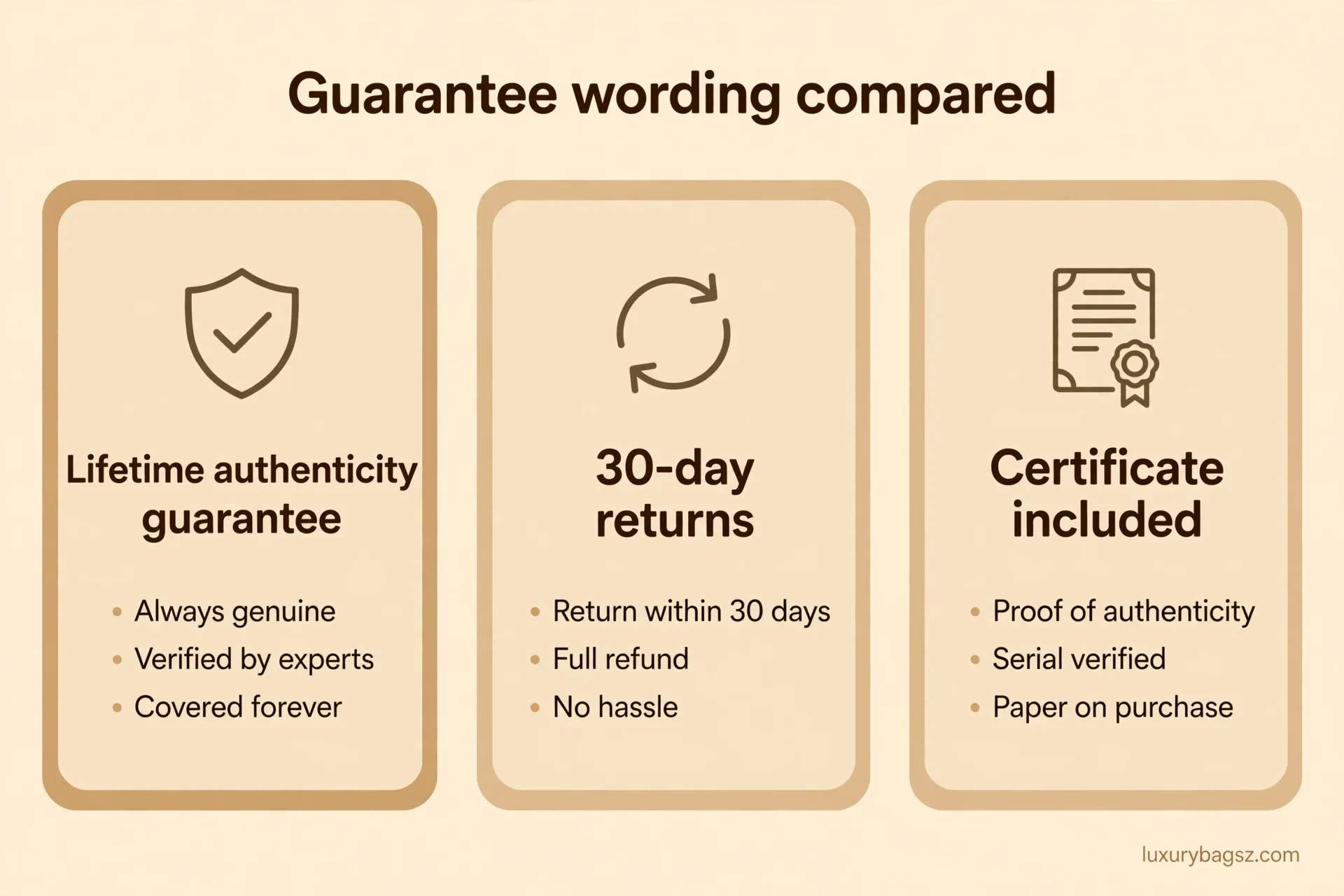
Guarantee is the word sellers lean on hardest and define least. Three forms dominate, and they are not worth the same. Read the exact wording, not the badge.
Lifetime Money-Back Authenticity Guarantee
This is the strongest form: if the bag is ever shown to be fake, you get a full refund. It survives the return window, which matters because many fakes are spotted months later, at repair or resale.
Check the proof it accepts. Fair terms accept a recognised independent authenticator or the brand. Weak terms let the seller alone decide, with no appeal: the seller marking their own homework.
Time-Limited Returns Only
A 14- or 30-day return policy is a condition remedy, not an authenticity guarantee. Once it expires, a fake is your problem unless consumer law helps. Short windows also force you to authenticate quickly, at your cost.
If this is all that is offered, confirm in writing that a fake verdict means a full refund including postage, not store credit, and book authentication for the day the bag arrives.
A Certificate With No Remedy
Some sellers offer a certificate and nothing else. Ask: if another expert says this bag is fake, what do I get back? If the answer is nothing, the certificate is decoration, an opinion with no outcome attached.
Keep the certificate with the invoice as a record of what was claimed. Never let it replace a refund promise, or pay a premium for one from an unnamed issuer.
Exact Questions to Get Answered in Writing
Send these before you pay, by email or platform message, so the answers stay on record. Evasion on any one is itself an answer.
- If an independent authenticator says the bag is fake, do I get a full cash refund, with no time limit?
- Who authenticated this bag, and what proof will I receive with it?
- Who pays return postage for a fake, and how long does the refund take?
- Does the guarantee cover the full price, including fees, taxes and delivery?
- Is the bag in your possession now, and do the photos show this exact bag?
- What is your legal business name and address for the invoice?
When a Check Fails: Stop, Test Small or Walk Away
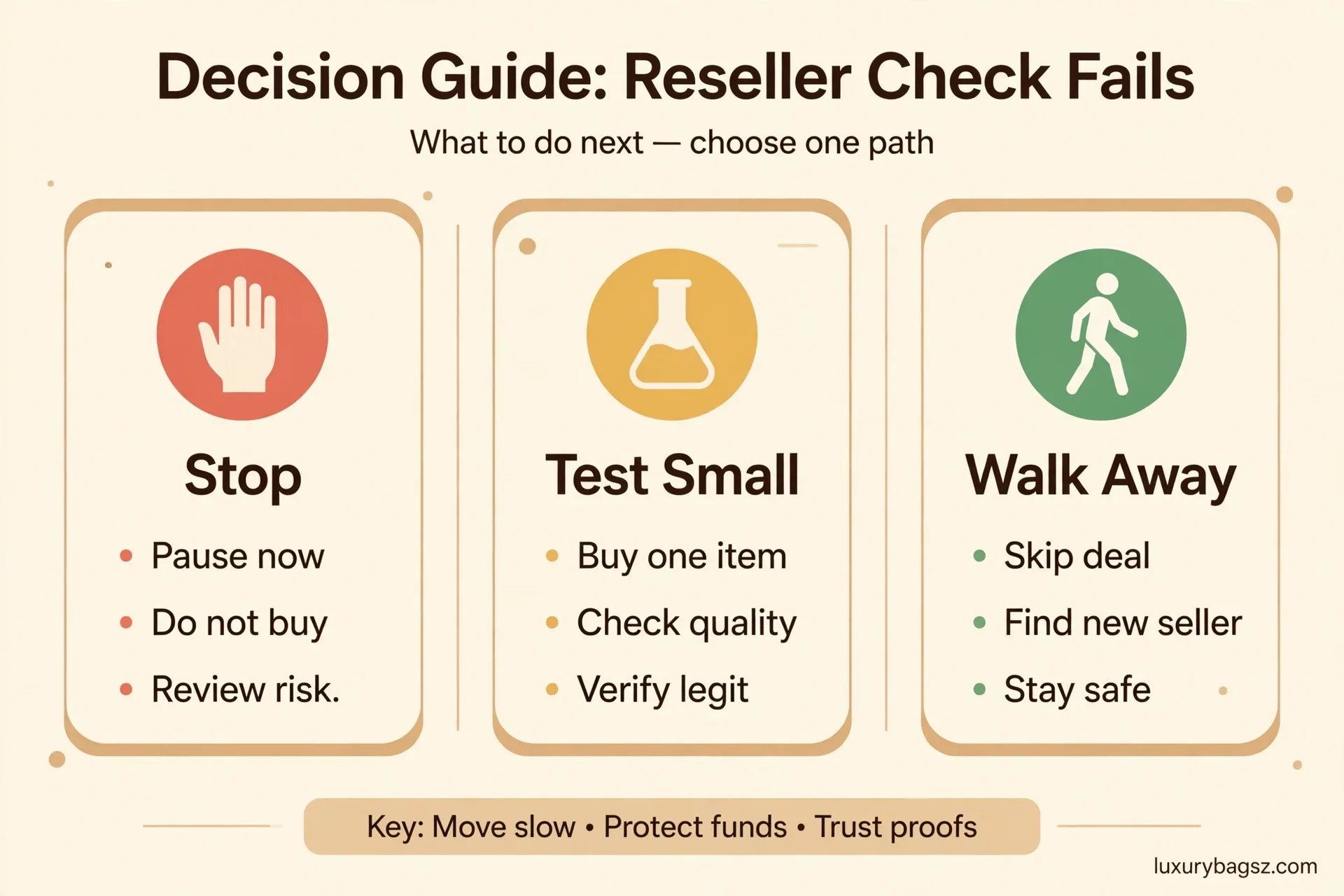
Match your response to the stage. Early identity failures are fatal, because everything later rests on knowing who holds your money. Later failures may be fixable, but only by the seller.
- No verifiable identity or address: walk away. There is no one to claim from.
- Very new account, but identity passes: test small first, or wait.
- Review patterns show refund or condition problems: walk away for high-value bags.
- Unresolved counterfeit claims: walk away unless disproved with documents.
- Dated photo refused or repeatedly delayed: stop. Do not pay for an unseen bag.
- Guarantee answers vague or verbal only: pause until the wording is written.
Testing small means a low-value first purchase, by a protected payment method, to see how the seller ships and handles queries. It tests service, not high-value authenticity.
Our route for buying a pre-owned designer bag safely covers the payment and delivery checks that sit alongside this vetting.
Common Mistakes That Let Fakes Through
Trusting Follower Counts and Platform Badges
Followers can be bought, and a large account can be a renamed account with a bought history. Most badges simply confirm an email, phone number or paid membership. Neither tells you who authenticated a bag.
Treating a Certificate or a Shop as Proof
A certificate alone proves only that someone printed it. Without a refund remedy, it costs the seller nothing to issue, even for a fake. Judge the remedy first, the paper second.
A physical shop makes a seller easier to find, not better at authentication. Shops have sold fakes, and rent is not expertise. Run the same five checks on a shop as on a website.
Judging by a Single Good Review
One glowing review, especially one the seller screenshots and sends you, proves almost nothing. It may be genuine, selected or invented. Patterns across independent sites, over time, carry weight.
Worked Example: Same Bag, Two Sellers
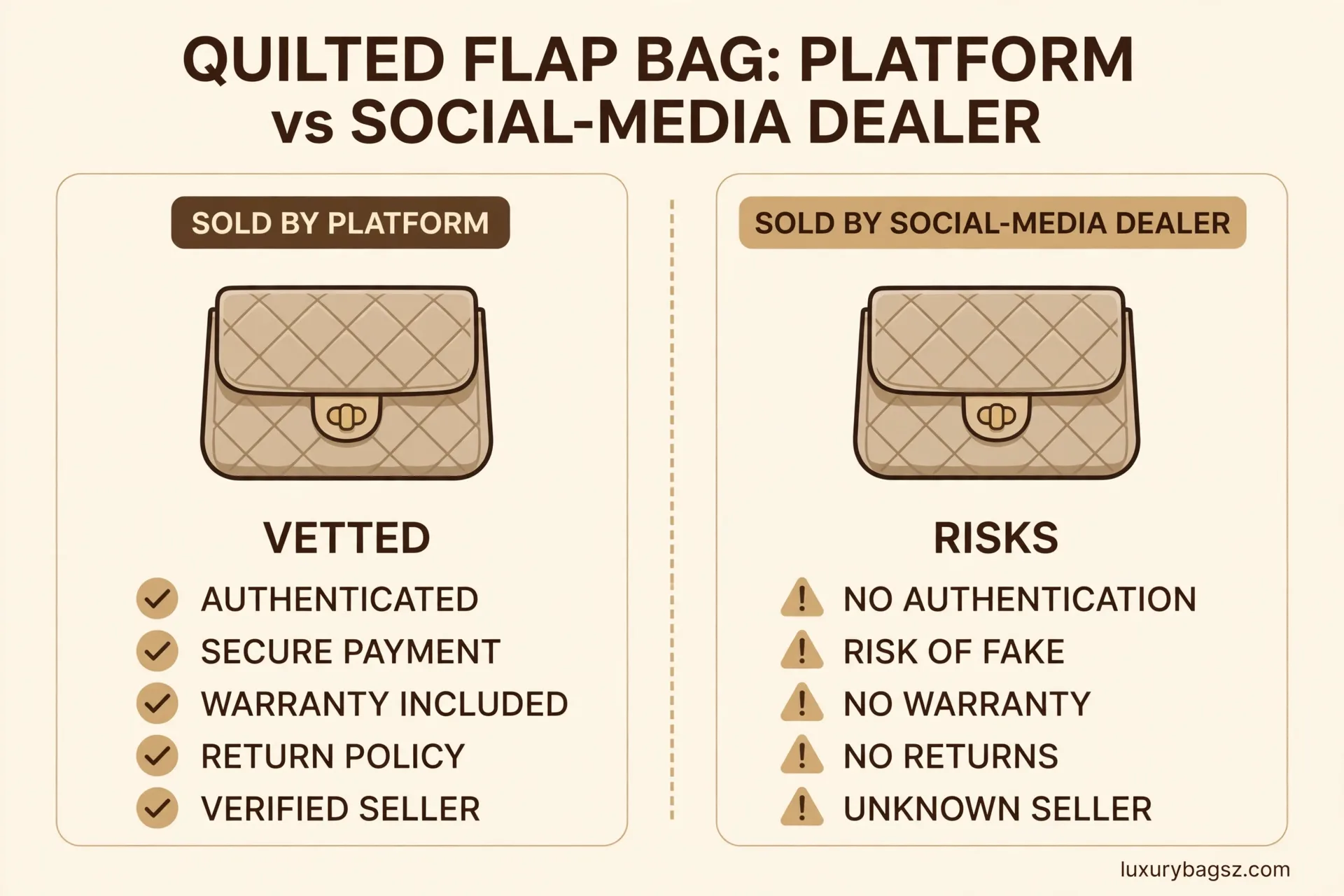
Take a black caviar Chanel Classic Flap, medium, offered the same week at similar money: a consignment platform at fair market price, and an Instagram dealer slightly cheaper, with a today-only discount.
| Check | Consignment platform | Instagram dealer |
|---|---|---|
| Identity | Registered, address matches register | Name only, no address |
| Age | Domain nine years old | 14 months, handle changed twice |
| Reviews | Pattern of praise for fast refunds | None independent |
| Scam searches | No counterfeit claims | Fake alleged on forum, unanswered |
| Dated photo | Sent within an hour | Refused, bag said to be abroad |
| Guarantee | Lifetime money-back | Certificate only, no refund |
| Verdict | Pass: buy, paying by card | Fail: walk away |
The platform passed because each answer could be checked by someone else: a register, a review site, an authenticator. The dealer, despite more followers, failed early and kept failing, with no address, no reviews, no bag in hand and no remedy.
Frequently Asked Questions
How can I tell if a designer bag reseller is legitimate?
Check five things in order: registered identity and address, trading history, independent reviews read for patterns, clean scam and counterfeit searches, and a custom photo of the stamp or code beside a dated note.
Is a certificate of authenticity enough to trust a seller?
No. A certificate states an opinion. It protects you only behind a written refund remedy. Ask what you get back if another expert calls the bag fake. If the answer is nothing, it adds no safety.
What guarantee should a legitimate reseller offer?
The strongest is a lifetime money-back guarantee that accepts an independent verdict and refunds the full price paid. A short return window is weaker, and a certificate with no remedy is weakest.
Are Instagram bag dealers safe to buy from?
Some are legitimate small businesses, but the format carries the highest risk. Insist on the full checks, pay by a protected method, and walk away if the dated photo or business address is refused.
What should I do if a reseller fails one check?
Match the response to the stage. No verifiable identity, unresolved counterfeit claims or a refused dated photo mean walk away. A very new but verified seller may justify a small test purchase first.
Does a physical shop mean a reseller is trustworthy?
No. A shop makes a seller easier to locate, not better at authentication. Staff expertise varies widely, and shops have sold fakes. Run the same checks as for any online seller.
Final Verdict
A legitimate designer bag reseller is easy to verify: real identity, real history, the real bag in hand, and a refund promise that survives in writing. Check in order, believe patterns over polish, and let failed checks end deals.
Good sellers welcome these questions, because the answers are their strongest sales tool. If a seller resents being checked, that tells you everything the checks were designed to find.