Hermès Date Codes and Blind Stamps: How to Read Every Era Without Being Fooled
Reading a Blind Stamp in Brief: Letter First, Shape Second, Bag Third
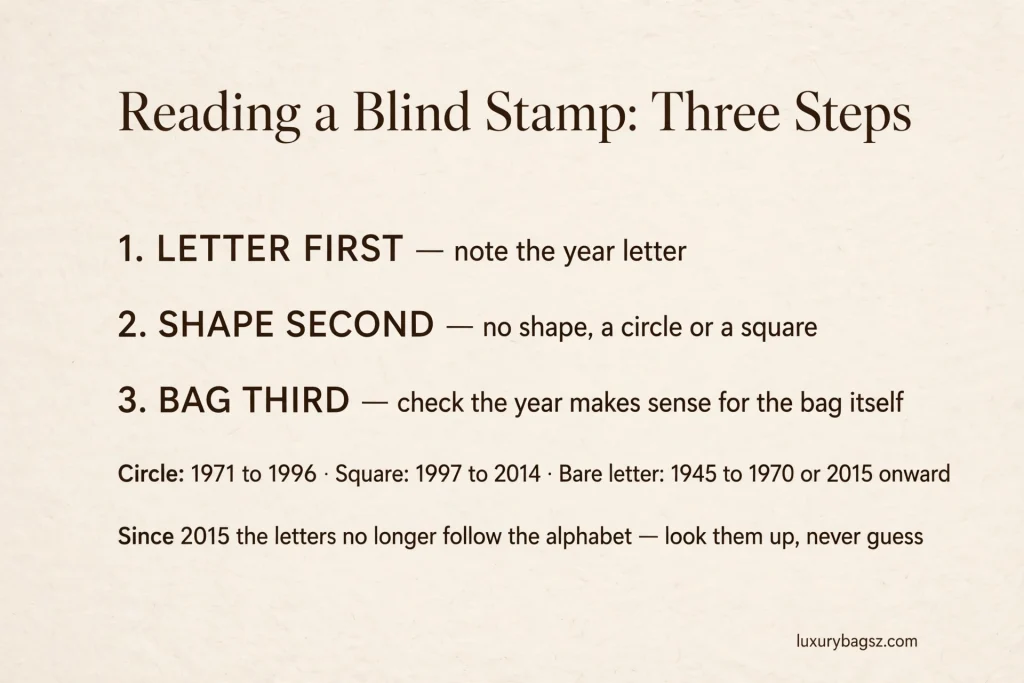
A Hermès blind stamp is a small, uninked letter pressed into the leather that records the year a piece was made, usually beside a craftsman code. To read it, note the letter first, then the shape around it — no shape, a circle, or a square — and then check that the year makes sense for the bag itself. A letter in a circle means 1971 to 1996, a letter in a square means 1997 to 2014, and a bare letter means either 1945 to 1970 or 2015 onward.
Since 2015 the letters no longer follow the alphabet, so a modern code must be looked up, not guessed.
That three-step reading is the whole skill, and it is also the limit of what a stamp can tell you. A stamp dates a piece; it does not prove the piece is genuine, because stamps can be copied, and a correct stamp on a fake bag is still a fake bag. Hermès has never published its date letters, so every chart you see online is collector consensus, not an official record — useful, widely agreed, but not a guarantee.
This guide gives you that consensus chart, explains where stamps sit on each bag, and shows the traps that catch even careful buyers.
One more essential fact before we start. Hermès issues no authenticity cards, and never has. Any seller who presents a card as proof of authenticity is either mistaken or misleading you, and any "certificate" that comes with a bag should be treated as a seller's opinion, not as a house document. Real Hermès proof is the bag itself: its leather, stitching, hardware, stamps and construction, all agreeing with each other.
Key Takeaways
- A blind stamp is an uninked year letter, usually beside a craftsman code, pressed into the leather.
- Shape decides the era: no shape is 1945–1970 or 2015 onward, circle is 1971–1996, square is 1997–2014.
- Modern letters are not alphabetical: T is 2015, X is 2016, A is 2017, C is 2018, D is 2019, Y is 2020, Z is 2021, U is 2022, B is 2023, W is 2024, K is 2025.
- A bare A could mean 1945 or 2017, so the bag's style, materials and construction must place it in the right era.
- The stamp alone never proves authenticity; it is one check among many.
- Hermès issues no authenticity cards, and Hermès does not publish its date letters.
What a Blind Stamp Actually Is
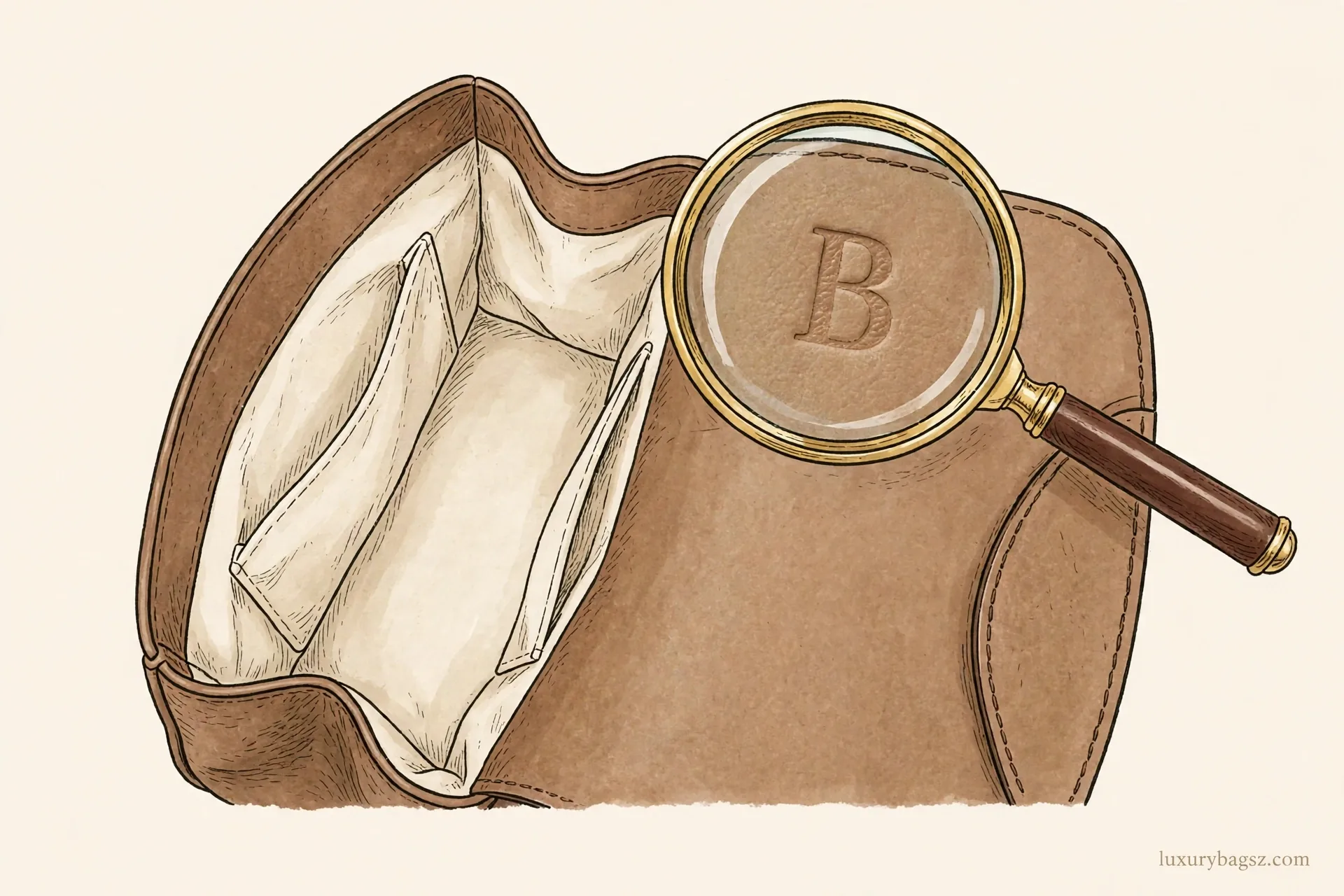
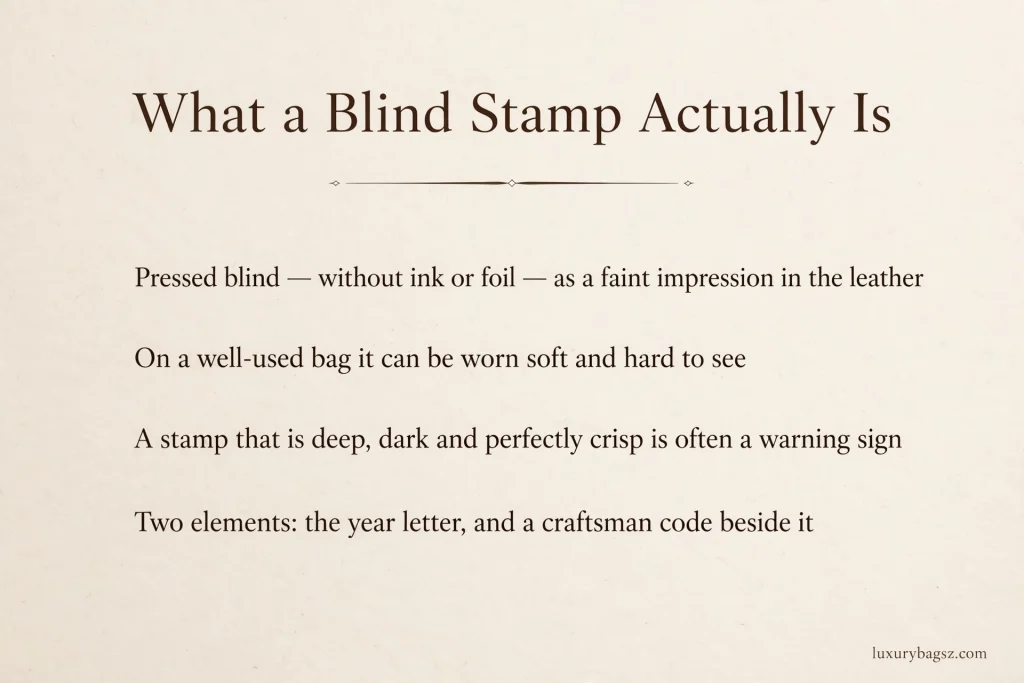
The name gives the game away: a blind stamp is pressed blind, without ink or foil, so it appears as a faint impression in the leather rather than as printed text. On a new bag it can be hard to see, and on a well-used bag it can be harder still, worn soft by years of opening, closing and handling.
That faintness is deliberate and, paradoxically, reassuring: a stamp that is deep, dark, perfectly crisp and easy to photograph from across a room is often a warning sign, not a comfort.
A typical stamp contains two elements. The first is the year letter, which is the part this guide decodes. The second is a craftsman code, usually a combination of letters and numbers beside or beneath the year letter, which identifies the artisan or team and the workshop in Hermès's internal system.
There is no public registry linking those codes to named craftspeople, so a seller who claims to know exactly which artisan made your bag from the code alone is overstating what the code can show. Treat the craftsman code as a consistency check — it should be present, neatly pressed, and in the format used for its era — not as a biography.
Stamps also carry occasional extra marks that confuse newcomers. An S stamped near the main Hermès mark can indicate a staff sale piece, and exotic leathers carry their own additional symbols, such as a small mark denoting crocodile or alligator type. A double stamp, seen on some 2011 production, reflects a transitional period rather than a fault.
None of these extras change the year reading, but knowing they exist stops you from mistaking a normal variation for a fake — or a fake's invention for a normal variation. Our Hermès history guide gives the wider story of how the house's craft, and its marking habits, developed over time.
The Four Eras: No Shape, Circle, Square, and No Shape Again
The system began in 1945, when Hermès started dating leather goods with a single letter and no surrounding shape. From 1945 to 1970 the letters ran alphabetically from A to Z, with A for 1945 and Z for 1970. Bags made before 1945 carry no blind stamp at all, which is normal for their age, not a defect — though it does mean dating a pre-1945 piece relies on style and construction rather than on a stamp.
In 1971 the house added a shape: letters inside a circle, again running alphabetically, with A for 1971 through Z for 1996. The circle era is the longest single run, covering a quarter of a century of Hermès production, from the height of the Kelly's fame through the launch of the Birkin in 1984. A circled letter is therefore one of the clearest dating signals you can find, because the circle removes the ambiguity that affects bare letters.
If you see a letter in a circle, you are looking at 1971 to 1996, full stop.
In 1997 the shape changed to a square, with A for 1997 running alphabetically to R for 2014. The square era covers the great expansion of Hermès's modern bag business, including many of the Birkins, Kellys and Lindys that dominate the pre-owned market today. Towards the end of 2014, some bags already appear with the square's final letter, R, without the surrounding square, marking the transition to the modern system.
That late-2014 variation is genuine and well documented by collectors, so a bare R on a bag that is otherwise consistent with 2014 should not alarm you on its own.
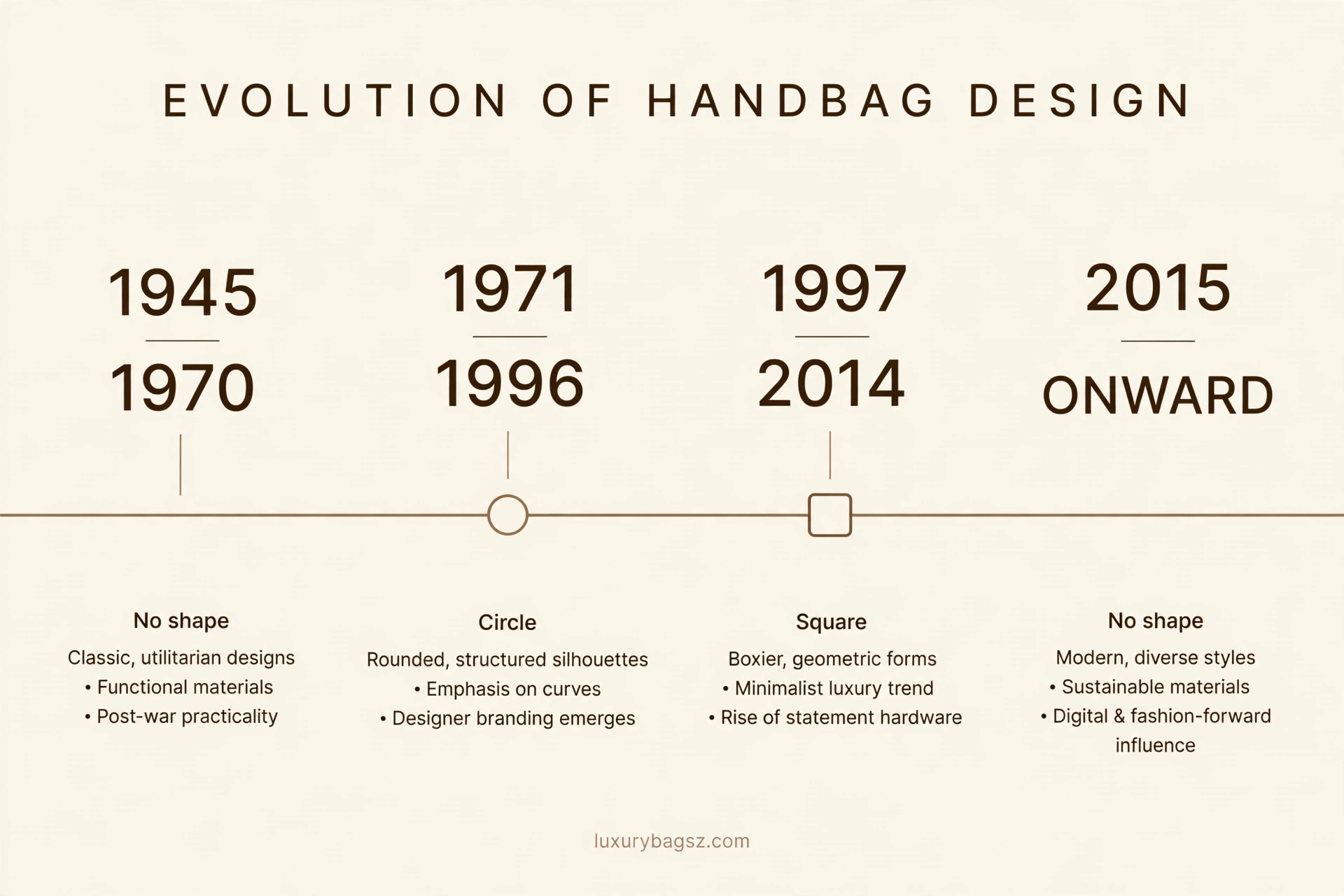
Since 2015, Hermès has returned to bare letters with no shape, but with a crucial twist: the letters no longer follow alphabetical order. Collectors widely report that this was done deliberately, so that counterfeiters could not predict the next year's letter.
The result is a system that is easy to use once you have the chart, and impossible to guess without it — which is exactly why this guide exists, and why you should never try to work out a modern year by counting through the alphabet.
The Modern Letters, 2015 Onward: The Chart You Actually Need
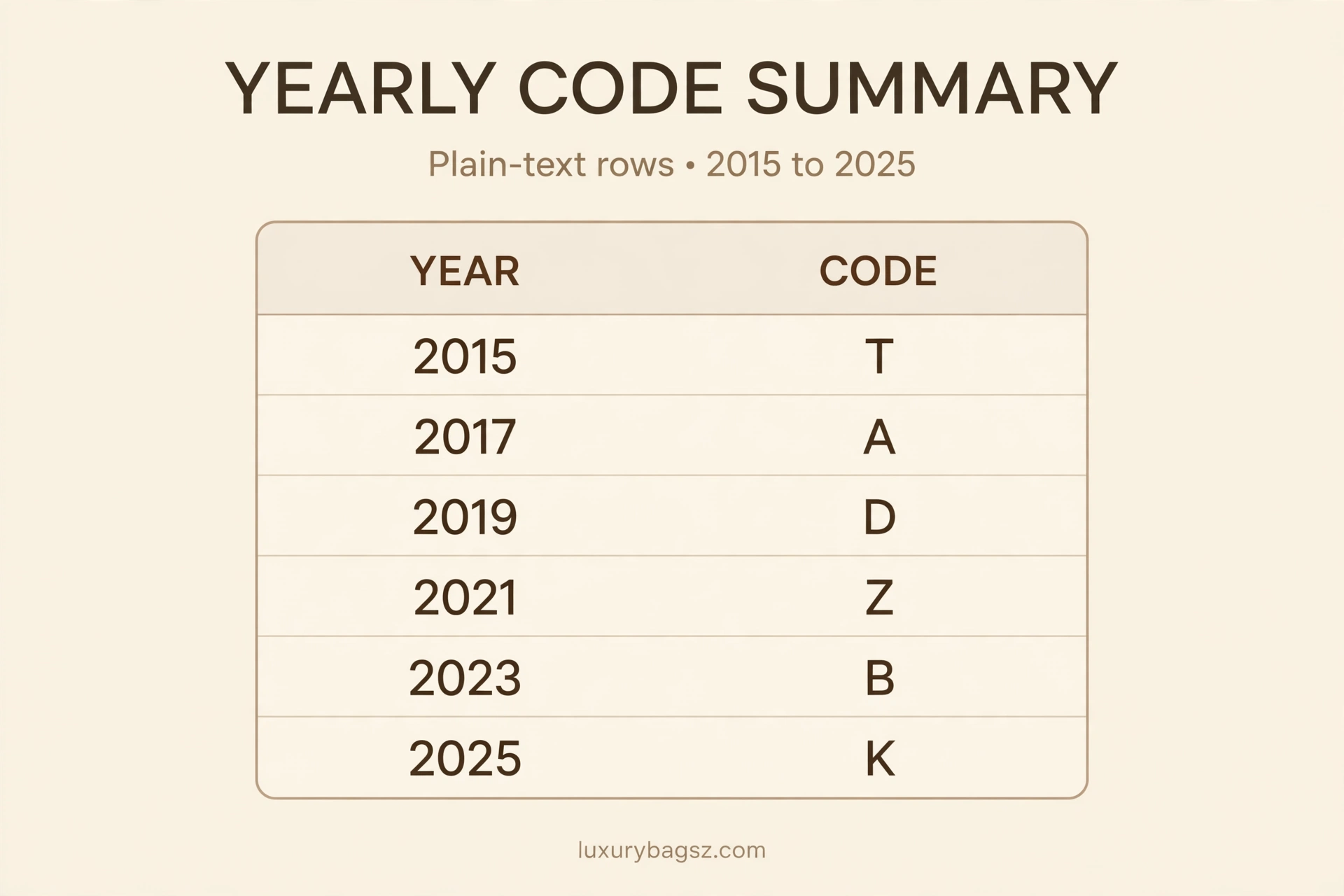
Here is the modern chart as reported by multiple collector sources, including PurseBlog, PurseBop and specialist authentication references. Treat it as strong consensus, not as an official Hermès publication, because Hermès does not publish these letters. The 2026 letter is reported by collectors and resellers in early 2026, and should be treated as reported rather than confirmed until more evidence accumulates.
The sequence runs: 2015 is T, 2016 is X, 2017 is A, 2018 is C, 2019 is D, 2020 is Y, 2021 is Z, 2022 is U, 2023 is B, 2024 is W, and 2025 is K. The reported 2026 letter is G. Notice how the sequence jumps: T to X, X to A, A to C, C to D, D to Y. There is no pattern to exploit, and any seller who tells you they "worked out" a modern year from first principles is either consulting a chart or guessing.
Worked examples help. A bare K is 2025, a bare W is 2024, and a bare B is 2023. A bare A, however, is ambiguous: it could be 1945, from the first no-shape era, or 2017, from the modern era. The bag itself resolves the ambiguity. A 1945 bag will be a vintage piece in materials and construction of its time, while a 2017 bag will be a modern Birkin, Kelly, Constance or Lindy in a modern leather and colour.
The same logic applies to every repeated letter: T could be 1964 or 2015, U could be 1965 or 2022, and so on. Always read the letter together with the bag, never alone.
One further modern detail matters. Since around 2016, the stamp on Birkin and Kelly bags is most often found on the interior side wall, near the back, rather than on the strap or sangle as in earlier years. Placement varies by model and year, and a stamp in an unexpected place is worth noting, but it is not proof of fakery on its own. The next part covers where to look, model by model.
Where to Find the Stamp on Each Bag
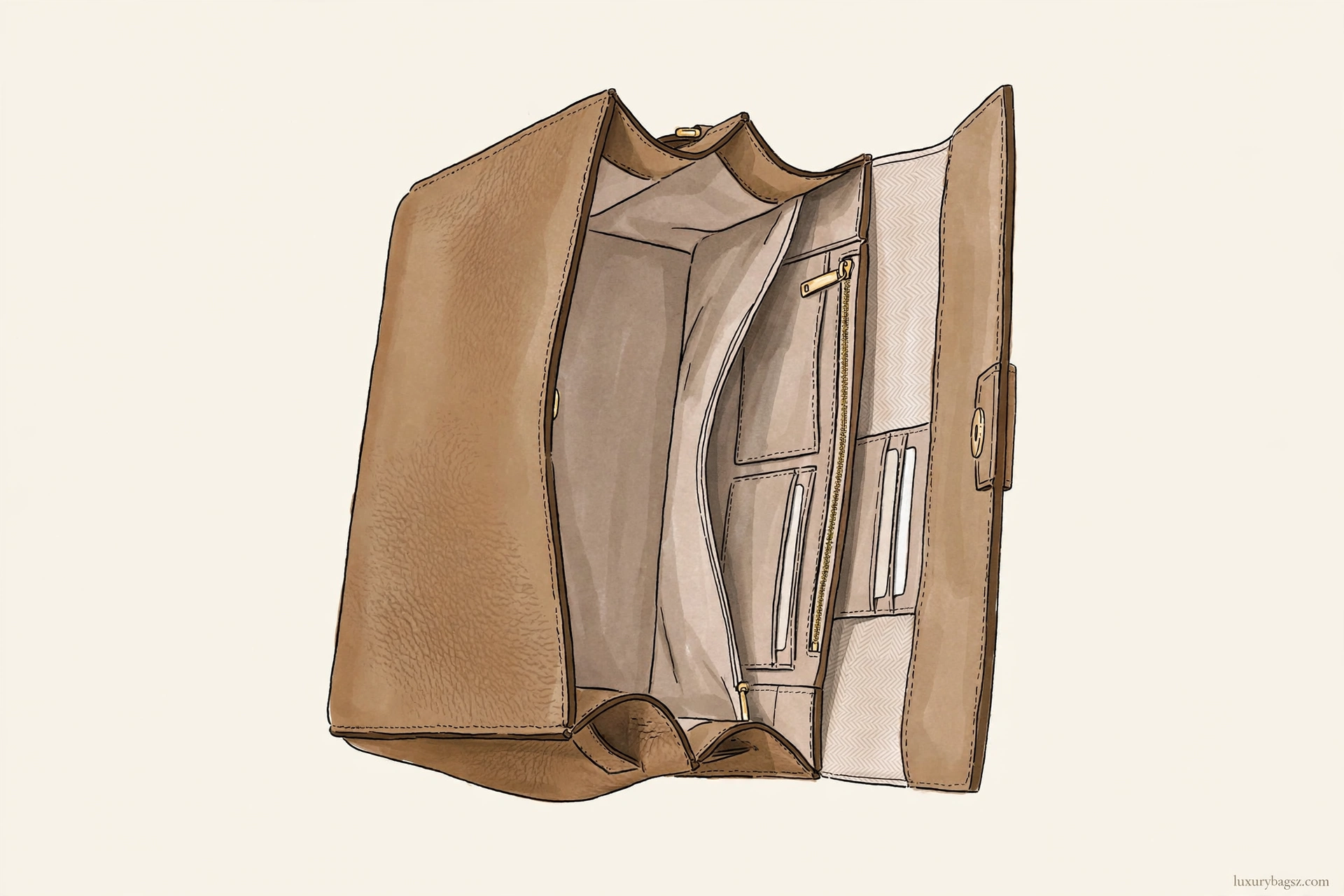
On Birkin and Kelly bags made since 2016, look on the left interior side wall, close to the back flap, pressing the leather gently to catch the light. Earlier Birkins and Kellys may carry the stamp on the sangle, the leather strap that secures the flap, or on an interior panel, so if you cannot find it on the side wall, check the strap and the interior panels before concluding it is missing.
A torch held at a low angle across the leather often reveals a faint stamp that direct light hides.
On a Constance, the stamp is normally on the middle interior panel. On a Lindy, Evelyne and Picotin, check the interior panels and, for the Evelyne, the interior pocket area. On smaller leather goods such as wallets and card holders, the stamp sits on an interior panel or beneath a flap, and it can be very small indeed.
Wherever it sits, it should be neat, evenly pressed, and consistent with the bag's era: a square-era bag should not carry a modern bare letter, and a modern bag should not carry a circled letter.
If you cannot find a stamp at all, do not panic immediately, but do slow down. Some very worn bags have stamps that have faded almost to invisibility, and some small pieces have stamps hidden under a lining edge. Photograph the likely areas in raking light, ask the seller for close photographs of those areas, and if the seller cannot or will not provide them, walk away.
A missing stamp on a post-1945 bag is a serious red flag, and no bargain is worth ignoring it.
The Traps: What a Stamp Cannot Prove, and What Fakes Get Wrong
The most dangerous misunderstanding about blind stamps is that a correct stamp equals a genuine bag. It does not. Counterfeiters know the charts too, and a well-made fake can carry a perfectly correct year letter in the correct shape. The stamp is a dating tool and a consistency check, not an authentication verdict. A bag whose stamp says 2023 but whose hardware, stitching or leather belong to a different era is suspicious.
A bag whose stamp is correct but whose overall craft is poor is still a fake.
Fakes also make stamp-specific mistakes that are worth learning. Stamps that are too deep, too dark, or too perfectly uniform often betray a machine-pressed fake, where genuine Hermès stamps are faint and slightly imperfect from hand pressing.
Stamps in the wrong place for the model and year, stamps with the wrong letter for the claimed purchase year, and stamps that contradict the bag's colour or leather history — a colour not yet introduced in the stamped year, for example — are all strong warnings.
Our fake Hermès Birkin checks and fake Hermès Kelly checks cover these tests alongside stitching, hardware and construction checks.
Another trap is the paperwork trap. Sellers sometimes present receipts, boxes, dust bags and even "authenticity cards" as if they proved a bag. Receipts can be faked or mismatched, boxes and dust bags are sold separately, and — to repeat the essential point — Hermès issues no authenticity cards, so a card proves nothing except that someone printed a card. Judge the bag, not the box it came in.
If the bag's stamp, leather, stitching and hardware all agree, the paperwork is a pleasant bonus. If they do not agree, no paperwork can rescue the bag.
A final trap is overconfidence in a single online chart. Sources disagree on minor points, such as the exact start of the late-2014 transition and the status of the reported 2026 letter. Where sources disagree, this guide says so rather than picking a winner silently. Cross-check any stamp that matters to a purchase against at least two reputable collector sources, and for a high-value bag, get an independent specialist authentication as well.
The stamp is the start of authentication, not the end of it.
A Practical Reading Method for Buyers
Use this method every time you examine a bag, whether in a boutique, at a dealer, or from photographs. First, find the stamp and photograph it in raking light, noting the letter and the shape around it, or the absence of a shape. Second, look up the year from the chart in this guide, remembering that bare letters are ambiguous and must be resolved by the bag itself.
Third, check the year against everything else you know: the model, the leather, the colour, the hardware, and the seller's claimed purchase date.
Fourth, look for contradictions. Does the stamped year predate the colour? Does a bag stamped 2020 use a hardware finish introduced later? Does a bag claimed as new carry a stamp from five years ago? Any contradiction deserves an explanation, and a seller who cannot explain it should not get your money. Fifth, run the full authentication check, not only the stamp check, or pay a specialist to do so.
Our guides to buying pre-owned safely and authenticating a pre-owned bag walk through that wider process step by step.
For sellers, the same method works in reverse. Photograph your stamp clearly, state the year it indicates, and explain how you read it. Honest, well-documented stamps sell bags faster and for better prices, because they remove the buyer's first doubt. Hiding a stamp, photographing it badly, or refusing to discuss it has the opposite effect, and experienced buyers will assume the worst.
Transparency about a stamp — including admitting when it is faint or hard to read — is a sign of a trustworthy seller.

Frequently Asked Questions
What is a Hermès blind stamp?
A blind stamp is a small, uninked letter pressed into the leather of a Hermès piece, recording the year it was made. It usually sits beside a craftsman code that identifies the artisan or team in Hermès's internal system. The stamp is faint by design, because it is pressed without ink, and it is one of the first details buyers and authenticators check.
How do I read a Hermès date code?
Note the letter, then the shape around it. No shape means 1945–1970 or 2015 onward, a circle means 1971–1996, and a square means 1997–2014. For modern bare letters, use the chart in this guide, since the letters are not alphabetical. Then check that the year fits the bag's model, leather, colour and hardware.
What year is a Hermès bag with the letter A?
It depends on the shape and the bag. A bare A could be 1945 or 2017, a circled A is 1971, and a squared A is 1997. The bag itself resolves the ambiguity: a 1945 piece will be vintage in style and materials, while a 2017 piece will be a modern bag in a modern leather and colour.
What is the Hermès stamp for 2024?
W, with no surrounding shape. The modern sequence around it runs U for 2022, B for 2023, W for 2024, and K for 2025. Remember that this sequence is collector consensus, not an official Hermès publication, because Hermès does not publish its date letters.
What is the Hermès stamp for 2025?
K, with no surrounding shape, as reported by PurseBop and specialist authentication references in January 2025. The reported letter for 2026 is G, but that should be treated as reported by collectors and resellers rather than confirmed, until more evidence accumulates.
Where is the blind stamp on a Birkin?
On Birkins made since 2016, it is most often on the left interior side wall, near the back flap. Earlier Birkins may carry it on the sangle strap or an interior panel. Use raking light — a torch held at a low angle — to reveal a faint stamp, and check the strap and panels if the side wall shows nothing.
Does a correct blind stamp prove a bag is real?
No. A stamp dates a piece; it does not prove authenticity. Counterfeiters can copy correct stamps, so a correct stamp on a fake bag is still a fake bag. Authentication requires checking leather, stitching, hardware, construction and stamps together, and for high-value bags, an independent specialist opinion is money well spent.
Does Hermès issue authenticity cards?
No. Hermès issues no authenticity cards, and never has. A card presented with a bag is not a house document and proves nothing about authenticity. Treat any seller who relies on a card as a warning sign, and judge the bag itself instead.
Why are modern Hermès date letters not alphabetical?
Collectors widely report that Hermès broke alphabetical order from 2015 onward deliberately, so that counterfeiters could not predict the next year's letter. Whether or not that was the motive, the effect is the same: modern years must be looked up in a chart, not worked out by counting through the alphabet.
What should I do if I cannot find a blind stamp?
Check all likely places in raking light, ask the seller for close photographs of those areas, and do not buy if the stamp cannot be shown. A missing stamp on a post-1945 bag is a serious red flag, though very worn bags can have stamps faded almost to invisibility. When in doubt, get a specialist authentication before paying.
Final Verdict: Learn the Chart, Then Look Beyond It
The blind stamp system is beautifully simple once you know it: letter, shape, and bag, in that order. No shape, circle, square, then no shape again; alphabetical for seventy years, then deliberately scrambled from 2015 onward. Learn the four eras and the modern chart, and you will never again be fooled by a seller who claims a 2023 bag carries a letter it cannot carry, or by a listing that treats a stamp as a guarantee.
But the stamp's simplicity is also its limit. It tells you when a piece was made, not whether it is genuine, and the most convincing fakes know the chart as well as you do. Use the stamp as your first check and your consistency test, then do the full work: leather, stitching, hardware, construction, and, for any bag that matters, a specialist opinion.
A stamp read well, and then wisely set aside in favour of the whole bag, is one of the most useful skills a Hermès buyer can own.