Girard-Perregaux History: Two Centuries of Swiss Watchmaking, From Bautte to the Laureato
The Watchmaker's Watchmaker, in One Paragraph
Girard-Perregaux is one of the oldest names in Swiss watchmaking, with roots reaching back to 1791, a defining Three Bridges tourbillon in the 19th century, and a modern icon in the Laureato sports watch of 1975.
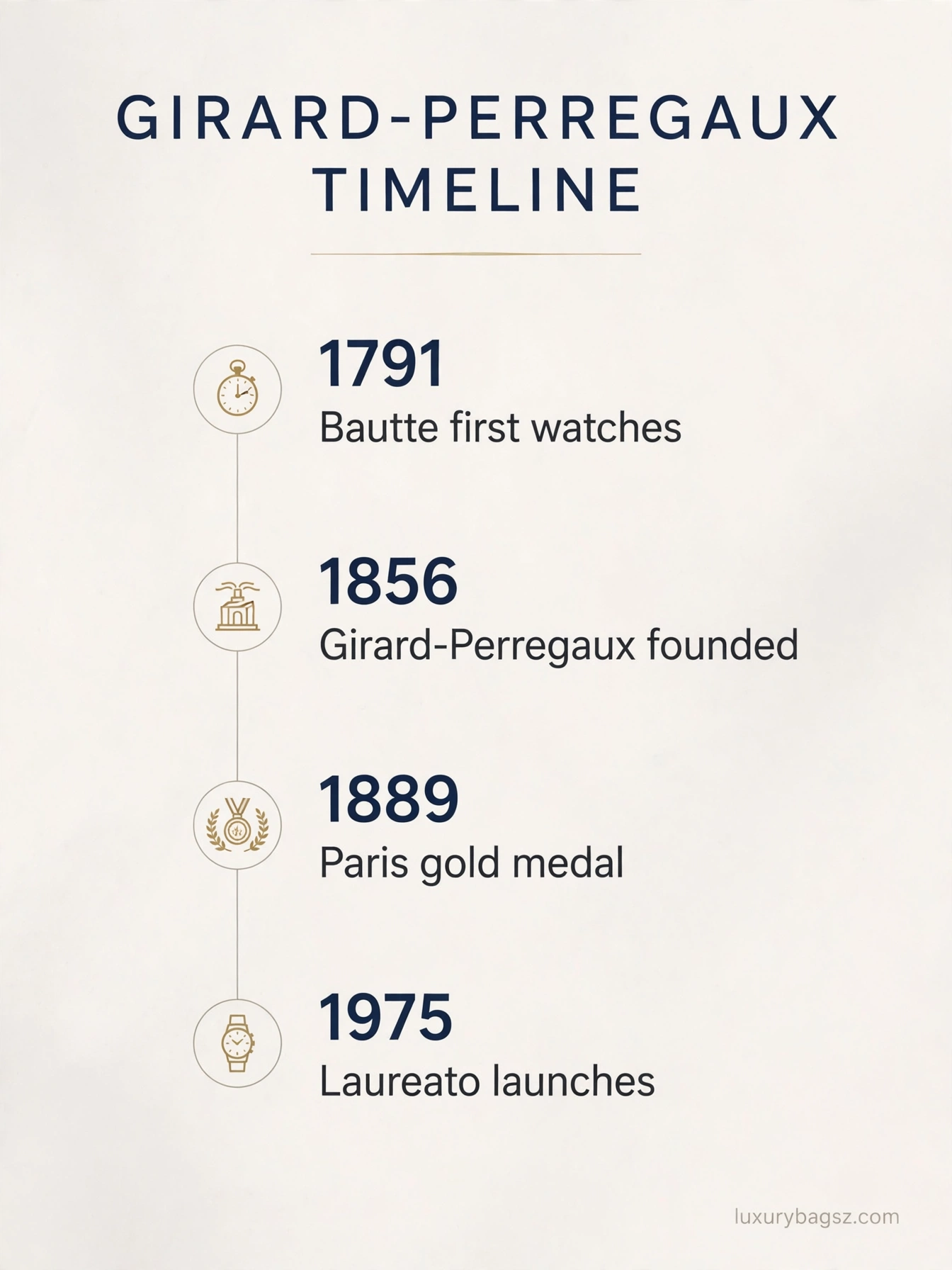
If you only remember three dates, remember these: 1791 for the Bautte origins, 1856 for the Girard-Perregaux name, and 1889, when the Three Bridges tourbillon won a gold medal at the Paris Universal Exposition. Everything else in this guide hangs off those three anchors.
Key Takeaways
- The lineage begins in 1791 with Jean-François Bautte, a Geneva watchmaker and goldsmith.
- Constant Girard founded Girard & Cie in 1852, and the Girard-Perregaux name dates to 1856.
- The Three Bridges tourbillon turned a hidden movement part into visible design.
- In 1880, the German Navy ordered 2,000 wristwatches, an early large-scale wristwatch order.
- The Laureato, launched in 1975, remains the brand's most recognisable modern watch.
Geneva in 1791: Jean-François Bautte
In 1791, the 19-year-old Jean-François Bautte signed his first watches in Geneva. What made his workshop unusual was its breadth: rather than farming out each trade, Bautte grouped watchmaking crafts under one roof, from case making to dial work and movement assembly.
That idea, later called a manufacture, is now standard language in luxury watchmaking, but in the late 18th century it was a genuine innovation. It gave one house control over quality at every step, and it explains why Girard-Perregaux still counts 1791 as its starting point.
Bautte's clientele included European royalty, and his watches won praise for precision. After his death, Jacques Bautte and Jean-Samuel Rossel carried the firm forward, keeping the Geneva tradition alive into the 19th century.
For a modern collector, the Bautte chapter matters because it sets the house apart from brands founded as marketing projects. Girard-Perregaux grew out of a working atelier, not a logo looking for a factory.
Constant Girard, Marie Perregaux, and the 1856 Name
The second strand of the story begins in La Chaux-de-Fonds, in the Swiss Jura. In 1852, watchmaker Constant Girard founded Girard & Cie there, in a town whose grid streets were laid out to bring light into watchmaking workshops.
In 1854, Girard married Marie Perregaux, who came from a family of watch merchants. Two years later, in 1856, the Girard-Perregaux Manufacture was founded, joining the two names that still sit on the dial today.
The two strands merged fully in 1906, when Constant Girard-Gallet, who had taken over from his father, acquired the Bautte house and combined it with Girard-Perregaux & Cie. That merger is why the brand can honestly claim both the 1791 lineage and the 1856 name.
Sources differ slightly on whether to date the firm to 1791, 1852, or 1856. All three dates are defensible, and they describe different things: the earliest workshop, the Girard workshop, and the married name. Treat any single "founded" year with that context in mind.
The Three Bridges: Engineering Turned Into Art
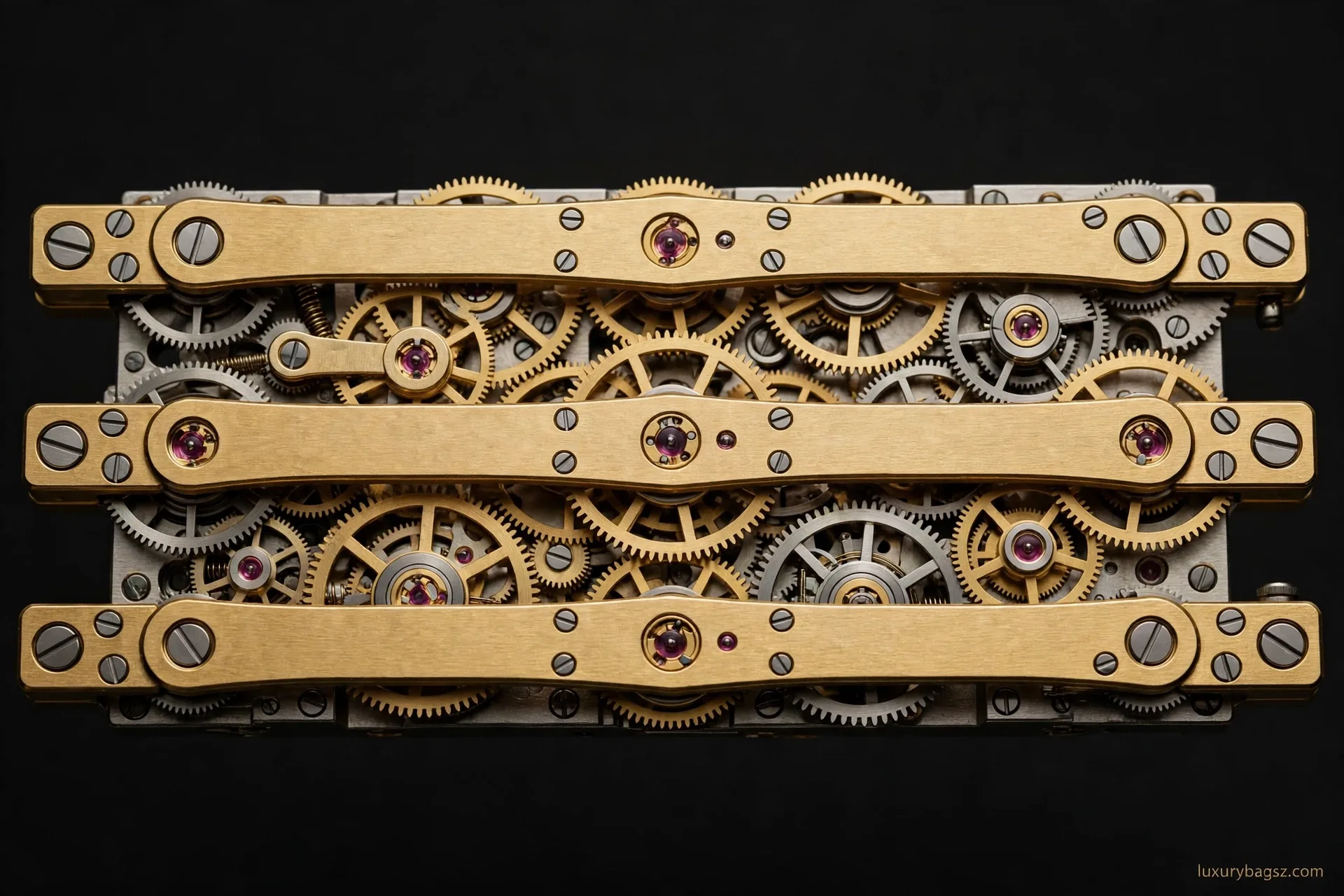
Constant Girard's most famous idea was the Tourbillon with Three Gold Bridges. He patented the movement design in the United States in 1884, and an early three-bridge pocket watch had already won awards in the 1860s.
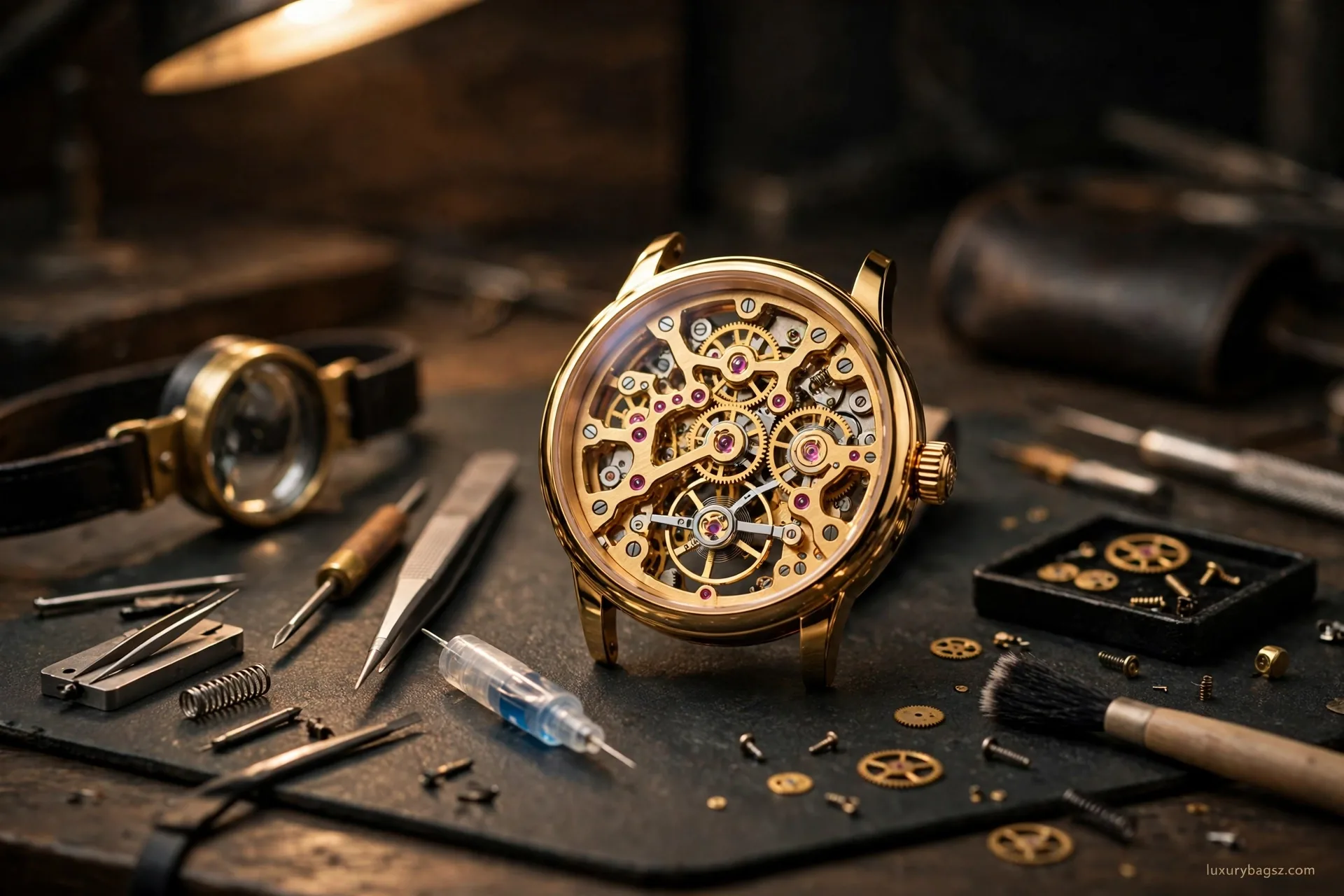
The brilliance was visual as much as technical. In most watches, bridges are hidden supports inside the movement. Girard shaped three parallel bridges in gold, arranged like arrows, and made them part of the watch's face. The mechanism became the decoration.
In 1889, the Tourbillon with Three Gold Bridges won a gold medal at the Paris Universal Exposition, the same fair that introduced the Eiffel Tower. That prize fixed the design in watchmaking history, and the house still uses the three-bridge motif today.
For buyers, the lesson is simple: when a Girard-Perregaux looks unusual, it is usually because an engineering choice is being shown rather than hidden. That honesty is the brand's signature.
The 1880 Naval Order and the Wristwatch Arrives Early
In 1880, Girard-Perregaux received an order from the German Navy, placed under Emperor Wilhelm I, for 2,000 wristwatches for naval officers. At a time when pocket watches still ruled, this was a strikingly early large-scale wristwatch production run.
The watches were practical tools, not jewellery, and the order is often cited as one of the first major commercial wristwatch contracts. Production was later paused as the public stayed loyal to pocket watches, and the wristwatch only triumphed in the 20th century.
Still, the order tells you something important about the house. Girard-Perregaux was willing to build for a new way of wearing a watch decades before fashion caught up. That same willingness reappears in its quartz work a century later.
Collectors should note that original 1880 naval pieces are museum-grade rarities, not realistic purchases. Their value to a buyer today is as history, showing why the brand's later sports watches feel so natural.
Precision, Quartz, and the High-Frequency Breakthrough
Through the late 19th century, Girard-Perregaux dominated chronometer competitions run by the Neuchâtel Observatory, winning prizes for accuracy again and again. Precision was not a slogan for the house; it was the product.
That tradition continued into the 1960s. In 1965, the house designed the Gyromatic HF, a high-frequency mechanical movement beating at 36,000 vibrations per hour, a genuine technical landmark. A year later, accounts date the Gyromatic High Frequency movement to 1966, a small dating difference that reflects launch versus production timing.
Then came quartz. Girard-Perregaux was among the first Swiss brands to adopt the technology, and its quartz movement running at 32,768 Hz became the industry standard frequency still used in quartz watches today. It also earned early COSC certification for a quartz chronometer.
The house that built its name on mechanical craft helped set the quartz standard, and that paradox is worth holding in mind. Girard-Perregaux has rarely chosen sides in the mechanical-versus-quartz debate; it has tried to lead both.

The Laureato and the Modern House
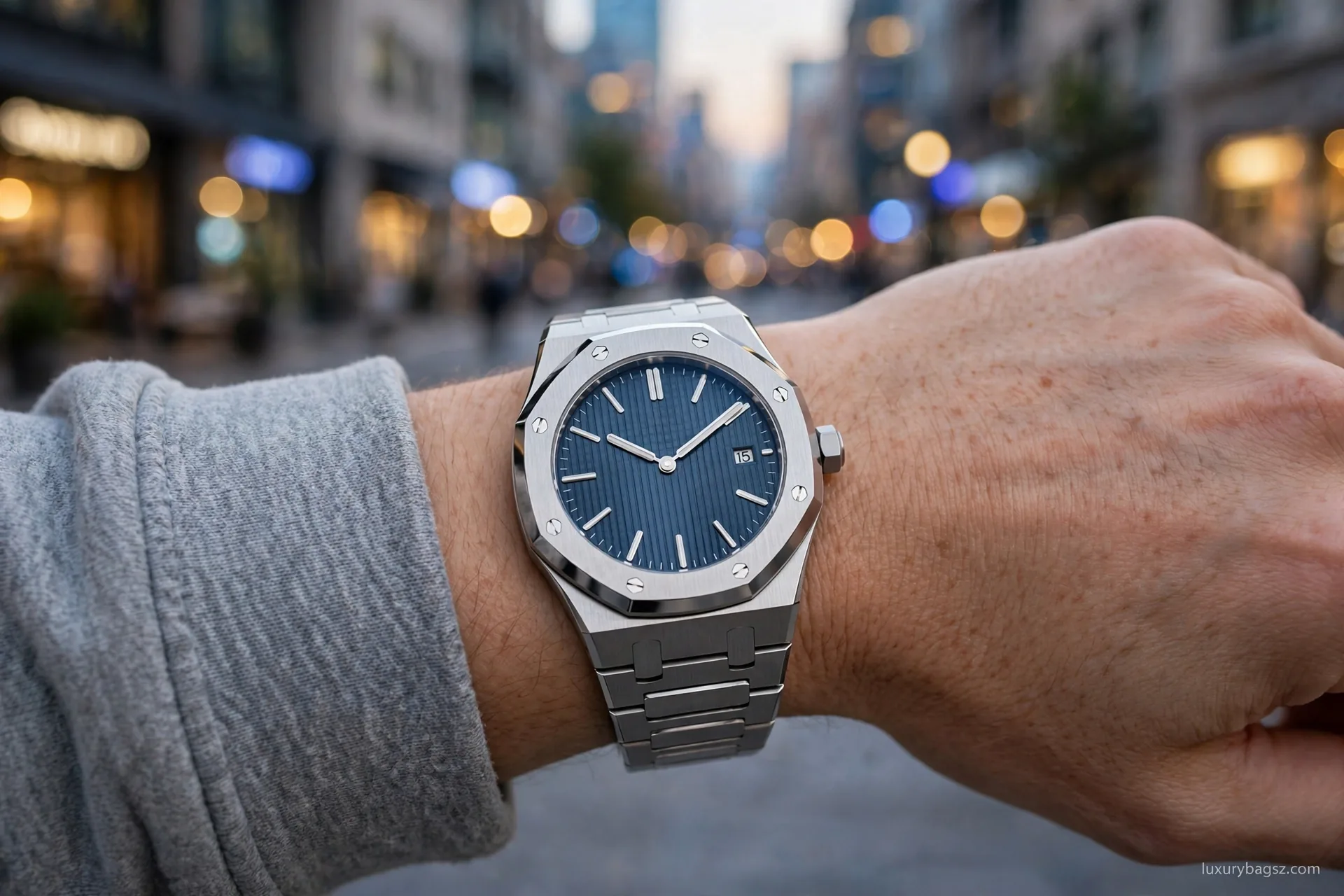
The Laureato arrived in 1975, Girard-Perregaux's answer to the luxury sports watch wave that also produced icons from other houses. It combined a slim profile, an integrated bracelet, and an octagonal bezel, and it was fitted with an in-house quartz calibre at launch.
Later Laureato generations moved to in-house automatic movements, including the 1995 Laureato 8010, as mechanical watchmaking enjoyed its renaissance. The design proved durable: the Laureato remains in production today in many sizes and materials, from steel to ceramic and titanium.
Ownership changed in recent years too. After a period under the French luxury group Kering, Girard-Perregaux returned to independent management ownership in 2022 through a management buyout of its Sowind Group parent. Collectors often welcome that independence, since it frees the house to focus on watchmaking rather than group fashion cycles.
If you are comparing Swiss sports watches, our guide to Rolex history gives useful context on how the big rival houses grew, and why Girard-Perregaux stayed smaller and more specialist.
What to Collect, and What to Check Before Buying
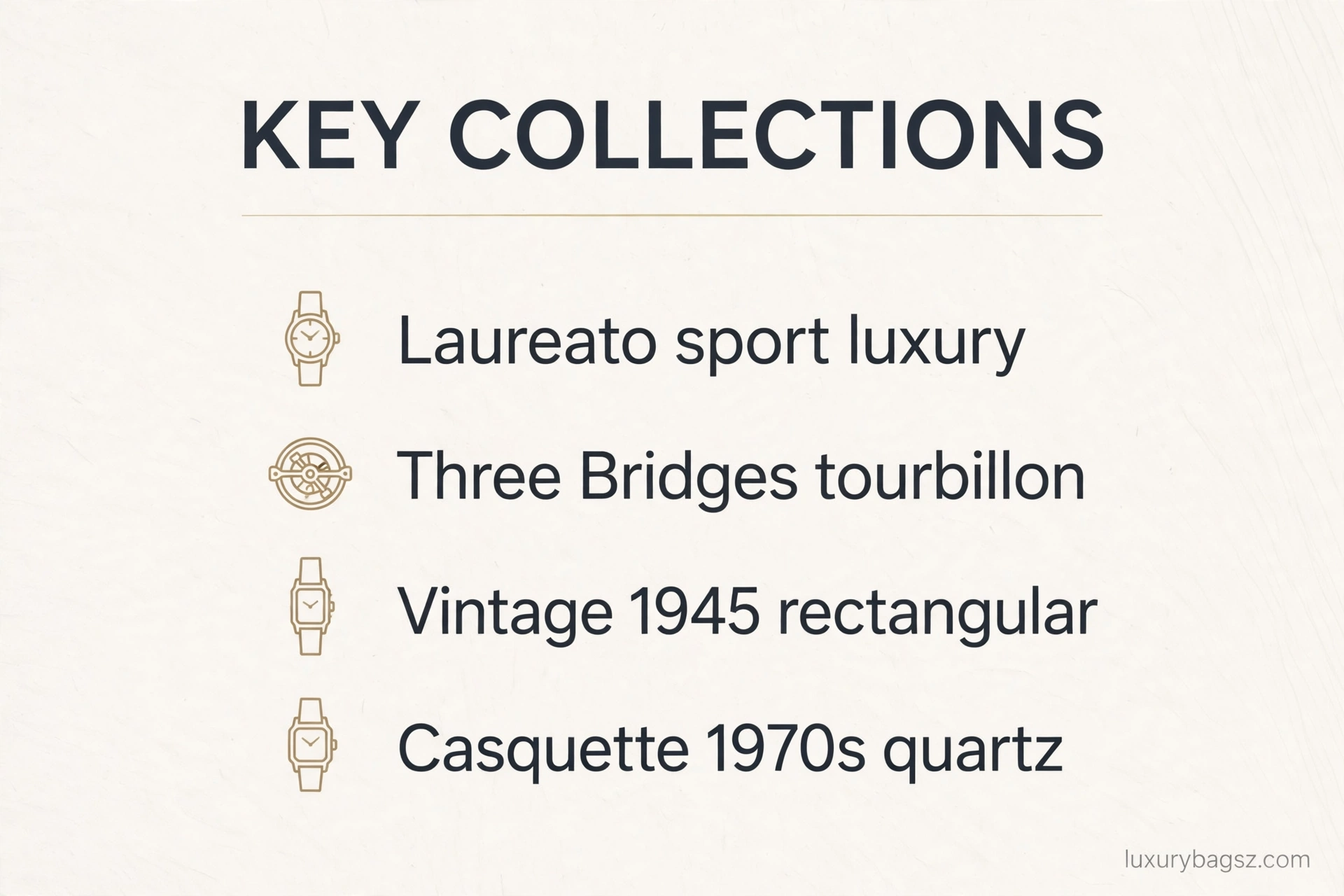
The most collectable Girard-Perregaux watches fall into four groups: Three Bridges tourbillons, early Laureato models, Vintage 1945 rectangular pieces, and the quirky 1976 Casquette quartz watch. Each rewards a different kind of buyer, from the connoisseur to the design fan.
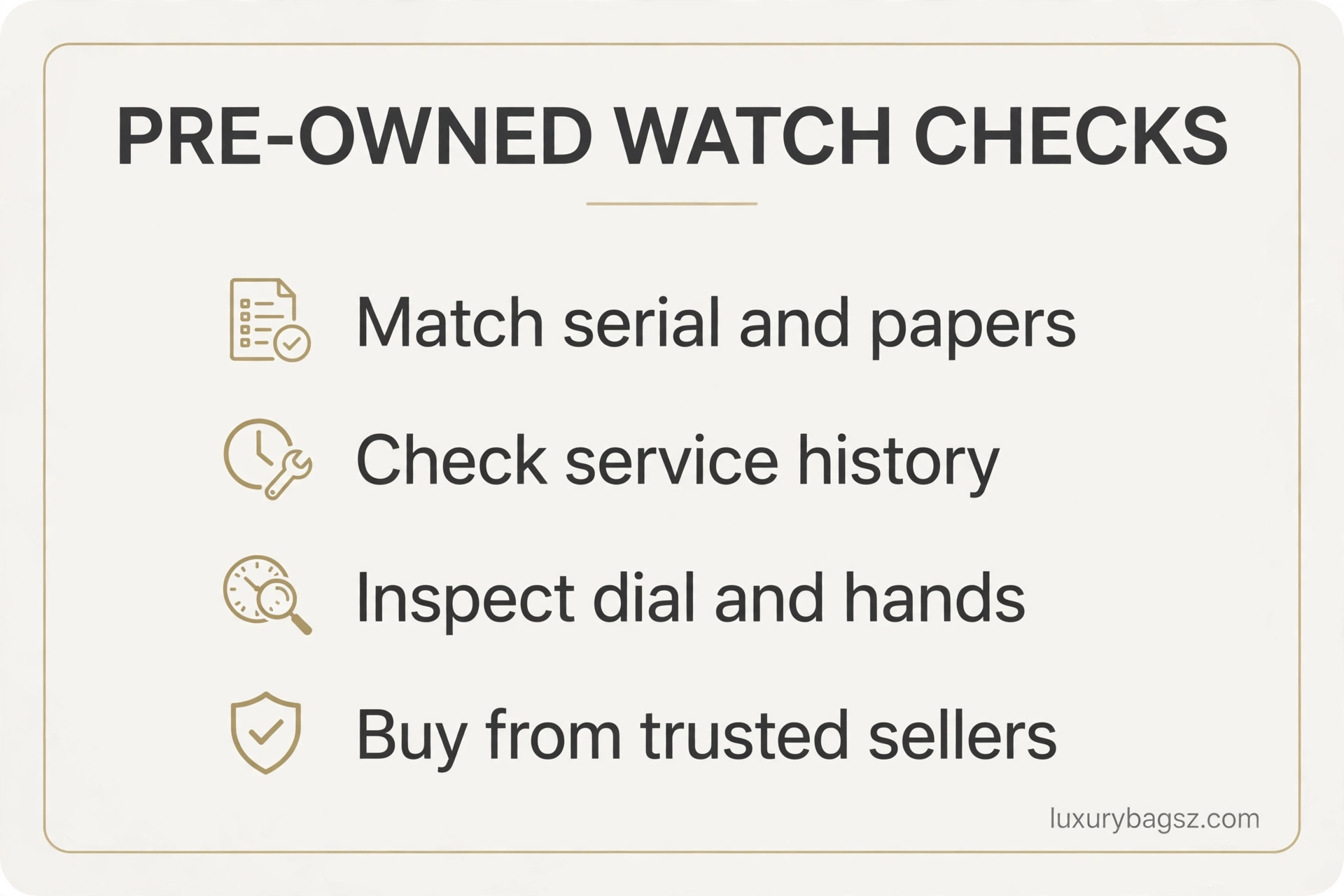
Before buying pre-owned, insist on matching serial numbers, original papers where they exist, and a clear service history. A watch without service records is not necessarily a bad buy, but it should be priced as a watch that will soon need a service.
Inspect the dial and hands closely under good light, since refinished dials and replaced hands are the most common value traps. Also check the bracelet or strap for stretch and correct end links, and buy from sellers with a written returns policy.
Our guide to collecting F.P. Journe watches covers similar independent-house checks, and the warning signs in our fake Rolex Datejust guide apply in spirit to any high-value watch purchase.
Girard-Perregaux Today: Small, Independent, and Still Inventing
Today the house is headquartered in La Chaux-de-Fonds, runs its own museum at Villa Marguerite nearby, and continues to make most of its movements in-house. It is a founding member of the Fondation de la Haute Horlogerie, which reflects its standing among peers.
Recent releases have revisited the archive with care: the Deep Diver revival, the Casquette 2.0 in ceramic and titanium, and anniversary Laureato editions in limited numbers. None of these chase fashion loudly; they assume the buyer already knows the history.
That quiet confidence is both the brand's charm and its commercial limit. Girard-Perregaux will probably never outsell the giants, and that is precisely why collectors value it. It remains a watchmaker's watchmaker, judged by people who open the case back.
For a rectangular dress-watch comparison, the Cartier Tank guide shows how another historic house turned a single shape into a century-long icon.
Frequently Asked Questions
1. When was Girard-Perregaux founded? Its lineage dates to 1791 with Bautte, while the Girard-Perregaux name dates to 1856, after Constant Girard married Marie Perregaux.
2. What is the Three Bridges tourbillon? A movement design with three parallel gold bridges made visible as decoration, patented in 1884 and awarded a gold medal in Paris in 1889.
3. Did Girard-Perregaux make the first wristwatches? Not the first ever, but its 1880 order of 2,000 wristwatches for the German Navy was one of the first large-scale wristwatch productions.
4. What is the Laureato? A luxury sports watch launched in 1975 with an integrated bracelet and octagonal bezel, still the brand's most recognisable modern line.
5. Is Girard-Perregaux independent today? Yes. After a period under Kering, it returned to management ownership in 2022 through a buyout of its Sowind Group parent.
6. What quartz standard did Girard-Perregaux set? Its quartz movement frequency of 32,768 Hz became the universal standard for quartz watches.
7. Where is Girard-Perregaux based? La Chaux-de-Fonds, Switzerland, with a museum at Villa Marguerite nearby.
8. What should I check on a pre-owned Girard-Perregaux? Serial numbers, papers, service history, dial and hand originality, and bracelet condition, plus a written returns policy.
9. Are Girard-Perregaux watches a good investment? Some limited and historic models hold value well, but buy for design and craft first, since resale depends heavily on model and condition.
10. What is the Vintage 1945 collection? A rectangular watch line inspired by a 1945 Art Deco original, relaunched as an anniversary edition in 1995.
Conclusion: Why the Quiet House Endures
Girard-Perregaux endured for over two centuries by doing one thing consistently: treating engineering as design. From Bautte's all-trades workshop to the Three Bridges and the Laureato, the house shows its working.
For a buyer, that is the best reason to choose it. You are not paying for noise. You are paying for a movement, a history, and a small Swiss house that still builds both itself.