

Pre-Owned Luxury Condition Grades Explained: From Pristine to Fair
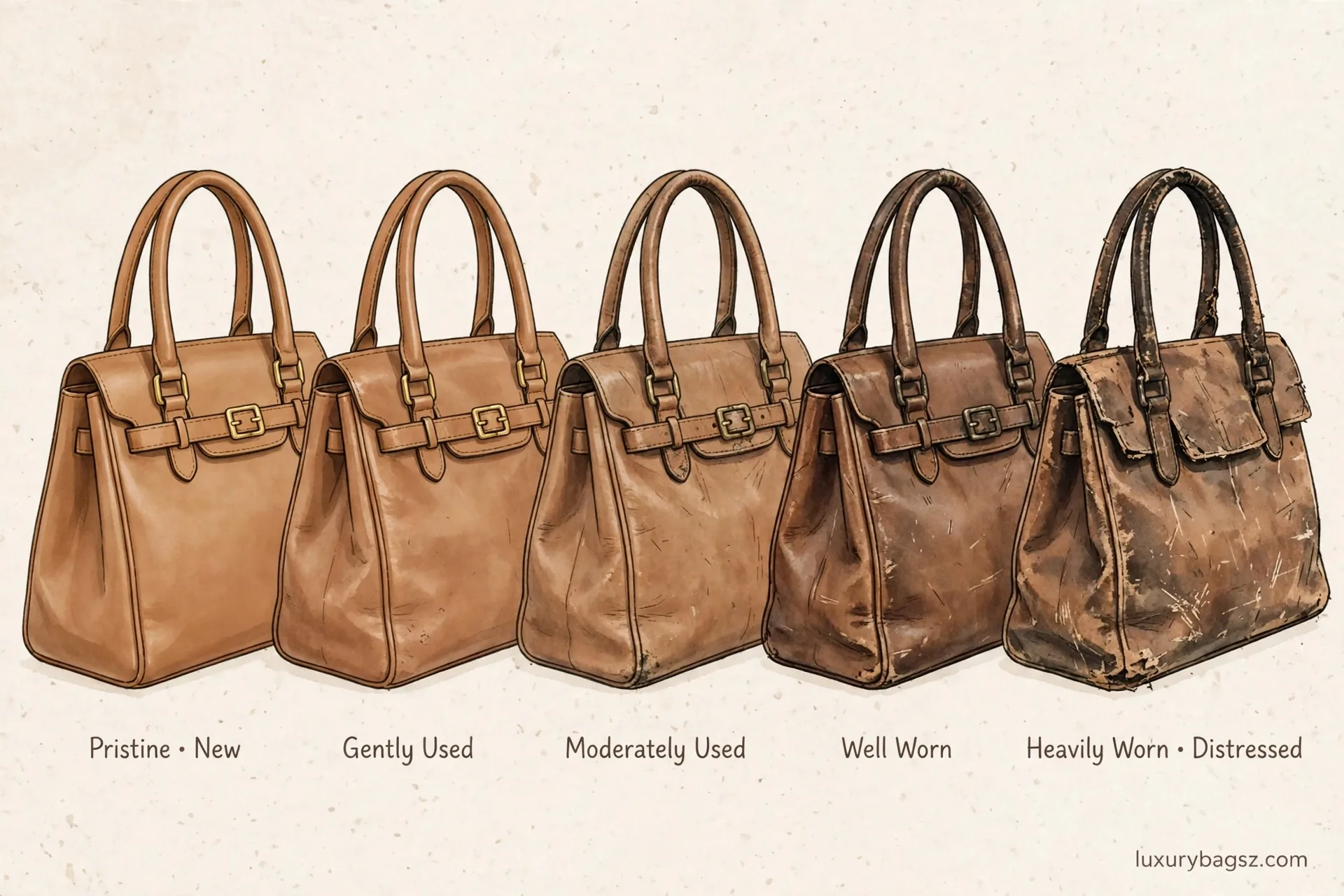
Grades in Brief
There is no industry-wide standard for pre-owned condition grades. Every platform uses similar words, but the same word can mean a different amount of wear on a different site. A "Very Good" bag on one platform may be an "Excellent" bag on another, so price should follow the photos and written notes, not the label alone.
Key Takeaways
- No universal grade standard exists: labels are not interchangeable across sellers or platforms.
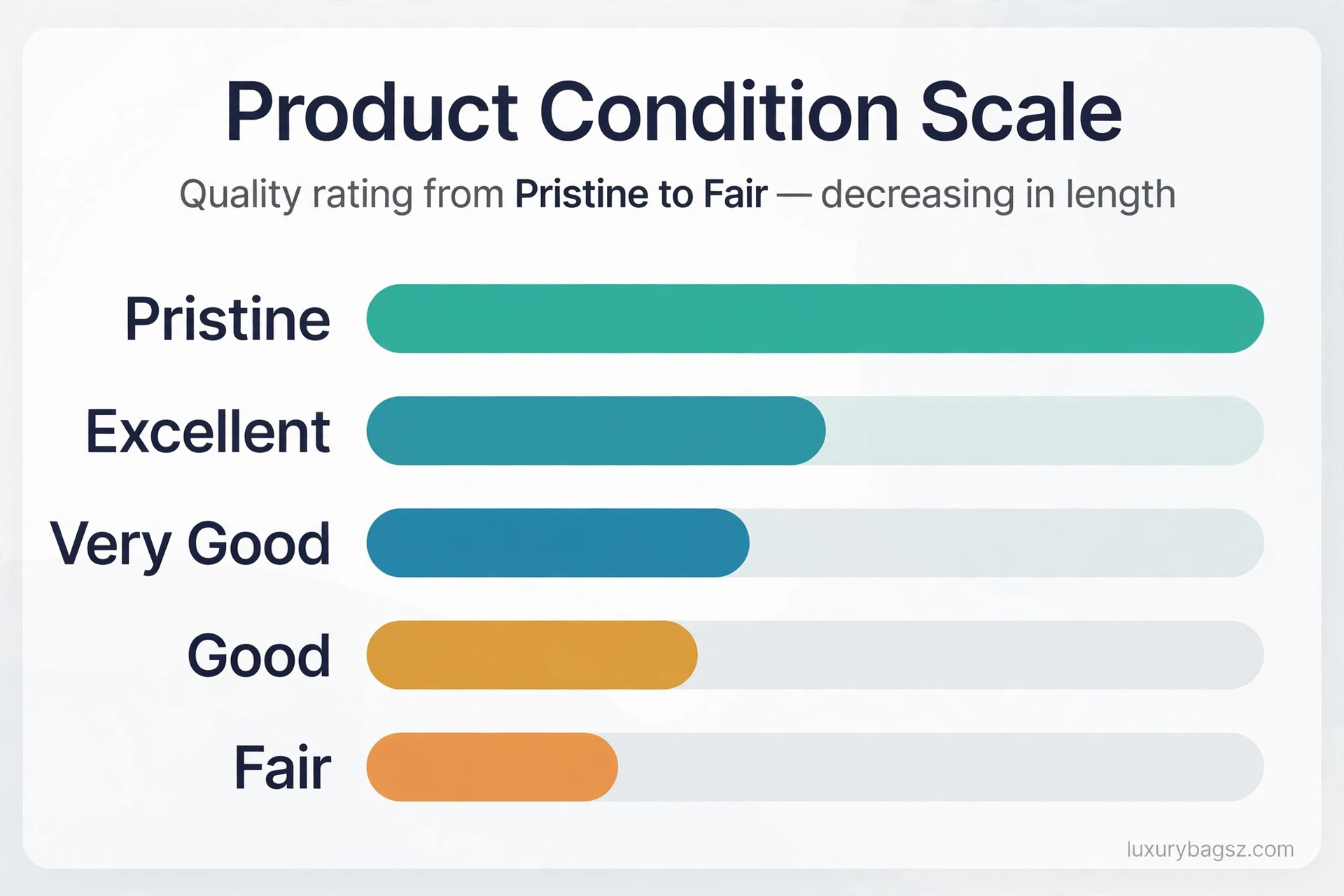
- The core ladder runs New or Unworn, Pristine or Like New, Excellent, Very Good, Good, then Fair or Well-Loved.
- Photos and written condition notes matter more than the grade word, especially at the Excellent versus Very Good boundary.
- One flaw in a critical zone — cracked handles, sticky lining, replaced hardware — can drop a whole grade.
- Grade bands roughly track price: Pristine near 85 to 95 percent of market value, down to Fair or Vintage near 20 to 40 percent, per one selling guide's ladder.
Why Grades Mislead
One word cannot carry where wear sits, how deep it runs, or whether it can be repaired. Graders also differ: a platform team, a professional seller, and a private seller grade with different care. Use the grade to filter, and the photos and notes to judge.
The Core Ladder, From New to Fair
New or Unworn (never carried, with or without tags) sits at the top, then Pristine or Like New (no wear), Excellent (barely used), Very Good (light honest wear), Good (visible wear, still usable), and Fair or Well-Loved (heavy wear, stains, repairs, or missing pieces).
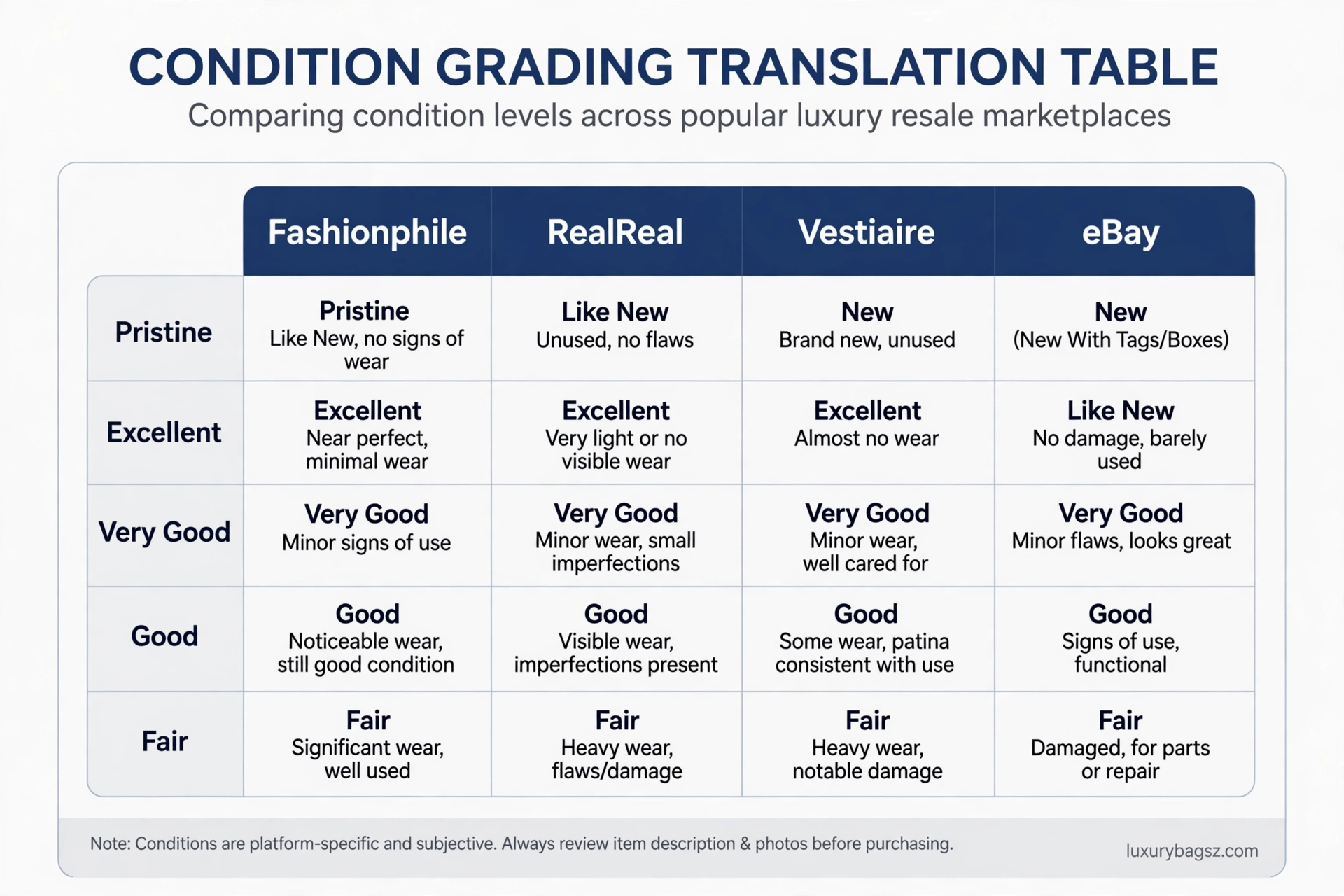
The Cross-Platform Translation Table
No competitor guide publishes this table. It is built from each platform's own definitions where they could be verified, and flagged where they could not.
| Shared meaning | Fashionphile | The RealReal | Vestiaire Collective | eBay (pre-owned) |
|---|---|---|---|---|
| Never worn, tags attached, full set | New | Pristine | Never Worn (where offered) | New with tags |
| Never worn, tags missing, no wear | New without tags (as listed) | Excellent | Very Good or Never Worn, by listing | New without tags |
| Barely used, at most faint marks | Excellent | Excellent | Very Good | Pre-owned — Excellent |
| Light honest wear, lightly worn corners | Very Good | Very Good | Very Good | Pre-owned — Excellent to Good |
| Visible wear, scuffs, hardware marks | Good | Good | Good | Pre-owned — Good |
| Heavy wear, stains, repairs, missing pieces | Fair | Fair | Fair | Pre-owned — Fair |
Fashionphile's own public grade glossary could not be verified in a full read for this guide; secondary coverage describes its range as New through Very Good to Fair, so that column is the commonly reported mapping, not a quoted official glossary. eBay's options are coarser, so a bag a specialist would call Very Good may appear as Excellent or Good on eBay.
Vestiaire grades by defect type: Very Good allows corner defects, dyed leather, and spots; Good adds discoloration, holes, pilling, and scratches or oxidation; Fair adds pulled threads, and hygiene defects cancel a sale. Use the table to translate, never to equalise.

What Each Platform Actually Means
The RealReal's published standards are clearest: Pristine means no wear plus tags, box, and dust bag; Excellent means clearly unused without them; Very Good means lightly worn corners or creased leather. On eBay, the seller's photos and notes are decisive, since its options are broad.
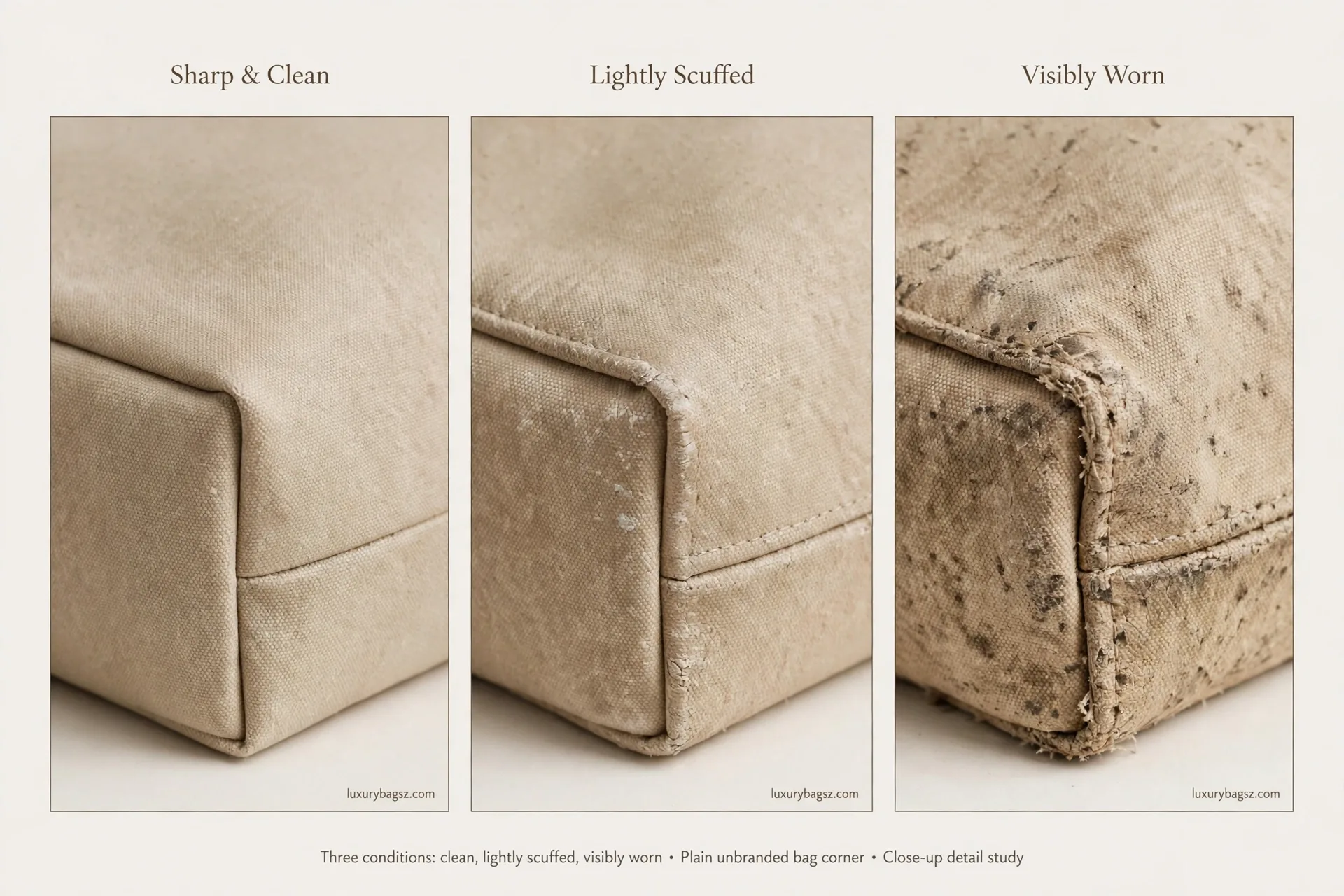
Photo Examples: What Each Grade Looks Like at the Corner
Picture one base corner in daylight. Pristine: sharp, unbroken edge paint. Excellent: sharp, at most a faint mark in close light. Very Good: softened edge, slight colour lightening. Good: plain scuffing and colour loss. Fair: deep scuffing, exposed piping, cracking, or visible repair. Handles and hardware follow the same arc.
Where Wear Matters Most: The Four Zones
Corners first: the most honest wear signal. Handles second: skin-oil darkening is very hard to reverse. Lining third: pen and makeup marks signal how the whole bag was treated. Hardware fourth: worn-through gold plating reads as heavy use. Behind all four, structure: a sagging bag has lost function.
Grade-to-Price Bands: What Each Grade Should Cost
One selling guide's ladder, as a share of market value: Pristine 85–95 percent, Excellent 70–85, Very Good 55–70, Good 40–55, Fair or Vintage 20–40. On a $2,000 value, that is roughly $1,700–$1,900 down to $400–$800. Brand, model, rarity, colour, and completeness shift every band.
How Material Changes the Grade
Lambskin shows scratches quickly, so light corner wear may already mean Very Good, while caviar with the same wear may still read Excellent. Canvas cracks near folds (structural, not cosmetic); suede marks plainly; exotic skins dry or crack if stored badly. For a Chanel example, our Classic Flap vs Boy comparison shows caviar and lambskin side by side.
The Self-Grading Checklist, and What Drops a Grade
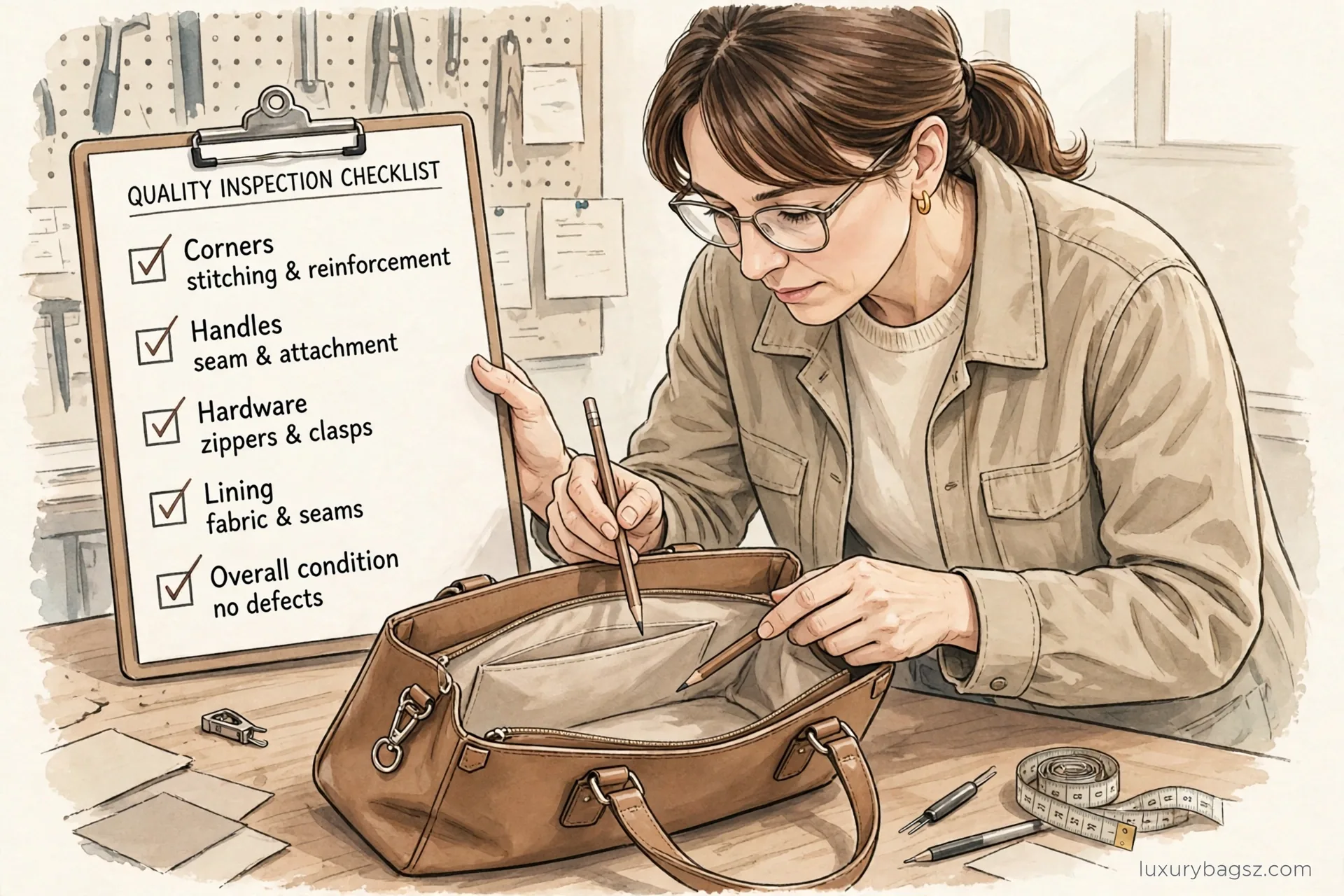
Grade in order: structure, corners, handles, hardware, exterior, interior, odour, completeness, restoration. Apply the lowest-zone rule: the grade cannot exceed its worst critical zone by more than one step. Cracked handles, sticky lining, and replaced hardware cost a full grade; corner scuffs and light marks cost less. Write the grade as a sentence and photograph every flaw.
New With Tags, New Without Tags, and Unworn but Aged
New With Tags means never worn with tags and usually full packaging. New Without Tags means unworn but missing tags or packaging, which costs money and certainty. Unworn but aged is trickiest: poor storage can dry or crack leather despite no carrying. Grade on present state, and ask for storage history.
Restoration, and When the Delivered Bag Grades Below Its Listing
Light disclosed work (spa clean, conditioning) may leave a grade unchanged; heavy work (redyeing, re-lining, replaced hardware) should cap it, and undisclosed restoration is a misgrading. If a delivered bag grades below its listing, photograph it beside the listing photos, keep it unused, and report zone by zone in writing, diarising both the return window and the chargeback deadline.

Grading as a Buyer: Questions Worth Asking
Ask for zone-by-zone grading, what would drop the grade one step, and separate answers on odour, storage, and repairs. Ask for a photo of the weakest zone, not the best angle, and ask who stands behind the grade.
Gentle, material-correct cleaning preserves a grade; harsh cleaning can create wear, as our guides on how to clean Chanel bags and how to clean a Hermès canvas bag show.
Frequently Asked Questions
Is there a standard grading system for pre-owned luxury bags?
No. There is no industry-wide standard, and labels are not interchangeable across sellers or platforms. Judge every listing by its photos and written condition notes.
What is the difference between Pristine and Excellent?
On The RealReal's published standards, Pristine handbags show no wear and include tags, box, and dust bag, while Excellent handbags are clearly unused but lack tags, box, or dust bag.
What does Very Good condition mean for a handbag?
Light, honest wear from occasional use: lightly worn corners, slight creasing, or faint interior signs, with the bag still presenting well and functioning perfectly.
Can a Fair condition bag be worth buying?
Yes, at a fair price and with eyes open. Fair bags suit everyday carrying, restoration projects, or first-time buyers entering a brand.
How do I grade my own bag before selling?
Inspect in order — structure, corners, handles, hardware, exterior, interior, odour, completeness, restoration — apply the lowest-zone rule, write the grade as a sentence, and photograph every flaw.
Does restoration lower a bag's grade?
Heavy restoration such as redyeing, re-lining, or replaced hardware should cap the grade and be disclosed. Light professional cleaning may leave a grade unchanged if disclosed.
Why do two bags with the same grade look different?
Because graders, materials, and wear locations differ, and one word cannot carry where wear sits or how deep it runs. Compare zone-by-zone photos, not grade words.
What should I do if a bag arrives in a lower grade than listed?
Photograph it at once beside the listing photos, keep it unused, and report the difference zone by zone in writing inside the return window. Diary the separate chargeback deadline too.
Are eBay condition grades the same as Fashionphile or RealReal grades?
No. eBay's pre-owned options are broader — Excellent, Good, and Fair — so a bag a specialist would call Very Good may appear as Excellent or Good on eBay.
What is the difference between New With Tags and New Without Tags?
New With Tags means never worn with original tags attached and usually full packaging. New Without Tags means the item itself is unworn but tags or packaging are missing.
Conclusion
Grades are a starting point, not a verdict. They help you filter hundreds of listings, but they cannot replace photos, zone notes, and your own judgement.
Translate across platforms with care, calibrate your eye with corner and handle photos, grade zone by zone, and treat any gap between label and evidence as a reason to ask, negotiate, or walk away.
Buy the bag the photos show, at the price its true grade supports, and you will rarely be disappointed by a label again.






