

What to Know Before Buying Your First Raw Denim: Fit, Weight, and the First Wash
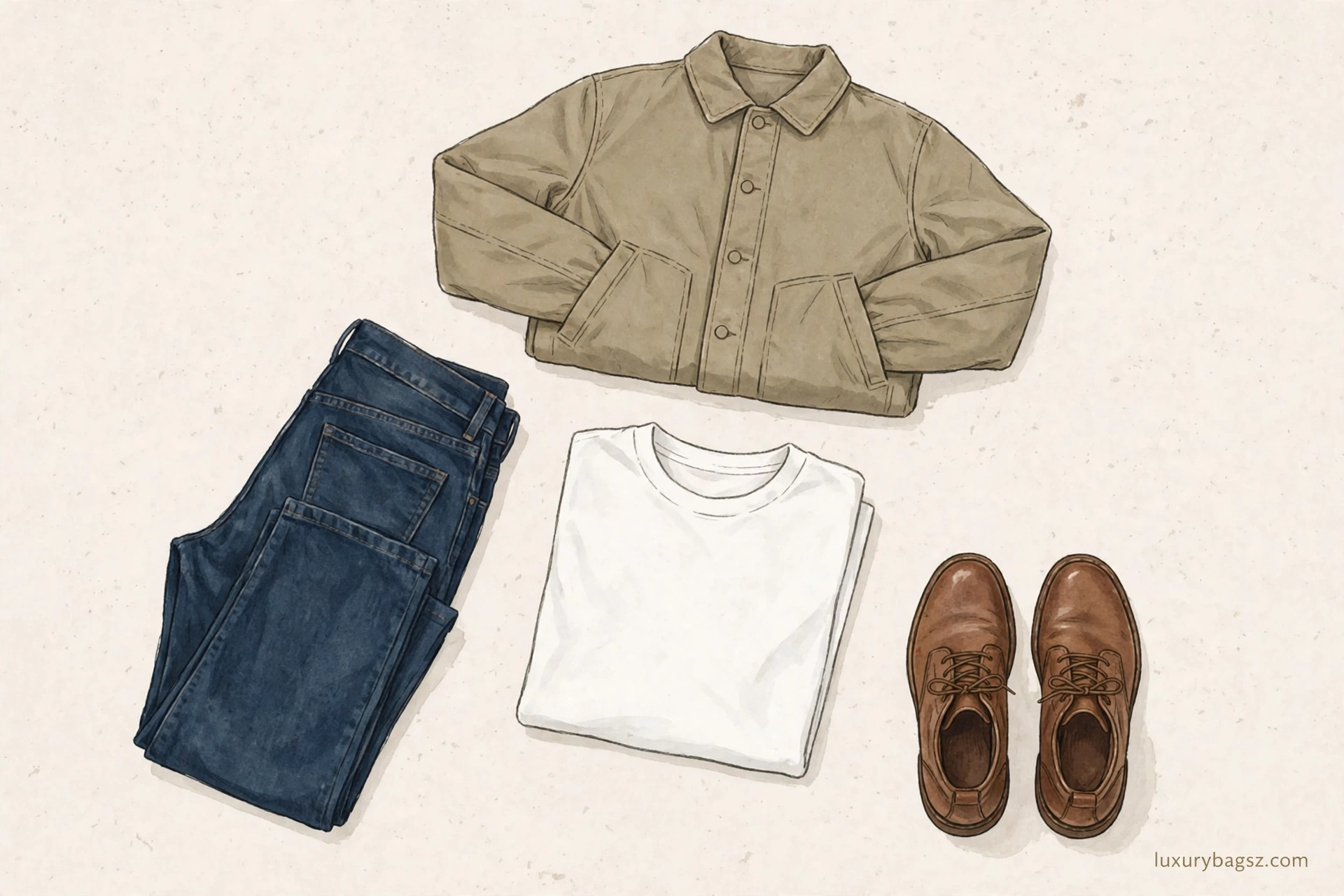
Your First Pair, in Short
Raw denim is denim that has never been washed, softened, or faded in a factory. It arrives stiff, very dark, and a little unforgiving, and it softens into a pair shaped by how you actually live in it.
Buy it snug rather than comfortable, in a midweight fabric of about 12 to 15 ounces, and in a straight or slim-straight cut. That combination suits the most bodies, the most wardrobes, and the widest range of weather.
Then wear the jeans often, for three to six months, before the first wash. That patience is what lets sharp creases and personal fades form instead of a soft, washed-out pair that looks like everything else on the rack.
Key Takeaways
- Raw means unwashed and untreated after dyeing, not a brand name or a guarantee of quality.
- Buy snug: rigid raw denim usually relaxes about half a size in the waist and thigh as it breaks in.
- Start at 12 to 15 ounces. Lighter is easier; heavier takes real commitment to break in.
- Sanforized jeans barely shrink. Unsanforized jeans can shrink 5 to 10 percent, so size up.
- Measure your best-fitting jeans and compare numbers, not just the size on the label.
- Wait three to six months before the first wash, then wash cold, inside out, and hang dry.
- Freezing jeans does not clean them. Airing them out does far more than a night in the freezer.
- If you hate stiff fabric, hate waiting, or need stretch, raw denim may not be your pair yet.
What Raw Denim Actually Is
Most jeans are washed, sanded, or chemically treated after dyeing so they feel soft and look worn before you buy them. Raw denim skips all of that. The fabric keeps its full stiffness and its full indigo colour, and every mark that appears later comes from real wear.
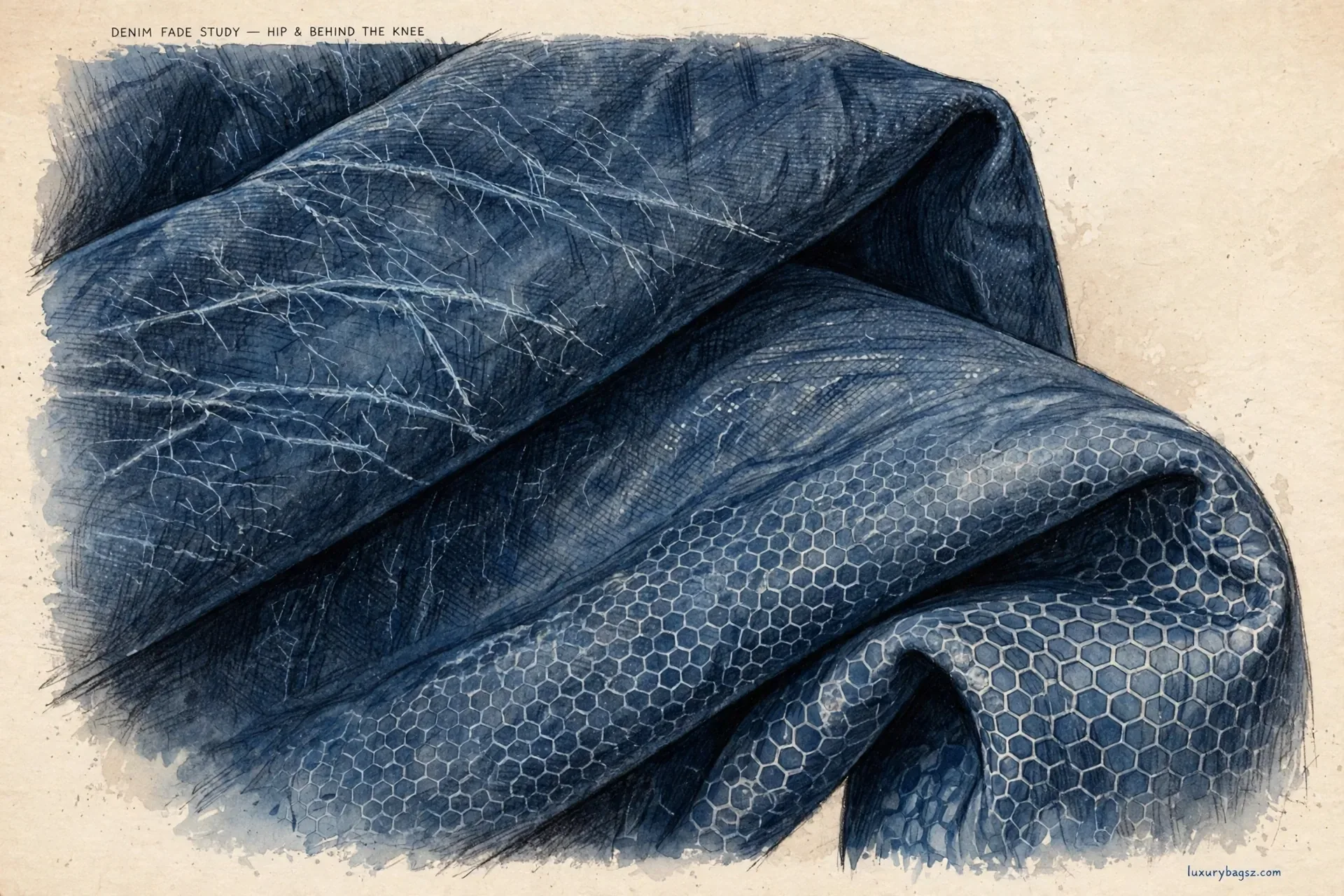
That is the whole appeal. Indigo dye sits mostly on the surface of the cotton yarn, with a pale core underneath. As you bend, sit, and walk, the surface dye rubs away at crease points and slowly reveals lighter blue, then white.
The result is a pair that records your life: whiskers fanning from the hips, honeycomb creases behind the knees, a faded wallet outline, a paler patch where a phone sits. No two pairs fade the same way, because no two people move the same way.
Raw is not the same as selvedge, and the two words are mixed up constantly. Selvedge describes how the fabric was woven, on a narrow shuttle loom that finishes its own edge. Raw describes whether it was washed. You can buy raw denim that is not selvedge, and selvedge denim that has already been washed.
Raw is also not automatically better denim. It is a starting point, not a quality grade. A cheap pair of raw jeans can still have weak stitching, thin pocket bags, and poor pattern work, while a washed pair from a good maker can last for years.
Judge the jeans on fabric, construction, and fit first, and treat "raw" as one choice among several. The unwashed state is what gives you the fades, but it does not rescue a badly cut pair.
Sanforized or Unsanforized: The Sizing Decision That Matters Most
Almost every fabric shrinks the first time it gets wet, and denim is no exception. Sanforization is a steaming and pressing treatment that pre-shrinks the fabric before it is cut and sewn, so the finished jeans shrink very little afterwards.
Most ready-to-wear raw denim is sanforized, and that is good news for a first pair. You can buy close to your usual size, allow for the usual break-in stretch, and wash without a nasty surprise.
Unsanforized denim, often sold as "shrink-to-fit," skips that treatment. Expect shrinkage of roughly 5 to 10 percent on the first wash, which can mean up to two inches in the waist and a noticeable loss of length.
If you choose unsanforized, size up, usually by one waist size and one length, and read the maker's own guidance before ordering. Some makers give exact pre-wash and post-wash measurements, and those numbers matter more than any general rule.
There is a second choice hidden inside this one: whether to soak before wearing. Some buyers soak unsanforized jeans to get the shrinkage out of the way early, then wear them from their true size. Others wear them raw and let body heat and movement shape them first.
Neither approach is wrong, but soaking first does soften the early fades slightly, because the fabric moves and settles before the creases set. If sharp, high-contrast fades are your goal, wearing first and washing later gives the stronger result.
For a first pair, the simplest path is sanforized. It removes the biggest sizing gamble and lets you focus on fit, weight, and whether you actually enjoy wearing stiff denim every day.

Picking a Weight You Will Actually Wear
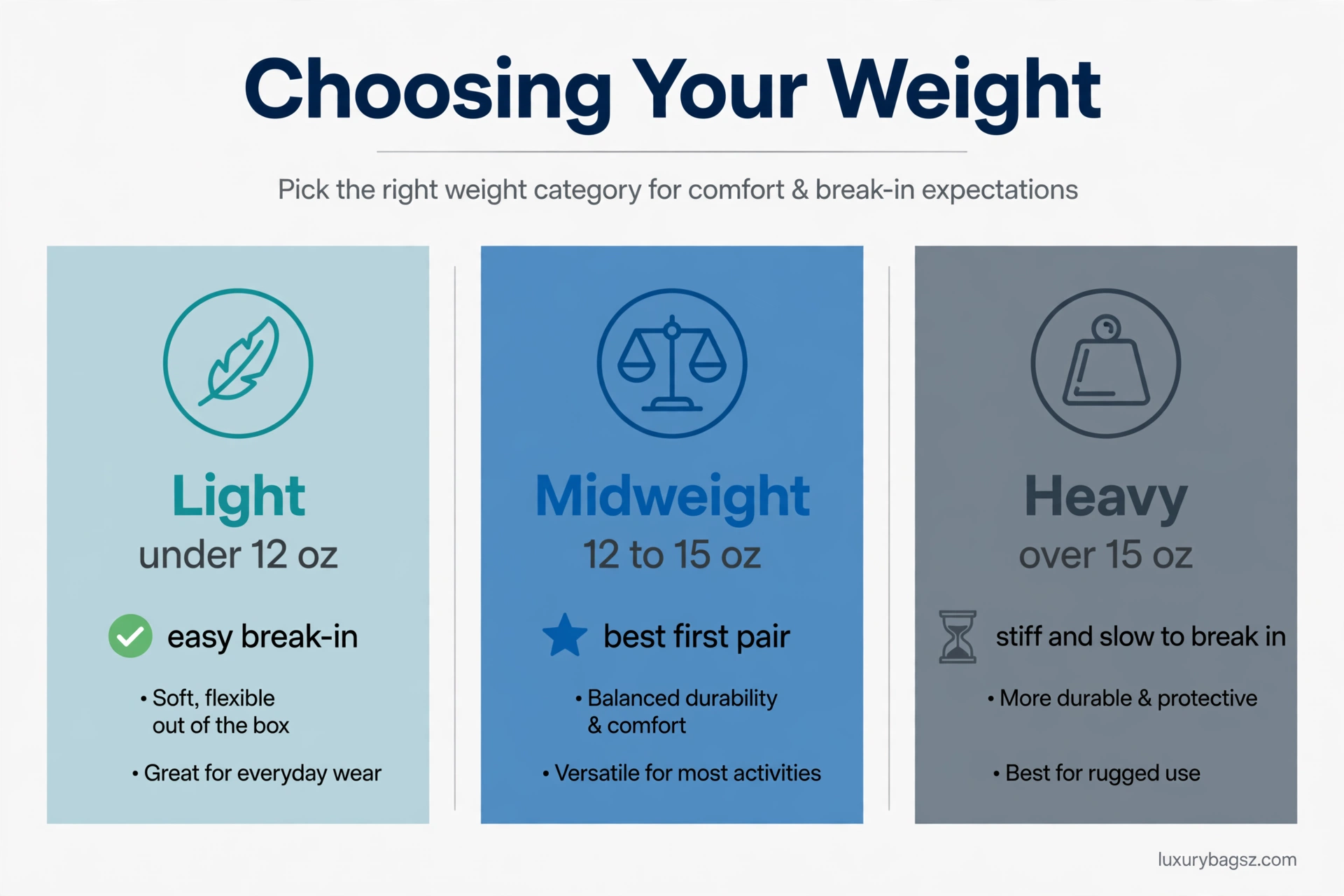
Denim weight is measured in ounces per square yard of fabric, and it tells you a lot about how a pair will feel. Light denim sits under about 12 ounces, midweight runs roughly 12 to 15 ounces, and heavy denim runs above 15 ounces, sometimes far above.
Light raw denim breaks in fastest and suits warm climates and people who dislike stiffness. Its fades tend to be softer and lower contrast, and very light fabric can wear through faster at stress points like the crotch and back pockets.
Midweight denim is the sensible first-pair choice, and rival guides agree on this point. At 12 to 15 ounces it is sturdy enough to hold sharp fades, comfortable enough to wear year-round in most climates, and not so stiff that the first two weeks feel like a punishment.
Heavy denim, from about 16 ounces upward, holds fades longer and feels almost like armour when new. Some enthusiasts love weights in the 20-ounce range and beyond, but those jeans can take months to soften, and they are a poor test of whether you like raw denim at all.
Climate matters as much as toughness. A 15-ounce pair that feels fine in a cool autumn can feel heavy in a humid summer, while a 12-ounce pair may feel thin if you wear jeans through a cold winter. If you live somewhere hot, lean toward the lighter end of midweight.
Also check whether the denim has stretch. True rigid raw denim is 100 percent cotton. A small amount of elastane makes jeans far more forgiving, but it also changes how fades form and how much the fabric recovers. For a first raw pair, rigid cotton teaches you what raw denim is.
Fit and Measurements: Numbers Beat Size Labels
Fit matters more with raw denim than with almost any other trouser purchase, because the jeans will loosen as they break in and then settle into your shape. A pair that feels perfect in the shop often feels loose after a month, while a pair that feels tight on day one often ends up just right.
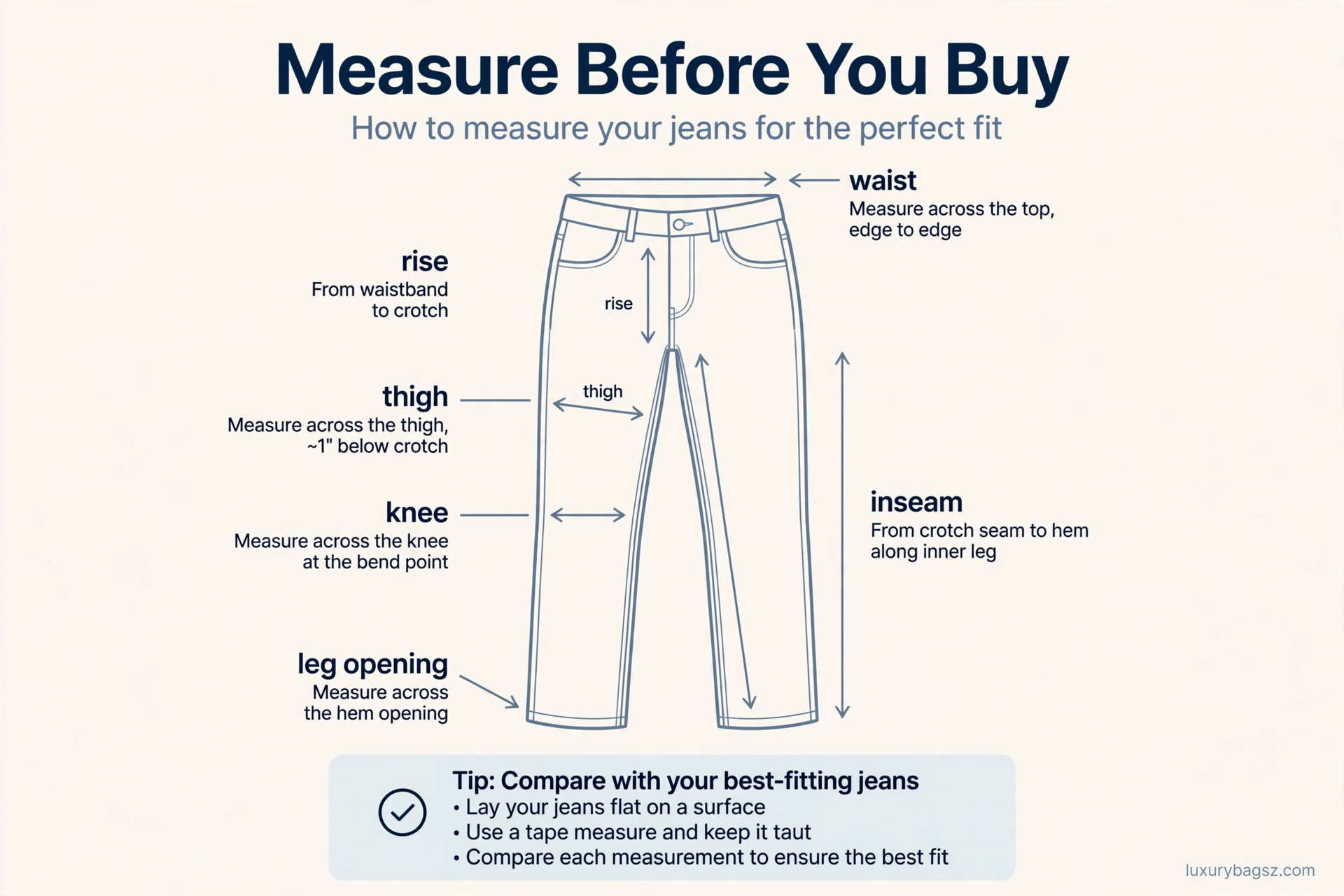
Start with your best-fitting jeans, not your body measurements alone. Lay them flat, measure them with a tape, and write the numbers down. The six numbers that matter are waist, rise, thigh, knee, leg opening, and inseam, and almost every raw denim retailer lists the same numbers for its jeans.
Compare those numbers directly, brand by brand, because a size 32 in one brand can measure very differently from a size 32 in another. Vanity sizing, different cuts, and different shrinkage allowances all make the label unreliable on its own.
When you try a rigid pair on, it should feel snug through the waist and thigh, but not painful. You should be able to button it without straining, sit down without the waistband digging hard, and walk without the thighs pulling. If it is already comfortable, it will probably stretch into a loose fit.
Pay attention to the rise as well as the waist. A low rise sits on the hips and can feel tight when you sit, while a mid or high rise gives more room through the seat and stays put when you bend. Rise is a comfort choice, not a fashion rule, and it affects fades around the hips.
For the leg, a straight or slim-straight cut is the safest first choice. It pairs with boots, trainers, and dress shoes, it shows the selvedge line neatly if you cuff, and it does not exaggerate the stiffness the way a skinny cut does or swamp your shoes the way a very wide cut can.
Finally, decide on length before you buy. Raw denim hems are often chain-stitched, and a good tailor can reproduce that finish, but it costs money and takes time. If you plan to cuff, buy a longer inseam; if you plan to hem, confirm the shop can chain-stitch before you cut.
Selvedge, Slub, Nep, and Other Words on the Label
Selvedge denim is woven on an old-style shuttle loom in narrow rolls, usually about 30 inches wide, with a finished, coloured edge that stops the fabric unravelling. Turn up the cuff and you will see that clean edge, often with a red or white line running through it.
That edge is a sign of how the fabric was made, not a promise of better fades. Many of the most interesting mills do use shuttle looms, but plenty of good non-selvedge denim exists, and some selvedge denim is woven from ordinary yarn. Buy the fabric, not the coloured line.
Slub refers to uneven thickness in the yarn, which shows up as subtle horizontal texture and irregular fading. Some buyers love heavy slub because it gives a rougher, more vintage look. Others prefer a clean, even surface that fades more smoothly. Neither is better; it is a texture preference.
Nep is the small, snow-like flecks of fibre that stick out from the fabric surface. A little nep adds character and a slightly rustic look. A lot of nep can look speckled, and it is worth seeing a photo of the actual fabric before you order a heavily nep-textured pair.
Twill direction is another label detail that affects fading. Most denim uses a right-hand twill, where the diagonal line runs one way. Left-hand twill feels softer and fades a little differently, and broken twill avoids the leg-twisting that can happen with a strong twill direction.
None of these details should drive your first purchase on their own. They matter once you know you like raw denim and want a second pair with a different character. For the first pair, weight, fit, and sanforization matter far more than twill direction or nep count.
What a First Pair Should Cost
Raw denim costs more than ordinary jeans, because the fabric is usually heavier, the production runs are smaller, and the construction is often better. That does not mean you need to spend a fortune on your first pair, and spending more does not guarantee a better break-in.
A sensible first-pair budget sits around $150 to $250, the range rival buying guides repeatedly point to for entry-level raw denim from respected makers. At that price you can get solid Japanese or American-milled fabric, chain-stitched hems, and honest measurements.
Below that range, check the details carefully. Thin pocket bags, single-needle hems where a chain stitch is claimed, and vague fabric descriptions are all warning signs. Above that range, you are usually paying for rarer fabric, a specific mill, or a smaller workshop, not for a fundamentally different pair of jeans.
Watch for hidden costs too. Hemming can cost $20 to $40 if you need a chain stitch, and a first wash that goes wrong can cost you the pair. Buying from a retailer with a clear exchange policy matters more with raw denim than with stretch jeans, because sizing is harder to guess.
Be wary of paying a premium for distressing on a "raw" pair. If the jeans arrive already faded, sanded, or ripped, they are not raw in the sense this guide uses, however the label describes them. True raw arrives dark, stiff, and unmarked.
Finally, do not buy two pairs at once. Wear the first pair for a few months, learn what you like and dislike about the weight, rise, and cut, and then buy the second pair with that knowledge. The second pair is almost always the better one.
The Break-In: What the First Weeks Really Feel Like
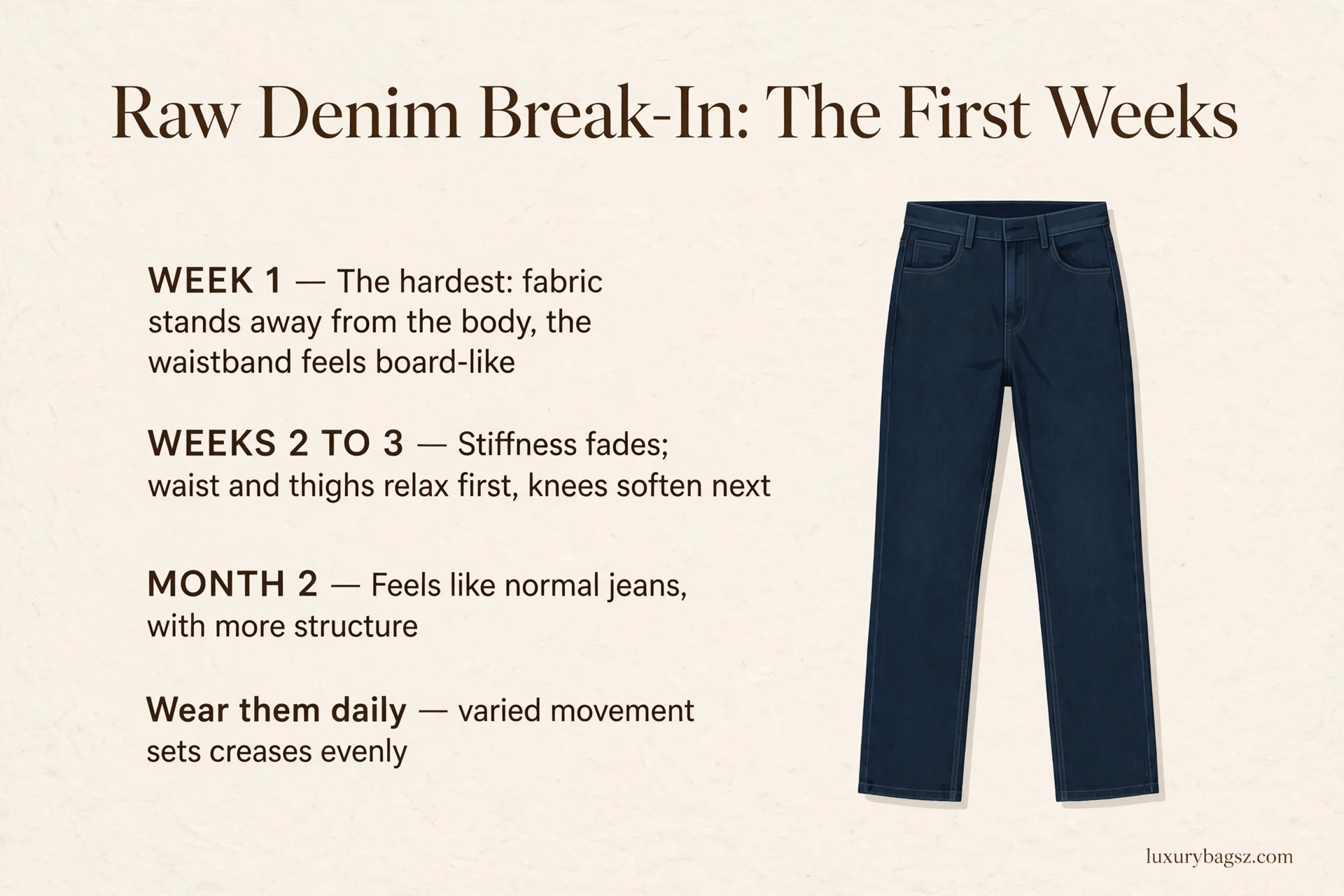
The first week in rigid raw denim is the hardest part, and it is worth knowing that in advance. The fabric stands away from the body, the waistband can feel board-like, and sitting for a long day can leave creases pressed into your skin.
That stiffness fades with wear, usually noticeably within two to three weeks of regular use. The waist and thighs relax first, the knees soften next, and the fabric gradually drapes instead of holding its own shape. By month two, most pairs feel like normal jeans with more structure.
Wear them as much as you can during this period. Daily wear builds creases faster and more evenly than wearing them once a week, and varied movement matters: walking, sitting, cycling, and crouching all set different crease lines. A pair worn only at a desk fades differently from a pair worn everywhere.
Watch out for indigo transfer, known as crocking, in the early weeks. New raw denim rubs blue dye onto light shoes, light bags, pale car seats, and white furniture. Keep light-coloured items away from fresh jeans for the first few wears, and check your shoes after a long day.
Smell is a common worry, and the advice around it is often silly. Freezing jeans does not kill the bacteria that cause odour in any meaningful way; cold pauses them, and they return once the jeans warm up. Airing the jeans overnight, ideally outside the wardrobe, does far more.
If the jeans get genuinely dirty, spot-clean the mark rather than washing the whole pair. A damp cloth and a little mild soap on the spot protects the fades elsewhere. Save the full wash for when the pair truly needs it, or when the fades have set enough to survive it.
The First Wash and Everyday Care
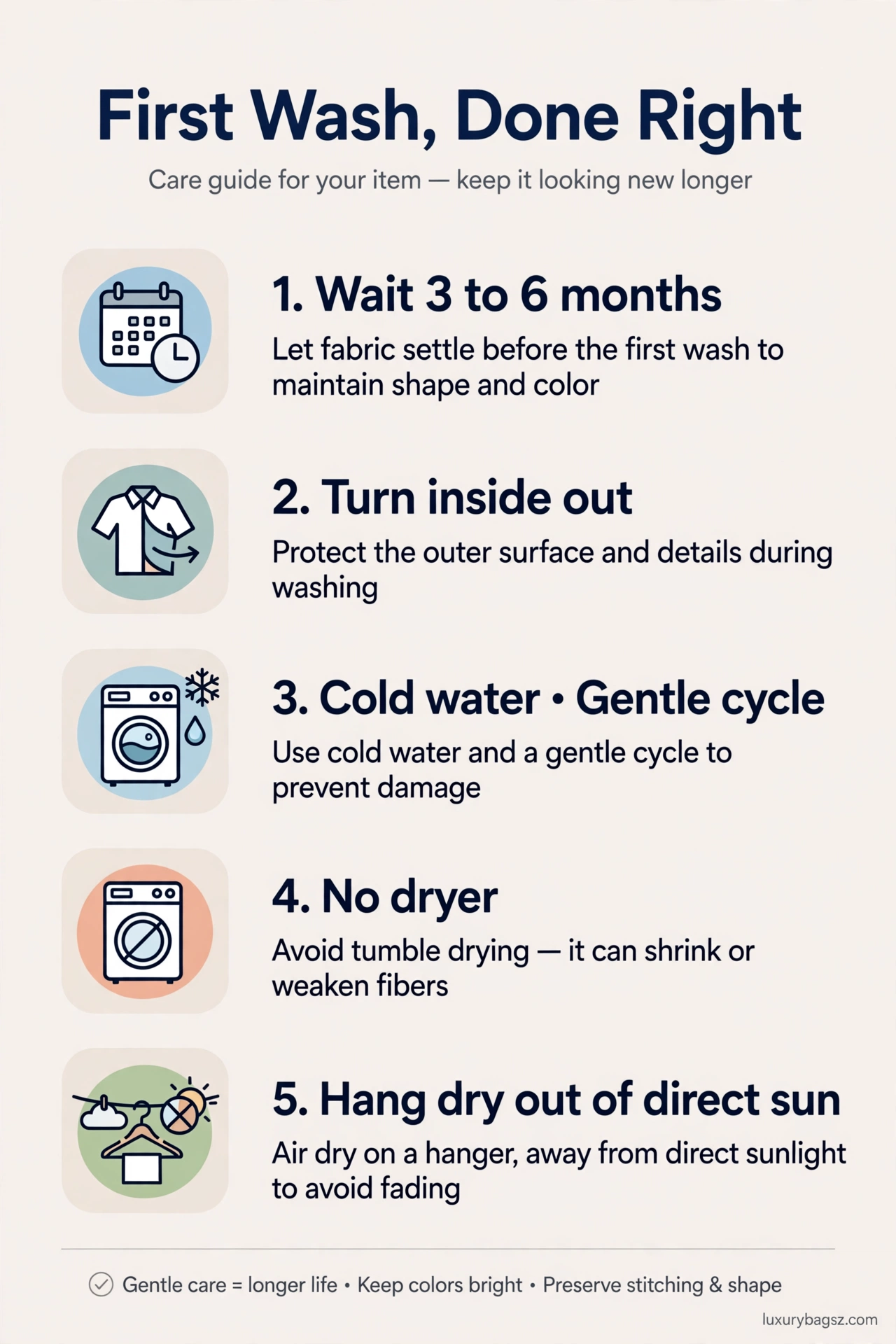
The standard advice is to wait three to six months before the first wash, and it exists for a reason. Every wash softens the fabric and blurs the creases that have started to form, so washing early gives you a softer pair with weaker, less defined fades.
When the time comes, turn the jeans inside out before washing. That protects the outer surface from friction against other clothes and keeps the fades sharper. Wash alone or with similar dark items, on a cold, gentle cycle, with a small amount of mild detergent.
Skip the dryer entirely. Hang the jeans to air dry, out of direct sun, which can fade indigo unevenly and stiffen the fabric. They will feel stiff again when dry, and that is normal; they soften within a wear or two.
Some enthusiasts hand-wash in a bathtub for maximum control, soaking the jeans in cool water, gently agitating them, and rinsing clean. That method works well, but it takes time and a clean tub, and a machine on gentle gives a very similar result for most buyers.
After the first wash, you can relax the rules a little. Most broken-in raw denim only needs washing every few months, not every few wears, and many owners wash two to four times a year. Judge by dirt and smell, not by a calendar, and keep washing cold and gentle throughout.
Repairs deserve a note here too. The crotch seam and back pockets are the usual first failure points, and a good tailor can reinforce them before they blow out. Catching a thinning spot early is far cheaper than repairing a full tear, so check those areas when you wash.
Mistakes That Ruin a First Pair, and When to Skip Raw
The most common mistake is buying too big. Shoppers used to stretch jeans buy their comfortable size, then watch the rigid pair relax into a baggy fit that never sharpens into good fades. Buy snug, trust the break-in, and exchange early if the waist truly will not button.
The second mistake is washing too soon. A wash in week two, because the jeans feel stiff or smell faintly, erases the early crease work and leaves a pair that looks washed rather than worn. Air them, spot-clean them, and wait until the fades have had time to set.
The third mistake is choosing heavy denim to prove a point. A 21-ounce pair sounds impressive, but if it sits in the wardrobe because it is too stiff to enjoy, it will never fade at all. The best raw denim is the pair you actually wear, not the heaviest pair you own.
The fourth mistake is ignoring the rest of your wardrobe. Dark raw denim pairs with almost everything, but it also transfers dye, so white trainers, a pale suede bag, and a light sofa are all at risk in the first month. Plan around that, or wear the jeans with darker shoes until the crocking settles.
Sources disagree on how often to wash after break-in, and on whether to soak unsanforized jeans before wearing. That disagreement is honest: both choices produce good jeans, just with slightly different fades. Pick the routine you will stick to, and stop chasing a single perfect method.
Raw denim is not for everyone, and that is fine. If you need stretch for comfort or mobility, if you wash jeans after every wear, or if you want a soft pair from day one, a washed selvedge or a stretch pair will make you happier. Raw rewards patience; it punishes anyone who wants instant comfort.
Frequently Asked Questions
How long should I wear raw denim before the first wash?
Aim for three to six months of regular wear. That gives creases time to set so the wash sharpens rather than erases them. If the jeans get truly dirty, spot-clean instead of washing the whole pair.
Should I size up or down in raw denim?
For sanforized rigid denim, buy snug, as it relaxes about half a size in the waist and thigh. For unsanforized denim, size up by about one waist size and one length to allow for 5 to 10 percent shrinkage.
What weight is best for a first pair of raw denim?
Midweight, about 12 to 15 ounces, is the best first choice. It holds fades well, works in most seasons, and breaks in without the long struggle of heavy denim.
Does raw denim stretch?
Yes, rigid cotton raw denim relaxes with wear, mainly in the waist, seat, and thighs, but it does not stretch and recover like elastane blends. Buy for the broken-in fit, not the out-of-the-box fit.
Is selvedge denim the same as raw denim?
No. Selvedge describes weaving on a shuttle loom with a finished edge. Raw describes denim that has not been washed. A pair can be one, both, or neither.
Will raw denim stain my shoes and furniture?
Yes, at first. New indigo rubs off onto light surfaces, a process called crocking. Avoid pale shoes, bags, and furniture for the first few wears until the transfer settles.
Does putting jeans in the freezer clean them?
No. Freezing pauses odour-causing bacteria but does not remove dirt or kill them reliably. Airing the jeans overnight and spot-cleaning marks works better.
How do I wash raw denim without ruining the fades?
Turn them inside out, wash cold on a gentle cycle with mild detergent, and hang dry out of direct sun. Never use the dryer, and wash only when the jeans truly need it.
How much should my first pair of raw denim cost?
Budget around $150 to $250 for a solid first pair from a respected maker. Cheaper pairs can work, but check stitching and fabric details carefully before buying.
Can I wear raw denim in summer?
Yes, if you choose a lighter weight, around 12 to 13 ounces, and a breathable cut. Heavy raw denim above 16 ounces is much harder to enjoy in hot, humid weather.
Final Verdict
A good first pair of raw denim is a midweight, sanforized, straight-cut pair bought snug and worn hard for months before washing. Get the measurements right, accept the stiff first weeks, and let the fades come from your own life rather than a factory finish. If that sounds like a project you will enjoy, raw denim will reward you with a pair no one else owns. If it sounds like a chore, buy washed denim and enjoy it from day one.






