How Distressed Denim Is Made: Inside a Jeans-Fading Factory
The Worn Look, Made on Purpose
Distressed denim is denim that has been deliberately faded, abraded, frayed, or ripped during manufacture so that a new pair looks worn. The wear is made in the factory, not earned by the owner, using dry abrasion, laser finishing, and wet washes.
The trick works because indigo dye sits on the surface of the cotton yarn like a ring, with a white core underneath. Rub, burn, or chemically strip that surface away and the pale core shows through, exactly as it does after years of real wear.
A fading factory is therefore a mix of craft and chemistry: workers with sandpaper and templates, laser machines running digital patterns, giant washers full of stones, and spray booths where chemicals lighten the fabric in seconds.
Key Takeaways
- Distressing removes surface indigo to reveal the white yarn core, copying real wear patterns.
- Dry methods include hand sanding, whiskering, and laser finishing; wet methods include stone, enzyme, bleach, and acid washes.
- Whiskers sit at the hips, honeycombs behind the knees, stacks at the ankle, and train tracks along seams.
- Laser finishing is the most precise and repeatable method, and it uses far less water than washing.
- Sandblasting with silica is now banned or avoided by responsible makers because of the lung disease risk to workers.
- Good distressing keeps the fabric strong; bad distressing leaves thin, fragile patches that tear early.
- Pre-distressed jeans start life weaker than raw jeans, so expect a shorter lifespan from heavy rips.
From Finished Jeans to the Fading Floor
Distressing happens after the jeans are sewn, not before. A finished, usually dark indigo pair arrives at the laundry or finishing plant, gets inspected, and is sorted by style, size, and the exact finish the brand ordered.
That order matters more than most shoppers realise. A brand sends a sample pair, or a detailed specification, showing exactly where each fade should sit and how strong it should be. The factory's job is to reproduce that sample hundreds or thousands of times.
Workers first mark the jeans. Templates, chalk lines, and pins show where whiskers should fan, where the knees should pale, and where a rip or repair should go. Without those guides, hand work drifts from pair to pair and the range looks inconsistent on a shop rail.
The jeans are then put on forms, mannequins, or inflatable legs that mimic a body in motion. This step is crucial: a fade placed on a flat pair often lands in the wrong place once the jeans are worn. Forms let the finisher see where real creases would fall.
Only then does the actual distressing begin, usually dry work first, then wet washing, then a final drying and quality check. The order varies by factory, but dry-then-wet is the common pattern, because washing softens the sharp edges left by sanding and makes the finish look lived-in rather than scraped.
Dry Work: Sanding, Whiskering, and Scraping by Hand
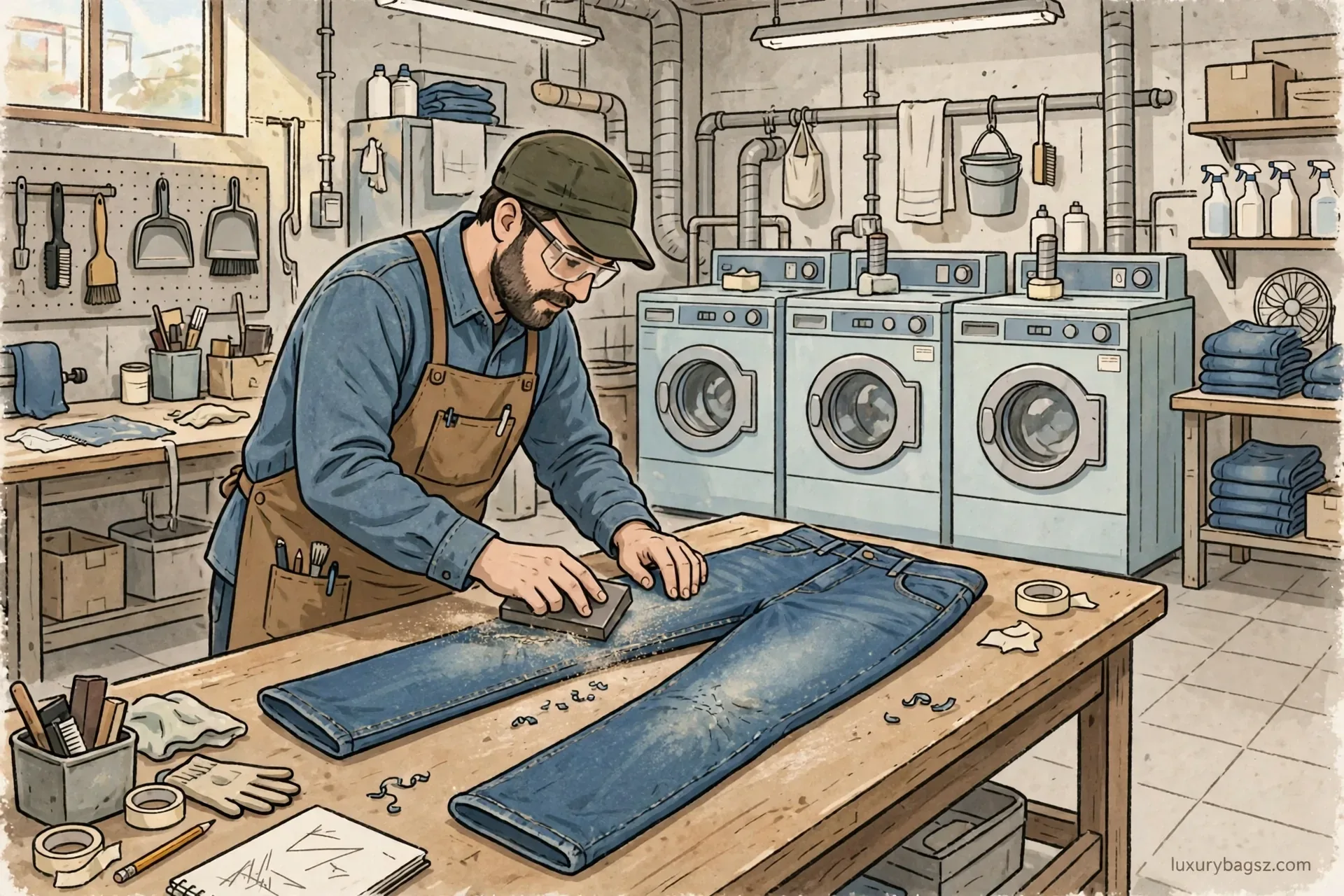
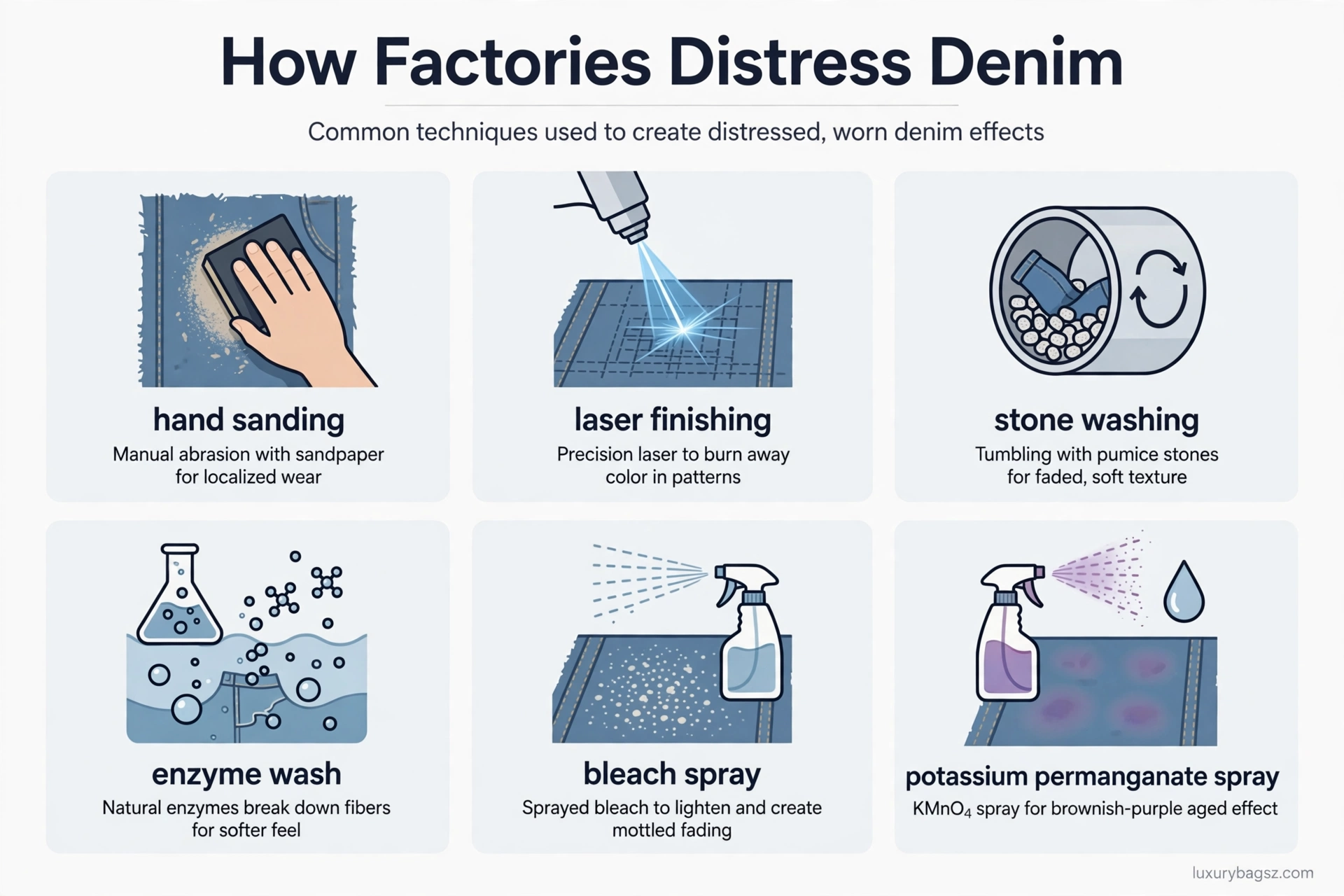
Hand sanding is the oldest distressing method and still the most artisanal. A worker rubs sandpaper, an abrasive block, or a rotary tool over the fabric until the indigo surface wears away and the pale core shows through.
Whiskering is a special case of hand sanding. The worker sands fine, radiating lines into the hip and crotch area, copying the creases that form where the body bends. Good whiskers are uneven, with varied lengths and depths, because real creases are never perfectly regular.
Scraping goes further than sanding. A blade or coarse abrasive removes more fibre, creating a rougher, more broken surface, often around pockets, hems, and fly edges. It is used for heavier vintage looks where the jeans should seem battered rather than gently faded.
Hand work is slow, and that is both its strength and its weakness. A skilled finisher can read the fabric and adjust pressure on the spot, producing a pair that looks genuinely worn. But two workers will never sand exactly alike, so hand-heavy finishes vary more from pair to pair.
That variation is part of why factories moved toward lasers for large orders. Hand sanding survives where a brand wants an artisanal story, a small run, or a finish too irregular for a machine to fake convincingly.
Wet Washes: Stone, Enzyme, Bleach, and Acid
Stone washing tumbles jeans in giant industrial washers with pumice stones. The stones batter the fabric, eroding indigo and softening the denim at the same time. Stone size, wash time, and drum speed set how strong the fade is.
It is the classic method behind the soft, pale jeans of the 1980s, and it still appears in many mid-price ranges. The downside is wear on the machines, stone dust in the wastewater, and a fairly even fade that can look less targeted than hand work or lasers.
Enzyme washing uses biological enzymes, usually cellulases, to break down surface fibres and loosen indigo without stones. It gives a softer hand feel with less mechanical damage, and it is often sold as the more eco-friendly option, though it still uses water and energy.
Bleach and acid washes use oxidising chemicals to strip colour quickly. A bleach spray lightens specific areas, while a full bleach wash pales the whole pair. Acid washing, famously, soaks pumice stones in bleach and tumbles them with the jeans, giving a high-contrast, mottled look.
Potassium permanganate spray is the chemical behind many sharp, local fades. Sprayed onto whiskers, knees, or pocket edges, it oxidises the indigo in minutes, then must be neutralised and rinsed out thoroughly. Left in the fabric, it weakens fibres and can leave a yellowish cast.
Each wet method trades control against damage. The stronger the chemical or the longer the wash, the paler the result and the weaker the cotton. Factories balance that trade against the brand's specification and the fabric's starting strength.
Laser Finishing: The Machine That Changed the Factory
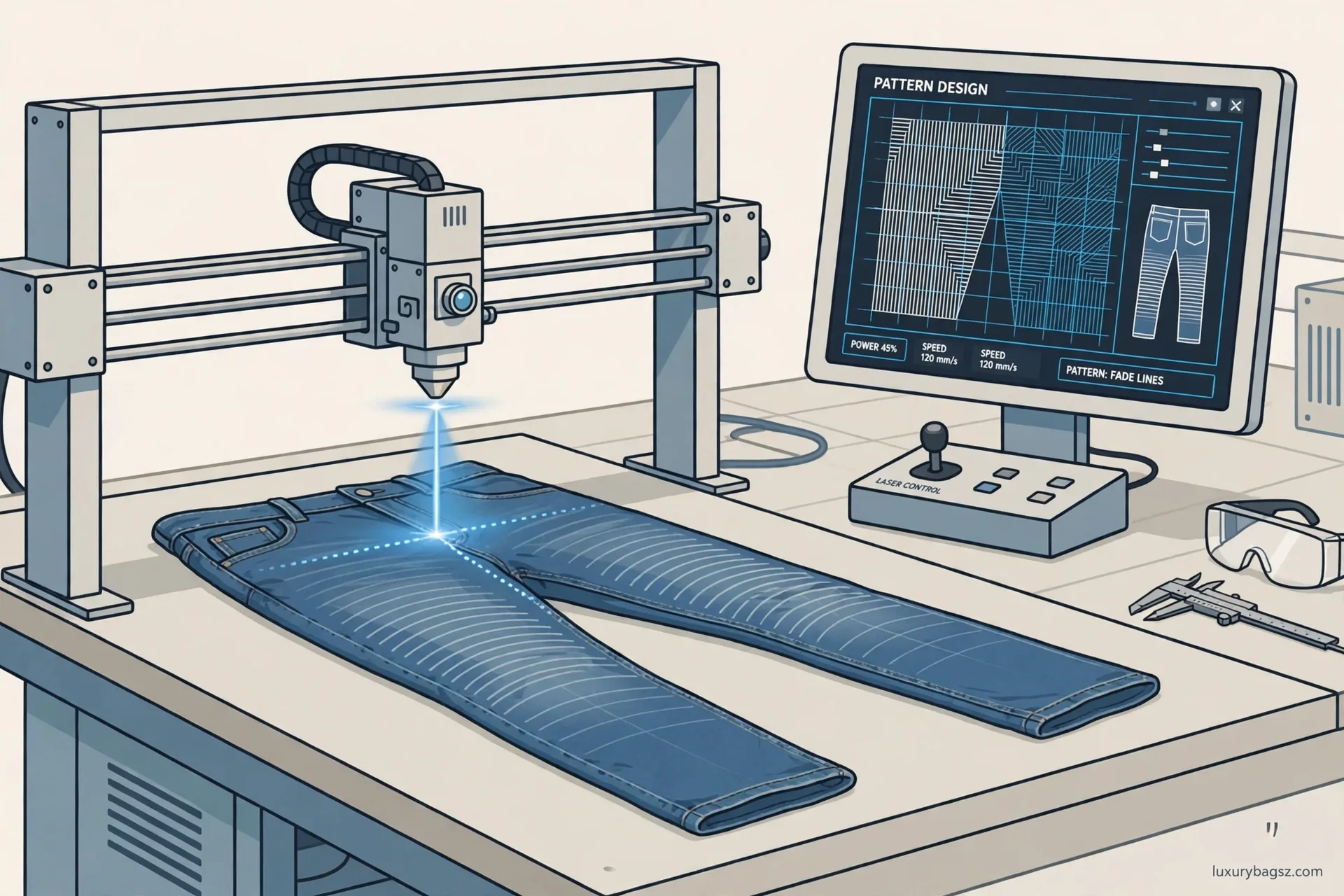
Laser finishing uses a computer-controlled beam to burn away surface indigo in a precise digital pattern. Designers draw the fade in software, map it to the garment's seams and stress points, and the laser reproduces it on every pair, down to thread-level detail.
Speed is the first advantage. What takes a hand finisher an hour or more, a laser can do in minutes, with no variation between pairs. For a brand ordering thousands of identical jeans, that consistency is worth more than any artisanal story.
Water savings are the second advantage. Laser work is dry, so it can replace several wet wash cycles. Industry claims put the saving at up to 90 percent less water for the fading step, though the total water footprint of a pair, including cotton growing and dyeing, remains large.
Calibration is where factories succeed or fail. The laser's intensity, focus, and pulse length must match the denim weight, stretch content, and desired effect. Set it too hot and the fabric scorches or thins; set it too cool and the fade looks faint and printed rather than worn.
Lasers also have limits. They work best on indigo denim, they struggle to reproduce the soft, three-dimensional feel of hand sanding, and they cannot create a real rip or a frayed edge on their own. Most laser-finished jeans still get hand work for rips, repairs, and hems.
For shoppers, a laser finish is not a quality mark on its own. It means the fade will match the sample closely, but it says nothing about the underlying fabric, stitching, or whether the jeans will last.
The Wear Patterns Factories Copy
Every distressed pair copies the same small set of real wear patterns, and knowing their names helps you judge whether a pair looks plausible or painted on.
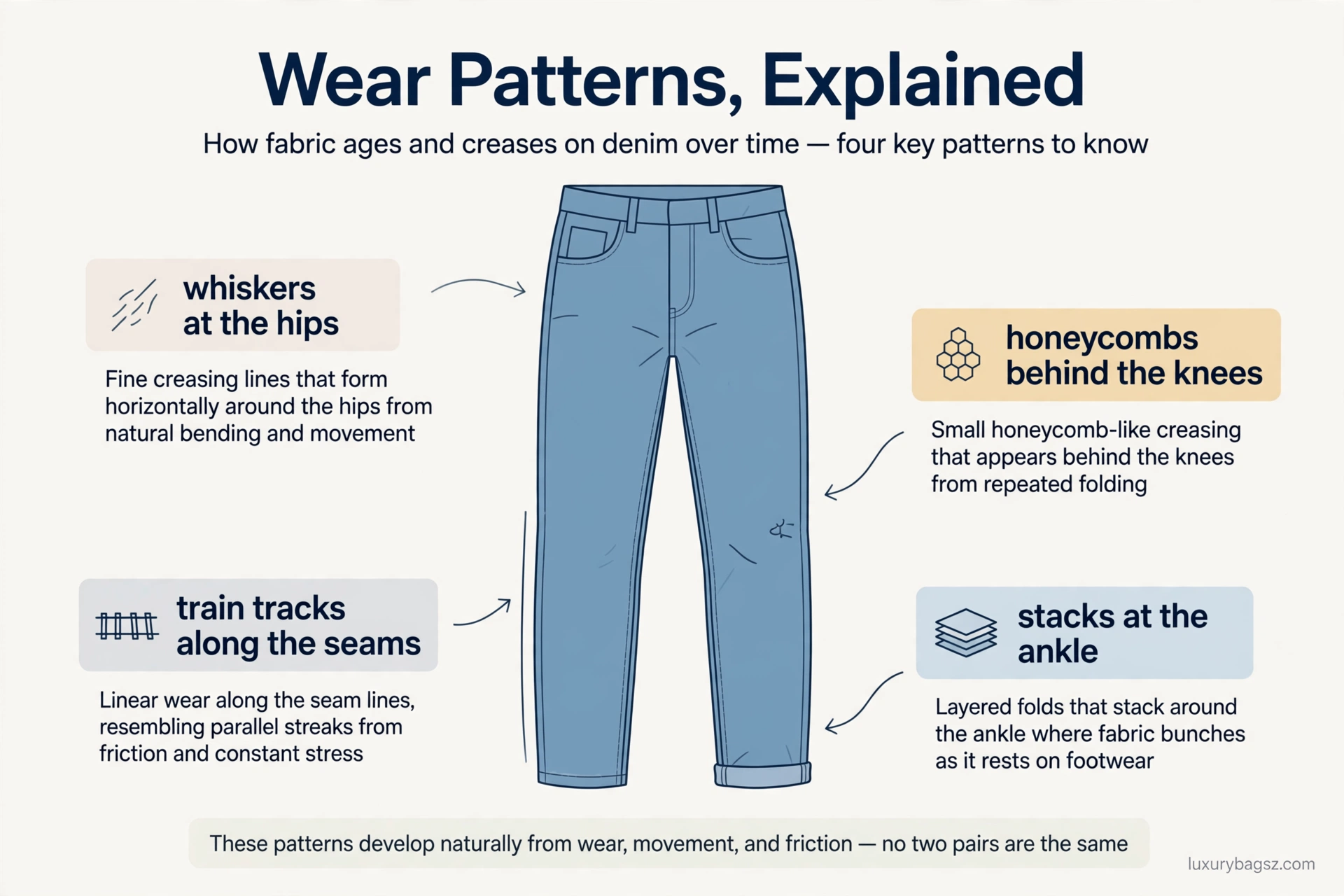
Whiskers are the radiating crease lines at the front hips and crotch, formed by sitting and walking. On a real pair they fan unevenly, with some lines deeper than others, and they follow the body's shape rather than running in perfect parallel rows.
Honeycombs are the diamond-lattice creases behind the knees, formed by bending the leg thousands of times. They should sit exactly where the knee bends, not halfway up the thigh or down the calf, which is a common giveaway of a careless finish.
Stacks are the horizontal wrinkles above the ankle, formed when a longer inseam bunches over shoes. They look best on straight or slim jeans worn slightly long, and they should fade in soft bands rather than hard white stripes.
Train tracks are the twin faded lines that run along the outer and inner seams, where the fabric edge wears faster than the flat cloth. They are subtle on a good pair and glaring on a bad one, where they look like someone drew lines down the leg with a ruler.
Rips and holes are a separate decision. Factories cut or abrade a hole, then often back it with fabric, stitch a repair over it, or leave raw frayed edges. A rip at the knee is the classic placement, because real jeans wear through there first, while rips in random spots usually look staged.
Sandblasting, Worker Safety, and the Greener Shift
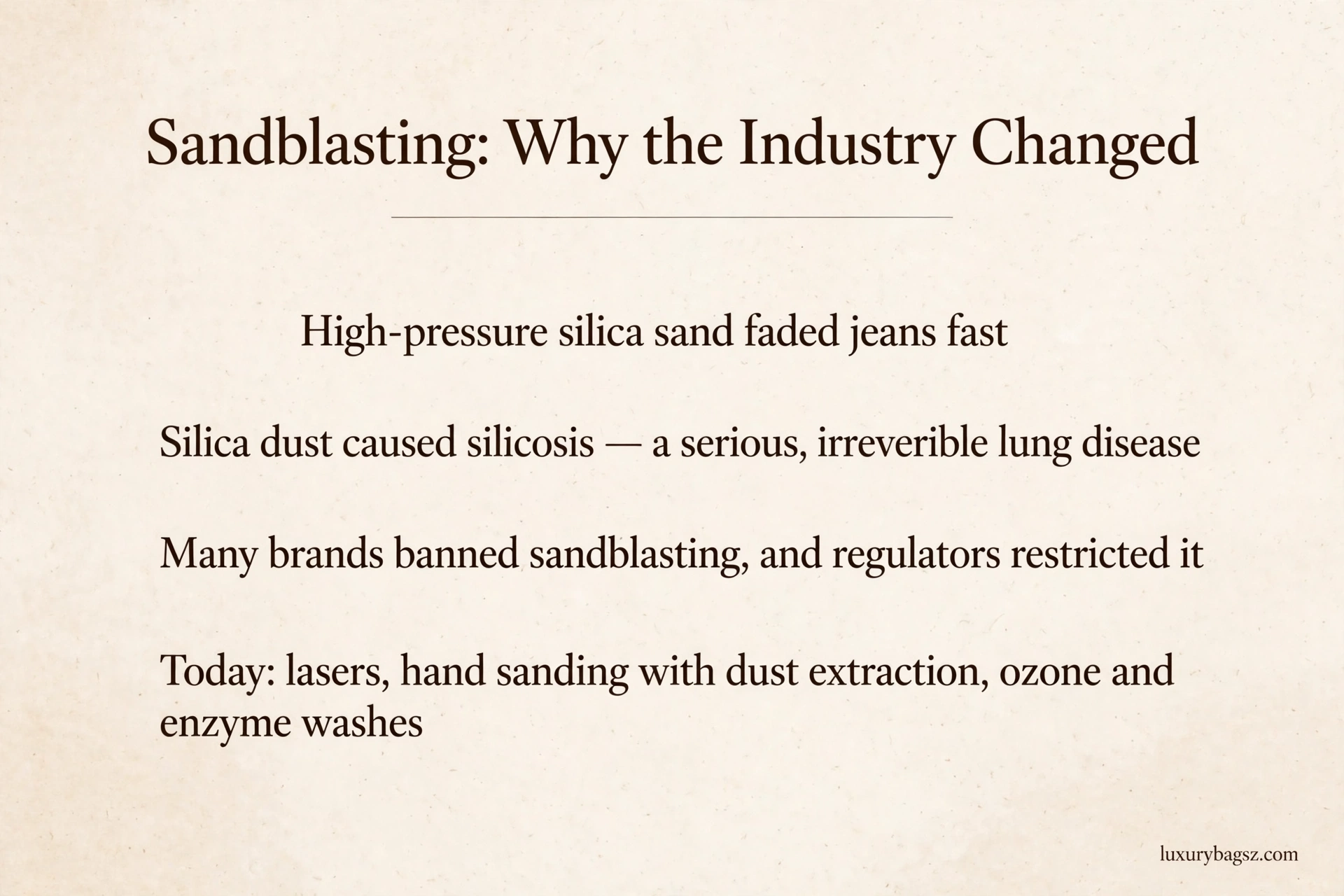
No honest factory tour can skip sandblasting, because it explains both the history of distressing and why the industry changed. High-pressure sandblasting blasted silica sand at jeans to fade them fast, and it worked brilliantly from a production view.
It also gave workers silicosis, a serious and irreversible lung disease, when silica dust was inhaled without proper protection. After investigations and campaigns in the 2000s and 2010s, many brands banned sandblasting outright, and regulators in several producing countries restricted it.
Responsible factories today use lasers, hand sanding with dust extraction, ozone, and enzyme washes instead. Ozone, in particular, fades denim in a closed chamber with far less water and no stones, though it needs careful handling and does not suit every finish.
Water remains the bigger environmental issue for most shoppers to weigh. Growing cotton for one pair of jeans can take thousands of litres of water, and repeated washing, rinsing, and chemical treatment adds more. Laser and ozone methods cut the finishing share, but they do not erase the cotton share.
When a brand claims a "sustainable" distressed pair, ask what exactly changed: less water in finishing, no sandblasting, certified chemicals, or just a marketing label. The first three are verifiable claims; the last one is not, and rival guides often repeat the label without checking.
Quality Control: Why Two Identical Pairs Can Differ
After distressing, jeans go through quality control that is stricter than for plain jeans, because the process itself can damage them. Inspectors check fade placement against the sample, look for scorched or thinned patches, and test whether seams and stress points still hold.
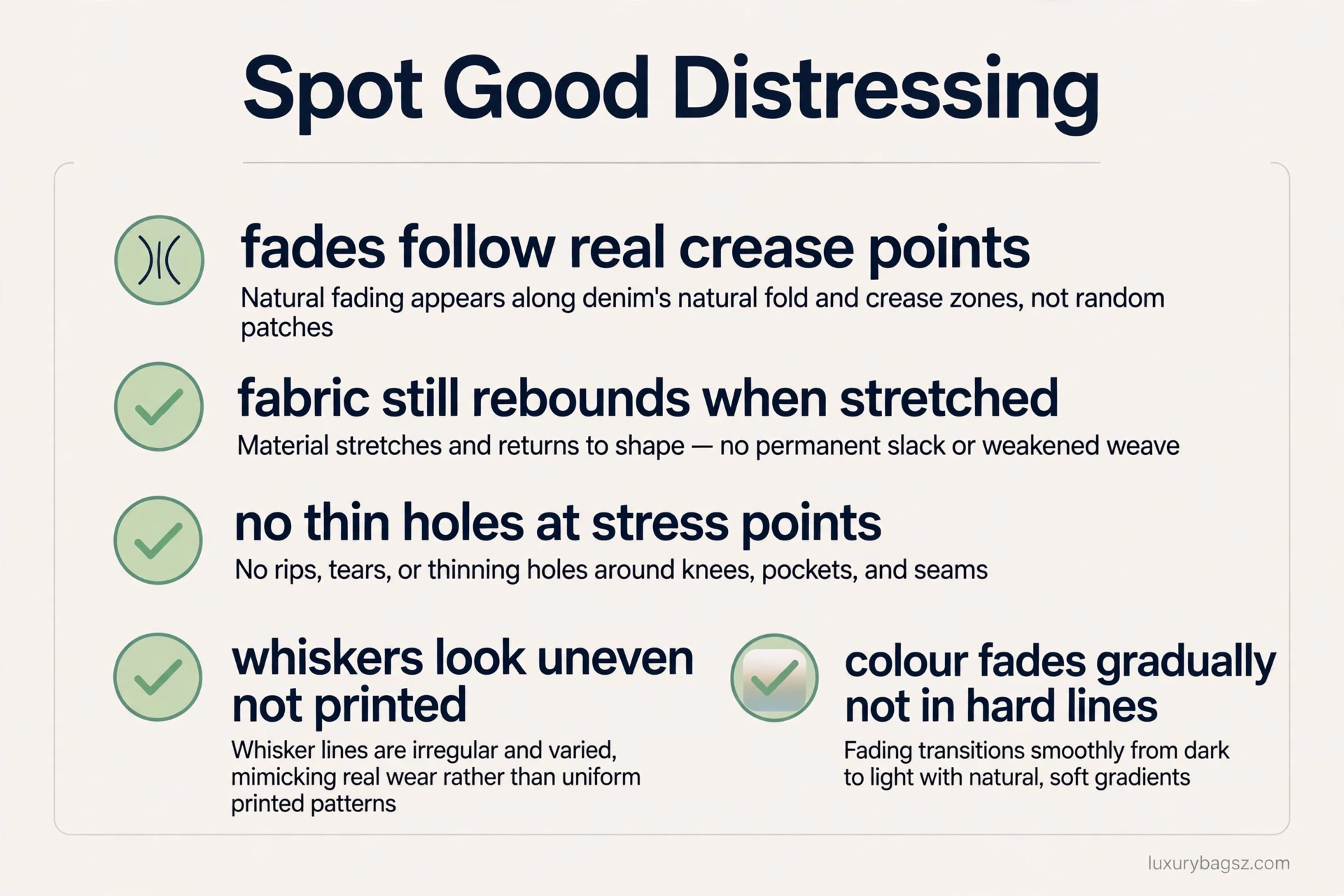
A simple shopper version of that test works well: gently stretch the fabric across a fade line and let go. Good factory distressing rebounds, because enough fibre remains. Over-distressed fabric stretches permanently, feels papery, or starts to tear along the fade.
Check the back of the fabric too, if you can. Heavy distressing that looks fine from the front sometimes shows as thin, almost see-through patches from the inside, especially at the knees and seat. Those pairs will not survive many washes.
Also check that the distressing matches the jeans' story. Fades should follow creases, rips should sit where wear happens, and the back pockets should not be paler than the seat for no reason. Random, symmetrical, or perfectly repeated patterns usually mean a printed or poorly calibrated finish.
Price is a weak guide here. Expensive distressed jeans can be over-treated, and cheap pairs can be lightly and honestly faded. Judge the fabric in your hands, not the label, and favour light or medium distressing if you want the pair to last.
Buying and Caring for Distressed Denim
Buy distressed jeans for the look, not for durability, and be honest about that trade. Every fade, rip, and wash removes some fibre, so a heavily distressed pair starts life weaker than the same jeans in raw or plain washed form.
If longevity matters, choose light distressing with no holes, or medium distressing with backed rips. Avoid pairs where the fabric already feels thin at the knees, seat, or crotch, because those are the first places to fail, and a wash will only weaken them further.
Wash distressed jeans cold, inside out, on a gentle cycle, and hang dry. Hot water and tumble drying accelerate fading and stress the weakened areas, and a ripped pair in a hot dryer can turn a small hole into a large tear in one cycle.
Repair early. A small hole can be patched from behind with iron-on or stitched reinforcement before it spreads, and many tailors offer visible sashiko-style repairs that suit the distressed look. Waiting until the hole doubles in size makes the repair bulkier and more visible.
Finally, compare distressed against raw if you want a truly personal pair. Raw denim takes months to fade but keeps its full strength and records your own movement. Distressed denim gives you the look on day one but gives you someone else's wear pattern. Neither is wrong; they are different bargains.
Frequently Asked Questions
How is distressed denim made in a factory?
Finished jeans are marked on body forms, then distressed with hand sanding, laser finishing, or wet washes such as stone, enzyme, bleach, and permanganate treatments, before a final wash and quality check.
What is the difference between distressed and destroyed denim?
Distressed denim is faded and abraded to look worn. Destroyed denim goes further, with deliberate holes, rips, and fraying. Destroyed pairs are weaker and need more careful washing and earlier repairs.
Are lasers better than hand sanding for distressing?
Lasers are more precise, repeatable, and water-efficient, which suits large orders. Hand sanding is more irregular and artisanal, which suits small runs and a genuinely worn look. Neither guarantees good fabric underneath.
Why does distressed denim cost more than plain denim?
Each extra finishing step adds labour, machine time, chemicals, and quality checks, and some pairs fail inspection and are discarded. You pay for the finishing work, not just the fabric.
Is sandblasted denim still sold?
Most responsible brands have banned silica sandblasting because of the silicosis risk to workers. If a seller still advertises sandblasting, treat that as a warning sign, not a selling point.
Does distressed denim last as long as raw denim?
No. Distressing removes fibre, so pre-distressed jeans start weaker than raw jeans. Light distressing lasts far longer than heavy rips, and gentle washing extends the life of any distressed pair.
Can I distress jeans at home?
Yes, with sandpaper, a pumice stone, or a diluted bleach spray, but home results are hard to control and easy to overdo. Work gradually, test on a hidden area, and stop before the fabric feels thin.
What are whiskers and honeycombs on jeans?
Whiskers are radiating crease fades at the hips. Honeycombs are diamond-lattice crease fades behind the knees. Both copy real wear, and both should sit where the body actually bends.
How do I wash distressed jeans without making holes bigger?
Wash cold, inside out, on a gentle cycle, and hang dry. Avoid hot water and tumble drying, which stress weakened areas, and repair small holes before they spread.
Is distressed denim bad for the environment?
It uses more water, energy, and chemicals than plain denim, mainly in washing and treatment. Laser and ozone finishing cut water use sharply, but cotton growing remains the largest water cost in any pair of jeans.
Conclusion
Distressed denim is a factory craft dressed up as an accident: sandpaper and lasers copying the creases, fades, and tears that real life would take years to make.
The best pairs respect that history, placing fades where a body bends and leaving enough fabric to last. The worst pairs print a pattern, thin the cloth, and call it vintage. Buy with your hands, check the stretch and the thin spots, and choose the wear you can live with.