

What Is a Chore Coat? Workwear’s Most Versatile Jacket
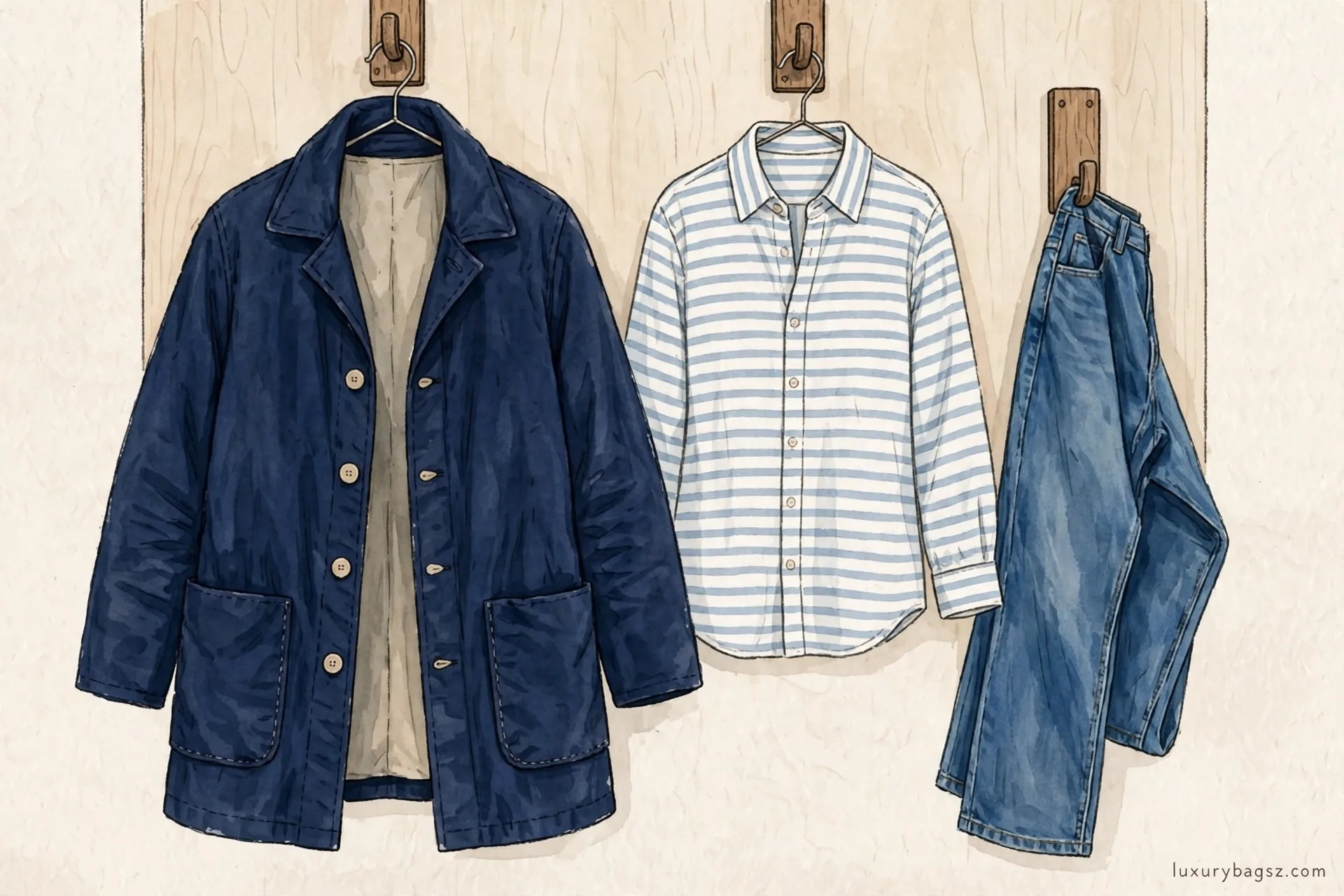
The Work Jacket That Goes With Everything
A chore coat, also called a chore jacket, is a square-cut, button-front workwear jacket with large patch pockets, made for French labourers in the 19th century and still worn today because it is tough, roomy, and plain enough to go with almost everything.
It was built for a working day: a hip-length body that moves freely, a shirt-style collar, and pockets big enough to hold tools, not just a phone and keys. That plainness is now its strength, because a coat with no logos, no padding, and no tailoring slips into casual, smart-casual, and workwear outfits alike.
If you buy one coat to cover three seasons, a chore coat in navy or olive moleskin is one of the safest choices in menswear. It is not a winter coat, not a blazer, and not a fashion statement; it is the layer you reach for when you do not want to think about what to wear.
Key Takeaways
- A chore coat is a 19th-century French work jacket, the bleu de travail, or working blue.
- Its signatures are a boxy fit, a button front, a shirt collar, a hip-length hem, and large patch pockets.
- Traditional fabrics are moleskin and cotton drill, both types of twill; canvas and wool are modern variants.
- Navy and olive are the most versatile first colours; moleskin is the classic first fabric.
- Fit is roomy by design: a sweater should fit underneath without strain, and the hem should sit at the hip.
- It works as workwear, casual wear, and smart casual, but it should be the only workwear piece in a smarter outfit.
- A chore coat with token pockets or a slim, tailored cut is a blazer in disguise, not a chore coat.
- Prices range from about $100 for good high-street versions to $300-plus for heritage makers.
From French Workwear to the Modern Wardrobe
The chore coat began as the French worker's jacket, the bleu de travail, worn by labourers, railway workers, and farmers in 19th-century France. It was dyed the deep indigo blue that gave French workwear its name, and some say that blue is the origin of the term blue collar.
The design was purely practical. There was no lining, no padding, and no pretension, because the jacket had to be cheap, tough, and easy to move in. The fit was roomy because it was worn over other clothes, and the three or four patch pockets were sized for the tools and papers of a working day.
American workers adopted a similar shape later, especially railroad men, farmers, and factory workers, who needed the same toughness and pocket space. American versions often used sturdier canvas or denim and added blanket linings for cold weather, while French versions stayed lighter and unlined.
Over the 20th century the coat moved from workshops into fashion, first through vintage and workwear enthusiasts, then through mainstream brands. A century and a half after its birth, the shape is almost unchanged, which is rare in menswear and a sign that the original design got the basics right.
Today it sits in the same corner of the wardrobe as an unstructured blazer: smarter than a casual jacket, easier than tailoring, and hardwearing enough to gain character with age. That middle ground is exactly why it suits so many outfits.
Anatomy: What Makes a Chore Coat a Chore Coat
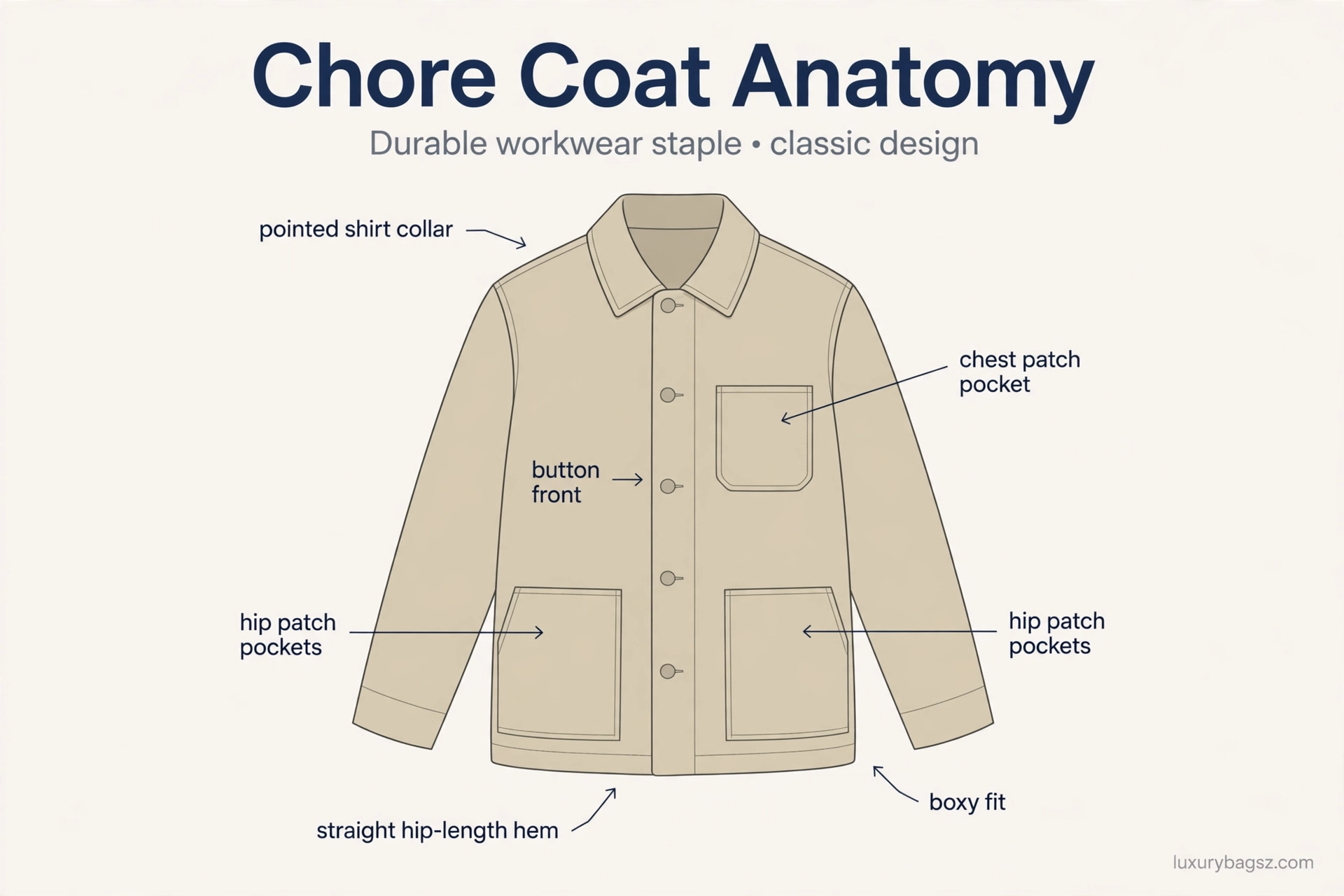
A chore coat has a small set of features, and if several are missing, you are looking at a different jacket. Learn them before you shop, and you will spot imitations quickly.
The pockets are the signature. Traditionally there are two large patch pockets at the hips and one or two on the chest, sewn on top of the fabric rather than let into it. They should be big enough to actually use; a chore coat with small, decorative pockets has lost its purpose.
The closure is almost always a button front. Zips appear on modern versions, especially lined or technical ones, but the classic coat buttons up the front, often with sturdy corozo, horn, or metal buttons that survive years of use.
The collar is a simple, pointed, shirt-style collar that can be turned up against wind or worn flat. Some versions add a corduroy collar, a nod to workwear jackets, but a plain collar is the French original and the most versatile.
The fit is straight and boxy, with a slightly dropped shoulder and a hem that falls at the high hip. It is not meant to hug the body, and it is not meant to be tailored. That boxy shape is what lets you layer a sweater underneath and move freely.
There is no lining in the classic version, no shoulder padding, and no waist shaping. The jacket is the fabric, and there is nowhere for poor cloth to hide, which is why fabric choice matters so much on a chore coat.

Fabrics: Moleskin, Drill, Canvas, and Wool
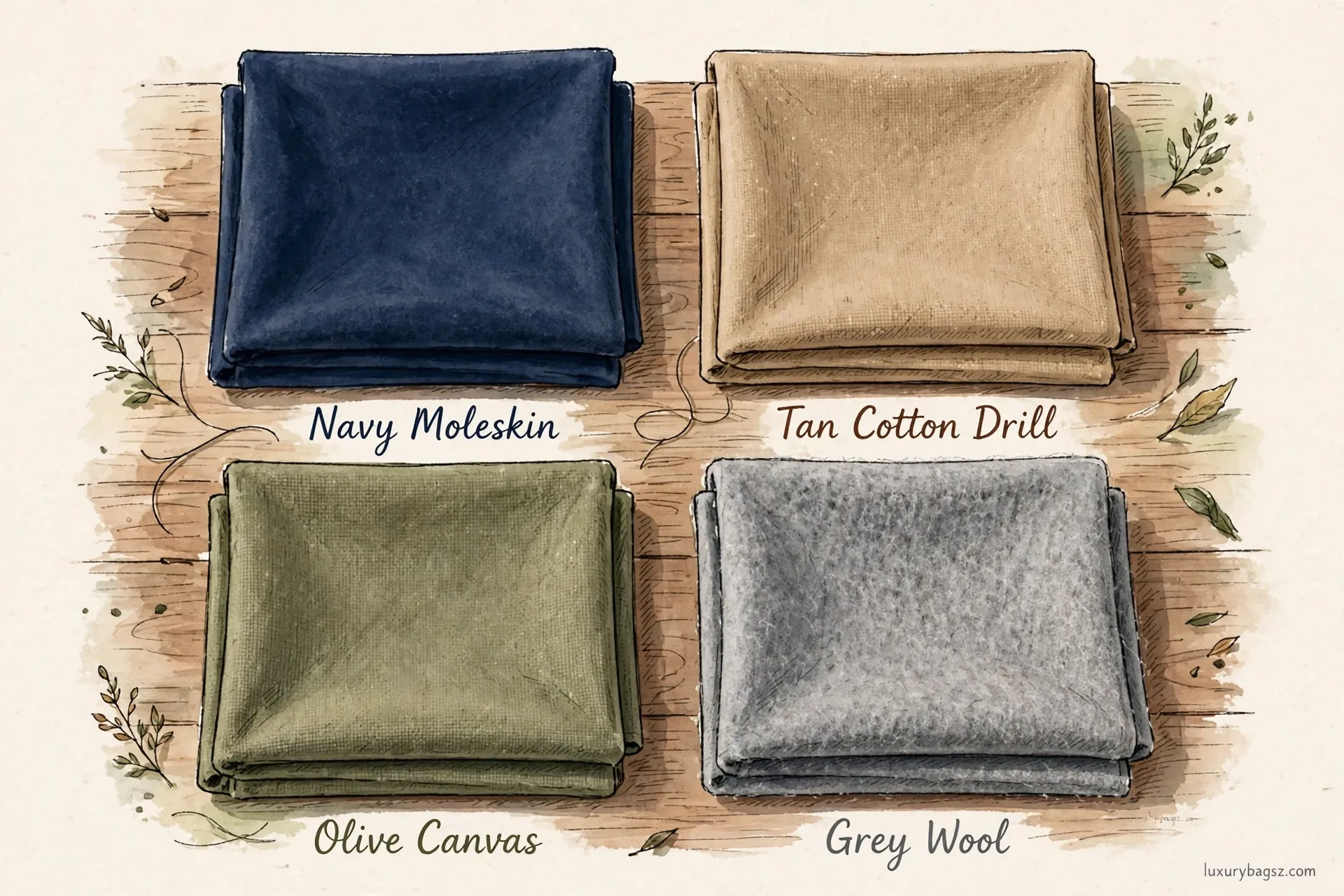
Traditionally, chore coats are made from one of two durable cotton fabrics, and both are types of twill, where the weave creates a diagonal pattern. Understanding them helps you pick the right coat for your climate.
Moleskin is the traditional chore coat fabric, and many guides call it the official fabric of the style. Despite the name, it contains no mole; it is a dense cotton twill with a short, brushed nap that feels soft, almost like suede, while remaining very tough. It drapes well, softens with wear, and suits spring and autumn best.
Cotton drill is the other classic, a sturdy, plain twill without the brushed nap. It feels crisper and more workwear-like than moleskin, holds its shape well, and often comes in tan, olive, or navy. Drill is a good choice if you prefer a crisper jacket or work in a warmer climate, where moleskin can feel heavy.
Canvas, usually cotton duck canvas, is the American workwear variant, famously used by brands such as Carhartt. It is stiff at first, very abrasion-resistant, and softens slowly with wear. A canvas chore coat is the toughest option, but also the least refined, and it suits workwear outfits better than smart-casual ones.
Wool moves the chore coat into cooler weather and a smarter register. A wool chore coat, sometimes unlined in the traditional way, looks closer to a blazer and pairs well with tailored trousers, but it needs more care and costs more. For a first coat, cotton is simpler and more forgiving.
Fabric weight matters too. A midweight cotton, roughly 300 to 400 grams per square metre, works across three seasons. Lighter fabrics suit summer evenings, while heavier canvas or wool suits late autumn, but no single chore coat covers deep winter on its own.
Fit: Roomy by Design, Not Sloppy
A good chore coat is not slim, and trying to make it slim ruins it. It should sit with a slightly dropped shoulder, a little ease through the body, and a hem around the high hip, with enough room for a sweater underneath without the buttons straining.
The usual advice is to take your normal size and check the layering, or go a size up from your blazer size if you plan to wear it as an overshirt. Both routes are legitimate, because the jacket predates the idea of a defined fit, and some wear it neat, almost as a blazer, while others size up and treat it as a shirt jacket.
Check three points when you try one on. First, the shoulder seam should sit just past your natural shoulder, not pulled inward. Second, you should be able to button it over a knit without the fabric pulling across the chest. Third, the sleeve should end at the wrist bone, with enough length to roll once if you like that workwear detail.
Length is the easiest fit mistake to make. A chore coat that falls to mid-thigh looks like a different jacket and swamps shorter wearers, while one that ends above the waistband looks like a cropped shirt. Hip length, covering the waistband by a couple of inches, is the classic proportion.
Women can wear the same shape, often in a smaller size or a women's cut with a slightly narrower shoulder, but the boxy, hip-length proportion stays the same. The coat's appeal is its plainness, and that plainness suits most bodies when the length and shoulder are right.
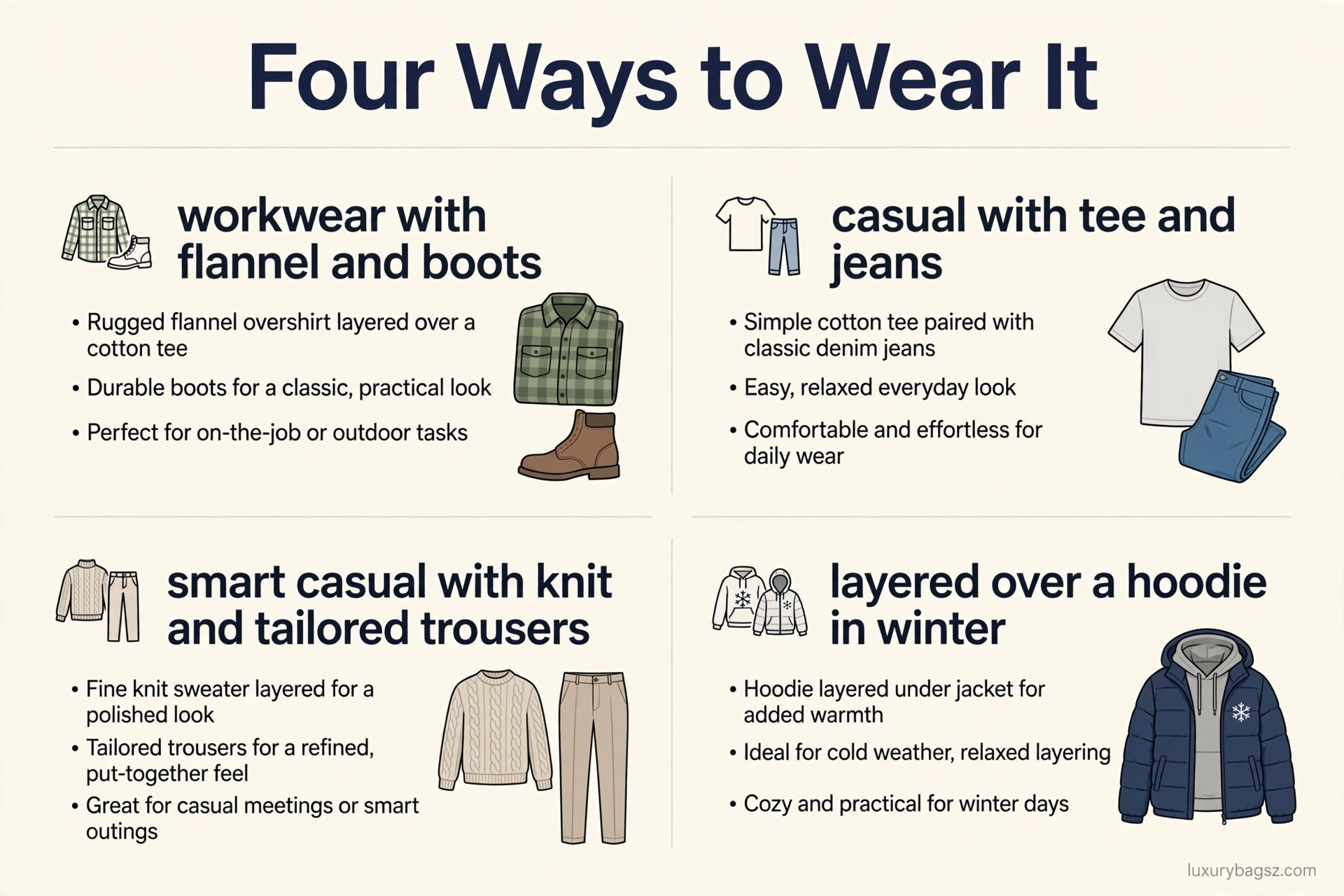
How to Style a Chore Coat: Four Reliable Outfits
The chore coat's trick is that it makes simple clothes look considered, as long as it is the workwear piece in the outfit and the rest stays clean. Pairing it with too many rugged pieces at once can tip the look into costume.
The workwear outfit is the original: chore coat over a chambray or flannel shirt, with canvas trousers or jeans and solid boots. This is the look for weekends, workshops, and outdoor work, and it works best in canvas, drill, or a darker moleskin.
The casual outfit is the everyday one: chore coat over a plain white tee or Breton stripe, with jeans and trainers or boots. Keep the colours simple, navy coat with ecru tee and indigo jeans, for example, and let the coat's texture do the work.
The smart-casual outfit is where the chore coat surprises people. Wear it over a fine knit or a button-up shirt, with tailored trousers and loafers or clean boots, and it stands in for a blazer without the formality. A wool or dark moleskin coat suits this outfit best, and the trousers should be well fitted to balance the boxy top.
The winter-layered outfit uses the coat's roomy fit. Layer it over a hoodie or a chunky knit, with dark jeans and boots, and add a scarf if needed. The coat is not warm enough alone in deep cold, but as a mid-layer over a hoodie it extends its season well into winter.
Colour, Season, and What to Buy First
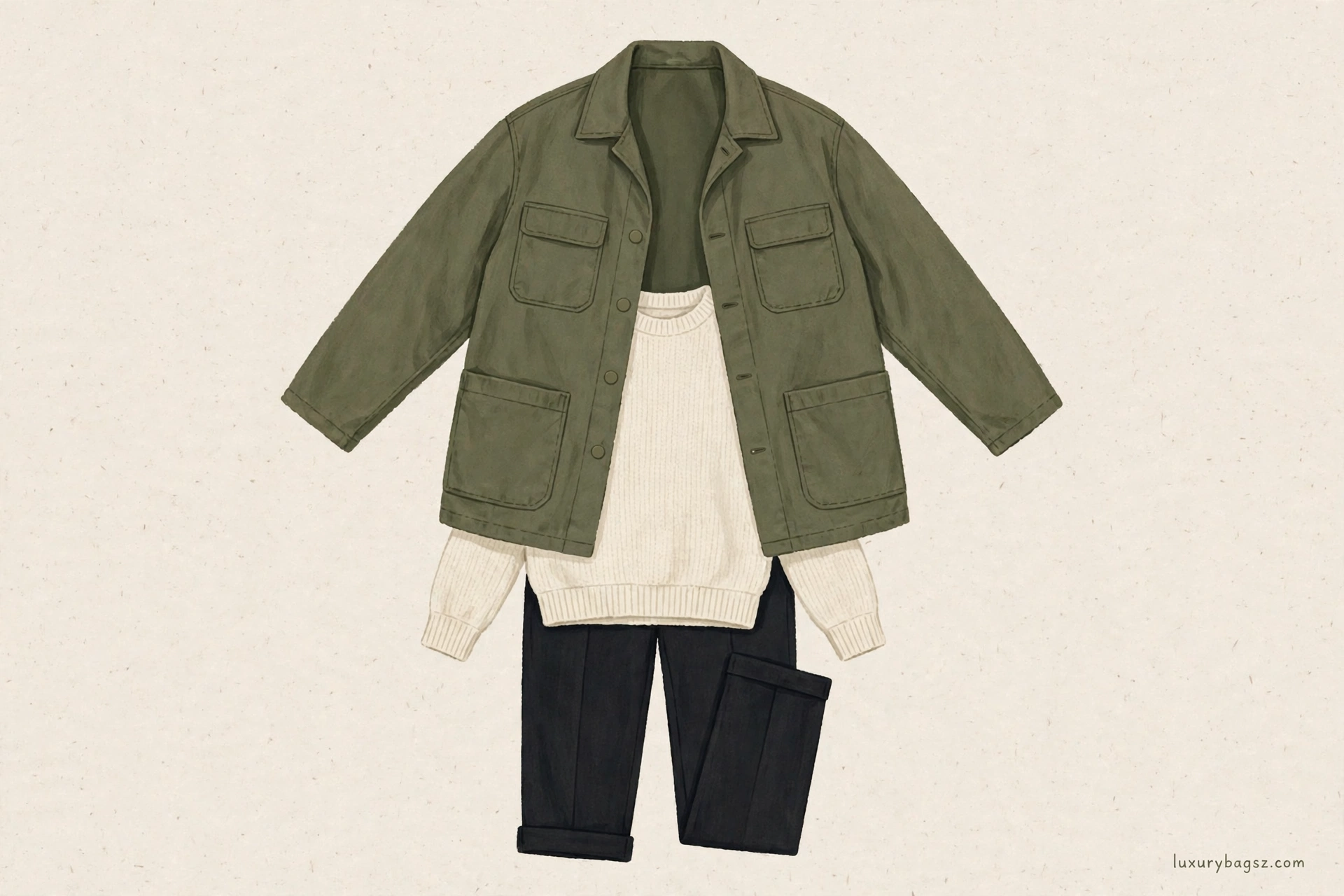
If you buy one chore coat, buy navy or olive. Navy is the original working blue and pairs with almost everything, from jeans to grey trousers, while olive adds warmth and suits earth tones, browns, and khaki. Both hide wear well and age gracefully.
Tan drill is the third classic, especially in French workwear, and it looks excellent with indigo denim and white tees in spring. It shows dirt more than navy or olive, though, so it suits buyers who do not mind a patina, or who wear the coat mainly in fair weather.
Black chore coats exist, but they can look flat, because the texture that gives a chore coat its character is less visible in black, and they can read as a uniform rather than a workwear piece. If you already own black jackets, navy or olive gives you more outfit range.
For fabric, a midweight cotton moleskin in navy is the most versatile first buy, as several guides agree. It is soft enough to wear from day one, tough enough to last, and smart enough for smart-casual outfits, which canvas is not always.
Seasonally, think of the chore coat as a three-season jacket: spring, autumn, and mild winter with layers. It is too warm for high summer in heavy moleskin or canvas, though a light drill version works on cool summer evenings, and too light for freezing weather without a heavy layer underneath.
Buying Checklist and Mistakes to Avoid
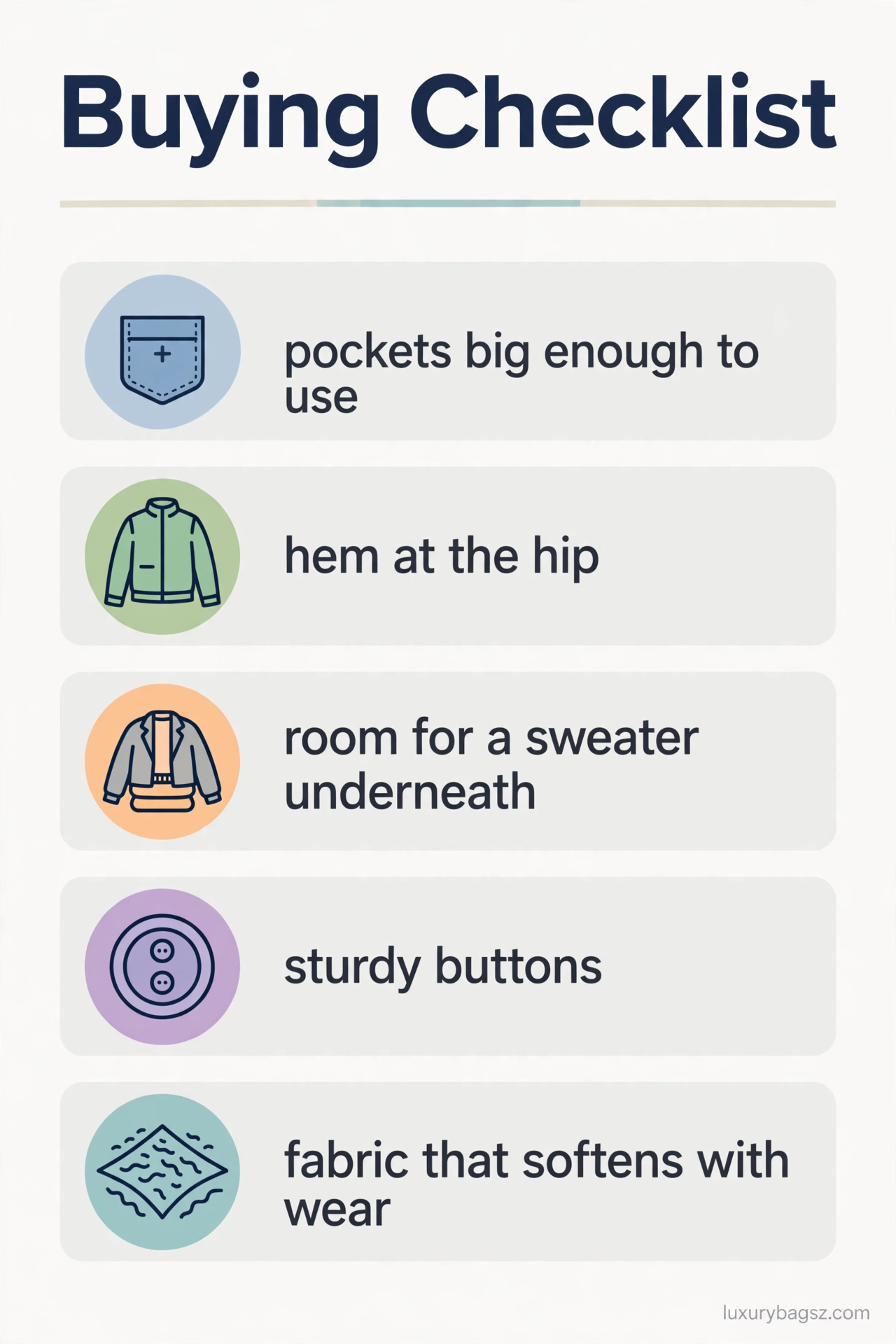
Use a short checklist before you pay, because chore coats look similar online and differ greatly in cloth and construction. First, are the pockets genuinely useful, large, and well stitched, or are they token flaps?
Second, does the hem sit at the hip, and does the coat button over a sweater without strain? Third, are the buttons sturdy and well sewn, with spare buttons included? Cheap buttons that pop off in the first month are a sign of corners cut elsewhere.
Fourth, does the fabric feel dense and substantial, with a weave you can see, rather than thin and papery? The jacket is unlined, so thin cloth will feel cheap and wear quickly. Fifth, does the coat soften in a way you like, or does it stay stiff and shiny, which can signal a synthetic blend?
Avoid three common mistakes. Do not buy a slim, tailored chore coat and expect it to work as workwear; the boxy shape is the point. Do not wear it with too many workwear pieces at once, or the outfit becomes a costume. And do not expect it to replace a winter coat or a blazer entirely; it bridges those worlds, but it does not replace either.
Price guidance is straightforward. Good high-street and workwear versions run about $100 to $180, heritage makers such as Le Mont Saint Michel or Taylor Stitch run $200 to $350, and wool or small-batch versions run higher. Pay for fabric and construction, not for a label, and check the cloth content before you pay a premium.
Care: Keeping a Chore Coat for Years
Chore coats are easy to care for, and they improve with wear, which is part of their appeal. Cotton moleskin and drill can usually be machine washed cold on a gentle cycle, then hung dry, but always check the maker's label first, because some versions need dry cleaning.
Wash only when the coat truly needs it, not after every wear. Cotton workwear picks up character from wear, and over-washing fades colour and softens the fabric faster than necessary. Spot-clean marks with a damp cloth and mild soap between washes.
Hang the coat on a sturdy wooden hanger, not a wire one, so the shoulders keep their shape. Avoid tumble drying, which can shrink cotton and stiffen moleskin, and avoid ironing the patch pockets flat, which can crease them unnaturally.
Repair early: restitch a loose button, reinforce a pocket corner, or patch a worn elbow before the damage spreads. A chore coat with honest repairs looks better, not worse, because repairs suit the workwear story, and they extend a coat that was built to last.
Finally, embrace the patina. Faded elbows, softened pockets, and a slightly sun-lightened shoulder are not flaws on a chore coat; they are the record of years of wear, and they are why vintage chore coats are so prized.
Frequently Asked Questions
What is a chore coat?
A chore coat is a square-cut, button-front workwear jacket with large patch pockets, originally made for French labourers in the 19th century from cotton moleskin or drill.
What is the difference between a chore coat and a blazer?
A blazer is tailored, with shaping, lining, and structured shoulders. A chore coat is flat, unlined, and square-cut, with patch pockets, and it is intentionally casual and roomy.
What fabric is best for a chore coat?
Moleskin is the classic first choice: soft, tough, and versatile. Cotton drill is crisper and cooler, canvas is toughest and most workwear-like, and wool is smarter and warmer.
How should a chore coat fit?
Roomy, with a slightly dropped shoulder, a hem at the high hip, and enough room for a sweater underneath without strain. It should not be slim or tailored.
What colour chore coat should I buy first?
Navy or olive. Navy is the original working blue and pairs with almost everything; olive suits earth tones and khaki. Tan drill is a good third choice for spring.
Can you wear a chore coat in winter?
As a mid-layer over a knit or hoodie, yes, into mild winter. Alone, it is a three-season jacket, not a deep-winter coat, because the classic version is unlined.
Is a chore coat the same as a shirt jacket?
They overlap, but a chore coat is heavier, hip-length, and pocket-led, while a shirt jacket is usually lighter and closer to a shirt in weight. Many modern "shackets" borrow the chore coat shape.
How do you wash a chore coat?
Usually machine wash cold on gentle and hang dry, but check the label first. Wash only when needed, spot-clean between washes, and avoid tumble drying.
Are chore coats still in style?
Yes. The shape has barely changed in 150 years, which makes it one of the least trend-sensitive jackets in menswear. It moves between workwear, casual, and smart-casual without dating.
How much should a good chore coat cost?
About $100 to $180 for good high-street versions, $200 to $350 for heritage makers, and more for wool or small-batch versions. Pay for fabric and construction over branding.
Summary
A chore coat is workwear at its most useful: a plain, tough, pocket-filled jacket that was designed for labourers and ended up suiting almost every wardrobe. Buy it in navy or olive moleskin, in a roomy hip-length fit, with pockets you can actually use, and wear it as the single workwear piece in an otherwise clean outfit. Do that, and you will reach for it more than almost any other jacket you own.






