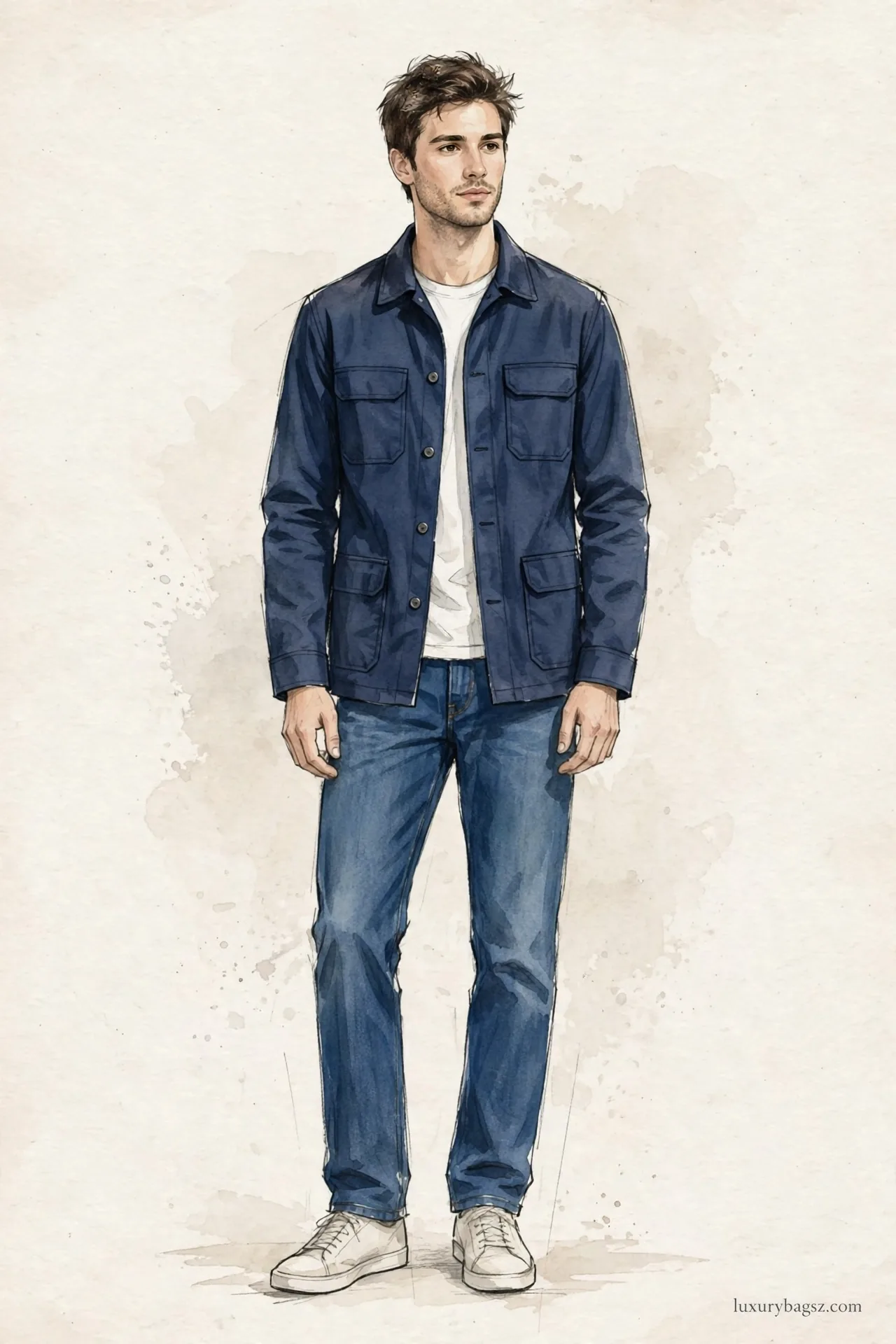
A chore coat is a straight, hip-length workwear jacket with a button front, a shirt-style collar and large patch pockets. Wear it slightly roomy over simple basics, and it bridges casual and smart-casual outfits better than almost any other jacket.
The easiest way in is a chore coat over a plain tee with jeans and boots or sneakers. From there it can stand in for a blazer with an Oxford shirt and chinos, or layer over knitwear when the weather turns cold.
Fit is relaxed but controlled. The coat should sit at the high hip, leave room for a layer underneath, and button without pulling. A coat that is too slim loses its workwear ease entirely.
Key Takeaways
A chore coat is a hip-length, button-front work jacket with patch pockets.
Wear it slightly roomy, with room for a tee, shirt or thin knit underneath.
It bridges high and low pieces: pair one smarter item with one casual item.
Navy, olive, tan, black and natural canvas are the easiest colours.
Skip ties and formal dress shoes; boots, sneakers and loafers suit it.
What a Chore Coat Is
The chore coat comes from French and American workwear, made for farm and workshop labour. Its design is deliberately plain: a straight body, a button front, a pointed shirt collar and usually three or four patch pockets.
Those pockets are the signature. Two large hip pockets and one or two chest pockets give the coat its utility look and its practicality, holding a phone, wallet, gloves or notebook within easy reach.
It differs from a blazer, which has lapels and tailoring, and from an overshirt, which is lighter and shirt-like. A chore coat sits between the two: sturdier than a shirt, more relaxed than a jacket, and useful across three seasons.
Fit: Roomy, Not Oversized
A good chore coat is not slim. It should sit with a slightly dropped shoulder, a little ease through the body and a hem around the high hip. That room is what lets it layer comfortably.
Size up from your blazer size if you are between sizes, especially if you plan to wear knitwear underneath. The coat should still button without strain over a shirt, and the sleeves should end at the wrist bone.
Length is the key proportion check. A coat that ends below the hip starts to look like a long jacket and loses the workwear balance. A coat that ends above the waist looks cropped and throws off the outfit.
Five Outfits That Work
The workwear original pairs a chore coat with a chambray or flannel shirt, canvas trousers and boots. It is honest, rugged and practical, and it suits weekends, workshops and outdoor days perfectly.
The weekend standard is simpler: a chore coat over a white tee with selvedge jeans and boots or sneakers. The coat adds detail and structure to a basic outfit without any extra effort.
For smart-casual days, wear it as a blazer stand-in. An Oxford shirt, chinos and loafers underneath, with the chore coat on top, reads polished but relaxed, ideal for creative offices and dinners.
In cold weather, layer the coat over chunky knitwear with corduroy trousers and leather boots. The generous cut handles the knit easily, and the textured trousers echo the coat’s workwear roots.
For a streetwear lean, throw a chore coat over a hoodie with tapered trousers and leather sneakers. Keep the colours muted and the hoodie plain, and the outfit stays sharp rather than sloppy.
Layering Through the Year
In spring and autumn, a chore coat is often the only outer layer you need. Wear it open over a tee or a light shirt, and button it on cooler mornings. Unlined cotton versions suit this role best.
Winter layering works because of the roomy cut. A thin knit, a flannel shirt or even a light quilted layer can sit underneath without bunching. For very cold days, add a scarf and let the coat act as a mid-layer under a heavier overcoat.
Summer use is limited to cooler evenings and air-conditioned rooms. Choose an unlined coat in light cotton or linen, and keep the layers underneath to a single tee. Heavy canvas in heat is a mistake.
The layering rule is simple: one textured or patterned layer at a time. If the coat is heavy canvas, keep the shirt and trousers smooth and plain, and vice versa.
Colours and Fabrics
Navy is the most versatile chore coat colour, pairing with jeans, chinos and most shirts. Olive adds workwear character and suits earth tones, while tan and natural canvas feel lighter and more summery.
Black chore coats read sharper and more urban, working well with monochrome outfits and dark denim. Brown and rust versions bring warmth in autumn, especially with cream knits and dark trousers underneath.
Canvas cotton is the classic fabric, sturdy and structured. Moleskin is softer and warmer, denim versions lean more casual, and wool blends suit smarter, colder-weather wear. Match fabric weight to season.
Lined versions, with blanket or quilted linings, add real warmth but also bulk. Buy lined only if you will wear the coat through winter, and buy unlined if you want a true three-season layer.
Chore Coats at Work
In creative and casual offices, a chore coat can replace a blazer convincingly. Choose a dark, clean version in navy or charcoal, wear it over a pressed Oxford shirt with tailored trousers, and keep shoes polished.
The coat’s patch pockets actually help at work, holding a phone and notebook without a bag. Just avoid overstuffing them, since bulging pockets undo the smart impression fast.
For manual or outdoor work, the original design still shines. Sturdy canvas, reinforced pockets and a roomy cut handle real use, and the coat looks better with wear rather than worse.
Formal offices, client pitches in traditional industries and black-tie events are beyond its range. In those settings, a chore coat reads too casual, however dark or clean it is.
Mistakes to Avoid
Wearing a chore coat too tight is the first mistake. A slim, stretched chore coat loses its workwear character and restricts layering, which is the coat’s main strength. Size for ease, not for a tailored silhouette.
Stacking too much workwear is the second mistake. A chore coat plus a flannel shirt plus cargo trousers plus work boots can tip into costume. Balance it with at least one plain, civilian piece.
Formal shoes and a tie with a chore coat clash badly. The coat’s shirt collar and patch pockets are inherently casual, and formal accessories fight them rather than lifting the outfit.
Finally, do not ignore the pockets. Overstuffed patch pockets sag and distort the coat’s straight lines. Carry the essentials, and put the rest in a bag or a jacket with an inside pocket.
Buying and Care
Check the pocket stitching, button quality and collar structure before buying. Reinforced pocket openings and solid buttons matter, since these areas take daily stress. A structured collar also helps block wind.
Look for a coat with at least one inside pocket for a wallet or phone. Exterior pockets are for gloves and small items, while valuables sit safer inside, especially when travelling.
Wash canvas chore coats sparingly and in cold water, hanging them to dry. Frequent hot washing fades the colour and softens the structure too fast. Spot-clean small marks rather than washing the whole coat.
A good chore coat should last for years and improve with wear, developing softness at the elbows and a gentle fade. Buy a colour you will reach for weekly, not a novelty shade that sits in the wardrobe.
Frequently Asked Questions
What is a chore coat?
A straight, hip-length workwear jacket with a button front, a shirt-style collar and large patch pockets. It comes from French and American labourers’ clothing and sits between an overshirt and a blazer.
How should a chore coat fit?
Slightly roomy, with a dropped shoulder, ease through the body and a hem around the high hip. It should button over a shirt or thin knit without pulling, and the sleeves should reach the wrist.
Can you wear a chore coat to the office?
In creative and casual offices, yes, especially a dark coat over an Oxford shirt with tailored trousers. In formal offices it is usually too casual, even in dark colours.
What do you wear under a chore coat?
A plain tee, an Oxford shirt, a henley or a thin knit all work. In cold weather, a chunky sweater fits under the roomy cut. Keep the layer plain if the coat is heavily textured.
What trousers go with a chore coat?
Jeans, chinos, canvas trousers and corduroys all suit it. Dark jeans and tailored chinos dress it up, while canvas and corduroy lean into its workwear roots.
What shoes suit a chore coat?
Boots, sneakers and loafers all work, depending on the outfit. Lace-up boots echo its workwear roots, sneakers keep it casual, and loafers suit the smarter, blazer-like version.
Is a chore coat warm enough for winter?
An unlined coat is a spring and autumn layer, not a winter coat. A blanket-lined version over knitwear handles cold days, and the coat can also sit under a heavier overcoat in deep winter.
What is the difference between a chore coat and an overshirt?
A chore coat is sturdier, more jacket-like, with larger patch pockets and a heavier fabric. An overshirt is lighter, closer to a shirt in weight, and usually less structured.
Can you wear a chore coat with a hoodie?
Yes, for a relaxed streetwear look. Keep the hoodie plain and the colours muted, pair with tapered trousers and leather sneakers, and avoid a bulky hood that distorts the coat’s collar.
How do you care for a chore coat?
Wash sparingly in cold water and hang to dry. Spot-clean small marks, avoid hot dryers, and let the canvas soften naturally with wear rather than forcing it with frequent washing.
Final Verdict
The chore coat earns its reputation because it does so much with so little fuss. Buy one in a versatile colour, wear it slightly roomy over simple basics, and let it bridge the gap between casual and smart. It is the rare jacket that works as hard on a weekend as it does on a workday.
Jessica is the founder of Luxury Bagsz and a handbag specialist with more than 10 years in the bag industry. She owns and collects preloved designer bags, has examined over 500 bags by hand, and checks authenticity using the Entrupy app alongside stitching, hardware, engravings and date codes.
The Rolex 1908 is the watch that made people take Rolex dress watches seriously again. Launched at Watches and Wonders in 2023, it replaced the Cellini collection, introduced a brand-new movement, and — for the first time on a standard modern Rolex — showed that movement through a sapphire caseback. It is also a watch…
The Short Answer on Hermès Clothing Prices Most Hermès clothing sits between about $1,000 and $8,000 in the US: shirts and knitwear typically start in the low thousands, tailoring and dresses in the mid thousands, and coats and leather pieces at the top. Nothing in the clothing line is priced casually, but the spread is…
Ready-to-Wear Is Hermès Beyond the Bag Hermès ready-to-wear is the house's clothing: seasonal collections for women and men covering coats, tailoring, knitwear, dresses, shirts, trousers and leather pieces, made to the same hand-finished standard as its bags. It is one of the house's historic crafts, not a side line. Clothing sits inside the ready-to-wear and…
Two Houses, One Wrist The apple watch hermes is the longest-running luxury smartwatch partnership in the world: Apple's technology in a silver titanium Hermès case, with Hermès-made bands, exclusive watch faces and an extra orange Hermès sport band in the box. Current sets centre on 42mm and 46mm cases, with bands from the classic Single…
The Other Anchor-Chain Watch The hermes nantucket watch takes the same anchor chain that inspired Cape Cod and draws a slimmer conclusion from it: a narrow rectangular case whose ends are literally the two halves of a Chaîne d'Ancre link, split and pulled apart. It is a smaller, dressier watch than Cape Cod — mostly…
The Watch That Started Hermès Watchmaking The hermes arceau watch, designed by Henri d'Origny in 1978, is where serious Hermès watchmaking begins: a perfectly round case held by asymmetric lugs shaped like stirrups, with numerals that lean as if galloping. Arceau is the broadest Hermès watch family — quartz and automatic, 25mm to 43mm, plain…