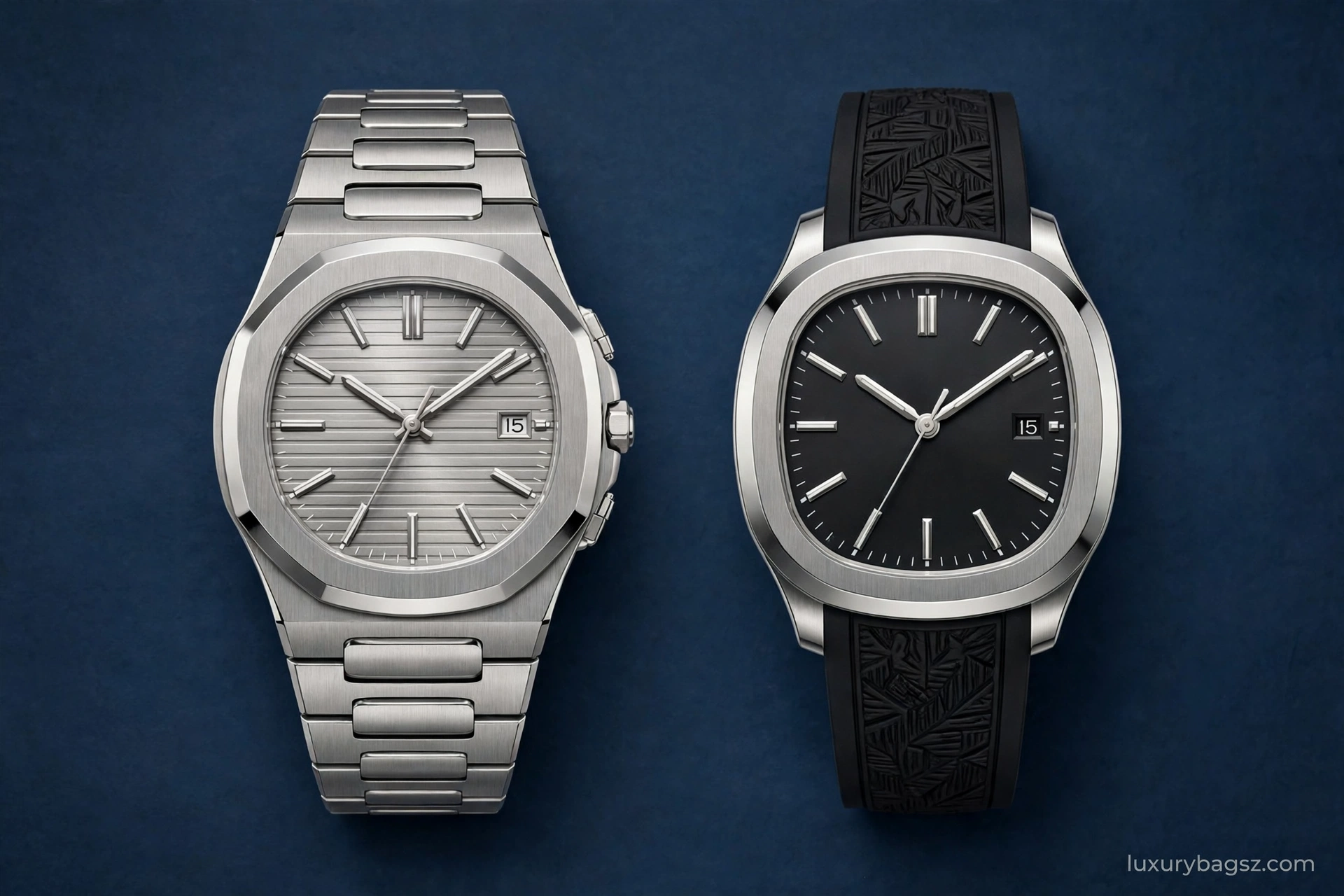
Buy the Aquanaut if you want a Patek Philippe sports watch you can actually wear every day, at the lower entry price, with the easier allocation path. Buy the Nautilus if you want the original design, the integrated bracelet, the broader range of complications, and the reference the whole category is measured against.
The numbers behind that pick are stark. In October 2026, according to Enthuster, a used Nautilus traded around $174,971 against an $82,021 list for the white gold 5811/1G, while a used Aquanaut traded around $69,898 against a $24,632 list floor. One Nautilus cost roughly the same as two and a half Aquanauts on the used market at those medians.
Neither watch transacts at list for a buyer without dealer history, so the used-market rows are the prices that describe reality. Both families are allocation-gated at authorised dealers, but the degree differs sharply: an Aquanaut within a buying relationship is realistic, while a first 5811 allocation without years of history is close to unheard of, according to Enthuster.
Key Takeaways
Nautilus launched in 1976 with ref. 3700/1A; Aquanaut launched in 1997 with ref. 5060A. The Nautilus is the original; the Aquanaut is the younger, more casual sibling.
Current time-and-date references share the self-winding calibre 26-330 S C, but the Nautilus range offers far more complications, including annual and perpetual calendars.
Nautilus means an integrated metal bracelet and horizontal-line dial; Aquanaut means a Tropical composite strap and a geometric, checkerboard-style dial.
October 2026 used medians (Enthuster, via WatchCharts): Nautilus about $174,971, Aquanaut about $69,898, both above retail, with the Aquanaut higher in percentage terms.
There is no steel time-and-date Nautilus in the current catalogue, according to Enthuster: the lead 5811/1G is white gold at $82,021 list.
Water resistance figures disagree across sources (120 m versus 30 and 60 m), and thickness, lug-to-lug and weight figures were not found in the opened competitor guides, so none are invented here.
Two Watches, One Family, Different Characters
The Nautilus and the Aquanaut sit at the heart of Patek Philippe’s luxury sports-watch offering, but they have very different characters. The Aquanaut is the younger and more casual of the two, while the Nautilus has a longer history, a recognisable integrated-bracelet design, and a more established position in the luxury sports-watch category.
The shared roots matter. The Aquanaut’s rounded octagonal case takes cues from the Nautilus, and the current time-and-date references in both families run the same movement. Buyers who handle both usually know within a minute which side they are on, according to Enthuster, because the Nautilus reads as jewellery-grade metal and the Aquanaut reads as sport.
History: 1976 Porthole, 1997 Younger Sibling
The Nautilus launched in 1976, designed by Gérald Genta, with a rounded octagonal case inspired by a ship’s porthole. The original stainless-steel ref. 3700/1A helped establish the high-end luxury sports watch as a distinct category, at a time when luxury watches were expected to be gold and dressy. Steel, priced like precious metal, was a provocation, and it worked.
The Nautilus evolved in stages. In 2006, Patek Philippe introduced the ref. 5711/1A for the collection’s 30th anniversary, reviving the classic stainless-steel Nautilus in modern form. In 2021, the steel 5711 was retired from the collection. In 2022, Patek Philippe introduced the ref. 5811/1G, with a 41 mm case in white gold, replacing the 40 mm stainless-steel case of the 5711/1A.
The Aquanaut arrived in 1997, offering a younger, more casual interpretation of the same design language. Its debut ref. 5060A was a stainless-steel model with a black dial and a composite strap. Patek Philippe itself notes that the collection initially appealed to a new, younger clientele, which is exactly the gap the Nautilus, by then a twenty-year-old icon, had left open.
The Comparison Table, With Disagreements Stated
This table gathers the comparison the competitor guides split across pages, and it flags every figure that sources disagree on. Read the notes below the table before you use any single number to decide.
Feature
Aquanaut
Nautilus
Launched
1997
1976
Original reference
5060A
3700/1A
Case style
Rounded octagonal, simpler
Porthole-inspired, rounded octagonal, with lateral ears
30 m for 5167A and 5168G (Watch Exchange, current specs)
60 m for 5712/1A (Watch Exchange); see disagreement note
Retail floor, Oct 2026
About $24,632 overall; 5167A about $27,257
5811/1G $82,021
Used median, Oct 2026
About $69,898
About $174,971
Price positioning
Generally lower entry, higher percentage premium
Generally higher entry, larger absolute premium
Allocation
Difficult, but attainable within a relationship
Close to unheard of for a first 5811 without years of history
Water resistance is the sharpest disagreement. A snippet-only source, Big Moe Watches, says both families are usually 120 m, while Watch Exchange cites current specifications of 30 m for the Aquanaut 5168G and 5167A and 60 m for the Nautilus 5712/1A. This guide follows Watch Exchange’s reference-specific figures, because they are tied to named references and current specifications, and it flags the 120 m claim as snippet-only and unverified.
Steel availability is the second disagreement. Enthuster states there is no steel time-and-date Nautilus in the current catalogue, and that the steel 5712/1A left the catalogue in 2025, while Watch Exchange still presents the 5712/1A as a popular reference without noting its status.
This guide follows Enthuster on current catalogue status, because it is dated October 2026 and explicit, and it treats Watch Exchange’s 5712/1A as a pre-owned and historical reference, not a current retail one.
Case Design: Porthole Architecture Versus Clean Octagon
The Nautilus case is the more complex architecture. Its rounded octagonal bezel, lateral ears, and integrated bracelet flow directly from the case, giving the watch a unified, architectural appearance on the wrist. The bracelet is not attached to the watch. It is part of the watch, and that integration is most of what you are paying to have finished.
The Aquanaut case carries some of the same rounded-octagonal elements, but the execution is noticeably simpler and more relaxed. Its cleaner, more streamlined case shape and composite strap give it a more contemporary, casual look. That simplicity is why the Aquanaut often feels sportier than the Nautilus despite their shared design roots.
Size figures only tell part of the story. The Aquanaut 5167A measures 40.8 mm, the larger 5168G measures 42.2 mm, and the Nautilus 5811/1G measures 41 mm. Case shape, bracelet integration and strap construction change how each watch sits, so similar diameters do not translate into the same wearing experience.
Both wear thin and short for their diameters, according to Enthuster, but no thickness, lug-to-lug, or weight figures were found in the opened competitor guides, so this guide gives none.
Dials, Hands, and How Each Watch Reads
The dial difference is immediate, even at a glance across a room. The Aquanaut uses a bold embossed geometric pattern with applied Arabic numerals, giving it a more modern and informal character. The pattern reads as a checkerboard, and the numerals make the time legible at a glance, even in poor light.
The Nautilus takes a more restrained approach, with horizontally embossed lines and applied hour markers. The result is more restrained, more formal, and more dependent on light: the horizontal lines catch light differently as the wrist moves, which is part of the Nautilus’s appeal and part of why it photographs so well.
Complication dials change the balance. The Nautilus 5712’s asymmetric dial, with moon phase, power-reserve indicator, small seconds and analog date, is a conversation piece on its own. The Aquanaut’s Travel Time and chronograph dials are busier but more obviously useful. If you want a dial that starts conversations, the Nautilus complications win. If you want a dial that tells the time fastest, the Aquanaut time-and-date wins.
Movements: One Shared Calibre, Then Divergence
The current Nautilus 5811 and the steel Aquanaut 5167A run the same calibre, the self-winding 26-330 S C with date and sweep seconds. It is the updated base automatic that replaced the long-serving 324 S C, according to Enthuster. One movement across both time-and-date references is the neatest possible illustration of how close these families are mechanically.
Up the two ranges, the complications diverge sharply. The Aquanaut line adds the Travel Time dual-zone, in refs such as the 5164, and the 5968 flyback chronograph, plus more recent additions including the 5261R annual calendar and the 5260 minute repeater. The Nautilus line carries the 5712 moonphase, the 5726 annual calendar, the 5990 travel chronograph, and the 5740 perpetual calendar, a Grand Complication.
Complication for complication, the Nautilus versions carry higher prices and older waiting lists, according to Enthuster. The Nautilus 5712 in steel left the catalogue in 2025, leaving the rose gold 5712/1R as the current moonphase Nautilus, which changes the price and availability picture for that reference entirely. Always confirm the exact reference and its catalogue status before comparing complication prices.
Bracelet, Strap, and Everyday Comfort
The Aquanaut is best known for its supple Tropical composite strap, which Patek Philippe describes as highly resistant to wear, salt water and UV radiation. Its flexibility contributes to the Aquanaut’s comfortable, more casual feel, making it well suited to everyday wear. The strap is the entire personality difference, according to Enthuster: the Aquanaut is the Patek you wear without thinking about it.
The Nautilus is closely associated with its integrated metal bracelet, which flows directly from the case and combines polished and satin-finished surfaces. The bracelet needs sizing with links, it shows scratches more readily than a composite strap, and it cannot be swapped for a strap without changing the watch’s character. It also lasts longer, holds its finish better with care, and reads as far more formal.
Comfort splits by wrist and by climate. In warm weather, a composite strap breathes and adjusts more forgivingly than a metal bracelet, which can feel tight as the wrist swells. In cold weather, a metal bracelet feels more substantial and less likely to catch on a cuff. On a smaller wrist, the Aquanaut’s strap wraps more forgivingly than a bracelet that must be sized link by link.
Key References to Know Before You Shop
For the Aquanaut, start with three references. The 5167A is the classic time-and-date steel Aquanaut, 40.8 mm, black embossed dial with gold-applied numerals, Tropical composite strap with a fold-over clasp, and calibre 26-330 S C. The 5168G is the white gold version, 42.2 mm, blue dial and matching strap, introduced in 2017, also on calibre 26-330 S C.
For the Nautilus, start with three references as well. The 5711/1A is the discontinued steel icon, blue dial, integrated steel bracelet, calibre 324 S C, retired in 2021 and still the reference the collection is measured against. The 5811/1G is the current white gold successor, 41 mm, replacing the 5711’s 40 mm steel case.
The 5712/1A is the steel moonphase reference, 40 mm, asymmetric blue dial, 60 m water resistance, calibre 240 PS IRM C LU, now out of the current catalogue according to Enthuster.
Beyond time and date, the Aquanaut 5164 adds Travel Time for a second time zone, the 5968 adds a flyback chronograph, and the 5261R adds an annual calendar. The Nautilus 5726 adds an annual calendar with day, date and month plus a moon phase and 24-hour indication, the 5990 combines Travel Time with a flyback chronograph, and the 5740 takes the collection into perpetual calendar territory.
Prices, Allocation, and Value Retention
Enthuster’s October 2026 figures, via WatchCharts, are the only dated, reference-linked prices found in this research, and they are reproduced here with their basis stated. The used-market values are family medians, not single-reference prices, so they describe the market’s centre, not any individual watch.
Measure
Aquanaut
Nautilus
Retail floor, Oct 2026
$24,632 overall; 5167A about $27,257
$82,021 (5811/1G)
Used median, Oct 2026
$69,898
$174,971
Used versus retail
About 284 percent of list
About 213 percent of list
Used premium in dollars
About $45,000 above the floor
About $93,000 above list
Enthuster’s own presentation needs care. Its table says the Aquanaut is about 184 percent above retail while its text says 284 percent of list. Those are the same ratio expressed two ways, not two different figures, and this guide gives the “percent of list” form to avoid confusion. The Nautilus figures show the same pattern: about 113 percent above in the table, about 213 percent of list in the text.
Both watches trade far above retail, which already puts them in a category almost no other watches occupy. The Nautilus carries the larger absolute premium, roughly $93,000 above list for the 5811/1G, while the Aquanaut’s premium is larger in percentage terms, because its retail is so much lower.
Servicing and Ownership Costs Nobody Quotes
No competitor guide found gives service intervals, service costs, strap replacement costs, or bracelet link costs for either family, and this guide does not invent them. That absence matters, because servicing is the largest recurring cost of owning a Patek Philippe, and it arrives whether or not you budgeted for it.
What can be said is structural. A Patek Philippe service through an authorised channel is a manufacture service, not a high-street repair, and it includes movement servicing, case and bracelet refinishing where appropriate, and water-resistance testing.
For the Aquanaut, budget for strap replacement as a recurring cost. Composite straps wear, and a genuine Patek strap with its fold-over clasp is a manufacture part, not a generic strap. For the Nautilus, budget for bracelet sizing and link costs, and for refinishing if the bracelet picks up heavy scratches.
Water-resistance servicing deserves its own note, given the disagreement in the comparison table. Whatever the correct rating for your reference, gaskets age and water resistance fades without servicing. A watch rated at 30 m should not be treated as a swimming watch, and a watch rated at 60 m should still be pressure-tested after any service or crystal work. Do not rely on a rating printed in a guide when your watch has not been tested in years.
Buying Pre-Owned: Reference, Condition, Papers, and Fakes
Watch Exchange’s pre-owned checklist is short and sound: reference, condition, service history, box and papers, authenticity, and try it on. This part expands each item, because the competitor guides give no fake tells, no box and papers detail, and no Extract from the Archives explanation for either family.
Confirm the exact reference before you compare prices. A 5167A and a 5168G differ in material, size and price by tens of thousands of dollars, and a 5711/1A and a 5811/1G differ in material, size and catalogue status. A listing that says only “Nautilus” or “Aquanaut” without a reference number is not a comparable listing. Ask for the reference, the calibre, and the year, and check them against Patek Philippe’s own records where possible.
Inspect condition reference by reference. On a Nautilus, check the bracelet for stretch, the bezel ears for dings, and the case for over-polishing that has softened the porthole edges. On an Aquanaut, check the strap for wear at the lugs and the clasp, the case for dings, and the dial for fading. On both, check the crystal, the hands, and the crown action, and ask whether the watch has been refinished and by whom.
Ask for the full set: original box, papers, warranty certificate, and any extra links or straps. Ask for the service history in writing, and for an Extract from the Archives where available, which confirms the watch’s original specification and production date from the manufacture.
Which One for Which Life
Choose the Aquanaut if you prefer a casual, contemporary design, if you like the comfort and look of a composite strap, if you want a luxury sports watch that feels less formal, if you prefer Arabic numerals and a geometric dial, and if you want the generally lower secondary-market entry point. That is Watch Exchange’s list, and it holds up against the prices in the prices section.
Choose the Nautilus if you value its longer history and established design, if you prefer an integrated bracelet and a porthole-inspired case, if you want access to a broader range of complications, and if you favour a more traditional luxury sports-watch identity. That is also Watch Exchange’s list, and it holds up against the complication range in the movements section.
The collector path most often described is Aquanaut first, relationship built, Nautilus later, mirroring the Tudor-to-Rolex ladder, according to Enthuster. That path is honest about allocation: the Aquanaut is the realistic entry into Patek’s sports catalogue, and the Nautilus is the reference the entire category is measured against.
The Decision, Step by Step
Try both on, in the metal and reference you would actually buy, not in a different size or material. Case dimensions alone do not tell the whole story, particularly when comparing the Aquanaut’s composite strap with the Nautilus’s integrated bracelet. A 40.8 mm Aquanaut and a 41 mm Nautilus sound identical on paper and feel different on the wrist.
Set your budget on used-market prices, not retail prices, unless you already have the dealer history for an allocation. A buyer without history who budgets $27,257 for a steel Aquanaut or $82,021 for a white gold Nautilus will find neither watch at that price. Budget $69,898 for an Aquanaut median and $174,971 for a Nautilus median, as of October 2026, and adjust by reference, condition and completeness.
Decide on complications before you decide on families. If you want a perpetual calendar, the Nautilus is your only choice between these two. If you want a flyback chronograph, both families offer one, at very different prices. If you want time and date only, the shared calibre means the choice is purely about case, bracelet, dial and price, which simplifies the decision enormously.
Frequently Asked Questions
Is the Aquanaut or Nautilus more expensive?
The Nautilus generally has the higher market entry point, though prices vary by reference, material and condition. In October 2026, Enthuster reported a used Nautilus median around $174,971 against a used Aquanaut median around $69,898, with retail floors of $82,021 for the white gold 5811/1G and about $24,632 for the Aquanaut overall.
Are the Aquanaut and Nautilus suitable for everyday wear?
Yes, both work well for everyday wear. The Aquanaut has a more casual design and a composite strap, while the Nautilus offers a sportier look with an integrated metal bracelet. The Aquanaut is the easier daily wearer; the Nautilus is the more formal one.
Which Patek Philippe should I buy, Aquanaut or Nautilus?
Buy the Aquanaut if you want a casual, comfortable, lower-entry Patek sports watch with an easier allocation path. Buy the Nautilus if you want the original design, the integrated bracelet, the broader complication range, and the reference the category is measured against. Try both on before deciding.
What should I check when buying a pre-owned Patek Philippe?
Check the exact reference, condition, service history, documentation and authenticity before purchasing. Ask for the full set, including box, papers and extra links or straps, and for an Extract from the Archives where available. Confirm the reference and catalogue status, because steel Nautilus references have left the current catalogue.
What is the water resistance of the Nautilus and Aquanaut?
Sources disagree, and this guide states the disagreement rather than resolving it silently. Watch Exchange cites current specifications of 30 m for the Aquanaut 5167A and 5168G and 60 m for the Nautilus 5712/1A. A snippet-only source claims 120 m for both, but that figure was not verified in a full page read.
Is there a steel time-and-date Nautilus in the current catalogue?
No, according to Enthuster in October 2026. The lead current Nautilus time-and-date reference is the white gold 5811/1G at $82,021 list, and the steel 5712/1A left the catalogue in 2025. Watch Exchange still presents the 5712/1A as a popular reference without noting its status, so treat it as a pre-owned reference.
Do the Nautilus and Aquanaut share a movement?
The current time-and-date references do: both the Nautilus 5811 and the steel Aquanaut 5167A run the self-winding calibre 26-330 S C with date and sweep seconds. Higher up the ranges, the complications diverge, with the Nautilus offering annual and perpetual calendars and the Aquanaut offering Travel Time and flyback chronograph versions.
Which holds its value better, Nautilus or Aquanaut?
Both trade far above retail, so neither is a poor store of value at October 2026 medians. The Nautilus carries the larger absolute premium, about $93,000 above list for the 5811/1G, while the Aquanaut’s premium is larger in percentage terms, about 284 percent of list, because its retail is much lower. Neither premium should be assumed permanent.
Is the Aquanaut the poor man’s Nautilus?
The nickname circulates, but the numbers stopped supporting it years ago, according to Enthuster. A steel Aquanaut trading around $69,898 on the used market is hardly a budget alternative, and the Aquanaut Chronograph 5968A traded near $131,000 per WatchCharts. The honest framing is younger sibling with its own demand curve.
Should I buy new or pre-owned?
Buy new if you have the dealer history for an allocation and want a guaranteed full set at retail. Buy pre-owned if you want immediate availability, a discontinued reference such as the 5711/1A, or a specific dial and material combination. Either way, verify the reference, condition, service history and papers before paying.
Final Verdict
The Aquanaut is the watch to buy if you want to wear a Patek Philippe sports watch now, every day, without thinking about it. It costs roughly a third of the Nautilus in comparable configurations on the used market, its allocation path is difficult rather than effectively closed, and its strap makes it the more versatile daily watch. On watch-per-dollar, it wins clearly.
The Nautilus is the watch to buy if the point is the reference itself. It is the original Genta design, the top of Patek’s sports hierarchy, the broader complication range, and the one whose secondary-market premium reflects that standing. It costs more, it waits longer, and it rewards patience with a watch no other sports watch quite matches.
Try both, budget on used prices, and choose by the life you will actually live in the watch. The Aquanaut first and the Nautilus later is a path many collectors take, and it is a good one, because it lets you wear a Patek now while you build toward the icon. Whichever you choose first, buy the exact reference, check it properly, and wear it.
Jessica is the founder of Luxury Bagsz and a handbag specialist with more than 10 years in the bag industry. She owns and collects preloved designer bags, has examined over 500 bags by hand, and checks authenticity using the Entrupy app alongside stitching, hardware, engravings and date codes.
The Rolex 1908 is the watch that made people take Rolex dress watches seriously again. Launched at Watches and Wonders in 2023, it replaced the Cellini collection, introduced a brand-new movement, and — for the first time on a standard modern Rolex — showed that movement through a sapphire caseback. It is also a watch…
Getting an Appointment, in Brief A Hermès bag appointment is a booked meeting with a sales associate to talk about leather goods, not a ticket that guarantees a bag. That one fact explains most of the confusion around it. Hermès does not publish a single global appointment rule, so the right method depends on the…
Search for “Vivienne Westwood snail jewellery” and you will not find a single, current, catalogue product called the Snail Necklace or the Snail Ring, the way you can find the Orb Pendant or the Pearl Choker. That absence is the first thing to understand, and it is the reason this guide is written the way…
The Short Answer on Hermès Clothing Prices Most Hermès clothing sits between about $1,000 and $8,000 in the US: shirts and knitwear typically start in the low thousands, tailoring and dresses in the mid thousands, and coats and leather pieces at the top. Nothing in the clothing line is priced casually, but the spread is…
Ready-to-Wear Is Hermès Beyond the Bag Hermès ready-to-wear is the house's clothing: seasonal collections for women and men covering coats, tailoring, knitwear, dresses, shirts, trousers and leather pieces, made to the same hand-finished standard as its bags. It is one of the house's historic crafts, not a side line. Clothing sits inside the ready-to-wear and…
Two Houses, One Wrist The apple watch hermes is the longest-running luxury smartwatch partnership in the world: Apple's technology in a silver titanium Hermès case, with Hermès-made bands, exclusive watch faces and an extra orange Hermès sport band in the box. Current sets centre on 42mm and 46mm cases, with bands from the classic Single…