

Audemars Piguet Royal Oak Buyer’s Guide: History, Sizes and Models

The Royal Oak in Brief
The Royal Oak is the world's first luxury sports watch, designed by Gérald Genta and introduced at the Basel Watch Fair in 1972. It was stainless steel, priced like a precious metal watch, with an octagonal bezel held by eight exposed hexagonal screws, an integrated bracelet, and a textured tapisserie dial. It invented a category, and more than fifty years later it remains one of the most coveted watches on earth.
The single most important decision you will face is choosing between the Jumbo Extra-Thin at 39 mm and the Selfwinding at 41 mm. The Jumbo carries the heritage, the slimmer profile, and the collector cachet. The Selfwinding offers the more versatile daily wearer, with a central seconds hand, a longer power reserve, and a lower entry price. Neither is the wrong choice, but they serve different philosophies.
On the secondary market in 2026, according to WatchGuys, expect roughly $38,000 to $50,000 for a steel Selfwinding 41 mm (15510ST), $70,000 to $85,000 for a steel Jumbo Extra-Thin (16202ST), and $45,000 to $58,000 for a steel Chronograph 41 mm (26240ST). Boutique waitlists for popular steel references remain in excess of 12 to 24 months.
Key Takeaways
- Royal Oak launched in 1972 as ref. 5402ST: 39 mm, about 7 mm thick, calibre 2121, priced at 3,300 CHF, roughly four times a Rolex Submariner of the era.
- Genta's design came from a diving-helmet inspiration, sketched overnight after an urgent call from managing director Georges Golay; sources differ on "a single evening" versus "a single night" versus "a few days later."
- Core current sizes: Jumbo Extra-Thin 39 mm, Selfwinding 37 mm and 41 mm, Chronograph 38 mm and 41 mm, plus 33 and 34 mm for smaller wrists.
- Reference codes decode by material: ST steel, OR rose gold, BA yellow gold, PT platinum, CB black ceramic, TI titanium.
- 2026 secondary prices (WatchGuys): 15510ST $38,000 to $50,000, 16202ST $70,000 to $85,000, 26240ST $45,000 to $58,000, with blue Bleu Nuit Nuage 50 dials commanding the highest premiums.
- Servicing is recommended every 5 to 8 years, with a full AP service costing $1,500 to $3,000 or more, according to WatchGuys.
A Crisis, a Phone Call, and a Diving Helmet
The Royal Oak's origin story begins with a crisis. In the late 1960s and early 1970s, the Swiss watch industry was reeling from quartz technology. Audemars Piguet, a small, family-owned manufacture in Le Brassus, was producing fewer than 5,000 watches a year and needed a bold move. Managing director Georges Golay turned to designer Gérald Genta with an overnight deadline: create a steel sports watch worthy of the Audemars Piguet name.
Genta reportedly sketched the design in a single evening, drawing inspiration from a deep-sea diver's helmet, according to WatchGuys. AssureOne tells the same story as a single night after an urgent call on the eve of the Basel Fair. Other retellings, seen only as snippets in this research, say a few days later.
The overnight version is the most widely repeated, and this guide follows it while noting the disagreement, because the exact hours matter less than the design that resulted.
The design broke every convention of its era. At a time when luxury meant gold, the Royal Oak was made from stainless steel, priced like a precious metal timepiece, and built with an industrial aesthetic the industry had never seen. Its octagonal bezel secured by eight exposed hexagonal screws, its integrated bracelet, and its textured tapisserie dial created a design language that would define an entire category.
The industry was sceptical. Collectors took notice. That split reaction is the Royal Oak's founding pattern, and it has repeated at every major change since: scepticism first, then imitation, then acceptance as the benchmark. Understanding that pattern helps you read every later debate, from the 41 mm size increase to the Offshore, as a variation on the same story.
1972: The Original Ref. 5402ST
The Royal Oak ref. 5402ST debuted at the Basel Watch Fair in 1972. At 39 mm and just 7 mm thick, it was the world's first luxury sports watch in stainless steel. It was powered by the ultra-thin calibre 2121, based on the Jaeger-LeCoultre 920, and priced at 3,300 CHF, roughly four times the cost of a Rolex Submariner at the time. The price was the provocation: steel, sold dearer than gold dress watches.
At 39 mm, traditionalists in 1972 nicknamed the original watch the Jumbo, because men's dress watches then hovered around 33 mm to 35 mm. Today, that 39 mm to 41 mm footprint is considered the golden ratio for sports watch wrist presence, according to AssureOne. The nickname stuck, and it now designates the ultra-thin, two-hand-plus-date models: the 5402, the 15202, and the current 16202.
The earliest production run, the A-series, identified by an A prefix on the serial number, is the most collectible vintage Royal Oak and commands significant premiums at auction, according to WatchGuys. Subsequent runs are designated B, C, and D series. A-series examples are rare, and a claimed A-series watch needs serial verification against manufacture records, not just a seller's word.
One early-sales figure circulates in snippet-only sources, claiming only 400 watches sold initially, but it is not mentioned by WatchGuys or AssureOne in the full pages read here. This guide does not repeat it as fact. What the full guides do agree on is that the watch was a slow commercial start and a long-term revolution, which is a more useful truth than any single first-year sales number.
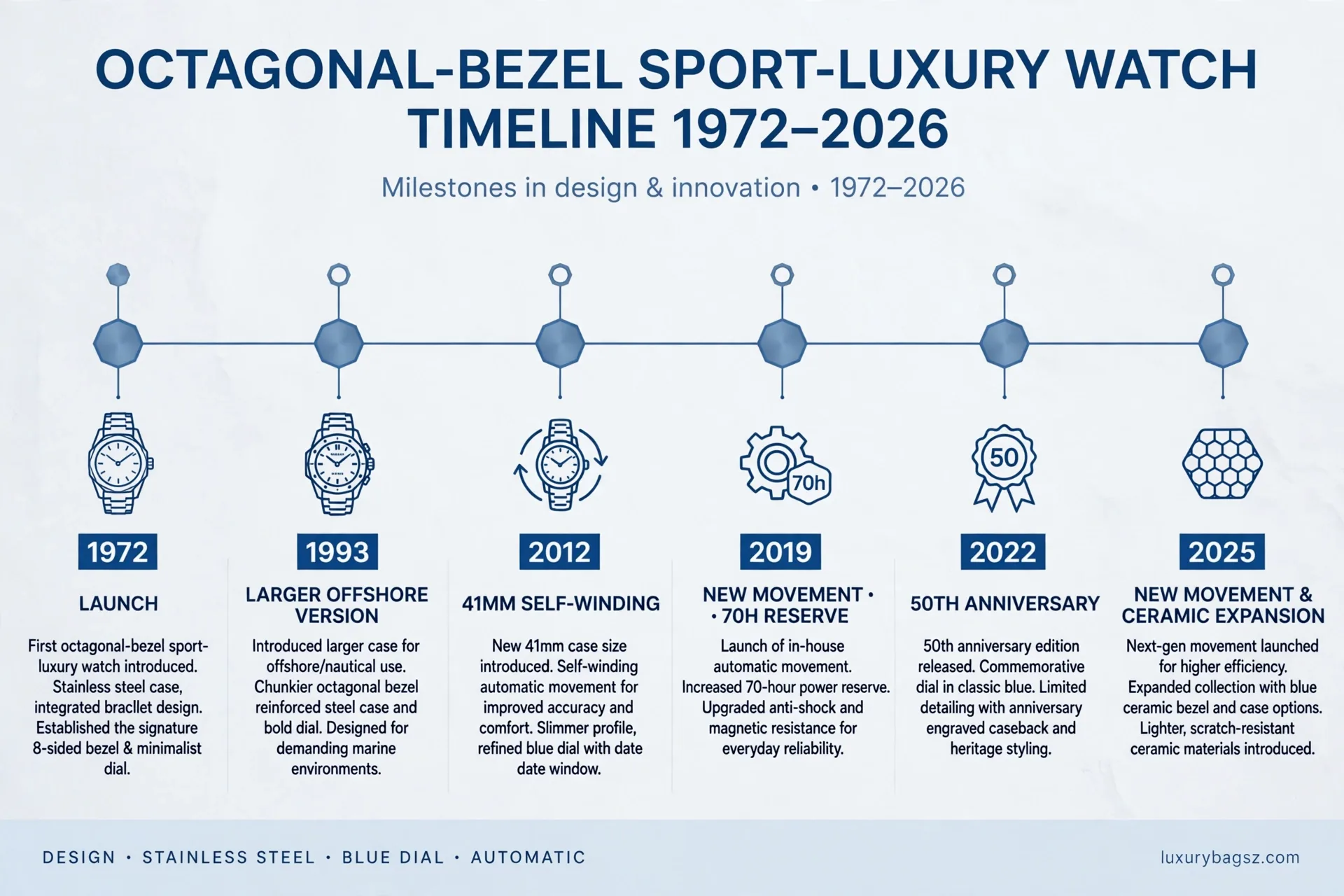
The Timeline: From Gold to Offshore to the 50th Anniversary
The Royal Oak's history divides into clear chapters, and knowing them helps you date any reference you meet. WatchGuys gives the fullest timeline found in this research, and it is summarised here with AssureOne's details added where they agree.
| Year | Milestone |
|---|---|
| 1972 | Ref. 5402ST debuts at Basel: 39 mm, 7 mm thick, calibre 2121, 3,300 CHF |
| 1977 | First Royal Oak in yellow gold, ref. 5402BA, legitimising the design in precious metals |
| 1986 | First major complication: the Perpetual Calendar, making the Royal Oak a high-complication platform |
| 1992 | 20th anniversary Jubilee edition, ref. 14802, limited to 1,000 pieces |
| 1993 | Royal Oak Offshore debuts, designed by Emmanuel Gueit, nicknamed the Beast |
| 1997 | Royal Oak Chronograph introduced, first models on calibre 2385, 40 mm case |
| 2000 | Jumbo transitions to ref. 15202, keeping 39 mm, ultra-thin profile, calibre 2121 |
| 2005 | Selfwinding ref. 15300 launches: thicker 39 mm case, calibre 3120, central seconds hand |
| 2012 | Selfwinding grows to 41 mm with ref. 15400, on calibre 3120 |
| 2019 | Ref. 15500 replaces the 15400, upgrading to calibre 4302 with 70-hour power reserve |
| 2022 | 50th anniversary: Jumbo moves to 16202 with calibre 7121, Selfwinding to 15510, Chronograph to 26240 |
| 2025 | Calibre 7138 perpetual calendar, expanded ceramic line, Frosted Gold on 41 mm Selfwinding |
| 2026 | 11 new references, including openworked perpetual calendar with calibre 7139, Chronograph 38 mm with calibre 6401, and a 7.5 percent average US price rise in January |
The 2022 generational update matters most for current buyers, because it defines every current reference. The Jumbo transitioned from the 15202 to the 16202, and the Selfwinding moved from the 15500 to the 15510, both with new in-house calibres and refined case geometry. Anniversary editions feature commemorative 50 Years rotors, which command additional premiums from collectors.

The Design Language: Bezel, Bracelet, and Tapisserie
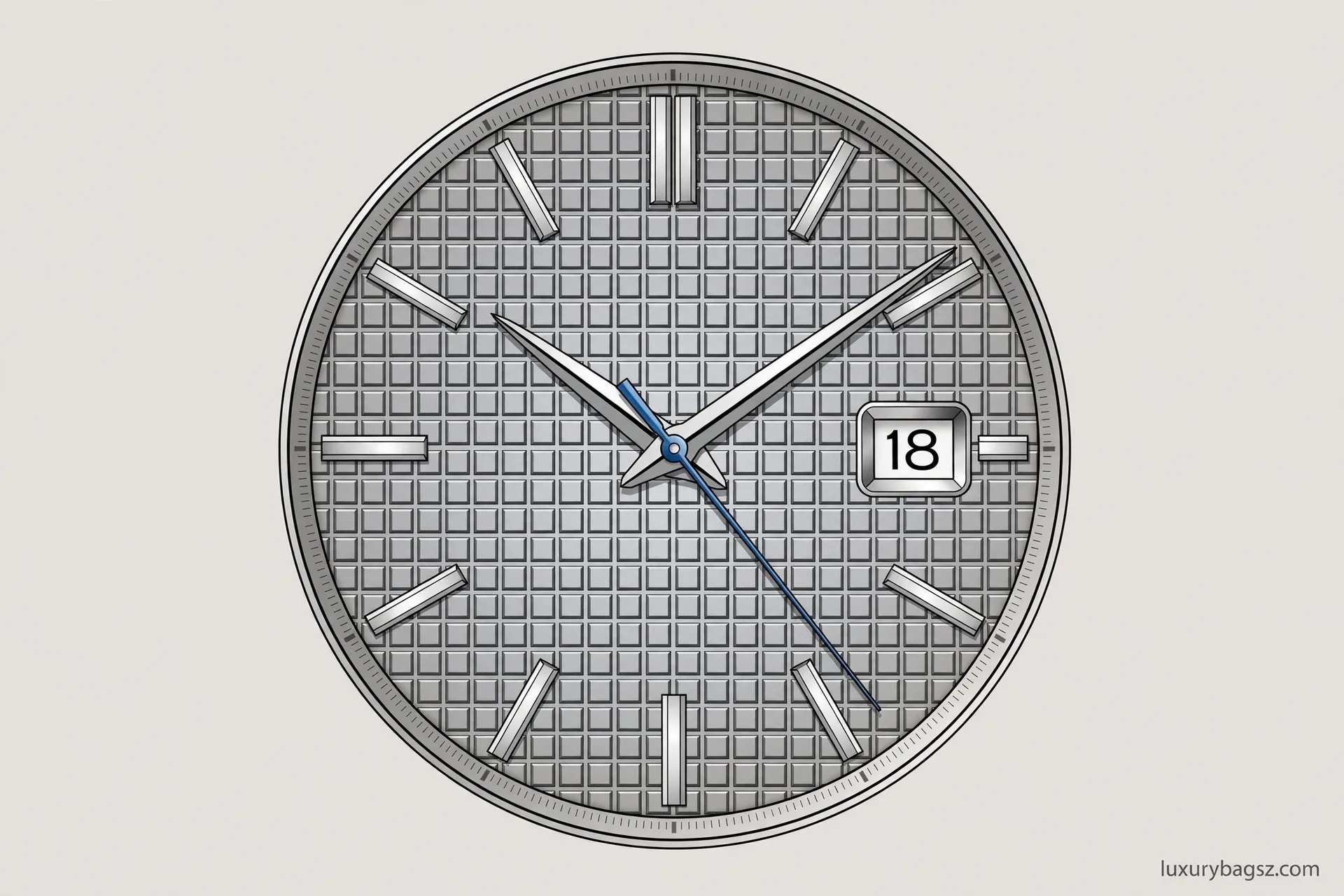
Three details define the Royal Oak's architectural language, and they are the same details fakes get wrong. The octagonal bezel is secured by eight functional, exposed white-gold hexagonal screws aligned in a circular perimeter. The screws are not decoration. They are structural, and they must sit completely flush against the bezel cutouts, forming an aligned circular pattern.
The integrated bracelet tapers seamlessly from the lugs to the clasp, with hand-finished brushed links and mirror-polished edge bevels. Every Royal Oak case and bracelet is hand-finished with alternating brushed and polished surfaces, a process that takes hours per watch, according to WatchGuys. That finishing is the watch's signature visual element, and it is also the first thing to degrade with wear or improper service.
The tapisserie dial is a geometric engine-turned pattern, cut using a traditional pantograph technique, according to AssureOne. Petite Tapisserie, with smaller squares, is used on the Jumbo Extra-Thin. Grande Tapisserie, with larger squares, appears on Selfwinding and Chronograph models. Mega Tapisserie is found on Offshore models. The pattern must be crisp, symmetrical, and free of printing bleeds under magnification.
What makes the Royal Oak unique within the Holy Trinity of Swiss watchmaking, alongside Patek Philippe and Vacheron Constantin, is its combination of industrial design and haute horlogerie finishing. The watch looks like a machine and finishes like a dress watch, and that contradiction is the whole point. A Royal Oak that looks only industrial, or only polished, has lost half its design.
Sizes: The Full Table, and How Each Size Wears
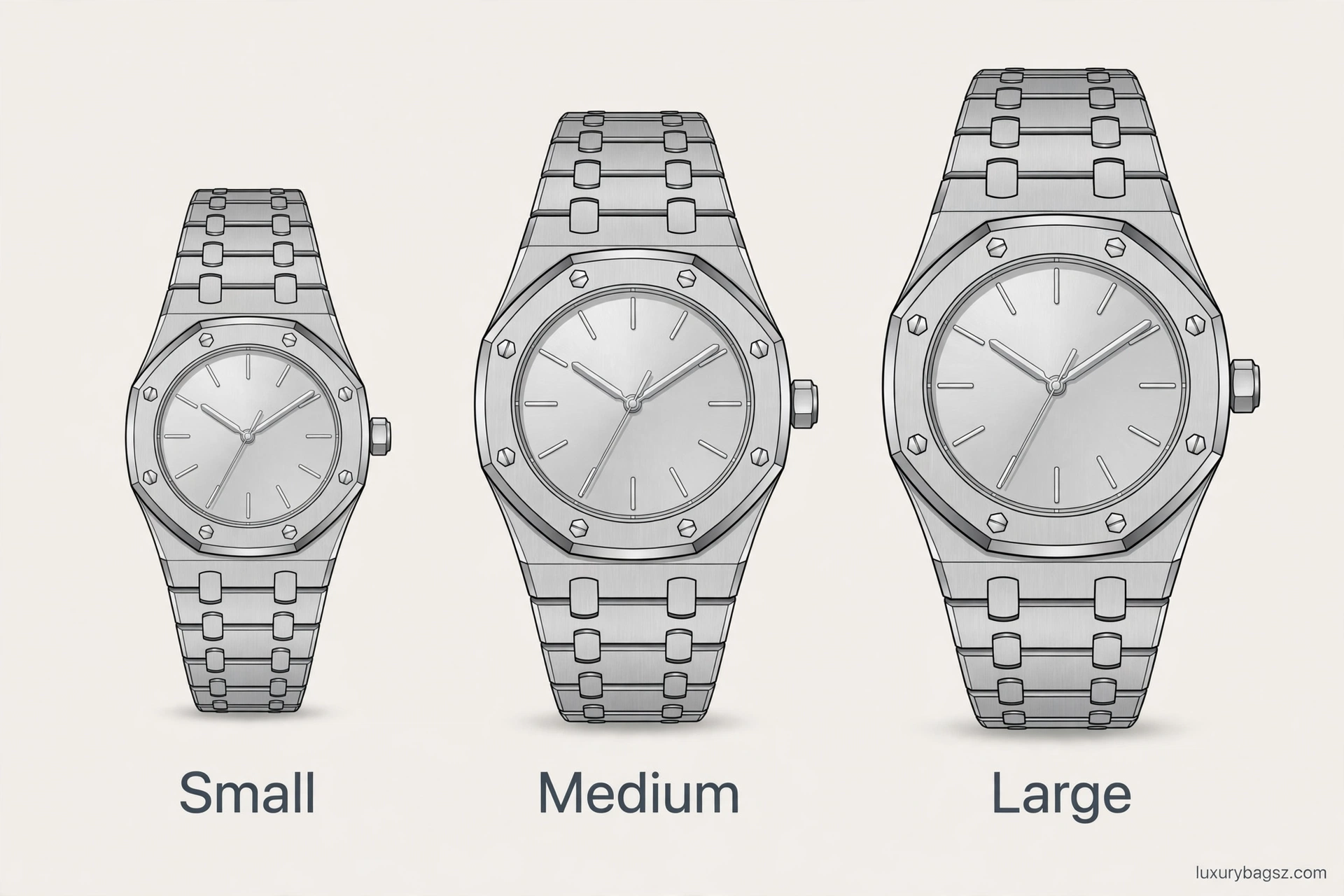
No competitor guide found gives one complete table of every current size with thickness, movement and water resistance, so this guide combines WatchGuys's reference tables with AssureOne's comparison table, and states plainly where figures were not found. Lug-to-lug and weight figures were not found in the opened guides, so none are given here.
| Reference | Style | Size | Thickness | Movement | Power reserve |
|---|---|---|---|---|---|
| 16202ST | Jumbo Extra-Thin | 39 mm | 8.1 mm | Calibre 7121 | 55 hours |
| 15510ST | Selfwinding | 41 mm | 10.5 mm (WatchGuys gives 10.4 mm) | Calibre 4302 | 70 hours |
| 15550ST | Selfwinding | 37 mm | 9.1 mm | Calibre 5900 | 60 hours |
| 26240ST | Chronograph | 41 mm | 12.4 mm | Calibre 4401 flyback | 70 hours |
Note the small disagreement on the 15510ST thickness: AssureOne gives 10.5 mm, while WatchGuys gives 10.4 mm in its comparison table and 10.4 mm in its specifications for the same reference. The difference is a rounding difference, not a different watch, but it is stated here so a buyer comparing pages is not confused.
Beyond the core four, Audemars Piguet offers 33 mm and 34 mm sizes for smaller wrists, and Chronograph models at 38 mm as well as 41 mm. The 37 mm Selfwinding, ref. 15550ST, is the natural step down from the 41 mm for a smaller wrist or a buyer who finds 41 mm too present. The 33 and 34 mm models are named by WatchGuys but not explained in depth, and no wrist-size-to-case-size guidance was found in either opened guide.
For wrist guidance, this guide gives reasoned advice, flagged as such, rather than a sourced table that does not exist. Under about 16 cm wrist circumference, try the 37 mm or 38 mm first. Between about 16 and 18 cm, the 39 mm Jumbo and the 41 mm Selfwinding both work, with the Jumbo wearing smaller because it is thinner. Above about 18 cm, the 41 mm wears most naturally, and the Jumbo can look small.
Try before you buy, because the Royal Oak wears larger than its diameter suggests, thanks to its integrated bracelet and wide bezel.
Jumbo Versus Selfwinding: The Debate That Defines Collecting
This is the debate that defines Royal Oak collecting, and WatchGuys frames it as two watches, two philosophies, one octagonal bezel. The Jumbo Extra-Thin, ref. 16202, at 39 mm and just 8.1 mm thick, is the spiritual descendant of the original 1972 ref. 5402. It displays hours, minutes, and date only, with no seconds hand, and that simplicity is the point.
The Jumbo is powered by calibre 7121, Audemars Piguet's modern evolution of the legendary calibre 2121, operating at 28,800 vibrations per hour with a 55-hour power reserve and a quick-set date. Its Petite Tapisserie dial pattern is exclusive to the Jumbo line, distinguishing it at a glance from the Grande Tapisserie used on the Selfwinding. For collectors and purists, the Jumbo represents the Royal Oak in its most distilled form.
The Selfwinding 41 mm, ref. 15510, is the more practical daily wearer. At 41 mm and about 10.4 mm thick, it has more wrist presence and a bolder aesthetic. Its calibre 4302 delivers a 70-hour power reserve, fifteen hours more than the Jumbo, a central seconds hand for precision timekeeping, and hacking functionality. Its Grande Tapisserie dial has a more pronounced texture that catches light differently, and its case is more robust.
On the secondary market, the 15510ST trades between $38,000 and $50,000, considerably less than the Jumbo's $70,000 to $85,000 range, making it the more accessible entry into the collection, according to WatchGuys. The Jumbo commands its premium for heritage, thinness, and collector cachet, not for extra function.
If you buy the Royal Oak because you love the design and respect what Genta created, the 16202 is the one, in WatchGuys's founder's words. If you buy it to wear every day, the 15510 is the better tool.
Chronograph, Perpetual Calendar, and High Complications
The Chronograph, ref. 26240, adds timing functionality to the core design through its calibre 4401 flyback movement, visible through an exhibition sapphire back. At 41 mm and 12.4 mm thick, it is the thickest of the core models, and that thickness changes how it wears under a cuff. Chronograph models also exist at 38 mm with calibre 6401, introduced in 2026, for buyers who want the complication in a smaller case.
The earlier Chronograph, ref. 26331ST, is famous for its high-contrast dual-tone Panda sub-dial configurations, powered by calibre 2385, and it remains a popular pre-owned choice. The move from 26331 to 26240 in 2022 brought a fully integrated in-house flyback chronograph, which matters for servicing and for collector interest, because integrated chronographs are more highly regarded than modular ones.
Beyond the chronograph, Audemars Piguet produces Perpetual Calendar, Tourbillon, Double Balance Wheel Openworked, and Grande Complication variants. The Perpetual Calendar ref. 26574ST, in steel at 41 mm on calibre 5134, is the best-known calendar Royal Oak, with a titanium version, ref. 26615TI, on the same calibre.
The Double Balance Wheel Openworked ref. 15407ST, in steel at 41 mm on calibre 3132, shows the movement architecture through an openworked dial.
The 2026 novelties extend the high end further: an openworked perpetual calendar with calibre 7139, a ceramic perpetual calendar in Bleu Nuit Nuage 50, and a Jumbo Extra-Thin Openworked in titanium and palladium BMG, or bulk metallic glass. These are collector pieces with limited availability, not daily wearers, and their prices sit far above the core steel models.
Do not compare a perpetual calendar price with a time-and-date price and call the difference a premium. They are different watches.
Smaller Models, Women's Models, and Who They Suit
The 33 mm, 34 mm and 37 mm models are named by WatchGuys but not explained in depth by either opened guide, and this part states that gap while giving the facts that were found. The 37 mm Selfwinding, ref. 15550ST, on calibre 5900 with a 60-hour power reserve, is the best-documented smaller model, and it is the natural choice for a wrist that finds 41 mm too large or 39 mm too thin.
Diamond-bezel variants exist at 37 mm, such as the ref. 15551ST, in steel with a diamond bezel, on the same calibre 5900. Diamond bezels change the watch's character from sports to jewellery, and they change its resale behaviour: diamond Royal Oaks appeal to a different buyer pool and do not always track steel time-and-date prices.
A snippet-only source, Mint Cover, notes that smaller references do not appreciate as strongly as larger ones, but no figures were given, so this guide reports the claim as snippet-only, not as a measured fact.
Quartz versus automatic matters at smaller sizes, though neither opened guide develops it for the Royal Oak. Smaller Royal Oaks have historically included quartz models, while the core 37 mm and above are automatic. A quartz Royal Oak is a different ownership proposition, with less servicing and less collector interest, and it should not be priced as an automatic equivalent.
For buyers choosing a smaller Royal Oak, the honest advice is to try the 37 mm first, then the 39 mm Jumbo, and to judge by wrist presence rather than diameter alone. The Royal Oak's integrated bracelet and wide bezel make it wear larger than a round watch of the same diameter, so a 37 mm Royal Oak can look like a 39 mm watch from another maker. That wear-large character is why the 37 mm suits more wrists than its number suggests.
Prices in 2026: Retail, Secondary, and What Moves Them
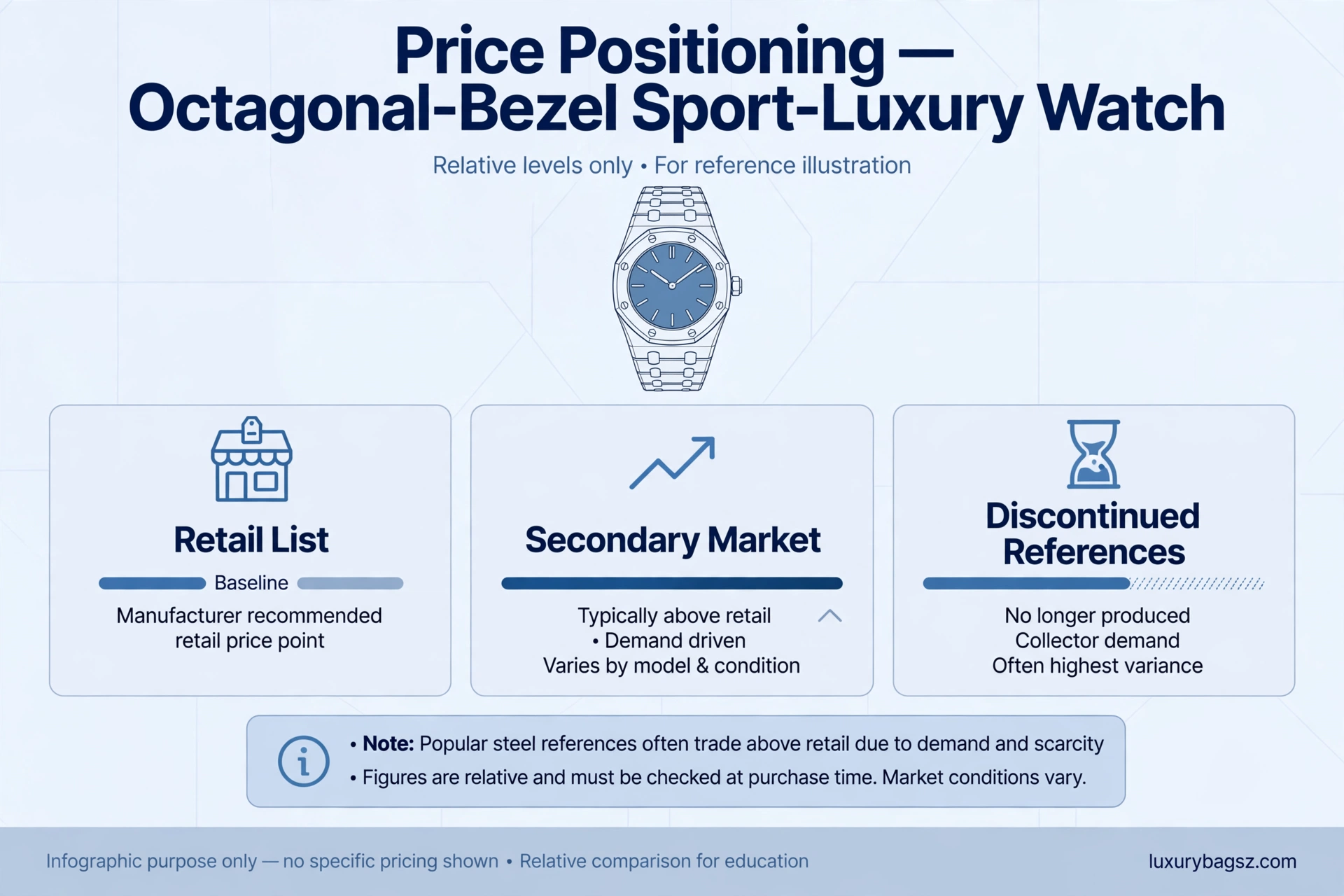
WatchGuys is the only priced source among the opened guides, because AssureOne's "market value" framing gives value drivers but no figures. All prices below are WatchGuys's 2026 figures, following a 7.5 percent average US price increase in January 2026, which narrowed the gap between retail and secondary values for steel models without closing it.
| Reference | Retail 2026 | Secondary 2026 |
|---|---|---|
| 16202ST, Jumbo Extra-Thin, steel, blue dial | About $40,100 | $70,000 to $85,000 |
| 15510ST, Selfwinding 41 mm, steel, blue dial | About $28,500 | $38,000 to $50,000 (WatchGuys gives $42,000 to $50,000 in its price table) |
| 26240ST, Chronograph 41 mm, steel, blue dial | About $45,150 | $48,000 to $58,000 (summary gives $45,000 to $58,000) |
| 15510OR, Selfwinding 41 mm, rose gold, blue dial | About $55,000 | $62,000 to $78,000 |
| 15202ST, discontinued Jumbo, steel, blue dial | Last retail about $33,300 | $65,000 to $80,000 |
| 15400ST, discontinued Selfwinding, steel, blue dial | Last retail about $22,500 | $32,000 to $38,000 |
Note the small internal ranges in WatchGuys's own figures: the 15510ST secondary range appears as $38,000 to $50,000 in the summary and $42,000 to $50,000 in the price table, and the 26240ST appears as $45,000 to $58,000 in the summary and $48,000 to $58,000 in the table. This guide gives both, because a buyer comparing pages on the same site will meet both, and the difference reflects condition and dial variation within the range, not an error.
Dial colour has a measurable impact. Blue dials consistently command the highest premiums across all sub-families, followed by green, a newer entrant gaining traction, and black. Silver and grey dials tend to trade at the lower end of the range for any reference. Limited editions and anniversary models, particularly from the 2022 50th anniversary series with commemorative rotors, command additional premiums.
Royal Oak Versus Offshore: The Bigger, Louder Sibling
The Royal Oak Offshore, designed by Emmanuel Gueit and launched in 1993, is a larger, more muscular evolution of the original. Initially controversial, with some calling it the Beast, it went on to become its own massive sub-collection, expanding the Royal Oak's reach into sport and pop culture. The nickname stuck and is now used affectionately by Offshore fans.
Size is the clearest difference. Diamond Club, seen only as a snippet in this research, gives Royal Oak sizes of 37, 39 and 41 mm against Offshore sizes of 42 to 44 mm, and water resistance of about 50 m for the Royal Oak. The Offshore's Mega Tapisserie dial, with larger squares than the Grande Tapisserie, matches its larger case, and its thicker case and bolder pushers suit a wrist that finds the classic Royal Oak too restrained.
Choose the classic Royal Oak if you want heritage, versatility, and a watch that suits a suit as well as a weekend. Choose the Offshore if you want presence, sportiness, and a watch that makes a statement before it tells the time. The Offshore's larger size and louder design narrow its audience, which is why the history-and-sizes guides barely mention it, even though it deserves its own decision.
Water resistance for the classic Royal Oak is 50 m, or 5 ATM, according to WatchGuys's specifications for the 15510ST. That is a splash and rain rating, not a swimming rating, despite the sports-watch name. Do not treat a Royal Oak as a dive watch, and have its gaskets checked at service, because 50 m on paper means little on a watch that has not been pressure-tested in years.
Reading the Reference Number
Audemars Piguet reference numbers look complex, but they tell you everything once you learn the system. The first five digits identify the model and complication. The two letters after that tell you the case material: ST for steel, OR for rose gold, BA for yellow gold, PT for platinum, CB for black ceramic, and TI for titanium.
After the periods, the next group identifies the bracelet or strap material, and the final two digits indicate the dial variant.
Worked example: 15510ST.OO.1320ST.01 breaks down as model 15510, steel case, with a steel bracelet and a specific dial variant. A 16202OR is a Jumbo Extra-Thin in rose gold. A 26240ST is a Chronograph in steel. Once you learn the system, you can decode any Royal Oak at a glance, and you will know exactly what you are looking at before you even see the watch.
That decoding protects you twice. First, it stops you comparing unlike references: a 15510ST and a 15510OR differ in material and price by tens of thousands of dollars, despite sharing the same model number. Second, it stops sellers misdescribing a watch: a claimed steel watch with an OR in its reference, or a claimed Jumbo with a 15510 number, is either a mistake or a misrepresentation, and either way it deserves a question.
For the same reason, our guide to Rolex serial number checks stresses decoding the numbers before trusting a listing, and the same discipline applies here. Learn the reference system before you shop, and every listing becomes easier to read.
Buying Pre-Owned: Authentication, Polishing, and the Full Set
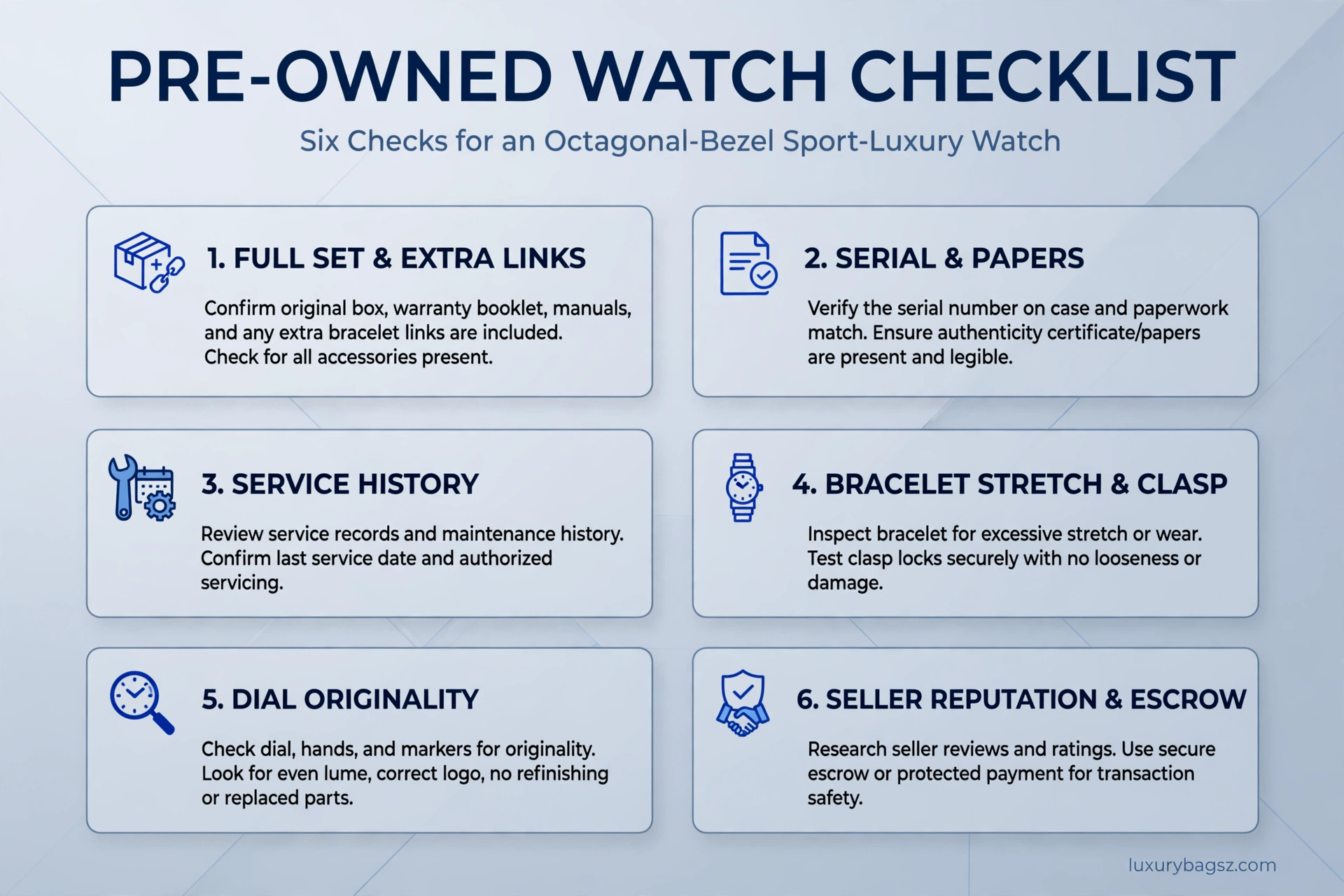
The Royal Oak is one of the most counterfeited luxury watches in the world, according to WatchGuys, and AssureOne's authentication checklist, while short, gives the right starting points. Bezel screws must sit completely flush against the bezel cutouts, forming an aligned circular pattern. Bevel lines must show sharp, distinct transitions between satin-brushed top surfaces and high-polish edge chamfers.
Tapisserie square pyramids must be crisp, symmetrical, and free of printing bleeds under magnification.
Bracelet flex is a telling check. Look for minimal lateral sagging, and check that link screws on the underside are unmarred and flush. A bracelet that sags sideways has worn links, and a bracelet with chewed link screws has been sized by someone without the right tools. Both faults lower value and suggest careless ownership.
Polishing history matters more on a Royal Oak than on almost any other watch, because the hand-finished brushed and polished surfaces show wear quickly. A Royal Oak that has been over-polished by a non-AP service centre will have rounded edges where they should be crisp, and brushed surfaces may appear uneven. A lightly worn, unpolished piece will always command a premium over an over-restored one, according to AssureOne.
Confirm the full set. At this price point, a complete set matters enormously: the original AP box, warranty card or certificate, instruction manual, and ideally, an AP Extract from the Archives. AssureOne reports that complete sets with all original extra links trade 10 to 15 percent higher than loose watches.
WatchGuys puts the gap between a full-set Royal Oak in excellent condition and one without papers or with heavy wear at $5,000 to $15,000, depending on the reference.
Retail Versus Secondary: Waitlists, Warranties, and Access
Buying at retail requires patience and, increasingly, an existing relationship with an Audemars Piguet boutique or AP House. Waitlists for popular steel references like the 15510ST and 16202ST typically exceed 12 to 24 months, and allocation is not guaranteed.
AP has moved toward a direct-to-consumer model, closing many third-party authorised dealer relationships in favour of brand-owned boutiques, which makes the retail path more controlled but harder to access for first-time buyers.
The secondary market offers immediate access to the full range of references, including discontinued models no longer available at retail, such as the 15202, 15400, 15500 and 26331. Pre-owned Royal Oaks from trusted dealers come authenticated, inspected, and backed by warranty, but at a premium above retail for most steel configurations.
Certain rose gold and older discontinued models can actually trade at or below their original retail price, so the secondary premium is not universal.
Warranty differs by channel. Retail purchases carry AP's 2-year warranty, extendable to 5 years via boutique registration, according to WatchGuys. Secondary purchases from a dealer carry that dealer's warranty, typically 2 years from a dealer such as WatchGuys, not a fresh AP warranty. Check which warranty you are getting, because a watch with no warranty and no service history is a different purchase from a watch with both.
For the same reason, our guide to telling a fake Rolex stresses buying the seller as much as the watch. A Royal Oak is no different: the dealer's authentication, warranty, and return policy are part of the purchase, not an optional extra, and they are worth paying for on a watch at these prices.
Servicing, Links, and the Cost of Keeping a Royal Oak
Audemars Piguet recommends servicing the Royal Oak every 5 to 8 years, according to WatchGuys. A full AP service can cost $1,500 to $3,000 or more, depending on the calibre and complexity, with high complications costing more than time-and-date models. Ask for service records and check when the movement was last serviced, because a recently serviced Royal Oak with documentation provides peace of mind and protects your investment.
Be wary of watches serviced by non-AP watchmakers, because aftermarket parts can affect both performance and authenticity. A Royal Oak's finishing is so specific that a non-AP polish can permanently damage its value, by rounding the bevels that collectors pay for. If a watch has been polished, ask who polished it and whether the work is documented. An undocumented polish is a discount, not a feature.
Extra links deserve their own question. Full sets with extra links trade 10 to 15 percent higher, according to AssureOne, but neither opened guide gives the cost of buying extra links separately or their availability. Ask your dealer for the link price and availability before you buy a watch that fits tightly, because a bracelet that cannot be sized to your wrist is a watch you cannot wear.
Frosted Gold deserves a final note for buyers considering gold models. The technique, developed with Florentine jeweller Carolina Bucci, hammers the gold surface with a diamond-tipped tool to create a shimmering, frosted effect on the case and bracelet.
It is available on select Royal Oak models in white and rose gold, and it changes both the look and the servicing: a frosted surface cannot be refinished like a brushed one, so buy it knowing its finish is part of its identity.
Frequently Asked Questions
When was the Royal Oak launched?
In 1972, at the Basel Watch Fair, as ref. 5402ST. It was 39 mm, about 7 mm thick, powered by calibre 2121, and priced at 3,300 CHF, roughly four times a Rolex Submariner of the era. It was designed by Gérald Genta and was the world's first luxury sports watch in stainless steel.
What sizes does the Royal Oak come in?
Current core sizes are 39 mm for the Jumbo Extra-Thin, 37 mm and 41 mm for the Selfwinding, and 38 mm and 41 mm for the Chronograph, plus 33 mm and 34 mm for smaller wrists. The 39 mm Jumbo is 8.1 mm thick, the 41 mm Selfwinding is about 10.4 mm thick, and the 41 mm Chronograph is 12.4 mm thick.
What is the difference between the Jumbo and the Selfwinding?
The Jumbo Extra-Thin, ref. 16202, is 39 mm, 8.1 mm thick, has no seconds hand, and runs calibre 7121 with a 55-hour power reserve. The Selfwinding, ref. 15510, is 41 mm, about 10.4 mm thick, has a central seconds hand, and runs calibre 4302 with a 70-hour power reserve. The Jumbo carries the heritage; the Selfwinding is the better daily wearer.
How much does a Royal Oak cost in 2026?
According to WatchGuys, retail is about $40,100 for a steel Jumbo 16202ST, about $28,500 for a steel Selfwinding 15510ST, and about $45,150 for a steel Chronograph 26240ST. Secondary prices are $70,000 to $85,000 for the Jumbo, $38,000 to $50,000 for the Selfwinding, and $45,000 to $58,000 for the Chronograph.
How do you read a Royal Oak reference number?
The first five digits identify the model and complication, and the two letters after them give the case material: ST steel, OR rose gold, BA yellow gold, PT platinum, CB black ceramic, TI titanium. The later groups identify the bracelet or strap material and the dial variant. For example, 15510ST is a Selfwinding in steel.
Is the Royal Oak a good investment?
It has demonstrated strong value retention, with discontinued references such as the 15202ST and 15400ST appreciating since leaving production, and current steel models trading above retail. That is a market observation, not a guarantee. Condition, dial colour, polishing history and completeness decide more than the reference name alone.
What is the Royal Oak Offshore?
The Offshore is a larger, more muscular Royal Oak sub-collection, launched in 1993 and designed by Emmanuel Gueit, nicknamed the Beast. Offshore sizes run about 42 to 44 mm, against 37 to 41 mm for the classic Royal Oak, with Mega Tapisserie dials. Choose it for presence and sportiness; choose the classic for heritage and versatility.
How often should a Royal Oak be serviced?
Every 5 to 8 years, according to WatchGuys, with a full AP service costing $1,500 to $3,000 or more depending on calibre and complexity. Ask for service records before buying pre-owned, and be wary of watches serviced by non-AP watchmakers, because aftermarket parts and poor polishing affect both performance and value.
How do you spot a fake Royal Oak?
Check that bezel screws sit flush in an aligned circular pattern, that bevel lines are sharp between brushed and polished surfaces, that tapisserie pyramids are crisp and symmetrical under magnification, that bracelet links show minimal sag, and that serial numbers match warranty paperwork. Buy from established dealers with multi-point authentication and an Extract from the Archives where available.
Should I buy a Royal Oak at retail or pre-owned?
Buy at retail if you have a boutique relationship and can wait 12 to 24 months or more for a popular steel reference, and want a fresh AP warranty. Buy pre-owned if you want immediate access, a discontinued reference, or a specific dial colour. Either way, verify authenticity, polishing history, service records and completeness before paying.
Conclusion
The Royal Oak began as a provocation: steel, priced like gold, sketched overnight, inspired by a diving helmet. It became the benchmark against which every luxury sports watch is measured, and it has stayed there for more than fifty years because its design never needed to shout. Eight screws, an integrated bracelet, and a tapisserie dial, finished by hand, still carry the whole watch.
Choose the Jumbo if you want the design in its purest form, thin, heritage-rich, and commanding a premium for exactly that purity. Choose the Selfwinding if you want the watch you will wear every day, with a seconds hand, a longer power reserve, and a lower entry price. Choose the Chronograph if you want timing function, and the Offshore if you want presence above all else.
Whatever you choose, decode the reference, check the finishing, confirm the full set, and budget for servicing. A Royal Oak in the right size, unpolished, complete, and recently serviced is a watch for decades. A Royal Oak bought on diameter alone, without those checks, is a gamble at prices where gambles are expensive. Buy the reference that fits your wrist and your life, and let the design do the rest.






