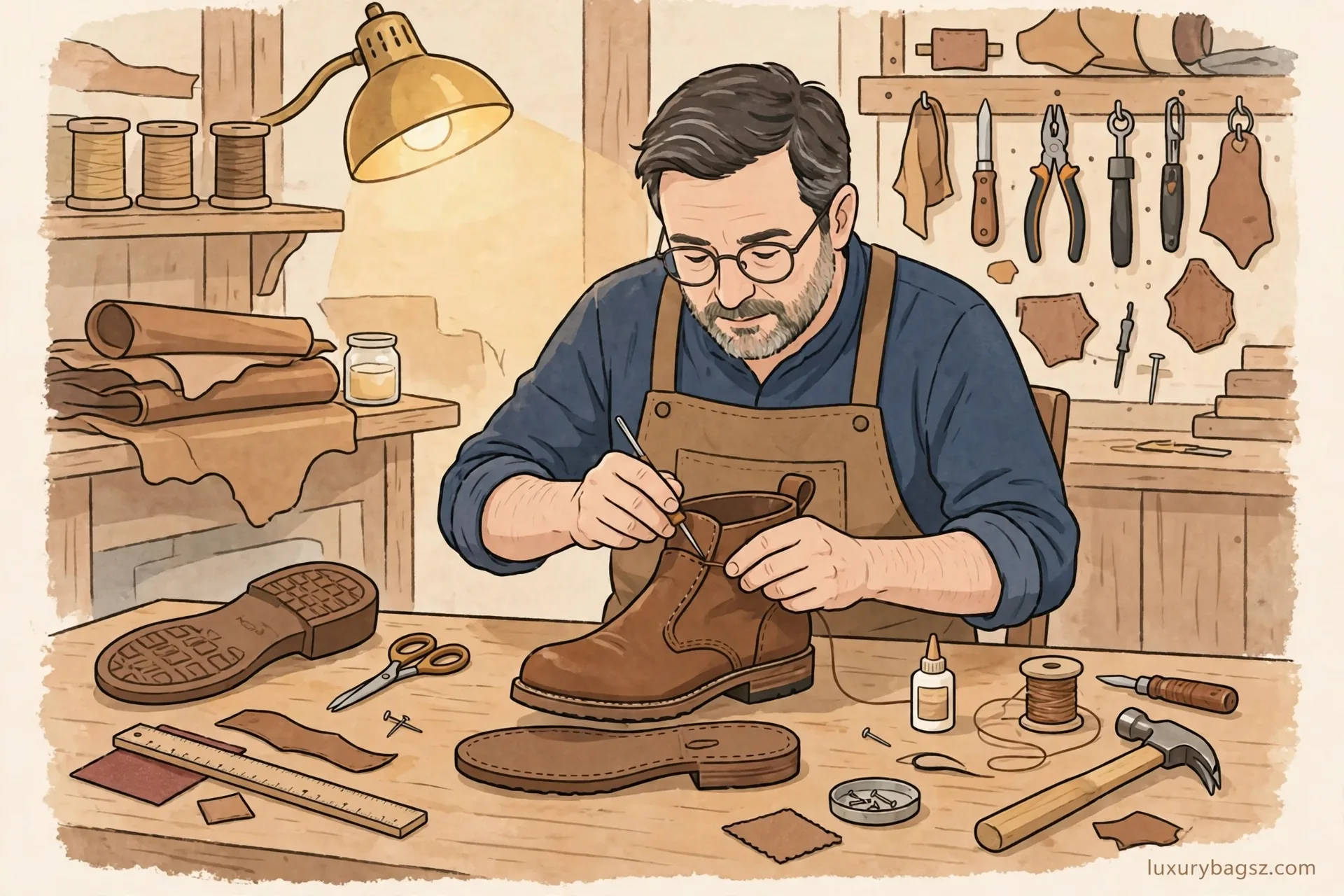
Most good boots can be resoled, and most cheap boots cannot. The deciding factor is construction, not brand or price alone. Boots with stitched soles, above all Goodyear welt boots, are made to be resoled several times. Boots with soles that are only glued on are usually not worth resoling, even when a cobbler agrees to try.
The quick test takes ten seconds: look at the edge where the sole meets the upper. If you see a strip of leather or rubber with stitching around the edge, the boot is likely resolable. If the sole is smoothly glued with no stitching at all, it probably is not.
Resoling typically costs $80 to $200, far less than a new pair of quality boots, and a well-made boot can survive three to five resoles over decades. The rest of this guide shows which constructions qualify, which boot types to check, and when replacement is the smarter spend.
Key Takeaways
Stitched construction is the key: Goodyear welt, Blake stitch, stitchdown and Norwegian welt boots all resole well.
Goodyear welt is the gold standard for resoling, because the welt protects the upper while soles are replaced.
Most glued, cemented boots under $250 are not designed to be resoled, and glue-only resoles are unreliable.
Check the sole edge for welt stitching, check the maker’s product page, or ask a cobbler when unsure.
A resole costs roughly $80 to $200, versus $300 or more for a new quality pair.
Do not resole boots with worn-thin uppers, cracked leather, broken safety parts or rotten stitching.
Factory recrafting services suit dress boots, while local cobblers suit work, hiking and cowboy boots.
After a resole, break the boots in gently again, because a new sole changes flex and feel at first.
The Ten-Second Test for Any Boot
Turn the boot over and look at the sole edge, where the upper meets the sole. A visible strip, called a welt, with stitching running around the perimeter, is the best sign of a resolable boot. The stitching shows a cobbler exactly where the old sole comes off and the new one goes on.
Next, check the inside. Blake-stitched boots show stitching inside the boot, around the insole edge, because the upper is stitched directly to the outsole. This construction resoles well too, though it needs a special Blake machine, so not every cobbler offers it.
Read the maker’s product page when the boot itself is unclear. Reputable makers state the construction plainly, often as Goodyear welted, Blake stitched or stitchdown, and many state whether the boot is resolable. If the page says nothing, email the maker or ask a cobbler before assuming.
Weigh the boot’s original price as a rough guide, not a rule. Boots over $300 are often welted and resolable, while boots under $150 are usually glued. Exceptions exist in both directions, so price alone never settles it, but it tells you how much hope to have before you check.
Goodyear Welt: The Gold Standard
Goodyear welt construction stitches the upper to a leather strip, the welt, and stitches the welt to the midsole, with the outsole bonded to the midsole. To resole, a cobbler cuts the welt-to-midsole stitching, removes the old sole unit, and stitches a new one on, leaving the upper and welt intact.
That separation is why Goodyear welt boots resole so cleanly, several times over. The upper never takes the stress of sole removal, so a well-kept upper can outlast three, four or five soles. With care, a Goodyear welted boot can last 20 to 30 years or more.
Brands built on this construction include Red Wing, Alden, White’s, Nick’s, Viberg, Crockett and Jones, Meermin and R.M. Williams, among others. Danner’s welted models, such as the Mountain Light and Bull Run, qualify too, while Danner’s glued models do not, which shows why model matters more than brand.
Sole choice at resole time is yours. A cobbler can fit leather soles for dress wear, rubber soles such as Vibram for grip, or Dainite studded rubber for a dress look with better traction. Rubber lasts longer on pavements, while leather suits dress boots and quiet floors.
Blake Stitch, Stitchdown and Norwegian Welt
Blake stitching sews the upper, insole and outsole together in one seam, visible inside the boot and underneath it. Blake-stitched boots resole well, but the work needs a Blake machine, so it costs more and takes longer than a Goodyear resole. Ask the cobbler in advance whether they have the machine.
Stitchdown construction stitches the upper flange directly outward onto the midsole, giving a flexible, durable bond that cobblers can work with easily. It is common on Pacific Northwest work boots and heritage boots, and it resoles reliably, often with a wide choice of replacement soles.
Norwegian welt, sometimes called Norvegese, stitches through the upper, insole and welt in a distinctive double seam, and it is highly water-resistant. It resoles well in skilled hands, though fewer cobblers handle it, so a specialist or the maker may be the better choice.
All three constructions share the key feature: a mechanical, stitched bond that a cobbler can undo and redo. That is the line between resolable and not. Glue alone, however strong when new, gives a cobbler nothing to stitch back into, which is why glued boots fail the test.
Glued and Cemented Boots: The Honest Verdict
Cemented construction bonds the upper directly to the midsole with adhesive, with no welt stitching. Most hiking boots under $250, most fashion boots, and the vast majority of trail shoes use this method, including popular models such as the Merrell Moab, Keen Targhee and Salomon Quest.
These boots are not designed to be resoled. A skilled cobbler can sometimes grind the old sole down and cement a new one on, but the result is unreliable, because the new bond is adhesive only, with no stitching to hold it. It may peel at the toe or heel within months, especially in wet or hot use.
Some exceptions exist. High-quality cemented boots with strong adhesives and sound uppers can sometimes be resoled acceptably, and some makers offer their own resole service for cemented models. Treat these as case-by-case judgments from a cobbler who has seen the boots, not as a general promise.
The economics usually settle it anyway. A glue-only resole costs nearly as much as a welted resole, but on a boot that cost $120 new, it rarely makes sense. Save the resole budget for boots built to be resoled, and replace glued boots when their soles wear out.
Boot Types, Checked One by One
Work boots split by construction, not by label. Welted work boots from Red Wing, Thorogood’s welted lines, White’s and Nick’s resole well and are worth resoling for years. Glued work boots, even sturdy-looking ones, usually are not, so check the welt before buying if long life matters to you.
Dress boots and Chelsea boots are usually resolable when they come from heritage makers. Goodyear welted Chelseas from R.M. Williams, Crockett and Jones, Meermin and similar makers resole cleanly, and factory recrafting services can return them close to new, with new soles, heels and laces.
Hiking and mountaineering boots vary widely. Welted leather hikers from Limmer, Zamberlan’s welted models and Hanwag’s welted lines resole well. Cemented hikers and boots with a full rubber rand, such as many Scarpa and La Sportiva models, need a specialist resoler or the maker, and some cannot be resoled at all.
Cowboy boots are usually resolable, because traditional cowboy construction uses a welt and a leather sole that cobblers know well. A good western cobbler can resole, reheel and even rebuild cowboy boots, and exotic cowboy boots need a specialist, not a general cobbler, for skin-safe work.
Motorcycle boots from quality makers often resole well, especially stitched models, and resoling is worth it for boots with intact armour and uppers. If crash damage has cracked internal armour, TPU guards or the shank, retire the boots regardless of sole condition, because safety parts cannot be restored by a resole.
When Resoling Is Not Worth It
Worn-thin uppers are the clearest stop sign. If leather is paper-thin at flex points, cracked across large areas, or torn at seams, a new sole cannot save the boot. The upper will fail soon after the resole, wasting the repair cost.
Rotten stitching is another stop sign. If welt thread crumbles or snaps with light pressure, often after years of damp or salt exposure, the boot needs restitching as well as resoling, and the combined cost may exceed the boot’s value. A cobbler can judge this honestly in minutes.
Broken safety parts end the discussion for work and motorcycle boots. A cracked steel toe cap, a broken shank, crushed armour or a failed waterproof membrane cannot be fixed by a resole, and wearing the boots on invites risk. Replace safety boots when their protection is compromised, full stop.
Finally, do the maths. If a resole costs $150 and a comparable new pair costs $180, replacement wins, especially when the old pair also needs heels, laces and conditioning. Resoling shines when the boots are quality, broken-in, and dearer to replace than to repair.
The Resole Process, Cost and Turnaround
A standard resole starts with inspection: the cobbler checks the welt, upper, insole and heel, then quotes a price and a sole choice. Next, the old sole and heel are removed, the welt is cleaned and repaired if needed, and the new sole is cut, bonded and stitched on.
Heel caps, welting repairs, new laces and a clean and condition are often included or offered as extras. Ask what the quote covers before you commit, because a bare sole-only price and a full refurbishment price can differ by $50 or more. A full service usually leaves boots looking close to new.
Costs in the United States typically run $80 to $150 for a standard resole, $150 to $200 for premium soles or factory recrafting, and more for mountaineering or exotic work. Turnaround is usually one to three weeks for a local cobbler, and four to eight weeks for a factory service with shipping.
Break in resoled boots gently. A new sole is stiffer than a worn one, and flex points feel different for the first days. Wear them indoors for short periods first, then build up, just as with new boots, and condition the uppers after the first few wears.
Choosing a Cobbler and Caring for Resoled Boots
Choose a cobbler with experience in your boot’s construction. A dress-shoe cobbler may not handle heavy work boots well, and a general cobbler may not have a Blake machine. Ask what constructions they resole, look at finished work if you can, and check reviews for boots like yours.
Factory recrafting suits dress boots from makers such as Allen Edmonds and Alden, who offer their own services with original lasts and materials. Local cobblers suit work, hiking and cowboy boots, where sole choice and fit matter more than factory originality. Both routes are legitimate.
Mail-in resole services widen the choice when no good local cobbler exists. Pack boots well, include a note stating the sole you want and any fit issues, and confirm turnaround and total cost including return shipping before sending. Photograph the boots before posting, for your own record.
After a resole, care stays the same: brush after wear, condition smooth leather when dry, keep boots dry between wears, and check heel caps early. A resoled boot that is cared for will reach its next resole in better shape, and that cycle is how a good pair becomes a decades-long pair.
Frequently Asked Questions
How do I know if my boots can be resoled?
Look for welt stitching around the sole edge, check the maker’s product page for the construction, or ask a cobbler. Stitched boots usually resole well, while smoothly glued boots usually do not.
Can all leather boots be resoled?
No. Only boots with stitched construction, such as Goodyear welt, Blake stitch or stitchdown, resole reliably. Glued boots can sometimes be re-soled with adhesive only, but the result is unreliable.
How much does it cost to resole boots?
Typically $80 to $150 for a standard resole, $150 to $200 for premium soles or factory recrafting, and more for mountaineering or exotic boots. New quality boots usually cost $300 or more.
How many times can boots be resoled?
Goodyear welt boots can often be resoled three to five times, as long as the upper and welt stay sound. Each resole should include a welt check, because a worn welt limits further resoles.
Can hiking boots be resoled?
Welted leather hikers can, while most cemented hikers under $250 cannot be resoled reliably. Mountaineering boots with a full rubber rand need a specialist resoler or the maker.
Are Red Wing boots resoleable?
Most Red Wing heritage and work models are Goodyear welted and resole well. Check the specific model, because some Red Wing lifestyle models use different construction.
Can a cobbler resole glued boots?
Some cobblers will try, by grinding the old sole and cementing a new one, but the bond is adhesive only and may peel. Ask for an honest assessment, and expect no guarantee on a glue-only resole.
How long does a resole take?
Local cobblers usually take one to three weeks, while factory recrafting with shipping takes four to eight weeks. Ask for a turnaround estimate before committing, especially for work boots you need daily.
Should I resole or replace my boots?
Resole when the boots are quality, well-fitting and cheaper to repair than replace, and the uppers are sound. Replace when uppers are thin or cracked, safety parts are broken, or repair costs approach new-boot prices.
Do resoled boots feel different?
Yes, at first. A new sole is stiffer and flexes differently, so break resoled boots in gently indoors for a few days before full-day wear. The feel settles quickly with use.
Summary
Resolability comes down to one question: is the sole stitched on, or only glued on? Stitched boots, led by Goodyear welt, are made for several resoles and decades of wear. Glued boots are made to be replaced when their soles wear out.
Check the welt, check the maker, and ask a cobbler when unsure. When the uppers are sound and the maths favours repair, a resole is one of the best value moves in footwear, turning a worn pair back into a daily pair for a fraction of replacement cost.
Jessica is the founder of Luxury Bagsz and a handbag specialist with more than 10 years in the bag industry. She owns and collects preloved designer bags, has examined over 500 bags by hand, and checks authenticity using the Entrupy app alongside stitching, hardware, engravings and date codes.
The Oran in Short The Hermès Oran is a flat leather slide sandal built around a single strap cut into the shape of the letter H. Designed in 1997 by Pierre Hardy for Hermès’ Year of Africa collection, and named after the Algerian coastal city of Oran, it has been in continuous production for nearly…
Louis Vuitton x Richard Prince is one of the most argued-over collaborations in luxury fashion, and also one of the most misunderstood. People remember it as “the watercolor bags” or “the joke bags,” as if it were one idea. It was actually several ideas at once, all shown for Spring/Summer 2008 under Marc Jacobs, who…
The Rolex 1908 is the watch that made people take Rolex dress watches seriously again. Launched at Watches and Wonders in 2023, it replaced the Cellini collection, introduced a brand-new movement, and — for the first time on a standard modern Rolex — showed that movement through a sapphire caseback. It is also a watch…
Getting an Appointment, in Brief A Hermès bag appointment is a booked meeting with a sales associate to talk about leather goods, not a ticket that guarantees a bag. That one fact explains most of the confusion around it. Hermès does not publish a single global appointment rule, so the right method depends on the…
Search for “Vivienne Westwood snail jewellery” and you will not find a single, current, catalogue product called the Snail Necklace or the Snail Ring, the way you can find the Orb Pendant or the Pearl Choker. That absence is the first thing to understand, and it is the reason this guide is written the way…
The Short Answer on Hermès Clothing Prices Most Hermès clothing sits between about $1,000 and $8,000 in the US: shirts and knitwear typically start in the low thousands, tailoring and dresses in the mid thousands, and coats and leather pieces at the top. Nothing in the clothing line is priced casually, but the spread is…