How to Spot a Fake Golden Goose Sneaker
Reading Distressing Like Real Wear
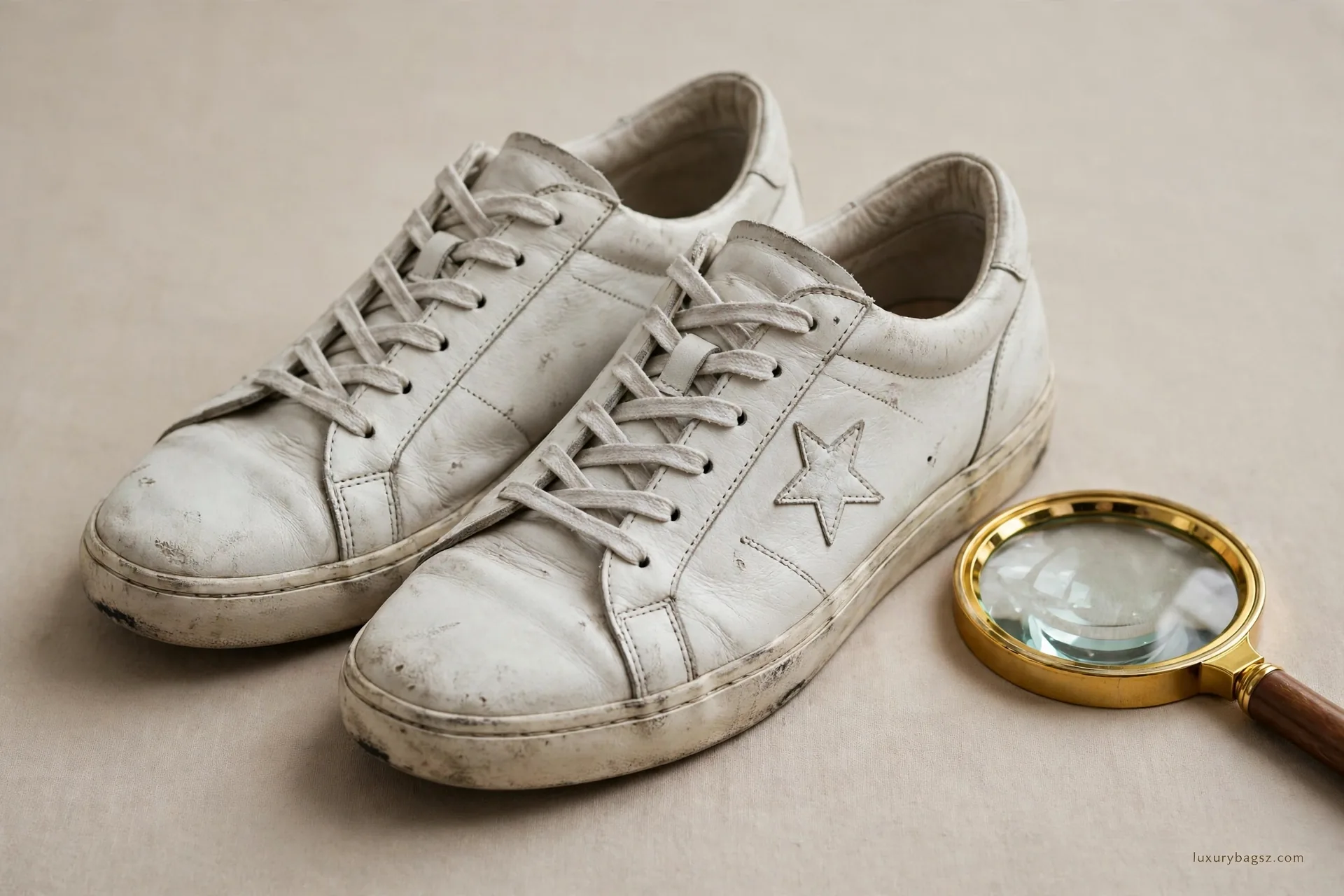
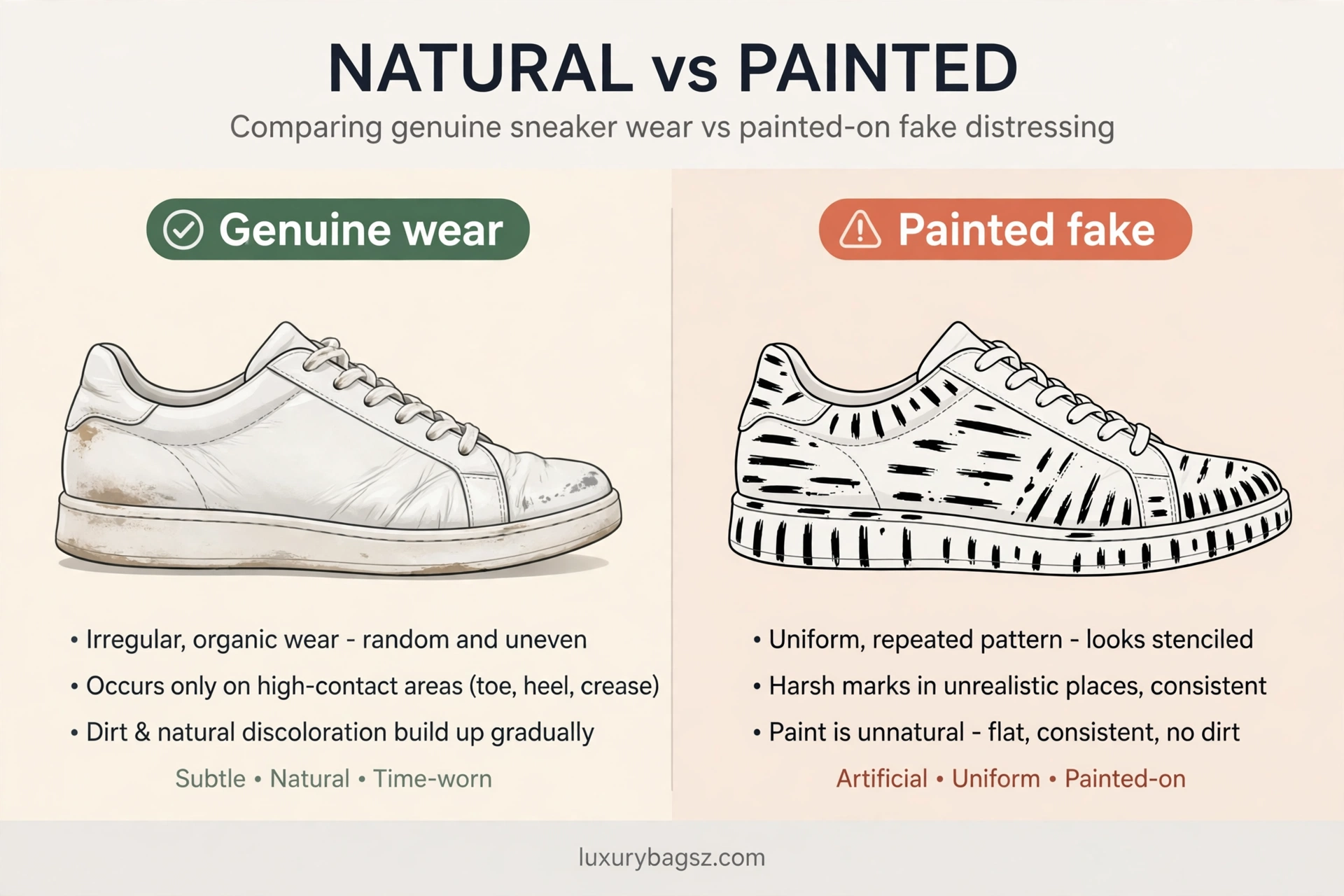
Judge the worn effect by where it falls, not by whether marks exist. On an authentic pair, scuffing gathers at believable pressure points such as the toe, heel and sole edges, looks layered rather than flat, and varies slightly between shoes because the finish is applied by hand.
Marks that appear uniformly printed, have hard edges or sit in places a shoe would never rub are far more suspect. Turn next to the star, which should be sharply pointed, evenly outlined and securely stitched, with both sides closely matched.
Materials complete the picture. Leather and suede should feel soft, full and natural, never stiff, papery or sealed under a thick glossy coating.
The Golden Goose in Brief
Golden Goose sneakers are famously hard to authenticate, and the reason is built into the design: they arrive pre-distressed. Scuffs, marks, dirt effects and worn-looking soles are intentional, which means a buyer cannot simply treat every scuff as damage or every mark as a fake sign.
Counterfeiters exploit that confusion, producing pairs whose distressing looks random and unconvincing, and whose materials and finishing give them away on closer inspection.
Stack that judgement with the star, leather, stitching, sole, labelling and seller checks below, and judge the pair as a whole. Golden Goose styles vary — Super-Star, Ball Star, Slide, Francy and others — so always compare against the same style, not against Golden Goose sneakers in general.
Key Takeaways
- Distressing is intentional on genuine pairs, so judge its placement, realism and quality, not its mere presence.
- The star applique should be cleanly cut, evenly stitched and correctly placed, with matching stars on both shoes.
- Real Golden Goose leather is soft, substantial and natural-looking, never plasticky, papery or coated in a thick shine.
- The sole, heel tab, tongue label and size information must all agree with the style and size claimed.
- Because distressing confuses the eye, complete daylight photographs of both shoes are essential; never buy from a single glamour shot.
Part 1: Know Which Golden Goose Style You Are Looking At
Identify the style, size and colourway before judging anything. A Super-Star, with its leather star and distressed white leather, is not judged by Ball Star standards, and a Slide has a different sole, collar and profile from a Francy. Ask the seller to state the style name, the size in EU and US terms, and the colourway, and to photograph any box label or receipt that supports those claims.
Size conversions deserve care, since Golden Goose uses EU sizing as its primary scale and conversions vary slightly between retailers. A size that converts impossibly, or a style name that does not exist in that colourway, should stop the deal until resolved.
A seller who cannot name the style or size is not necessarily selling a fake, but you cannot verify a pair you cannot identify, and for a distressed shoe that identification matters more than usual.
Part 2: Distressing That Looks Lived In, Not Painted On
Study the distressing as a whole. Genuine Golden Goose distressing concentrates where wear naturally happens: the toe cap, the heel, the sole edges, the sides where a shoe brushes surfaces, and the star edges. It varies in intensity, looks layered rather than flat, and differs slightly between the two shoes, because it is applied by hand rather than stamped by machine.
Fake distressing often fails in recognisable ways. Marks may look painted or printed on, with flat, uniform colour and hard edges that real wear does not produce. Scuffs may sit in impossible places, such as the middle of a protected panel that would never touch the ground.
Distressing may be identical on both shoes, suggesting a stencil rather than handwork, or it may be so heavy that it looks like damage rather than the brand's deliberate worn-in look. Also check the soles: genuine distressed soles show believable wear patterns, while fake soles sometimes show a uniform dirty coating that looks sprayed on.
Photographs in daylight, without filters, are essential here, since filters can hide painted distressing and exaggerate real wear.
Part 3: The Star Applique
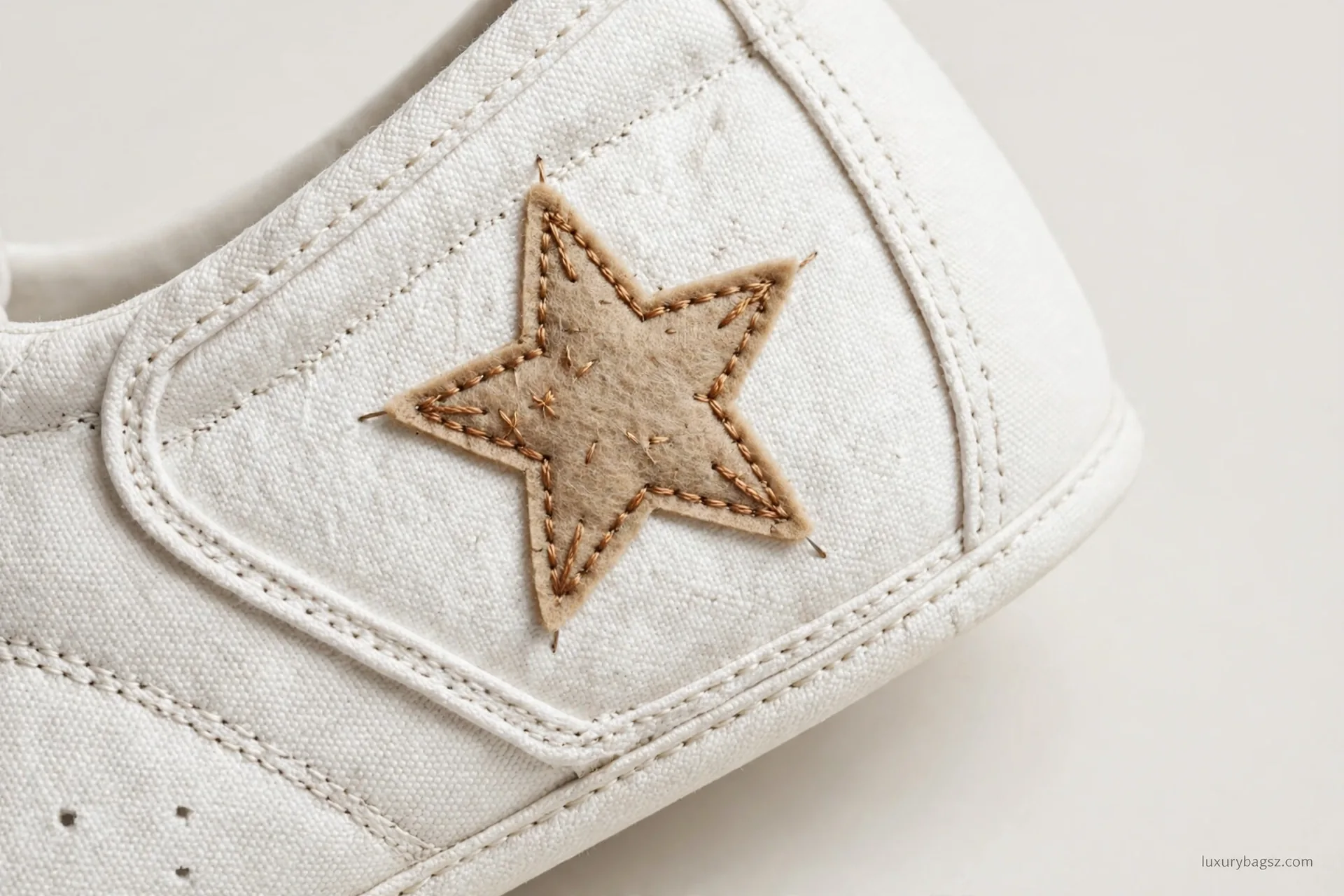
The star is Golden Goose's signature, and it deserves close inspection. On a genuine pair, the star is cleanly cut, with sharp points, even edges and stitching that follows the star's outline evenly and tightly. The star material — leather, suede, glitter or another finish depending on the style — should feel like quality material, not thin plastic or flaking coating, and its colour should match the style's specification.
Fakes often show stars that are slightly misshapen, with rounded or uneven points, stitching that drifts off the star's edge, or material that peels, cracks or looks printed rather than appliqued. Compare both shoes: genuine stars match in size, placement and stitching, while copies sometimes differ between shoes. Also check star placement on the panel.
A star sitting too high, too low or too far toward the heel compared with genuine pairs of the same style is a proportion error, not a design variation. Request straight-on side photographs of both stars in daylight.

Part 4: Leather, Suede and Overall Materials
Genuine Golden Goose leather is soft, supple and substantial, with a natural grain that varies gently across panels. Suede versions feel soft and napped, and textile or glitter details feel like quality materials rather than cheap coatings. The leather should bend naturally with the shoe, not crease like cardboard or shine like plastic.
Fakes commonly fail on materials. Leather that feels thin, stiff, plasticky or coated in a thick, shiny finish is a warning, as is suede that feels like felt, mats unevenly or shows bald patches on a pair sold as new. Check the leather under the tongue and inside the shoe where finishing is less polished: synthetic backing, foam-like reverses or a uniform printed grain can give a copy away. Colour also matters.
Golden Goose whites are rarely pure, bright white, since distressing and the brand's vintage look soften them, but the base colour should still match the style's specification and match between the two shoes. A pair whose two shoes differ noticeably in shade has a manufacturing problem.
Part 5: Stitching Discipline
Stitching on a genuine Golden Goose pair is even, tight and consistent, with constant stitch length and straight lines following panel edges at a steady distance. Thread colour should match the design intent on each panel, and there should be no loose loops, frayed ends or skipped stitches across the pair.
Compare matching areas on both shoes: toe box stitching, collar stitching, star edging, heel tab stitching and sole stitching where visible. Genuine production usually matches left and right; copies often do not, with one shoe showing more stitches or a wandering line. Inspect stitching on the inside of the shoe and under the tongue where visible for loose threads and uneven tension.
A single damaged stitch on a worn pair can be use, but a pattern of sloppy stitching across both shoes is a manufacturing signature, not wear, and it is especially telling on a premium-priced sneaker.
Part 6: Sole, Heel Tab and Foxing
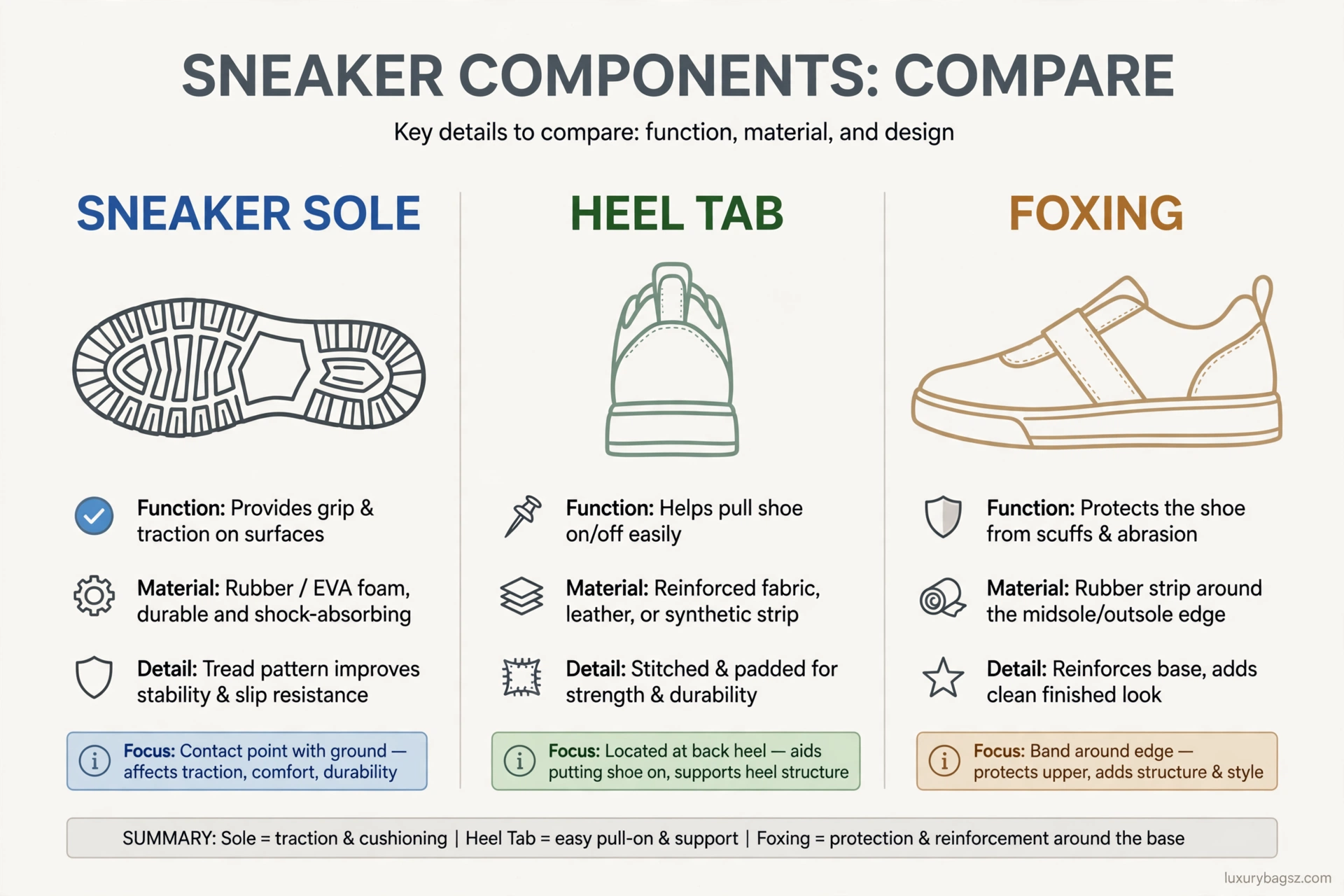
Turn the shoes over and study the sole. The midsole and outsole should be cleanly moulded, evenly coloured and correctly proportioned for the style, with tread patterns that are crisp and deeply formed rather than shallow or blurry. The foxing — the strip around the sole edge — should be even, correctly coloured and neatly finished, without glue overflow or rough edges.
The heel tab deserves its own look. On genuine pairs it is well-formed, evenly stitched and correctly branded where the style calls for branding, with a shape and thickness that matches genuine pairs. A heel tab that is too thin, too thick, misshapen or sloppily stitched is a warning. Also check the sole's distressing honestly: wear should be believable for the pair's story.
A pair sold as new with heavily worn soles, or a pair sold as well-worn with pristine soles, has a story problem. Compare both soles, since genuine soles match in pattern, colour and finish.
Part 7: Tongue, Laces and Interior Labelling
Inspect the tongue label closely. Genuine labelling should be crisp, correctly spelled, correctly sized and cleanly attached, with even stitching. The tongue itself should be well-shaped and padded as the style intends, not too long, too narrow or unevenly cut. Laces should be the correct length, thickness, colour and tip finish for the style, and extra laces where included should match.
Inside the shoe, check the insole and any printed or stamped branding for crispness, correct spelling and correct placement. Fakes often let interior details slip, with blurry text, wrong fonts or branding in the wrong position, because buyers photograph the outside far more than the inside.
Also check the interior lining: it should be cleanly fitted, without bunching, glue marks or loose threads, and its material should feel like quality textile or leather rather than thin synthetic fabric. A lining that bunches or peels on a pair sold as new suggests rushed assembly.
Part 8: Size, Style and Region Information
Golden Goose size information appears on the tongue label, the insole or the box label depending on the style, and all instances should agree. Check that the EU size, any US conversion, the style code and the country of manufacture are correctly formatted, correctly spelled and consistent with the pair claimed. Spelling errors, misaligned printing, blurry text or a size conversion that no genuine Golden Goose label uses are serious warnings.
Sources disagree about minor labelling wording across production runs and regions, so a small wording difference alone is not a verdict. What matters is consistency: the tongue, the box and the seller's description should all name the same style and size. A tongue that says one size and a box that says another, or a style code that belongs to a different model, is a major inconsistency that must be resolved before payment.
Photograph every label, on both shoes, and the box label before paying.
Part 9: Box, Dust Bag and Accessories
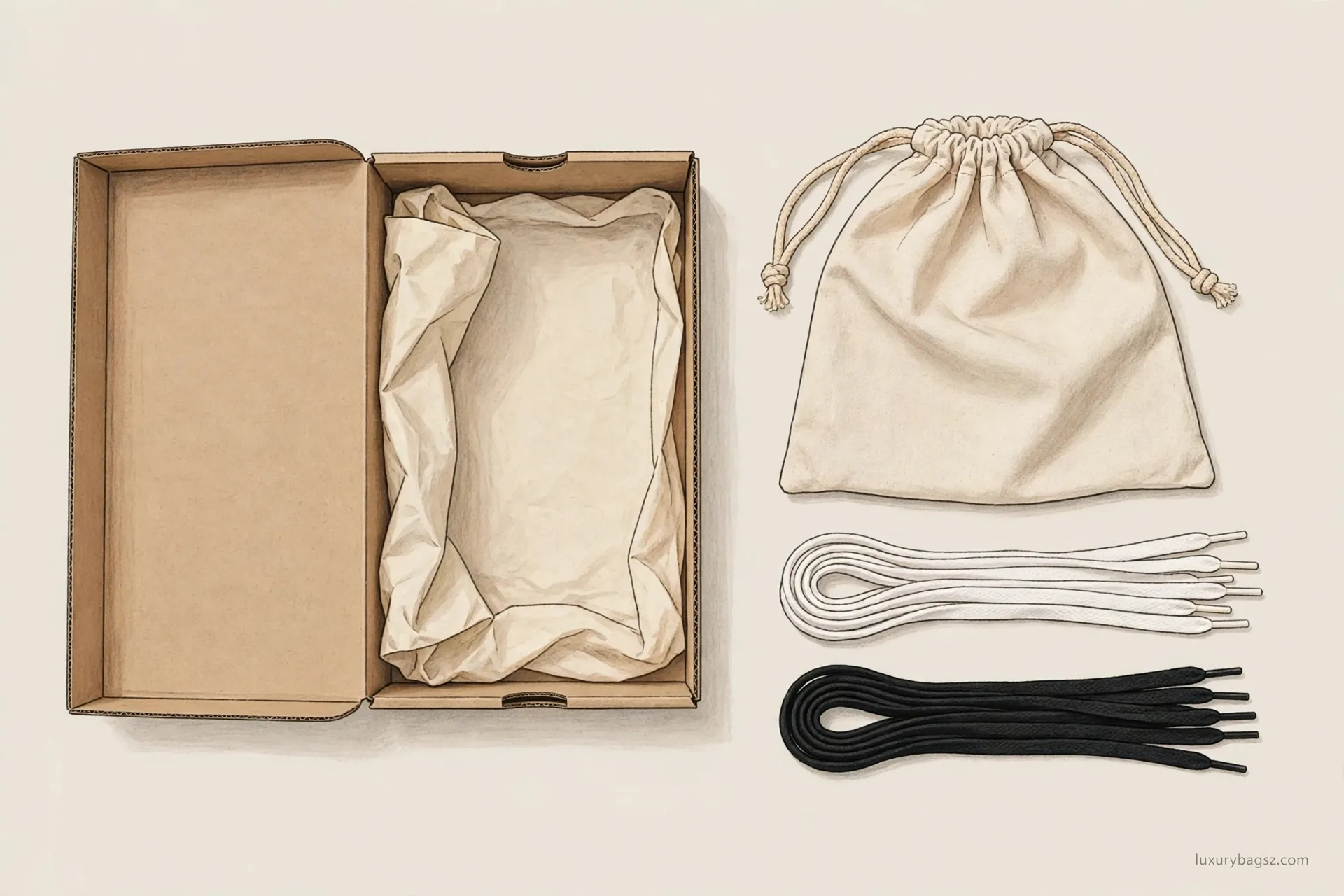
Golden Goose packaging includes a box, often with a dust bag and extra laces. The box should be sturdy, correctly printed and correctly labelled, with crisp graphics, correct spelling and a label matching the shoes inside. The dust bag should feel like substantial fabric rather than thin, shiny material, and extra laces should match the pair in length, colour and tip finish.
Treat packaging as weak evidence on its own. Boxes are swapped, replaced and copied, and genuine pairs are often sold without the original box. Consistency is what counts: a box label that matches the shoes, accessories that match the style, and a seller story that explains any missing item. A perfect box with failing shoes proves nothing, and a missing box with perfect shoes is a smaller, different problem.
Never pay a large premium for a box alone, and never accept a box photograph as a substitute for shoe photographs.
Part 10: Shape, Toe Box and Overall Profile
Study the pair's overall shape from the side, front and back. A genuine Golden Goose pair has a balanced, slightly vintage profile: a toe box that holds its shape without looking boxy, a collar that sits cleanly, and a silhouette that matches the style's reference photographs. The shoes should look like a pair, not like two similar but different shoes.
Fakes often distort the profile: a toe box that is too tall, too flat or too pointed, a collar that is too thick or too thin, or a shoe that looks stretched or squashed compared with genuine pairs. Check both shoes standing side by side, since profile errors show more clearly in a pair.
Also check toe box perforations where present and the shape of the toe cap: perforations should be evenly spaced and cleanly punched, and the toe cap should sit symmetrically on both shoes.
Part 11: The Pair Test — Left Versus Right
Because Golden Goose distressing is hand-applied, genuine pairs are not identical, but they are consistent. Stars should match in size and placement, soles should match in pattern and colour, stitching should match in quality, and the overall level of distressing should be comparable between shoes. One shoe heavily distressed and the other nearly pristine, on a pair sold as new, is not hand variation; it is a mismatch.
Apply the same test to materials and colour. Leather grain, suede nap and base colour should be comparable across the pair, allowing for natural leather variation. A pair where one shoe's leather feels premium and the other's feels plasticky, or where one shoe's grey reads warm and the other's reads cold, has a consistency problem.
This pair test catches many fakes that pass single-shoe inspection, because copiers often quality-check one shoe and let the other slip.
Part 12: Photographs That Actually Prove Something
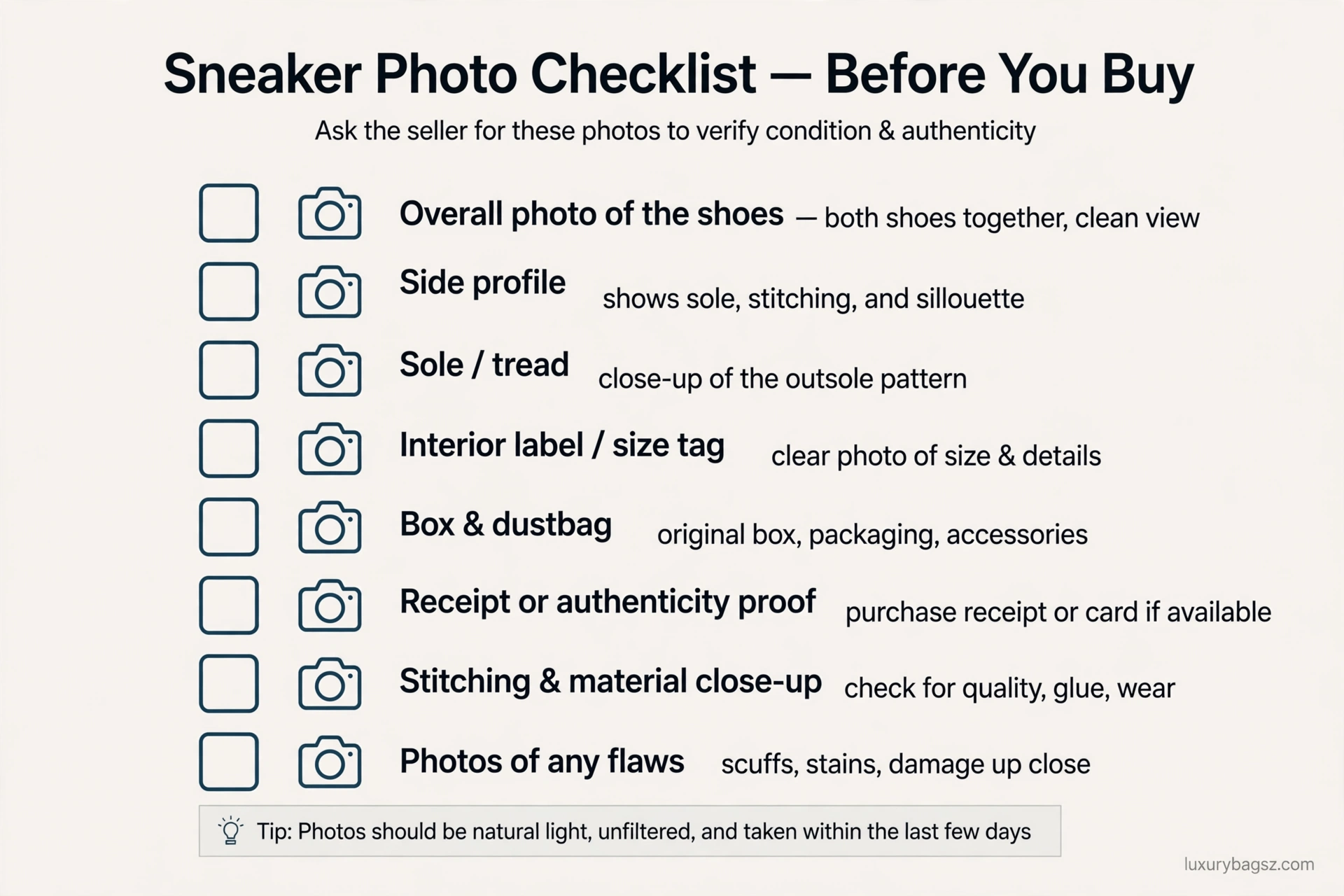
Request a full photograph set before paying: both shoes from the outer side, inner side, front, back and top, both stars close up, tongue labels, size information on both shoes, insoles, midsoles and outsoles, heel tabs, box label and box sides, dust bag and extra laces, and any wear or flaws. Ask for daylight, in-focus, unfiltered shots, with both shoes in frame for comparison shots.
Be wary of listings with a single glamour shot, stock photographs, heavily filtered images or photographs showing only one shoe. Filters are especially misleading for Golden Goose, since they can hide painted distressing and exaggerate real wear. Reverse-search the main image if anything feels borrowed, and compare backgrounds across photographs.
A genuine seller can usually produce one extra photograph on request, such as both shoes beside a handwritten note with the date. Refusal to provide basic detail shots is a strong reason not to proceed.
Part 13: Seller, Price and Listing Language
Seller evidence matters as much as shoe evidence. Check the seller's history, feedback and other listings: a new account selling many Golden Goose pairs in many sizes at low prices is a classic fake pattern. A long-standing seller with a single pair, detailed photographs and a clear, consistent story is a different proposition.
Compare prices against sold listings for the exact style, size and condition, remembering that distressing and condition affect value, so compare like with like. Read the listing language carefully: vague descriptions, copied marketing text, refusal to answer specific questions, pressure to pay outside the platform and changing stories between messages are all red flags.
Use a platform with buyer protection and a clear returns process, and keep all messages on the platform. For a premium purchase, a professional authentication service is a sensible extra step.
Part 14: What to Do If You Already Bought a Pair
If doubts arise after purchase, do not wear the pair heavily until you have an answer, since wear complicates a return. Photograph everything first: the listing, the box and accessories as received, and every detail you now question, including both shoes side by side.
Contact the seller promptly and in writing, naming the specific checks that failed rather than making a general accusation, and keep copies of every message. If the seller will not resolve it, use the platform or payment provider's buyer protection route promptly, since deadlines are often short, and consider a professional authentication report naming the failing details. If the pair is confirmed fake, do not resell it as genuine at any price.
Report the seller through the platform so the listing can be reviewed.
Part 15: Where Fake Golden Goose Pairs Most Often Appear
Fakes do not appear evenly across the sneaker market, and knowing where they concentrate helps you calibrate your caution. Social media marketplaces, classified sites and messaging-app sales carry a high share of fake Golden Goose pairs, because listings there often lack buyer protection, photographs are easy to copy, and sellers can disappear after payment.
That does not mean every social-media listing is fake — many genuine private sellers use those channels — but it does mean the burden of proof is higher there, and unprotected payment should be a deal-breaker for a premium purchase.
Resale platforms with authentication services are safer but not foolproof. A platform check usually examines photographs or the physical pair, comparing star, materials, stitching, sole and labelling against reference pairs, and it reduces risk substantially.
Even so, Golden Goose distressing complicates photograph checks, since a filter or poor lighting can hide painted distressing or exaggerate real wear, so a platform pass should sit alongside your own photograph review, not replace it.
Established retailers and boutiques selling new pairs carry the lowest risk, but they also carry full retail prices, while established consignment stores offer reputation and a physical premises to return to, usually at a higher price that reflects that service.
The practical lesson is to match your checking effort to the channel. A boutique purchase needs little authentication work. A platform purchase needs the full photograph set, in daylight and without filters, plus a careful reading of the platform's authentication terms.
A private, unprotected purchase needs the most work of all — complete photographs of both shoes, a video call showing the pair, a written description of style, size and condition, and a payment method with recourse — or it is not worth doing at all. Channel risk is part of authentication, not separate from it, and for a shoe whose distressing already confuses the eye, the channel you choose matters more than usual.
Part 16: How Professional Sneaker Authentication Works, and Its Limits
When your own checks leave doubt, a professional sneaker authentication service is the sensible next step, and understanding what it does helps you use it well. Most services examine detailed photographs, and some examine the physical pair, comparing the star, distressing pattern, materials, stitching, sole, heel tab and labelling against reference pairs and production knowledge.
A good report names the specific details that passed or failed, explains its reasoning, and states its confidence level, rather than offering a bare yes or no that you cannot test.
Choose a service with a track record for Golden Goose and for distressed sneakers generally, clear terms about what it examines, and a written report you can use in a dispute. Be wary of free, instant authentications from anonymous accounts, which carry no accountability, and of services that guarantee a result before seeing the pair.
Costs vary, but for a Golden Goose-priced purchase the fee is small compared with the loss from a fake, and many services offer a faster turnaround for an additional fee where a purchase deadline requires it. Ask in advance what photographs the service needs, since a service given only a side photograph of one shoe, or filtered photographs that hide distressing quality, cannot do its job, however expert its authenticators.
Understand the limits too. Photograph-based authentication cannot judge leather feel, weight or distressing texture, and even in-hand authentication is an expert opinion, not a legal guarantee. Two reputable services can occasionally disagree on a borderline pair, particularly where heavy distressing, wear or repair complicates the evidence.
That is why a professional opinion should sit alongside your own checks and the seller evidence, not replace them. When your checks, the seller's story and a professional report all point the same way, you have the strongest position a buyer can reasonably obtain, and when they disagree, the disagreement itself is information worth acting on before money changes hands.
Part 17: Reading a Golden Goose Listing Like an Authenticator
A listing tells a story, and authenticators read that story for consistency before they ever examine a stitch. Start with the title and description: does the seller name the style, colourway, size and condition in specific terms, or does the listing rely on vague praise and copied marketing language?
Specific, verifiable detail — "Super-Star in white leather, EU 41, worn five times, light toe scuffing, includes original box, dust bag and extra laces" — is the language of a seller who knows the actual pair. Vague language — "100% authentic designer sneakers, high quality, fast shipping" — is the language of a seller describing a category, not an object, and it should lower your confidence before you look at a single photograph.
Next, compare the listing's claims against its photographs, line by line. If the description says "new with box" but the photographs show sole wear, heavy creasing or a missing box, the story and the evidence disagree, and the disagreement matters more than either claim alone. If the description says one size but the box label photograph shows another, stop and resolve that mismatch.
If the description mentions extra laces or a dust bag, those items should appear in photographs; their absence, when the description promises them, is a gap to close before paying, not a detail to overlook. Pay special attention to distressing claims: a listing that describes distressing as "damage" or fails to mention it at all may come from a seller who does not understand the brand, which is itself a warning.
Then examine the seller's other activity and the price as part of the same story. A private seller with a history of varied personal items and consistent photographs is a different proposition from an account created weeks ago that lists only high-demand sneakers in many sizes at low prices. A price is not just a number; it is a claim about the pair's style, size, condition and completeness.
A near-new Super-Star in a popular size, with a full set, priced far below comparable sold listings, is a story that does not add up, and the gap needs an explanation that survives scrutiny. If no explanation survives, the price is not a bargain; it is the most honest warning the listing contains.
Part 18: Cleaning a Genuine Pair Without Ruining the Distressing
Authentication is only the first half of ownership; care decides whether a genuine Golden Goose pair still looks intentionally distressed rather than simply dirty in a year's time. The key principle is restraint: clean dirt, not distressing.
Brush off loose dirt with a soft brush, wipe leather with a soft, slightly damp cloth, and address fresh stains promptly rather than letting them set, using products suited to the specific material and testing any product on a hidden area first. Aggressive scrubbing, bleach or harsh solvents can strip the hand-applied distressing that gives the shoe its look, turning a deliberate finish into patchy damage.
Treat each material as it requires. Smooth leather responds to gentle wiping and occasional conditioning; suede needs a suede brush and protector spray, never water saturation; glitter or coated details need the lightest touch of all, since scrubbing flakes them. Soles can be cleaned more firmly with a brush and mild soap, but avoid soaking the whole shoe, which damages adhesives and interior linings.
Dry shoes naturally at room temperature, stuffed with tissue or shoe trees to hold shape, and never with direct heat, which cracks leather and warps soles.
Finally, keep your authentication evidence with the pair. Retain the listing, photographs, box label photographs, professional report if you obtained one, and all accessories, since that file protects resale value and makes a future buyer's authentication far easier.
A genuine Golden Goose pair, cleaned gently and stored properly, keeps its lived-in look believable for years, while a pair cleaned aggressively loses the very finish that made it desirable in the first place.
One last habit separates confident Golden Goose owners from anxious ones: photograph the pair once a year, in the same daylight and from the same angles as your purchase photographs, and keep those photographs with your purchase file.
Annual photographs make slow changes — sole wear, star edge wear, distressing softening — visible before they become damage, and they give you a dated record if you ever need to prove condition for insurance, repair or resale. A pair whose life is documented is a pair whose value is protected, and the few minutes this takes each year are the cheapest insurance a sneaker owner can buy.
Frequently Asked Questions
What is the fastest way to spot a fake Golden Goose sneaker?
Check the distressing, the star and the materials together. If distressing looks painted on, the star is misshapen or sloppily stitched, or the leather feels plasticky, you already have strong evidence.
Are Golden Goose sneakers supposed to look dirty?
Yes, by design. Genuine pairs arrive pre-distressed with scuffs and worn-looking details. The question is whether the distressing looks hand-applied and believable, not whether marks exist.
Can a genuine Golden Goose pair have different distressing on each shoe?
Yes, hand-applied distressing varies slightly between shoes. Large differences — one shoe heavily marked and the other nearly pristine — are a mismatch, not normal variation.
Does a box prove a Golden Goose pair is real?
No. Boxes, dust bags and extra laces are copied and swapped. Judge the shoes first, and use the box only as supporting, consistency evidence.
Is a low price a reliable fake sign for Golden Goose?
It is a strong warning, not a verdict. Compare sold listings for the exact style, size and condition, and be especially wary of sellers offering many pairs at low prices.
What photographs should I ask a seller for?
Both shoes from every angle, both stars, tongue labels, size information, insoles, soles, heel tabs, box label and accessories, all in daylight and without filters.
Can Golden Goose sneakers be authenticated from photographs alone?
Often yes, when photographs are complete, and professional services do this routinely. Borderline pairs may need an in-hand examination, since leather feel and distressing quality are hard to judge from photographs.
Do fakes ever copy the star well?
Yes. The best copies reproduce the star shape reasonably, which is why you must stack checks. Materials, stitching, sole, labelling and seller evidence often catch what the star misses.
Should I clean a Golden Goose pair to check if it is fake?
No, do not attempt aggressive cleaning before authentication, since cleaning can alter distressing and complicate a return. Inspect first, authenticate, and only then decide on care.
What should I do if a professional service disagrees with the seller?
Keep the written report, the listing and all messages, and raise the case through the platform or payment provider promptly, since claim deadlines are short. Specific failing details carry far more weight than a general claim.
Final Verdict
Golden Goose authentication is about reading distressing like a language: genuine wear tells a believable story in believable places, while fake distressing looks painted, uniform or impossible. Combine that reading with the star, leather, stitching, sole, labelling and seller checks, demand complete daylight photographs of both shoes, and never let a low price rush you past a failing check.
A real Golden Goose pair looks lived in and feels premium at the same time; when a pair manages only one of those, believe the evidence in front of you. That evidence-first habit, applied patiently to every pair you consider, will save you far more than it ever costs in time. Patience here pays for itself.