

How to Spot a Fake Audemars Piguet Royal Oak
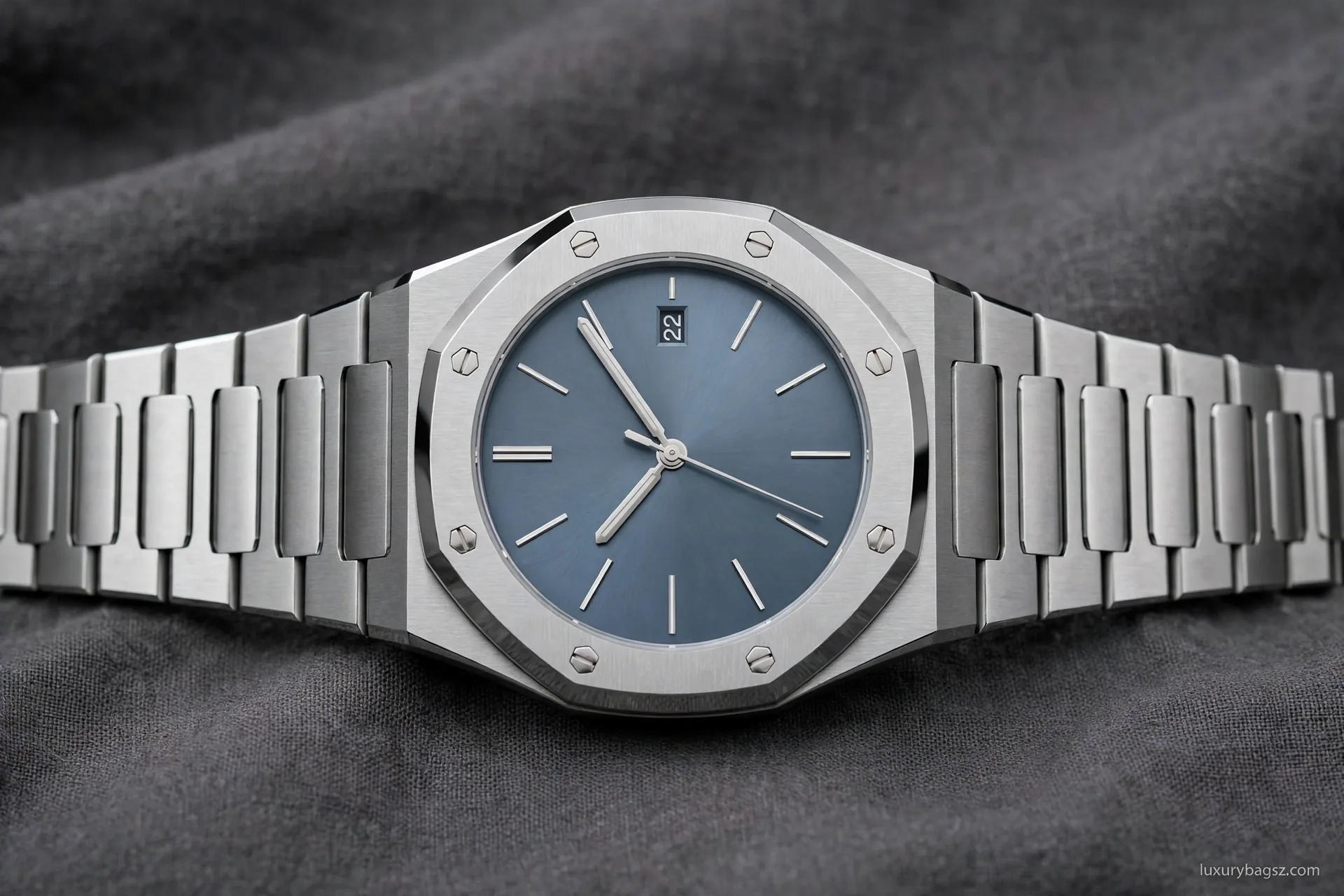
Where Royal Oak Copies Usually Give Themselves Away
Check the watch against its stated reference first, then focus on the dial pattern, bezel screws, bracelet, case thickness and movement. A Jumbo, a Selfwinding, a Chronograph and an Offshore are different watches, and any mixing of their features means the piece is wrong.
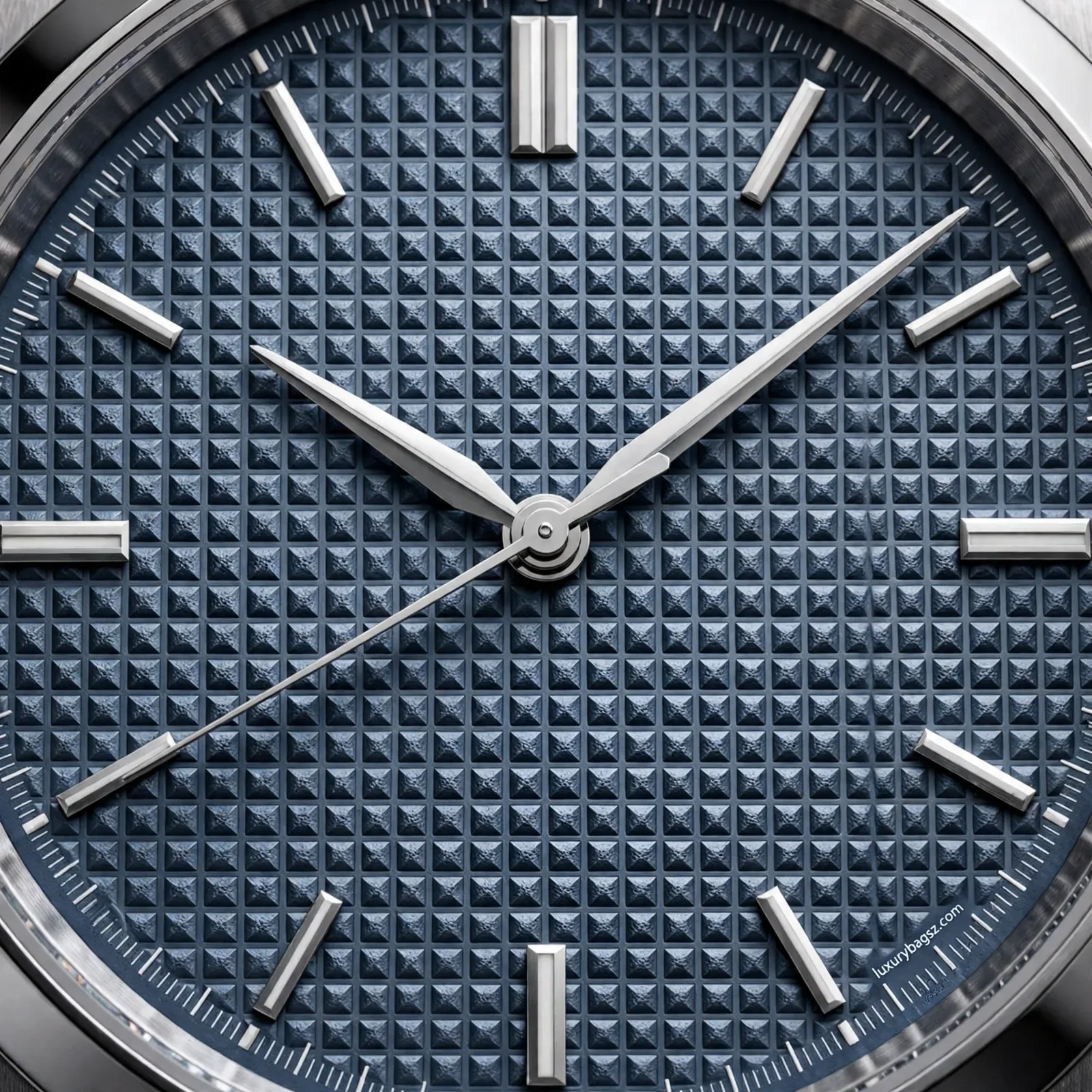
A genuine tapisserie dial has small guilloche squares with real depth and even, crisp edges when seen under angled light; a flat or fuzzy version is a major warning. All eight screws in the octagonal bezel should be hexagonal, evenly finished and correctly aligned.
The integrated bracelet must taper as it should, move freely link by link and be finished properly underneath as well as on top. Finally, the calibre inside has to be the one specified for that reference and period.
The Royal Oak Checklist at a Glance
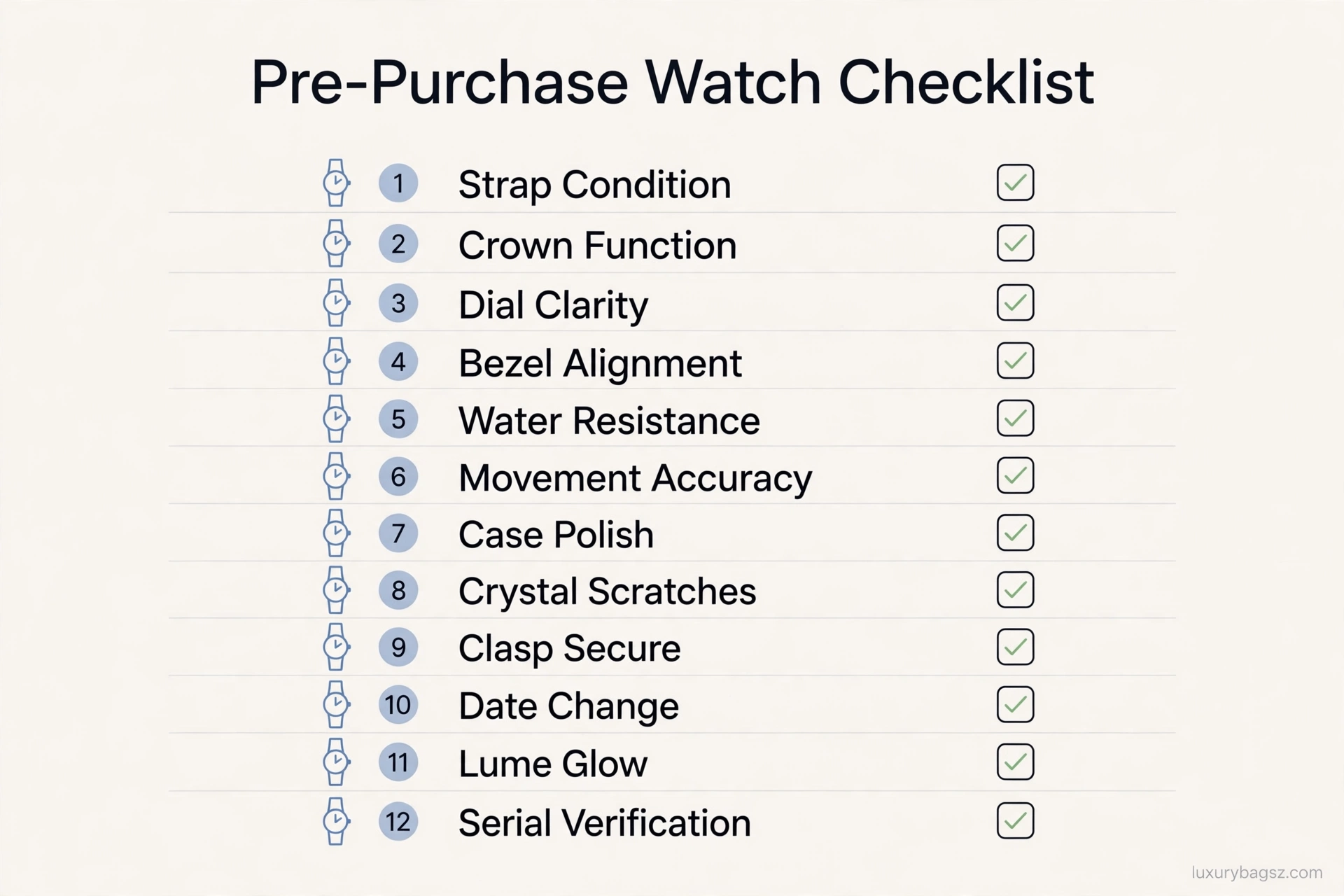
This guide is the fake checklist for the Royal Oak, not another history of it. A Royal Oak history and sizes guide already exists, covering the 1972 design, the model range, and the sizes in detail, and this guide does not repeat that history. What follows is purely practical: the twelve checks that separate a genuine Royal Oak from a fake, from the tapisserie dial and the bezel screws to the bracelet, the calibre, and the papers.
The Royal Oak is one of the most faked luxury sports watches in the world, and its fakes range from crude copies to high-grade superclones that copy the octagonal bezel and integrated bracelet closely.
The good news for buyers is that the Royal Oak's design is unusually demanding to manufacture well: the tapisserie dial, the bezel screw alignment, the bracelet finishing, and the thin calibre all require expensive tooling, and counterfeiters usually compromise on at least one of them. Your job is to find the compromise.
As with every watch in this cluster, start from the reference. A Jumbo Extra-Thin, a Selfwinding 41 mm, a Selfwinding Chronograph, and an Offshore are different watches with different cases, dials, bracelets, and calibres, and a watch that mixes their features is wrong even if it looks impressive. Judge the whole watch against its stated reference, and insist on an independent inspection before a high-value purchase.
Key Takeaways
- This is the checklist, not the history: for Royal Oak history and sizes, use the companion history guide, and use this guide for authentication.
- The tapisserie dial must show crisp, even, three-dimensional guilloche squares; flat, fuzzy, or uneven tapisserie is a major fake tell.
- The eight bezel screws must be hexagonal, correctly aligned, and evenly finished; misaligned, round-headed, or roughly finished screws fail the check.
- The integrated bracelet must taper correctly, articulate smoothly, and finish evenly on all surfaces, including the underside.
- The calibre must match the reference: ultra-thin calibres on Jumbo models, larger automatic calibres on Selfwinding models, and chronograph calibres on chronographs.
- Papers, box, and serial numbers must agree with the watch and suit its era; superclones copy the outside best and the movement and paperwork worst.
Reference First: Jumbo, Selfwinding, Chronograph, Offshore
Royal Oak references define the watch. The Jumbo Extra-Thin, currently 39 mm and famously thin, carries an ultra-thin calibre and a two-hand-plus-date layout with no central seconds hand on classic versions. The Selfwinding models, in 37 mm and 41 mm among other sizes, carry a central seconds hand and a larger automatic calibre. Chronograph models add subdials and pushers with a chronograph calibre.
Offshore models are larger, thicker, and sportier, with different cases, bezels, and dials altogether.
Obtain the reference number, the serial number, and the production era, and learn the correct combination from Audemars Piguet materials and reputable dealer listings. A Jumbo dial layout on a Selfwinding case, a chronograph dial on a time-only case, or an Offshore bezel on a standard Royal Oak case are all mismatches that fail the check immediately, however well made the individual parts look.
Be especially careful with popular steel references, where demand and prices are highest and fakes are most sophisticated. For these, compare against auction records and specialist dealer archives, not against a single listing, and treat any reference or size claim that does not match known production as suspect until a specialist proves otherwise.
The Tapisserie Dial: Depth, Evenness, and Printing
The tapisserie dial is the Royal Oak's signature and one of its best tests. On a genuine Royal Oak, the tapisserie pattern consists of small, three-dimensional squares cut by guilloche, with crisp edges, even depth, and a uniform pattern across the whole dial. Under magnification and raking light, the pattern shows real depth and a consistent, almost architectural regularity.
The applied markers and numerals sit precisely on the pattern, with clean facets and even spacing.
Fakes commonly fail here in three ways. First, flat tapisserie: a printed or stamped pattern that looks like tapisserie head-on but shows no real depth under raking light. Second, uneven tapisserie: squares that vary in size or depth, or a pattern that drifts out of alignment near the dial edge or subdials. Third, fuzzy tapisserie: edges that look soft or melted rather than crisply cut.
Any of these, on a watch sold as genuine, is a strong warning.
Also check the dial printing and signature. The Audemars Piguet signature should be crisp, correctly spelled, and correctly placed for the reference, and any additional text, such as Automatic or Chronograph markings, should match the reference exactly. Date windows, where fitted, should be neatly cut with a centrally aligned date disc. A date that sits off-centre, or text that is fuzzy or misplaced, indicates a fake dial or a badly replaced one.

Hands, Markers, and Date by Reference
Royal Oak hands are typically slim baton hands with luminous fill, and their shape, length, and finish are fixed by reference. Check that the hour hand reaches its markers correctly, that the minute hand tracks the minute scale without overshooting, and that any seconds hand, where fitted, is the correct style for the reference.
On classic Jumbo models, note the absence of a central seconds hand: a central seconds hand on a reference that should not have one is a mismatch tell, not a bonus feature.
Applied markers should sit evenly on the tapisserie pattern with clean facets and consistent height. Markers that lean, sit at different heights, or show glue at their bases are warnings. Lume, where fitted, should be evenly applied and consistent in colour between hands and markers. Patchy, bubbly, or mismatched lume suggests a re-lumed or fake dial.
On chronograph models, check the subdial hands and layouts with equal care. Subdials must be concentric with even tracks, their hands must be the correct style and length, and the chronograph functions must operate precisely. A subdial hand that is the wrong style, or a chronograph that resets imprecisely, indicates a wrong movement or a fake watch, and should be investigated by a watchmaker.
The Integrated Bracelet: Taper, Articulation, and Finishing
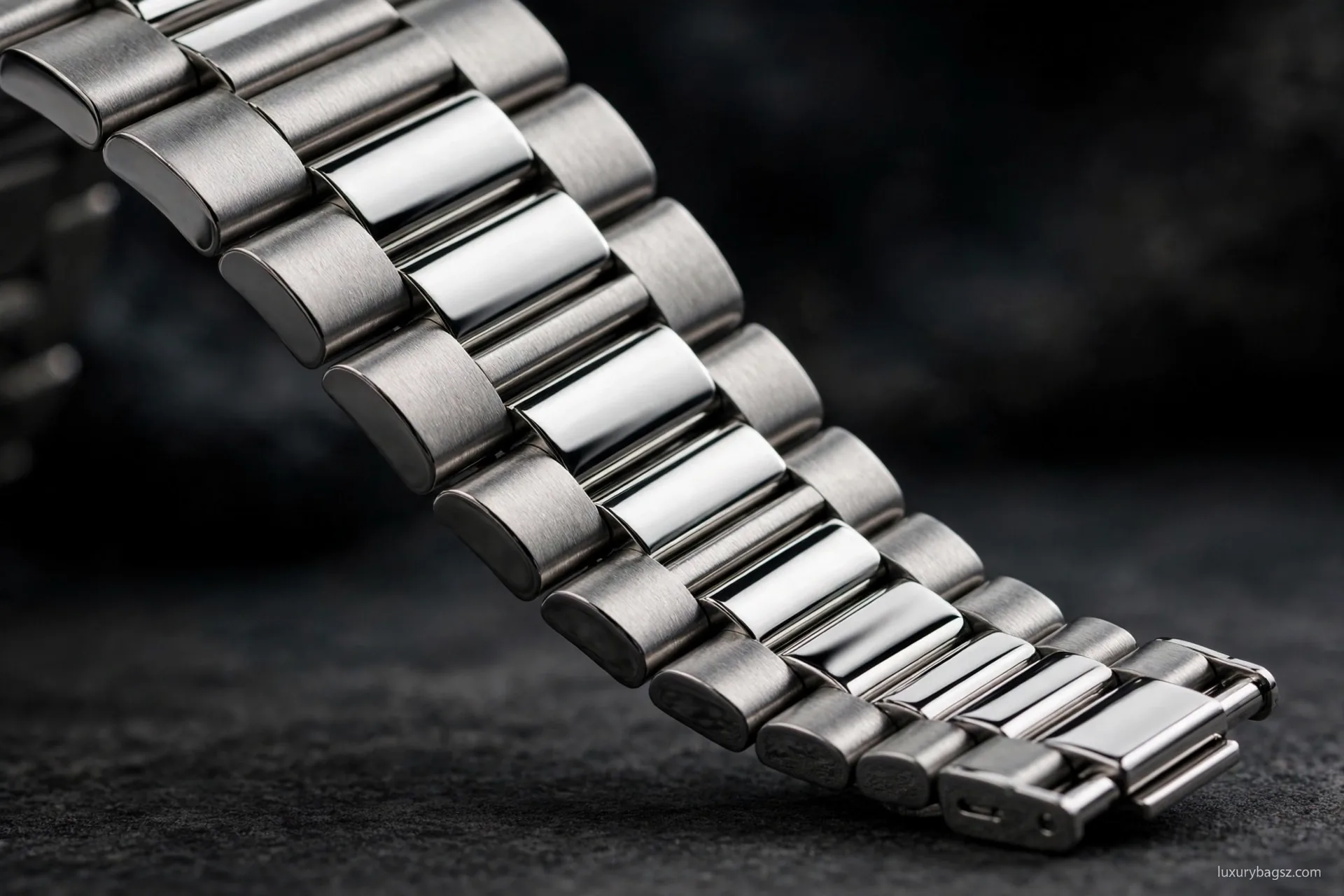
The Royal Oak's integrated bracelet is one of the hardest parts to fake well, because it tapers, articulates, and finishes to a standard that requires expensive manufacturing. On a genuine Royal Oak, the bracelet tapers smoothly from the case to the clasp, each link articulates freely and evenly, and the finishing, brushed and polished surfaces as specified, is consistent across every link, including the underside.
The bracelet should drape naturally and feel supple, not stiff or rattly.
Fakes commonly fail on taper, articulation, or underside finishing. A bracelet that does not taper correctly, that stays the same width to the clasp, or that tapers unevenly is a mismatch. Links that catch, grind, or vary in size indicate poor manufacturing. A bracelet that looks excellent on top but rough underneath, with burrs, pitting, or uneven brushing on the underside, shows where the counterfeiter economised.
Always examine the bracelet from underneath and from the side, not just from the top.
The clasp is the companion test. A genuine Royal Oak clasp closes with a firm, precise snap, sits flush, and carries clean, correctly rendered markings, including the AP emblem where specified. A clasp that feels flimsy, closes loosely, or shows shallow or misspelled markings is a serious warning.
Also check the end links where the bracelet meets the case: the integration should be seamless, with even gaps and matching finishing, not a visible step or uneven gap.
The Octagonal Bezel and Its Eight Screws
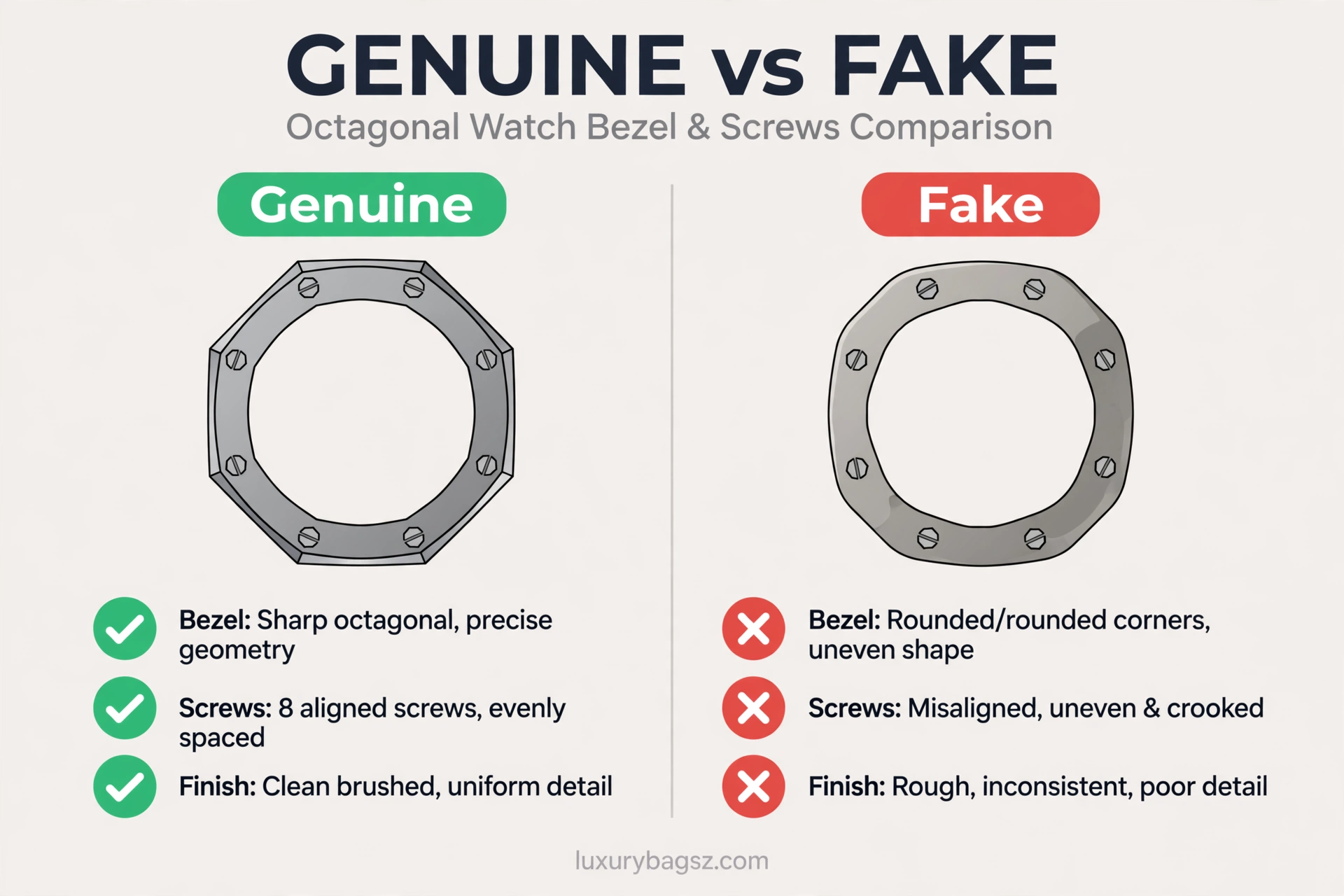
The octagonal bezel with eight exposed hexagonal screws is the Royal Oak's most recognisable feature, and its screws are a precise test. On a genuine Royal Oak, the eight screws are hexagonal, correctly sized, evenly finished, and aligned so that their slots or orientations follow the design specification for the reference.
The bezel itself is crisply octagonal, with clean edges and even finishing, and the screws sit flush and secure, with no wobble, no uneven seating, and no damage to the surrounding bezel.
Fakes frequently get the screws wrong. Common faults include screws that are round-headed rather than hexagonal, screws that are misaligned or randomly oriented, screws that sit proud of or recessed into the bezel unevenly, and screws whose finishing is rough or whose edges are soft.
Because the screws are so visible, counterfeiters try hard here, but consistent alignment and finishing across all eight screws is expensive to achieve, and a single misaligned or poorly finished screw is a warning that should trigger the full checklist.
Also check the bezel's overall geometry. The octagon should be regular, with straight sides and clean corners, not slightly rounded, wavy, or asymmetrical. A bezel that looks almost octagonal, but not quite, indicates poor tooling, and poor tooling on the bezel usually means poor tooling elsewhere too.
Case: Dimensions, Thinness, and Finishing
Royal Oak cases are defined by their thinness, especially on Jumbo models, and by their finishing: a combination of brushed and polished surfaces with crisp transitions. Measure the case diameter and thickness and compare them against the reference specification.
Fakes commonly miss on thickness, because a thin genuine calibre is hard to copy cheaply, and a Jumbo that is noticeably thicker than the genuine reference is suspect even if its dial and bezel look right. The same applies to Selfwinding and chronograph models: the test is deviation from the stated reference, not absolute thickness.
Case finishing should be even and precise, with no wavy reflections, no polishing bleeding into brushed areas, and no soft, melted-looking edges. Examine the case flanks, the bezel, and the area where the bracelet meets the case, where finishing errors are most visible. A case that is beautifully finished on the front but rough on the flanks is telling you where the counterfeiter spent their effort.
Check the crown and pushers as well. The crown should be correctly sized and shaped for the reference, often with an octagonal or fluted profile as specified, and should wind and set smoothly. Chronograph pushers should operate with a firm, precise click and return cleanly. Mushy, sticky, or uneven pushers, or a crown that wobbles or feels gritty, are warnings.
Calibre by Reference: Ultra-Thin, Automatic, Chronograph
The calibre check is decisive for high-value Royal Oak watches and must be done by a qualified watchmaker where the case allows it. Jumbo Extra-Thin models carry ultra-thin calibres, historically the calibre 2121 family and currently its successors, which achieve remarkable thinness. Selfwinding models carry larger automatic calibres, such as the 3120 and 4302 families depending on reference and era.
Chronograph models carry chronograph calibres with their own specifications. The movement in the watch must be the calibre specified for its reference and era; a mismatch is a hard fail.
A genuine Audemars Piguet calibre shows superb finishing: even Geneva stripes or other decoration as specified, bridges with clean, polished bevels, screws that are correctly finished, and calibre and AP markings that are correctly engraved and match the reference. Rough bridges, unpolished screws, glue, generic unmarked parts, or a movement that is visibly a decorated generic calibre with an AP-branded rotor are hard evidence of fakery.
The rotor itself deserves attention: genuine AP rotors, including skeletonised rotors on some calibres, are finely finished and correctly marked, while fake rotors often show rough edges or incorrect markings.
Movement behaviour matters too. The watch should run steadily, with correct power reserve behaviour for its calibre, a date change that is crisp at midnight where fitted, and chronograph functions that operate precisely where fitted. Erratic running or imprecise complications on an unknown watch should be treated as a movement warning until a watchmaker proves otherwise.

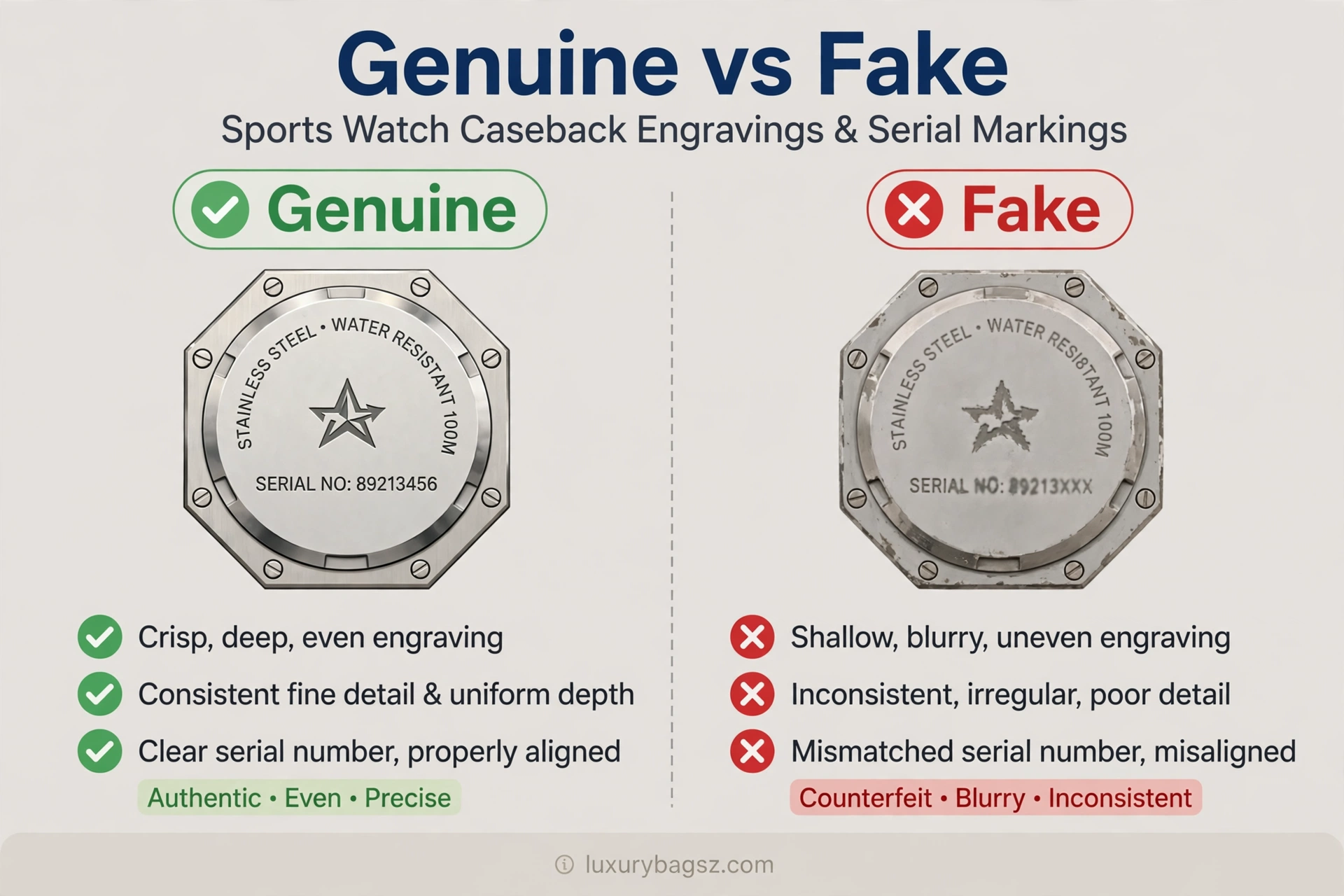
Caseback, Serial, and Reference Markings
Royal Oak casebacks vary by reference: some are solid with engravings, some are exhibition backs showing the movement, and some carry special markings. Whatever the configuration, it must match the reference. A solid back where an exhibition back is specified, or vice versa, is a serious discrepancy.
Engravings, where present, should be sharp, evenly deep, and correctly spelled, including the Audemars Piguet name, the reference, and any edition markings.
Serial numbers must agree across the case, the papers, and any other documentation, and must suit the claimed production era. A serial that looks freshly engraved on a worn case, that uses a different font from surrounding engraving, or that belongs to a different era than the watch's design is a warning.
Audemars Piguet serial and reference numbering has evolved over the decades, so era-appropriate checking by a dealer or specialist matters more than any single rule of thumb.
Also check the markings between the lugs and on the bracelet, where reference and serial information may appear. Genuine markings there are sharp and correctly formatted; shallow, uneven, or oddly formatted markings in hidden areas are warnings, because counterfeiters concentrate on visible surfaces and often neglect the parts only a buyer or watchmaker will see.
Weight, Feel, and Overall Finish
A genuine Royal Oak has a balanced, substantial feel that suits its material and size: steel models feel solid, gold models feel dense, and the bracelet drapes naturally. Fakes often feel too light, because of cheaper base metals and hollow links, or oddly balanced, because the case, movement, and bracelet weights do not match. Weight alone never authenticates a watch, but a watch that feels wrong should trigger the full checklist.
Overall finish is the companion test. Examine every surface under good light: case, bezel, screws, bracelet top and underside, clasp, and crown. Genuine finishing is consistent, with no rough casting marks, burrs, pitting, or rushed polishing. Fakes often finish the dial and bezel well while neglecting the bracelet underside, the case flanks, and the clasp interior. Those neglected areas frequently decide the verdict.
Also assess the watch as a functioning object. Wind it, set it, operate its complications, and flex its bracelet. A genuine Royal Oak operates with precision at every control and articulates smoothly at every link; a fake often feels gritty, loose, or inconsistent at one or more points. That tactile evidence, combined with the visual checks, is difficult to fake across every control at once.
Box, Papers, and Provenance
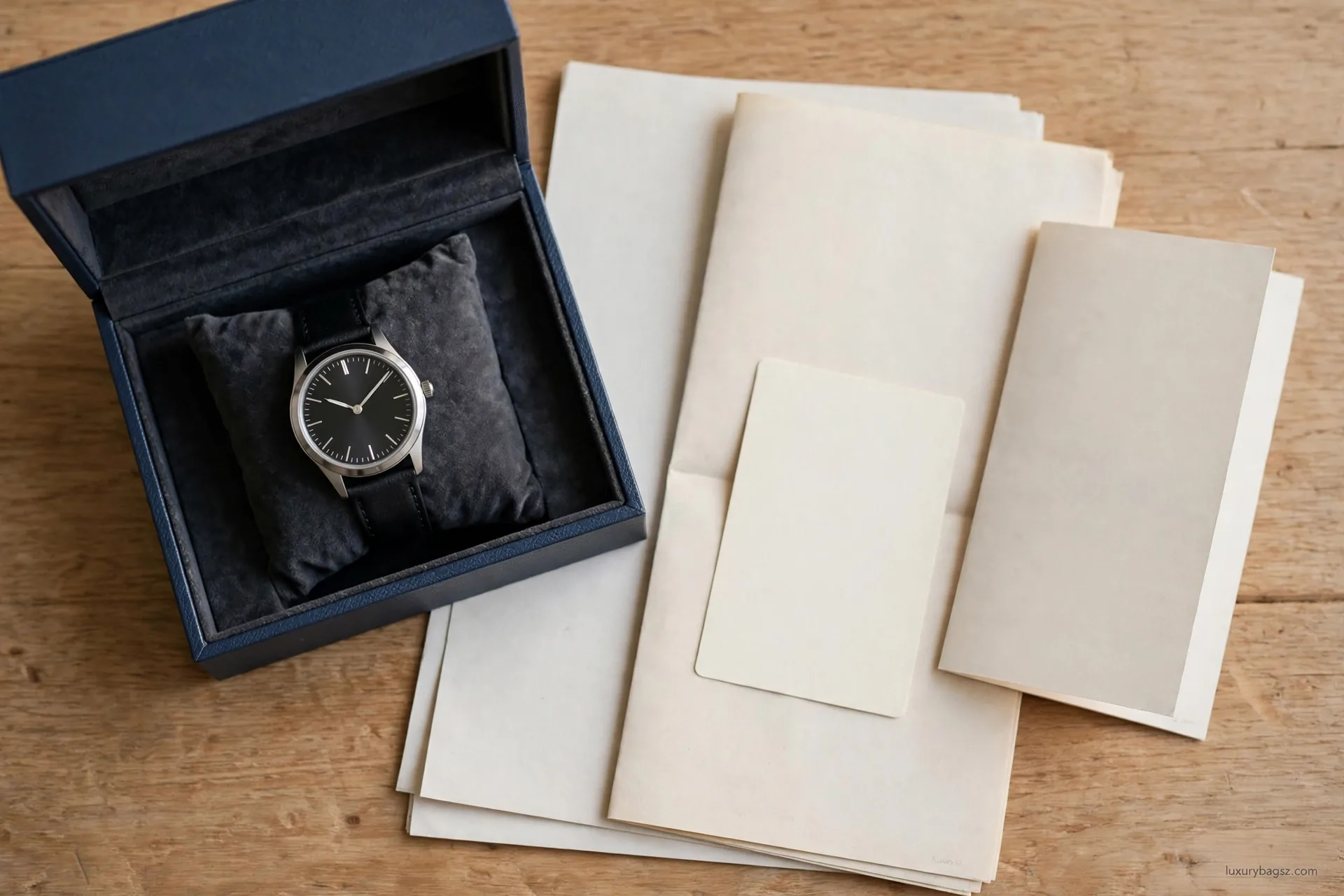
Royal Oak boxes and papers should suit the watch's era and reference. Modern Audemars Piguet presentation boxes are substantial and correctly branded, and the papers, including the guarantee card, should show the reference, serial number, and purchase details matching the watch exactly. A box style from a different era, papers whose serial differs from the case, or printing that is fuzzy or inconsistent are warnings.
As always, box and papers support but never prove genuineness: fake boxes and papers are common, and genuine watches frequently lose theirs.
Provenance means a verifiable dealer history, service records, or a reputable marketplace trail. Because popular steel Royal Oak models command high prices and long waitlists, stories about boutique allocations, estate finds, or one-time offers should be treated as claims to be verified, not as facts.
Where servicing has occurred, ask for records and check that replaced parts are disclosed; a serviced Royal Oak with a replaced crystal or strap is normal, while an undisclosed replacement dial, bezel, or movement is a different matter.
Superclone Traps Specific to the Royal Oak
High-grade fake Royal Oak watches copy the octagonal bezel, the tapisserie look, and the integrated bracelet silhouette closely enough to fool a casual inspection and to photograph convincingly. The traps that let them through are predictable. First, judging the watch by its bezel screws alone, while ignoring the calibre and bracelet underside.
Second, accepting a tapisserie dial that looks right head-on without checking its depth under raking light. Third, trusting papers without checking the serial match and era style. Fourth, letting a popular steel reference's high price or long waitlist create urgency that overrides inspection.
The defence is procedural: reference first, then tapisserie, hands, bracelet, bezel screws, case, calibre, caseback, weight and finish, papers, and then an independent inspection. A seller who welcomes that procedure, provides additional photographs, and agrees to an inspection window is behaving like a seller of a genuine Royal Oak. A seller who resists it is providing behavioural evidence that should weigh as heavily as any physical tell.
Buying Safely: Inspection, Escrow, and Recourse
Before paying in full for a pre-owned Royal Oak, secure a written return period that allows an independent inspection, including opening the case where appropriate, and agree in writing what happens if the watch is judged fake or not as described. Take the watch to a reputable watchmaker or Audemars Piguet specialist, ask them to check the calibre, the tapisserie dial, the bezel screws, and the bracelet, and get their opinion in writing.
If the seller refuses an inspection window, walk away.
Use payment methods with recourse and avoid irreversible transfers to unknown sellers. Escrow through a reputable marketplace can help, but check what it covers: some services verify only that the watch matches its listing photographs, not that it is genuine in the full sense of this guide. Keep complete records of the listing, the seller's description, correspondence, photographs of the watch and serial number, papers, and the inspection report.
A genuine Royal Oak is a landmark watch; the days spent verifying it are a small price for confidence in it.
For background on the Royal Oak itself, the Audemars Piguet Royal Oak history and sizes guide complements this checklist, and the same whole-piece discipline applies to jewellery, as the Cartier Love bracelet fake guide shows.
Servicing, Bracelet Care, and the Waitlist Reality
Servicing a Royal Oak is a specialist matter, and its service history affects both condition and value, which makes it part of authentication. Audemars Piguet recommends servicing at intervals measured in years, and a Royal Oak with a documented service history from AP or a reputable specialist is easier to trust, because each service involved inspection by people who know the calibre and the bracelet.
When buying pre-owned, ask when the watch was last serviced, by whom, and what was done, including whether the bracelet, clasp, and gaskets were addressed, and budget for a service if the history is vague. Royal Oak servicing is not inexpensive, particularly for chronographs and perpetual calendars, and that cost should be part of your purchase calculation, not a surprise afterward.
Bracelet care deserves emphasis because the integrated bracelet is both the Royal Oak's glory and its vulnerability. The bracelet's links and screws wear with daily use, and dirt buildup in the links accelerates that wear.
A gentle clean with a soft brush and mild soapy water, followed by thorough drying, keeps the bracelet supple, and a watchmaker can advise on deeper cleaning and on screw checks, because bracelet screws can loosen over time and should be checked at service.
Avoid wearing a Royal Oak bracelet through heavy manual work or impacts, which can dent links and damage the integrated fit, and have the bracelet inspected if it develops play, rattling, or uneven articulation.
The waitlist reality is the context in which Royal Oak fakes thrive, and understanding it protects buyers. Popular steel Royal Oak references command long boutique waitlists and high secondary prices, which creates urgency, and urgency is the fake seller's best friend.
A seller who pressures you to decide quickly, who offers a popular steel reference at a large discount with no inspection window, or who claims a boutique allocation story that cannot be verified, is exploiting that urgency. Genuine sellers of genuine Royal Oak watches understand that buyers need time and inspection, and they accommodate it, because they know the watch will pass.
Let patience be your authentication tool: a Royal Oak bought slowly, with inspection, is worth more than a Royal Oak bought quickly, on hope.
Offshore and Special Variants: Extra Checks
Royal Oak Offshore models need checks beyond the standard Royal Oak list, because they are larger, thicker, sportier, and more varied than standard models. Offshore cases, often 42 mm to 44 mm and beyond, with thicker profiles, rubber-clad crowns and pushers on many references, and distinctive bezels, must be judged against their specific Offshore reference, not against standard Royal Oak dimensions.
A standard Royal Oak dial, bezel, or bracelet on an Offshore case, or vice versa, is a mismatch, and Offshore rubber elements deserve particular attention: genuine Offshore rubber is evenly finished, correctly textured, and securely fitted, while fake rubber often looks plasticky, fits loosely, or shows moulding flaws.
Offshore chronograph pushers, protected by crown guards on many references, should operate crisply and return cleanly, and their guards should be correctly proportioned and finished.
Special variants, including chronographs with unusual dial colours, limited editions, and watches in ceramic, titanium, or other materials, need material-specific checks.
Ceramic cases and bezels should be flawlessly finished, with no moulding marks, chips inconsistent with stated condition, or colour variation, and their weight and feel differ from steel, so a ceramic watch that feels like steel, or a steel watch sold as ceramic, fails immediately. Titanium models are lighter than steel and show a distinctive grey tone, and their finishing, including brushing, should be even and precise.
Limited editions need edition-specific verification against auction and dealer records, including dial, caseback, and papers, because limited Offshore and special editions are heavily faked.
Across all variants, the principle remains reference discipline, applied more strictly as variation increases. The more unusual the Royal Oak, the more documentation it needs, the more specialist its inspection should be, and the less you should rely on general impression.
A standard steel Selfwinding Royal Oak can be judged confidently with this guide's twelve checks plus an inspection; an Offshore limited edition in ceramic needs those checks plus edition verification, material verification, and a specialist's opinion. That scaling of effort with unusualness is what keeps buyers safe across the whole Royal Oak range, from the simplest Jumbo to the most elaborate Offshore.
Boutique, Grey Market, and Pre-Owned: Understanding the Channels
Royal Oak buyers face three main channels, each with different prices, protections, and risks. Boutiques offer new watches with full warranty, presentation, and provenance, but popular steel references involve long waitlists and allocation practices that vary by boutique and client history, and boutique prices are retail prices, which pre-owned buyers compare against.
Buying new from a boutique is the safest authentication route, because the watch comes directly from the manufacturer, but it is also the slowest route for popular references, and that slowness drives many buyers to other channels.
Grey-market dealers sell new or unworn watches outside authorised channels, often at prices above retail for popular references, reflecting scarcity, or below retail for less popular ones. Grey-market watches are typically genuine, but their warranty position, provenance, and return terms vary, and buyers should verify the dealer's reputation, the watch's papers and serial, and the warranty situation before purchase.
A grey-market watch without papers, or with papers that do not match the watch, is a warning, however attractive its price, because papers are part of what makes a new watch verifiable.
Pre-owned dealers and marketplaces, covered in earlier buying guidance, offer the widest selection of references, including discontinued models no longer available new, at prices set by the secondary market. Their authentication quality varies, so the same rules apply: reference verification, movement inspection, paperwork match, and a return window.
Across all channels, the principle is consistent: the scarcer and more popular the reference, the more carefully you should verify, because scarcity attracts both genuine sellers and sophisticated fakes, and the channel's reputation is only as good as its inspection. For a Royal Oak, channel choice is not merely about price; it is about how much authentication you are buying along with the watch.
Frequently Asked Questions
Does this guide repeat the Royal Oak history guide?
No. This guide is the fake checklist only. The companion history and sizes guide covers the design history and model range, and this guide deliberately does not repeat that history, so you can use the two together without duplication.
What is the most reliable Royal Oak fake tell?
The combination of tapisserie depth under raking light with the calibre match for the reference. Fakes often get one right and the other wrong; a genuine Royal Oak gets both right together.
Must all eight bezel screws be aligned identically?
Their alignment must follow the design specification for the reference. The test is not a single folk rule about screw slots, but consistent, correct alignment and finishing across all eight screws, judged against verified examples of the same reference.
Are all genuine Royal Oak bracelets integrated?
Standard Royal Oak models use integrated bracelets, but some variants, including Offshore models and certain strap versions, differ. Judge the bracelet or strap against the specific reference, not against a general Royal Oak expectation.
Can a Royal Oak be genuine without box and papers?
Yes. Many genuine Royal Oak watches, especially vintage ones, have lost their boxes and papers. Missing papers lower the price and raise the need for inspection, but they do not prove fakery.
Should Jumbo models have a central seconds hand?
Classic Jumbo Extra-Thin models do not carry a central seconds hand in the way Selfwinding models do. A central seconds hand on a reference that should not have one is a mismatch tell; always check against the specific reference.
How much does professional Royal Oak authentication cost?
It varies by provider and by whether the case is opened, but it is normally a small fraction of the watch's value. For a high-value Royal Oak, skipping authentication to save a modest fee is poor arithmetic.
Can Audemars Piguet verify my watch's serial number?
Audemars Piguet service centres can inspect and service watches and will generally decline to work on a watch identified as counterfeit. Ask the service centre what inspection options apply to your reference.
Do all genuine Royal Oak dials have tapisserie?
Most classic Royal Oak dials do, but some variants, including certain Offshore and special-edition dials, differ. Judge the dial against the specific reference, and treat tapisserie depth as a test where tapisserie is specified.
Is a Royal Oak with a replaced bracelet still worth buying?
Only if the replacement is correct for the reference, fully disclosed, and reflected in the price. An undisclosed or incorrect bracelet, especially one that does not taper or articulate correctly, should end the deal unless an expert advises otherwise.
Final Verdict
A genuine Audemars Piguet Royal Oak proves itself through demanding details: a tapisserie dial with real depth, eight bezel screws finished and aligned with precision, an integrated bracelet that tapers and articulates flawlessly, a case as thin as its reference requires, a calibre that belongs to that reference, and papers that match the watch exactly. Fakes copy the silhouette; they struggle to sustain that standard across the whole watch.
Check the reference first, run the twelve checks, and buy only with an inspection window. The Royal Oak you bring home will then be what it claims to be: the original luxury sports watch, still setting the standard it invented.






