

How to Pronounce Designer Names Correctly: The Fashion Pronunciation Guide
Hermès Is Air-MEZ, Gucci Is GOO-Chee
Start with the essentials: Hermès is air-MEZ, Chanel is sha-NEL, Gucci is GOO-chee and Versace is ver-SAH-cheh. Louis Vuitton comes out as loo-EE voo-ee-TAWN; Spanish house Loewe is loh-EH-veh, and Audemars Piguet lands as oh-duh-MAR pee-GAY.
French names usually stress the final syllable and drop most closing consonants, whereas Italian names sound nearly every letter with clear vowels. Japanese names keep each syllable even, as in Issey Miyake, EE-say mee-YAH-kay, so listen, repeat aloud and record yourself to improve steadily. A close, confident attempt in a boutique beats avoiding the name altogether.
Designer Names at a Glance
Saying a designer name correctly is a small skill with an outsized effect: it helps you in boutiques, in conversation, and in search, and it shows respect for the house and its language. Mispronouncing a famous name is common, even among fashion lovers, because luxury names come from French, Italian, Spanish, German, and Japanese, each with different rules.
This guide gives you phonetic pronunciations for the names shoppers ask about most, explains the rules behind them, and shows you how to practise without embarrassment. Phonetics here use plain English sounds, with capitals marking the stressed syllable, so you can read them aloud immediately.
A note on variation: many houses accept more than one pronunciation, especially where a name has travelled internationally. Where sources disagree, this guide says so plainly and gives the version closest to the original language, plus the common English version where it differs.
Key Takeaways
- French names often drop final consonants and stress the last syllable: Hermes is air-MEZ, Chanel is sha-NEL.
- Italian names stress vowels clearly and pronounce most letters: Gucci is GOO-chee, Versace is ver-SAH-cheh.
- Spanish names pronounce the J as an H sound and roll or soften the R: Loewe is loh-EH-veh in Spanish.
- Swiss watch names follow French and German rules: Audemars Piguet is oh-duh-MAR pee-GAY.
- Japanese names pronounce each syllable evenly: Issey Miyake is EE-say mee-YAH-kay.
- Listening to native speakers, repeating aloud, and recording yourself beats reading phonetics alone.
- Asking boutique staff politely is always better than guessing loudly or avoiding the name.
- Regional accents vary, so a close, confident attempt is better than silence.
Why Pronunciation Matters, and Why It Feels Hard
Pronunciation matters because names carry identity. A house name honours its founder, its city, or its language, and saying it well shows that you have taken the trouble to learn it. In a boutique, it also helps staff understand you instantly, especially for similar-sounding names.
It feels hard because luxury names break English rules. French drops letters that English would pronounce, Italian stresses syllables that English would flatten, and Spanish and German use sounds that English does not have in the same form. No wonder shoppers hesitate before saying a name aloud.
The good news is that most rules are consistent within a language. Learn French silent endings once, and you can pronounce dozens of names. Learn Italian vowel stress once, and you can handle most Milanese houses. This guide teaches rules first, then names, so you learn a system, not just a list.
Finally, remember that nobody expects perfection. Boutique staff hear many versions of every name, and a close, confident attempt, delivered with a smile, is always welcome. The aim is clarity and respect, not a perfect accent.
The Four Rules That Cover Most Names
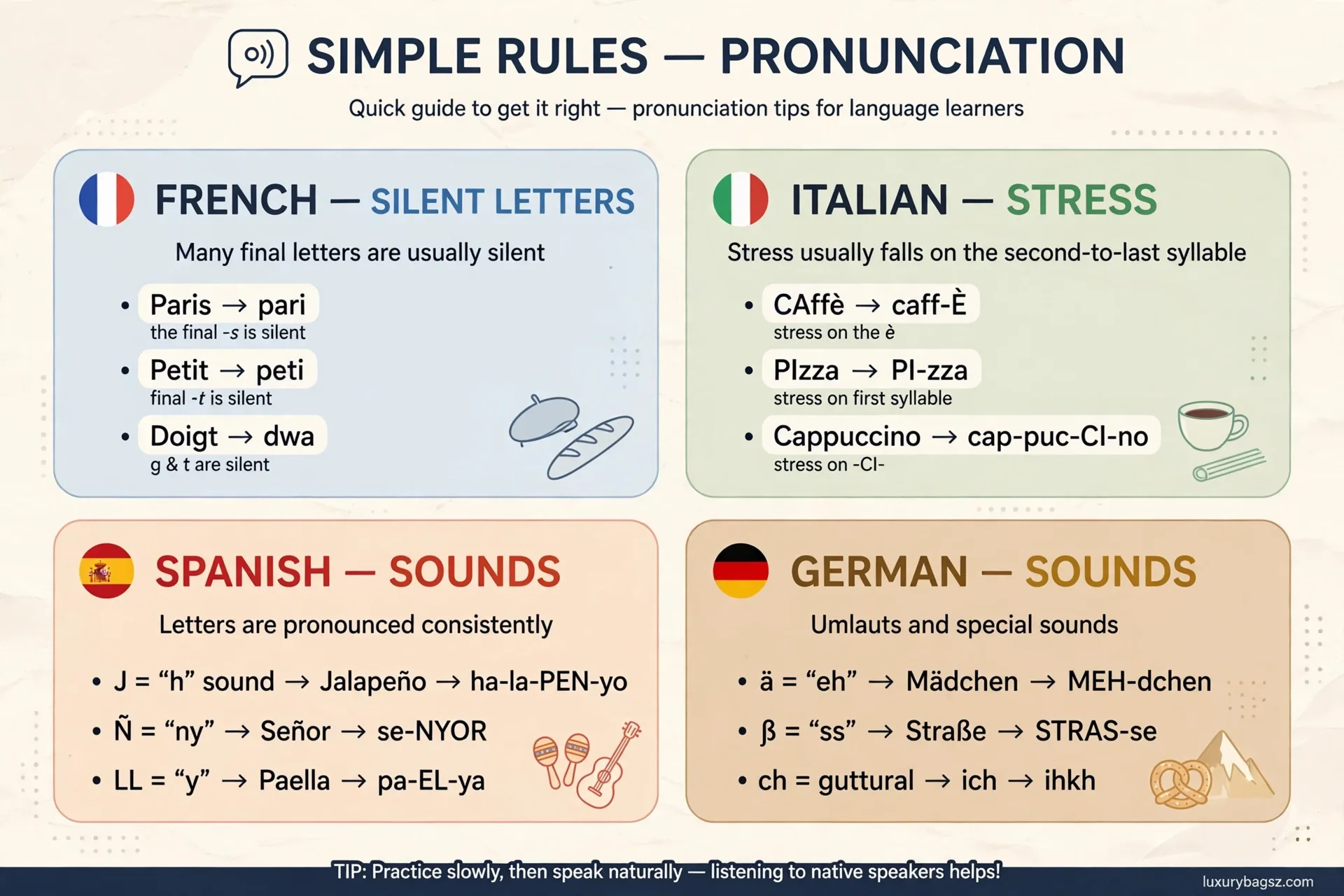
French rule: stress the last syllable, and do not pronounce most final consonants. The S in Hermes is silent, the T in Saint Laurent is soft, and the final E in many names is barely sounded. Nasal vowels, as in Givenchy and Saint Laurent, add a nasal quality that English speakers can approximate without perfecting.
Italian rule: pronounce every vowel, and stress the syllable marked in this guide. Italian C before E or I sounds like CH, as in Gucci and Cucinelli, while C before A, O, or U sounds like K. Double consonants, as in Bottega and Cucinelli, are held slightly longer than single ones.
Spanish rule: J sounds like a breathy H, as in Jacquemus is French, but for Spanish names such as Loewe, the W and V sounds differ from English, and the R is tapped or rolled lightly. Vowels are pure and short: A as in father, E as in bed, I as in machine, O as in dog, U as in rule.
German and Swiss rule: W sounds like V, CH sounds like a throaty H, and umlauts change vowel quality. Watch names from German-speaking Switzerland follow these rules, while French-speaking Swiss names follow French rules, which is why Swiss pronunciation varies by region and house.
How to Use the Phonetics in This Guide
Phonetics in this guide use capital letters for the stressed syllable and hyphens between syllables. For example, air-MEZ means stress the second syllable, with AIR rhyming with hair and MEZ rhyming with fez. Read the phonetics aloud slowly, then at normal speed.
Sounds are approximate, because English letters cannot capture every French nasal or Italian double consonant perfectly. The aim is a close, recognisable pronunciation, not a phonetic transcription for linguists. Where a sound has no English equivalent, the guide describes it in plain words.
Listen as well as read. Search for a house's own videos, interviews with its designers, or boutique staff saying the name, and imitate what you hear. Your ear will correct details that phonetics alone cannot, especially for nasal vowels and rolled Rs.
Practise in short bursts: five names at a time, repeated aloud three times, then revisited the next day. That spaced repetition builds muscle memory far better than cramming fifty names once and forgetting them.

French Houses A to C: The Essentials
Hermes is air-MEZ, with a silent H and S, and stress on the second syllable. The common English error, HER-meez, pronounces both letters that French drops. The house itself uses air-MEZ, and boutique staff will understand that version instantly.
Chanel is sha-NEL, with SH as in shop, A as in father, and stress on NEL. The common error, cha-NEL with a hard CH, sounds English, while the French SH is softer and correct. Coco Chanel's name is koh-koh sha-NEL.
Celine is say-LEEN, with SAY as in say and LEEN as in lean. The accent on the E, in the older spelling Celine with an acute accent, marks the AY sound, though the house dropped the accent in branding under Hedi Slimane. Either spelling is pronounced the same.
Cartier is kar-tee-AY, with KAR as in car, TEE as in tea, and AY as in say. The final R is barely sounded in French, though English speakers often pronounce it lightly. Our Celine Luggage vs Triomphe comparison is a useful next read once you can say the house name confidently.
French Houses D to L: Dior, Givenchy, and More
Dior is dee-OR, with DEE as in deed and OR as in or, stress on the second syllable. The common error, DY-or, flattens the vowels, while the French version keeps them pure and separate. Christian Dior is kris-tee-AHN dee-OR.
Givenchy is zhee-von-SHEE, with ZH as in measure, VON nasalised, and SHEE as in she. The G is soft, the N is nasal, and the final Y sounds like EE. English speakers often say gi-VEN-chee, which French speakers will understand but which misses the nasal quality.
Louis Vuitton is loo-EE voo-ee-TAWN, with LOO as in loo, EE as in ee, VOO as in voo, and TAWN nasalised. The S in Louis is silent, and the final N in Vuitton is nasal, not pronounced as a hard N. Practice it as three smooth parts, not five separate words.
Lanvin is lahn-VAHN, with LAHN nasalised and VAHN nasalised, while Saint Laurent is san loh-RAHN, with SAN nasalised, LOH as in low, and RAHN nasalised. Yves Saint Laurent is eev san loh-RAHN, with EEV as in eve.
French Houses M to V: More Names Shoppers Ask About
Balenciaga is bah-len-see-AH-gah, with BAH as in bah, LEN as in len, SEE as in see, AH as in ah, and GAH as in gah. The Spanish founder's name follows Spanish vowel rules, though the house is now Paris-based, and the pronunciation stays close to Spanish.
Jacquemus is zhak-MOOS, with ZHAK as in Jacques and MOOS as in moose. The final S is silent in French, though some English speakers pronounce it. The house, founded by Simon Porte Jacquemus, is a modern French favourite, and its name is a common boutique question.
Vetements is vet-MAHN, with VET as in vet and MAHN nasalised, meaning clothes in French. The brand, founded by Demna and Guram Gvasalia, uses a French name with a deliberately understated pronunciation that matches its aesthetic.
Comme des Garcons is kom day gar-SOHN, with KOM as in com, DAY as in day, GAR as in gar, and SOHN nasalised, meaning like boys in French. The house is Japanese, founded by Rei Kawakubo, but its name is French, so French rules apply.
French Jewellery and Beauty Names
Boucheron is boo-shuh-RON, with BOO as in boo, SHUH as in shuh, and RON nasalised. The house, founded in Paris in 1858, is a Place Vendome jeweller, and its name is often mispronounced as boo-CHE-ron with a hard CH.
Chaumet is shoh-MAY, with SHOH as in show and MAY as in may, while Van Cleef and Arpels is van KLEEF ay ar-PEL, with KLEEF as in cleef and PEL as in pel. The final S in Arpels is silent in French.
Chopard is shoh-PAR, with SHOH as in show and PAR as in par, while Piaget is pee-ah-ZHAY, with PEE as in pee, AH as in ah, and ZHAY as in zhay. Both are Swiss houses with French names, so French rules apply despite their Swiss base.
Guerlain is gair-LAHN, with GAIR as in gair and LAHN nasalised, while L'Occitane is lox-ee-TAN, with LOX as in lox, EE as in ee, and TAN nasalised. Beauty names follow the same French rules as fashion houses.
Italian Houses A to G: The Essentials
Gucci is GOO-chee, with GOO as in goo and CHEE as in chee, stress on the first syllable. The common error, GOO-see, uses an S sound, while Italian C before I sounds like CH. The house, founded by Guccio Gucci, is pronounced the same way.
Prada is PRAH-dah, with PRAH as in pra and DAH as in dah, stress on the first syllable. The common error, PRAY-dah, uses an English AY vowel, while Italian A is pure, as in father. Our Prada Galleria guide is a good next read once the name feels natural.
Fendi is FEN-dee, with FEN as in fen and DEE as in dee, while Versace is ver-SAH-cheh, with VER as in ver, SAH as in sah, and CHEH as in cheh. The final E in Versace is sounded lightly, not dropped as in French.
Dolce and Gabbana is DOL-cheh ay gab-BAH-nah, with DOL as in dol, CHEH as in cheh, GAB as in gab, and NAH as in nah. Dolce means sweet, Gabbana is a surname, and both follow Italian vowel rules with clear, pure sounds.
Italian Houses L to V: More Names to Master
Bottega Veneta is boh-TEH-gah VEH-neh-tah, with BOH as in boh, TEH as in teh, GAH as in gah, VEH as in veh, NEH as in neh, and TAH as in tah. Bottega means workshop, Veneta means Venetian, and both words stress the second syllable of Bottega and the first of Veneta.
Valentino is vah-len-TEE-noh, with VAH as in vah, LEN as in len, TEE as in tee, and NOH as in noh, stress on the third syllable. The common error, val-en-TEE-noh with a flat first vowel, misses the Italian A, which is pure and open.
Moschino is mos-KEE-noh, with MOS as in mos, KEE as in kee, and NOH as in noh, while Etro is EH-troh, with EH as in eh and TROH as in troh. Both follow Italian rules, with C before H sounding like K in Moschino.
Loro Piana is LOH-roh pee-AH-nah, with LOH as in low, ROH as in roh, PEE as in pee, AH as in ah, and NAH as in nah. Brunello Cucinelli is broo-NEL-loh koo-chee-NEL-lee, with double consonants held slightly longer and stress on NEL in both names.
Spanish Houses: Loewe, Balenciaga, and More
Loewe is loh-EH-veh in Spanish, with LOH as in low, EH as in eh, and VEH as in veh, stress on the second syllable. In English, many speakers say loh-WAY, which the house accepts in English-speaking markets, but loh-EH-veh is closer to the Spanish original, and boutique staff will understand both.
Balenciaga, covered in the French group for its Paris base, follows Spanish vowel rules as well: bah-len-see-AH-gah, with pure vowels and a soft G. The founder, Cristobal Balenciaga, was Spanish, and the name retains Spanish sounds despite the house's Paris location.
Zara is THAH-rah in Castilian Spanish, with TH as in think, though in Latin American Spanish and in English it is SAH-rah, with S as in sah. Both are understood, and the English SAH-rah is the most common version in shops worldwide.
Mango is MAHN-goh in Spanish, with MAHN as in man and GOH as in goh, while Massimo Dutti is MAH-see-moh DOO-tee, with pure vowels and double T held slightly longer. Spanish names reward pure vowels and a breathy J where it appears.
British and American Houses
Burberry is BUR-buh-ree in English, with BUR as in bur, BUH as in buh, and REE as in ree, stress on the first syllable. The name, from founder Thomas Burberry, follows straightforward English rules and is rarely mispronounced, though some speakers stress the second syllable.
Alexander McQueen is al-ig-ZAHN-duh muh-KWEEN, with standard English pronunciation, while Stella McCartney is STEL-uh muh-KART-nee. British designer names usually follow English rules, though Scottish and Welsh names may use local sounds.
Ralph Lauren is ralf LOR-en, with RALF as in Ralph and LOR-en as in Lauren, though the designer himself pronounces Lauren as luh-REN in the French style. Both versions are understood, and the house accepts the English LOR-en commonly used in shops.
Tommy Hilfiger is TOM-ee HIL-fi-guh, with standard American pronunciation, while Calvin Klein is KAL-vin KLYNE, with KLYNE rhyming with line. American houses generally follow American English rules, making them easier for English speakers than French or Italian names.
Japanese Houses: Clear Syllables, Even Stress
Issey Miyake is EE-say mee-YAH-kay, with EE as in ee, SAY as in say, MEE as in mee, YAH as in yah, and KAY as in kay. Japanese vowels are pure and short, and each syllable is pronounced evenly, without the strong stress English speakers often add.
Rei Kawakubo is ray kah-wah-KOO-boh, with RAY as in ray, KAH as in kah, WAH as in wah, KOO as in koo, and BOH as in boh. Kawakubo founded Comme des Garcons, and her name follows the same even-syllable pattern.
Yohji Yamamoto is YOH-jee yah-mah-MOH-toh, with YOH as in yoh, JEE as in jee, YAH as in yah, MAH as in mah, MOH as in moh, and TOH as in toh. The J in Yohji sounds like English J, not French ZH.
Junya Watanabe is JOON-yah wah-tah-NAH-beh, with JOON as in June, YAH as in yah, WAH as in wah, TAH as in tah, NAH as in nah, and BEH as in beh. Sacai is sah-KYE, with SAH as in sah and KYE as in kye, stress on the second syllable.
Swiss Watch Names: French, German, and Mixed Rules
Audemars Piguet is oh-duh-MAR pee-GAY, with OH as in oh, DUH as in duh, MAR as in mar, PEE as in pee, and GAY as in gay. The S in Audemars is silent, and the T in Piguet is silent, following French rules for this French-speaking Swiss house.
Patek Philippe is PAH-tek fil-EEP, with PAH as in pah, TEK as in tek, FIL as in fil, and EEP as in eep. Patek follows Polish-French sounds, Philippe follows French rules, and the house, based in Geneva, uses the French pronunciation.
Vacheron Constantin is vash-RON kon-stan-TAN, with VASH as in vash, RON nasalised, KON as in kon, STAN as in stan, and TAN nasalised. The final N in both words is nasal, not hard, following French rules.
Jaeger-LeCoultre is zhay-ZHAIR luh-KOOLT, with ZHAY as in zhay, ZHAIR as in zhair, LUH as in luh, and KOOLT as in koolt. The name combines German Jaeger with French LeCoultre, and the French pronunciation dominates in watch circles.
More Watch Names: German and French-Swiss
A. Lange and Sohne is AH lahng-uh unt ZUR-nuh, with AH as in ah, LAHNG as in lang, UH as in uh, UNT as in unt, ZUR as in zur, and NUH as in nuh. The umlaut in Sohne changes the O to a rounded sound, approximated here as UR.
Glashutte is GLAHS-hoo-tuh, with GLAHS as in glass, HOO as in hoo, and TUH as in tuh, following German rules where W would sound like V, though this name has no W. The town in Saxony gives its name to several watch houses.
TAG Heuer is tag HOY-er, with TAG as in tag and HOY-er as in hoyer, following German rules for Heuer. IWC is pronounced by its letters, eye-double-you-see, or as IWC Schaffhausen, eye-double-you-see SHAHF-how-zen, with German sounds for Schaffhausen.
Rolex is ROH-leks, with straightforward English sounds, while Omega is oh-MAY-guh, with OH as in oh, MAY as in may, and GUH as in guh. These names are rarely mispronounced, though Omega's stress on MAY surprises some English speakers.
How to Practise Without Embarrassment
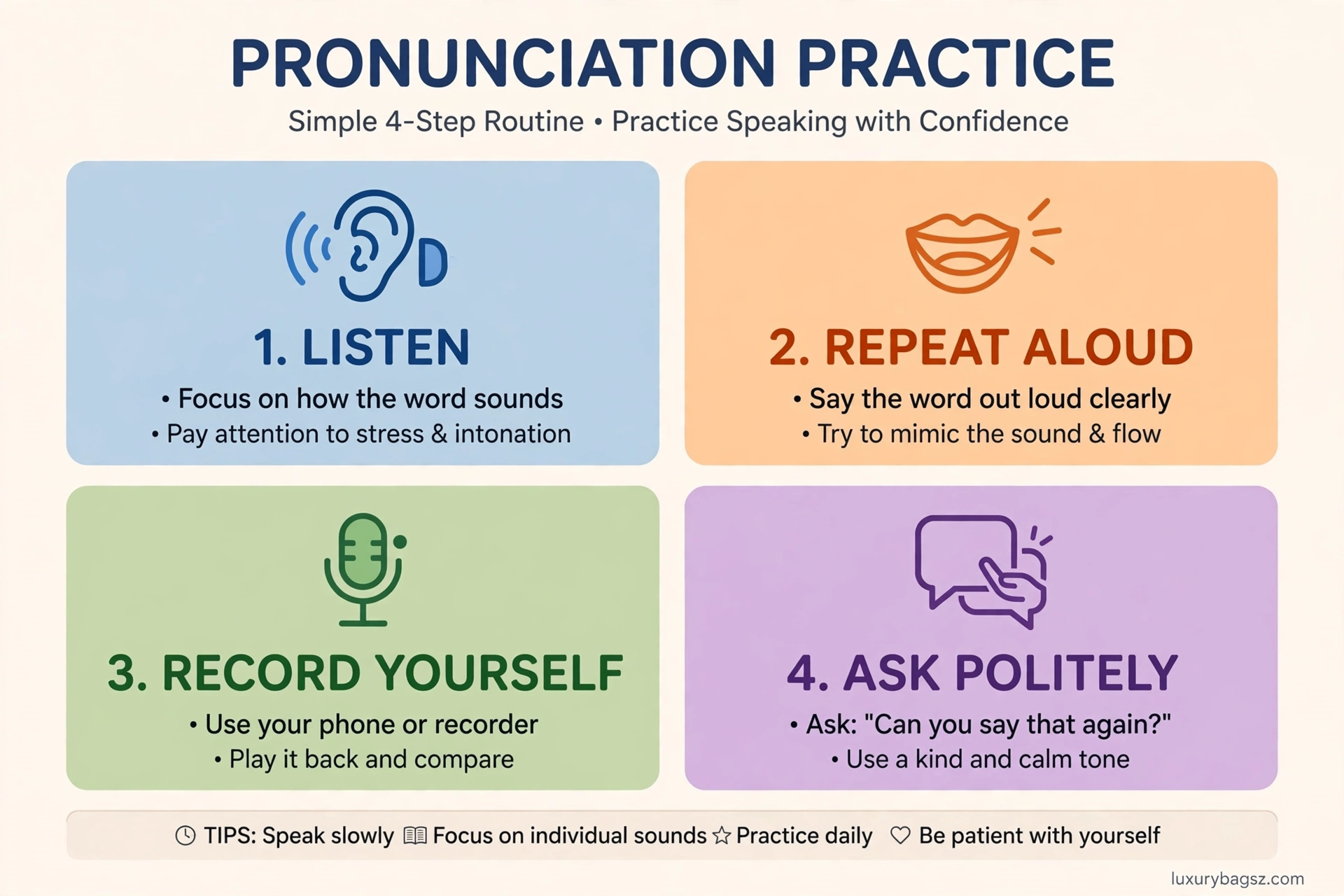
Practise alone first, using this guide's phonetics and online audio from houses, designers, or native speakers. Repeat each name three times slowly, then at normal speed, and record yourself to hear the difference between your version and the model.
Practise in context, not in isolation. Say the full phrase you will use in a shop, such as asking for a size or a colour, with the brand name inside it. Contextual practice feels more natural and prepares you for real conversation better than repeating a name alone.
Use boutique staff as allies, not judges. A polite question, such as asking how staff pronounce a name, is welcome and normal, and staff hear many versions daily. Most will correct gently or simply use the correct version in reply, which teaches without embarrassment.
Finally, practise regularly, not once. Five minutes a day for a week, revisiting five names at a time, builds confidence far better than an hour before a shopping trip. Confidence, not perfection, is the goal, and it grows with repetition.
Common Mistakes, and Easy Fixes
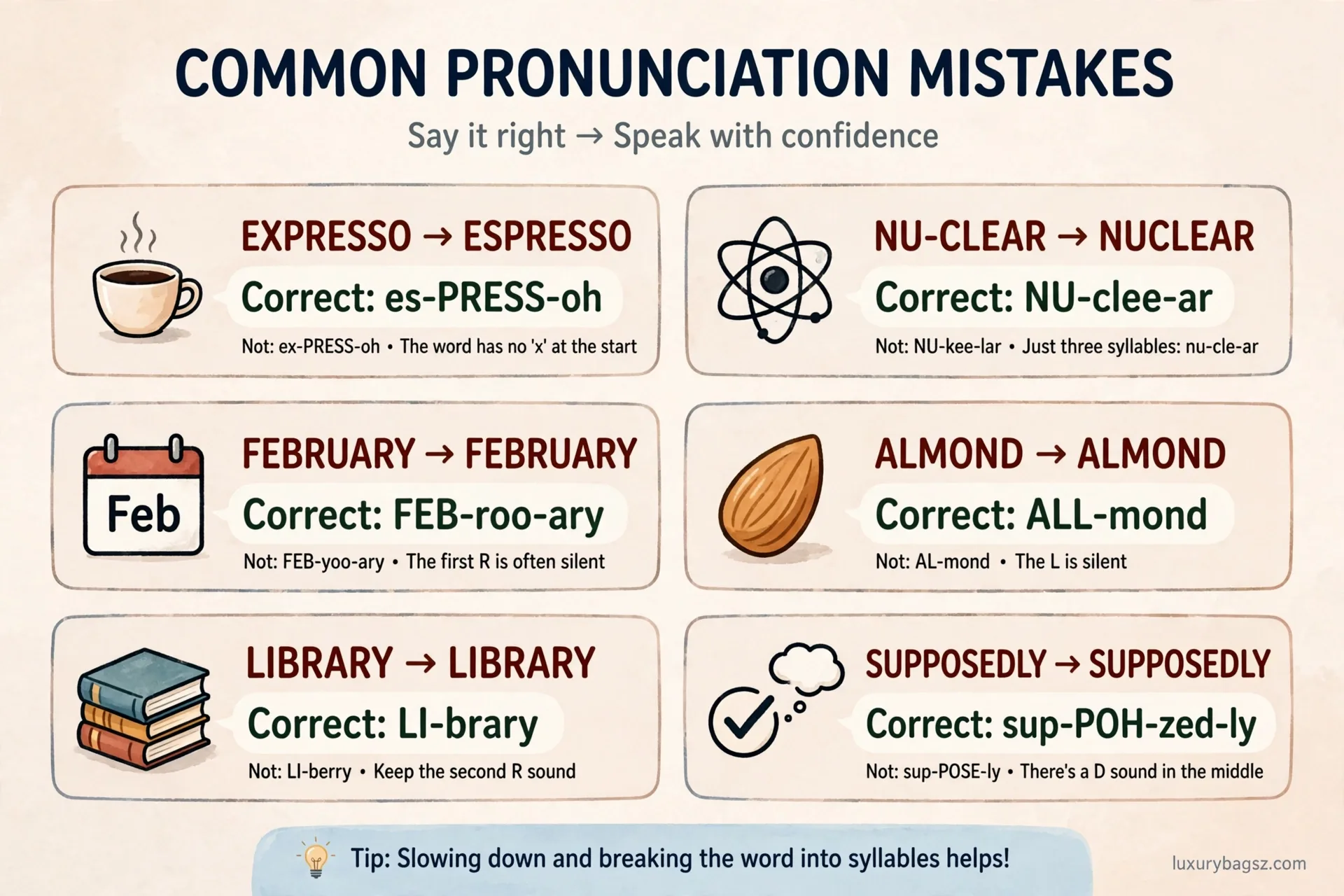
The most common mistake is pronouncing French final letters that should be silent, such as the S in Hermes or the T in Vuitton's nasal ending. Fix it by dropping the final letter and stressing the last sounded syllable, as in air-MEZ and voo-ee-TAWN.
The second mistake is using English vowels for Italian names, such as PRAY-dah for Prada or GOO-see for Gucci. Fix it by using pure vowels, PRAH-dah with A as in father, and CH for C before I, GOO-chee with CH as in cheese.
The third mistake is flattening Japanese names with English stress, such as IS-see mee-YAKE for Issey Miyake. Fix it by pronouncing each syllable evenly, EE-say mee-YAH-kay, without hammering one syllable.
The fourth mistake is avoiding a name altogether, pointing or saying that brand instead. Avoidance feels safer but prevents learning, and it can confuse staff. A close attempt, even if imperfect, is better than silence, and staff will help.
Pronunciation in Boutiques: Scripts That Help
In a boutique, a simple script helps: greet staff, state what you want, and use the brand name naturally, without apologising for pronunciation. For example, asking for a size in a bag, using the house name once, is enough; repeating it nervously draws more attention than a small error.
If you are unsure, listen first. Staff will say the house and product names during conversation, and you can mirror their pronunciation in your next sentence. Mirroring is natural, polite, and effective, and it avoids a direct correction.
If staff correct you, accept graciously and repeat the corrected version once. A simple thank you and a repeat shows respect and helps memory, while arguing or over-apologising makes the moment awkward for everyone.
For phone or online orders, pronunciation matters less, because staff read the name, but saying it correctly still helps when confirming details. Practise the name before calling, and have the product reference or code ready as a backup.
Regional Variations, and When Both Versions Are Right
Regional variation means some names have two accepted pronunciations, and insisting on one can be pedantic. Loewe as loh-EH-veh in Spanish and loh-WAY in English is a clear example, with both understood and both used by the house in different markets.
Zara as THAH-rah in Castilian Spanish and SAH-rah elsewhere is another, with the English SAH-rah dominant in shops worldwide. Ralph Lauren as LOR-en in English and luh-REN in the designer's French style is a third, with both accepted.
Watch names also vary by region, with French-speaking and German-speaking Swiss houses using different rules, and with English speakers adapting both. A close version, delivered confidently, is usually enough, and native speakers rarely correct a respectful attempt harshly.
When sources disagree, this guide gives the original-language version first, then the common English version. Use the original where you can, use the English version where it is standard in your market, and do not worry about a small difference between them.
Teaching Others, and Helping Friends
Teaching pronunciation to friends works best with kindness and phonetics, not correction. Share a phonetic spelling, say the name aloud together, and practise in a low-pressure setting, such as before a shopping trip, rather than correcting someone publicly in a boutique.
Use memory aids: Hermes rhymes with air-fez without the F, Chanel rhymes with shall-nell without the first L, and Gucci rhymes with coochie without the negative connotation, though that last aid is best used privately. Aids that are vivid stick better than abstract rules.
Encourage listening over reading. Send a friend a short video of a designer or boutique staff saying the name, and practise together by repeating it. Audio beats phonetics for nasal vowels, rolled Rs, and Italian double consonants, which text alone cannot fully capture.
Finally, normalise mistakes. Everyone mispronounces a new name at first, including fashion professionals, and learning is part of enjoying fashion. A friend who feels safe making mistakes will learn faster than one who fears correction.
Your Pronunciation Toolkit, and Next Steps
Your toolkit starts with this guide's rules and phonetics, plus audio from houses, designers, and native speakers. Bookmark a few reliable pronunciation videos, and revisit them before shopping trips or events where you will discuss fashion.
Add a personal list of names you use most, with your own phonetic notes in words that make sense to you. Personal notes, such as air-MEZ for Hermes or GOO-chee for Gucci, stick better than generic guides, because they use your own sound associations.
Practise weekly, not just before a purchase. Five names, three repetitions, once a week, keeps pronunciation fresh and builds confidence over time. Add new names as you discover houses, and retire names you no longer use.
Finally, enjoy the learning. Pronunciation connects you to the languages, cities, and founders behind fashion, from Paris to Milan to Madrid to Geneva to Tokyo. Saying a name well is a small pleasure, and it deepens your appreciation for the clothes and watches you love.
Quick Reference: Thirty Names in One Place
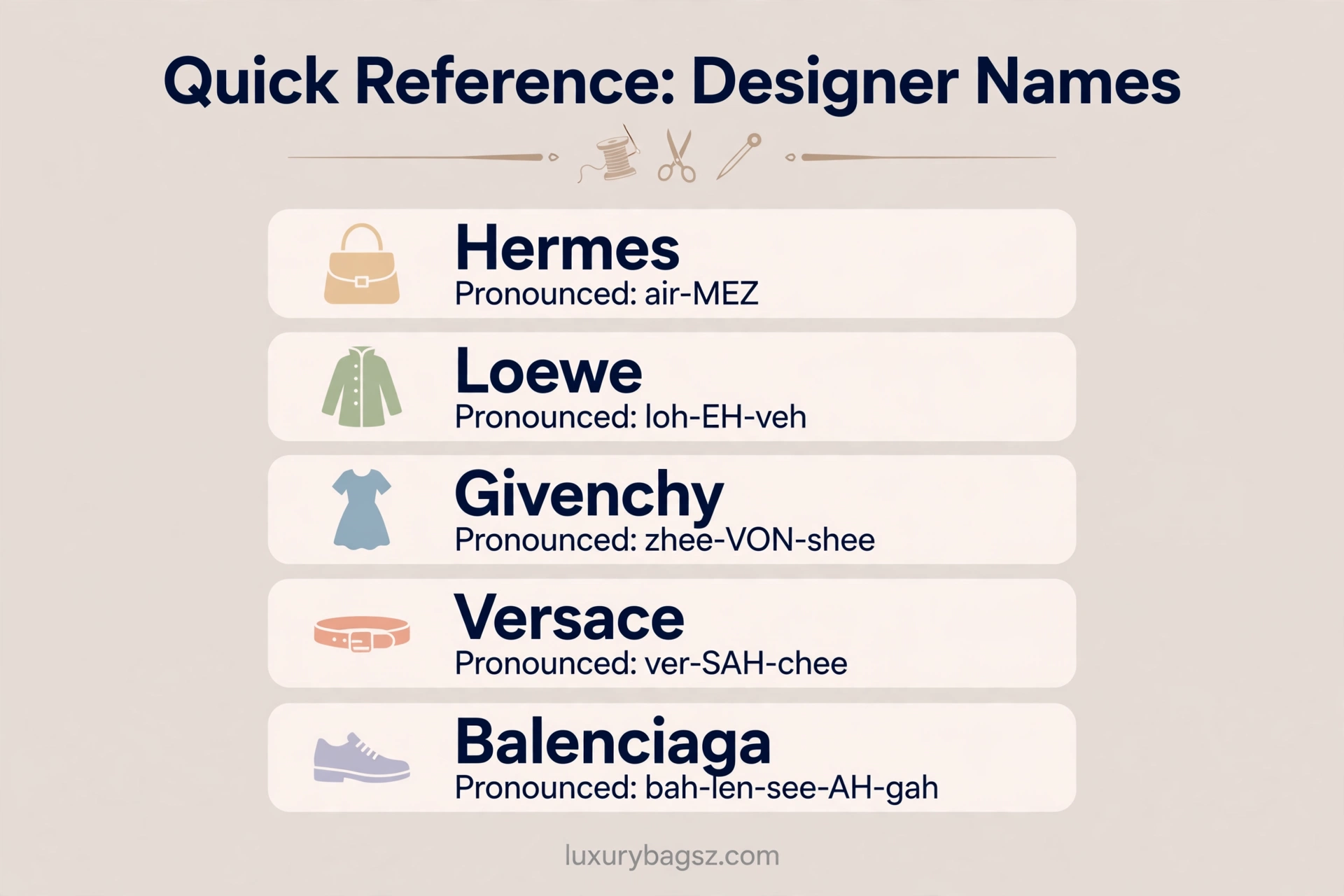
For a fast refresher before shopping, here are thirty names in brief: Hermes air-MEZ, Chanel sha-NEL, Celine say-LEEN, Dior dee-OR, Givenchy zhee-von-SHEE, Louis Vuitton loo-EE voo-ee-TAWN, Saint Laurent san loh-RAHN, Lanvin lahn-VAHN, Balenciaga bah-len-see-AH-gah, Jacquemus zhak-MOOS, and Comme des Garcons kom day gar-SOHN cover the French houses most shoppers meet.
Italian houses follow: Gucci GOO-chee, Prada PRAH-dah, Fendi FEN-dee, Versace ver-SAH-cheh, Dolce and Gabbana DOL-cheh ay gab-BAH-nah, Bottega Veneta boh-TEH-gah VEH-neh-tah, Valentino vah-len-TEE-noh, Moschino mos-KEE-noh, Loro Piana LOH-roh pee-AH-nah, and Brunello Cucinelli broo-NEL-loh koo-chee-NEL-lee.
Spanish, British, American, Japanese, and Swiss names complete the set: Loewe loh-EH-veh, Zara SAH-rah, Burberry BUR-buh-ree, Ralph Lauren ralf LOR-en, Issey Miyake EE-say mee-YAH-kay, Yohji Yamamoto YOH-jee yah-mah-MOH-toh, Audemars Piguet oh-duh-MAR pee-GAY, Patek Philippe PAH-tek fil-EEP, Vacheron Constantin vash-RON kon-stan-TAN, and Jaeger-LeCoultre zhay-ZHAIR luh-KOOLT.
Read this list aloud once before a shopping trip, and keep it on your phone for a discreet check in store. A quick refresher beats a long study session when you need a name in the moment, and it builds confidence with every use.
Frequently Asked Questions
How do you pronounce Hermes?
Hermes is pronounced air-MEZ, with a silent H and S, and stress on the second syllable. The common English error, HER-meez, pronounces both letters that French drops.
How do you pronounce Louis Vuitton?
Louis Vuitton is pronounced loo-EE voo-ee-TAWN, with a silent S in Louis and a nasal final N in Vuitton. Practice it as three smooth parts, not five separate words.
How do you pronounce Gucci?
Gucci is pronounced GOO-chee, with stress on the first syllable and CH as in cheese for the C before I. The common error, GOO-see, uses an S sound.
How do you pronounce Loewe?
Loewe is pronounced loh-EH-veh in Spanish, though many English speakers say loh-WAY, which the house accepts in English-speaking markets. Both versions are understood.
How do you pronounce Balenciaga?
Balenciaga is pronounced bah-len-see-AH-gah, with pure Spanish vowels and stress on the fourth syllable. The G is soft, and each vowel is sounded clearly.
How do you pronounce Audemars Piguet?
Audemars Piguet is pronounced oh-duh-MAR pee-GAY, with a silent S in Audemars and a silent T in Piguet, following French rules.
How do you pronounce Versace?
Versace is pronounced ver-SAH-cheh, with stress on the second syllable and CH as in cheese for the C before E. The final E is sounded lightly.
How do you pronounce Comme des Garcons?
Comme des Garcons is pronounced kom day gar-SOHN, with a nasal final N, following French rules, though the house itself is Japanese.
Is it rude to mispronounce a designer name?
No, mispronunciation is common and rarely rude, especially when delivered with respect and a willingness to learn. Boutique staff hear many versions daily and welcome a close attempt.
How can I improve my fashion pronunciation?
Listen to native speakers and house videos, repeat names aloud in context, record yourself, practise regularly in short bursts, and ask boutique staff politely when unsure.
Conclusion
Pronouncing designer names correctly is a learnable skill, not a talent: learn the French, Italian, Spanish, and German rules, practise five names at a time, listen to native speakers, and use boutiques as allies rather than judges. Start with the houses you buy most, master Hermes, Chanel, Gucci, Louis Vuitton, and Prada, and add new names gradually as your wardrobe grows.
A close, confident attempt beats silence every time, and it shows respect for the founders, cities, and languages behind the fashion you love. Keep this guide handy, practise weekly, and enjoy saying the names as much as you enjoy wearing them, every single day, with confidence and with respect for the languages behind them.






