

How to Authenticate Tiffany & Co Jewellery
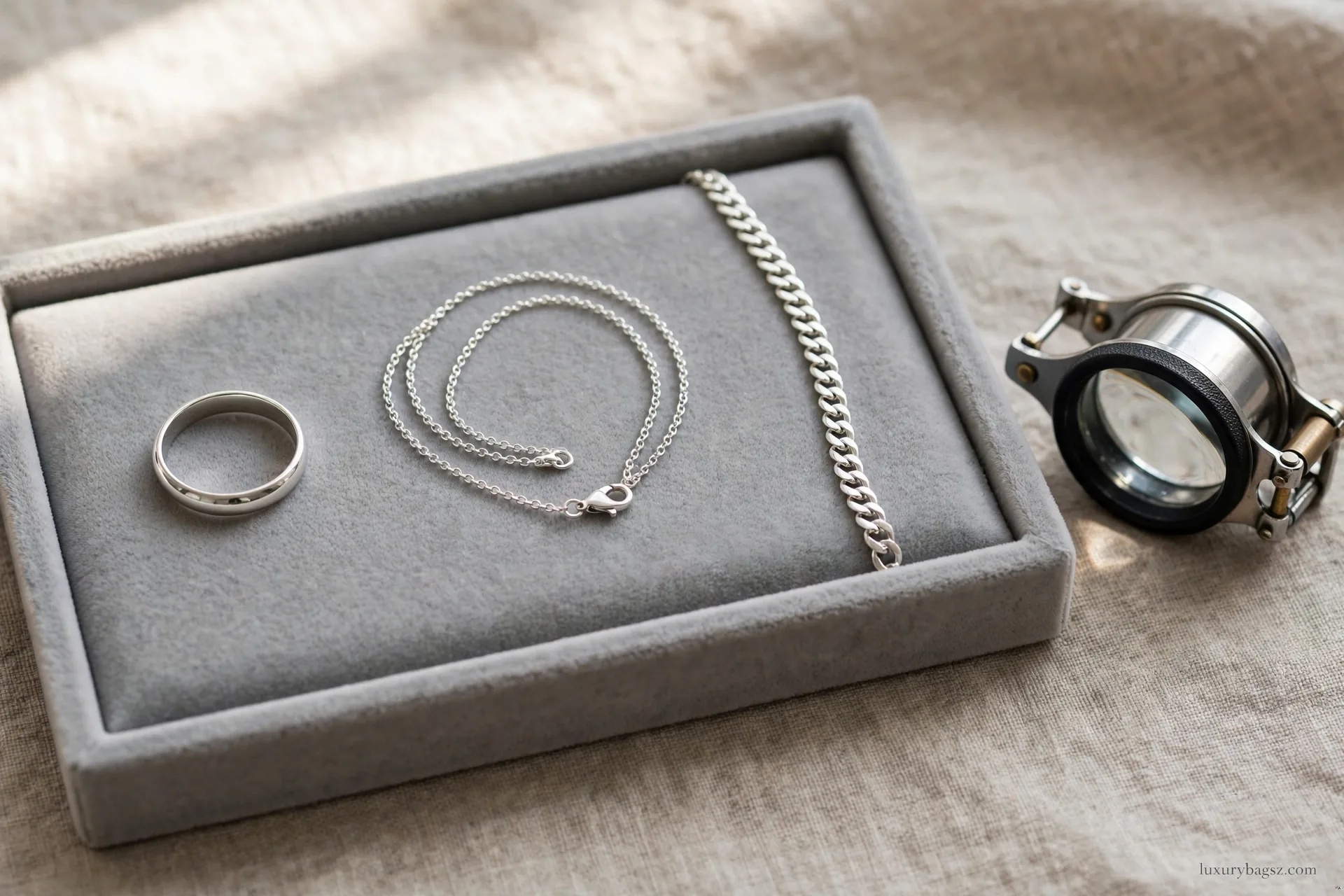
The Tiffany Test at a Glance
Tiffany & Co, founded in New York in 1837, is one of the most counterfeited jewellery brands in the world, and its most copied pieces are also its most recognisable: the Return to Tiffany heart tag, the Tiffany T collection, the Elsa Peretti Bean and Open Heart designs, the Tiffany Setting engagement ring, and the classic sterling silver collections.
Authentication is therefore not a single test but a combination of hallmarks, engraving quality, craftsmanship, metal, stones, and packaging, judged against the specific collection and era.
Two principles govern everything that follows. First, Tiffany's quality is consistent: a genuine piece is well made in every detail, not just the visible ones, and a fake is usually excellent in one place and careless in another. Second, Tiffany's markings evolved over time, so a hallmark or engraving style that is correct for a 2020 piece may be wrong for a 1990 piece, and vice versa.
Judge every piece against its collection and era, not against a single timeless rule.
This guide covers jewellery authentication broadly, from sterling silver to gold and diamond pieces, with collection-specific notes where they matter. It does not replace a jeweller's inspection for high-value pieces, especially diamond jewellery, where stone verification requires equipment and expertise. For those pieces, use this guide to screen, and a reputable jeweller to verdict.
Key Takeaways
- Tiffany authentication combines hallmarks, engraving quality, craftsmanship, metal, stones, and packaging, judged against the specific collection and era.
- Genuine Tiffany hallmarks are crisply and evenly engraved, correctly spelled, and correctly formatted for the collection and era; shallow, fuzzy, or misspelled marks fail the check.
- Sterling silver Tiffany pieces should be marked 925 and feel substantial; lightweight, hollow-feeling, or roughly finished silver is a warning.
- Craftsmanship should be consistent on all surfaces, including clasps, hinges, backs, and interiors, where fakes often economise.
- Diamond pieces need stone checks: setting quality, stone consistency, and, for high-value pieces, certification and jeweller verification.
- Boxes, pouches, and papers support but never prove genuineness: fake Tiffany packaging is common, and genuine pieces frequently lose theirs.
Know the Collection and Era First
Tiffany has produced an enormous range of collections over nearly two centuries, and each has its own design language, hallmark style, and construction. A Return to Tiffany tag, a Tiffany T bracelet, an Elsa Peretti Bean pendant, a Tiffany Setting ring, and a Tiffany Victoria piece differ in markings, metal, stones, and finishing.
Before checking anything, identify the collection, the design, and the approximate era, and learn what that piece should look like from Tiffany's own materials and reputable dealer listings.
Era matters because Tiffany's markings changed. Early pieces may carry different hallmark formats from modern ones, and some vintage pieces carry marks that modern buyers do not expect. A hallmark style that is correct for a 1980s piece may be wrong for a 2020 piece, and a modern hallmark on a claimed vintage piece is an era mismatch.
If the seller cannot name the collection or era, or names a combination that does not exist, stop and demand clarification or a jeweller's opinion.
Limited and retired designs deserve extra care. Retired Tiffany designs are popular on the pre-owned market, and counterfeiters target them because buyers are less certain what is correct. For any retired design, compare against auction records and specialist dealer archives, and treat any design claim without supporting photographs of genuine examples as unverified.
Hallmarks: Format, Spelling, and Engraving Quality
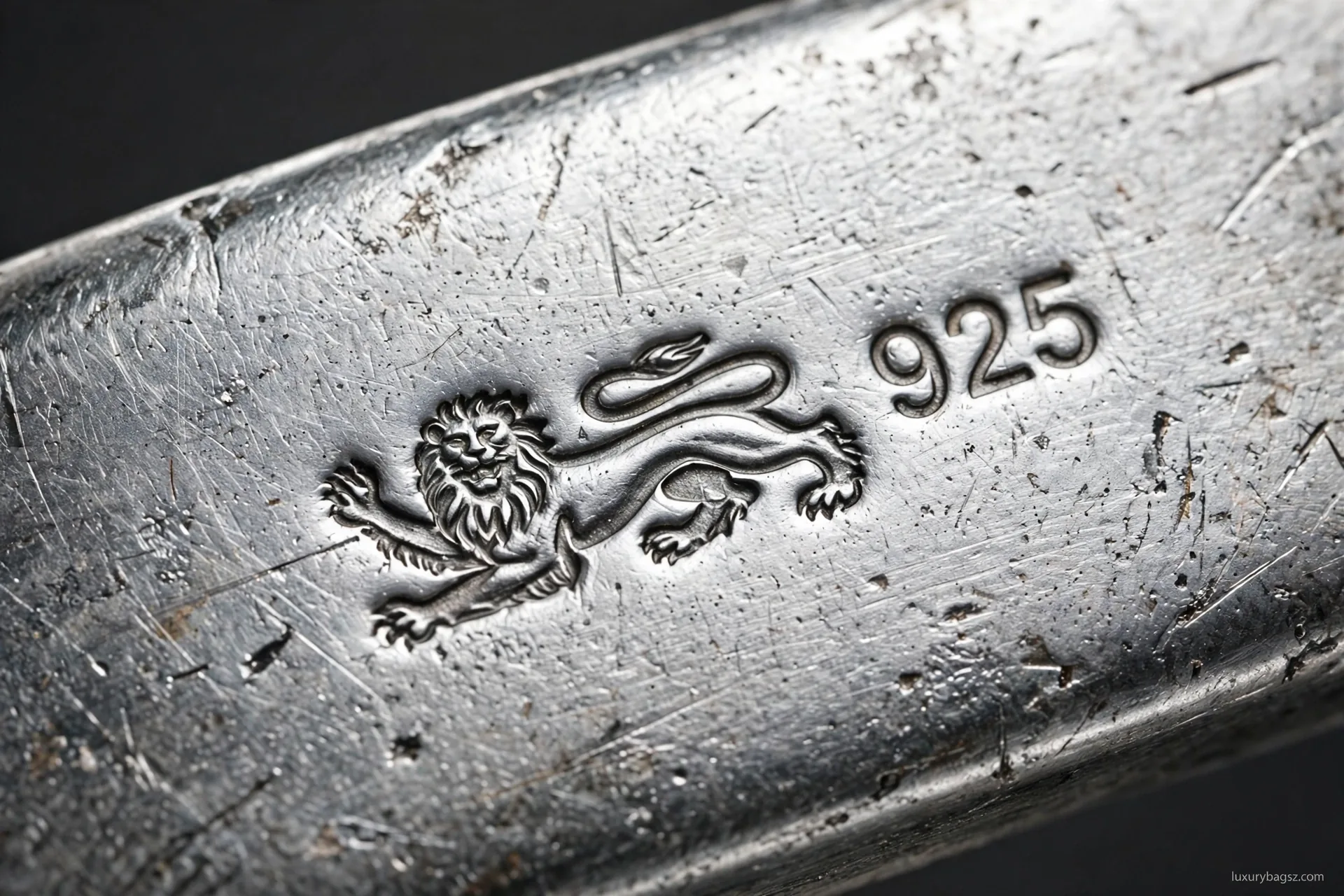
Hallmarks are the starting point for Tiffany authentication, but they are also the most copied feature, so quality matters more than presence. On a genuine Tiffany piece, hallmarks are crisply and evenly engraved, with clean letterforms, consistent depth, and correct spelling.
Common marks include "Tiffany & Co." with the ampersand, "925" for sterling silver, "750" for 18 karat gold, "950" for platinum where applicable, and, on some pieces, "Made in" markings or additional assay marks depending on era and market. The exact combination varies by collection, material, and era, and must be checked against verified examples of the same piece.
Fakes commonly fail on hallmark quality rather than hallmark presence. Typical faults include shallow or uneven engraving, letters that are too bold or too thin, spacing that drifts, misspellings such as "Tiffany and Co" without the ampersand where the genuine mark uses one, or hallmark formats that do not belong to the collection or era.
Photograph hallmarks under magnification and in raking light, which reveals uneven depth, and compare the font and layout directly against verified examples.
Be cautious with hallmark location. Genuine Tiffany hallmarks sit where the collection specifies: on the tag for Return to Tiffany pieces, on the clasp or interior for bracelets, on the shank for rings, and so on. A hallmark in an unexpected location, or a piece with no hallmark at all where one is specified, is a warning. Note, however, that very small pieces may carry minimal markings, and some vintage pieces carry marks that have worn.
Wear looks different from never having been engraved sharply: worn marks are smooth and even, while fake marks are often sharp in some letters and shallow in others.

Engraving and Lettering Across the Piece
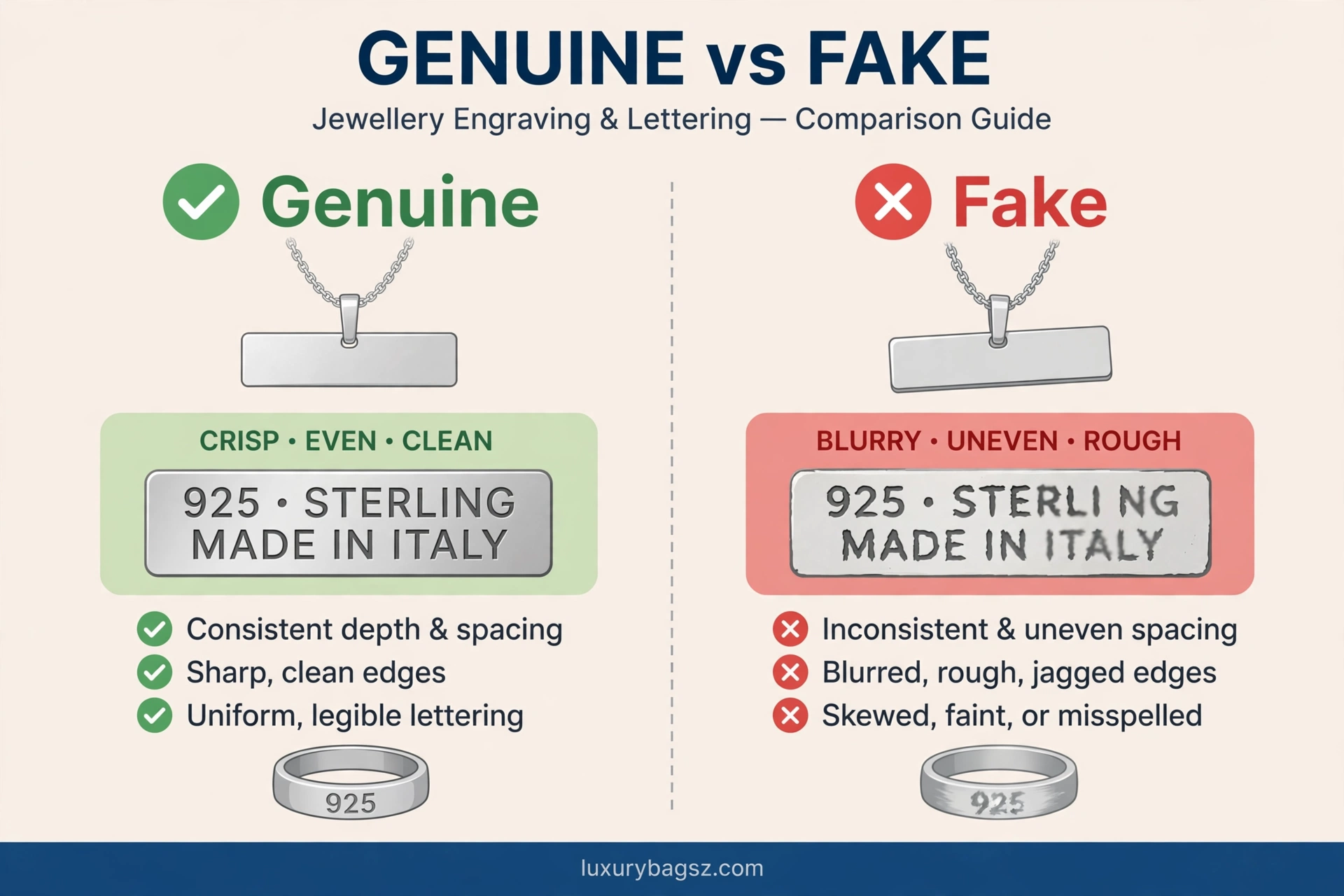
Beyond hallmarks, Tiffany pieces often carry engraved text: "Return to Tiffany" on tag pieces, "Please Return to Tiffany & Co. New York" on classic tags, collection names, or personalised engravings added by owners. Genuine Tiffany engraving is crisp, evenly deep, and correctly spelled, with letterforms that match the collection's style.
The classic Return to Tiffany tag engraving, for example, is clean and precise, with even spacing and no fuzzy edges, even on small tags.
Fakes often betray themselves in engraving details that buyers overlook. Common faults include letters that are too large or too small for the piece, spacing that is uneven, text that is slightly misspelled or mis-punctuated, and engraving that is shallow in some letters and deep in others. On tag pieces, check both sides: genuine tags are finished on both sides, while fake tags often show a well-engraved front and a rough, poorly finished back.
Personalised engraving complicates matters. A genuine Tiffany piece may carry an owner's initials or message added after purchase, and that engraving may differ in style from Tiffany's own marks. Do not mistake a later personalisation for a fake tell, but do check that the Tiffany marks themselves, separate from any personalisation, are correct.
If a personalisation obscures or overlaps a hallmark, ask a jeweller to assess whether the underlying mark is genuine.
Craftsmanship: Finish on Every Surface
Tiffany craftsmanship is consistent across the whole piece, not just the front. Examine every surface: the front, the back, the interior, the clasp, the hinge, the jump rings, and the edges. Genuine Tiffany silver and gold pieces show smooth, even finishing, with polished areas evenly polished, brushed areas evenly brushed, and clean transitions between them. Edges are smooth, with no burrs, sharp spots, or rough casting marks.
Fakes often concentrate finishing on the visible front and neglect the back and interior. Common faults include rough backs, unpolished interiors, jump rings that are poorly closed or unevenly sized, hinges that feel loose or gritty, and edges that catch on fabric or skin.
Run a fingertip over the back and interior, if the seller permits handling: a genuine Tiffany piece feels smooth everywhere, while a fake often feels rough in the places the buyer is least likely to check.
Weight and balance are companion tests. Genuine Tiffany sterling silver pieces feel substantial for their size, because sterling silver is dense and Tiffany pieces are solidly constructed. Gold pieces feel dense as their karat requires. A piece that feels suspiciously light, hollow, or tinny, or that balances oddly, deserves the full checklist.
Weight alone never authenticates a piece, but a piece that feels wrong should not pass on its hallmarks alone.
Chains, Clasps, and Closures
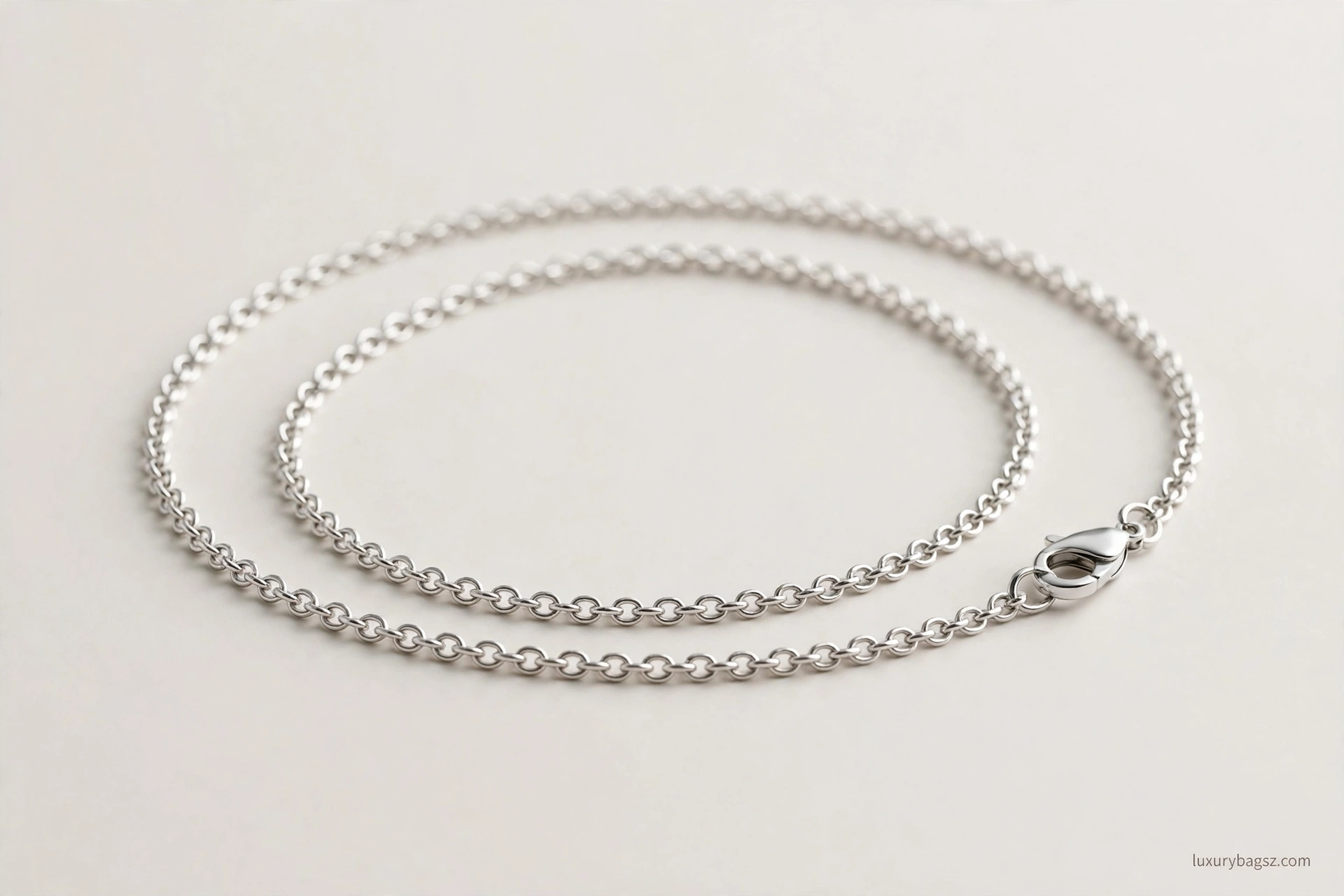
Chains are a revealing test because they are difficult to manufacture well at low cost. Genuine Tiffany chains show uniform links, even in size and shape, with clean soldering and smooth finishing. Links that vary in size, that show rough solder joints, that catch or snag, or that feel stiff in one place and loose in another indicate poor manufacturing.
Check the chain along its full length, not just near the clasp, because fakes often use a better chain length near the clasp and a poorer one elsewhere.
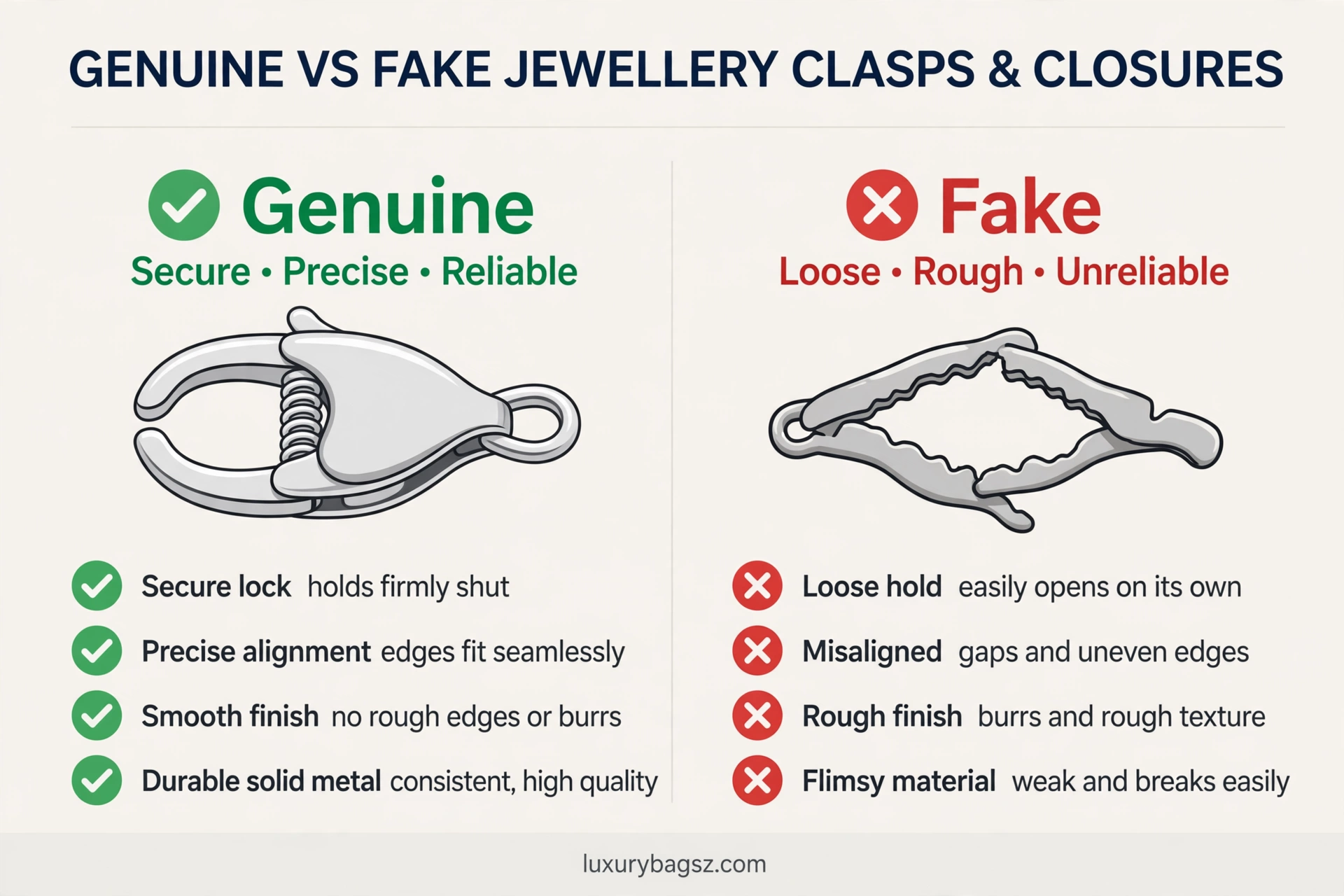
Clasps and closures deserve equal attention. Genuine Tiffany clasps, whether lobster, toggle, box, or other styles as specified for the collection, close with a firm, precise action, sit flush when closed, and carry clean, correctly rendered markings. A clasp that feels flimsy, closes loosely, gaps when shut, or shows shallow or misspelled markings is a serious warning.
Toggle clasps, common on Tiffany bracelets, should fit precisely: a toggle bar that is too long, too short, or too thin for its ring is a mismatch tell.
Also check the jump rings and connectors where chains meet pendants, tags, or clasps. Genuine connectors are neatly closed, correctly sized, and finished to the same standard as the rest of the piece. Connectors that are visibly open, unevenly sized, or roughly finished suggest a fake or a poorly repaired piece, and on an unknown piece they should trigger a jeweller's inspection.
Silver and Gold: Metal Quality and Testing
Metal quality is a fundamental check. Sterling silver Tiffany pieces should be marked 925 and should behave like sterling silver: dense, with a bright, even lustre that develops a natural patina with wear. Gold pieces should be marked for their karat, commonly 750 for 18 karat, and should show the colour and density of that karat.
A piece claimed as sterling silver that looks dull, grey, or plasticky, or a piece claimed as 18 karat gold that looks brassy or pale, deserves investigation.
Home metal tests, such as magnet tests or acid tests, are unreliable and can damage a genuine piece. A magnet test proves little, because many non-precious metals are also non-magnetic, and some genuine pieces contain magnetic components in clasps or findings. Acid tests can damage finishes and should only be performed by a jeweller on an inconspicuous area, if at all.
The reliable route is a jeweller's assessment, using proper testing equipment, including X-ray fluorescence testing where appropriate, which identifies metal composition without damaging the piece.
Also check for plating. Some fakes are base metal plated with silver or gold, and plating wears differently from solid metal: it shows wear at edges and high points, revealing a different-coloured base metal beneath, and it feels lighter than solid metal. A piece that shows base metal showing through at worn edges, or that feels too light for its size and claimed metal, is a plating warning.
Genuine Tiffany silver and gold pieces are solid metal as specified, not plated base metal, except where a specific design specifies vermeil or another construction, which should be verified against the collection.
Diamonds and Gemstones: Setting, Consistency, and Certification
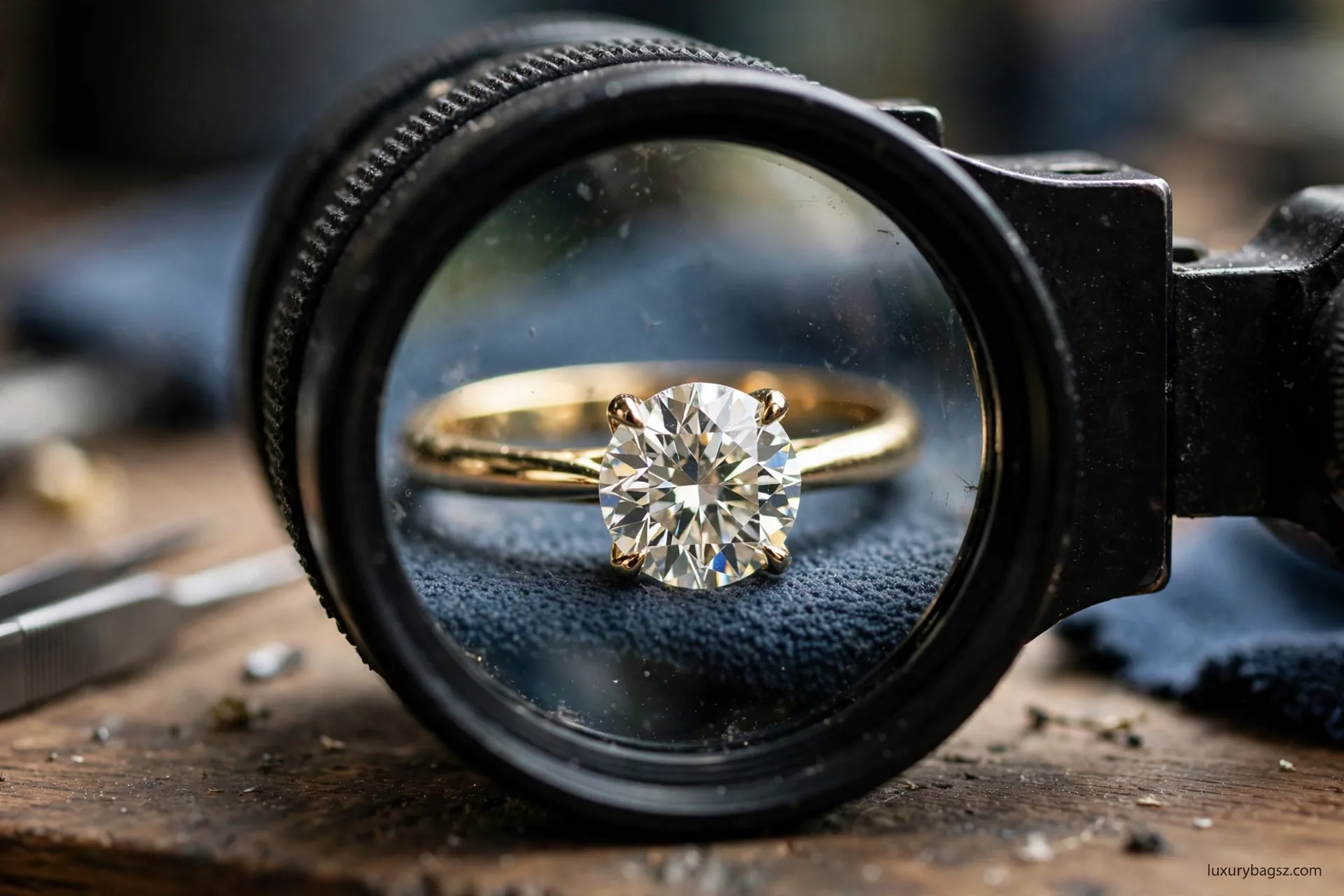
Diamond and gemstone Tiffany pieces need stone checks in addition to metal and hallmark checks. Setting quality is the first test: genuine Tiffany settings hold stones securely and evenly, with prongs that are uniform, smoothly finished, and correctly sized for the stones, and with stones that sit at a consistent height and orientation. Stones that sit unevenly, that wobble, that show glue, or that are held by rough, uneven prongs are warnings.
The Tiffany Setting, with its six-prong design, is a particular test: the prongs should be slender, even, and elegantly finished, lifting the diamond high while holding it securely.
Stone consistency is the second test. In multi-stone pieces, diamonds should be consistent in colour, clarity appearance, and cut quality as specified for the collection, with no single stone that looks obviously different from its neighbours. A single cloudy, yellowish, or poorly cut stone among otherwise fine stones suggests a replacement or a fake.
In single-stone pieces, the stone's cut, brilliance, and overall appearance should match Tiffany's standards for that collection and price level; a dull, poorly cut, or visibly included stone on a piece sold as a high-grade Tiffany diamond deserves a jeweller's assessment.
Certification is the third test for high-value pieces. Genuine Tiffany diamond jewellery above certain sizes is typically accompanied by a Tiffany diamond certificate or grading report, and the certificate's details, including carat weight, colour, clarity, and cut, should match the stone and the piece.
A certificate that does not match the stone, that belongs to a different piece, or that is missing on a high-value piece sold as certified is a warning. For any high-value diamond piece, have a jeweller verify the stone independently, including checking any laser inscription on the girdle where applicable, rather than relying on paperwork alone.
The Tiffany Setting and Engagement Rings Specifically
Engagement rings deserve separate attention because they are high-value, heavily faked, and emotionally significant purchases. The Tiffany Setting, introduced in 1886, is defined by its six-prong setting that lifts the diamond above the band, allowing light to enter from all sides.
On a genuine Tiffany Setting, the prongs are slender, even, and knife-edged in profile, the band is smoothly finished with correct proportions for its width and metal, and the hallmarks on the shank are crisp and correctly formatted.
Check the band profile and finishing with care. Genuine Tiffany bands show even thickness, smooth edges, and a consistent finish, with no rough casting marks or uneven polishing. The setting should hold the diamond securely with no wobble, and the diamond should sit centrally and level, not tilted or off-centre.
A diamond that tilts, wobbles, or sits unevenly is a warning, whether the cause is a fake setting or a damaged genuine one, and either way it needs a jeweller's assessment before purchase.
Also verify the ring's size, metal, and stone details against its paperwork. A Tiffany Setting sold with a certificate for a different carat weight, colour, or clarity, or with a band metal that does not match its hallmark, fails the check. For engagement rings, the stakes justify the cost of an independent jeweller's inspection and, where applicable, an independent grading report, before committing to a high-value purchase.
Patina, Wear, and Vintage Pieces
Vintage Tiffany pieces show honest wear, and wear patterns are themselves a test. Genuine sterling silver develops a natural patina with use, and that patina should be even and consistent with the piece's age and stated history. A vintage piece with a suspiciously perfect, freshly polished surface and no patina at all may have been heavily polished, restored, or faked.
Conversely, a piece with heavy, uneven tarnish that does not match its claimed age or storage history deserves questioning.
Wear should be consistent across the piece. A clasp that shows heavy wear while the rest of the piece looks new, or a tag that looks new while its chain shows heavy wear, suggests mixed parts or replacement.
Hallmarks on vintage pieces may have softened with wear and polishing, but they should still be legible and correctly formed; hallmarks that have been polished away entirely, or that look freshly engraved on a heavily worn piece, are warnings.
Restoration complicates vintage assessment. A genuine vintage Tiffany piece may have been re-polished, re-plated where applicable, or repaired, and those interventions are legitimate when disclosed. Undisclosed restoration, especially re-engraving of hallmarks or replacement of clasps or stones, is a different matter.
Ask for restoration history, compare against other examples from the same era, and let a jeweller who knows vintage Tiffany judge whether the wear pattern is honest.
Box, Pouch, and Papers
Tiffany packaging is iconic: the blue box, the white ribbon, the pouch, and the papers. Genuine Tiffany packaging is well made, with clean printing, correct colours, and materials that match the era of the piece. Modern Tiffany blue boxes use a specific shade of blue, often called Tiffany Blue, with crisp branding and clean construction.
Papers should show the piece details, purchase information, and retailer stamp where applicable, with printing that is crisp and consistent.
Fake Tiffany packaging is extremely common, and it is often more convincing than the fake jewellery it accompanies. A blue box alone proves nothing, and a blue box with a fake piece is a standard counterfeit package. Conversely, genuine Tiffany pieces frequently lose their boxes and pouches, especially vintage pieces, and a missing box does not prove fakery.
Judge packaging as supporting evidence, never as the verdict, and always return to the piece itself.
Check packaging for internal consistency. The box style, pouch style, and papers format should suit the piece's era: a modern box with a 1980s piece, or vintage-style papers with a current piece, needs explaining. Papers should match the piece's description, metal, and stones, not approximately but exactly. A certificate for a different carat weight, or papers describing a different collection, are mismatches that fail the check.

Common Traps: What Fools Tiffany Buyers
The traps that fool Tiffany buyers are consistent. The first is the blue-box trap: a buyer accepts a blue box as proof, without checking the piece itself. The second is the hallmark trap: a buyer sees a "Tiffany & Co." mark and stops, without checking its quality, format, and era fit.
The third is the price trap in both directions: a high price does not guarantee genuineness, and a low price from a genuine seller does not guarantee fakery, but a large discount combined with no returns and an irreversible payment method is the classic fake-sale pattern. The fourth is the photograph trap: Tiffany fakes photograph well, and hallmark and craftsmanship details need the piece in hand or a jeweller's inspection.
The defence is procedural: collection and era first, then hallmarks, engraving, craftsmanship, chains and clasps, metal, stones, patina, and packaging, in that order, with a jeweller's inspection before payment on any high-value piece. A seller who welcomes that procedure, provides additional photographs, and agrees to an inspection window is behaving like a seller of a genuine piece.
A seller who resists it is providing behavioural evidence that should weigh heavily.
Buying Safely: Inspection, Returns, and Recourse
Before paying in full for a pre-owned Tiffany piece, especially a high-value diamond or gold piece, secure a written return period that allows an independent jeweller's inspection, and agree in writing what happens if the piece is judged fake or not as described. Take the piece to a reputable jeweller, ask them to check the hallmarks, metal, stones, and craftsmanship, and get their opinion in writing.
If the seller refuses an inspection window, walk away.
Use payment methods with recourse and avoid irreversible transfers to unknown sellers. Escrow through a reputable marketplace can help, but check what it covers: some services verify only that the piece matches its listing photographs, not that it is genuine in the full sense of this guide. Keep complete records of the listing, the seller's description, correspondence, photographs of the piece and its hallmarks, papers, and the inspection report.
A genuine Tiffany piece is a lifetime piece and often an heirloom; the days spent verifying it are a small price for confidence in it.
The same inspection-first approach applies across designer jewellery, as the Cartier Love bracelet fake guide, the Cartier Juste un Clou guide, and the Van Cleef & Arpels Alhambra guide all show: check hallmarks, craftsmanship, and papers together, never any one of them alone.
Caring for Tiffany Jewellery: Tarnish, Cleaning, and Storage
Long-term care for Tiffany jewellery, particularly sterling silver, centres on tarnish, which is normal and manageable. Sterling silver tarnishes when exposed to air, humidity, and sulphur compounds, developing a dull or darkened surface that some owners mistake for damage.
Tarnish is a surface change, not a defect, and it is removed by gentle cleaning with a silver cloth or a mild silver cleaning method appropriate to the piece, followed by thorough rinsing and drying where washing is used.
Avoid abrasive silver polishes on pieces with detailed engraving, stones, or delicate finishes, which abrasion can damage, and avoid dipping solutions on pieces with stones or oxidised finishes unless a jeweller advises them for that piece.
Daily care habits reduce tarnish and wear. Store Tiffany silver in a tarnish-resistant pouch or a lined box, away from humidity, and avoid storing silver with rubber bands, which contain sulphur compounds that accelerate tarnishing. Remove jewellery before swimming, bathing, cleaning with chemicals, and applying perfumes or lotions directly onto the piece, allowing products to dry or absorb first.
Clean pieces gently after wear, with a soft cloth, before storing them, so that skin oils and products do not sit on the surface between wearings.
Professional care completes the routine. Tiffany offers cleaning and servicing for its pieces, and independent jewellers do too, and a periodic professional clean and inspection, particularly for diamond and gemstone pieces, catches loose stones, worn prongs, and clasp wear before they become losses. Keep service records with the piece's papers, and store the piece, its box, and its papers together where possible.
A Tiffany piece that is cleaned gently, stored properly, and inspected periodically retains both its beauty and its resale appeal, because its condition tells the next buyer that it was valued, not merely worn.
Metal-Specific Notes: Silver, Gold, and Platinum Tiffany
Tiffany pieces in different metals need metal-specific authentication attention, because each metal shows fakery differently. Sterling silver pieces, marked 925, are the most commonly faked Tiffany metal, because silver is accessible and silver designs are popular.
Check silver pieces for weight and density: genuine sterling silver feels substantial, with a bright, even lustre, while fake silver pieces, often plated base metal, feel light, look dull or grey, and show base metal at worn edges. Silver hallmarks should be crisp and correctly formatted, and silver pieces should show even finishing on backs and interiors, where plated fakes often reveal thin or uneven plating.
Gold Tiffany pieces, in yellow, white, or rose gold, typically 18 karat and marked 750, need karat and colour checks. Yellow gold should show a rich, consistent colour, white gold should show the bright white of rhodium plating where applicable, with wear revealing warmer gold beneath over time, and rose gold should show a consistent pink tone, not a patchy or brassy colour.
Gold pieces should feel dense for their size, and their hallmarks should match their colour: a yellow-gold piece with white-gold hallmarks, or vice versa, is a mismatch. Two-tone pieces should show a clean contrast between metals, with no colour bleeding at joins.
Platinum Tiffany pieces, marked 950 where applicable, are denser and heavier than gold pieces of the same size, and their hallmarks, finishing, and weight should all reflect platinum, not white gold. A platinum piece that feels like white gold, or that carries gold hallmarks, fails the check. Platinum's natural white-grey colour, without plating, also differs from rhodium-plated white gold, which is brighter white when freshly plated.
When in doubt about any metal, a jeweller's test, such as X-ray fluorescence testing, identifies composition without damaging the piece, and that test is worth its modest cost for any high-value Tiffany piece whose metal is uncertain.
Frequently Asked Questions
Does a Tiffany blue box prove a piece is genuine?
No. Fake Tiffany boxes are extremely common and often accompany fake jewellery. The box is supporting evidence only; the piece itself, its hallmarks, metal, and craftsmanship, decides genuineness.
What hallmark should a Tiffany sterling silver piece carry?
Sterling silver Tiffany pieces are typically marked 925, together with the Tiffany & Co. mark in the format correct for the collection and era. The mark's quality, spelling, and era fit matter more than its mere presence.
Can I authenticate Tiffany jewellery from photographs alone?
Sometimes for crude fakes, but not reliably for good ones. Hallmark depth, craftsmanship on backs and interiors, metal quality, and stone details all need the piece in hand or a jeweller's inspection.
Are all genuine Tiffany pieces marked Tiffany & Co.?
Most are, in the format correct for their collection and era, but marking conventions vary, especially on very small or vintage pieces. Judge markings against verified examples of the same piece, not against a single universal rule.
Does a missing box or papers mean a Tiffany piece is fake?
No. Many genuine Tiffany pieces, especially vintage ones, have lost their boxes and papers. Missing packaging lowers the price and raises the need for inspection, but it does not prove fakery.
Should I trust a Tiffany certificate for a diamond piece?
Only when the certificate's details match the stone and piece exactly, and ideally after an independent jeweller verifies the stone. Certificates are faked and can be paired with different stones.
How can I tell if a Tiffany silver piece is plated rather than solid?
Plated pieces often feel lighter than solid silver, show base metal at worn edges, and wear unevenly. A jeweller's metal test, such as X-ray fluorescence testing, identifies composition without damaging the piece.
Are Return to Tiffany tags the most faked Tiffany design?
They are among the most faked, because they are popular, recognisable, and relatively simple to copy. Check tag engraving on both sides, hallmark quality, chain quality, and clasp action with particular care.
Can Tiffany verify a piece I already own?
Tiffany service centres and stores can inspect, clean, and service pieces, and may be able to advise on a piece's authenticity, though policies vary by location and piece. Contact Tiffany directly for the options that apply to your piece.
Is a Tiffany piece with replaced stones or clasps still worth buying?
It can be, if the replacements are disclosed, correctly done, and reflected in the price. Undisclosed replacements sold as original are a different matter and should end the deal unless a jeweller advises otherwise.
Summary
A genuine Tiffany & Co piece earns its verdict across the whole piece: hallmarks that are crisp, correctly spelled, and era-appropriate, engraving that is even and precise, craftsmanship that is smooth on every surface including the back and interior, metal that feels and tests as specified, stones that are set evenly and consistently, and packaging that suits the era.
Fakes copy the blue box and the famous name; they struggle to copy all of those things at once. Check the collection and era first, run the twelve checks, and buy only with a jeweller's inspection window. The Tiffany piece you bring home will then be what it claims to be: elegant, well made, and worthy of the blue box it came in.






