

How Luxury Goods Are Made: Ateliers, Handcraft, Materials and the Hours Behind the Price
How Luxury Goods Are Made in Brief
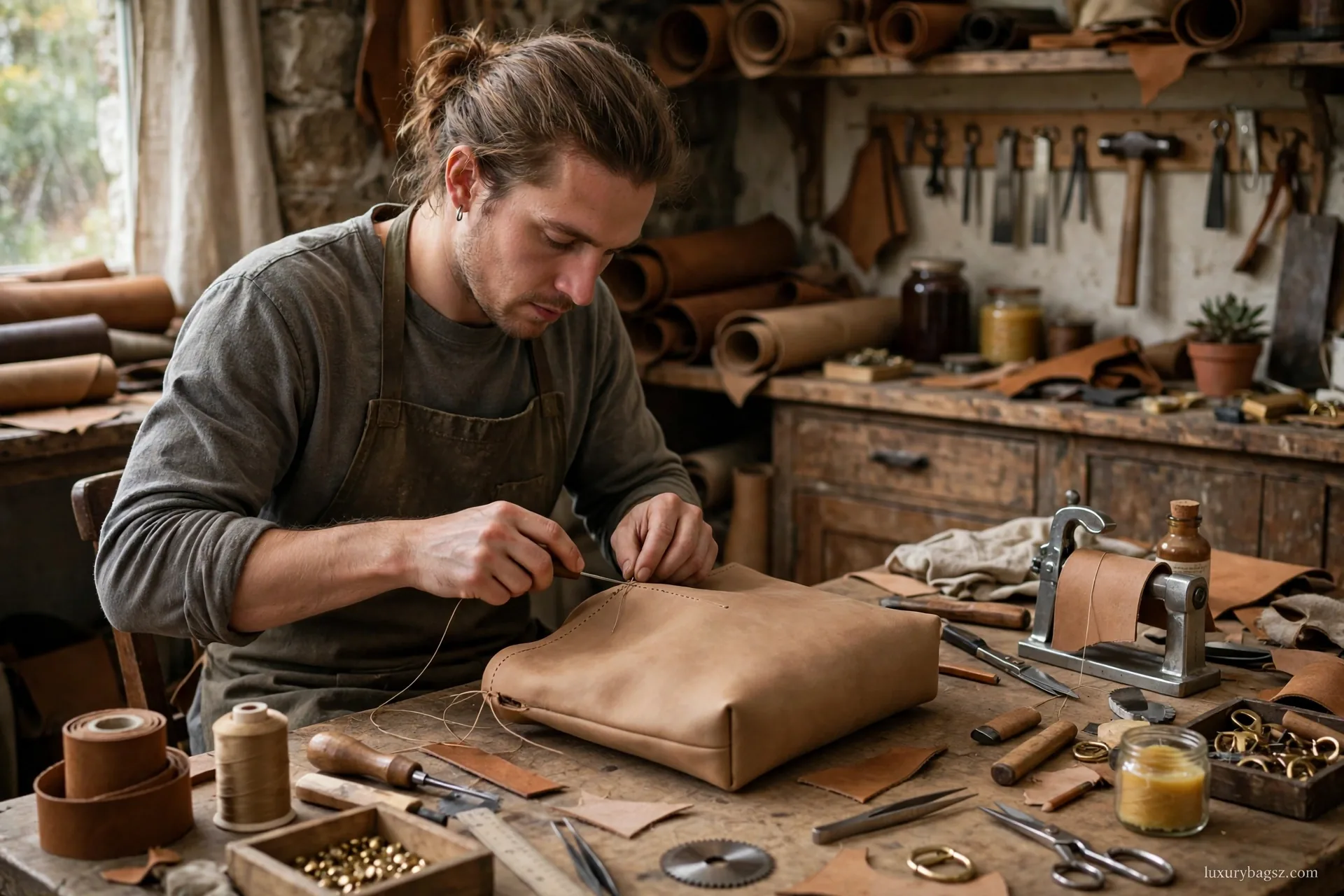
Luxury goods are made slowly, by skilled hands, from carefully chosen materials, in workshops where each stage is checked before the next begins. That sentence sounds simple, but it hides the real story: weeks of material preparation, hours of cutting and stitching by one maker or a small team, and finishing and inspection routines that reject work most factories would accept.
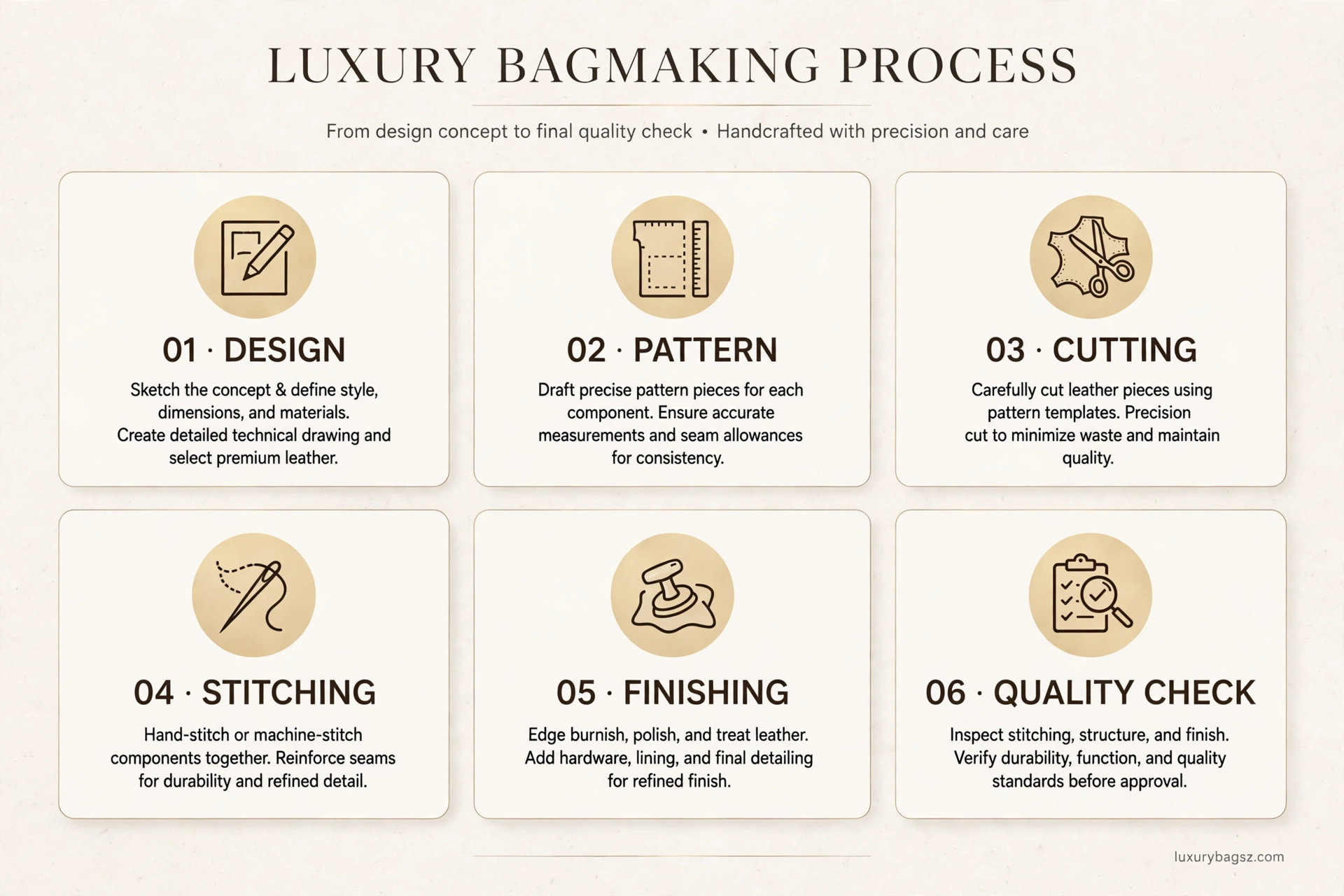
This guide follows the making journey, not the shopping journey. It explains how a design becomes a pattern, how materials are chosen and prepared, how pieces are cut, stitched and assembled, how edges, linings and hardware are finished, and how quality control decides what leaves the workshop and what does not. It covers bags, shoes, tailoring, watches and jewellery in turn, since each category has its own making logic.
It is deliberately different from the guide on spotting craftsmanship. Spotting quality teaches you to judge a finished garment by its seams, fabric and finishing. This guide teaches you how that finished quality came to be, stage by stage, hour by hour, in the atelier. The two guides complement each other, but they answer different questions, and this one stays on the making side.
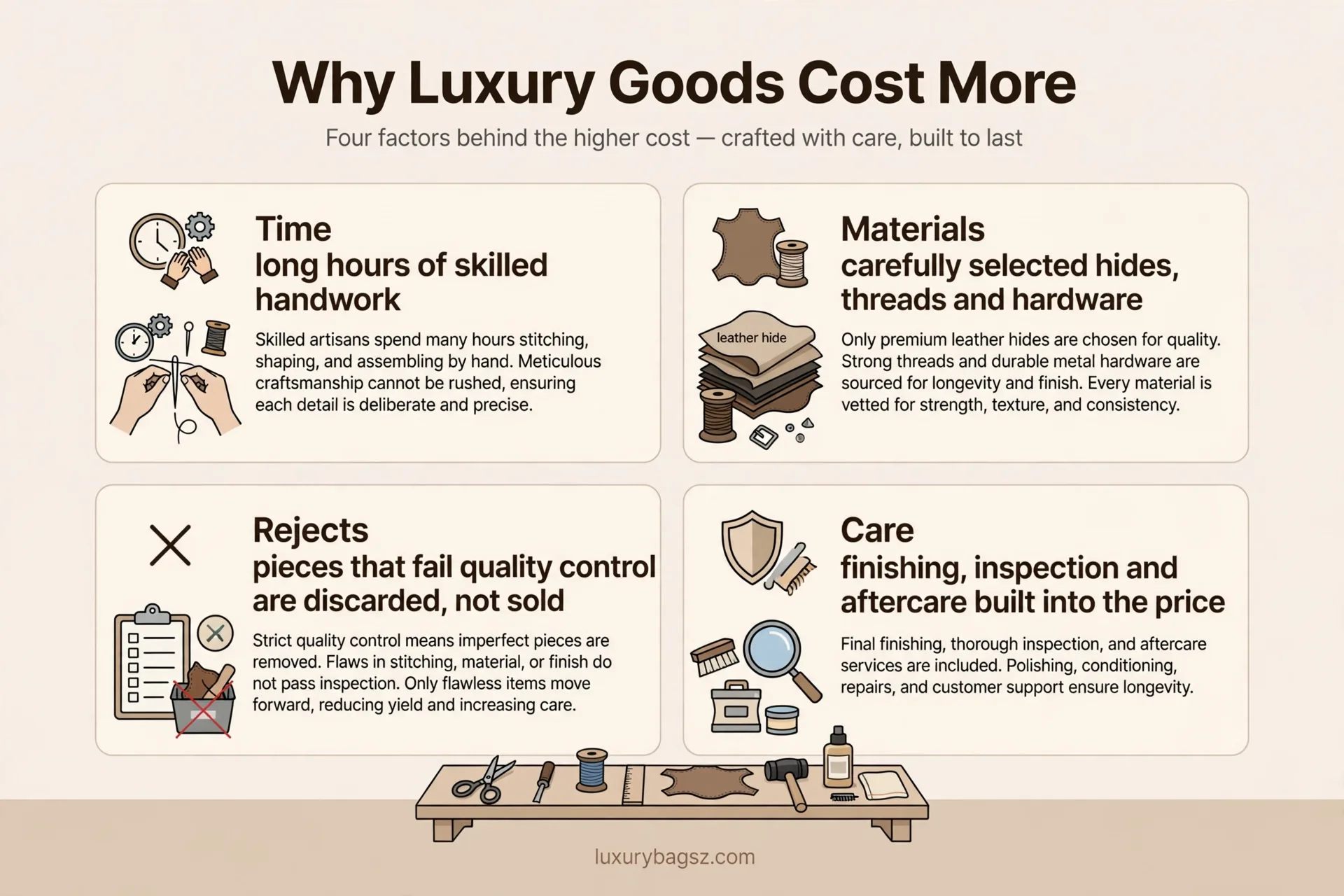
If you take one idea from this guide, let it be time. Luxury making spends time where mass making saves it: on material selection, on cutting placement, on hand stitching, on edge finishing and on inspection. That time is the main reason luxury goods cost more, last longer and feel different in the hand, and it is the thread that runs through every category below.
Key Takeaways
- Luxury making is slow by design: material preparation, cutting, stitching, finishing and inspection each take time.
- One maker or a small team often follows a piece through many stages, rather than a long assembly line.
- Material selection happens before cutting, and the best areas of a hide or cloth go to the most visible parts.
- Hand stitching, especially saddle stitching, is chosen for strength and repairability, not just appearance.
- Finishing, edges, linings and hardware take a large share of total making time.
- Quality control rejects and reworks pieces at every stage, not only at the end.
- Training takes years: apprentices learn one skill at a time before making complete pieces.
- Hand and machine work combine in most luxury goods; the balance differs by category and price.
The Atelier: Where Luxury Making Happens
An atelier is a workshop, not a factory floor, and its organisation shapes everything made there. Benches are arranged for light and space, tools are personal and maintained, and makers work seated, with materials, patterns and reference pieces within reach. The pace is steady rather than hurried, since rushing causes the mistakes that luxury inspection later rejects.
Ateliers vary by house and category. A leather atelier smells of leather, wax and edge paint, with cutting tables, stitching ponies and finishing benches. A tailoring atelier holds cutting tables, pressing equipment and fitting mirrors, with cloth stored by weight and pattern. A watch atelier is quiet, dust-controlled and brightly lit, with benches for assembly, regulation and casing.
A jewellery atelier combines benches for setting, polishing and engraving, with secure storage for stones and metals.
Scale varies too. Some houses make everything in one atelier, while others split work across specialist workshops: one for cutting, one for stitching, one for finishing, or one region for cases and another for movements. Splitting work does not mean lowering standards, provided each workshop follows the same patterns, materials and inspections, but it does mean a finished piece may travel between workshops before it is complete.
What ateliers share is accountability. A maker signs, stamps or records their work, so a fault can be traced to a stage and a person, and so a piece can be repaired by someone who understands how it was made. That traceability, from bench to buyer, is part of what separates luxury making from anonymous mass production.
Materials First: Selection Before Cutting
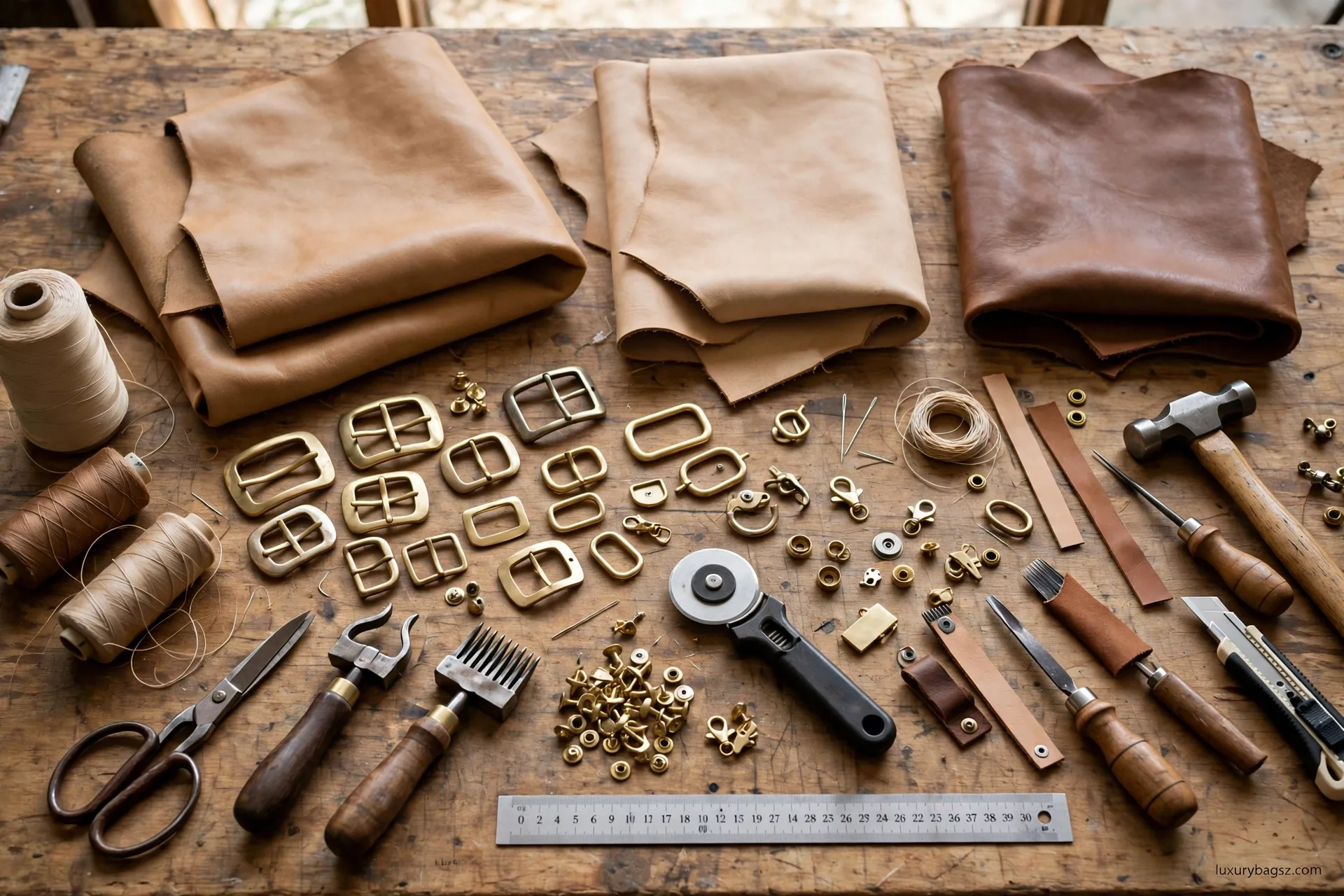
Luxury making starts with material selection, and selection is stricter than in mass making. Hides are inspected for scars, stretch, thickness and grain, and only the best areas are used for visible panels, while weaker areas go to hidden parts or are rejected. Cloth is checked for weight, weave, colour consistency and flaws, and dye lots are matched so a garment's panels share one colour.
Materials are also rested and prepared before cutting. Leather is conditioned, relaxed and sometimes backed, cloth is steamed and rested so it does not shrink or twist after cutting, and metals are alloyed, tested and finished to specification. Preparation takes days or weeks, and it prevents the distortion, shrinkage and fading that rushed making causes later.
Sourcing matters as much as selection. Houses build long relationships with tanneries, mills, farms and mines, and they specify farming, tanning, weaving and finishing standards in detail. A tannery that understands a house's leather, or a mill that understands its cloth, produces more consistent material than a new supplier chosen on price alone, and consistency is what lets cutting and stitching proceed without constant adjustment.
Waste is part of selection too. Cutting placement, described in the cutting section, minimises waste, but some waste is unavoidable when only the best areas are used. Luxury houses increasingly reuse offcuts for small goods, trims and repair stock, turning selection waste into useful material rather than landfill, and that reuse is both an economic and an environmental choice.
Design and Pattern: From Idea to Template
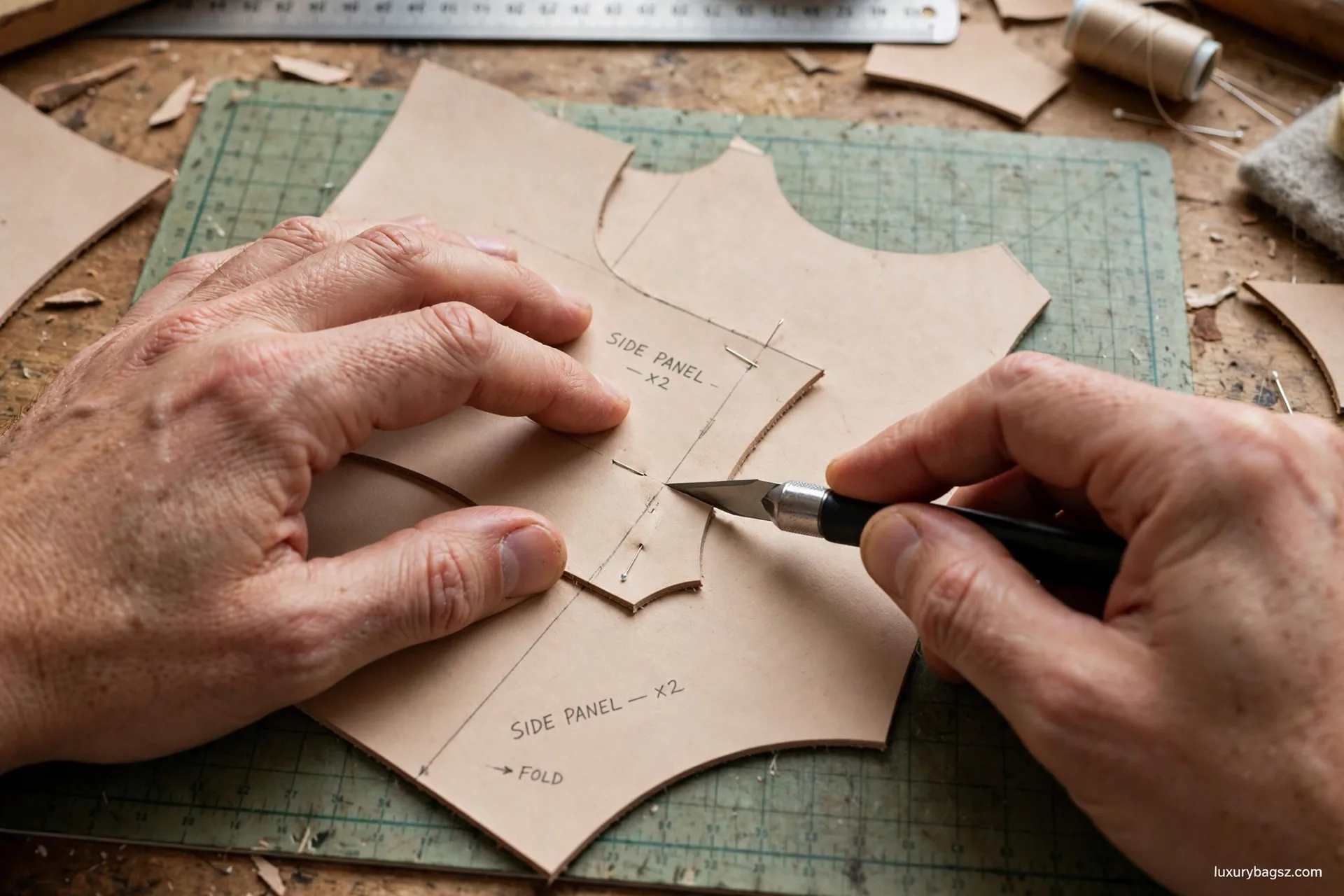
Design in luxury starts with a sketch, a reference and a brief, but it becomes making through pattern. A pattern is a full-size template for every piece of a product, cut from card or paper, tested, adjusted and approved before production. Pattern making is a skilled craft in itself, since a pattern decides fit, proportion, drape and material use for every piece that follows.
Prototypes test the pattern in real material. A first prototype, often called a toile in tailoring or a sample in leather goods, reveals fit problems, proportion errors and construction difficulties that a sketch hides. Prototypes are fitted, worn, photographed and revised, sometimes several times, before a design is approved for production.
A design that looks good on paper but fails as a prototype does not proceed, whatever its marketing appeal.
Patterns also carry making information: stitch lines, fold lines, hardware positions, seam allowances and grain directions. A cutter reads a pattern as a set of instructions, not just a shape, and a stitcher follows its marks for seam placement and finishing. Accurate patterns reduce waste, speed later stages and keep every piece of a style consistent, which is why pattern archives are guarded as house assets.
Digital tools now support pattern making, with computer-aided design, grading across sizes, and digital cutting for some stages. Digital tools improve accuracy and speed, but they do not replace judgement: a pattern still needs a human to test it in material, fit it on a body or a form, and approve it for production. Luxury houses use digital tools as aids, not as substitutes for prototype testing.
Cutting: Placement Decides Quality
Cutting is where material meets pattern, and placement decides both appearance and durability. A cutter lays pattern pieces on a hide or cloth, choosing which area suits each piece: the strongest, most even leather goes to high-stress and highly visible areas, while stretchier or less perfect areas suit hidden parts, linings or small pieces.
On patterned cloth, the cutter aligns stripes, checks and prints across seams and pockets, accepting extra waste for a matched result.
Cutting tools vary by material and house. Leather is cut by hand with a knife, by press with a shaped cutter, or by digital cutter for accuracy, while cloth is cut by hand shears, by band knife or by digital cutter, depending on layers and precision. Hand cutting suits small runs and complex shapes, press cutting suits consistent shapes, and digital cutting suits accuracy and nesting, where pieces are arranged to minimise waste.
Edges are prepared during cutting. Leather edges are thinned, or skived, so seams lie flat and stitch cleanly, while cloth edges are marked, notched and sometimes bound to prevent fraying. Linings, stiffeners, reinforcements and interfacings are cut at the same stage, so the stitching stage receives a complete kit, not a partial set that forces improvisation.
A skilled cutter wastes as little as possible while rejecting flawed areas, and that balance is a craft judgement, not a calculation. Cutting too tightly around flaws saves material but risks a weak or ugly panel, while cutting too generously wastes expensive material. Luxury cutting errs toward quality, accepting waste that mass cutting would avoid, because a flawed panel costs more in reputation and repair than the material saved.
Stitching and Assembly: Joining Pieces Into Shape
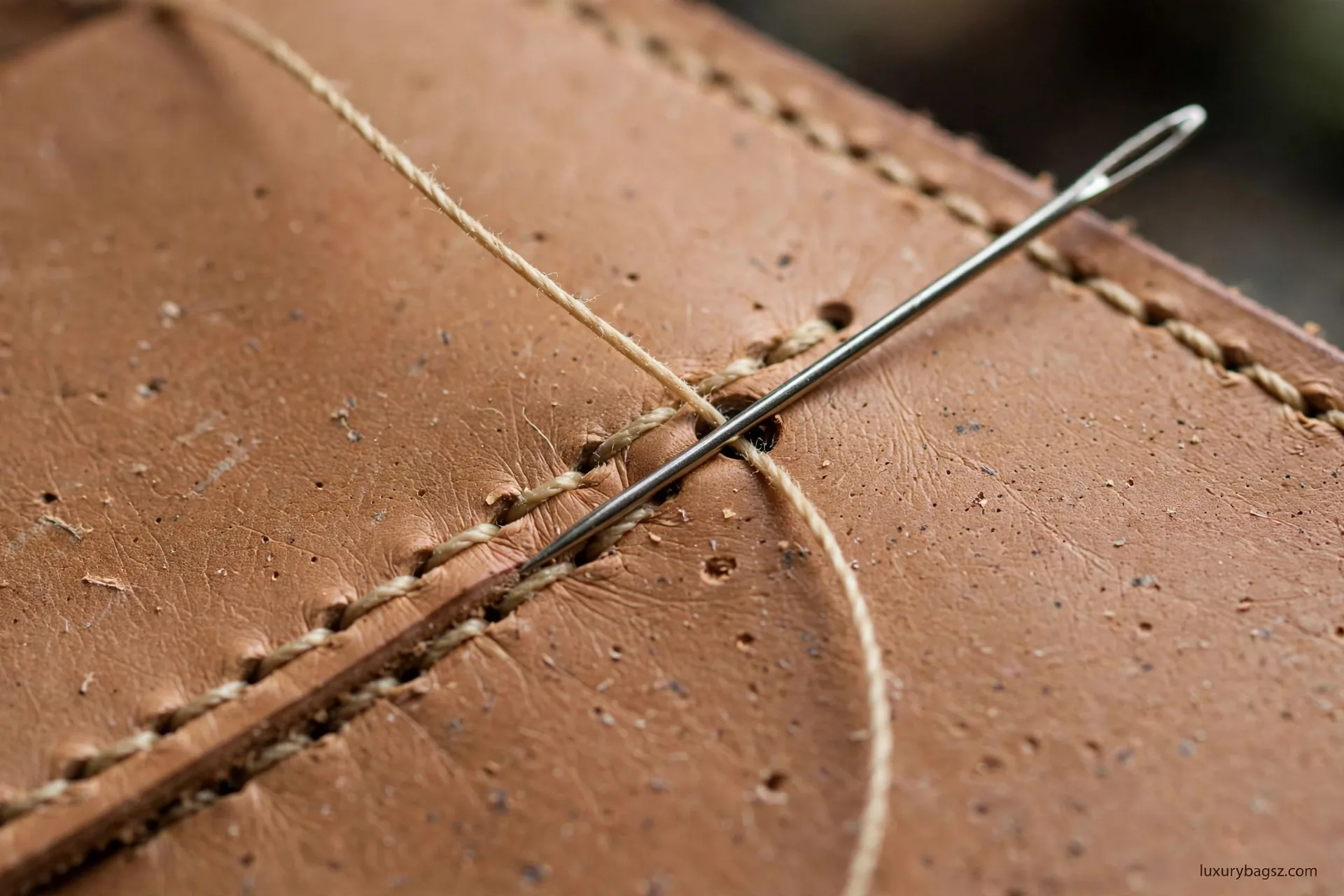
Stitching joins cut pieces into a three-dimensional product, and it is the stage most buyers associate with handcraft. In leather goods, saddle stitching, done by hand with two needles passing through each hole from opposite sides, creates a locked stitch that holds even if one thread breaks, which is why it suits bags, belts and small leather goods that carry load.
Machine stitching, done with a lockstitch machine, is faster and consistent, and it suits long, straight seams and high-volume styles.
In tailoring, stitching includes basting, a temporary hand stitch that holds pieces for fitting, permanent hand stitching for lapels, hems and linings, and machine stitching for long seams and stress points. A tailored jacket combines all three, with handwork where flexibility and appearance matter and machine work where strength and consistency matter. The balance, not the presence of handwork alone, defines tailoring quality.
In shoemaking, stitching joins the upper, attaches it to the insole and welt, and secures the sole, with Goodyear welting, Blake stitching and hand welting offering different balances of durability, repairability and flexibility. Each method needs its own tools, skills and time, and each suits different shoe types and prices.
Assembly order matters too: a shoe lasted poorly cannot be saved by good sole stitching, just as a bag stitched well but cut poorly cannot be saved by finishing.
Assembly also includes shaping: lasting shoes over a form, moulding bag panels over a shape, pressing tailored garments into form, and setting watch cases and jewellery mounts. Shaping turns flat pieces into products that hold form on the body or wrist, and it needs time, since leather, cloth and metal all need to settle into shape rather than being forced into it.
Handwork: What Hands Do That Machines Cannot
Handwork earns its reputation in specific places, where a hand stitch flexes, looks or holds better than a machine stitch. Hand-stitched hems flex with fabric, hand-rolled edges on scarves and shawls look softer than machine edges, hand-finished linings move better than machine-finished ones, and hand-set stones sit more securely than machine-set ones where setting is complex. In these places, handwork is a functional choice, not a romantic one.
Handwork also allows adjustment during making. A hand stitcher feels tension, thickness and resistance as they work, and adjusts stitch length, thread tension and placement to the material in front of them, while a machine follows a fixed setting. That adaptability matters for natural materials, whose thickness and stretch vary across a hide or a cloth length, and it is why handwork persists even where machines could sew faster.
Training for handwork takes years. Apprentices learn one skill at a time, such as cutting, stitching, edge finishing or polishing, under a master, before combining skills into complete pieces. A leather artisan may train for several years before making a whole bag alone, a tailor trains through cutting, fitting and finishing stages, and a watchmaker trains through assembly, regulation and casing before working independently.
That training time is part of luxury's cost, and part of its quality.
Handwork is not automatically better in every place. Machine work beats handwork for long, straight, high-tension seams, for consistent stitch density, and for tasks where human variation would weaken the product. Luxury making uses both, choosing the method that serves each stitch, seam and finish best, and judging the result, not the method, as the quality test.
Bags: A Leather Good From Hide to Handle
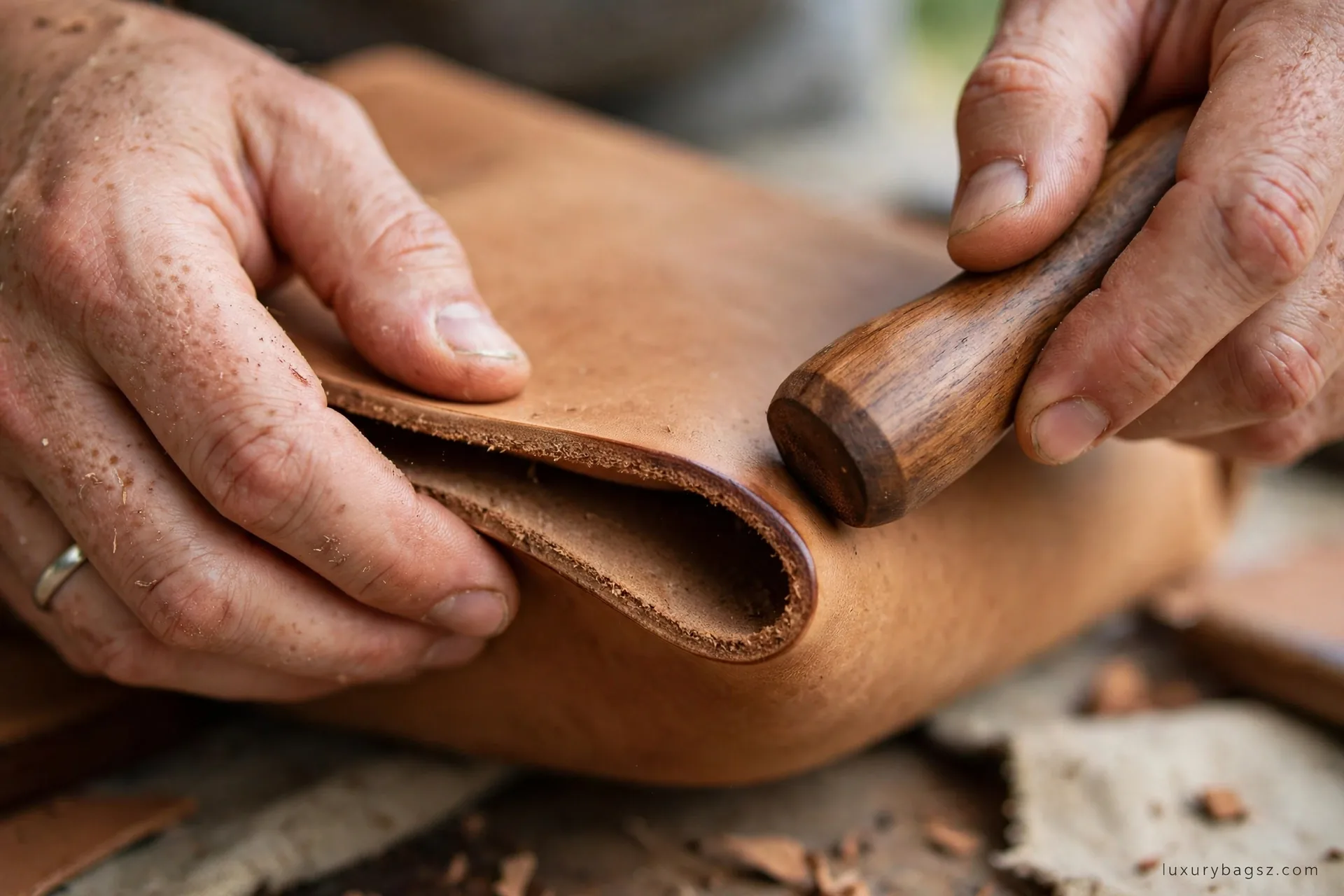
Bag making illustrates luxury leather craft clearly. After material selection and cutting, panels are skived, marked and prepared, then stitched, often by saddle stitching for load-bearing seams, with edges painted, burnished or bound. Handles are formed, reinforced and attached with stitching and rivets that distribute load, since a handle failure ruins a bag however beautiful its body.
Interiors matter as much as exteriors in bag making. Linings are cut, stitched and fitted to move with the bag, pockets are positioned and reinforced, and zips, clasps and hardware are set with care for alignment and function. A bag's interior, inspected closely, reveals making quality as surely as its exterior, since linings and pockets are where rushed work hides.
Hardware is selected, tested and fitted during assembly, not added as an afterthought. Locks, clasps, feet, rivets and chains are checked for finish, weight and function, and their attachment points are reinforced, since hardware pulls on leather with every use. A lock that sticks, a foot that loosens or a chain that twists signals a fitting problem, not just a hardware problem, and it is corrected before the bag leaves the workshop.
Finishing for bags includes edge painting in thin, even layers, burnishing for a smooth edge, cleaning, conditioning where appropriate, and a final inspection of shape, stitching, hardware and lining. A finished bag is stuffed, shaped and stored to hold form, and it is checked again before packing, since a bag that leaves the atelier misshapen rarely recovers in a shop.

Shoes, Tailoring, Watches and Jewellery: One Discipline
Shoemaking follows its own logic, from last to sole. A last, a foot-shaped form, decides a shoe's fit and shape, and uppers are lasted over it, pulling leather into form and securing it to the insole. Soles are attached by stitching, gluing or both, heels are built and finished, and edges are trimmed, stained and polished.
The whole process balances fit, durability and repairability, with welted construction allowing resoling that glued construction does not.
Tailoring follows a fitting logic. A pattern is cut, basted together, fitted on a client or form, adjusted, and then finished with canvas, padding, linings and handwork that give a jacket its shape and drape. Fitting is iterative: a jacket is tried, marked, altered and tried again, sometimes several times, before it is considered complete.
That fitting time is tailoring's defining cost, and it is why bespoke tailoring cannot be rushed without losing its purpose.
Watchmaking follows a precision logic. Movements are assembled from hundreds of tiny parts, regulated for accuracy, cased, sealed and tested for water resistance and function. Each stage needs clean conditions, specialised tools and steady hands, and a single dust particle or misaligned part can stop a movement.
Watchmaking's time lies in assembly, regulation and testing, not in case polishing alone, and its quality control is measured in seconds per day, not in appearance alone.
Jewellery making follows a setting and finishing logic. Metals are alloyed, cast or forged, shaped, soldered and polished, stones are cut, set and checked for security and alignment, and finishes are applied and inspected under magnification. A jewellery piece's quality lies in its setting security, its polish consistency and its wearability, all of which need hand skill and magnification to judge.
Each category's logic differs, but the discipline is shared: skilled stages, checked work, and time spent where it matters.
Machines in Luxury Making: Help, Not Replacement
Machines play a large, honest role in luxury making, and pretending otherwise distorts the story. Cutting machines improve accuracy, stitching machines provide consistent seams, pressing machines shape tailored garments, and polishing machines finish metals and cases, all under human control.
A machine operated by a skilled maker, with settings adjusted to the material, produces better work than a hand tool operated without skill, and luxury houses use machines where they serve quality.
What machines do not do is replace judgement. A machine cannot choose which hide area suits a panel, cannot feel a cloth's stretch and adjust, cannot judge a lapel's roll by eye, and cannot decide whether a stitch tension suits a particular leather thickness. Those judgements remain human, and they are where luxury training and experience show.
Automation also has limits in luxury's small runs and varied materials. A factory line optimised for one style in one material cannot adapt to luxury's variety: different hides, cloths, colours, sizes and customisations in small batches. Ateliers therefore combine machine assistance with hand adaptability, using machines for repeatable precision and hands for variable judgement, in a balance that shifts by house, category and price.
For footwear, the how boots are made guide shows this balance concretely, following hide preparation, cutting, sewing, lasting and sole attachment through factory and workshop stages, and it is a useful companion to this general guide for readers who want one category in full detail.
Finishing and Quality Control: The Last, Longest Stage
Finishing takes a surprising share of total making time, because it is where a product becomes presentable and durable. Edges are painted, burnished or bound in thin layers, each dried before the next. Surfaces are cleaned, conditioned where appropriate, and polished. Linings are fitted and finished, hardware is cleaned and checked, and the whole product is shaped, stuffed or pressed into its intended form.
Quality control runs through finishing and through every earlier stage, not only at the end. Cutters check hides and cloth, stitchers check seams as they work, finishers check edges and hardware, and a final inspector checks the whole product against its pattern, sample and standard. A product that fails at any stage is reworked or rejected, and rework is expected, not hidden, since catching a fault early costs less than catching it after sale.
Inspection criteria are specific and demanding. Stitching must be even, edges must be smooth, hardware must function, linings must lie flat, colours must match, and shapes must hold. A product that passes on appearance but fails on function, such as a clasp that sticks or a seam that gaps under tension, is rejected just as surely as a product that fails on appearance. Function and appearance are both quality criteria in luxury inspection.
Rejected products are not simply discarded. Reworkable faults are corrected by the maker who made them or by a specialist finisher, while unreworkable faults may lead to a product being dismantled for reusable parts or destroyed to protect brand standards. That strictness protects buyers, but it also adds cost, since rejected time and material cannot be recovered, and it is part of why luxury prices reflect more than material and labour alone.
Time, Training and the People Behind the Product
Time is luxury making's most honest cost driver. A leather bag may take many hours of cutting, stitching and finishing, a tailored suit may take dozens of hours including fittings, a pair of welted shoes may take a full working day or more, and a mechanical watch movement may take weeks of assembly, regulation and testing.
These times vary by house, style and complexity, and they should be treated as ranges, not as exact claims for any single product.
Training time adds to product time. An artisan's years of apprenticeship, a tailor's progression through cutting and fitting, a shoemaker's mastery of lasting and welting, and a watchmaker's training in assembly and regulation all represent investment that product prices must repay. A house that trains its makers well produces better work and retains skill, while a house that cuts training saves cost but loses quality over time.
Working conditions matter to quality as well as to ethics. Makers who work in good light, with proper tools, reasonable hours and fair pay, produce steadier work than makers under pressure, in poor conditions or on piece rates that reward speed over care. Luxury buyers increasingly ask about maker welfare, and the answer affects both the ethics and the quality of the product in their hands.
For readers interested in fully handmade footwear, the bespoke shoes guide explains how bespoke shoemaking differs from factory and bench-made shoes, including fitting, lasting and handwork, and it shows why bespoke time and cost exceed even bench-made luxury shoes. That comparison helps set expectations for any handmade luxury category.
Why Luxury Goods Cost More: Time, Materials, Rejects and Care
Luxury prices reflect time, materials, training, inspection, rejects and aftercare together, not any single factor. Material costs are higher because only the best areas and lots are used, and rejected material is wasted. Labour costs are higher because skilled makers take longer and are paid for skill. Inspection costs are higher because rework and rejection consume time and material that cannot be sold.
Distribution, marketing and brand costs also contribute, and honest pricing discussion acknowledges them, since a luxury price is not purely a making price. A house's shops, shows, advertising and service network all cost money, and they are part of what a buyer pays for, alongside the product itself. Separating making cost from brand cost is difficult from outside, since houses do not publish full cost breakdowns, and estimates vary widely.
Aftercare is a making cost too, in the sense that houses that offer repair, servicing and restoration invest in workshops, parts and skills that support products for years after sale. A bag that can be repaired, a watch that can be serviced, and a shoe that can be resoled all carry aftercare value that a disposable product does not, and that value belongs in a price comparison, not just the purchase price.
For one famous bag, the why a Birkin is so expensive guide breaks down craftsmanship, materials, scarcity and brand factors in detail, and it is a useful case study for how time, skill and scarcity combine in a single luxury price. Use it as an example, not as a universal formula, since every house and product balances those factors differently.
Handmade, Hand-Finished and Made by Hand: Reading the Claims
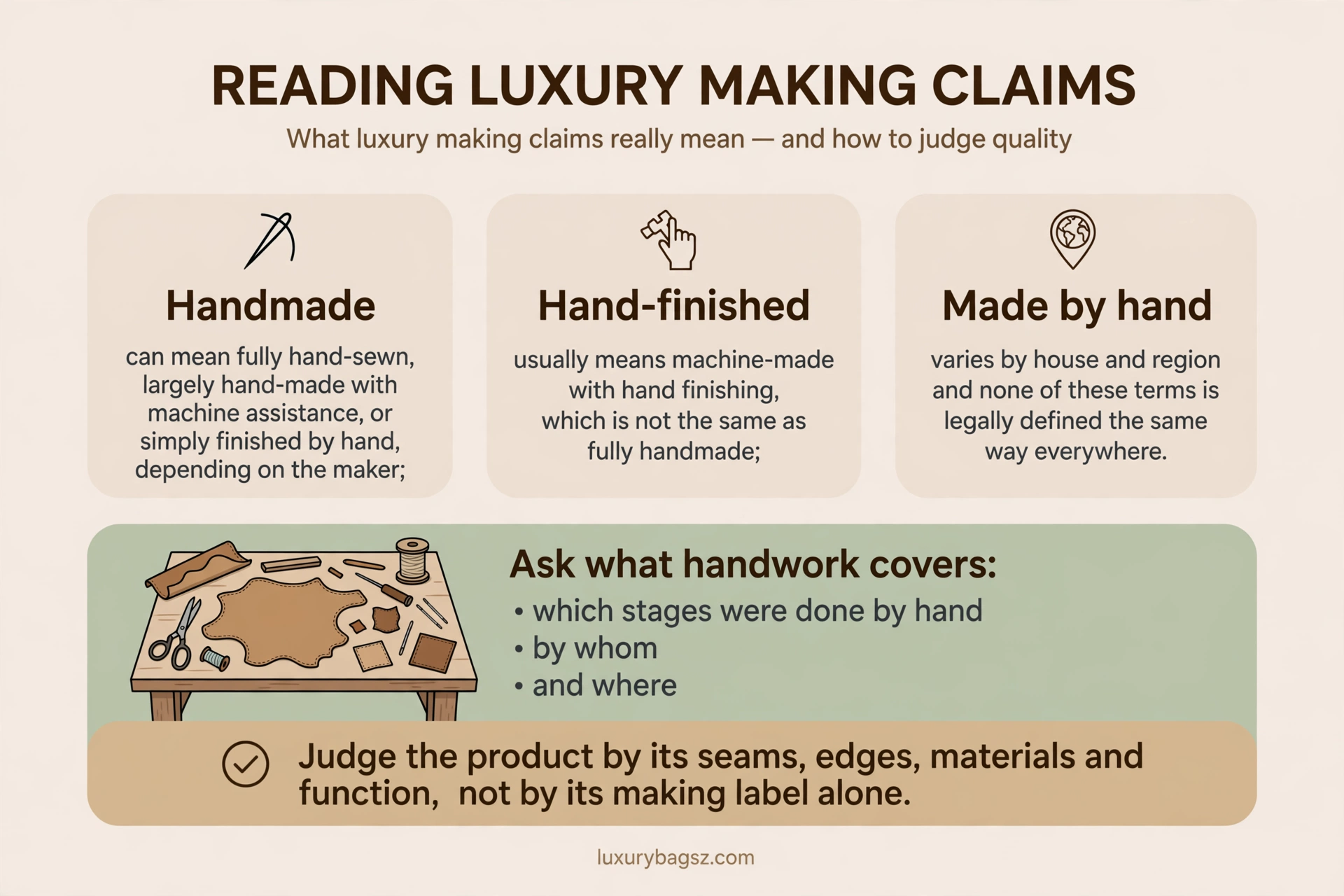
Making claims need careful reading, since handmade, hand-finished, handcrafted and made by hand mean different things in different houses and regions, and none is legally defined in the same way everywhere. Handmade may mean fully hand-sewn, largely hand-made with machine assistance, or simply finished by hand, depending on the maker.
Hand-finished usually means machine-made with hand finishing, which can still be high quality, but it is not the same as fully handmade.
Ask what handwork covers for a specific product: which stages were done by hand, by whom, and where? A bag with hand saddle stitching throughout differs from a bag with hand-finished edges only, and both differ from a bag with hand-stitched branding but machine-stitched structure. Specific answers deserve more trust than general claims, and a maker who describes stages honestly is more credible than one who repeats handmade without detail.
Machine-made does not mean poor quality, and handmade does not mean perfect quality. A well-made machine product with good materials, accurate patterns and strict inspection can outperform a poorly made handmade product with weak materials and rushed finishing. Judge the product by its seams, edges, materials and function, using the spotting guide's inspection routine, rather than by its making label alone.
Claims also vary by category. Handmade tailoring, handmade shoes and handmade watches each imply different stages and skills, so compare claims within a category, not across categories. A handmade watch movement and a handmade bag share a word, but they share little else in making terms, and their prices reflect different skills, times and materials.
Buying With Making in Mind
Buying with making in mind changes what you look for. Ask how a product was made, in stages, not just where it was made or what it is called. Ask about materials, their origin and processing, about handwork stages, about inspection, and about repair and aftercare. Specific answers, with stages and services named, signal a maker who understands their own product.
Inspect the product as the spotting guide teaches, and relate what you see to making stages: even stitching to stitching skill, matched patterns to cutting care, clean linings to finishing time, and solid hardware to fitting care. A product whose inspection matches its making story is a coherent purchase, while a product whose story promises handcraft but whose inspection shows rushed work is a warning.
Consider lifetime cost, not just purchase price. A well-made product that lasts, repairs and resells well often costs less per wear than a cheaper product replaced repeatedly, even before environmental costs are counted. Making quality, durability and aftercare together decide lifetime value, and luxury's case rests on those three, not on purchase price alone.
Finally, support makers whose making you admire, by buying, caring for, repairing and reselling their work well. A luxury product's story does not end at purchase; it continues through wear, care and repair, and the way you treat a well-made product honours the time, skill and material that made it. That respect, expressed in care and longevity, is the buyer's part of the making story.
Frequently Asked Questions
Are luxury goods really handmade?
Partly, and it varies by product, house and price. Most luxury goods combine handwork and machine work, with handwork concentrated where it serves function and appearance best, such as stitching, finishing, fitting and setting. Fully handmade products exist, especially in bespoke categories, but they are the exception, not the rule, and their time and cost reflect that.
How long does it take to make a luxury bag or suit?
It varies widely by style, house and complexity, but a leather bag commonly takes many hours of cutting, stitching and finishing, while a tailored suit takes dozens of hours including fittings. These are ranges, not exact claims for any single product, and bespoke work takes longer than bench-made work in the same category.
Why is saddle stitching prized in leather goods?
Saddle stitching, done by hand with two needles passing through each hole from opposite sides, creates a locked stitch that holds even if one thread breaks. That strength and repairability suit load-bearing seams on bags, belts and small leather goods, which is why it is prized beyond its appearance.
Does machine work mean a luxury product is lower quality?
No. Machine work provides consistent, strong seams and accurate cutting where those qualities matter most, and most luxury goods combine machine and hand work. Quality depends on materials, patterns, inspection and the right method for each stage, not on whether a single method was used throughout.
What is the difference between bespoke, made-to-measure and ready-to-wear?
Bespoke means a pattern made for one client, with multiple fittings, while made-to-measure adapts an existing pattern to a client's measurements, and ready-to-wear is made to standard sizes without individual fitting. Bespoke takes longest and costs most, made-to-measure sits between, and ready-to-wear offers immediacy at the cost of individual fit.
How are luxury watches made and tested?
Watch movements are assembled from hundreds of parts in clean, bright conditions, regulated for accuracy, cased, sealed and tested for water resistance and function. Testing includes timing, pressure testing and functional checks, and a watch that fails any test is reworked or rejected before sale, however good it looks.
What happens to luxury goods that fail quality control?
Reworkable faults are corrected, often by the original maker or a specialist finisher, while unreworkable faults may lead to dismantling for reusable parts or destruction to protect brand standards. Rejection protects buyers, but it adds cost, since rejected time and material cannot be recovered, and it contributes to luxury pricing.
How long does it take to train a luxury artisan?
Typically several years, learning one skill at a time under a master before making complete pieces independently. Leather artisans, tailors, shoemakers and watchmakers all follow staged training, and that investment in skill is part of both product quality and product cost.
Is handmade always more durable than machine-made?
Not necessarily. Durability depends on materials, construction method, stitching quality and finishing, not on the method label alone. Excellent machine work can outlast sloppy handwork, and the most durable products usually combine the right method for each stage with strict inspection.
How can I tell if a luxury product was well made?
Inspect it as the spotting guide teaches: check seams for evenness, fabric or leather for quality, pattern matching, linings, buttons and hardware, edges and finishing, and fit in movement. A product whose inspection matches its making story, with specific stages and services a maker can name, is a coherent, well-made purchase.
Final Verdict
Luxury goods are made by time, skill and inspection, applied stage by stage from material selection to final check. Design becomes pattern, pattern becomes cut pieces, cut pieces become stitched, shaped and finished products, and every stage is checked before the next begins. Hand and machine work combine, training takes years, and rejected work is reworked or discarded rather than sold.
That discipline costs more, and it is why luxury goods feel different, last longer and repay care. Buy with making in mind, inspect what you buy, care for it well, and you will own products whose making story is visible in every seam, edge and finish.






