

Why Is the Hermes Birkin So Expensive?
The Short Answer on Price
A Birkin is expensive for four reasons that stack on top of each other. It is made slowly by one artisan, from costly materials, in limited numbers, and sold only through boutiques.
No single reason explains the price alone. The labour is real but modest next to the retail tag, and the materials are superb but not uniquely rare.
The largest driver is scarcity: demand far exceeds supply, and Hermes refuses to close that gap. That refusal is deliberate, and it is what turns a well-made bag into a five-figure one.
As reported for 2026, a Togo Birkin 25 retails for about $13,500 in the US. Rare exotics and diamond hardware push prices past $200,000 and, at auction, past $400,000.
Key Takeaways
- One artisan makes each Birkin by hand, but published making times disagree: 18 hours, 18 to 24 hours, and about 40 hours all appear in print.
- Materials matter, but even the finest leather explains only part of the price. Scarcity and controlled distribution explain far more.
- Birkins are boutique-only, never sold online, and the Hermes quota rules cap how many quota bags one client can buy each year.
- On resale, small leather Birkins in neutral colours often sell above retail. Larger, worn, or unusual bags often do not.
- An analyst estimate puts the production cost of a basic Birkin near $800. That figure is disputed and old, and it should never be quoted as a fact.
- A Birkin is not a guaranteed investment. Past resale strength is not a promise about any single bag you buy.
Part 1: The Price in Plain Numbers
Start with the numbers, because the debate gets vague fast. As reported for 2026 by Sotheby's, a Togo Birkin 25 retails for about $13,500 in the US and €9,600 in Europe.
A Togo Birkin 30 retails for about $14,900 in the US, and a Togo Birkin 35 for about $16,300. Those are the standard leather starting points, not the ceiling.
Exotic skins change the picture entirely. Ostrich Birkins often sell for $25,000 to $35,000 on resale, while crocodile and alligator versions usually exceed $40,000.
At the extreme end, a store-fresh diamond Himalaya Birkin can fetch more than $400,000 at auction. Jane Birkin's own 1984 prototype sold for $10.1 million at Sotheby's in 2025.
The spread is the first clue. If materials alone set the price, the range would be narrower. Something else — scarcity, demand, and brand — does most of the work.
Prices also vary by market. SACLÀB notes that retail prices in countries with import taxes, such as the US, Hong Kong, and Australia, run roughly 15% to 25% higher than in European Hermes stores.
For scale, BagUSeek puts the Kelly 25 starting price at $13,700 in the US for 2026, just above the Birkin 25 at $13,500. The two icons sit in the same price world, which is why they are so often compared.
Part 2: One Artisan, One Bag
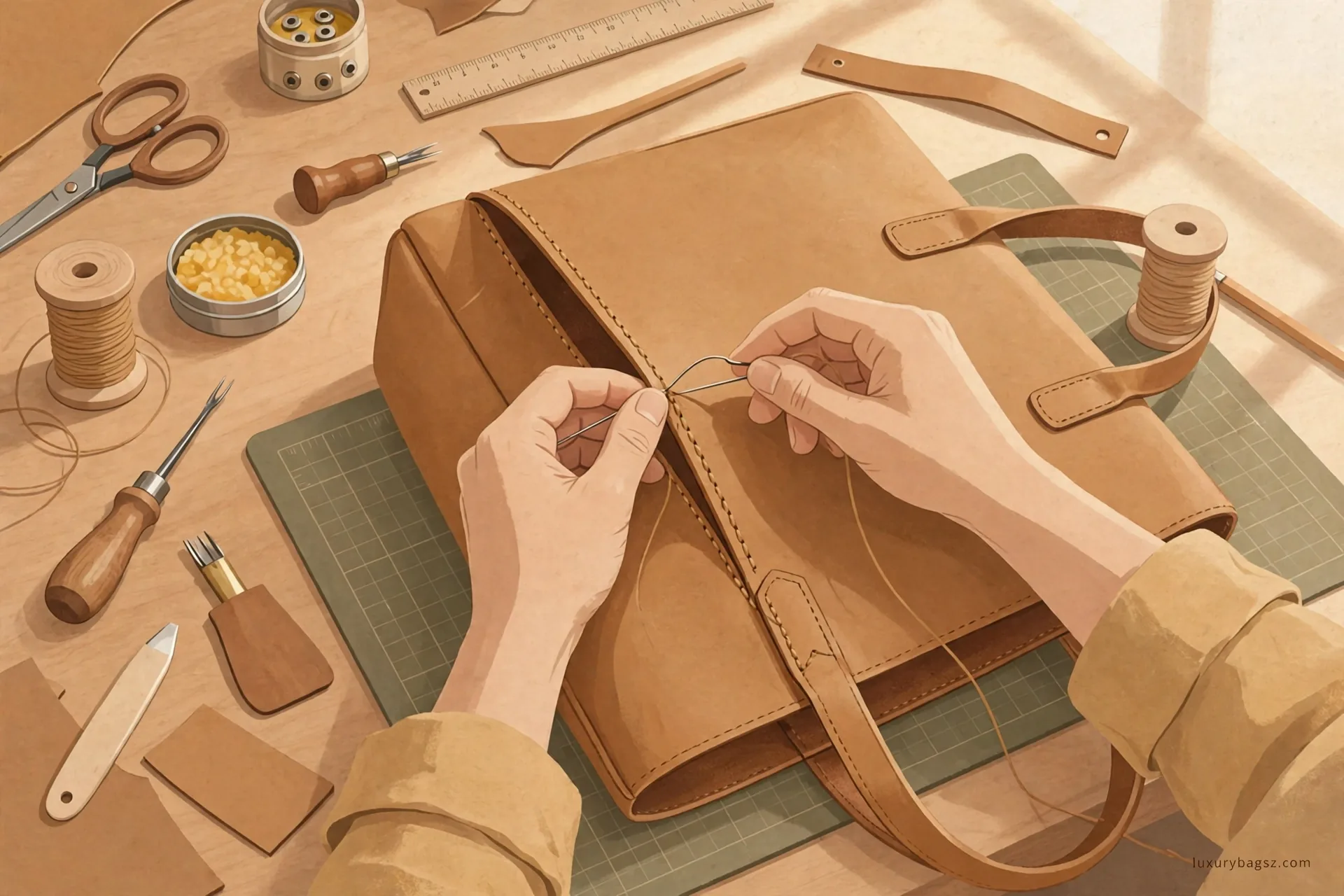
Every Birkin is made by a single artisan from start to finish. No assembly line divides the work, and the same hands cut, stitch, and finish the bag.
That practice has a name in some guides: monotache, meaning one craftsperson per bag. It creates accountability, since the maker's stamp inside the bag identifies who made it.
Hermes artisans are said to be able to recognise their own bags from a lineup. Whether or not every artisan truly can, the claim captures the point: each bag is one person's work.
Training takes years before an artisan is allowed to work on a Birkin at all. SACLÀB reports that only about 200 new craftspeople are trained each year across the house.
That training bottleneck is itself a price driver. Hermes cannot simply hire thousands more makers to meet demand, because the skill takes years to build and the standards are strict.
Each finished bag is stamped with a code identifying its year, workshop, and maker. That stamp is why a Birkin can be traced back to one artisan, and why repairs can be matched to the original making.
Part 3: The Hours Disagreement, Stated Plainly
Ask how long a Birkin takes to make and you will get different answers, so this guide states them all rather than picking one. Sotheby's says at least 18 hours.
Other guides say 18 to 24 hours, and one puts the range at 18 to 40 hours depending on leather and complexity. SACLÀB says about 40 hours, and another guide says 40 to 50 hours.
The honest summary is that published figures range from 18 to about 50 hours, with most clustering at 18 to 24 hours for standard leather. Exotic skins take longer.
Why does the range matter? Because anyone who says "40 hours of labour justifies $13,500" is using one end of a disputed range. Labour explains part of the price, not all of it.
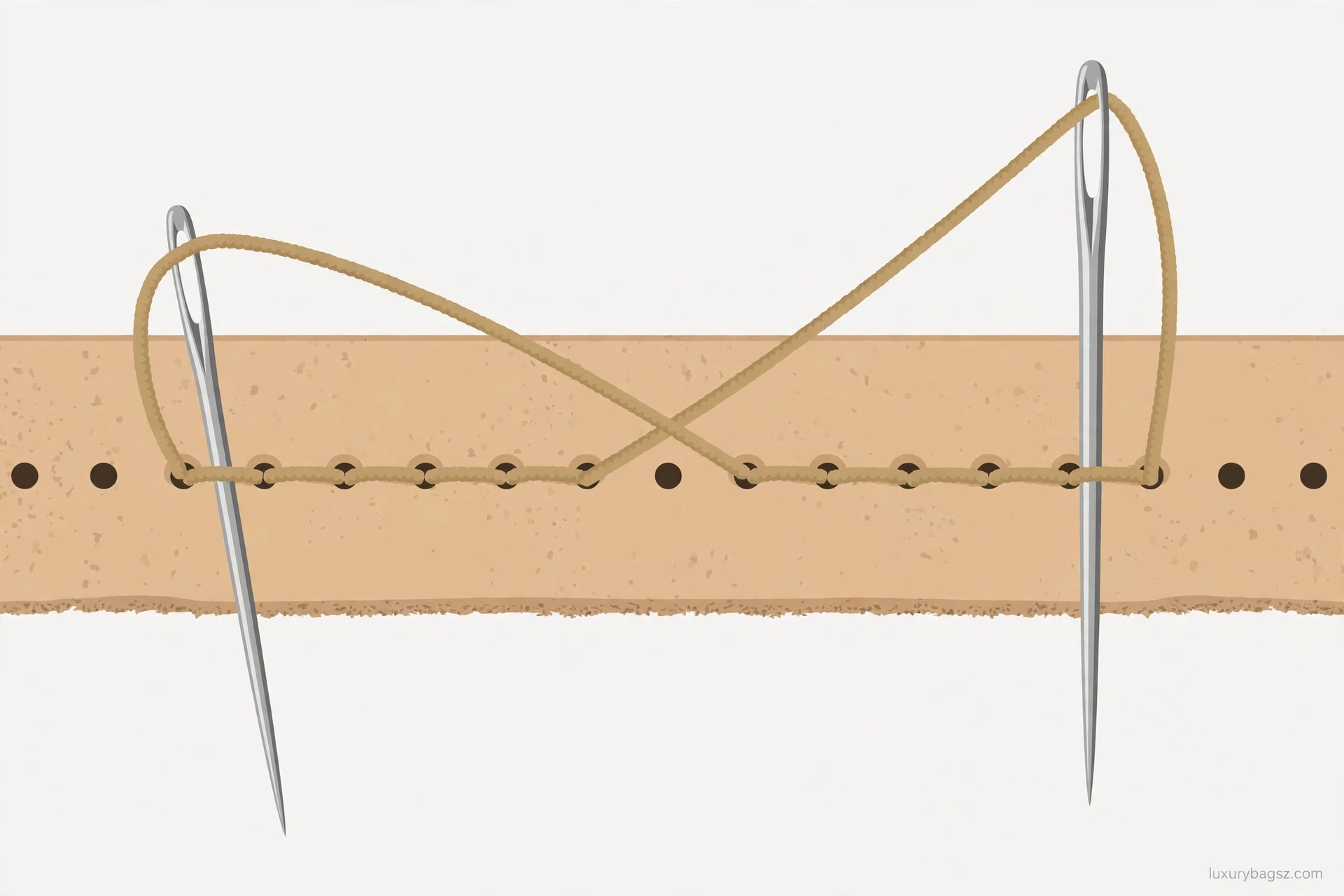
What is not disputed is the method. The saddle stitch uses two needles and one waxed linen thread, pulled through each hole by hand. If one side of a seam breaks, the rest holds.
That stitch is slower than machine sewing and stronger under stress. It is a genuine quality difference, and it is part of what buyers pay for — just not the whole price.
Part 4: What the Labour Really Buys
Slow making buys three things a buyer can actually feel. The first is consistency: one maker controls every seam, edge, and finish on the bag.
The second is durability. Hand saddle-stitching, careful edge painting, and hand-polished hardware are built to survive decades of use, not just a season.
The third is repairability. A bag made by hand can be taken apart and repaired by hand, and Hermes spa service exists precisely to clean, reshape, and repair its bags.
But labour has a ceiling as an explanation. Even at 40 hours, skilled handwork does not add up to $13,500 on its own, and honest guides admit this openly.
Overhead fills some of the gap. French ateliers, years of artisan training, flagship boutiques, and global distribution all cost money before a single bag is sold. Those costs are real, even if they are rarely itemised in public.
The rest of the price comes from materials, from the cost of running boutiques and ateliers, and — above all — from scarcity. Pretending otherwise would be marketing, not analysis.
Part 5: Materials and Why They Cost More
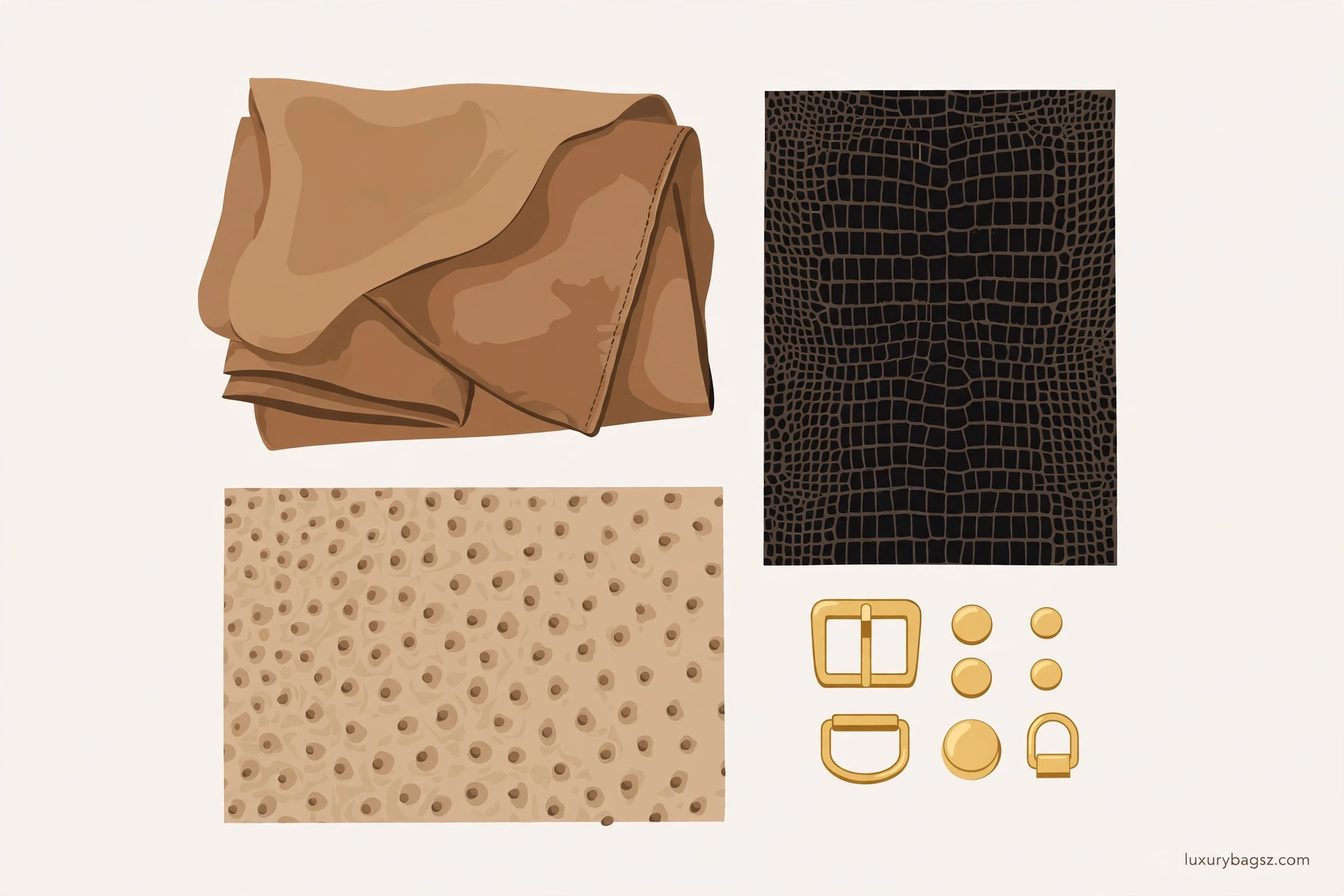
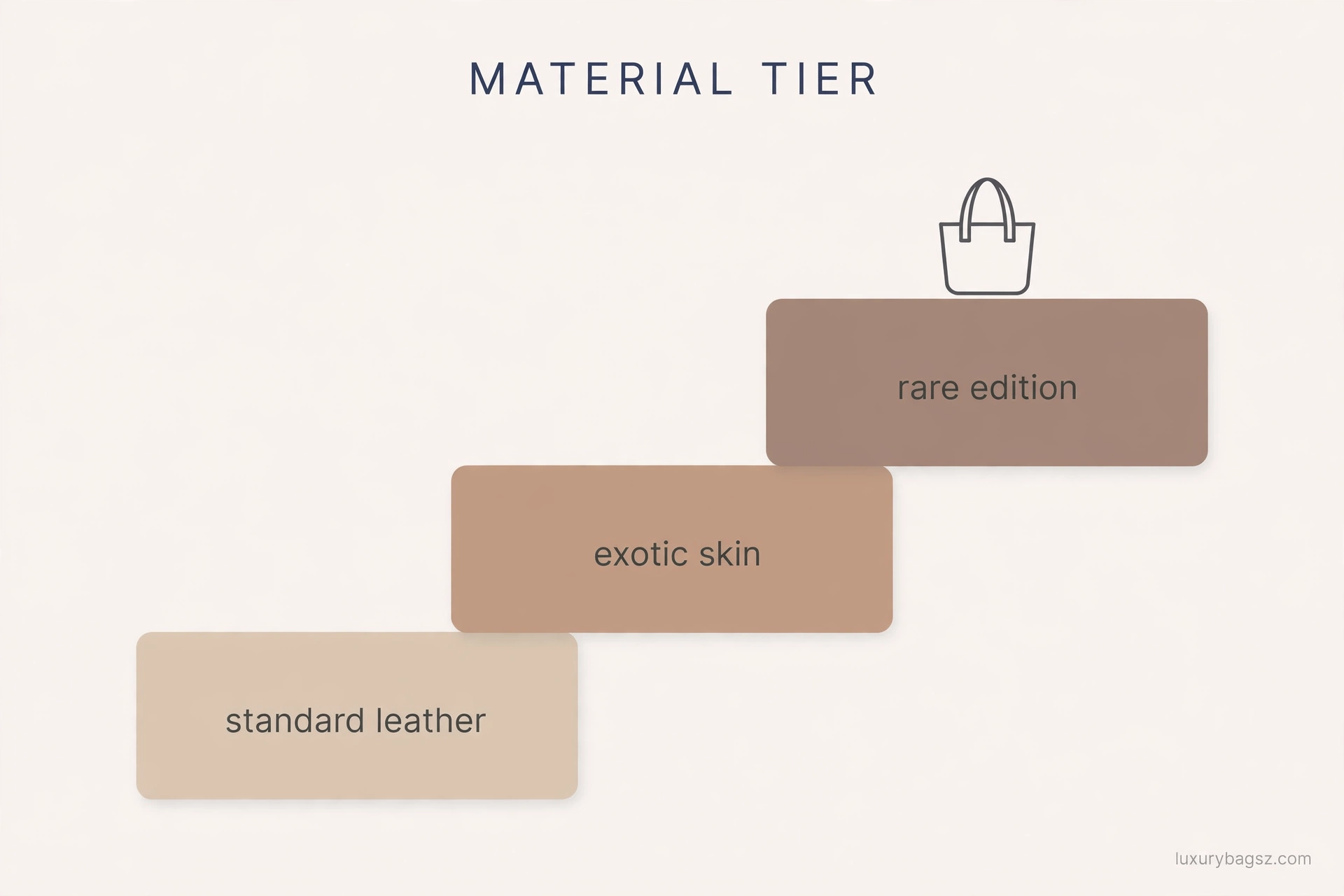
Hermes uses premium leathers such as Togo, Clemence, and Epsom for standard Birkins, and exotic skins such as crocodile, alligator, ostrich, and lizard for rarer ones.
Each hide is inspected for flaws, and imperfect skins are rejected. For crocodile, a single hide may yield only two or three bags, and scale symmetry matters for matching panels.
Exotic skins also carry legal and ethical costs. Trade in endangered species is governed by CITES rules, and compliant sourcing, paperwork, and handling add expense.
Hardware adds its own cost. Standard Birkins use gold-plated or palladium hardware, polished by hand, while rare bags use solid gold or diamond-set hardware.
One guide claims exotic leather accounts for only 15 to 20% of the final retail cost. That figure is unverified, but the direction is right: materials are necessary, not sufficient, to explain the tag.
Colour work adds cost too. Hermes releases a curated palette each year, and dyeing leather evenly — especially pale shades and exotics — is skilled work. A hide that dyes unevenly cannot be used as intended, which adds waste to the process.
Part 6: The $800 Production Cost Claim
Here is the most quoted — and most misused — number in the Birkin debate. An equity analyst at Exane BNP Paribas estimated the production cost of a basic Birkin at around $800, as reported in The Economist.
SACLÀB repeats that estimate, while noting that Hermes attributes its prices to craftsmanship instead. The $800 figure covers basic production cost, not the full cost of the business.
It leaves out atelier overhead, training, boutique costs, marketing, distribution, taxes, and the cost of rejected materials. It is also old, and costs have risen since it was published.
The claim is useful for one thing only: it proves the retail price is not a simple markup on leather and labour. A large part of what you pay is scarcity, brand, and access.
Quoting $800 as "what a Birkin costs to make" without those caveats is misleading. This guide states the estimate, its source, and its limits, and goes no further.
Part 7: Scarcity by Design
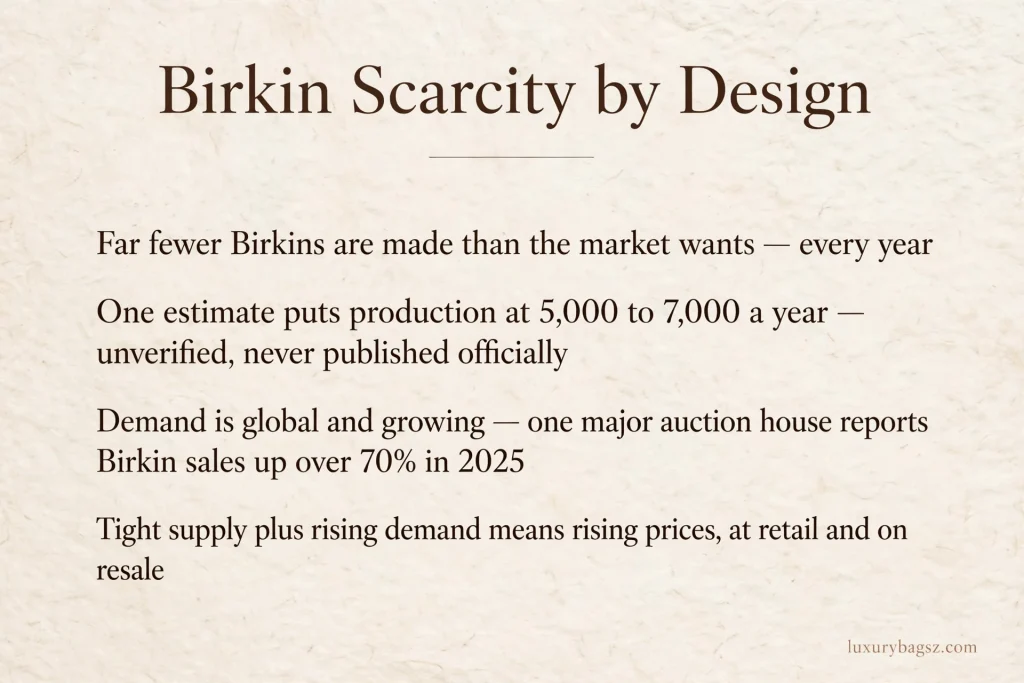
Scarcity is the largest single driver of Birkin prices, and it is deliberate. Hermes produces far fewer Birkins than the market wants, year after year.
One oft-quoted estimate puts annual Birkin production at roughly 5,000 to 7,000 bags. That figure is unverified — Hermes does not publish production numbers — but the direction is clear.
Demand, by contrast, is global and growing. Sotheby's reports its Birkin sales up over 70% in 2025 versus 2024, and nearly double since 2023.
When demand grows and supply stays tight, prices rise. That is basic economics, and Hermes benefits from it at retail and watches it repeat on resale.
The key question is whether the scarcity is natural or engineered. The honest answer is both: hand-making genuinely limits output, and Hermes also chooses not to scale up.
Waiting times show the gap in human terms. SACLÀB notes that scoring a dream Birkin in store can take months to over a year, even after registering interest, and some buyers report waiting far longer.
Boutiques still run a wish-list system rather than a public queue. There is no ticket number to track and no promised date, which is why patience — or the resale premium — is part of the price.

Part 8: The Quota System and Boutique-Only Sales
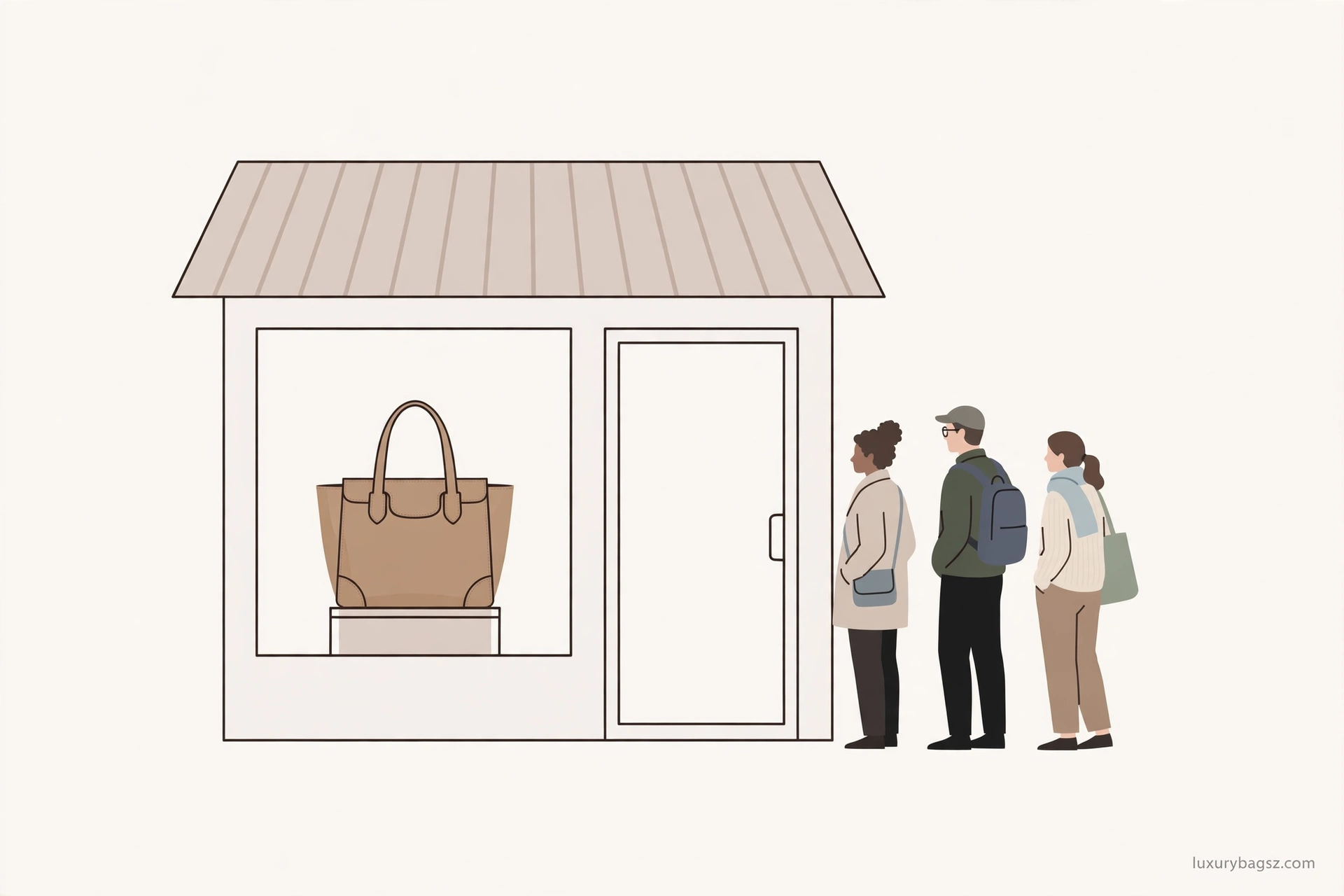
Scarcity is enforced through how Birkins are sold. They are sold in boutiques only, never through the Hermes website or any online channel.
Access usually depends on a relationship with a sales associate built over time, plus flexibility on size, leather, and colour. There is no public official waitlist.
The Hermes quota rules then cap how many quota bags one client can buy in a year. Even a loyal client cannot simply order several Birkins at once.
Getting a visit is part of the same system, and the guide to getting a Hermes bag appointment explains how that process works in practice.
The comparison of buying Hermes online versus in store is useful here too, because it sets out why the online route cannot deliver a Birkin at all.
This system creates a second market. Buyers who want a specific bag now, rather than after months or years, pay a premium on resale — and that premium feeds back into the bag's mystique.
Part 9: The Resale Feedback Loop
Resale prices are where scarcity turns into money. Sotheby's reports the average Birkin 30 in Togo at $22,300 on its platform in 2025, well above the $14,900 retail figure.
That gap is not uniform. Small Birkins in neutral colours and clean condition command the strongest premiums, while larger, worn, or unusual bags sell closer to — or below — retail.
The loop works like this: scarcity pushes resale above retail, high resale makes retail feel like a bargain, and that feeling pushes more buyers toward boutiques.
High resale also attracts speculators, which tightens supply further for genuine buyers. The cycle is self-reinforcing, and it has run for decades.
But the loop has losers. A buyer who pays a large resale premium for a trendy colour or an oversized bag may find that premium gone when tastes shift.
BagUSeek's resale pattern is worth memorising. Small leather Birkins usually hold up best, larger sizes show a wider spread, and visibly worn bags behave very differently from crisp ones.
Condition is the quiet killer of premiums. Corner wear, darkened handles, and missing extras can each shave thousands, which is why two identical-looking listings can sit far apart in price.
Part 10: Brand, History, and the Story Premium
Part of the price is the story, and it would be dishonest to leave it out. The Birkin carries forty years of cultural weight, from Jane Birkin's spilled straw bag to record auction results.
Celebrity ownership, film and television appearances, and auction headlines keep the bag in public conversation without Hermes spending on conventional advertising.
That fame has a price effect. A bag everyone recognises as expensive becomes desirable precisely because it is recognised, which is a cycle no new brand can copy quickly.
Hermes also guards the story carefully. Limited advertising, restrained branding, and tight distribution all protect the sense that a Birkin is earned rather than bought.
Auction records feed the same story. Jane Birkin's original prototype reached $10.1 million in 2025, and her later "Voyageur" Birkin reached $2,856,000 at Sotheby's Abu Dhabi in December 2025. Headlines like those cost Hermes nothing and raise every Birkin's aura.
Call this the story premium if you like, but name it honestly. It is real money in the price, and it is the part most likely to shrink if fashion ever moves on.
Part 11: What the Price Does Not Guarantee
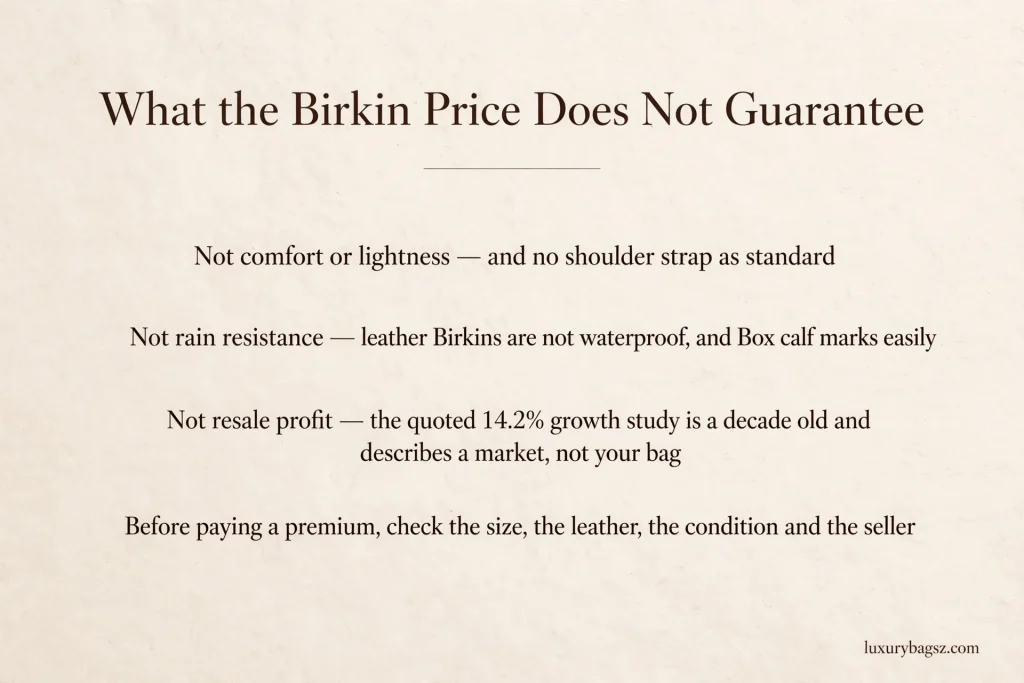
An expensive Birkin is not automatically a good Birkin for you. Paying more does not buy comfort, lightness, or hands-free carry, and the standard bag has no shoulder strap.
Paying more does not buy rain resistance either. Leather Birkins are not waterproof, and Box calf marks easily, so a costly bag can still be a fragile daily companion.
Paying more does not guarantee resale profit. A 2016 Baghunter study claiming 14.2% average annual growth is still quoted in guides, but it is a decade old and describes a market, not your bag.
Before paying a premium, check four things: the exact size and leather, the condition and completeness of the set, the seller's authentication, and whether you would still love the bag if resale fell.
If the answer to the last question is no, the premium is a speculation, not a purchase. That is a fine choice to make knowingly, and a poor one to make by accident.
Part 12: Paying Less Without Getting Burned
There are honest ways to pay less than the headline price. Buying pre-owned in a less trendy colour, a larger size, or slightly worn condition can cut thousands.
Buying vintage leather can help too, though SACLÀB notes that Barenia and Box vintage bags are scarce and delicate, so they are exceptions to the usual vintage discount.
Patience is the cheapest discount of all. Flexibility on colour and leather at retail avoids the resale premium entirely, if you can wait for the right offer.
What never saves money safely is cutting corners on authentication. A price far below market is a warning, and peer-marketplace deals need strong photos, authentication, and a return path.
Completeness is a legitimate discount lever. SACLÀB notes that bags missing the padlock or clochette usually sell for less, so accepting an incomplete set — knowingly, from a trusted seller — is a sane way to pay less.
The cheapest Birkin is the one you keep and use for decades. Cost per wear beats sticker price every time, and a well-chosen standard leather bag usually wins that maths.
Frequently Asked Questions
Why are Birkin bags so expensive?
Craftsmanship, materials, scarcity, and brand all stack up. One artisan makes each bag by hand, materials are costly, production is limited, and boutiques control access tightly.
How many hours does it take to make a Birkin?
Published figures disagree: Sotheby's says at least 18 hours, other guides say 18 to 24 hours, and SACLÀB says about 40 hours. The honest range is roughly 18 to 40 hours for most bags.
Does it really cost $800 to make a Birkin?
An analyst once estimated about $800 for basic production cost, but that figure is old, disputed, and excludes overhead, training, boutiques, and rejected materials. It is not the full cost.
Why can't I just buy a Birkin online?
Hermes sells Birkins in boutiques only, never through its website. Online listings are resale, not retail, and the price and authenticity checks are yours to make.
What is the Hermes quota system?
The quota system caps how many quota bags, including Birkins, one client can buy in a year. It limits supply even for established clients and pushes demand toward resale.
Do Birkin bags hold their value?
Many small leather Birkins in neutral colours sell above retail, but not every Birkin does. Size, leather, colour, condition, and completeness decide resale far more than the name alone.
Are Birkin bags a good investment?
No bag is a guaranteed investment. Past resale strength is real for popular combinations, but a single bag can lose its premium if tastes, condition, or the market shifts.
Why do exotic Birkins cost so much more?
Exotic skins are rarer, harder to source legally, and yield fewer bags per hide. Crocodile and alligator Birkins usually exceed $40,000 on resale, and diamond versions go far higher.
Is the Birkin's scarcity real or artificial?
Both. Hand-making genuinely limits how many bags can be made, and Hermes also chooses not to scale production to meet demand. The two effects reinforce each other.
What is the cheapest way to own a Birkin?
Patience at retail avoids the resale premium, while pre-owned in a larger size, a less trendy colour, or slightly worn condition costs less. Never save money by skipping authentication.
Final Verdict
A Birkin is expensive because slowness, scarcity, and story all charge at once. The handwork is genuine, the materials are superb, and the boutique system keeps supply far below demand.
None of that makes every Birkin worth its price to every buyer. The price buys a superbly made, scarce, recognisable bag — not comfort, weatherproofing, or a guaranteed return.
Buy the standard leather size you will actually carry, in a colour you will still love in ten years. Pay the premium knowingly or wait it out patiently, and never let the price tag do your thinking for you.






